

Plot Summary
The Burdened Reader
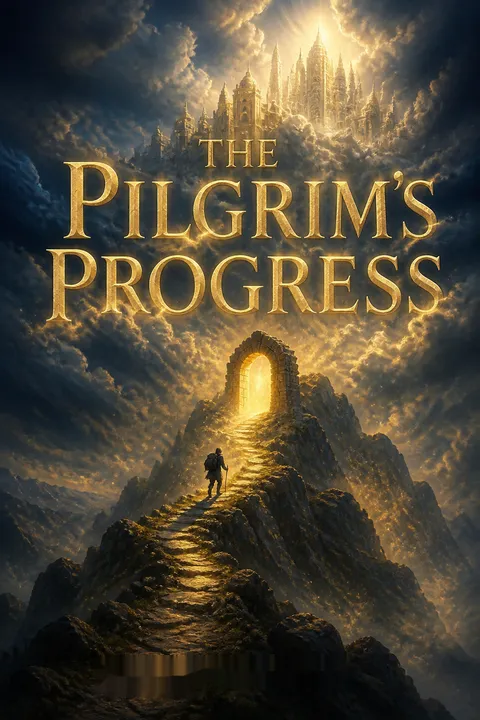
In a dream, a ragged man named Christian reads a book and realizes that he carries a crushing burden and lives in a city destined for destruction. His wife and children dismiss his fear, and their rejection leaves him to pray and wander alone. Evangelist finds him in the fields and points him toward a distant gate, telling him to keep a light in view.
Christian runs from home, ignoring his family’s pleas. Obstinate pursues him but turns back in disgust; Pliable follows, drawn by Christian’s promise of a better country. Their first stretch ends in the Slough of Despond. Christian sinks under his burden, while Pliable claws his way toward home and abandons the pilgrimage.
The journey begins as a conflict between private conviction and social attachment. Christian’s family does not debate his warning on its merits; they treat his distress as illness, making departure both a spiritual decision and a rupture of ordinary belonging. Pliable’s quick enthusiasm shows the opposite danger: he wants the promised destination without yet accepting the cost of travel. The bog gives physical form to a mind overwhelmed by fear, while Christian’s heavier burden makes the same obstacle more dangerous for him. Bunyan begins by distinguishing a durable commitment from a borrowed one, but leaves Christian’s own steadfastness unproven.
The Wrong Road
Help pulls Christian from the bog and sets him on firm ground, explaining that fear and doubt gather there for many travelers. Soon, Worldly Wiseman persuades him to seek relief from Legality in the village of Morality rather than continue toward the gate. Christian turns aside, but the mountain beside Legality’s house looms over the road and flashes with fire.
Evangelist returns, rebukes him for trusting advice that promises ease while diverting him from the appointed way, and tells him he may still go back. Christian retraces his steps without delay. At the gate, Good-will welcomes him and pulls him inside just before arrows fly from a nearby fortress. Christian has entered the narrow road, though his burden remains.
Worldly Wiseman’s counsel is persuasive because it borrows Christian’s own urgency: he too promises to remove the burden. Its appeal lies not in obvious wickedness but in a practical shortcut that preserves comfort and reputation. The mountain makes the cost of that shortcut visible before Christian can reach its supposed remedy. Evangelist’s severe correction does not cancel Christian’s agency; it forces him to recognize that he chose the detour. Good-will’s welcome then offers a different kind of authority, one that receives the penitent rather than bargaining with him. The gate opens onto discipline, not instant emotional ease.
Lessons at the Interpreter’s
Good-will directs Christian to the Interpreter, whose house becomes a school of caution and hope. A portrait presents a spiritual guide responsible for directing others, while a dusty room shows how rules alone can stir up the very corruption they expose; cleansing comes through grace.
Two children embody the choice between immediate pleasure and delayed reward. Behind a wall, a hidden figure feeds oil to a fire that another tries to extinguish, showing Christian that unseen help sustains belief.
The Interpreter also shows him a palace guarded by armed men and a despairing man locked in an iron cage. A frightened sleeper recounts a vision of judgment. Christian leaves carrying these warnings and encouragements as practical instruction for the road ahead.
The Interpreter’s episodes teach Christian to read appearances without trusting them blindly. The dusty room distinguishes diagnosis from cure: recognizing disorder does not itself repair it. The hidden caretaker of the fire answers a related psychological fear, that a vulnerable inner commitment must depend entirely on the pilgrim’s own effort. The palace and the cage place courage beside despair, making each a possible future rather than an abstract doctrine. These lessons do not make Christian invulnerable. Instead, they give him interpretive tools, so later setbacks can be understood as trials within the journey rather than proof that the journey has failed.
The Burden Falls Away
Christian follows the fenced highway until he reaches a hill with a cross above an open tomb. There, his burden slips from his back, rolls down the slope, and disappears into the grave. Three shining messengers then announce his forgiveness, replace his rags with a fine garment, mark his forehead, and give him a sealed roll to present at the Celestial Gate.
His relief is physical as well as inward: he can travel without the weight that had made every obstacle harder. But the road immediately tests what he has received. Simple, Sloth, and Presumption refuse his warning and stay asleep in their chains. Formalist and Hypocrisy climb over the wall to join the highway without entering through its gate.
The cross gives Christian’s central problem a turning point: the burden is not managed or morally earned away, but removed through an act beyond his power. The garment, mark, and roll make assurance tangible, yet the sleeping figures and unauthorized entrants show that proximity to the road is not the same as commitment to it. Bunyan places relief beside danger so that conversion cannot be mistaken for arrival. Christian now has reasons to continue and a visible sign of acceptance, but he must still learn vigilance. The scene shifts his emotional center from terror toward gratitude while preserving the possibility of failure.
The Hill and the Lions
At the foot of Hill Difficulty, Christian chooses the steep central road while Formalist and Hypocrisy take easier paths that end in ruin. He rests at an arbour on the slope, falls asleep, and loses the sealed roll that certifies his journey. After reaching the summit, he discovers it missing and must descend in darkness to retrieve it.
The recovery costs him time and confidence, but he resumes the climb and reaches the palace called Beautiful after sunset. Two lions block the narrow approach. Watchful, the porter, explains that they are chained and directs Christian to stay in the middle of the path. He passes them unharmed and is admitted for the night, where the household welcomes him and listens to his account.
The hill makes progress laborious, while the missing roll turns carelessness into a concrete delay. Christian’s return is not a new spiritual beginning, but the painful recovery of something he already possessed. The lions sharpen the difference between actual danger and danger as it appears to a frightened traveler: their chains matter, but Christian cannot see them until Watchful explains. The palace offers rest without ending the journey, suggesting that community and instruction can restore a pilgrim’s strength. His experience also sets a pattern for later failures: he can make mistakes, suffer their consequences, and still continue with help.
Apollyon’s Assault
After leaving Beautiful, Christian descends into the Valley of Humiliation, where the fiend Apollyon blocks his way and demands that he return to his former allegiance. Apollyon lists Christian’s past failures, then attacks when persuasion fails. Christian is wounded and loses his sword, but recovers it and strikes Apollyon hard enough to drive him away.
He treats his wounds with leaves from the tree of life and continues into the Valley of the Shadow of Death. There, darkness hides a narrow path between a ditch and a mire, while flames, frightening sounds, and hostile whispers assault him. Christian keeps moving and reaches daylight. At the valley’s far edge he sees Faithful, a fellow traveler from his former city.
Apollyon’s attack makes temptation intimate: the fiend does not invent Christian’s failures but uses them to argue that those failures define him. Christian’s victory depends not on denying his weakness but on continuing to act while wounded. The following valley changes the nature of the threat. Instead of a visible opponent, Christian faces uncertainty, isolation, and thoughts he fears may be his own. Daylight gives him perspective only after he has crossed the worst stretch. The two valleys therefore test different capacities: resistance in open conflict and persistence when reassurance is unavailable.
Faithful Finds a Companion
Christian catches up with Faithful, who explains that he left their city after hearing its destruction was coming. Faithful describes resisting Wanton, Adam the First, Discontent, and Shame, each offering pleasure, security, or social approval in exchange for abandoning the road.
The companions meet Talkative, who speaks fluently about religion but avoids questions about whether his beliefs shape his conduct. Christian tells Faithful what he knows of Talkative’s life, and Faithful tests him directly; Talkative withdraws rather than examine himself.
Evangelist then catches up with the pilgrims and warns that danger awaits them in Vanity Fair, where one of them may die for their beliefs. The warning gives their next destination a clear and frightening cost.
Faithful’s account widens the journey from private endurance to shared interpretation. His temptations are recognizably social: desire, inherited habits, fear of humiliation, and pressure to preserve standing. Talkative poses a subtler threat because he can reproduce religious language without allowing it to judge his behavior. Faithful’s test exposes the difference between knowing the right vocabulary and accepting accountability. Evangelist’s warning then changes the companions’ expectations. They are no longer merely anticipating difficulty; they have been told that public witness may require a life. Their friendship becomes a form of preparation for that risk.
Vanity Fair’s Verdict
Vanity Fair sells status, pleasure, wealth, and power, but Christian and Faithful refuse its goods and draw the crowd’s anger. Authorities beat them, parade them in chains, and put them on trial before Lord Hategood. Envy, Superstition, and Pickthank accuse Faithful of opposing the town’s customs and ruler.
The jury, chosen from men representing malice and corruption, convicts him. Faithful is tortured and burned, while Christian is sent back to prison. He later escapes and continues. Hopeful, moved by the pilgrims’ conduct and Faithful’s courage, joins him. The fair has taken Christian’s closest companion, but Faithful’s example has changed a bystander into a fellow traveler.
The trial dramatizes how a society can recast dissent as disorder when its comforts are treated as unquestionable. The accusations are not neutral descriptions of harm; they are a defense of the fair’s authority against a rival moral standard. Faithful’s calm under abuse makes the trial’s injustice visible, but the narrative does not make his death a simple victory. Christian survives, while Hopeful’s conversion shows how witness can travel beyond the victim’s control. Loss and influence coexist: the community destroys Faithful’s body but cannot prevent his conduct from creating a new companion.
The Silver-Mine Detour
Christian and Hopeful meet By-ends, a polished traveler who adapts his religious principles to whatever protects his wealth and standing. He soon joins three like-minded companions, who defend using religion as a route to profit.
Christian refuses their argument, and they fall behind. At the Hill Lucre, Demas invites the pilgrims to inspect a silver mine where previous travelers have been killed or maimed. Hopeful is tempted, but Christian recalls the danger and keeps them on the road.
By-ends and his companions accept the invitation and disappear from the pilgrimage. Nearby, the pilgrims see a pillar marking Lot’s wife and recognize it as a warning against turning back toward what they have left. They continue to a life-giving river and rest beside it.
By-ends and Demas embody different versions of the same bargain: making the journey serve material advantage. By-ends gives the bargain a respectable argument, while the mine gives it a physical consequence. Hopeful’s moment of temptation matters because Christian does not merely condemn greed; he helps his companion pause before acting. The pillar of Lot’s wife turns memory into a safeguard, reminding them that looking back can become a form of attachment. The river offers genuine refreshment after refusal, but its comfort is temporary. The pilgrims have escaped one lure, not every future shortcut.
Doubting Castle’s Prisoners
When the main road grows rough, Christian persuades Hopeful to cross a stile into By-path Meadow. Their guide, Vain-confidence, falls into a pit, and a storm leaves the pilgrims stranded on Giant Despair’s property. The giant captures them and, urged on by his wife Diffidence, beats them, starves them, and presses them to kill themselves.
Christian nearly gives in, but Hopeful reminds him of earlier dangers they survived and refuses the giant’s demand. During the night Christian remembers the Promise key carried in his bosom. It opens the dungeon and castle gates, though the final lock resists, and the noise wakes the giant. His illness prevents pursuit. Back on the highway, the pilgrims mark the stile so others can avoid the same trap.
The detour begins with a plausible complaint: the proper road is hard, and an easier path appears to run beside it. Its danger grows through shame and despair, since the prisoners know they have trespassed and the giant exploits their self-blame. Hopeful becomes essential when Christian’s own history no longer comforts him. The key works only after Christian recalls it, making memory itself an instrument of escape. Their warning marker converts private failure into public care. They cannot undo the suffering they endured, but they can prevent later travelers from mistaking convenience for safety.
Warnings from the Shepherds
At the Delectable Mountains, Christian and Hopeful are welcomed by four shepherds: Knowledge, Experience, Watchful, and Sincere. The shepherds show them the remains of travelers who followed error, blind pilgrims trapped near Doubting Castle, and a dark entrance leading toward hell.
The sights make Christian and Hopeful weep, especially because they recognize how recently they escaped the same danger. From a high point, the shepherds let them glimpse the Celestial City through a viewing glass, though fear makes their hands shake.
Before the pilgrims leave, the shepherds give them directions and warn them against Flatterer and the sleep-inducing Enchanted Ground. Ignorance, a traveler from the nearby country of Conceit, joins the road behind them, confident in his own goodness.
The shepherds provide guidance, but their hospitality includes disturbing evidence rather than easy reassurance. The blind travelers are especially important: they show that a person can continue moving after losing the ability to judge where the road leads. The view of the city offers hope without full possession; the pilgrims can glimpse their destination but cannot yet look steadily at it. Ignorance enters as a counterpoint to their fear. He mistakes confidence in his moral habits for secure knowledge, setting up a conflict between self-assessment and a standard outside the self.
Guides, Thieves, and Doubt
As Christian and Hopeful travel, they discuss Little-faith, a pilgrim robbed of his spending money but not his jewels, then escape a false guide who leads them into a net. A shining messenger frees them and chastises them for ignoring the shepherds’ directions.
Atheist laughs at their destination, claiming he searched for it without success, but Hopeful recalls the city they glimpsed and keeps walking. On the Enchanted Ground, Hopeful admits how he once resisted conviction, tried to repair himself through good behavior, and remained frightened until Faithful taught him to trust Christ’s righteousness.
He explains that this belief changed his feelings toward sin and made him want to live differently. Christian and Hopeful then challenge Ignorance’s confidence in his own virtue, but he refuses their counsel.
This stretch tests the pilgrims through competing accounts of what can be trusted. Little-faith’s story distinguishes spiritual assurance from material security; the false guide exploits their failure to consult reliable directions, while Atheist tries to make personal disappointment universal proof. Hopeful’s history gives the debate emotional weight: he once sought safety through self-improvement, only to find that his efforts could not quiet his fear. His change is not permission to ignore conduct; he describes a new desire to live well. Ignorance, by contrast, treats sincerity as evidence enough and cannot recognize the limits of his own judgment.
The Enchanted Ground
Christian keeps Hopeful awake by drawing him into conversation as the Enchanted Ground makes travelers drowsy. They examine why people begin a religious journey and later abandon it.
Hopeful recounts how fear, social shame, attachment to old pleasures, and relief from guilt can draw a person back; Christian adds that retreat often begins by neglecting private discipline and ends in open return to old habits. Their discussion helps them cross the dangerous country without sleeping.
The landscape changes as they enter Beulah, where the air is gentle, the city lies within sight, and the Shining Ones walk among the pilgrims. Christian and Hopeful find rest in the King’s gardens, but the city’s brilliance is so intense that they can only approach it gradually.
Here, companionship becomes a practical defense: conversation keeps the body awake and makes the pilgrims examine how commitment erodes over time. Their account of backsliding is incremental rather than melodramatic. Neglect comes first, followed by isolation, rationalization, and conduct that once would have caused shame. This psychological sequence makes vigilance a daily practice, not a single heroic decision. Beulah offers a striking change in atmosphere, yet it does not cancel the final passage. The pilgrims can now see their destination more clearly, but their desire for it has become so strong that nearing it brings its own ache.
The River and the Gate
Two shining guides lead Christian and Hopeful to a deep river with no bridge. Each must cross it to reach the Celestial Gate. Christian sinks and fears that his past sins will keep him from arrival, but Hopeful holds him up and reminds him of the help he has already received. Christian regains confidence, finds the river shallower, and reaches the far bank.
The guides escort both pilgrims up the hill to the city, where they present the certificates given near the beginning of the journey and are welcomed inside. The gates close behind them. Ignorance reaches the same river by boat, crosses easily, but has no certificate. The King orders him removed, revealing that proximity to the gate cannot substitute for the journey’s deeper assurance.
The river makes mortality the last passage, but Christian’s fear is specifically moral: he worries that remembered failures invalidate everything that preceded them. Hopeful’s support turns companionship into a means of keeping another person afloat, not merely a comfort along the way. The certificates complete the earlier sequence of signs, from burden to garment, mark, and roll. Ignorance’s easy crossing creates a sharp contrast with Christian’s struggle: outward ease does not establish inward readiness. The ending grants Christian and Hopeful entry while refusing a simple equation between confidence, respectable conduct, and acceptance.
Analysis
The Pilgrim’s Progress turns religious belief into a route that can be followed, lost, and recovered. Its allegorical method is powerful because it makes inner conflict spatial: fear is mud, temptation is a fork, public conformity is a fair, despair is a locked cell. These settings do not simply label emotions. They create choices with consequences, so the reader watches Christian interpret his own condition under pressure.
Christian is neither a flawless hero nor a passive recipient of rescue. He departs from home, accepts help, makes avoidable mistakes, and must sometimes be reminded of what he already knows. His vulnerability is central to the book’s moral psychology. Assurance does not mean an absence of fear; it means a continuing relationship to guidance, memory, and companions when fear makes the road hard to read. Hopeful’s role makes this especially clear. He is not merely rescued by Christian’s example; he becomes the person who steadies Christian in the dungeon and at the river.
The story repeatedly challenges easy measures of spiritual worth. Talkative knows religious language, By-ends uses religion for advantage, and Ignorance trusts his decency. Their errors differ, but each substitutes a visible performance or self-judgment for deeper transformation. By contrast, Faithful’s conduct at Vanity Fair shows that conviction has public consequences, even when those consequences include persecution. His influence survives him through Hopeful, making witness a form of continuity that institutions cannot fully control.
The journey’s obstacles also complicate the promise of progress. A pilgrim may be welcomed and still suffer, receive comfort and still lose his way, escape one danger only to meet another. The final river makes this vulnerability explicit: Christian cannot conquer death by strength, and Hopeful must help him through. The ending resolves the journey through entry into the city, but not through individual self-mastery. Bunyan’s strongest claim is relational: the road is endured through grace, remembered promises, correction, and the faithful presence of others.
Review Summary
The Pilgrim's Progress receives mixed reviews. Some praise its profound allegory and spiritual insights, considering it a classic of Christian literature. Others find it dated, didactic, and difficult to read due to its 17th-century prose. Many appreciate its influence on later literature and its vivid imagery, while some criticize its narrow religious perspective. Readers often note the book's historical importance but disagree on its relevance for modern audiences. The allegorical characters and moral lessons are seen as both strengths and weaknesses by different reviewers.
People Also Read









Characters
Christian
Burdened pilgrimChristian is the central traveler, a husband and father who leaves the City of Destruction after reading a book that makes him fear both his burden and the city’s fate. He is sincere but not self-sufficient: he can be discouraged, misled by easy counsel, careless during rest, and shaken by danger. His progress depends on accepting correction and help from Evangelist, Good-will, the Interpreter, fellow pilgrims, and the shepherds. Christian’s defining tension is between a strong desire for deliverance and a recurring fear that his failures have made him unworthy of it. His journey tests whether he can keep moving without confusing temporary comfort, personal virtue, or visible success with the destination he seeks.
Hopeful
Steadfast companionHopeful joins Christian after witnessing the pilgrims’ conduct at Vanity Fair. He is not naturally fearless; his own account describes a past shaped by pleasure, resistance to conviction, and attempts to earn peace through reform. Faithful helps him understand a different basis for hope, and the change makes him more than a follower. Hopeful listens carefully, warns Christian when a shortcut seems dangerous, forgives him when a bad choice brings them into peril, and supports him when fear overwhelms him. His strength is relational rather than solitary. He gives Christian a companion who can remember earlier lessons when Christian cannot, while also learning to receive correction himself.
Faithful
Courageous fellow pilgrimFaithful comes from Christian’s former city and begins his journey after concluding that its destruction is real. He meets temptations similar to Christian’s, including sexual desire, pride, fear of public shame, and pressure to return to a respectable life. Faithful’s defining quality is not an absence of fear but a willingness to examine what each temptation asks him to surrender. His conduct at Vanity Fair becomes a powerful example to observers, including Hopeful. Through him, the story shows how a person’s public behavior can shape another person’s choices, even when that influence cannot protect the person from hostility.
Evangelist
Guide to the gateEvangelist finds Christian in distress and directs him toward the wicket-gate. He returns when Christian strays after listening to Worldly Wiseman, correcting him firmly while still pointing him back toward the road. Later, he visits Christian and Faithful to prepare them for the danger of Vanity Fair. Evangelist represents guidance that combines moral clarity with the possibility of return. He does not walk the whole journey for Christian; instead, he appears at moments when a warning or renewed direction can keep the pilgrim from mistaking a detour for a destination.
Worldly Wiseman
Comforting false guideWorldly Wiseman offers Christian an apparently sensible shortcut to relief through Legality and the village of Morality. He appeals to Christian’s desire to be free of his burden while emphasizing safety, respectability, and comfort. His advice sounds practical because it avoids the difficult road Evangelist prescribed, but it cannot deliver what Christian seeks. Worldly Wiseman’s role shows how misleading counsel can present itself as common sense rather than open hostility.
Pliable
Fair-weather companionPliable follows Christian after hearing about the promised country, but his interest depends on the journey matching his expectations. The Slough of Despond quickly changes his mind, and he returns home rather than face further hardship. Pliable’s willingness to start is genuine in the moment, yet it has not been tested by sustained difficulty. His brief companionship gives Christian an early example of enthusiasm that cannot survive discomfort.
Good-will
Keeper of the gateGood-will welcomes Christian through the wicket-gate and warns him about the danger posed by attackers near its entrance. He then points him toward the narrow road and the Interpreter’s house. His welcome is generous, but it does not promise a trouble-free journey. Good-will helps establish that admission and guidance can coexist with continuing danger.
The Interpreter
Teacher through visionsThe Interpreter receives Christian into his house and teaches through carefully staged scenes rather than direct instruction alone. His rooms reveal the limits of moral effort, the value of patience, the sustaining force of grace, the cost of despair, and the need for courage. The Interpreter equips Christian to recognize patterns he will meet again on the road. His teaching does not remove the pilgrim’s risks; it gives him images with which to understand them.
Apollyon
Enemy on the roadApollyon confronts Christian in the Valley of Humiliation and claims authority over the land from which Christian came. He tries first to persuade Christian to return, then uses his past mistakes to weaken his resolve. When persuasion fails, Apollyon attacks with force. He embodies an adversary who knows a pilgrim’s vulnerabilities and turns remembered failure into an argument against continuing.
Talkative
Fluent religious pretenderTalkative speaks eagerly about religious ideas and appears to be an appealing companion to Faithful. Christian knows him from home and recognizes the gap between his public talk and his private conduct. When Faithful asks whether his beliefs shape his life, Talkative avoids answering and leaves. He serves as a warning that eloquence and knowledge can imitate conviction without producing responsibility or care for others.
By-ends
Profit-minded pilgrimBy-ends presents himself as a traveler to the Celestial City while openly adapting his principles to circumstances that favor his wealth and reputation. He objects when Christian expects him to remain committed during hardship or public disgrace. By-ends is persuasive because he can dress self-interest in practical reasoning. His role tests whether the pilgrims regard their beliefs as a governing commitment or a tool for worldly advantage.
Ignorance
Confident self-judgeIgnorance joins the road from the country of Conceit and trusts his own decency, religious habits, and good intentions as evidence that he is ready for the Celestial City. Christian and Hopeful challenge his assumptions, but he resists their attempts to make him examine himself more deeply. Ignorance is not portrayed as openly malicious. His danger lies in sincere confidence that leaves no room for correction.
Giant Despair
Keeper of the dungeonGiant Despair captures Christian and Hopeful after they stray into his grounds. He uses physical abuse, deprivation, and threats to convince them that escape is impossible and death is preferable. His power grows when the pilgrims accept his view of their situation. He personifies despair as an active force that narrows attention until a person forgets available sources of hope.
Diffidence
Voice of despairDiffidence is Giant Despair’s wife and encourages him to increase the pilgrims’ suffering. She advises him to beat them and intensify their hopelessness. Her role makes despair a shared system of pressure rather than a single brute force.
Obstinate
Hostile neighborObstinate pursues Christian after he leaves the City of Destruction, hoping to force him home. He refuses to consider the promised destination and abandons the pursuit when Christian will not turn back. He represents resistance that comes from attachment to familiar life and contempt for unfamiliar conviction.
Help
Rescuer from the bogHelp pulls Christian out of the Slough of Despond and explains why many travelers struggle in that place. He points out that safer steps exist, even when fear makes them difficult to see. His intervention turns a near-disaster into a chance to continue.
Watchful
Palace porterWatchful guards the approach to the house called Beautiful and advises Christian how to pass the chained lions. He offers practical reassurance at a moment when Christian is close to retreating. His help lets the pilgrim enter a place of rest and fellowship.
Vain-confidence
Guide into the pitVain-confidence walks ahead of Christian and Hopeful after they leave the proper road for By-path Meadow. In the darkness, he falls into a pit, leaving the pilgrims without a reliable guide. His name signals the danger of confidence unsupported by careful judgment.
Demas
Voice beside the mineDemas invites travelers to turn aside toward a silver mine, presenting material gain as a small and harmless opportunity. Christian recognizes the danger and refuses. Demas represents the lure of immediate profit that can interrupt a journey without appearing to demand a full change of direction.
Evangelist’s wife and children
Family left behindChristian’s wife and four children remain in the City of Destruction when he leaves. They regard his warning as a sign of disturbed judgment and call after him to return. Their absence gives the pilgrimage an intimate cost: Christian seeks their safety, but cannot make them share his conviction.
Plot Devices
The burden and roll
Visible signs of assuranceChristian’s burden gives bodily weight to his awareness of danger and guilt. At the cross it falls away, while a garment, forehead mark, and sealed roll become signs he carries onward. The roll comforts him when the road grows frightening, and losing it forces him to retrace his steps. Near the city, the roll serves as his certificate of entry. Together, these objects turn inward states into things that can be carried, lost, recovered, and presented. Their changing importance tracks Christian’s movement from distress toward assurance, while showing that receiving a sign does not remove the need to keep traveling.
The road and its forks
Choices made visibleChristian’s route is a landscape of decisions. The wicket-gate marks the proper entrance; Worldly Wiseman’s detour, the easy paths at Hill Difficulty, By-path Meadow, and the silver mine offer alternatives with consequences. Their physical form makes abstract choices memorable: a pilgrim can see a steep road, a stile, a pit, or a tempting mine before understanding what each means. The road also changes emotional character, passing through valleys, a fair, mountains, and a bright country near the end. Its geography turns progress into a sequence of commitments rather than a single decision made at the beginning.
The Interpreter’s visions
Lessons staged as scenesThe Interpreter teaches Christian through enacted images: a dusty room, two children with different attitudes toward time, a fire preserved behind a wall, a palace under attack, a prisoner in an iron cage, and a sleeper terrified by judgment. Each scene makes a spiritual or psychological conflict concrete without requiring Christian to have already experienced it. The visions foreshadow later trials and give him interpretive patterns he can recall. Their function is both instructional and dramatic: the reader learns alongside Christian, while the images remain available as memory anchors for the dangers and hopes that follow.
Named landscapes
Inner states become terrainPlaces such as the Slough of Despond, Valley of the Shadow of Death, Vanity Fair, and Doubting Castle translate emotional and social pressures into environments. Their names help a listener remember what each setting does: fear traps, darkness disorients, public appetite punishes difference, and despair imprisons. These places are not merely symbols placed beside the action. Christian and his companions must physically cross them, and their choices determine whether a landscape becomes a temporary trial or a lasting danger.
The Celestial certificate
Final proof of readinessThe sealed roll given to Christian becomes a certificate he is instructed to present at the Celestial Gate. It offers comfort during the journey and becomes especially important after he loses it on Hill Difficulty. At the end, Christian and Hopeful present their certificates before entering, while Ignorance arrives without one despite his confidence and respectable conduct. The device ties the opening’s personal assurance to the ending’s public threshold. It also distinguishes the travelers’ inward claims from evidence recognized by the story’s final authority.
FAQ
Synopsis & Basic Details
What is The Pilgrim's Progress about?
- Spiritual Journey Allegory: The Pilgrim's Progress is an allegory depicting a man named Christian's journey from the City of Destruction to the Celestial City, representing a Christian's path to salvation.
- Trials and Tribulations: Christian faces numerous trials, temptations, and obstacles along his path, each symbolizing the challenges a believer encounters in their spiritual life.
- Triumph of Faith: The story emphasizes the importance of faith, perseverance, and reliance on God's grace to overcome these challenges and ultimately reach eternal life.
Why should I read The Pilgrim's Progress?
- Timeless Spiritual Insights: The book offers timeless insights into the Christian faith, exploring themes of sin, redemption, temptation, and the pursuit of holiness, making it relevant across generations.
- Allegorical Depth: Its allegorical nature allows readers to engage with complex spiritual concepts through relatable characters and situations, fostering deeper understanding and reflection.
- Inspirational Journey: The narrative provides an inspirational journey of perseverance and hope, encouraging readers to remain steadfast in their faith despite the challenges they may face.
What is the background of The Pilgrim's Progress?
- Religious and Political Context: Written by John Bunyan, a Puritan preacher, the book reflects the religious and political climate of 17th-century England, where nonconformists faced persecution.
- Personal Experience: Bunyan's own experiences with imprisonment for his religious beliefs heavily influenced the themes of struggle, perseverance, and the importance of staying true to one's faith.
- Biblical Foundation: The allegory is deeply rooted in biblical teachings and imagery, drawing from various scriptures to illustrate the Christian journey and the path to salvation.
What are the most memorable quotes in The Pilgrim's Progress?
- "Flee from the wrath to come.": This quote, given by Evangelist, encapsulates the urgency and motivation behind Christian's journey, highlighting the need to escape eternal damnation.
- "My heart is fixed, O God, my heart is fixed.": This quote, though not directly from the text, reflects the unwavering resolve and commitment to faith that Christian demonstrates throughout his pilgrimage.
- "So he passed over, and all the trumpets sounded for him on the other side.": This quote, describing Faithful's entrance into the Celestial City, symbolizes the triumphant reward for those who remain faithful to the end.
What writing style, narrative choices, and literary techniques does John Bunyan use?
- Allegorical Narrative: Bunyan employs allegory as his primary narrative technique, using symbolic characters, places, and events to represent spiritual truths and the Christian journey.
- Simple and Direct Language: The writing style is characterized by its simplicity and directness, making the complex spiritual themes accessible to a wide audience, including those with limited education.
- Biblical Allusions and Imagery: Bunyan heavily incorporates biblical allusions and imagery, drawing from scripture to reinforce his message and create a rich, symbolic landscape for his story.
Hidden Details & Subtle Connections
What are some minor details that add significant meaning?
- The Burden on Christian's Back: The physical burden Christian carries symbolizes the weight of sin and guilt, a constant reminder of his need for redemption, which is only lifted at the cross.
- The Sealed Roll: The roll given to Christian by the Shining Ones represents the assurance of salvation and the promises of God, providing comfort and guidance throughout his journey.
- The Interpreter's House: The various scenes shown by the Interpreter, such as the dusty room and the fire, offer symbolic representations of the human heart, sin, and the work of grace, providing deeper insight into the spiritual life.
What are some subtle foreshadowing and callbacks?
- Evangelist's Warnings: Evangelist's warnings about the dangers of the path foreshadow the various trials and temptations Christian will face, preparing the reader for the challenges ahead.
- The Lions at the Palace Beautiful: The lions, initially frightening, are revealed to be chained, foreshadowing the limited power of evil and the protection God provides to believers.
- The Loss and Recovery of the Roll: Christian's loss of his roll and his subsequent search for it foreshadows the importance of maintaining faith and the consequences of spiritual carelessness.
What are some unexpected character connections?
- The Relationship Between Legality and Sinai: The connection between Mr. Legality and Mount Sinai reveals the law's inability to provide salvation, highlighting the need for grace through Christ.
- The Lineage of Demas: Demas's connection to Gehazi and Judas reveals his true nature as a hypocrite and a betrayer, emphasizing the dangers of worldly gain over spiritual commitment.
- The Shared Origin of By-ends and His Companions: The fact that By-ends and his companions were all taught by Mr. Gripe-man highlights the corrupting influence of worldly values and the dangers of prioritizing material gain over spiritual growth.
Who are the most significant supporting characters?
- Help: Help's timely intervention in the Slough of Despond symbolizes God's grace and assistance in times of despair, highlighting the importance of divine aid in overcoming spiritual obstacles.
- The Shepherds on the Delectable Mountains: The Shepherds represent spiritual guides and mentors who provide wisdom, encouragement, and a glimpse of the Celestial City, emphasizing the importance of spiritual community.
- The Shining Ones: The Shining Ones, who appear at various points in the story, symbolize angelic beings who offer guidance, comfort, and protection to pilgrims, highlighting the divine support available to believers.
Psychological, Emotional, & Relational Analysis
What are some unspoken motivations of the characters?
- Worldly Wiseman's Fear of Suffering: Worldly Wiseman's motivation is not genuine concern for Christian, but rather a fear of the suffering and sacrifice required on the true path, leading him to seek an easier, worldly solution.
- Pliable's Desire for Immediate Gratification: Pliable's quick abandonment of the journey reveals his underlying desire for immediate gratification and his inability to endure hardship for long-term spiritual rewards.
- Giant Despair's Need for Control: Giant Despair's actions are driven by a need to control and dominate others, reflecting the destructive nature of despair and its desire to keep others in bondage.
What psychological complexities do the characters exhibit?
- Christian's Internal Struggle: Christian's internal struggle with doubt, fear, and despair highlights the psychological challenges of the spiritual journey, demonstrating the constant battle between faith and doubt.
- Hopeful's Resilience: Hopeful's resilience and ability to encourage Christian in times of despair showcase the psychological strength that can be found in faith and fellowship.
- Ignorance's Self-Deception: Ignorance's self-deception and inability to recognize his spiritual blindness reveal the psychological barriers that can prevent individuals from seeking true salvation.
What are the major emotional turning points?
- The Lifting of Christian's Burden: The moment Christian's burden falls off his back at the cross is a major emotional turning point, symbolizing the relief and joy of forgiveness and redemption.
- Faithful's Martyrdom: Faithful's martyrdom is a deeply emotional moment, highlighting the cost of discipleship and the ultimate triumph of faith over death.
- Christian's Despair in the River of Death: Christian's despair in the River of Death is a powerful emotional low point, showcasing the fear and doubt that can accompany the final test of faith.
How do relationship dynamics evolve?
- Christian and Hopeful's Bond: The relationship between Christian and Hopeful evolves from a chance encounter to a deep bond of mutual support and encouragement, highlighting the importance of spiritual companionship.
- Christian's Interactions with Evangelist: Christian's interactions with Evangelist demonstrate the importance of spiritual guidance and mentorship, as Evangelist consistently redirects Christian back to the true path.
- The Rejection of By-ends: The rejection of By-ends and his companions by Christian and Hopeful highlights the incompatibility of true faith with hypocrisy and worldly values.
Interpretation & Debate
Which parts of the story remain ambiguous or open-ended?
- The Nature of the Enchanted Ground: The exact nature of the Enchanted Ground and its effects on pilgrims is left somewhat ambiguous, allowing for various interpretations about the dangers of spiritual complacency.
- The Fate of Ignorance: The final fate of Ignorance, while seemingly clear, leaves room for debate about the nature of salvation and the importance of genuine faith over mere outward actions.
- The Extent of Grace: The extent to which grace is available to those who have strayed from the path is left open to interpretation, prompting reflection on the nature of God's mercy and forgiveness.
What are some debatable, controversial scenes or moments in The Pilgrim's Progress?
- The Severity of Christian's Chastisement: The severity of Christian's chastisement by the Shining One after falling into the net can be debated, raising questions about the nature of divine discipline and its purpose.
- The Depiction of Legalism: The portrayal of Legality and the law as a hindrance to salvation can be controversial, prompting discussions about the role of law and grace in the Christian faith.
- The Treatment of Ignorance: The harsh treatment of Ignorance at the end of the story can be debated, raising questions about the nature of judgment and the importance of understanding over mere belief.
The Pilgrim's Progress Ending Explained: How It Ends & What It Means
- Triumphant Entry into the Celestial City: The ending depicts Christian and Hopeful's triumphant entry into the Celestial City, symbolizing the ultimate reward of eternal life and the fulfillment of their spiritual journey.
- The Transfiguration of the Pilgrims: The transfiguration of the pilgrims and their reception by the heavenly host represent the transformation and glorification of believers in the presence of God.
- The Exclusion of Ignorance: The exclusion of Ignorance from the Celestial City highlights the importance of genuine faith and the dangers of self-righteousness, emphasizing that salvation is not based on outward actions alone.
Download PDF
Download EPUB
.epub digital book format is ideal for reading ebooks on phones, tablets, and e-readers.








