

Plot Summary
The Ring in the Study
During a cold London summer, Digory Kirke lives with his Aunt Letty and Uncle Andrew while his mother, Mabel, lies gravely ill and his father is away in India. Digory befriends Polly Plummer, and their explorations through the attic rafters lead them into Andrew’s locked study. There they find pairs of bright rings, which hum faintly.
Andrew lures Polly toward a yellow ring by pretending it is a harmless gift. When she touches it, she vanishes. Digory discovers that his uncle has used magic on animals and now wants children as test subjects. Andrew admits that a green ring can bring Polly back, but refuses to risk the journey himself. Digory takes the ring, knowing his uncle has left him no decent alternative.
Andrew’s experiment makes a moral failure look like intellectual daring. He claims that exceptional knowledge frees him from ordinary obligations, then arranges for children to bear the danger he fears. Digory sees through the performance, but his rescue of Polly is also shaped by coercion: Andrew weaponizes Digory’s loyalty to make him do what an adult will not. The sick mother gives this choice its emotional pressure. Digory’s first step into magic is not a thirst for power, but an attempt to repair a family wound.
Pools Beyond the Wood
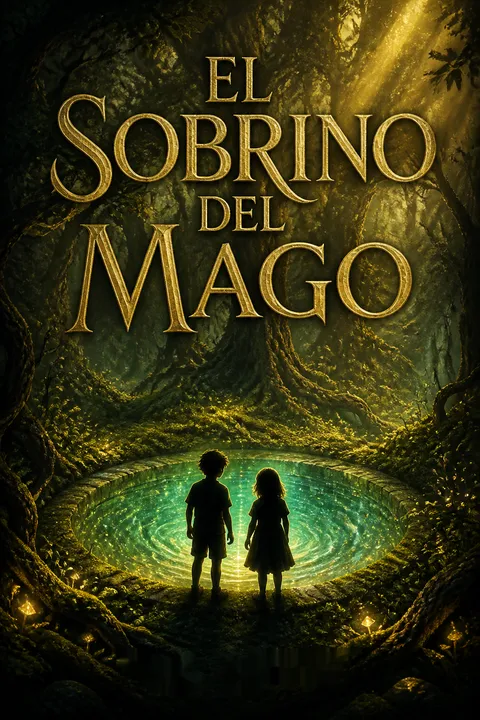
Digory surfaces beside a pool in a peaceful forest where Polly is already waiting. The Wood between the Worlds dulls their memories and makes them want to sleep, but they recognize that each pool may lead elsewhere. They test the green rings and confirm that one pool returns them toward London. Polly insists they mark it before exploring, preventing them from losing their way home.
Their yellow rings fail to open a new world, so they try green ones instead and plunge into a different pool. They land in the silent ruins of a vast palace, with no living thing in sight. Inside, rows of enchanted royal figures surround a pillar bearing a bell and a hammer. A warning invites them to strike and face the danger.
The Wood turns travel into a problem of attention: its calm is so persuasive that the children nearly forget the people and responsibilities that brought them there. Polly’s insistence on marking the home pool counters Digory’s appetite for discovery with practical care. Their different instincts become essential rather than merely temperamental. The rings also reveal Andrew’s partial understanding: he built tools without grasping the system they belonged to. The children’s journey begins in wonder, but the unmarked bell makes curiosity itself a consequential choice.
Charn's Last Queen
Polly wants to leave the dead palace untouched, but Digory cannot bear the thought of never knowing what the bell would do. He strikes it, and its note swells until part of the roof collapses. A regal woman rises from the last enchanted figure: Jadis, the final queen of Charn.
As the palace crumbles, she leads the children outside and explains that she destroyed every living creature in her world by speaking a forbidden word during a civil war. Jadis blames her sister and insists that a ruler stands above ordinary rules.
Digory recognizes Andrew’s same self-serving logic in grander form. Jadis decides to conquer the children’s world. When she attacks Polly, the children touch their rings and escape, but Jadis clings to them and reaches the Wood too.
Jadis’s history turns a ruined palace into evidence of what unchecked sovereignty can do. She describes mass destruction as a necessary act of rule, using the same exemption from ordinary ethics that Andrew claimed for his experiments. Digory’s decision to strike the bell is not a simple triumph of curiosity: Polly warned him, and he overrode her, making another person bear the cost of his need to know. His recognition of Andrew in Jadis begins a sharper moral education. Their danger now comes from both reckless inquiry and the power it awakens.
London's Stolen Chariot
Jadis follows Digory and Polly into Andrew’s study, where she mistakes the frightened magician for a powerful ruler and orders him to prepare her conquest. Andrew obeys until she leaves with him. At the Ketterleys’ house, Aunt Letty challenges Jadis; the queen’s magic fails in this world, but her strength remains, and she throws Letty onto a mattress.
Jadis steals jewels, commandeers a hansom, and terrorizes a London crowd. Digory and Polly seize a chance to touch her and use a yellow ring. The Cabby, his horse Strawberry, and Andrew are caught in the chain of contact and dragged with them. When they use a green ring to leave the Wood, the whole group arrives in a world of darkness, before anything has yet been made.
London strips Jadis of some of her supernatural force but not her confidence that other people exist to serve her. Her physical violence makes the limits of magic plain: a failed spell does not make her harmless. The crowd’s comic confusion also exposes the gap between Jadis’s imperial self-image and the ordinary social world she means to dominate. Digory and Polly’s escape has unintended consequences, carrying three others with them. In the dark new world, Andrew’s experiment has become more than a private abuse: it has transported a whole accidental company to the edge of creation.
A World Sings Awake
A Lion’s song fills the darkness, kindles stars, raises the sun, and brings grass, trees, and animals into being. The Lion, Aslan, calls selected creatures to think and speak. Jadis attacks him with the iron bar she tore from London’s lamp-post, then flees when it cannot injure him. The bar takes root and grows into a living lamp-post.
Andrew hears only frightening animal noises, while Digory, Polly, and the Cabby understand the new world around them. Digory confesses that he brought Jadis there. Aslan tells him that Adam’s descendants must help repair the harm. He makes the Cabby and his wife, Helen, the first King and Queen of Narnia, then asks Digory to find a protective apple.
Narnia’s beginning is shown as a relationship between creation and responsibility. Aslan’s song gives the land life, but its first crisis comes from an outsider whom Digory has brought in. His confession matters because he stops disguising his curiosity as an accident and accepts that he caused harm. Andrew’s inability to hear the animals speak is more than a comic misunderstanding: his habitual refusal to take other lives seriously has made him incapable of recognizing their personhood. Frank and Helen’s appointment offers a contrasting model of authority grounded in care, work, and fairness.
The Apple Errand
Aslan names Strawberry Fledge and gives him wings, then sends him with Digory and Polly westward to find an apple that can protect Narnia from Jadis. They fly over the new country and spend the night in the mountains, where a piece of buried toffee has grown into a fruit tree.
The small discovery gives them food and confirms that Narnia’s living soil transforms what is planted in it. At dawn they continue toward a blue lake enclosed by icy peaks. On a green hill, Digory finds a walled garden with a warning that its fruit must be taken for someone else, not stolen for oneself. He enters alone, picks a silver apple for Aslan, and turns to leave.
The journey gives Digory a task that cannot be reduced to obtaining something useful. He must carry a gift for Narnia without treating its power as his property. The toffee tree quietly rehearses the larger pattern: what is planted can grow beyond its original purpose, for good or ill. Fledge’s transformation also contrasts with Andrew’s magic. Aslan grants the horse a new capacity without exploiting him, while the children’s mission depends on trust rather than control. The garden’s rule prepares Digory for a choice between service and possession.
The Witch's Bargain
Jadis appears inside the garden after climbing its wall and eating an apple herself. Stronger now, she tempts Digory with the fruit’s promise of long life and offers him a different prize: one bite could cure his mother. For a moment, the choice nearly breaks him. He wants Mabel well, and the Witch names the private grief he has carried throughout the adventure.
But she also urges him to abandon Polly and take the fruit in secret. That selfish demand exposes the bargain beneath her apparent concern. Digory remembers his promise and his mother’s values, refuses to eat, and returns to Fledge with the apple for Aslan. The flight back is quiet; he is still grieving, but no longer deceived about what he chose.
Jadis’s temptation is powerful because it addresses a real love, not a shallow appetite. Digory is not asked to choose between virtue and pleasure, but between an uncertain duty and the possible restoration of his mother. The Witch’s offer turns care into leverage, treating Mabel’s illness as a means to recruit Digory into secrecy and abandonment. His refusal does not erase his grief or make the decision painless. Instead, he tests the promise against the person he loves and recognizes that a cure obtained through betrayal would contradict the very care he hopes to express.
Fruit Comes Home
Digory gives the apple to Aslan, who has him plant its seed beside the river. A silver tree grows quickly, and its scent will keep Jadis away from Narnia. Aslan explains that the Witch has already eaten a stolen apple: it grants her lasting life, but also makes the life-giving fruit hateful to her. He gives Digory another apple, this one freely offered to heal his mother.
Back in London, Digory feeds it to Mabel, who falls into peaceful sleep and gradually recovers. He and Polly bury the rings around the apple tree that grows in their garden. Years later, storm-felled wood from that tree becomes a wardrobe. Andrew abandons magic, and the tree’s wood preserves the passage between worlds.
The ending distinguishes between possessing a power and receiving it rightly. Jadis gets the permanence she wanted, but her stolen fruit converts desire into a lasting burden; Digory’s freely given apple brings healing without promising immortality. The paired trees extend that distinction across worlds: one protects Narnia, while the other quietly preserves a route between Narnia and Earth. Digory’s earlier curiosity has not been erased, but it has been disciplined by accountability and care. Even Andrew’s retreat from magic marks a small consequence of the adventure: knowledge no longer looks harmless once its human cost has become undeniable.
Analysis
The novel makes creation inseparable from ethical responsibility. Digory does not mean to bring Jadis into Narnia, but his curiosity sets the danger in motion, and the story refuses to let good intentions erase that consequence. His repair is not an act of mastery: he must accept a task, obey limits, and carry a gift meant for others. Jadis and Andrew form a telling pair. Both imagine that knowledge or rank exempts them from ordinary obligations; one destroys a world to preserve sovereignty, while the other experiments on the vulnerable to protect his own safety. Aslan’s authority offers a countermodel, using power to make life possible and to restore what has been harmed. The apple gives this moral structure its sharpest test. The fruit itself is not evil, but taking it for private control twists its gift into misery. Digory’s grief remains real even after he chooses rightly, which keeps the story from presenting virtue as a painless bargain. Its final movement also links healing to inheritance: a freely given apple saves his mother, and the tree grown from its core eventually becomes a passage between worlds. What is planted in care can outlast the person who planted it.
Review Summary
The Magician's Nephew is widely praised for its imaginative world-building, engaging characters, and beautiful portrayal of Narnia's creation. Readers appreciate the backstory it provides for the series, including explanations for the wardrobe and lamp-post. Many find themes of faith, morality, and redemption compelling. Some critics note heavy-handed Christian allegory and occasional slow pacing. Overall, most readers consider it a magical, thought-provoking introduction to Narnia, with memorable scenes like Aslan's song of creation and the exploration of different worlds.
People Also Read


Characters
Digory Kirke
Curious, burdened rescuerA thoughtful boy newly displaced from the country, Digory lives in London while his mother is seriously ill and his father is away. His curiosity draws him toward forbidden places and unanswered questions, but he is not indifferent to the people who suffer because of his choices. Loyalty to Polly first pushes him into danger; concern for his mother later makes him vulnerable to Jadis’s temptation. Digory’s central struggle is learning that good intentions do not cancel consequences. He is capable of admitting fault, keeping a difficult promise, and acting without certainty that he will receive what he wants.
Polly Plummer
Practical, brave companionPolly is Digory’s observant neighbor and first friend in London. She enjoys exploration but is more alert than Digory to the practical conditions that make adventure survivable: she marks the pool that leads home and keeps their return route in mind. Her courage is steady rather than showy, and she resists being treated as an accessory to Digory’s decisions. When he hurts her, she expects him to acknowledge it before she continues helping him. Polly’s judgment and loyalty make her an equal partner whose caution repeatedly protects them both.
Uncle Andrew
Cowardly experimental magicianAndrew Ketterley is Digory’s uncle, a vain and fearful amateur magician who prizes discovery while shifting its dangers onto others. He dresses selfishness in the language of scholarship, claiming that exceptional minds should not be bound by ordinary rules. His treatment of animals and children reveals how easily intellectual ambition can become exploitation when empathy is dismissed as a lesser concern. Andrew is also anxious about age, status, and his own safety, contradictions he conceals beneath grand claims. He is most dangerous when he believes himself to be the cleverest person in the room.
Jadis
Conquering queen of CharnJadis is the beautiful, formidable last queen of a dead world. She interprets power as a right to command and treats the lives of ordinary people as instruments of state. Her explanations of Charn’s destruction shift blame to her sister while revealing little remorse for those she erased. Jadis can read weakness in others and make an offer seem like mercy when it serves her ambitions. Her physical presence is as threatening as her magic, and her certainty that she deserves dominion brings her into conflict with anyone who refuses to be used.
Aslan
Creator and moral authorityAslan is a great Lion whose song and commands shape the new world of Narnia. His authority is immense, but he does not resemble a ruler who demands obedience for private gain. He gives creatures speech and freedom, appoints caretakers, and makes those responsible for harm participate in repair. Aslan’s attention to Digory combines moral seriousness with compassion, allowing the boy to face his actions without reducing him to them. His way of exercising power offers a direct contrast to Jadis’s domination and Andrew’s self-serving experiments.
Frank
Country cabman and future kingFrank is the London cabman whose horse is taken over by Jadis. He is practical, decent, and more composed in danger than Andrew, responding to crisis with concern for people and animals. His country upbringing and modest expectations do not prevent him from taking responsibility when asked. Aslan recognizes in him the capacity to work, judge fairly, and protect others. Frank’s plainspoken values offer a grounded alternative to the grandiose authority claimed by Jadis and Andrew.
Helen
Frank's steadfast wifeHelen is Frank’s wife, brought from London to join him in the new world. She meets an impossible change with quiet composure and stands beside Frank as he accepts a responsibility neither expected. Her presence matters because Frank’s sense of home is bound to partnership, not ambition. Helen’s steadiness complements his practical kindness and helps make their authority feel domestic and communal rather than imposed.
Strawberry, later Fledge
Winged horse and guideStrawberry is Frank’s hard-working cab horse, whose treatment in London has made him wary and tired. In Narnia he becomes a talking animal and later receives wings, taking the name Fledge. He is gentle, good-humored, and initially unsure of his new abilities, but willingly carries Digory and Polly on their journey. His change from exploited work animal to trusted companion reflects the story’s attention to how creatures flourish when treated with care.
Mabel Kirke
Digory's gravely ill motherMabel is Digory’s mother, whose illness is the private grief shaping his decisions from the beginning. Though she is too unwell to join his adventures, her values remain present in his conscience, especially when he faces Jadis’s offer. Digory’s love for her is tender and urgent, and his hope of helping her makes him vulnerable to promises that seem to bypass loss. Mabel represents the intimate human need behind the story’s larger questions about magic and power.
Aunt Letty
Firm Ketterley household anchorLetty Ketterley is Andrew’s sister and the adult responsible for the household where Digory is staying. Practical and firm, she tries to keep Andrew from troubling the children and manages the daily care of Digory’s mother. Her plain judgment stands against Andrew’s self-importance, though she cannot prevent him from acting behind her back. Letty’s steadiness gives the children a measure of ordinary protection in a house made dangerous by secrecy.
Plot Devices
The magic rings
Passage between worldsAndrew makes paired yellow and green rings from material he does not fully understand. Touching a yellow ring draws a traveler into the Wood between the Worlds; a green ring carries a traveler from the Wood into another world. Contact can spread the effect to others, a fact Andrew has not anticipated. The rings let Digory and Polly move through the story’s connected settings, but they also make escape and unintended transport possible. Their power depends on handling them carefully, and the children eventually bury every ring so no one can repeat Andrew’s experiment.
The Wood between the Worlds
Crossroads of creationThis quiet forest lies outside the worlds the children visit. Each pool leads to a different world, while the Wood itself seems to soften memory and invite sleep. Its stillness makes it a refuge between dangers, but its many identical pools can leave travelers stranded unless they mark their route. The setting turns interworld travel into a navigable system and establishes that magic connects places Andrew barely understands. It is also the threshold through which the children carry Jadis, Andrew, Frank, and Strawberry into Narnia.
The bell and hammer
Curiosity's dangerous testIn Charn’s enchanted hall, a bell hangs above a hammer beside a warning that presents striking it as a choice with consequences. Polly wants to leave it alone, but Digory cannot tolerate the uncertainty and strikes it. The sound collapses part of the palace and wakes Jadis, changing the journey from exploration into flight from a powerful enemy. The bell gives physical form to the risk of pursuing knowledge without considering who may be harmed by the answer.
The Deplorable Word
Power without restraintJadis reveals that an ancient forbidden word can destroy every living thing except the speaker. She used it during Charn’s civil war, leaving herself alone in a ruined world. The word explains why Charn is lifeless and establishes the scale of Jadis’s willingness to protect her claim to power. It also echoes Andrew’s belief that exceptional people may ignore ordinary moral limits. Aslan’s warning about the danger of similar knowledge in other hands connects this destroyed world to the choices people may make elsewhere.
The silver apple and trees
Desire meets consequenceA silver apple from a walled garden can protect Narnia and can also heal Digory’s mother. Jadis tempts Digory to eat or take it for himself, while the garden’s warning directs him to take fruit for another or leave it untouched. The consequences depend not only on the fruit’s power but on how and why it is taken. Digory plants one apple in Narnia, and the apple he carries home helps Mabel recover. The resulting trees keep a connection alive between the worlds.
FAQ
Synopsis & Basic Details
What is The Magician's Nephew about?
- Origin Story of Narnia: The story follows two London children, Digory Kirke and Polly Plummer, who accidentally stumble upon a magical means of traveling between worlds, leading them to witness the creation of Narnia by the great Lion, Aslan. It serves as a prequel, explaining how Narnia began and how evil first entered it.
- Accidental Inter-World Travel: Through the reckless experiments of Digory's Uncle Andrew, the children are propelled into a desolate, dying world called Charn, where they inadvertently awaken its last, tyrannical queen, Jadis, and bring her back to London.
- Moral Choices and Consequences: The narrative explores themes of temptation, responsibility, and the nature of good and evil as Digory grapples with personal grief for his sick mother and the profound moral choices presented by Aslan and the malevolent Jadis.
Why should I read The Magician's Nephew?
- Foundation of Narnia: It provides the essential backstory for the entire Chronicles of Narnia, revealing the origins of the lamp-post, the White Witch, and the very creation of the magical land, enriching the experience of subsequent books.
- Profound Moral Lessons: The book offers deep insights into temptation, the consequences of selfish actions, and the power of selfless love and obedience, making it a thought-provoking read for all ages.
- Imaginative World-Building: C.S. Lewis's vivid descriptions of the Wood Between the Worlds, the desolate Charn, and the vibrant birth of Narnia showcase unparalleled imagination, transporting readers to truly unique and memorable settings.
What is the background of The Magician's Nephew?
- Post-WWII Allegorical Context: Written after the main Narnia series, Lewis uses this prequel to explore deeper theological and philosophical questions, particularly the problem of evil and the nature of creation, often seen as an allegorical retelling of Genesis.
- Victorian/Edwardian London Setting: The story begins in a specific historical period, "long ago when your grandfather was a child," referencing Sherlock Holmes and the Bastables, grounding the fantastical elements in a familiar, yet slightly bygone, era of British history.
- Author's Personal Reflections: Lewis, a scholar of mythology and Christianity, weaves in elements from various mythologies (e.g., Atlantean dust, talking animals) and Christian theology (e.g., creation by song, temptation in a garden), reflecting his own intellectual and spiritual journey.
What are the most memorable quotes in The Magician's Nephew?
- "All get what they want; they do not always like it.": Aslan's profound statement to Polly about Jadis's immortality (Chapter 14) encapsulates the theme of unintended consequences and the misery that can accompany selfish desires, a key insight into Jadis's motivations.
- "Ours, my boy, is a high and lonely destiny.": Spoken first by Uncle Andrew (Chapter 2) and later by Jadis (Chapter 5), this phrase highlights the self-serving justification for their cruel actions, revealing a shared, twisted philosophy of power and exceptionalism.
- "Narnia, Narnia, Narnia, awake. Love. Think. Speak. Be walking trees. Be talking beasts. Be divine waters.": Aslan's command during the creation of Narnia (Chapter 9) is the pivotal moment of awakening, imbuing the new world with life, consciousness, and moral agency, defining its very essence.
What writing style, narrative choices, and literary techniques does C.S. Lewis use?
- Direct, Conversational Narration: Lewis employs a warm, avuncular narrator who directly addresses the reader ("you know," "as you may guess"), creating an intimate and guiding tone that makes complex themes accessible and engaging.
- Allegorical and Mythopoeic Language: The narrative is rich with allegorical elements, particularly in Aslan's creation song and Digory's temptation, drawing on biblical and mythological archetypes to imbue the story with deeper, universal meaning.
- Contrast and Juxtaposition: Lewis frequently uses stark contrasts—the quiet Wood vs. the desolate Charn, Aslan's creative song vs. Jadis's destructive Word, Uncle Andrew's petty magic vs. Aslan's divine power—to highlight moral and thematic differences.
Hidden Details & Subtle Connections
What are some minor details that add significant meaning?
- The Rings' True Nature: Uncle Andrew believes yellow rings are "outward" and green are "homeward," but the narrator reveals the truth: yellow draws you into the Wood, green draws you out of the Wood into a world (Chapter 3). This subtle detail underscores Uncle Andrew's superficial understanding of magic and his inability to grasp its true mechanics, highlighting his intellectual arrogance and lack of genuine wisdom.
- The Cabby's Voice Transformation: As the Cabby speaks with Aslan about becoming King, his voice gradually changes from a "sharp, quick voice of a cockney" to a "slower and richer" country voice (Chapter 11). This detail symbolizes his spiritual and moral transformation, shedding the harshness of London life and reconnecting with his inherent goodness and the natural world, making him fit for Narnian royalty.
- The Humming of the Rings: Polly notices a "very, very faint humming sound" in Uncle Andrew's study, which grows louder near the rings (Chapter 1). This subtle auditory detail hints at the rings' inherent magical energy and the latent power of the Wood Between the Worlds, suggesting a living, vibrational quality to the magic that Uncle Andrew, in his scientific detachment, fails to fully appreciate.
What are some subtle foreshadowing and callbacks?
- Uncle Andrew's "Lonely Destiny" Echoes Jadis: Uncle Andrew's self-important declaration, "Ours, my boy, is a high and lonely destiny" (Chapter 2), is almost verbatim repeated by Jadis (Chapter 5). This foreshadows their shared moral corruption and self-serving philosophy, subtly linking their characters despite their vastly different scales of power and suggesting a common root of evil in pride and isolation.
- The Lamp-post's Accidental Seed: Jadis's violent act of tearing off a lamp-post bar in London (Chapter 8) seems a mere act of destruction, but its subsequent growth into a living lamp-post in Narnia (Chapter 9) is a callback to the accidental introduction of elements from one world into another. It subtly foreshadows how even destructive acts can be repurposed or transformed by Narnia's inherent magic and Aslan's creative power, becoming a beacon of light in the new world.
- Aunt Letty's "Land of Youth" Remark: Aunt Letty's casual comment about needing "fruit from the land of youth" to help Digory's mother (Chapter 7) initially seems like a throwaway line. However, it subtly foreshadows Digory's quest for the Apple of Life and the existence of such a magical remedy, planting the seed of hope and purpose in Digory's mind long before Aslan gives him the direct command.
What are some unexpected character connections?
- Uncle Andrew and Jadis's Shared Vanity: Beyond their similar "lonely destiny" philosophy, both Uncle Andrew and Jadis are driven by extreme vanity. Uncle Andrew admires Jadis's "superb creature" status and imagines her falling in love with him (Chapter 6), while Jadis believes her "beauty and Magic" will conquer any world (Chapter 5). This shared flaw, rooted in self-absorption, makes them two sides of the same coin, albeit one a petty dabbler and the other a world-destroying empress.
- Polly's Practicality and the Cabby's Humility: Polly, often the voice of common sense and caution, finds a kindred spirit in the Cabby, whose grounded nature and simple goodness contrast sharply with the adults' grandiosity. Their shared practicality and lack of pretension make them the most suitable human companions for the children and, in the Cabby's case, the ideal first King of Narnia, highlighting the value of ordinary virtues.
- Digory's Mother as a Moral Compass: Though largely absent, Digory's mother profoundly influences his moral choices. His memory of her strictness about "keeping promises - and not stealing" (Chapter 13) directly counters Jadis's temptation to take the apple selfishly. This connection reveals how the values instilled by loved ones can serve as an internal guide even in the face of overwhelming external pressure.
Who are the most significant supporting characters?
- Fledge (Strawberry), the Cab-Horse: Transformed from a weary London cab-horse into a magnificent winged steed, Fledge is crucial for Digory's quest to the Western Wild. His loyalty, newfound freedom, and ability to carry the children symbolize the redemptive power of Narnia's magic and the potential for even the most downtrodden to find their true purpose.
- Aunt Letty, the Grounded Guardian: Digory's aunt, though initially appearing as a stern figure, serves as a vital moral anchor in the London scenes. Her no-nonsense attitude and refusal to be intimidated by Jadis (Chapter 7) provide a stark contrast to Uncle Andrew's cowardice and highlight the strength of ordinary human decency against supernatural evil.
- The Talking Beasts of Narnia: While a collective, the newly awakened Talking Beasts are significant as the first citizens of Narnia. Their initial confusion, their joyous acceptance of Aslan's gifts, and their immediate, instinctual understanding of good and evil (e.g., their reaction to Uncle Andrew) establish the moral fabric and unique character of the new world.
Psychological, Emotional, & Relational Analysis
What are some unspoken motivations of the characters?
- Uncle Andrew's Craving for Recognition: Beyond mere curiosity, Uncle Andrew's deepest motivation is a desperate desire for recognition and power, masked by intellectual pretense. He boasts of his "high and lonely destiny" (Chapter 2) and dreams of becoming a millionaire by exploiting Narnia (Chapter 9), revealing a profound insecurity and a need to prove his superiority to a world that has dismissed him.
- Jadis's Fear of Irrelevance: While she projects immense pride, Jadis's actions are subtly driven by a fear of irrelevance and a need for absolute control after destroying her own world. Her immediate desire to conquer Earth (Chapter 5) and her relentless pursuit of power stem from an existential void, a need to fill the emptiness left by her catastrophic choices.
- Polly's Underlying Loyalty: Polly's initial reluctance and practical concerns often mask a deep-seated loyalty to Digory. Her decision to stay with him on the quest for the apple, despite her fear and hunger, and her quick defense of him against Jadis's manipulation (Chapter 13) reveal an unspoken commitment to their friendship and a strong moral compass.
What psychological complexities do the characters exhibit?
- Digory's Guilt and Redemption Arc: Digory carries immense guilt for his role in bringing Jadis to Narnia and for striking the bell in Charn. His desperate desire to heal his mother is intertwined with a need for personal redemption, making his journey a complex psychological struggle between self-interest and selfless obedience, culminating in Aslan's forgiveness and a renewed sense of purpose.
- Uncle Andrew's Self-Delusion and Moral Blindness: Uncle Andrew's most striking psychological complexity is his profound self-delusion. He rationalizes his cruelty, perceives Aslan's song as mere roaring (Chapter 10), and interprets the animals' curiosity as a threat, demonstrating a complete inability to perceive beauty or goodness when it challenges his worldview. This moral blindness is a self-imposed prison.
- Jadis's Pride as a Shield for Despair: Jadis's overwhelming pride and ruthlessness are a psychological defense mechanism. Her "despairing faces" among the statues (Chapter 4) and Aslan's comment that her immortality is "length of misery" (Chapter 14) suggest that her fierce exterior hides a deep, internal despair and loneliness, a consequence of her own destructive choices.
What are the major emotional turning points?
- Digory's Outburst of Grief and Aslan's Tears: The most significant emotional turning point for Digory is when he breaks down and pleads with Aslan for his mother's cure, only to see "great shining tears" in the Lion's eyes (Chapter 12). This moment of shared grief and empathy profoundly shifts Digory's understanding of Aslan's compassion and the true nature of suffering, moving him from self-pity to a deeper connection.
- Polly's Fury at Digory's Betrayal: Polly's "furious anger" after Digory strikes the bell and grabs her wrist (Chapter 4) marks a critical emotional rift between the children. Her subsequent coldness and demand for an apology (Chapter 6) highlight the emotional impact of Digory's impulsiveness and the importance of trust in their relationship, forcing him to acknowledge his wrongdoing.
- Uncle Andrew's Terror and Faint: Uncle Andrew's complete psychological collapse and faint upon encountering the Talking Beasts (Chapter 11) is a major emotional turning point for him. It strips away his pretense of control and intellectual superiority, revealing his deep-seated fear and vulnerability when confronted with true, untamed magic, leading to his temporary incapacitation and eventual humbling.
How do relationship dynamics evolve?
- Digory and Polly: From Squabbling to Steadfast Alliance: Their relationship begins with typical childhood squabbles and Digory's impulsive actions often put Polly in danger. However, through shared peril and Digory's eventual apology and reliance on her common sense, their bond evolves into a deep, trusting friendship, making them a formidable team against Jadis.
- Uncle Andrew and Jadis: Master Manipulator Becomes Enslaved: Initially, Uncle Andrew attempts to manipulate Jadis, seeing her as a "superb creature" for his experiments. However, the dynamic quickly reverses, with Jadis asserting her dominance and reducing him to a terrified "slave" (Chapter 6). This evolution highlights the dangers of dabbling in powers beyond one's control and the ultimate futility of his petty magic against true evil.
- The Cabby and His Wife: Humble Servants to Royal Partners: The Cabby and his wife, Nellie, are brought to Narnia as ordinary Londoners. Their relationship, characterized by mutual respect and simple affection, is elevated by Aslan, who crowns them King Frank and Queen Helen (Chapter 11). This transformation underscores the theme that true leadership stems from inherent goodness and partnership, not worldly status.
Interpretation & Debate
Which parts of the story remain ambiguous or open-ended?
- The Nature of the Wood Between the Worlds: While described as an "in-between place" (Chapter 3), the exact nature and origin of the Wood remain somewhat mysterious. It's a nexus, but whether it's a natural phenomenon, a creation of Aslan, or something else entirely is not fully explained, leaving its deeper cosmological significance open to interpretation.
- The Extent of Jadis's Lost Powers: The story states Jadis loses her "power of turning people into dust" in our world (Chapter 7) but retains her immense physical strength. The precise mechanism or reason for this selective loss of magic is not detailed, prompting questions about the inherent magical properties of different worlds and how they interact with external magical forces.
- The Long-Term Impact of Uncle Andrew's "Reformation": While Uncle Andrew "never tried any Magic again" and became "a nicer and less selfish old man" (Chapter 15), the narrator also notes he still liked to boast about Jadis. This leaves some ambiguity about the depth of his true change; was it genuine repentance, or merely a pragmatic avoidance of further trouble, still tinged with vanity?
What are some debatable, controversial scenes or moments in The Magician's Nephew?
- Digory's Decision to Strike the Bell: Digory's choice to strike the bell in Charn, despite Polly's warnings and the ominous inscription (Chapter 4), is highly debatable. Was it pure curiosity, a fatal flaw, or an unavoidable act driven by the enchantment of the room? This moment sparks discussion about free will versus predestination and the nature of temptation.
- Aslan's Apparent "Cruelty" to Uncle Andrew: Aslan's decision to put Uncle Andrew to sleep and make him unable to hear his voice, perceiving only growlings and roarings (Chapter 14), can be seen as controversial. Is this a merciful act, protecting him from a truth he cannot bear, or a form of divine judgment that denies him true understanding and redemption? This raises questions about the limits of grace and the consequences of self-imposed spiritual blindness.
- The Deplorable Word as a Metaphor for WMDs: Jadis's use of the Deplorable Word to annihilate all life in Charn (Chapter 5) is often interpreted as a powerful allegory for weapons of mass destruction, particularly in the context of the atomic bomb. This raises ethical debates about the responsibility of power, the morality of total war, and the devastating consequences of unchecked scientific or magical advancement.
The Magician's Nephew Ending Explained: How It Ends & What It Means
- Healing and New Beginnings: The ending sees Digory's mother miraculously healed by the Narnian apple, symbolizing the triumph of selfless love and obedience over temptation. This personal healing for Digory's family parallels the new beginning for Narnia, established under the wise rule of King Frank and Queen Helen, signifying hope and restoration.
- The Legacy of the Wardrobe and Future Adventures: The apple core planted by Digory grows into a tree, whose wood is later fashioned into the famous wardrobe (Chapter 15). This explains the origin of the portal to Narnia in "The Lion, the Witch and the Wardrobe," creating a cyclical narrative and emphasizing that the choices made in this story have profound, lasting consequences across worlds and generations.
- Aslan's Warning and Enduring Hope: Aslan's final warning about the potential for humanity to repeat Charn's destruction (Chapter 15) serves as a sobering message about the dangers of unchecked evil and tyranny. However, the children's enduring memory of Aslan's "golden goodness" and the feeling that "all was well" provides a powerful counterpoint, offering a message of ultimate hope and the presence of divine comfort amidst worldly struggles.
The Chronicles of Narnia (Publication Order) Series

About the Author
Other books by C.S. Lewis






Download PDF
Download EPUB
.epub digital book format is ideal for reading ebooks on phones, tablets, and e-readers.








