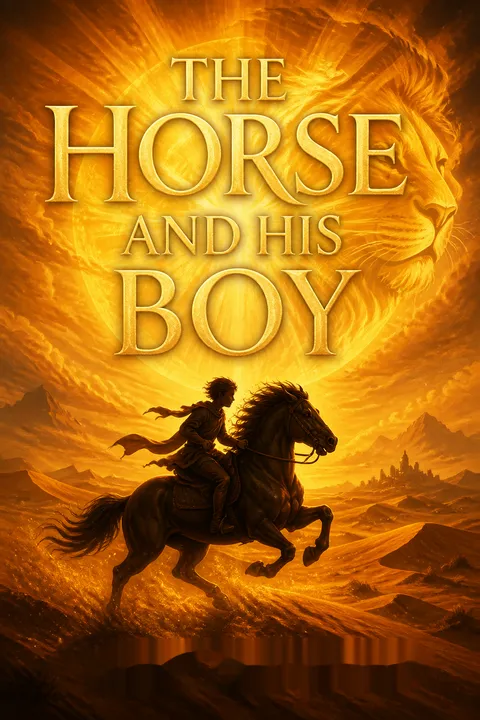


Plot Summary
The Boy and the War Horse
Shasta lives as a servant to Arsheesh, the fisherman who raised him, until a visiting Tarkaan offers to buy him. Overhearing the bargain, Shasta also learns that Arsheesh found him as an infant in a boat, not as his son. The news loosens a knot he has carried for years: he has never felt affection for Arsheesh and now has reason to believe he belongs elsewhere.
The Tarkaan's horse, Bree, speaks privately and reveals that he is a captured Narnian who has spent years pretending to be an ordinary mount. Knowing the Tarkaan is cruel, Bree proposes they escape together. Shasta retrieves the tack, climbs onto Bree, and rides north into the world beyond his familiar ridge.
Shasta's first freedom begins not with a heroic revelation but with the discovery that his old life has no legitimate claim on him. His uncertainty about his birth gives escape an emotional as well as practical force: leaving Arsheesh means abandoning both mistreatment and the only identity he has known. Bree offers a contrasting model of selfhood. He has survived by concealing his nature, yet still treats Narnia as home. Their bargain is mutual dependence, though Bree initially assumes the role of teacher and Shasta that of pupil.
A Mare Speaks at Midnight
Bree teaches Shasta to ride as they travel north, and their difficult lessons become easier with every day on the road. One night, a lion's roar drives them into a creek, where they meet Hwin, a Narnian mare, and Aravis, the young Calormene noblewoman riding her. Aravis explains that her father promised her to Ahoshta, an older courtier she despises.
Rather than submit, she planned her escape, forged a message to delay pursuit, and disguised herself in armor. Her first hope of suicide was interrupted when Hwin revealed she could speak and described Narnia. Bree proposes that the four travel together. Though Aravis treats Shasta as beneath her, they agree to meet at the Tombs beyond Tashbaan if the city separates them.
The meeting puts two kinds of captivity beside each other. Shasta has been exploited without knowing his origins; Aravis has rank and wealth but little control over her future. Hwin's intervention makes escape imaginable to Aravis, while Bree's insistence that Hwin is a person rather than property challenges the assumptions Aravis has inherited. Shasta, meanwhile, is still hungry for approval and feels excluded when Aravis and Bree share familiar stories. Their party forms through necessity before it forms through trust.
The Wrong Prince
To cross Tashbaan unnoticed, the fugitives muddy the horses, shorten their tails, and dress the children as poor travelers. The city's crowds separate Shasta from Bree and Aravis just as a Narnian procession passes.
Its leader, King Edmund, mistakes Shasta for Prince Corin, a missing boy from Archenland, and takes him to Queen Susan. Shasta stays silent, afraid that admitting the mistake will expose the escape. In the Narnians' lodging, he hears that Susan has rejected Prince Rabadash and that Edmund fears the Calormenes may hold her or attack their northern neighbors.
The Faun Tumnus devises a ruse: the Narnians will pretend to prepare a banquet, then secretly sail away. Shasta falls asleep before he can decide how to escape or explain himself.
The disguise succeeds at the level of appearance and fails at the level of circumstance: Shasta's resemblance to Corin gives him shelter, but also makes him a participant in a danger he cannot interpret. His silence reflects the habits Arsheesh taught him, especially the belief that adults are more likely to punish than help. The Narnian court offers a sharp contrast in kindness, yet Shasta cannot trust it because he does not know its rules. Tumnus's plan also turns hospitality into a political performance, using the expectation of a feast to conceal flight.
The Tombs Keep Watch
The real Corin climbs through a window into the room and finds Shasta occupying his place. After Corin explains that he escaped a street brawl and a brief capture, Shasta takes his route out through the window and over a wall. He reaches the northern edge of Tashbaan alone, with the desert ahead and no sign of his companions at the Tombs.
A large cat approaches and leads him to shelter among the stone monuments. During the night, it drives away creatures crying in the desert, then curls against him until he sleeps. In the morning Shasta marks the direction of Mount Pire, finds food and water, and waits for Bree and Aravis. As the day passes without them, he begins to suspect they have left him behind.
Shasta's loneliness here is sharpened by his tendency to read uncertainty as rejection. He has no evidence that Aravis deserted him, yet her earlier coldness makes that explanation feel inevitable. The cat offers protection without requiring him to understand who it is or why it helps. That unexplained kindness quietly challenges Shasta's expectation that survival depends on managing other people. His practical acts at dawn, marking the mountain and finding provisions, show that he is already learning to act without Bree's direction.
Lasaraleen's Hidden Door
Aravis avoids the Narnians' escort by jumping into the litter of her old friend Lasaraleen, who hides her at home and arranges for Bree and Hwin to be led to the Tombs. To get Aravis out of the city, Lasaraleen guides her through the palace gardens toward a water gate. They lose their way and hide as the Tisroc, Rabadash, and Ahoshta enter a room nearby.
Aravis overhears Rabadash propose a secret raid: he will seize Anvard, then ride through Narnia to capture Susan. Once the men leave, Aravis forces the frightened Lasaraleen to continue. She escapes by boat across the river and reaches the Tombs, where Shasta emerges from hiding. The four reunite, and Aravis warns them that Rabadash is coming.
Lasaraleen's help is sincere but unreliable: she cares for Aravis, yet comfort and social convention repeatedly distract her from the danger. Aravis survives by taking charge, even when that means frightening a friend who would rather retreat. The overheard plan turns a private flight into a race against an army. It also clarifies the difference between Rabadash's public courtliness and his private appetite for conquest. Aravis brings more than news to the reunited group; she brings a reason their journey matters to people beyond themselves.
The Desert's Green Thread
Using a route Shasta heard described by a Narnian raven, the four ride from the Tombs toward Mount Pire and a narrow valley that cuts across the desert. They travel through the night and endure a punishing day of glare, heat, and scarce water. Shasta's feet burn when he tries to walk on the sand, so Bree carries him.
At last they find the hidden valley, follow its stream to a pool, and drink until they can think again. Exhaustion overcomes all four, and they sleep through the cool hours that might have preserved their lead. When Aravis wakes them, Bree resists setting out without rest, while Hwin quietly presses for urgency. They move on, with the Calormene army still behind them.
The desert makes their different habits visible. Shasta endures pain because he has little experience of comfort; Aravis stays alert to the danger of delay; Bree, accustomed to being driven by masters, struggles to command himself once no one forces him forward. Hwin's quiet insistence is the most practical judgment in the group, even though Bree initially dismisses it. Their lost hours do not undo the journey, but they expose the difference between freedom as escape and freedom as self-discipline.
The Hermit's Refuge
The travelers cross the Winding Arrow into Archenland and spot Rabadash's force behind them. As they gallop toward Anvard, a lion pursues them. Bree pulls ahead, but Shasta sees it bearing down on Hwin and Aravis, jumps from his saddle, and runs back toward them. The lion claws Aravis's back, then breaks off as Shasta reaches her.
The wounded girl and exhausted horses reach the Hermit of the Southern March, who treats Aravis and sends Shasta onward to warn King Lune before Rabadash can attack. Bree and Hwin remain at the refuge. Shasta starts running through rough country despite his fatigue, carrying the warning alone. The Hermit watches over Aravis while the race for Anvard continues.
Shasta's leap back toward Aravis is the journey's clearest measure of his change. He acts before he can calculate whether he is brave, and the choice contradicts his old assumption that he is merely unlucky and powerless. Bree's flight, by contrast, confronts him with the gap between his boasts and his conduct. The Hermit's refuge briefly protects the group, but it is not a place to hide from consequence. Shasta must leave the safety of others and carry responsibility farther than his strength seems to allow.
The Voice in the Mist
Fog swallows Shasta as he rides toward Anvard, separating him from King Lune's party. At a fork, Rabadash's horsemen pass along the other road, revealing the assault is close. Shasta continues through the mist, despairing that everyone else has found safety while he has been left behind. A great unseen presence walks beside him and listens as he recounts his troubles.
At dawn, the presence reveals itself as Aslan and explains that the lions and cat were all the same guide, steering the fugitives together and keeping Shasta's boat from drifting past Arsheesh. Shasta reaches Narnia, where woodland creatures initially gossip instead of acting. The dwarf Duffle takes charge, and a stag carries the warning to Queen Lucy and the Narnian army.
The revelation changes the meaning of earlier danger without erasing its physical cost. The lion that frightened Shasta also redirected him; the cat that seemed merely comforting had guarded him. Aslan's account gives the boy a larger pattern, but not a guarantee that pain can be avoided: Aravis was still wounded, and Shasta still had to run. The delay among Narnia's comfortable woodland creatures adds a human-scale counterpoint to providence. Help may be present, but someone still has to recognize urgency and act.
Anvard's Narrow Escape
Queen Lucy and King Edmund lead Narnian forces toward Anvard after receiving the stag's warning. King Lune's defenders are holding the castle gate against Rabadash's battering ram when the Narnians descend on the attackers.
Shasta rides with Corin at the rear, despite having little idea how to fight. When the armies collide, he loses his sword and falls from his horse, but survives the chaos. Narnian forces rout the Calormenes, and King Lune's soldiers emerge from the castle to finish the defense.
Edmund defeats Rabadash's men, while Rabadash becomes caught by his torn armor on a hook in the wall. Lune refuses to treat the captured prince as an honorable knight. After the battle, he sees Shasta beside Corin and embraces them both, to the court's astonishment.
The battle is won through collective coordination rather than Shasta's individual prowess. He is brave enough to enter the danger but inexperienced enough to be a liability, which keeps courage distinct from competence. Narnian talking animals, giants, archers, and Archenland's defenders each contribute differently to the victory. Rabadash's accidental suspension turns the prince's theatrical self-image into public absurdity, while Lune's restraint refuses to let humiliation replace judgment. The king's embrace of both boys signals that Shasta's place in this story is changing, even before he understands why.
A Name Beneath the Rags
At the Hermit's refuge, Aslan tells Bree that his pride, not his worth, has been wounded, and explains to Aravis that her scratches matched the punishment inflicted on the slave girl she drugged. Soon Prince Cor visits Aravis and reveals that Shasta is his true name no longer: he is Cor, the elder twin of Corin and son of King Lune.
As an infant, Cor was kidnapped by Lord Bar, a disgraced chancellor, and sent away in a boat with a knight who died keeping him alive. The boat reached Arsheesh's shore because Aslan guided it there. Cor's return fulfills a prophecy that he would save Archenland from a great danger. Aravis apologizes for looking down on him, and the party travels to Anvard, where Lune welcomes her into his household.
The revelations connect moral responsibility with identity. Cor's birth explains his resemblance to Corin, but it does not make him valuable for the first time; his choices on the road have already shown what he can do. Aravis is made to feel the harm she caused a powerless servant, while Bree must see that his Narnian origin does not automatically make him admirable. Aslan corrects both without reducing them to their worst acts. Recognition becomes meaningful because it follows action, not because bloodline alone supplies character.
The Donkey's Boundary
At Anvard, Rabadash rejects King Lune's offer of release under conditions and renews his threats against Susan. Aslan appears and warns him to accept mercy, but Rabadash's pride hardens into more insults.
Aslan transforms him into a donkey, with one path back to human form: he must stand at Tashbaan's temple, and afterward he can never travel far from it without changing again. Returned to Calormen, Rabadash becomes a peaceable ruler largely because the limit protects his throne.
At Anvard, Cor accepts that he is Lune's heir, while Corin is relieved to remain a prince. Cor and Aravis later marry and rule Archenland; Bree and Hwin settle in Narnia and keep visiting their friends. The runaways have found homes, but each must grow into a different kind of freedom.
Rabadash's punishment is tailored to his governing flaw: he has treated distance, power, and other people as things he can command, so his future is bounded by the temple he invoked and the city he wanted to dominate. The possibility of return makes the judgment more than simple revenge, though his later peace is self-interested rather than transformed virtue. Cor's acceptance of kingship offers a contrasting model of authority as obligation, not personal reward. The ending gives each traveler a home while preserving the work of becoming worthy of it.
Analysis
The novel makes travel a test of how people use freedom once they have escaped control. Shasta and Aravis begin with sharply different disadvantages: he has no status or knowledge of his origin, while she has rank but is expected to surrender her choice in marriage. Bree and Hwin add another form of captivity, one disguised by the assumption that a horse is property. Crossing borders does not immediately undo these habits. Aravis initially ranks Shasta beneath her, Bree mistakes self-importance for Narnian identity, and Shasta distrusts the very people who might help him.
The journey repeatedly separates appearance from moral substance. Shasta looks like a prince before he knows his birth; Rabadash performs courtesy while planning violence; Bree boasts of bravery and then runs from the lion; Aravis is brave but has harmed a servant she considers expendable. The story's corrections are concrete. Shasta jumps from Bree to help Aravis, Aravis must confront the pain inflicted on the maid, and Bree is asked to exchange superiority for humility. Recognition follows conduct rather than replacing it.
Aslan's guidance gives the apparent accidents a larger pattern, but it does not make the characters passive. Shasta still has to ride, run, warn the king, and face battle. Providence and agency work together: the road can be shaped, but the traveler must keep moving. The political plot reinforces that point. Narnia's army saves Anvard through cooperation, while Rabadash's attempt to turn Susan into a possession and Archenland into a foothold collapses under the very arrogance that made him dangerous.
The ending distinguishes power from responsibility. Cor does not welcome the crown as a prize, and Lune describes rule as accepting danger and hardship on behalf of others. Against the Calormene court's hierarchy of ownership, the northern kingdoms imagine authority as service and talking animals as neighbors. The fugitives find homes not because they have become flawless, but because they have learned to see other lives more clearly.
Review Summary
The Horse and His Boy receives mixed reviews. Many praise its adventurous storyline and memorable characters, particularly Shasta and Aravis. However, numerous readers criticize its portrayal of the Calormenes, citing racist stereotypes and orientalism. Some find the pacing slow and the narrative less engaging than other Narnia books. Fans appreciate Lewis's writing style and moral lessons, while others feel the religious allegory is heavy-handed. The book's placement in the series chronology and its departure from the Pevensie siblings' perspective are points of contention among readers.
People Also Read


Characters
Shasta
The northbound foundlingA curious boy raised in hardship by the fisherman Arsheesh, Shasta longs for the country beyond the ridge near his home. Because he has little reason to trust adults, he keeps important truths to himself and often mistakes uncertainty for rejection. His first escape is partly an attempt to discover where he belongs, but the journey tests him through hunger, fear, and responsibility for other people. Shasta is not naturally skilled or confident. His strength lies in responding when someone else is in danger, even before he understands what that choice will cost.
Bree
The exiled talking war-horseBree is a Narnian talking horse captured as a foal and kept in Calormen, where he has learned to hide his intelligence. Proud of his training and imagined standing among Narnian horses, he likes to lecture Shasta and measure himself against others. His confidence is partly a defense against years of servitude: he wants to believe that his past has not diminished him. Bree is brave in some circumstances and frightened in others, a contradiction that makes his return to freedom a test of character as well as a change of country.
Aravis
The defiant Calormene noblewomanAravis is a high-born Calormene girl who values independence, horses, and the outdoors more than the social rewards other people promise her. Her refusal to accept a marriage arranged for political advantage drives her toward escape. She is resourceful and courageous, but also proud enough to dismiss people she considers beneath her. That pride shapes her early treatment of Shasta and her calculations about the journey. Aravis's composure helps her survive danger, though she must learn that intelligence and rank do not make her morally exempt from the consequences of her choices.
Hwin
The captive Narnian mareHwin is a gentle talking mare stolen from Narnia when she was young and made to serve a Calormene household. She is modest about her own courage, often allowing stronger personalities to speak over her, but her judgment is consistently practical. Hwin stops Aravis from killing herself, helps make the escape possible, and recognizes when the group must keep moving. Her quietness should not be mistaken for weakness. She offers a model of courage based on steadiness and care rather than display.
Aslan
The guiding sovereignAslan is the great Lion revered in Narnia, a presence of authority, power, and personal knowledge. He intervenes in the travelers' lives in ways they do not always recognize at the time, and his guidance may feel frightening before its purpose is clear. Aslan does not flatten his companions into simple labels of good or bad. He confronts pride and wrongdoing directly, yet leaves room for mercy and change. His attention is intensely particular: each person is met through the choices and responsibilities that belong to that person's own life.
Prince Corin
The impetuous Archenland princeCorin is a young prince with a quick temper, a taste for action, and a talent for getting into trouble. He fights when provoked and resists being kept away from danger, even when older and wiser people have good reason to restrain him. His boldness can be generous, but it is not always well judged. Corin's friendship with Shasta begins when the boys discover they have been mistaken for one another, and his lively confidence provides a striking contrast to Shasta's caution.
King Lune
The fatherly border kingKing Lune rules Archenland with warmth, plain speech, and a strong sense of duty. He is more approachable than Shasta expects a king to be, but his kindness does not make him soft about justice or responsibility. Lune takes the safety of his people seriously and resists treating even an enemy's life as a matter of convenience. His understanding of kingship emphasizes service under law, not entitlement to comfort.
Rabadash
The Calormene crown princeRabadash is a powerful prince accustomed to having his wishes treated as commands. He can perform courtesy when it serves him, but becomes threatening when Queen Susan refuses him. His pursuit of Susan grows entangled with his desire to expand Calormen's power, exposing how easily he treats a person as a prize and a neighboring country as an object to seize. Rabadash's pride makes him dangerous because he mistakes restraint for weakness and assumes that status should shield him from consequences.
King Edmund
The measured Narnian kingEdmund is one of Narnia's kings and Susan's brother. He approaches the threat in Tashbaan with caution, noticing that Rabadash's polished manners conceal a growing danger. Edmund is practical in council and decisive in battle, but he does not mistake force for the only form of judgment. His experience makes him wary of political traps, while his loyalty to Susan and the neighboring kingdom of Archenland helps determine the response to Rabadash's attack.
Queen Susan
The Narnian queen under threatSusan is a Narnian queen whose visit to Tashbaan becomes politically dangerous when Rabadash expects her to accept his proposal. She is gracious enough to give him a chance, but does not let hospitality override her judgment of his conduct. Her refusal is a personal decision with consequences for the safety of her companions and neighboring lands. Susan is not present in every stage of the adventure, yet the choices made around her reveal how the Calormene court treats women and political power.
Queen Lucy
The archer queen of NarniaLucy is a Narnian queen who joins the campaign to help Archenland. She combines compassion with practical courage, and her presence among the archers shows that tenderness does not prevent her from taking part in danger. Lucy is also willing to argue for mercy when Rabadash is captured. Her judgment is not naïve; she understands the harm he has caused, but still believes that a defeated enemy should be offered a chance to choose differently.
Tumnus
The faun with a sharp planTumnus is a Narnian faun traveling with Edmund and Susan in Tashbaan. His quick thinking helps the royal party use the preparations for a supposed banquet to conceal its departure by ship. He is warm toward Shasta when the boy is mistaken for Corin, offering him food, rest, and a glimpse of the life he assumes awaits the prince. Tumnus's kindness is real, though Shasta's fear prevents him from trusting it fully.
Lasaraleen
Aravis's fashionable friendLasaraleen is a wealthy young Tarkheena who loves clothes, parties, gossip, and the comforts of city life. She cares for Aravis and risks helping her, but often loses focus when the situation becomes frightening or inconvenient. Her friendship shows that affection does not require people to share priorities or temperaments. Lasaraleen's social ease gives Aravis access to places she could not enter alone, while her timidity forces Aravis to take charge of their escape.
The Hermit of the Southern March
The watcher in a green refugeThe Hermit lives in a walled refuge in Archenland and keeps watch on distant events through a magical pool. He treats Aravis's wounds, cares for the exhausted horses, and sends Shasta to carry an urgent warning to King Lune. His knowledge is considerable but not unlimited, especially when it comes to the future. The Hermit offers shelter without pretending that rest can remove the travelers' responsibilities.
Arsheesh
Shasta's hard-hearted guardianArsheesh is a poor fisherman who raises Shasta in a small cottage on Calormen's southern coast. He expects the boy to do much of the household work and treats him harshly when business goes badly. Arsheesh's account of finding Shasta in a boat becomes the first clue that the boy's past is not what he was taught to believe.
The Tisroc
The cautious Calormene emperorThe Tisroc rules Calormen and weighs political advantage against the danger of open war. He distrusts Narnia's power even as he resents its independence, and he is willing to let Rabadash pursue an ambitious plan while keeping himself at a distance from its consequences. His manner is measured, but his priorities are shaped by preserving his throne rather than protecting others.
Ahoshta Tarkaan
Aravis's intended husbandAhoshta is a powerful courtier whose rise depends on favor, flattery, and political usefulness. He is older than Aravis and has been chosen as her husband by her father, despite her strong objection. His position shows how marriage can be used to bind families and consolidate influence in Calormen's ruling class.
Lord Bar
The disgraced royal chancellorLord Bar is a former Archenland chancellor whose history is tied to the royal family and the uncertainty surrounding a lost child. His political position gives him access to the secrets and movements of the court. He is a reminder that public honor and private loyalty do not always coincide.
Sallowpad
The raven who knows routesSallowpad is an old Narnian raven who knows the desert from years of flight above it. His directions describe a hidden valley and river route through the otherwise difficult crossing. The practical knowledge he supplies becomes useful because Shasta hears it while trapped among the Narnians in Tashbaan.
Duffle
The practical Narnian dwarfDuffle is a red dwarf who responds to Shasta's warning with action when the woodland creatures are still debating what should be done. He supports the exhausted boy, gets him food, and helps set the message moving toward Narnia's leaders. Duffle's briskness contrasts with the comfortable inaction Shasta first encounters in the woods.
Plot Devices
Talking Horses
Freedom made visibleBree and Hwin are not ordinary mounts but intelligent Narnian beings held in Calormen. Their ability to speak gives the children knowledge, companionship, and a reason to seek a country where they can live as equals. The device also tests assumptions: Aravis initially treats Hwin as property, while Bree's pride in his Narnian identity does not prevent him from acting fearfully. Their animal perspective makes human customs, especially slavery and social rank, newly strange.
The Tombs and hidden valley
A route through dangerThe Tombs of the Ancient Kings provide a meeting place beyond Tashbaan because locals fear them, while the raven's directions point to a concealed valley that leads through the desert to Archenland. These locations turn geography into a sequence of choices: the fugitives must separate safely, find one another again, and cross a landscape where a wrong direction or lost hour can become fatal. Shasta's sight of Mount Pire helps him keep the route when the others are absent.
The mistaken identity
A false place in courtShasta's resemblance to Prince Corin causes Edmund and the Narnians to mistake him for a missing royal boy. The error gives Shasta a brief refuge and lets him overhear the court's plans, but it also leaves him afraid that he will be treated as a spy when the truth emerges. Corin's unexpected return allows Shasta to escape. The resemblance later points toward the hidden history of Shasta's birth.
Aslan's unseen interventions
Danger with hidden directionSeveral encounters that seem like separate threats or acts of luck are later revealed to involve the same Lion. The intervention brings Shasta and Aravis together, protects Shasta at the Tombs, pushes his infant boat ashore, and helps the travelers reach the people who need warning. This device changes how earlier scenes are understood without pretending that fear, exhaustion, or injury were unreal. Guidance in the story often arrives before the characters can recognize it.
The lost royal infant
Birth and belonging convergeShasta's arrival in a boat as an infant creates an unanswered question beneath his longing to leave Arsheesh. The clue returns through his resemblance to Corin and the history of Lord Bar's flight from Archenland. His identity changes his place in the royal family, but the story first establishes his courage and generosity through his actions on the road. The eventual recognition connects private belonging to the larger political danger threatening Archenland.
FAQ
0. Synopsis & Basic Details
What is The Horse and His Boy about?
- A Journey to Freedom: The story follows Shasta, a young boy raised by a fisherman in Calormen, who longs for the mysterious North. He discovers he's not the fisherman's son and, with a talking Narnian warhorse named Bree, escapes to seek freedom in Narnia.
- Unexpected Companions: Their perilous journey across the desert and through the bustling city of Tashbaan leads them to Aravis, a Calormene noblewoman fleeing an arranged marriage, and her talking mare, Hwin. The four unlikely companions unite, each seeking a new life in the free lands of the North.
- Race Against Invasion: Through a series of dramatic events, including mistaken identity and eavesdropping on a secret plot, Shasta and Aravis uncover Prince Rabadash's plan to invade Archenland and Narnia. They must race against time to warn King Lune and his allies, leading to a climactic battle that will decide the fate of the Northern kingdoms.
Why should I read The Horse and His Boy?
- Unique Narnian Perspective: This standalone adventure offers a fresh look at the world of Narnia, told from the perspective of characters outside the Pevensie family, providing rich insights into the neighboring lands of Calormen and Archenland. It expands the lore and geography of Lewis's beloved universe.
- Themes of Identity and Destiny: The narrative deeply explores questions of belonging, self-worth, and the discovery of one's true heritage, particularly through Shasta's journey from a "nobody" to a prince. It's a powerful story about finding your place and purpose, guided by a mysterious, benevolent force.
- Adventure and Moral Growth: Beyond the thrilling chase scenes and battles, the book is a profound exploration of character development, as each protagonist—Shasta, Aravis, and Bree—confronts their flaws, learns humility, and grows in courage and compassion, making it a compelling read for all ages.
What is the background of The Horse and His Boy?
- Golden Age of Narnia: The story is set during the reign of High King Peter and his siblings, King Edmund and Queens Susan and Lucy, placing it chronologically within the "Golden Age" of Narnia, after the events of The Lion, the Witch and the Wardrobe but before Prince Caspian. This context highlights Narnia's established peace and power.
- Calormene Empire's Influence: The narrative vividly contrasts the hierarchical, often cruel, and culturally distinct Calormene Empire with the free, more egalitarian societies of Narnia and Archenland. Calormen's worship of Tash and its emphasis on rigid social structures and flowery, deceitful speech are central to the cultural backdrop.
- Political Tensions and Geography: The plot is driven by the long-standing political tensions between Calormen and the Northern kingdoms, particularly Archenland, which serves as a buffer state. The journey itself traverses diverse landscapes, from the arid Calormene coast and vast desert to the lush mountains and valleys of Archenland and Narnia, emphasizing the geographical divide between these cultures.
What are the most memorable quotes in The Horse and His Boy?
- "I was the lion.": Aslan's profound revelation to Shasta in Chapter 11, where he explains his unseen guidance and interventions, encapsulates the theme of divine intervention and foreshadowing and personal destiny. It signifies that even in moments of despair, a higher power is at work, shaping events for good.
- "Do not dare not to dare.": Aslan's direct challenge to Bree in Chapter 14, urging him to overcome his fear and pride by physically touching the Lion, is a powerful call to courage and faith. It highlights the necessity of confronting one's deepest anxieties to achieve true freedom and humility.
- "Never taunt a man save when he is stronger than you: then, as you please.": King Lune's wise counsel to Corin in Chapter 13, after Corin mocks Rabadash, reveals the Archenland/Narnian code of honor and chivalry. It underscores the difference between true strength and arrogant cruelty, a core theme contrasting the Northern and Calormene cultures.
What writing style, narrative choices, and literary techniques does C.S. Lewis use?
- Oral Storytelling Tradition: Lewis employs a direct, conversational narrative voice, often addressing the reader ("you may be sure that Shasta pricked up his ears at this point"), which mimics the style of a storyteller sharing a tale aloud. This creates an intimate, engaging tone, drawing the reader into the adventure.
- Dual Perspective & Parallel Narratives: The story frequently shifts between Shasta's and Aravis's perspectives, especially during their time in Tashbaan, offering a rich, multi-faceted view of events. This narrative choice builds suspense and allows for a deeper exploration of contrasting cultural experiences and individual character growth.
- Allegory and Symbolism: Beyond the surface adventure, Lewis weaves in clear allegorical elements, particularly through Aslan's character, who embodies divine love, justice, and redemption. The contrast between Calormen and Narnia, and the journey from slavery to freedom, also serve as broader symbolic representations of spiritual and moral truths.
1. Hidden Details & Subtle Connections
What are some minor details that add significant meaning?
- Arsheesh's Twisted Proverbs: The fisherman Arsheesh frequently quotes "poets" with self-serving maxims like, "'Application to business is the root of prosperity, but those who ask questions that do not concern them are steering the ship of folly toward the rock of indigence.'" This detail subtly establishes the Calormene culture's emphasis on pragmatic, often cynical, wisdom over genuine curiosity or moral truth, contrasting sharply with Narnian values.
- The Cat at the Tombs' Unblinking Eyes: When Shasta is alone and terrified among the Tombs, a large, solemn cat appears, whose "eyes made you think it knew secrets it would not tell." This seemingly minor detail is a subtle, early manifestation of Aslan's watchful presence, hinting at the divine intervention and foreshadowing Shasta receives even when he feels most abandoned, foreshadowing Aslan's later revelation.
- Bree's "Horsey" Accent When Angry: When Shasta admits he's only ridden a donkey, Bree retorts with an angry neigh, "Ridden the wha-ha-ha-ha-ha." Lewis notes, "Talking horses always sound more horsey in accent when they are angry." This small, humorous detail underscores Bree's deep-seated pride in his Narnian identity and his disdain for anything less than true horsemanship, revealing his vanity even before his direct confrontation with Aslan.
What are some subtle foreshadowing and callbacks?
- Shasta's "Northern Stock": Early in their escape, Bree tells Shasta, "I'm sure you're true Northern stock. But not too loud. I should think they'd be asleep soon now." This seemingly casual remark subtly foreshadows Shasta's true identity as a prince of Archenland, a Northern kingdom, hinting at his noble lineage long before its official revelation.
- Corin's Impulsive Fighting Spirit: Prince Corin's immediate and enthusiastic desire to fight, even picking a fight with a Dwarf ("I'll knock you down if you try to bind me"), foreshadows his future reputation as Corin Thunder-Fist. This contrasts with Shasta's initial fear of battle and highlights the inherent differences in their temperaments despite being twins, setting up their distinct roles.
- The Tisroc's "Eighteen Other Sons": During his council with Rabadash, the Tisroc coldly states, "If he fails—I have eighteen other sons and Rabadash, after the manner of the eldest sons of kings, was beginning to be dangerous." This chilling detail foreshadows Rabadash's ultimate downfall and transformation, revealing the ruthless, pragmatic nature of Calormene succession and the Tisroc's willingness to sacrifice his own son for political stability.
What are some unexpected character connections?
- Mr. Tumnus's Continued Role: The Faun, Tumnus, who was Lucy Pevensie's first Narnian friend in The Lion, the Witch and the Wardrobe, reappears as a trusted advisor to King Edmund and Queen Susan. His presence provides a direct link to the earlier Narnian chronicles, showing the continuity of characters and the enduring friendships forged in Narnia's history, rather than just a new adventure.
- Bree and Hwin's "Second Cousins": During their first conversation, Bree and Hwin discover they are "some sort of second cousins once removed" from Narnia, having remembered "the very same places in Narnia—'the grasslands up above Beaversdam'." This detail emphasizes the deep, familial bond and shared heritage among Talking Beasts, highlighting their collective identity and longing for home beyond their individual escapes.
- Lasaraleen's Accidental Heroism: Aravis's frivolous, fashion-obsessed friend, Lasaraleen, initially seems like a superficial character, but her social connections and unwitting assistance are crucial to Aravis's escape and overhearing Rabadash's plot. Her character demonstrates how even seemingly insignificant or self-absorbed individuals can play a vital, if unintentional, role in larger, heroic events.
Who are the most significant supporting characters?
- The Hermit of the Southern March: This wise, ancient figure provides a crucial sanctuary for Aravis, Bree, and Hwin, offering not just physical healing but also spiritual counsel. His magical pool allows them to witness the battle, and his direct, humble wisdom helps Bree confront his vanity and Aravis understand the consequences of her actions, serving as a pivotal mentor figure.
- King Lune of Archenland: As Cor's biological father, King Lune embodies the ideal Northern ruler: jovial, kind, and just, yet firm when necessary. His immediate acceptance of Shasta (Cor) and his compassionate, yet principled, judgment of Rabadash highlight the stark moral contrast between Archenland and Calormen, providing a benevolent paternal figure Shasta never had.
- Mr. Tumnus the Faun: Beyond his cameo, Tumnus's quick thinking devises the Narnians' escape plan from Tashbaan, demonstrating his continued intelligence and loyalty. His presence grounds the story within the established Narnian lore and reminds readers of the long-standing peace and wisdom that characterize the Pevensies' reign.
2. Psychological, Emotional, & Relational Analysis
What are some unspoken motivations of the characters?
- Shasta's Quest for Parental Love: Shasta's initial excitement at the idea of being a Tarkaan's son, and his later deep relief at not being Arsheesh's child, reveals a profound, unspoken longing for genuine parental affection and acceptance. His journey is not just for freedom, but for a loving family, which he eventually finds in King Lune.
- Bree's Fear of Narnian Judgment: Bree's intense vanity about his appearance and his anxiety over "low, bad habits" like rolling stem from an unspoken fear that he won't be "good enough" for Narnia after years of slavery. He worries he has lost his true Narnian identity and will be judged by his free peers, revealing a deep insecurity beneath his proud exterior.
- Aravis's Desire for Self-Determination: While fleeing an unwanted marriage, Aravis's deeper motivation is a fierce desire for autonomy and control over her own life, a stark contrast to the subservient role expected of Calormene women. Her initial pride and independence are a defense mechanism against a society that seeks to strip her of her agency.
What psychological complexities do the characters exhibit?
- Shasta's Imposter Syndrome and Self-Doubt: Despite being a prince, Shasta struggles with a deep-seated belief that he is "nobody," a direct result of Arsheesh's abuse and his low status. This "imposter syndrome" makes him hesitant to speak up or assert himself, even when he has vital information, highlighting the lasting psychological impact of his upbringing.
- Bree's Pride-Humility Paradox: Bree is a complex mix of boastful pride in his Narnian heritage and warhorse prowess, yet he exhibits profound cowardice when faced with real, wild lions. This paradox reveals his internal struggle to reconcile his idealized self-image with his actual fears, leading to a necessary humbling that ultimately makes him a wiser horse.
- Aravis's Class Prejudice and Moral Blindness: Aravis, despite her own flight from oppression, initially displays significant class prejudice towards Shasta and a chilling lack of empathy for her drugged slave. Her psychological complexity lies in her journey from this ingrained Calormene worldview to one of greater compassion and humility, forced by hardship and Aslan's direct intervention.
What are the major emotional turning points?
- Shasta's Relief at Not Being Arsheesh's Son: Overhearing the Tarkaan reveal he is not Arsheesh's biological son is a pivotal emotional moment for Shasta. "That took a great weight off his mind. 'Why, I might be anyone!' he thought." This sudden sense of possibility and relief from a burdensome, unloving relationship is the catalyst for his decision to escape and seek a new identity.
- Aslan's Personal Revelation to Shasta: The moment Aslan reveals his identity and his continuous, unseen presence throughout Shasta's journey ("I was the lion... I was the cat... I was the lion who pushed the boat") is a profound emotional turning point. It transforms Shasta's self-pity and sense of being "unfortunate" into an understanding of divine purpose and deep, personal care, giving him courage and a sense of belonging.
- Bree's Humbling by Aslan's Whiskers: Bree's intellectualized faith in Aslan is shattered when the real Lion tickles his ear, forcing him to confront Aslan's physical reality and his own vanity. This direct, slightly comical, yet deeply significant encounter is an emotional turning point that strips away Bree's self-conceit and allows him to embrace true humility, realizing he is "not quite the great Horse he had come to think."
How do relationship dynamics evolve?
- Shasta and Bree: From Utility to Unconditional Friendship: Their relationship begins as a pragmatic alliance for escape, with Bree as the knowledgeable, somewhat condescending mentor and Shasta as the inexperienced rider. Through shared dangers and mutual reliance, their bond deepens into a loyal, affectionate friendship, culminating in Bree's genuine concern for Shasta's safety and Shasta's eventual acceptance of Bree's flaws.
- Aravis and Shasta: From Antagonism to Enduring Love: Initially marked
The Chronicles of Narnia (Chronological Order) Series
About the Author
Other books by C.S. Lewis





Download PDF
Download EPUB
.epub digital book format is ideal for reading ebooks on phones, tablets, and e-readers.








