

Key Takeaways
Stop treating every thought as truth; return attention to the senses
Thoughts crowd out experience. Koike calls the habit of getting lost in mental chatter a thinking disease. The mind rehearses the past, anticipates trouble, and searches for stimulation, leaving less attention for what is happening now. A person can sit beside a partner yet mentally remain at work, missing the simple reality of holding hands. The problem is not that thinking is always bad, but that unobserved thoughts can take over attention.
Practice noticing the drift. When attention wanders, register what is happening and return to a physical sensation, such as the sound of a voice or the feeling of air on skin. The aim is not to force the mind blank. It is to become less governed by each thought that appears.
This resembles cognitive defusion, a psychological skill in which thoughts are noticed as mental events rather than treated as facts or orders. The comparison is useful because it clarifies the book's title: not thinking means loosening the grip of thought, not abolishing reason. Attention to sensation can also interrupt rumination by giving awareness a concrete present task. The limitation is that reflection is essential for planning, learning, and recognizing danger. The practical target is compulsive mental looping, not thought itself.
Name the emotion before it chooses your next sentence
Impulse disguises itself as choice. Koike uses the Buddhist term kleshas for disturbing impulses that steer perception and behavior. He highlights desire, anger, and uncertainty or ignorance. A compliment can trigger a hunger for more praise; a supervisor's reminder can feel like an attack on one's competence and provoke a defensive reply. In both cases, a reaction may arrive before a considered decision.
Create a pause. When irritation appears, mentally identify it as an emotion being experienced, rather than proof that the other person is wrong. That small distance can prevent both venting and forced suppression. In an apology, the same discipline means focusing on the harm and offering a specific repair, rather than reaching for an excuse that protects one's image.
Putting a name to an emotion can create a useful gap between feeling and action. The book's distinctive move is to treat that gap as a form of ethical discipline: speech is not merely self-expression, since it changes another person's experience too. This is especially valuable in conflict, where a quick retort often serves pride more than problem solving. Still, calm observation should not become a demand to tolerate mistreatment. A pause can support a firm boundary as readily as a conciliatory response.
Listen for distress beneath the words, not just the topic
Conversation carries more than content. Koike asks listeners to notice changes in voice, breathing, pauses, and facial expression. A partner describing a dull work problem may not be seeking a clever solution. The shifting pace or a strained voice may reveal that the person needs to feel heard. In the same way, criticism can come from someone who is upset or under pressure, even when the criticism itself is unfair.
Observe before interpreting. Attend to the signals, then respond with patience or a question instead of immediately defending yourself or interrupting. The point is to make room for another person's experience, not to assume that every sigh or glance has a fixed meaning. Listening carefully can turn an uninteresting topic into a more human exchange.
The shift from debating a conversation's subject to noticing the speaker's state is a strong antidote to self-focused listening. It has a clear parallel with active listening practices, which prioritize reflecting and clarifying before advising. The method is most humane when cues prompt curiosity rather than certainty. Voice and posture are ambiguous, and interpreting them as reliable evidence of hidden pain can become amateur mind reading. A simple check in question often protects the insight from turning into a confident but mistaken diagnosis.
Train attention on ordinary sensory details to recover presence
Passive sensing can become active attention. Koike distinguishes merely seeing or hearing from deliberately looking and listening. Choose one small object in view, notice how it changes as you pass it, or attend to a quiet sound usually buried beneath louder ones. He frames change as impermanence: the world is continually shifting, even when familiarity makes it seem dull. Buddhist teaching also speaks of six doors through which experience is recognized: the eyes, ears, nose, tongue, body, and awareness.
Use the body as an anchor. When thought scatters, notice a fingertip on a keyboard, the feel of clothing, or the air against the skin. These exercises are not meant to make every sensation pleasant. They are ways to meet immediate experience before the mind adds its extra story.
This is an accessible account of attentional training because it turns an abstract instruction to be present into small, testable acts of perception. It also challenges the assumption that fulfillment requires stronger entertainment: some richness comes from detecting detail already available. The approach is not equally suitable in every setting. A noisy or threatening environment may call for protection, not deeper sensory immersion. The useful principle is selective attention, guided by context, rather than a universal duty to accept every stimulus.
Make digital attention deliberate, not a referendum on your worth
Online approval can become a loop. Koike argues that public writing and social media can turn the wish to connect into repeated checking for comments, visits, and recognition. A post may briefly ease the worry of being ignored, then create pressure to produce more and monitor the response. He cites a Japanese government survey in which fewer than one in five blogs was updated more than once a month, suggesting how often the initial enthusiasm faded.
Separate expression from evaluation. Drafting by hand, choosing only the most useful ideas, and keeping a private journal can reduce the pull of an audience. The journal's job is to record what happened and how emotions changed, not to polish a public identity. Online tools remain useful, but their metrics need not decide whether an activity matters.
The book identifies a psychological vulnerability that digital platforms can monetize: social approval is immediate, measurable, and easy to check again. A private journal changes the audience from an imagined crowd to the writer's own careful attention, making honesty easier. Yet online participation can also provide belonging, support, and valuable public expression. The distinction is not between internet use and virtue. It is whether the user chooses a purpose for going online, or lets notifications and comparison quietly choose one instead.
Taste each bite before deciding you need another
Restriction can intensify preoccupation. Koike argues that treating food as forbidden may keep attention fixed on eating and add stress to whatever was already driving overeating. He recommends changing the experience of a meal rather than relying only on willpower. In a quiet meal, notice the food's texture and changing flavor, the movement of the tongue, and the moment of swallowing. Setting down a spoon between bites can help keep attention on eating instead of racing ahead.
Let attention register enough. The proposal is that careful tasting can make a modest portion more satisfying. The same sensory practice applies when an itch or uncomfortable temperature draws attention: first notice the sensation before automatically reacting. This is not a promise that mindfulness cures eating problems or physical discomfort. It is a way to see what is happening before habit takes over.
The useful insight is that appetite is shaped not only by food quantity but also by attention, emotion, and routine. Slowing a meal can make eating more perceptible and less automatic, while a nonjudgmental pause can help distinguish bodily hunger from a desire for distraction. The book's account should not be taken as a complete explanation of overeating, which can involve medical, social, and psychological factors. Sensory awareness is a practice, not a substitute for appropriate care or adequate nutrition.
Release possessions deliberately to loosen the fear of losing them
Ownership occupies mental space. Koike describes possession as both remembering that an item belongs to you and resisting its loss. A coat rarely worn or a book already finished may still generate a recurring decision: keep it in case it becomes useful, or finally let it go. Pushing the question into a drawer does not necessarily settle it; the unresolved attachment can remain in mind.
Letting go is practice. Sell, give away, or discard what is genuinely unnecessary, and notice the response. Koike extends the idea to money, arguing that generosity can loosen the belief that security depends on accumulating more. He is not recommending waste or indifference to basic needs. The aim is to distinguish useful resources from possessions kept mainly to soothe insecurity or strengthen an image of worth.
The chapter turns decluttering into an exercise in observing attachment, rather than a contest to own fewer things. That distinction matters: the psychological value lies in choosing freely, not in treating minimalism as a new status symbol. Possessions can provide safety, memory, and practical independence, so disposal is not automatically liberating. A more durable test is whether an item serves a real purpose and whether keeping it is a considered choice, rather than a reflexive defense against imagined future loss.
Help by listening first, not by managing someone else's life
Advice can serve the adviser. When someone is struggling, an eager crowd may offer solutions before understanding what the person wants. Koike describes a worker considering leaving a job who was surrounded by colleagues' advice and left feeling exposed and exhausted. Their helpfulness may have answered their own desire to feel useful more than the worker's need to be heard.
Make room before offering direction. Listen without rushing to agree, contradict, or take charge. Ask questions that help the person explain their aims and notice contradictions for themselves. Koike's term zenyu describes a good friend whose presence supports mutual development, not someone who simply approves of everything. Compassion, in this view, requires attention to another person's pain while resisting the urge to make their problem a stage for one's own virtue.
This account anticipates a central principle of effective support: help is more likely to fit when the recipient's goals are understood first. Listening also restrains the helper's impulse to convert another person's vulnerability into proof of personal goodness. There is an important balance, though. Listening does not require passivity when someone faces immediate danger, and advice can be welcome when requested. The strongest version of the practice asks what kind of support is wanted, then offers it without taking ownership of the other person's choices.
Plan the task, then stop renegotiating with every distraction
Decisions made once save attention. Koike recommends making a concrete plan before beginning work, including a sensible order and a time allowance for each task. Without one, a person may open a computer to write an email, drift into online news, make coffee, then return frustrated and unfocused. A simple kitchen timer can mark when to move on, even if a task is unfinished.
Protect the chosen sequence. Schedule leisure or online browsing rather than pretending temptation will not appear. Then avoid checking unrelated material during focused work. The plan is not a demand for perfect productivity. It reduces repeated inner bargaining, so attention can stay with the task at hand. The same approach can make a delay less wasted: use waiting time for breathing, listening, or noticing the surroundings instead of feeding irritation.
This is a practical account of precommitment: deciding in advance can reduce the number of moments in which immediate temptation must be resisted. It also exposes how distraction often creates a second burden, frustration about having been distracted. The value lies in a plan that is concrete but revisable when circumstances genuinely change. A rigid schedule can become another source of self-punishment. The timer should support attention, not turn ordinary work into a test of obedience.
Use concentration to inspect the mind, not escape reality
Concentration is a means, not a destination. In a conversation with neuroscientist Yuji Ikegaya, Koike considers how bodily signals such as pain and discomfort shape behavior. Ikegaya complicates the idea that all pleasure is merely pain disappearing: the brain also has reward circuits, and its workings cannot be reduced to one explanation. Their exchange treats conscious choice cautiously. Koike frames awareness as a chance to veto some reflexive reactions, while Ikegaya presents this as a plausible interpretation, not established scientific proof.
Use focus to observe patterns. Buddhist practice, as Koike presents it, combines self discipline, concentration, and observation of the mind. Concentration matters because it helps reveal the habits steering attention and action. If meditation becomes a pleasant hiding place from difficult reality, it has missed its purpose. The test is whether it helps a person meet daily life with greater clarity.
The dialogue is most valuable where it resists easy certainty. Neuroscience can describe neural activity, reward, pain, and learned responses, but those descriptions do not by themselves settle philosophical questions about free will or the self. Koike's practice remains useful without requiring a final answer: noticing an impulse may create a moment in which action can be reconsidered. Concentration also has a tradeoff. Narrow focus can obscure surroundings, so sound judgment includes knowing when to widen attention.
Analysis
Koike's book is less a case against thinking than a manual for reclaiming attention from reflexive thought. Its organizing wager is practical: when the mind spins stories about praise, criticism, food, possessions, or social approval, redirecting attention to sensory information can weaken the story's control. That wager gives the book a strong through line. Listening, eating, writing, tidying, and parenting all become training grounds for noticing the instant when an impulse starts shaping behavior.
The work's most useful distinction is between awareness and suppression. The reader is not asked to crush anger, hunger, or distraction, but to notice them before treating them as commands. This resonates with contemporary practices that teach people to observe thoughts without fusing with them. Koike also gives the method an ethical dimension: attention is not merely a productivity tool, because better listening may reduce the strain imposed on other people.
The book is less persuasive when it treats broad claims about the brain as settled facts. Its neuroscientist guest provides an important corrective, distinguishing the brain's aversion systems from reward systems and acknowledging that scientific explanations remain incomplete. The conversation on free will is best read as a practice prompt, not a demonstrated theory. Likewise, some claims about possessions, emotion, or sensory awareness are presented more categorically than the examples can establish.
A balanced reading preserves the exercises and loosens the universal claims. Sensory attention can interrupt rumination, but thought is also necessary for planning, moral judgment, and recognizing genuine danger. Letting go can reduce avoidable attachment, but material security matters. Compassion can begin with listening, but sometimes action is urgent. The book is strongest when its method is applied flexibly: notice what is happening, test whether a reaction is useful, and choose a response with more care than reflex alone allows.
Review Summary
The Practice of Not Thinking receives mixed reviews, with ratings ranging from 1 to 5 stars. Some readers find the book insightful and helpful for mindful living, praising its practical advice on reducing mental clutter and increasing awareness. Others criticize it as overly simplistic, culturally specific to Japan, or lacking in depth. The Buddhist perspective and concepts like kleshas are appreciated by some but confusing to others. Many reviewers note that while the book offers interesting ideas, its application to modern Western life can be challenging.
Glossary
thinking disease
Unnoticed mental overactivityKoike's label for getting absorbed in repetitive, distracting thought until attention to immediate experience weakens. It does not mean that thinking itself is an illness or that reasoning should stop. The problem is thought that runs automatically, feeds distress, and interferes with listening, sensing, or responding deliberately.
kleshas
Disturbing mental impulsesA Buddhist term Koike uses for impulses that cloud perception and pull behavior toward distress. He emphasizes desire, anger, and uncertainty or ignorance. In his account, these impulses can be activated by praise, criticism, boredom, or other sensory input, then shape speech and action before a person notices what is happening.
six doors
Routes for receiving experienceThe six channels through which experience is registered in the Buddhist framework used by Koike: sight, hearing, smell, taste, bodily sensation, and awareness. The first five receive sensory information; awareness recognizes such experiences, including thoughts. Attending to these doors helps a practitioner notice what is entering the mind and how it is being interpreted.
impermanence
The continual changing of thingsA Buddhist principle that phenomena do not remain fixed but change from moment to moment. Koike applies it to ordinary perception: a familiar face, a passing street scene, or a voice is continually changing, even when habit makes it seem static. Noticing those small changes can renew attention to present experience.
dependent arising
Things arise through conditionsA Buddhist teaching that events and experiences arise through conditions and relationships rather than in isolation. Koike uses the idea to connect attention across situations: how a person listens to everyday sounds can affect readiness to listen to a partner or colleague. It frames perception and behavior as shaped by an interconnected stream of influences.
muzan
Unawareness of one's wrongdoingA Buddhist term Koike applies to shamelessness or failing to recognize the moral weight of one's behavior. He uses anonymous online hostility as an example: a person may pretend that an invented screen identity, rather than the actual self, is responsible. That distancing can make harmful conduct easier to excuse.
zenyu
A mutually supportive friendKoike's term for a good friend whose presence helps people develop their minds in ways that benefit both. It does not mean a person who hides their real feelings or agrees with everything. The concept encourages attention to whether relationships tend to bring clarity and calm or reinforce agitation and harmful habits.
Noble Eightfold Path
A Buddhist path of practiceA central Buddhist framework of eight practices traditionally grouped around ethical conduct, concentration, and wisdom. Koike presents it as guidance for thought, speech, action, livelihood, mindfulness, concentration, and understanding. In this book, it supports the idea that mental clarity grows through disciplined conduct as well as meditation.
threefold training
Ethics, focus, and insightKoike's description of Buddhist training through higher virtue, a higher mind, and higher wisdom. Higher virtue means rules guiding conduct; a higher mind means developing concentration; higher wisdom means observing mental patterns within that focused state. The sequence treats concentration as preparation for insight, rather than as an end in itself.
issaikaiku
All experience involves sufferingA Buddhist expression Koike describes as meaning that everything is suffering, pain, or unhappiness. He connects it to recognizing that sensory stimulation and mental reactions can contain discomfort, even when the brain interprets relief as pleasure. The term expresses a Buddhist perspective, not a neuroscientific finding that every pleasurable experience is literally pain.
FAQ
What's "The Practice of Not Thinking" about?
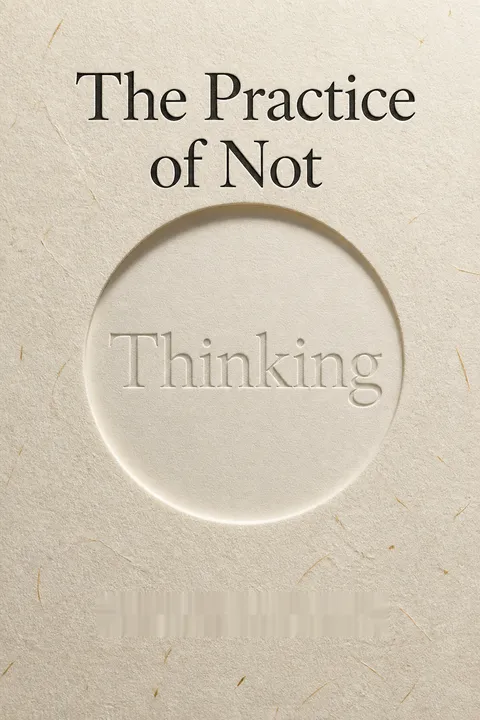
- Mindful Living Guide: "The Practice of Not Thinking" by Ryūnosuke Koike is a guide to mindful living, focusing on reducing excessive thinking to improve mental clarity and well-being.
- Control Over Thoughts: The book emphasizes the importance of controlling one's thoughts to prevent them from dictating behavior and leading to negative emotions.
- Five Senses Focus: It suggests honing the five senses—sight, hearing, smell, taste, and touch—to bolster perception and reduce unnecessary thinking.
- Buddhist Principles: The book incorporates Buddhist principles, particularly the Noble Eightfold Path, to guide readers in living a balanced and mindful life.
Why should I read "The Practice of Not Thinking"?
- Reduce Mental Clutter: The book offers practical techniques to reduce mental clutter and achieve a clearer, more focused mind.
- Improve Emotional Well-being: By controlling excessive thinking, readers can improve their emotional well-being and reduce stress.
- Practical Exercises: It provides exercises and practices that can be easily integrated into daily life to enhance mindfulness.
- Buddhist Insights: Readers interested in Buddhism will find valuable insights into how Buddhist teachings can be applied to modern life.
What are the key takeaways of "The Practice of Not Thinking"?
- Thinking Disease: Excessive thinking can lead to a "thinking disease," causing frustration and reducing concentration.
- Mind and Body Control: The book outlines steps to control both the mind and body, emphasizing the importance of awareness and discipline.
- Five Senses Utilization: Utilizing the five senses actively can help maintain a balanced state of mind and reduce unnecessary thoughts.
- Buddhist Practices: Incorporating Buddhist practices, such as meditation and the Noble Eightfold Path, can lead to a more mindful and fulfilling life.
How does Ryūnosuke Koike suggest controlling excessive thinking?
- Awareness of Thoughts: Koike suggests becoming aware of the thoughts that drift into the mind and setting them aside to prevent them from taking control.
- Focus on Senses: By focusing on the five senses, individuals can redirect their awareness away from unnecessary thoughts.
- Meditation Practice: Regular meditation is recommended to train the mind to concentrate and reduce the noise of excessive thinking.
- Mindful Living: Practicing mindful living through daily activities, such as eating and listening, can help maintain mental clarity.
What is the "thinking disease" mentioned in "The Practice of Not Thinking"?
- Definition: The "thinking disease" refers to the tendency to overthink, which can lead to frustration, confusion, and a lack of concentration.
- Negative Impact: Excessive thinking can cause mental exhaustion and prevent individuals from living the way they want.
- Mind's Stimulation: The mind often seeks stronger stimulation, leading to a cycle of negative thoughts that are hard to break.
- Solution: The book suggests practicing mindfulness and focusing on the five senses to overcome the thinking disease.
How does "The Practice of Not Thinking" incorporate Buddhist principles?
- Noble Eightfold Path: The book uses the Noble Eightfold Path as a framework for living mindfully and controlling thoughts.
- Three Poisons: It addresses the three disturbing emotions—desire, anger, and uncertainty—and how they can be managed through Buddhist practices.
- Meditation and Awareness: Buddhist meditation and awareness practices are emphasized as tools for achieving mental clarity and reducing unnecessary thoughts.
- Self-Discipline: The book encourages self-discipline and setting personal rules to prevent the mind from becoming unsettled.
What are some practical exercises from "The Practice of Not Thinking"?
- Mindful Eating: Focus on the taste and texture of food to fully experience eating without distractions.
- Listening Practice: Pay attention to the sounds around you without letting them trigger unnecessary thoughts.
- Observation of Emotions: Write a journal to observe and understand your emotions objectively.
- Breathing Awareness: Concentrate on your breathing to calm the mind and reduce stress.
How does Ryūnosuke Koike suggest using the five senses to reduce thinking?
- Active Engagement: Actively engage with the senses by looking, listening, smelling, tasting, and touching with intention.
- Sensory Focus: Focus on specific sensory experiences to bring awareness to the present moment and reduce mental noise.
- Mindful Observation: Use the senses to observe the world around you, which can help ground the mind and prevent overthinking.
- Sensory Exercises: Practice exercises that involve concentrating on sensory details, such as feeling the air on your skin or the texture of an object.
What is the relationship between the brain and the mind according to "The Practice of Not Thinking"?
- Pain as Foundation: The book suggests that pain forms the foundation of the brain, influencing how we process information and emotions.
- Mind's Programming: The mind is programmed to convert pain into pleasure, which can lead to stress and increased pain.
- Brain's Reflexes: The brain often operates on reflexes, and awareness can help intercept negative commands before they take control.
- Selfless Enlightenment: Understanding the brain's reflexive nature can lead to selfless enlightenment and greater freedom from mental constraints.
What are some key quotes from "The Practice of Not Thinking" and their meanings?
- "By thinking, we can become ignorant": This quote highlights how excessive thinking can cloud judgment and reduce awareness.
- "The brain continues to churn out thoughts": It emphasizes the mind's tendency to produce thoughts incessantly, often without our control.
- "Satisfying your mind by responding to your senses": This suggests that engaging with the senses can fulfill the mind and reduce unnecessary thinking.
- "Concentration is not an objective; it’s only a tool": This underscores the idea that concentration is a means to achieve mindfulness, not an end in itself.
How does "The Practice of Not Thinking" address modern challenges with information overload?
- Digital Overwhelm: The book acknowledges the stress caused by constant digital information and suggests ways to manage it.
- Mindful Practices: It offers mindful practices to help individuals disconnect from digital distractions and focus on the present.
- Reducing Noise: Techniques are provided to reduce the mental noise created by information overload, leading to clearer thinking.
- Balanced Living: The book encourages a balanced approach to technology use, integrating mindfulness into daily life to combat information fatigue.
What is the significance of meditation in "The Practice of Not Thinking"?
- Tool for Clarity: Meditation is presented as a tool for achieving mental clarity and reducing the noise of excessive thoughts.
- Self-Observation: It allows for self-observation, helping individuals become aware of their thought patterns and emotional responses.
- Concentration Development: Meditation helps develop concentration, which is essential for mindful living and controlling the mind.
- Buddhist Tradition: The practice is rooted in Buddhist tradition, emphasizing the importance of meditation in achieving a balanced and mindful life.
Download PDF
Download EPUB
.epub digital book format is ideal for reading ebooks on phones, tablets, and e-readers.








