

Key Takeaways
Manage product development as economic flow, not a sequence of phases.
The formal process can mislead. Phase-gate systems often demand that requirements be finished before design begins. Yet Reinertsen reports that 95 percent of developers surveyed had already begun design before all requirements were known, with half the requirements known on average. The official sequence and the actual work had diverged. Teams were already overlapping tasks, but doing so quietly rather than adapting the process openly.
Design for information flow. Flow-Based Product Development treats work as a changing stream of information. Its central practices include smaller transfers between stages, faster feedback, and limits on work in progress. This is not simply manufacturing’s first-in, first-out method applied to engineering: projects differ in delay cost, task duration, and uncertainty, so the flow system must reflect those differences.
The gap between formal procedure and actual practice is a useful diagnostic. When teams routinely work around a process, the workaround may be carrying information the official process cannot accommodate. Making that behavior visible can improve both learning and accountability. The caution is that overlap is not automatically wise: concurrent work can create rework when dependencies are tight. The economic question is whether earlier learning and shorter delays are worth that risk, not whether phases should always be abolished.
Put every trade-off in life-cycle profit, especially the price of delay.
Translate proxies into economics. Teams often target cycle time, utilization, quality, or innovation without knowing how a change in one affects the whole project. Reinertsen’s project economic framework estimates how product cost, product value, development expense, cycle time, and risk influence life-cycle profit. This makes competing effects comparable rather than treating each metric as an independent goal.
Start with delay. Cost of delay, or COD, is the profit lost when a project or milestone arrives late. The book reports that only 15 percent of developers know their projects’ COD, and people on the same project have given estimates varying by as much as 50 to 1. In one example, releasing an imperfect product to manufacturing four weeks earlier added $18,000 in defect costs. Whether that trade was sensible depended on the value of those four weeks.
A shared economic unit can turn an argument about values into a testable decision: what is gained, what is spent, and what assumptions drive the result? This resembles decision analysis, where uncertain inputs are made explicit instead of hidden inside confident judgments. COD estimates will still be noisy, especially early in a project. Their value is not false precision; it is revealing whether a decision changes under plausible assumptions and which unknowns deserve better evidence.
Stop maximizing utilization; at 98.5%, queues become the real workload.
Busy resources can slow the system. Product development inventory, sometimes called design-in-process inventory, consists of unfinished designs and other work waiting between activities. It is easy to miss because it is information rather than physical stock. Yet queues lengthen cycle time, delay feedback, increase tracking overhead, raise risk, and sap urgency. The author reports that surveyed developers ran at an average 98.5 percent utilization.
The curve gets steep. In a variable process, queue size rises sharply as utilization approaches 100 percent. For a simple random queue, each halving of spare capacity roughly doubles the average queue. Little’s Formula relates average work in the system to time: average WIP divided by average completion rate gives average flow time. Manage the queue directly, rather than trusting utilization estimates or waiting for late cycle-time reports.
The argument shifts attention from visible busyness to the time work spends waiting. This is a systems perspective: improving one resource’s utilization can worsen the performance of the whole chain. Queueing theory makes that trade-off vivid, although the book’s simple queue models are illustrations, not universal forecasts for every team. Arrival patterns, task variability, shared resources, and priority rules all matter. The practical lesson holds: measure waiting and throughput before adding pressure to keep every specialist occupied.
Preserve valuable uncertainty, then limit the damage of bad bets.
Risk can create value. Product development changes designs and tests possibilities, so eliminating all variability would also eliminate many opportunities to discover better products. The economic result depends on the payoff, not just the probability of success. Reinertsen compares three technical paths costing $15,000 each: a 50 percent chance of saving $100,000 had higher expected value than a certain $16,000 saving.
Make failure informative. For a test with two possible outcomes, a 50 percent chance of failure maximizes information per test because either result is informative. That does not mean every test should aim for failure: exploratory tests seek learning, while validation tests seek confidence. The practical strategy is to shape consequences through small experiments, fast feedback, and early stopping. A promising outcome can earn further investment; an unpromising one need not consume the entire budget.
This is a real-options view of experimentation: small, staged investments preserve the choice to continue when evidence improves and stop when it does not. It explains why a high failure rate can coexist with sound portfolio economics when successes have outsized returns and failures are cheap. The 50 percent figure needs its boundary conditions: it describes information from a binary test, not a universal target for project success. Test value also depends on whether the information can change a decision.
Break work into small transfers to shorten queues and expose mistakes.
Small batches reveal problems sooner. A batch is the amount of work passed together to the next activity. Smaller batches can shorten queues without adding capacity, reduce overload, and bring feedback forward. If reviewers wait for 200 drawings, a faulty assumption in the first 20 can spread through the remaining 180. Reviewing completed work weekly can catch it earlier and reduce downstream rework.
Pay for smaller batches by lowering transaction costs. More frequent reviews, tests, or handoffs may seem expensive, but automation, stable routines, and predictable meeting times reduce the cost of each transfer. Software teams that test daily, for example, can isolate defects in smaller code changes. Batch size still involves a trade-off between transfer costs and the cost of waiting. It can also change over a project: rapid learning may matter most early, while later work may justify larger batches.
Small batches are valuable not merely because they move work faster, but because they make cause and effect easier to see. That improves diagnosis as well as cycle time. The approach works best when tasks can be separated and interfaces are clear; otherwise, frequent handoffs can create coordination friction or incomplete work. The strongest implementation therefore pairs batch reduction with investment in test automation, modular design, and repeatable review routines rather than treating frequency alone as the solution.
Cap active work, and intervene before congestion starts feeding itself.
Limit work in progress. A WIP constraint sets an upper limit on unfinished work in a process or pipeline. In a model of a queue operating at 90 percent utilization, a light limit at twice its unconstrained average WIP cut cycle time by 28 percent, while blocking and underutilization cost 1 percent. Those results depend on the model’s assumptions, but they illustrate that modest limits can yield large gains.
Act on rising queues. Random delays can accumulate into long-lived high-queue periods; chance alone may not clear them quickly. Teams can pause incoming work, remove low-value projects, shed optional requirements, or add flexible capacity. Local limits between stages can signal trouble quickly, while a portfolio limit can reduce the number of active projects. Make WIP visible with a board or other simple tool, and examine old, stuck items instead of trusting averages alone.
A WIP limit is both a control and a choice about where unfinished work waits. Blocking work can protect a congested development stage, but sending it to an upstream queue is not cost-free if the opportunity is perishable. The book’s strongest point is that limits should be connected to the economics of each queue, not adopted as a moral rule against inventory. Teams also need an agreed response when a limit is reached, or the limit becomes a dashboard decoration.
Route and prioritize work by delay economics, not FIFO or project rank.
Choose sequence by the work. First-in, first-out is sensible when jobs have similar durations and delay costs. Development work rarely fits that description. When delay costs differ, higher-cost-of-delay work may deserve earlier service; when costs are similar, shorter jobs can go first. When both vary, weighted shortest job first ranks work by cost of delay relative to the time it occupies a constrained resource.
Use rhythm as well as priority. Cadence means processing or reviewing work at regular intervals. A predictable weekly review can reduce coordination overhead while providing frequent feedback. Synchronizing adjacent tasks can reduce waiting, and a network-style process can send each project through only the activities it needs. In one engineering-change process described in the book, joint weekly reviews cut average processing time from 40 days to five.
Prioritization is most valuable when queues are large, but complex ranking systems can create an illusion of precision when estimates are weak. Broad categories of delay cost and approximate task duration may be sufficient to avoid the largest mistakes. The network analogy adds another important idea: a process need not be a single fixed route. However, tailored routes require clear interfaces and enough visibility to prevent local shortcuts from creating system-wide incompatibilities.
Make feedback fast enough to change decisions while change is cheap.
Control what predicts trouble. Cycle time reports what has already happened; queue size can warn what is coming. A cumulative flow diagram plots accumulated arrivals and departures over time. The gap between them shows unfinished work, while their slopes reveal incoming demand and completion rate. These measures make queues visible and support earlier action than waiting for a late milestone.
Treat goals as revisable. Plans are based on incomplete information, so a deviation is not automatically a failure. A new customer preference or technical result may make a different choice more profitable. The book’s example of Team New Zealand’s yacht designers contrasts simultaneous comparisons between two similar boats with tests conducted on one boat at different times. More comparable conditions made small performance differences easier to detect and learning faster.
Fast feedback improves both control and inference: when less time passes between an intervention and its result, fewer unrelated changes cloud interpretation. That is why short cycles work best alongside controlled comparisons and attention to noise. Yet not every signal warrants an immediate course correction. Small samples can fluctuate, and reacting to every blip creates instability. A good feedback system specifies which deviations matter economically, how strong the evidence must be, and who can act.
Decentralize perishable decisions, but align teams with shared economic rules.
Push decisions toward fresh information. A problem or opportunity that loses value quickly should be handled by people close enough to see it and authorized to respond. Boeing’s 777 program used a shared rule allowing engineers to spend up to $300 in unit cost to save a pound of weight. Thousands of designers could make locally timed choices while following the same system-level economic logic.
Coordinate without micromanaging. The book draws on Marine Corps practice: communicate the mission and its purpose, define roles and boundaries, and let local teams adapt within them. Centralize resources when scale or concentration matters; decentralize execution when response time matters. Begin implementation in small increments, learn from results, and expand what works. The author reports that some organizations using these methods achieved fivefold to tenfold improvements in portions of their development process.
Decentralization is not simply permission to improvise. It depends on shared information, decision rules, practiced collaboration, and escalation paths for problems beyond local authority. This combination resembles a well-designed control system: local action is fast, while common constraints preserve system-level coherence. The military analogy is useful but should not be romanticized; product teams usually face different stakes and incentives. In regulated or safety-critical work, local discretion still needs explicit boundaries and auditable decisions.
Analysis
The book’s central move is to redefine product development as a flow problem governed by economics, rather than a planning problem governed by conformance. Its argument is unusually integrated: cost of delay makes queues financially legible; queueing theory explains why high utilization creates waiting; small batches and WIP limits control that waiting; and fast feedback allows teams to update decisions as evidence changes. The result is not a menu of isolated techniques but a logic for choosing among them.
Its most useful distinction is between variability itself and the economic consequences of variability. That separation prevents two common errors: trying to suppress uncertainty that may contain upside, and accepting avoidable delays because variation is considered inevitable. Staged experiments, flexible requirements, and rapid tests are valuable because they preserve options while limiting exposure. Similarly, decentralization is not presented as the opposite of control. Shared economic rules can coordinate many local choices without routing every decision through senior management.
The framework also imposes a demanding managerial discipline. Cost of delay, capacity, and project value are difficult to estimate, and teams can disguise preference as quantitative analysis. Estimates should therefore be treated as decision aids, tested against ranges and updated with evidence, not as objective truths. Queueing models likewise clarify mechanisms, but their numerical outputs depend on assumptions about arrivals, service, and task structure. A measured limit is not automatically the right limit.
The strongest implementation path follows the book’s own logic: make work visible, measure WIP and flow time, identify one costly queue, reduce transfer friction, and test a modest intervention. Review both intended and unintended effects. The point is not maximum speed, minimum inventory, or maximum innovation in isolation. It is better economic decisions made while information is fresh, with enough capacity and flexibility to respond when reality changes.
Review Summary
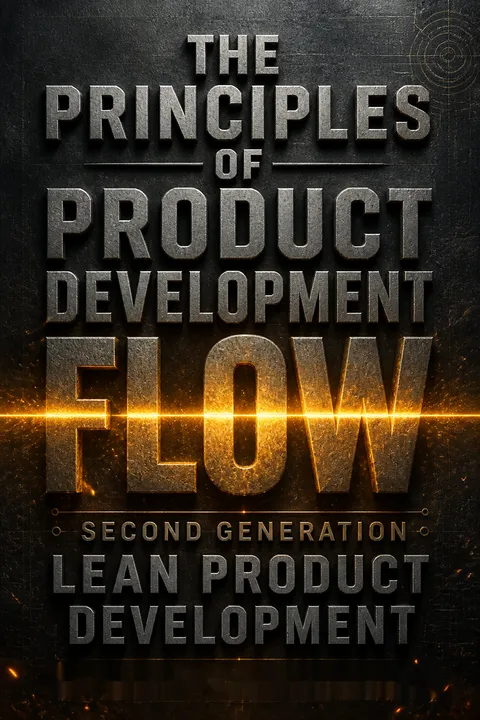
The Principles of Product Development Flow receives mostly positive reviews for its insightful content on product development economics and queuing theory. Readers praise its comprehensive approach and valuable principles, though some find it dense and challenging to read. The book challenges conventional wisdom, offering a unique perspective on product development that differs from traditional manufacturing approaches. While the writing style and organization receive criticism, many consider it essential reading for product development professionals, citing its potential to revolutionize organizational practices.
People Also Read








Glossary
Flow-Based Product Development
Economically managed development flowAn approach to product development that manages work as a variable flow of information rather than as a fixed sequence of fully completed phases. It emphasizes economically informed decisions, smaller transfers, limited work in progress, rapid feedback, and flexible control. It adapts lean flow ideas to development work, where project priorities, task durations, and delay costs differ.
Cost of Delay
Profit lost through waitingThe economic loss caused when a project, product, or milestone arrives later than it otherwise could. Cost of Delay translates time into a decision-relevant financial measure, allowing teams to compare schedule improvements with added expense, risk, or scope changes. It can differ across projects and milestones, so a single company-wide estimate may conceal important trade-offs.
design-in-process inventory (DIP)
Unfinished development workThe investment tied up in partially completed designs and other active development work. Unlike factory inventory, DIP is usually information stored in files, systems, and people’s work, so it is difficult to see on a balance sheet or in a workplace. High DIP commonly accompanies long queues, slow feedback, long flow times, and costly project overhead.
Little’s Formula
Connects work, rate, and timeA queueing relationship stating that average work in a system equals average throughput multiplied by average time in the system. Rearranged, average flow time equals average work in progress divided by average completion rate. The relationship applies across many kinds of queueing systems and helps teams estimate flow time from visible WIP and throughput.
cumulative flow diagram (CFD)
Visualizes work entering and leavingA chart that plots cumulative arrivals and cumulative departures over time. The vertical gap between the two lines represents work that has entered but not yet left a process, while the horizontal gap indicates elapsed flow time. The slopes show arrival and completion rates, making it easier to spot growing queues and distinguish demand changes from capacity changes.
work-in-process constraints
Limits unfinished active workRules that set an upper bound on work currently active in a process or system. When the limit is reached, new work may be held back, removed, or handled through added capacity or changed priorities. Constraints can control cycle time and prevent extreme congestion, but their value depends on the costs of blocking work and where waiting occurs.
asymmetric payoff-function
Unequal rewards for outcomesAn economic relationship in which upside and downside outcomes have different sizes or consequences. In development, a successful experiment may lead to a large opportunity, while failure may cost only the limited effort invested so far. Under such conditions, more variability can increase expected value, though additional uncertainty is beneficial only when its possible gains justify its losses.
cadence
Regular process rhythmA predictable timing pattern for recurring work, reviews, or decisions. A fixed cadence can reduce scheduling and coordination overhead, make waiting times easier to anticipate, and support smaller batches of work. It can also prevent delays in one task from continually shifting the timing of connected activities. Cadence requires enough capacity margin to absorb variation.
weighted shortest job first (WSJF)
Prioritizes delay value per timeA sequencing method for situations where jobs differ in both cost of delay and the time they occupy a constrained resource. Priority is based on cost of delay divided by task duration. The method aims to gain more economic value from scarce capacity, rather than ranking whole projects by return on investment or processing all work strictly in arrival order.
mission orders
Purpose with local discretionA way of communicating the intended outcome and reason for an operation while leaving room for people close to events to decide how best to achieve it. In the book’s account of Marine Corps doctrine, shared intent helps decentralized teams adapt to obstacles and opportunities without losing alignment. Effective use depends on clear boundaries, shared information, and trained judgment.
FAQ
What's The Principles of Product Development Flow about?
- Lean Development Focus: The book emphasizes applying lean principles to product development to enhance efficiency and minimize waste.
- Flow-Based Approach: It introduces a flow-based paradigm, advocating for smaller batch sizes and rapid feedback, contrasting with traditional phase-gate processes.
- Economic Framework: Donald G. Reinertsen provides an economic framework to quantify costs associated with delays and queues, aiding better decision-making.
Why should I read The Principles of Product Development Flow?
- Practical Insights: Offers actionable methods and real-life examples to improve product development processes.
- Transformative Ideas: Challenges conventional wisdom, encouraging a rethink of managing variability and queues.
- Expert Guidance: Draws on decades of experience, providing insights that can significantly improve throughput and decision-making.
What are the key takeaways of The Principles of Product Development Flow?
- Emphasize Flow: Achieving flow requires managing queues and reducing batch sizes to enhance efficiency.
- Cost of Delay: Understanding and quantifying this cost is crucial for informed economic decisions in product development.
- WIP Constraints: Implementing work-in-process constraints helps control cycle times and improve process performance.
What are the best quotes from The Principles of Product Development Flow and what do they mean?
- Complacency Warning: "It ain’t what you don’t know that gets you into trouble. It’s what you know for sure that just ain’t so." This highlights the dangers of complacency and the importance of questioning established beliefs.
- Queues and Waste: "Queues are the root cause of the majority of economic waste in product development." This emphasizes the need to manage queues effectively to reduce waste.
- Cautious Experimentation: "Don’t test the water with both feet." This suggests the value of small, incremental changes rather than large, risky leaps.
How does The Principles of Product Development Flow define the concept of "flow" in product development?
- Continuous Movement: Flow refers to the continuous movement of work through the development process, minimizing delays.
- Lean Alignment: It aligns with lean principles, advocating for small batch sizes and rapid feedback.
- Economic Efficiency: Achieving flow reduces cycle times and enhances responsiveness to market changes.
What is the "Cost of Delay" in The Principles of Product Development Flow and why is it important?
- Economic Impact: The Cost of Delay quantifies the profit lost for each day of delay in a project or feature.
- Decision-Making Tool: Understanding this cost helps prioritize tasks and make informed resource allocation decisions.
- Economic Framework: Quantifying the Cost of Delay is crucial for improving product development economics.
How does The Principles of Product Development Flow suggest managing queues?
- WIP Constraints: Advocates for implementing work-in-process constraints to control queue sizes and improve flow.
- Cumulative Flow Diagrams: Recommends using these diagrams to visualize and monitor queue sizes, identifying bottlenecks.
- Rapid Interventions: Encourages quick interventions when queues grow large to prevent economic damage.
What are the benefits of reducing batch sizes in product development according to The Principles of Product Development Flow?
- Faster Feedback: Smaller batch sizes lead to quicker feedback loops, allowing early adjustments.
- Reduced Risk: Decreases the risk of large-scale failures, as smaller changes are easier to manage.
- Improved Efficiency: Enhances efficiency by minimizing queues and reducing waiting time in the development pipeline.
How does The Principles of Product Development Flow address the relationship between variability and product development?
- Beneficial Variability: Argues that variability can create economic value, especially when leading to innovation.
- Asymmetric Payoffs: Emphasizes that variability's economic impact is influenced by payoff-function asymmetry.
- Optimal Variability: Suggests an optimal level of variability that maximizes economic value, rather than eliminating it.
What is the significance of WIP constraints in The Principles of Product Development Flow?
- Control Cycle Time: WIP constraints help manage cycle times by limiting work in progress.
- Reduce Queues: Prevents large queues, which can lead to delays and increased costs.
- Adaptability: Allows teams to respond effectively to demand and resource variability, enhancing flexibility.
How does The Principles of Product Development Flow address the concept of fast feedback?
- Accelerates Learning: Fast feedback loops enable quick learning from actions, identifying issues early.
- Improves Decision-Making: Timely feedback allows informed decisions aligned with project goals.
- Reduces Queue Size: Contributes to smaller queues, improving flow and efficiency.
What role does decentralized control play in The Principles of Product Development Flow?
- Empowers Teams: Allows teams to make quick decisions without waiting for higher management approval.
- Enhances Agility: Enables effective responses to changes and challenges, crucial for navigating complexities.
- Facilitates Local Initiative: Emphasizes that local initiative is crucial for success, allowing teams to seize opportunities.
Download PDF
Download EPUB
.epub digital book format is ideal for reading ebooks on phones, tablets, and e-readers.








