

Plot Summary
The Iowa Saucer Hoax
Sam Nivens, an operative for a secret intelligence section, is called back from leave by his chief, Andrew, known as the Old Man. With fellow agent Mary disguised as his sister, Sam investigates a reported spacecraft landing near Grinnell, Iowa. The supposed saucer is a cheap fake, but six agents sent ahead have vanished, and Mary notices that the people around the farm seem emotionally vacant.
In Des Moines, station manager Barnes reaches for a gun after Mary signals danger. Sam shoots him, and the three agents discover a pulsing gray parasite beneath his shirt. They trap it in a can and escape through a covert garage route. The evidence points to a real invasion concealed behind a public hoax.
The false saucer is not merely a decoy; it demonstrates how easily official explanations can turn evidence into entertainment. Sam’s instinctive suspicion and Mary’s less measurable reading of people complement Andrew’s ability to reason from sparse facts. Yet the discovery arrives through violence: Barnes’s body becomes proof, and the agents must treat a familiar human shape as a potential disguise. The story makes the first act of resistance an epistemic one, the choice to distrust a reassuring account when bodies and missing people contradict it.
The President Looks Away
Andrew briefs the President, while Sam and Mary describe the parasite and Barnes’s death. The President doubts that the landing site could be anywhere but the McLain farm, and a live video call with Barnes appears to confirm that Sam killed an innocent man. The staff visible behind Barnes all have rounded shoulders, but the President still refuses Andrew’s demand for quarantine.
He sends the agents away on leave and tells Andrew to rest. Sam is shaken by the refusal, then sees the capital’s ordinary people below its glowing domes and decides he cannot abandon them. At the Library of Congress, he and Mary search old reports of flying objects and unexplained disappearances, finding patterns that suggest Earth has been visited repeatedly.
The President’s failure is not simple stupidity. He relies on records, jurisdiction, and repeatable evidence, while the enemy has already captured the institutions that produce those things. The apparently living Barnes exposes the weakness of verification when a parasite can use a host’s identity and public role. Sam’s decision to keep working grows from a concrete image of the city’s residents, not from confidence in government. The archive then enlarges the crisis: what looked like a single landing may be the latest recurrence of a long, misclassified history.
A Warning Without Authority
The library records suggest roughly thirty-year surges in sightings and disappearances. Sam and Mary take their findings to Andrew, who is resting in Florida, and he orders an analysis of the disappearance pattern. Sam proposes a public demonstration: he will enter the occupied area while a camera records him searching for parasites.
Andrew agrees, sending Sam with technician Jarvis and agent Davidson while Mary returns to Washington to guard the President. Before Sam leaves, Mary kisses him and asks him to come back. The landing site has already been swept by fire, erasing visible traces of the spacecraft. Sam’s team finds an elderly farmer there instead, and Sam attacks him to check his back, only to discover he is innocent.
The agents’ first effort to create undeniable proof runs into two different limits: the evidence has been erased, and suspicion can injure the innocent. Sam’s assault on the farmer shows how quickly defensive vigilance can become a moral hazard. His mistake matters because it costs more than time; it forces him to confront the difference between a plausible hypothesis and a verified fact. Mary’s parting gesture also gives the mission a private stake, but the separation is practical rather than romantic. The operation is built around what each agent can do, even when that means sending them apart.
Des Moines Turns Hostile
At the Des Moines station, Sam recognizes the hunched posture of Barnes’s secretary and pulls up her sweater, exposing a parasite. Jarvis’s scanning equipment fails, and possessed employees attack the agents.
Sam and Davidson shoot their attackers, including a second Barnes, while the secretary is carried into the elevator. The parasite disappears during the escape. Back at the Section, Mary identifies Jarvis as possessed, and the agents uncover a live parasite on his back. Andrew orders an emergency search of everyone in the offices.
During the forced inspection, Jarvis is revealed as a controlled host, while Andrew’s secretary, Miss Haines, bolts from the room. Sam pursues her into a washroom, where someone strikes him from behind. He wakes under the enemy’s control.
The station raid turns a suspicion about compromised officials into open combat, but it also reveals the cost of trying to capture evidence rather than simply destroy it. The failed scanner leaves the agents blind at the worst moment, and their escape does not secure the parasite they sought. Inside their own headquarters, familiar coworkers become possible threats, and Andrew’s emergency search breaks the section’s ordinary trust. Miss Haines’s flight and Sam’s sudden blackout make the danger intimate: no secure room, professional loyalty, or trained reflex can guarantee that a person remains in control of their body.
Sam Becomes the Puppet
While possessed, Sam remains conscious but loses control of his choices. He rents a warehouse loft, orders parasite-carrying cells, and recruits a building superintendent and landlord. The landlord’s connections give the invaders access to the Constitution Club, where Sam helps take over its staff, members, and visiting officials.
The parasites use human recruits to spread through key positions in Des Moines while ordinary life continues around them. Andrew eventually intercepts Sam on a flight to New Orleans, drugs him, and brings him to a new Section base.
Sam remembers everything he did. He also learns that the invasion has spread to several major cities and that his first recruits included an assistant secretary of the Treasury. The knowledge leaves him physically ill and terrified of what his memories contain.
Possession is frightening here because it does not erase Sam’s intelligence or memory. It converts them into tools for an agenda he consciously opposes, making the familiar self an accomplice without consent. His recruitment of officials follows the enemy’s logic: institutions can be captured by controlling the people who keep them functioning, while the public sees no visible break in routine. Sam’s recovery therefore cannot be a simple return to himself. He has to face both the bodily violation and the fact that his skills, normally a source of pride, were used to extend the invasion.
A Bargain Called Peace
Andrew keeps Sam’s parasite alive on an orangutan and uses Sam’s recent experience to prepare for an interrogation. Sam initially refuses to help, then agrees to watch as the parasite is transferred onto him.
Restrained in a chair, he speaks for the creature, which describes its people as bringing contentment through surrender. It cannot identify its home in terms the interrogators can extract, and electrical shocks eventually kill it. Hypnotic analysis of Sam’s memories later supplies the missing location: Titan, Saturn’s moon.
Sam blames Mary for sitting in the chair first, believing she knowingly forced him to take her place. Andrew tells him that Mary volunteered without knowing Sam would be selected. The correction begins to loosen Sam’s anger, though not his distrust of Andrew.
The parasite’s promise is disturbing because it does not present domination as cruelty. It offers relief from conflict, a seductive bargain that reframes the loss of agency as peace. Sam’s response exposes how control can be made to feel comforting from inside the host, even as the independent self experiences terror and violation. His anger at Mary also shows how trauma searches for a human target when the true source is inhuman. Andrew’s manipulation may serve survival, but it damages the trust on which his team depends, leaving necessity morally expensive rather than clean.
Congress Shows Its Back
The President’s advisers cannot persuade Congress to accept an emergency declaration, and a committee treats Sam’s testimony as entertainment. At a joint session, Senator Gottlieb begins a procedural move against the President.
Mary spots that he is possessed; Andrew sends a warning, and Sam leaps onto the senator, exposing the parasite beneath his clothes. The President points out the creature to the lawmakers, and the chamber erupts. Guards and agents restore enough order for members to be inspected, uncovering more possessed officials.
Congress finally grants the President broad emergency powers. Gottlieb later regains control and supports compulsory searches, helping force his colleagues to comply. The government can now impose the public measures Andrew had demanded from the beginning.
The exposure of Gottlieb changes the political problem from competing testimony to shared sight. Congress does not act because Sam has become a more persuasive speaker; it acts because the hidden enemy is suddenly present in the chamber, attached to a person whose authority had helped conceal it. Yet the scene is not a simple triumph of truth. It requires physical force, bodily exposure, and suspension of normal procedure. Gottlieb’s later willingness to compel searches shows how coercive power can protect a public, but also how quickly emergency measures become the only language institutions understand.
Kansas City Saturated
The President launches Schedule Bare Back, requiring citizens to expose their shoulders so parasites can be spotted. Sam is sent into Kansas City to assess the occupied zone before a planned military offensive.
He evades a screening trap at the city entrance, then notices too few adults dressed for the heat and a public swimming pool inexplicably closed. A possessed policeman attacks him when he investigates a staged news scene, and Sam kills the parasite by crushing it through the officer’s back.
He escapes the crowd and captures another possessed man, taking him toward Washington as evidence. A military roadblock forces him to land, delaying his report. His warning arrives too late to prevent the government’s operation against the occupied cities.
Sam’s observations are small and cumulative: clothing choices, a shut pool, a false news report, a carefully arranged checkpoint. The enemy’s strength lies not in making everything look extraordinary, but in preserving ordinary surfaces while quietly changing their meaning. Sam’s brief success against the policeman demonstrates that a parasite can be killed without elaborate weapons, but the escape also reveals the limits of individual skill against a coordinated system. His delay is not merely a tactical failure. It gives the enemy time to exploit the government’s mistaken assumption that the invasion remains numerically limited.
The Failed Counterblast
While Sam is away, Schedule Counter Blast sends military teams to seize communication stations across occupied territory. The operation initially appears successful, but the messages reporting progress are false, and the invading forces disappear into Zone Red.
Andrew learns that escaped parasites at the National Zoo have multiplied by splitting in contact with other hosts. A gibbon’s parasite divides, and the new creature attaches itself to another ape, proving that the enemy can reproduce rapidly wherever hosts are available.
The discovery explains how Kansas City became saturated and why the military’s forces were overwhelmed. With direct attacks too dangerous and the public increasingly fearful, the front settles into a grim stalemate. Sam’s leave and his relationship with Mary become the next personal turning point.
The failed assault is caused by a bad estimate, not a lack of courage. The military applies a conventional model of enemy numbers to an organism that can multiply through contact, so each captured host may become the source of further losses. The zoo demonstration makes the horror measurable, yet measurement offers no immediate remedy. The operation’s collapse also shifts the emotional scale of the war: state power is no longer an obvious counterweight to invasion. Sam and Mary’s later retreat into private life occurs against this knowledge, not in ignorance of the danger.
A Marriage in Hiding
After Sam’s recovery and a period of training officials, he discovers that Mary has been waiting for him while on leave. They leave the Section together and finally agree to marry. The pair register a binding lifetime contract, then fly to Sam’s remote cabin in the Adirondacks. For two weeks, they cook, read, practice shooting, and settle into a tenderness neither had expected to find in their dangerous work.
Sam’s cat, Pirate, accepts Mary as part of the household. They avoid news and try to treat the cabin as a refuge from the war. Their happiness is real, but their isolation cannot make them safe: the parasites are spreading beyond the cities, and their habits have begun to adapt.
The marriage is a choice to build a shared life without pretending that danger has disappeared. Sam wants the contract partly as proof that his feelings are not a reflex of crisis; Mary insists that love needs time rather than a legal guarantee. Their quiet routines give the story a necessary counterweight to the institutional emergency, while the cat makes their domestic world concrete and vulnerable. The retreat is not an escape from history so much as a temporary refusal to let history occupy every hour. That refusal will be tested through the bodies they trust most.
The Cat Takes the Slug
After taking a time-stretching drug, Sam and Mary return to ordinary time and discover Pirate has been outside. Mary goes to find him. When she comes back, a parasite is beneath her clothing and has taken control of her. Sam wrestles her away from the fireplace, trying to dislodge the creature without killing his wife.
Heat drives it from Mary, but it lands beside Pirate and transfers to the cat. Sam burns the parasite in the fire, then treats Mary’s burns and his own injured hands. Pirate dies before dawn. Mary wakes, learns what happened, and insists they return to the Section. On the journey, Sam reasons that the parasite may have come from their hermit neighbor and may have been sent to recapture him.
The home invasion collapses the distinction between safety and danger. Mary’s body, Pirate’s familiar presence, and Sam’s own physical strength all become unreliable or insufficient, forcing him to act without any option that preserves everyone untouched. His decision to use the fire is a desperate trade: injury to Mary and the cat for a chance to stop the parasite from escaping. The loss of Pirate gives the rescue a domestic cost, not just a tactical one. Mary’s resolve to return to duty shows that survival does not erase the war; it changes what the couple must carry back into it.
Mary Remembers Venus
Back at the Section, Sam and Mary are subjected to searches because parasites may hide beyond the shoulders. A newly tracked saucer lands near Pass Christian, and the agents join the force that captures it. Inside, they find dead Titanian beings, thousands of parasites, and suspended human captives.
Andrew asks Mary to recover a buried childhood memory, and she recalls her life among the Whitmanite colony on Venus. Her parents were taken by the invaders, while she survived in the colony and was later preserved in suspended animation.
Mary identifies nine-day fever as the illness that killed her parasite and left her alive. Since she is immune, the memory points the scientists toward a possible way to kill the invaders without simply destroying their human hosts.
Mary’s recovered history turns private trauma into strategically valuable knowledge, but the story refuses to treat that conversion as effortless. Andrew’s examination presses into memories Mary had sealed away, and Sam has to protect her agency even while accepting the potential consequences of what she remembers. The revelation also complicates the invasion’s history: the parasites have encountered humanity before, on Venus, and their apparent mastery is not invulnerability. Nine-day fever becomes a bridge between a child’s survival and a planetary defense. The crucial resource is not a new weapon but an experience that institutions had failed to ask about.
The Fever Crosses Red
Scientists confirm that nine-day fever can kill the parasites and that an antitoxin may save infected human hosts. Sam realizes that direct contact between parasites can spread the disease through their network, so human volunteers would alert the enemy; infected apes can carry it silently.
Tests on chimpanzees confirm the plan. The military launches Schedule Fever, using animal carriers to infect parasites across Zone Red, then prepares Schedule Mercy, which sends teams with antitoxin to treat the hosts.
Green points begin appearing on the map as occupied areas fall. Sam joins the rescue effort, treating sick residents in Jefferson City. There, Andrew calls for help. Sam finds him alone in a car, but Andrew is already controlled by a parasite that has escaped infection.
The counterstrategy succeeds by turning the enemy’s own method of coordination against it. Direct contact, previously the mechanism that unified parasite knowledge and multiplied their reach, becomes a route for contagion. The choice of apes is ethically and tactically specific: they can carry infection without warning the network through speech. Schedule Mercy then separates killing the parasite from abandoning its host, preserving the human population wherever possible. But the green map does not mean the danger is over. Andrew’s possession reveals that a single uninfected parasite can still exploit a gap in a nearly successful campaign.
The Last Puppet String
Andrew has taken Sam aboard a stolen aircraft, intending to escape south with the only parasite in their region not killed by the fever. Bound beside him, Sam hears the parasite promise him peace and begins to see it split in preparation to take a second host.
He cannot free his hands, so he kicks the control panel and fires the aircraft’s launching units. The force crushes the exposed parasite, but the aircraft dives and crashes into the Gulf. Sam wakes badly injured beside Andrew, who is still alive long enough to pass on his mother’s pride in him.
Schedule Mercy nearly clears the continent, though no one can prove every parasite is gone. Sam takes command of the Section and joins Mary on an expedition to Titan, leaving their young daughter with Andrew.
The climax answers the novel’s central question about freedom through action rather than argument. Sam’s father offers the same promise of contentment that the parasite once made, but Sam recognizes that relief purchased through surrender is another form of captivity. His only available weapon is his body, which he uses to disrupt the parasite’s division at the cost of crashing the aircraft. The ending does not claim that the planet is permanently safe; an unconfirmed survivor remains possible. Instead, the expedition to Titan turns vigilance outward, while the child left with Andrew makes the cost of continuing the war unmistakably personal.
Analysis
The novel’s invasion works by separating appearance from agency. A person may speak, remember, and perform a job while no longer choosing any of those actions. That premise gives the story its horror, but it also sharpens its political argument: institutions can continue to look functional after their authority has been captured. The President’s initial reliance on records, Congress’s delay, and the fabricated broadcasts from occupied cities all show how public confidence can become a weapon against the public itself.
Sam’s experience of possession makes the conflict more intimate than a contest between armies. He remembers recruiting people for the invaders, and his technical competence becomes evidence of how completely a self can be commandeered. The parasites’ promise of peace is therefore psychologically precise. Their control does not need to feel like constant pain; it can feel like relief from uncertainty. The novel challenges the idea that comfort and freedom naturally coincide, especially when surrender is presented as a cure for conflict.
The counterattack depends on combining forms of knowledge that the story initially keeps apart. Mary’s buried memory, Sam’s practical understanding of parasite behavior, and the scientists’ experiments together produce a workable plan. None is sufficient alone. This collaboration also places limits on Andrew’s command style: decisive leadership may be necessary, but manipulation leaves damage among the people expected to follow him.
Finally, the story refuses a clean return to normal. The campaign can reclaim most occupied territory, yet the possibility of hidden survivors remains, and public habits have changed. Sam and Mary’s expedition to Titan is not a triumphant restoration of innocence. It is an acceptance that freedom has to be defended without certainty that the danger is gone. The novel’s most durable lesson is not that humanity will always win, but that a species unwilling to resist its own subjugation has already begun to lose.
Review Summary
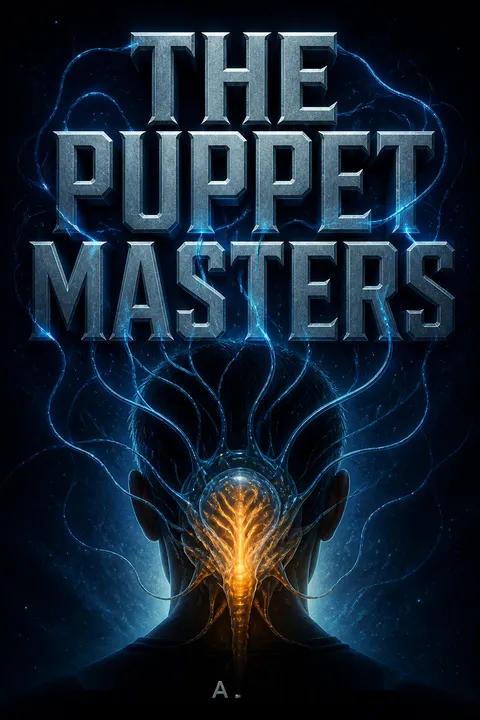
The Puppet Masters is a classic sci-fi novel about alien slugs invading Earth and controlling humans. Reviews praise its fast-paced action, innovative ideas, and suspenseful plot. Many note its dated elements, including sexism and Cold War paranoia, but appreciate its influence on the genre. Some readers find the characters thin and dialogue awkward, while others enjoy Heinlein's sharp wit and world-building. Overall, opinions are mixed, with fans of vintage sci-fi generally rating it higher than modern readers.
People Also Read


Characters
Sam Nivens
The unwilling field operativeSam is a highly trained intelligence operative whose humor and appetite for risk mask a persistent need to prove he can act independently. He trusts Andrew’s judgment even as he resists being directed, and he approaches problems through observation, practical improvisation, and hard-won experience. His work makes him alert to manipulation, but also leaves him vulnerable to emotional overreaction when someone he loves appears to have used him. Sam’s growth is not a change from courage to fearlessness. It is a movement toward accepting responsibility for other people, including the consequences of choices made under pressure. His bluntness can wound, yet his loyalty is expressed most clearly in what he is willing to risk with his own body.
Mary
The instinctive agentMary is a skilled operative whose most unusual strength is her ability to detect emotional wrongness in people before she can explain it. She is observant, disciplined, and sparing with words, yet she can use charm as deliberately as she uses a weapon. Sam initially misunderstands her reserve as coldness; their work reveals a woman who combines professional composure with real tenderness and a strong sense of personal choice. Mary does not define herself through being desired or protected, even when others assume those roles for her. Her courage comes from a capacity to act while afraid, and her insistence on living in the present offers a counterpoint to Sam’s habit of planning, worrying, and trying to control what comes next.
Andrew
The calculating section chiefAndrew, called the Old Man by his agents, leads the secret intelligence section with a mix of fierce loyalty, strategic patience, and a willingness to make brutal choices. He trusts evidence over convention and can recognize a pattern while others are still debating whether it is possible. His authority rests less on formal rank than on the confidence he inspires in people who know how readily he would risk himself for the mission. Andrew’s greatest strength is also his danger: he can treat individuals as necessary pieces in a larger calculation. The strain between his protective attachment to his agents and his readiness to manipulate them gives his leadership its moral complexity.
The President
The constitutional commanderThe President is personable and politically experienced, with an instinct for making people feel heard. He initially relies on official records and advisers who discount Andrew’s warnings, showing how democratic authority can be constrained by the very procedures meant to make it legitimate. Once confronted with visible evidence, he accepts the need for extraordinary powers and publicly submits himself to the same exposure demanded of citizens. His role is not that of an infallible leader, but of a public official who must bridge the distance between private intelligence and collective action.
Doris Marsden
Sam's outspoken nurseDoris cares for Sam during his recovery and meets his self-pity with warmth, directness, and a sharp sense of fairness. She is married and has children, facts that keep Sam’s flirtation grounded in reality rather than wish fulfillment. Doris understands that professional duty does not excuse cruelty within the team, and she challenges Sam when he minimizes the harm done to him. Her humor and practical nursing work give the story an ordinary human voice amid the military emergency.
Davidson
Sam's steady field partnerDavidson accompanies Sam on dangerous field work and helps him survive the raid on the Des Moines station. He is capable under pressure, but violence against possessed hosts shakes him, especially when the distinction between a human body and the parasite controlling it becomes difficult to hold. His reaction shows that trained agents are not emotionally insulated from what the mission requires. Davidson’s loyalty is practical and understated: he follows Sam into danger, reports honestly, and returns to duty after injury.
Jarvis
The compromised technicianJarvis is a technical specialist assigned to document Sam’s attempt to gather proof in Iowa. His equipment is crucial to the plan, but the mission’s confusion and violence quickly overwhelm the careful operation. Jarvis represents the vulnerability of expertise when an adversary can enter the chain of command through a human body. His presence also forces the Section to confront the possibility that even its own agents may be compromised without knowing it.
Dr. Hazelhurst
The Venus disease specialistHazelhurst is a military physician with experience in the diseases of Venus. He is cautious about claims that have not been tested, and his medical knowledge helps turn Mary’s remembered illness into a practical line of investigation. At first, he approaches the problem through the established limits of his field; collaboration with Sam’s operational reasoning pushes him toward a larger solution. Hazelhurst’s skepticism is not obstruction for its own sake. It is the discipline that helps distinguish a promising idea from a usable treatment.
Dr. Vargas
The zoo biologistVargas studies the parasites through animal hosts and conducts the experiments that reveal how they reproduce. He is intellectually energetic and willing to handle dangerous evidence, though his initial interpretations remain tied to familiar biological models. His work makes the zoo a laboratory for discoveries the military cannot obtain through battle alone. Vargas represents the importance of scientific inquiry even when its methods unsettle people who want immediate action.
Dr. McIlvaine
The alien-mind theoristMcIlvaine is a comparative psychologist who resists assuming that alien life must follow human biological or psychological patterns. His speculative ideas about the parasites’ shared memory challenge the investigators to consider forms of identity unlike individual human consciousness. He can seem detached beside the physical suffering of the hosts, but that distance allows him to ask questions the field agents would not naturally formulate. His theories help the team recognize that the enemy’s organization may be as important as its bodies.
Colonel Kelly
The laboratory security chiefKelly is a security specialist assigned to protect the research facility and its work. He understands that secrecy and containment are essential, but he also recognizes that a biological war cannot be won through conventional security habits alone. His warnings about how permanent the social changes may become are grounded in the limits of the campaign, not defeatism. Kelly brings a long view to a team focused on the next operation.
Senator Gottlieb
The compromised lawmakerGottlieb is a senior senator whose political instincts and loyalty to his party make him a consequential figure in Congress. His public manner gives no easy indication of the danger hidden beneath it. He embodies the way an institution’s most respectable voices can become instruments of forces its members do not recognize.
Pirate
Sam's mountain catPirate is Sam’s independent, affectionate tomcat, accustomed to coming and going from the cabin on his own terms. He quickly accepts Mary, making him a small but vivid sign that their shared home is becoming real. His presence connects Sam to a private life that exists outside the Section and its emergencies.
Plot Devices
The Titan parasites
Human bodies as coverThe invaders are soft, many-limbed parasites that attach to a host’s back and control its movements, speech, and memory. A possessed person can appear entirely normal, allowing the enemy to take over communications, government, and military systems without announcing a change in daily life. The parasite can use the host’s intelligence but does not share the host’s consent. This mechanism drives the story’s central uncertainty: a familiar face may be a trusted person, an unwilling instrument, or a deliberate deception. The parasites’ ability to survive on animals expands the threat beyond humans and undermines simple rules for detecting them.
Direct parasite conferences
A network that shares memoryWhen parasites touch, they exchange information directly. The investigators first understand these contacts as conferences, but observations at the zoo show that the process can also produce new parasites through fission. This helps explain the rapid saturation of cities and the false confidence behind the military’s early estimates. The shared information makes the invaders difficult to deceive: a parasite can pass knowledge of a captured agent, a safe house, or an enemy plan to others. The same network later provides a route for disease to spread among the parasites. It is both their communication system and their vulnerability.
Schedule Bare Back
Exposure as detectionThe President orders citizens to expose their shoulders so that parasites attached there can be seen. The measure turns bodily visibility into a public defense and gives uninfected regions a way to search themselves. It fails as a complete solution because parasites can conceal themselves elsewhere, and occupied authorities can falsify reports or keep people from hearing the order. The policy also changes social life, creating new expectations about clothing and new reasons for suspicion. Its evolution into more extensive public exposure shows how a practical emergency measure can reshape customs long after its original purpose is understood.
Nine-day fever
A disease turned against invadersMary’s childhood experience on Venus identifies nine-day fever as an illness that killed the parasite controlling her while leaving her alive. The illness is usually deadly to humans, so the discovery alone cannot serve as a weapon. Researchers must pair it with an antitoxin and find a way to spread it through the parasites without alerting them. Sam’s insight that direct parasite contact can transmit the infection leads to the use of animal carriers. The resulting strategy separates the parasite’s death from the host’s fate, allowing rescue teams to treat infected people rather than destroying occupied cities.
Tempus pills
Subjective time stretchedThe drug slows a user’s subjective experience of time, making a short period of clock time feel much longer. Sam uses it to extend leisure, and later shares it with Mary during their honeymoon. The drug’s effects create a contrast between measurable time and lived time: a day may contain far more experience, but that does not necessarily make it more meaningful. Their use of it briefly changes the pace of the story, then gives way to the ordinary vulnerability of time passing and the danger they cannot postpone.
FAQ
Basic Details
What is The Puppet Masters about?
- Alien Parasite Invasion: The story follows Sam, a secret agent, who uncovers an alien invasion where slug-like creatures attach to human backs, taking complete control of their hosts' minds and bodies.
- Fight for Freedom: Sam and his colleagues, led by the enigmatic Old Man, race against time to convince a skeptical government and public of the threat and find a way to combat the insidious, mind-controlling alien parasites before humanity is completely subjugated.
- Espionage and Survival: Blending elements of espionage thriller and science fiction horror, the narrative details the desperate measures taken by the clandestine Section to identify, understand, and ultimately fight an enemy that can hide in plain sight and turn ordinary citizens into puppets.
Why should I read The Puppet Masters?
- Pioneering Sci-Fi Thriller: Published in 1951, it's a foundational work in the alien invasion genre, predating Invasion of the Body Snatchers and exploring themes of identity, freedom, and paranoia relevant to the Cold War era.
- Compelling Characters: The novel features complex characters like the pragmatic, ruthless Old Man and the resilient protagonist Sam, whose personal struggles with identity and trauma add depth to the high-stakes plot.
- Thought-Provoking Themes: It delves into profound questions about individuality, the nature of control, the price of security, and the resilience required to fight for liberty against an enemy that seeks not just conquest but assimilation.
What is the background of The Puppet Masters?
- Cold War Context: Written during the height of the Cold War, the novel reflects anxieties about unseen enemies, infiltration, and loss of individual freedom, mirroring fears of communist expansion and totalitarian control.
- Post-Atomic World: The story is set in a near-future world recovering from atomic bombings ("Manhattan Crater," "New Brooklyn"), suggesting a society already vulnerable and wary, making the alien threat even more potent.
- Heinlein's Military Influence: Author Robert A. Heinlein's background as a Naval Academy graduate and former naval officer is evident in the Section's hierarchical structure, the characters' disciplined approach to duty, and the strategic thinking employed against the invaders.
What are the most memorable quotes in The Puppet Masters?
- "A boss is the man who does the bossing.": This quote, attributed to the Old Man, encapsulates his pragmatic philosophy of leadership and power, emphasizing action and effectiveness over titles or formal authority, defining his approach to the crisis.
- "The price of freedom is the willingness to do sudden battle, anywhere, any time, and with utter recklessness.": This line, appearing in Sam's final report, summarizes the harsh lesson learned from the conflict, highlighting the constant vigilance and aggressive defense required against an enemy that exploits complacency.
- "You can usually bribe a communist, but what bribe can you offer a slug?": Sam's bitter reflection contrasts human political corruption with the alien parasites' seemingly alien motivations, underscoring the difficulty of understanding and negotiating with a truly non-human intelligence driven by survival and expansion.
What writing style, narrative choices, and literary techniques does Robert A. Heinlein use?
- First-Person Narrative: The story is told from Sam's perspective, providing immediate access to his thoughts, fears, and experiences, creating a sense of urgency and personal involvement in the unfolding crisis.
- Hard-Boiled Tone: Heinlein employs a direct, often cynical, and action-oriented prose style, characteristic of pulp fiction and espionage thrillers, which grounds the fantastic premise in a gritty, realistic voice.
- Didacticism and Social Commentary: Woven throughout the narrative are discussions and reflections on political philosophy, individual liberty, bureaucracy, and human nature, often delivered through dialogue or Sam's internal monologue, reflecting Heinlein's characteristic exploration of societal ideas.
Hidden Details & Subtle Connections
What are some minor details that add significant meaning?
- The Significance of Clothing: The shift from "Schedule Bare Back" to "Schedule Sun Tan" and the eventual widespread nudity in Zone Green isn't just about hiding parasites; it subtly strips away social pretense and highlights how deeply ingrained modesty taboos are, making the forced exposure a profound psychological weapon against human society. Sam's discomfort and later indifference to nudity ("Skin was skin and what of it?") mark a significant cultural shift forced by the invasion.
- The Smell of the Slugs: The recurring description of the slugs' odor – "decaying organic matter," "gangrenous wound," "marsh gas," "reek of dead slugs" – serves as a visceral, primal warning system for the characters, a detail that bypasses intellectual skepticism and appeals directly to instinctual revulsion, emphasizing the alien parasites' fundamentally alien and repulsive nature.
- The Zoo Animals as Hosts: The progression of hosts from humans to apes, then to a baboon, a chimp, and finally an elephant and a cat, subtly illustrates the slugs' adaptability and desperation, showing they will use any available "livestock" and hinting at their potential to spread beyond human control into the animal kingdom, expanding the scope of the threat.
What are some subtle foreshadowing and callbacks?
- Mary's "Harem Guard" Insight: Mary's early, seemingly intuitive assessment that the possessed men felt like "harem guards" foreshadows the slugs' later discovery and exploitation of human sexuality in Zone Red, hinting at a deeper, disturbing connection between the parasites and the primal aspects of their hosts.
- The Thirty-Year Cycle: Sam's discovery of a roughly thirty-year cycle in "flying saucer" sightings and mysterious disappearances foreshadows the revelation that the slugs' activity is tied to Saturn's approximately 29.5-year orbital period, a subtle clue to their origin and cyclical invasion pattern.
- The Old Man's Limp: The Old Man's unexplained limp, mentioned early on, is a subtle detail that hints at his long, dangerous history and sacrifices made in service, adding weight to his authority and dedication when the stakes become existential.
What are some unexpected character connections?
- Mary's Venusian Past: The revelation that Mary is a survivor of a failed Venusian colony and spent years in suspended animation in a slug ship is a major, unexpected twist that links her deeply to the alien threat's history and provides the crucial clue to their biological weakness (nine-day fever).
- Sam's Relationship with the Old Man: The complex, often contentious relationship between Sam and the Old Man is revealed to have deeper roots than just boss and subordinate, culminating in Sam calling him "Dad" and the Old Man revealing his paternal pride, suggesting a long-standing, hidden familial bond or mentorship that transcends their professional roles.
- The Renegade Humans: The discovery of humans in Zone Red who willingly serve the slugs ("renegades") is a shocking and unexpected connection, revealing that the alien threat isn't solely external but also exploits a capacity for betrayal and vileness within humanity itself.
Who are the most significant supporting characters?
- Mary: Beyond being Sam's romantic interest, Mary is crucial due to her unique ability to sense possessed individuals and, most importantly, her hidden past as a survivor of a previous slug encounter, which holds the key to finding a biological weapon against them.
- The President: Initially a figure of political skepticism, the President becomes a vital ally whose charisma and willingness to take unprecedented action (like stripping in Congress) are essential for mobilizing the nation against the invasion.
- Colonel Kelly: As the pragmatic scientific criminologist, Kelly provides crucial insights into the slugs' nature and the long-term implications of the invasion, representing the scientific and intellectual effort required to understand and combat the alien threat beyond brute force.
Psychological, Emotional, & Relational Analysis
What are some unspoken motivations of the characters?
- The Old Man's Paternal Drive: While outwardly ruthless and dedicated solely to the Section's mission, the Old Man's actions towards Sam and Mary, particularly engineering their relationship and ensuring their safety (within mission parameters), suggest an unspoken paternal motivation, a desire to ensure the continuation of his "line" or values in the face of existential threat.
- Mary's Need for Safety and Belonging: Mary's eagerness to settle down with Sam, her deep-seated fear of the slugs, and her reaction to the cabin suggest an unspoken motivation driven by her traumatic, rootless past; she seeks a sense of permanent safety and belonging that the cabin and her relationship with Sam represent.
- Sam's Quest for Validation: Sam's initial cynicism and later need to prove himself to the Old Man, even after being deeply hurt, hint at an unspoken motivation stemming from his difficult relationship with his father and his past failures, seeking validation and a sense of worth through his dangerous work.
What psychological complexities do the characters exhibit?
- Trauma and Resilience: Sam and Mary both exhibit psychological trauma from their experiences with the slugs, manifesting as fear, revulsion, and difficulty processing their memories, yet they also demonstrate remarkable resilience, pushing past their psychological scars to continue the fight.
- The Nature of Identity Under Possession: The narrative explores the psychological complexity of identity when a host is possessed; Sam describes feeling detached, aware but not in control, highlighting the terrifying loss of self and the psychological horror of being an automaton.
- The Burden of Command: The Old Man's character explores the psychological burden of command in a crisis, requiring him to make morally ambiguous decisions and sacrifice individuals for the greater good, leading to moments of weariness and emotional strain despite his outward toughness.
What are the major emotional turning points?
- Sam's First Encounter with a Slug: The initial discovery of the slug on Barnes's back is a major emotional turning point, shifting the narrative from a mysterious espionage mission to a visceral horror story and instilling a deep-seated revulsion and fear of the parasites in Sam.
- Mary's Willingness to be Bait: Mary's decision to sit in the experimental chair, knowing the risks, is a significant emotional turning point that reveals her deep courage and dedication, profoundly impacting Sam and forcing him to confront his own fears and feelings for her.
- Sam's Rescue of His Father: The desperate struggle in the car and Sam's actions to save his father from the slug, even at the cost of his father's life, is a pivotal emotional climax, resolving their complex relationship and solidifying Sam's commitment to fighting the slugs, fueled by personal loss.
How do relationship dynamics evolve?
- Sam and Mary's Romance: Their relationship evolves rapidly from a professional, somewhat antagonistic partnership ("Bud-and-Sis" routine) to a deep, committed romance and marriage, forged under extreme pressure and mutual vulnerability, becoming an emotional anchor in the chaos of the invasion.
- Sam and the Old Man's Conflict and Reconciliation: Their dynamic shifts from a loyal but often challenging subordinate-boss relationship to open conflict (Sam's defiance, the Old Man's manipulation) and ultimately to a form of reconciliation and mutual respect, acknowledging their deeper connection and shared purpose.
- Human-Host Interaction: The relationship between humans and possessed hosts evolves from initial unawareness, to suspicion, fear, and finally to a ruthless willingness to kill the host to destroy the parasite, illustrating the dehumanizing effect of the invasion and the stark choices required for survival.
Interpretation & Debate
Which parts of the story remain ambiguous or open-ended?
- The Full Extent of Slug Capabilities: While the story reveals much about slugs (possession, fission, direct conference, Venusian weakness), their ultimate intelligence, motivations beyond survival/expansion, and technological origins (did they build the ships?) remain somewhat ambiguous, leaving room for interpretation about their true nature.
- The Fate of Renegade Humans: The narrative introduces the concept of humans willingly serving the slugs ("renegades") but doesn't fully explore their motivations or ultimate fate, leaving open the question of how many such individuals exist and what their long-term role might be.
- The Future of Humanity's Vigilance: The ending emphasizes the need for perpetual vigilance ("The race will have to be always on guard"), but whether humanity can truly maintain this level of readiness and sacrifice over generations against a hidden, cyclical threat remains an open question.
What are some debatable, controversial scenes or moments in The Puppet Masters?
- The Old Man's Manipulation of Sam and Mary: The Old Man deliberately engineers situations (like Mary being bait in Project Interview, or arranging their leave) to achieve his objectives, raising ethical questions about his methods and whether the ends justify the means, particularly when it involves risking the psychological well-being of his agents.
- Schedule Bare Back and Forced Nudity: The government-mandated stripping of citizens, while presented as a necessary defense, is a controversial concept that challenges civil liberties and personal privacy, sparking debate within the narrative and among readers about the acceptable limits of state power in a crisis.
- The Killing of Possessed Humans: The necessity of killing possessed individuals to destroy the slugs, including seemingly innocent people and even Sam's father, is a morally complex and controversial aspect of the story, forcing characters and readers to confront the difficult reality of sacrificing individuals for the survival of the species.
The Puppet Masters Ending Explained: How It Ends & What It Means
- Operation Vengeance Launched: The novel concludes with Sam, Mary, and other slug survivors embarking on a twelve-year mission aboard the UNS Avenger to Titan, Saturn's moon, which they've identified as the slugs' home world, aiming to eradicate the threat at its source using the "nine-day fever" weapon.
- Perpetual Vigilance Required: The ending emphasizes that despite the success of "Schedule Mercy" on Earth, the slugs are not fully defeated; isolated instances of possessed animals still occur, and the cyclical nature of the invasions (tied to Saturn's year) means humanity must remain constantly prepared for future attacks, highlighting that freedom requires eternal vigilance.
- Themes of Resilience and Sacrifice: The final chapters underscore the novel's core themes: the resilience of the human spirit in the face of overwhelming horror, the necessity of sacrifice (personal and collective) for survival, and the idea that humanity must embrace its "ferocity" and willingness to fight to secure its place in a dangerous universe.
About the Author
Other books by Robert A. Heinlein





Download PDF
Download EPUB
.epub digital book format is ideal for reading ebooks on phones, tablets, and e-readers.








