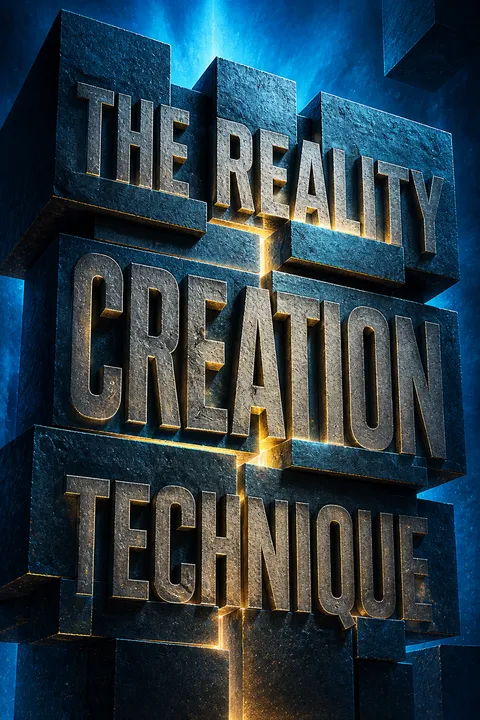


Key Takeaways
Name the reality you choose, then meet each objection without retreating.
A two-part practice. Dodson calls his method the Reality Creation Technique, or RCT: state a preferred outcome as a decision, then notice and release whatever contradicts it. He favors present-tense wording that signals choice or permission, rather than language that emphasizes wanting or postpones fulfillment. Start with an aim the mind can entertain. The book suggests testing a modest financial intention before attempting a much larger one.
Keep it deliberate. A beginner might state an intention and its objection a few times, then return to it later. Dodson recommends no more than five repetitions in a session and no more than 50 in a day, warning that constant repetition can become empty affirmation. The method is meant to combine clear direction with honest attention to inner resistance.
The method's strongest psychological move is to pair aspiration with an honest inventory of what makes it feel implausible. That resembles mental contrasting, a goal-setting approach in which a desired future is considered alongside present obstacles. The pairing can make intentions more actionable than cheerful repetition alone. The metaphysical claim that intention itself creates external events is a separate proposition, however. The practice can be useful as reflection even when treated as a way to clarify motivation and notice self-defeating assumptions, not as a guarantee of outcomes.
Treat spontaneous doubts as data, not a scavenger hunt for flaws.
Follow what appears. A counter-intention is Dodson's term for anything that arises against the chosen outcome: a doubt, memory, bodily sensation, emotion, competing preference, or urge to stop. If the intention is greater income, for instance, an objection might be disbelief, fear of losing money, or a sense of not deserving it. The response is not to manufacture more negativity by searching for hidden problems. Attend to what comes up on its own.
Enough, not perfect. Dodson says the aim is not to eliminate every doubt. He proposes that attention directed toward the preferred reality just over half the time is sufficient, and that an intention-cycle is done when objections no longer arise spontaneously or the intended result appears. This is his practical rule, not a demonstrated threshold.
This rule guards against a familiar trap in introspection: treating every passing thought as evidence of a deep defect that must be excavated. In cognitive therapy, noticing a thought without automatically believing or disputing it can reduce its grip. The book's broader framing, in which even fatigue or a smaller alternative counts as opposition, risks making the exercise overly rigid. A useful test is whether noticing an objection helps someone choose a next step, rather than making ordinary uncertainty feel like a personal failure.
Let resistance surface without turning it into another fight.
Allow the feeling. Dodson argues that pushing an unwanted thought or emotion away can keep attention fixed on it. His emotional releasing practice asks a person to notice where tension or heaviness is felt, stay with the sensation, and stop demanding that it vanish. The stated goal is to loosen resistance, not to force a particular mood.
Try a lighter touch. For a persistent objection, he also describes alternating it with the intention until the objection loses force. Mimicking a thought in an exaggerated, playful way is another option, intended to reduce its authority. These approaches are variations on the same sequence: recognize the counter-intention, give it room, and return attention to the chosen outcome. The book advises short practice for beginners rather than marathon sessions.
The distinction between feeling an emotion and obeying it is valuable. Contemporary acceptance-based therapies use similar attention to bodily experience and cognitive defusion, the skill of seeing thoughts as mental events rather than commands. Humor can also create distance from a rigid inner narrative. These techniques are not substitutes for support when distress is severe, persistent, or linked to trauma. A practice of acceptance should not become a demand to tolerate harmful conditions or to treat every painful feeling as a blockage to be cleared.
Write broad intentions lightly, without demanding when or how they arrive.
A different kind of list. In the book's second approach, soft intending means writing down preferred experiences regularly and then loosening control over which ones happen, by what route, or on what schedule. Unlike a conventional task list, an intention list is meant to direct attention toward desired outcomes rather than obligations. Dodson suggests including both modest and ambitious preferences, along with things already appreciated, so the exercise does not become a single-minded demand.
Keep it playful. A person might include the desired outcome of a necessary errand, rather than only a task to complete, or set a small intention for a calm, safe drive. The author recommends regular lists, sometimes daily for beginners and less often for experienced practitioners. He stresses that writing is not a contract with the future; expectation and neediness, in his view, undermine the soft approach.
Writing preferences can make them more salient, and regularly naming desired outcomes may help someone notice relevant opportunities that would otherwise pass unnoticed. That is a plausible attentional mechanism, distinct from the book's claim that a universal field selects and delivers results. The contrast with endless task lists is also useful: outcomes and priorities can restore meaning to routine obligations. Yet planning is not inherently opposed to ease. For complex goals, a light intention can complement concrete steps, deadlines, and feedback rather than replace them.
Use discomfort as a signal to pause and steer, not row harder.
The river as a guide. Dodson's Stream of Life metaphor pictures a person in a boat on a current. Fighting upstream represents straining against circumstances; drifting without direction represents surrendering all choice. His preferred stance is a soft steering toward a desired course, with occasional pauses to observe where the current is going. In practical terms, he treats emotional ease as a sign of alignment and discomfort as a cue to relax, reconsider a thought, or choose a more relieving next step.
Do not fight the signal. A bad feeling is not, in this model, proof that a goal is impossible. It is information to stop escalating effort blindly. The riverbank represents stepping back, as in meditation or reflection, before choosing a direction again. The metaphor encourages steering rather than either rigid control or complete passivity.
The river image makes a useful distinction between effort that advances a purpose and effort consumed by resistance. It echoes psychological flexibility: adapting behavior to context while remaining oriented toward values. Feelings can provide valuable information, but they are imperfect navigators. Anxiety may accompany a worthwhile challenge, while immediate relief can sometimes reward avoidance. The practical question is not simply whether an action feels good now, but whether it supports a considered value over time. That keeps the metaphor from turning comfort into the only measure of a sound choice.
Act from clarity, not as a frantic payment for fear.
Behavior reveals priorities. Action RCT treats behavior as a visible expression of alignment or conflict with an intention. Dodson identifies three broad kinds of aligned action: steps that move toward an outcome, actions that express qualities such as creativity or courage, and acting as if the outcome were already part of one's life. In his example of a financial intention, this could mean making time for creative work or setting a reasonable boundary, rather than behaving from panic about money.
State is not a substitute. The author recommends settling emotional resistance before acting, so effort is not merely an attempt to compensate for fear. He also says some outcomes may occur with little action, depending on a person's level of energy and focus. That claim is speculative; the more grounded lesson is to notice whether behavior serves the aim or perpetuates avoidance.
The idea that action can expose a mismatch between a stated goal and daily behavior is a strong diagnostic tool. Behavioral science often treats action as both an outcome of motivation and a source of new information about capability. The book's emphasis on acting from a better emotional state may help interrupt panic-driven overwork, but waiting to feel fully aligned can become procrastination. Many outcomes, especially health, employment, and financial security, depend on practical behaviors and external conditions. Emotional preparation works best when it enables those behaviors.
Choose goals that feel like yours, not costumes borrowed from others.
Fit matters more than prestige. Dodson uses shopping for clothes to explain the difference between what he calls soul intentions and borrowed ambitions. A garment admired on a celebrity may still feel wrong when worn; similarly, a career or lifestyle can look impressive without fitting the person pursuing it. In his analogy, an easy, genuine sense of recognition matters more than pressure from a salesperson, status label, or comparison with someone else.
Pause when choice becomes strained. The author recommends stepping away when a decision turns into exhausting analysis or an attempt to persuade oneself. He says the best choice is one that both deliberation and inner preference can accept. This is not a claim that every difficult decision is false. It is a prompt to distinguish personal interest from the desire to win approval or imitate a public image.
This account resonates with self-determination theory, which distinguishes autonomous goals from goals pursued mainly for approval or status. The clothing story makes the distinction concrete: visible appeal does not guarantee personal fit. Still, intuition is not an infallible voice from beyond social influence. Preferences are shaped by experience, access, and culture, and meaningful commitments can involve ambivalence. A useful interpretation is not to obey every immediate feeling, but to ask whether a goal remains worthwhile when applause, prestige, and comparison are removed.
Read coincidences as invitations, not laboratory evidence.
Striking matches stand out. Dodson recounts noticing a model on a billboard during a train trip and thinking that meeting her would be welcome. On the return journey, he says, she sat across from him and they spoke at length. He also describes a period of intense attention to construction vocabulary, followed by an unusual run of coaching clients whose work involved buildings or real estate. He reads both episodes as evidence that focused intention corresponds with later events.
Separate report from proof. These anecdotes show how the author interprets synchronicity: a meaningful coincidence is treated as a response from reality, even when the mechanism is unknown. They are vivid stories, not controlled tests. The account does not establish how often intentions were unmatched, how likely the encounters were, or what role ordinary attention and chance played.
The stories are memorable partly because they compress intention, attention, and surprise into a single scene. Research on selective attention and frequency illusion offers a less supernatural possibility: once a topic is salient, related events become easier to notice and recall. That explanation does not erase the personal meaning of an encounter, but it does distinguish meaning from causal evidence. The stories are strongest as invitations to observe what a person is attending to, and weakest when treated as proof that thought alone governs external events.
Analysis
The book is a compact, practice-oriented work of spiritual self-help. Its structure moves from personal will, a focused cycle of intention and resistance, to divine will, a softer practice of trusting a larger current. That two-part design is the book's central tension: readers are asked both to decide firmly and to stop forcing outcomes. The river metaphor reconciles the positions by presenting agency as steering rather than total control.
The most transferable material is psychological rather than paranormal. Naming a preferred outcome clarifies direction. Noticing spontaneous objections can expose fear, competing priorities, or assumptions that would otherwise stay vague. Allowing a feeling instead of suppressing it may reduce the attention consumed by struggle. Writing preferences can also counter the drift of a day governed entirely by other people's demands. These practices can be used without accepting the author's metaphysical explanations.
Those explanations deserve careful boundaries. The book presents attention and emotional state as causes of external events, and interprets coincidences as responses from the Universe. Its anecdotes are personal reports, not controlled evidence that intention produces an outcome independently of ordinary action, chance, or selective attention. The claim that even nonmanifestation is simply another counter-intention makes the theory difficult to test: success confirms it, while failure can be folded back into the process. That structure may encourage persistence, but it also risks self-blame when circumstances are shaped by illness, discrimination, poverty, or other people.
A grounded use of the method treats intention as a compass, not a guarantee. The reader can state what matters, notice resistance without shame, and then choose actions that fit the situation. Softening attachment may reduce needless strain; it should not mean abandoning plans, evidence, or help. The book is most useful when its spiritual language opens reflection and least reliable when it is treated as a complete account of how reality works.
Review Summary
The Reality Creation Technique receives overwhelmingly positive reviews, with readers praising its simplicity and effectiveness. Many describe it as life-changing, offering practical techniques for manifesting desires through intention-setting and awareness. Readers appreciate the book's concise nature and clear explanations, finding it superior to other self-help literature. Some highlight the concept of "soft intending" as particularly impactful. While a few reviewers found the content familiar, most recommend it highly for its actionable advice on reality creation and personal growth.
People Also Read




Glossary
Reality Creation Technique
Intention plus resistance releaseDodson's two-step practice for focusing on a preferred reality and working with objections that arise. The practitioner states an intention as a decision, notices a spontaneous counter-intention, and acknowledges or releases it before returning attention to the intended outcome. The book presents written, spoken, mental, emotional, and action-based variations.
Counter-Intention
Anything opposing an intentionDodson's term for a thought, feeling, belief, sensation, memory, action, or competing preference that conflicts with a chosen outcome. It is not limited to conscious doubt. In the technique, the practitioner responds to counter-intentions that arise spontaneously rather than searching for every possible hidden objection.
Emotional Releasing
Allowing a feeling to passA way of responding to a counter-intention by locating its felt quality in the body and allowing the sensation to be present without trying to suppress or force it away. The book describes attention, breathing, welcoming, and relaxing with the sensation as possible approaches. Its stated purpose is to loosen resistance around the emotion.
Deeper Releasing
Tracing resistance to basic wantsA practice for examining the underlying desire or resistance associated with an intention or counter-intention. Dodson proposes five recurring themes: approval and love, control, freedom, unity, and security. The practitioner identifies which theme seems relevant, feels the associated wanting or aversion, and attempts to release attention from the sense of lack.
Soft Intending
Writing preferences without pressureA less forceful approach in which a person regularly records preferred experiences, while avoiding rigid demands about how, when, or where they must occur. Lists may mix everyday and ambitious preferences with appreciation for what is already present. Dodson frames the practice as directing attention while leaving delivery to the Universe or a higher force.
Intention list
A written set of preferencesA recurring list of things a person would like to experience, be, or do, expressed in a light and non-demanding manner. Unlike a conventional task list, which emphasizes actions and obligations, an intention list is meant to clarify desired outcomes and guide attention. The book also suggests including appreciation and reasons for particular intentions.
Stream of Life
Metaphor for life's directionDodson's metaphor for the movement of life as a river carrying a boat. Paddling against the current represents struggle and resistance; drifting without any steering represents relinquishing choice. The preferred position is to relax resistance and make modest directional adjustments toward a desired course, using feelings as signals about one's perceived alignment.
Action RCT
Testing intention through behaviorThe behavioral variation of the Reality Creation Technique. Actions are considered in relation to a stated intention: they may move toward an outcome, express qualities the person values, or resemble behavior associated with already having reached the goal. Actions that conflict with the intention can be examined as visible expressions of counter-intentions.
Soul intentions
Personally authentic aimsDodson's term for goals he regards as arising from a person's authentic nature rather than from imitation, social pressure, or a desire for status and approval. He illustrates the distinction through clothing that feels genuinely one's own versus clothing chosen to copy an admired person. The concept is spiritual in the book, not a clinically defined construct.
FAQ
What's "The Reality Creation Technique" by Frederick Dodson about?
- Psycho-spiritual tool: The book introduces a technique designed to help individuals create their preferred reality through focused intention and the release of counter-intentions.
- Two-step process: The core method involves stating your intention and releasing any counter-intentions, alternating between these steps until the desired reality manifests.
- Personal and divine will: It explores reality creation through both personal will, which involves active intention, and divine will, which emphasizes allowing the universe to manifest your desires.
- Practical and mystical: The technique is presented as a comprehensive tool that covers practical aspects of life as well as mystical and spiritual dimensions.
Why should I read "The Reality Creation Technique"?
- Comprehensive approach: The book offers a single, unified technique that addresses both practical and mystical aspects of reality creation, making it a versatile tool for personal development.
- Simplicity and depth: While the technique is simple, the book provides detailed explanations, examples, and variations to deepen understanding and application.
- Empowerment: It empowers readers to take control of their reality by focusing on intentions and handling counter-intentions, leading to personal growth and fulfillment.
- Balance of effort and allowing: The book teaches the balance between actively creating reality and allowing the universe to manifest desires, offering a holistic approach to life.
What are the key takeaways of "The Reality Creation Technique"?
- Intention and counter-intention: The technique involves stating clear intentions and addressing any counter-intentions that arise, which are obstacles to manifestation.
- Decision over desire: Intentions should be framed as decisions rather than desires, as decisions imply commitment and certainty.
- Handling resistance: The book emphasizes the importance of acknowledging and releasing resistance to allow intentions to manifest.
- Divine will: It introduces the concept of divine will, where one aligns with the natural flow of life and allows the universe to fulfill intentions.
How does the Reality Creation Technique work?
- Two-step process: The technique involves stating your intention and releasing counter-intentions, alternating between these steps until the desired reality manifests.
- State your intention: Clearly articulate what you intend to manifest, using phrases like "I have," "I am," or "I allow" to convey certainty and presence.
- Release counter-intentions: Identify and release doubts, objections, and resistances that contradict your intention, acknowledging them as part of the process.
- Repeat until manifestation: Continue alternating between stating intentions and releasing counter-intentions until the reality you intended manifests.
What is the difference between personal will and divine will in the book?
- Personal will: Involves actively creating reality through focused intention and handling counter-intentions, emphasizing personal effort and decision-making.
- Divine will: Focuses on aligning with the natural flow of life, allowing the universe to manifest desires without force or resistance.
- Balance: The book suggests learning both paths to achieve a balanced approach to reality creation, combining effort with allowing.
- Stream of life analogy: Divine will is likened to going with the flow of a river, where one trusts the natural course of life to lead to the right destination.
What are counter-intentions, and how do you handle them?
- Definition: Counter-intentions are doubts, objections, resistances, and beliefs that contradict your stated intention, acting as obstacles to manifestation.
- Acknowledgment: The book advises acknowledging counter-intentions rather than resisting them, as resistance only strengthens them.
- Releasing resistance: Techniques such as emotional releasing and mimicking are suggested to release resistance and dissolve counter-intentions.
- Focus on intention: Maintain a balance between focusing on your intention and addressing counter-intentions, ensuring that the intention remains the primary focus.
How do you state an intention effectively according to the book?
- Use present tense: Frame intentions in the present tense using phrases like "I have," "I am," or "I allow" to convey certainty and presence.
- Avoid desire language: Avoid using "I want" or "I will," as these imply lack or future projection, which can hinder manifestation.
- Decision over desire: State intentions as decisions, which imply commitment and certainty, rather than mere desires or wishes.
- Specificity and realism: Start with realistic and achievable intentions, gradually moving to more advanced goals as confidence and experience grow.
What role does resistance play in the Reality Creation Technique?
- Strengthens problems: Resistance to counter-intentions or problems only strengthens them, as it focuses energy on the unwanted.
- Acknowledgment and release: The book emphasizes acknowledging resistance and releasing it to allow intentions to manifest.
- Enjoying challenges: It suggests viewing problems and challenges as stepping stones to manifestation, embracing them as part of the process.
- Art of non-resistance: Learning to release resistance is crucial in the technique, as it frees up energy and aligns one with the desired reality.
What is the "Stream of Life" analogy in the book?
- Life as a stream: Life is likened to a stream that flows naturally, and one can choose to go with the flow or resist it.
- Going with the flow: Aligning with the stream means trusting the natural course of life and allowing it to lead to the right destination.
- Paddling upstream: Resisting the flow by paddling upstream is seen as a waste of energy and slows progress.
- Soft control: The book advocates for soft control, where one gently steers in the preferred direction while allowing the stream to carry them.
How does the book suggest handling emotional releasing?
- Identify energy centers: Check for tightness, contraction, or heaviness in energy centers like the stomach, solar plexus, chest, forehead, or crown.
- Allow and release: Allow the energy to flow, open up, and release resistance, using techniques like breathing, welcoming, and relaxing.
- Synonyms for releasing: The book provides various synonyms and alternatives for releasing, such as "open up," "allow it to flow," and "let it go."
- Integration with intention: Combine emotional releasing with intention stating to enhance the effectiveness of the Reality Creation Technique.
What are some examples of intentions and counter-intentions in the book?
- Intention examples: "I allow myself to make $15,000 a month with ease," "I have a healthy and athletic body," "I am a vibrant and successful lawyer."
- Counter-intention examples: "I can't do it with ease," "I don't deserve that much," "How am I supposed to achieve that?"
- Handling counter-intentions: The book suggests acknowledging and releasing counter-intentions, viewing them as part of the process rather than obstacles.
- Balance of focus: Maintain a balance between focusing on the intention and addressing counter-intentions, ensuring the intention remains primary.
What are the best quotes from "The Reality Creation Technique" and what do they mean?
- "It's not a desire, it's a decision": This quote emphasizes the importance of framing intentions as decisions, which imply commitment and certainty, rather than mere desires or wishes.
- "Don’t make it happen, allow it to happen": This highlights the balance between effort and allowing, suggesting that one should trust the universe to manifest desires without force or resistance.
- "Everything that happens relates to your intentions": This underscores the idea that all experiences are connected to one's intentions, and that one has control over their reality through focused intention.
- "Enjoy the 'problem' as a stepping stone to manifestation": This encourages viewing challenges as opportunities for growth and manifestation, embracing them as part of the process rather than obstacles.
About the Author
Other books by Frederick Dodson




Download PDF
Download EPUB
.epub digital book format is ideal for reading ebooks on phones, tablets, and e-readers.








