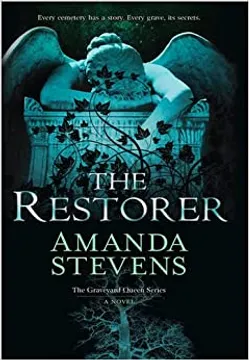


Plot Summary
Rosehill's First Rule
At nine, Amelia Gray sees a white-haired ghost in Rosehill Cemetery, where her father Caleb works as caretaker. He teaches her to avoid acknowledging the dead, stay near hallowed ground, and keep away from people who are haunted.
The rules make her childhood safer, but also give her a private world her adoptive mother cannot share. At twenty-seven, Amelia restores old Southern cemeteries and writes a popular blog about them. A viral photograph has brought her readers and money, so she celebrates with dinner in Charleston.
There she recognizes the ghost of Lincoln McCoy, a businessman who killed his family and himself. He sees her seeing him. Amelia has kept the dead at a distance for years, but the encounter signals that her carefully managed life is about to change.
The rules are both protection and inheritance: Caleb gives Amelia practical methods for surviving the dead, but also teaches her that safety depends on concealment. Her cemetery work complicates this arrangement. She tends the resting places of others while guarding herself from the spirits who might claim her attention. The contrast between her public success and private isolation matters: even her new celebrity comes from an image of a ghost she insists is only a trick of light. Her first turning point is therefore not simply supernatural contact. It is the collision between a disciplined identity and a world that refuses to remain safely unseen.
A Body at Oak Grove
After dinner, Amelia meets John Devlin, a Charleston detective followed by the ghosts of a woman and a small girl. A storm has exposed a recently murdered woman in Oak Grove Cemetery, where Amelia has been documenting graves for a restoration project. Devlin needs her photographs and expertise before police disturb old burials. On the walk to her car, a black vehicle smashes a window and steals her briefcase.
Amelia escapes being hit when the driver speeds past, and Devlin realizes the theft may be linked to the homicide. At Oak Grove, Amelia sees the victim's body and helps identify the grave's position. She sends Devlin her stored images, but the stolen case leaves her with a new fear: whoever killed the woman may know she has evidence.
The murder turns Amelia's professional knowledge into an investigative liability. Her photographs were made to preserve a cemetery's condition, yet their record of the ground may expose how a killer used it. Devlin's ghosts add a second threat to their partnership: Amelia can see what he cannot, while he reads her expertise as practical rather than paranormal. Her decision to help is not driven by sudden bravery so much as by obligations she understands, professional accuracy and a promise given. The car attack changes the terms. She is no longer an observer assisting police; someone has acted against her, making the case personal before she understands why.
The Ring in the Garden
At home, Amelia studies her cemetery photographs and notices that the headstone above the newly disturbed grave faces the wrong way. A jasmine scent and moving garden swing announce the ghost child from Devlin's side of the veil. The girl points at Amelia, then vanishes, leaving a garnet ring in the soil.
The next morning Amelia buries it beneath a heart of stones, but Caleb sees the old white-haired ghost from her childhood again at Rosehill and warns her to return the ring to its source and avoid Devlin. He also reveals the existence of the Others, presences colder and more dangerous than ordinary ghosts. Amelia hides one more secret: Devlin's presence in her office had left her inexplicably drained after he fell asleep there.
The breach of Amelia's house dismantles her clearest distinction between safe and unsafe space. Her home had been protected ground, but the ring gives the haunting a physical trace, making avoidance harder to sustain. Caleb responds by tightening the rules, yet his late disclosure of the Others suggests that his instruction has always been incomplete. Amelia's secrecy mirrors his: she keeps the ring and her bodily reaction to Devlin from her father, while he withholds the scale of the danger. Their bond remains loving, but protection has become entangled with withheld knowledge, leaving Amelia to decide which silences preserve her and which keep her helpless.
The Cemetery's Second Secret
Returning to Oak Grove, Amelia finds police searching the grounds and hears that another set of remains has surfaced. A skeletal hand protrudes from an old grave; the stone's rose and winged cherub suggest the original burial was a woman. While assessing the site, Amelia learns from Devlin about Afton Delacourt, a seventeen-year-old murdered in Oak Grove fifteen years earlier.
Her powerful family and Emerson University helped keep the case quiet. Rumors tied Afton's death to the Order of the Coffin and the Claw, an elite campus society, and to séances held by professor Rupert Shaw. Devlin says Afton died slowly in Shaw's mausoleum. Amelia begins to suspect that the new killings and the old one share more than a cemetery.
Oak Grove stops functioning as a neutral historical site and becomes an archive of deliberate erasure. The missing publicity around Afton is itself evidence: social power has shaped what the city is allowed to remember. Amelia's expertise gives her a way into the case, but it also reveals how easily interpretation can be suppressed by money and institutional reputation. Devlin's suspicion of Shaw is not proof, and Amelia knows it; the mystery depends on resisting the satisfaction of a single explanation. The cemetery's symbols invite reading, while the cover-up warns that the people controlling records may also control the story.
A Shadow Gives Chase
During the search, Amelia encounters a dark shape that rushes at her from the woods with a force unlike any ghost she has seen. She reaches Devlin, whose dead companions reappear at dusk, and tells him a private investigator named Tom Gerrity has identified the victim as Hannah Fischer.
Gerrity says Hannah fled an abusive relationship before she disappeared and urges Amelia to read the cemetery for clues. At dinner with archaeologist Temple Lee and forensic anthropologist Ethan Shaw, Amelia sees a hostile teenage ghost in a letterman jacket; a wineglass then breaks beside Temple.
Rupert Shaw offers Amelia possible explanations for the shadow, including a collective thoughtform or a misperception, but cannot account for her certainty that it pursued her.
This section enlarges the danger in two directions. Hannah's case gives the murder a human history of abuse and failed protection, while the shadow introduces a force that does not fit Amelia's established rules. The distinction matters psychologically: she can manage familiar ghosts by refusing them recognition, but she has no reliable procedure for a presence that attacks without taking recognizable form. Meanwhile, the letterman apparition and broken glass connect the supernatural unease to physical evidence. Amelia's growing reliance on interpreters such as Devlin and Rupert exposes a vulnerability of its own: when experience exceeds her framework, she must trust people whose motives she cannot yet judge.
Shani's Unfinished Goodbye
Amelia drives to the bridge where Devlin's wife and daughter drowned, then visits their graves at Chedathy Cemetery. She learns that the child ghost's family name is Shani, and meets Essie Goodwine, the girl's great-grandmother, and Essie's lively great-granddaughter Rhapsody. Essie says Shani remains near her father because he has not let her go, and warns Amelia that Devlin will face a choice between the living and the dead.
She gives Amelia an amulet and a protective herb. As Amelia changes a flat tire near dusk, the same dark presence stalks her through the trees. Devlin happens upon her, repairs the damage with her, and escorts her home. Amelia does not explain the shadow, but their shared danger deepens her attachment to him.
Chedathy gives Amelia cultural knowledge that neither her father's rules nor Rupert's theories can supply. Essie's account treats the dead not as parasites by definition, but as family members caught in unfinished bonds. That perspective unsettles Amelia's inherited fear without making the ghosts harmless. Shani's attachment to Devlin also reframes his apparent coldness: grief has left him living beside a loss he cannot consciously perceive. Amelia's rescue by Devlin intensifies the emotional danger precisely because it offers warmth and safety. Her attraction is no longer an abstract temptation; it has become entangled with a family tragedy and with the possibility that her presence could alter the dead man's bond to his past.
The Room Beneath Bedford
The delayed exhumation identifies the earlier remains as Jane Rice, a nurse missing for years. Afterward, Amelia notices flies entering a Bedford family vault and helps Devlin discover a concealed chamber and a tunnel system beneath the mausoleum. She falls through weakened brickwork, so Devlin drops down after her rather than leave her alone.
In the chamber, they find a pulley, leg irons and a skeleton chained to the wall. They follow the tunnels, passing further openings and a hidden well, then climb out beyond the cemetery. The discovery confirms that someone used Oak Grove's underground spaces to hold victims. Amelia also sees that the grave inscriptions and symbols may be deliberate messages, not merely historical decoration.
The chamber converts the cemetery's metaphorical function as an archive into a literal crime scene. What Amelia reads on stone is now matched by chains, a pulley and a hidden route beneath the ground. Her fall makes her knowledge bodily: she is no longer interpreting violence from a safe distance but trapped inside the structure that enabled it. Devlin's decision to descend after her shows care through action, while their escape establishes a fragile trust. Yet the chamber also complicates that intimacy, since the evidence suggests a repeated, organized practice rather than a single impulsive murder. The dead have been hidden in a system built to keep both bodies and history out of sight.
Camille's Stone Cracked Open
An anonymous blog comment reproduces Hannah's epitaph; after Amelia reads the newly cleared inscription on Jane Rice's grave, a second comment appears. She and Devlin connect the verses and soul-in-flight imagery to the killer's idea of release.
A third inscription on a box tomb describes a quiet death and a protected secret. Devlin accepts Amelia's reading and has the lid lifted. Inside lies Camille Ashby, the Emerson administrator who hired Amelia. Camille has been stabbed, unlike the women apparently tortured and suspended by their feet.
Her murder raises the possibility that the killer is changing his method or covering a separate secret. Devlin warns Amelia to step away from the case, but the messages have made her blog part of the killer's channel.
The epitaphs function as both clue and performance. The killer borrows the cemetery's language of mourning to cast murder as liberation, forcing Amelia to distinguish the victims' actual histories from the story their killer tells about them. Camille's body disrupts the pattern at the moment Amelia begins to understand it, keeping interpretation provisional. The blog makes the exchange especially intimate: a space built for sharing cemetery knowledge becomes a public surface the murderer can use to reach her. Devlin's request that she withdraw is protective, but it also acknowledges a troubling fact: the case now depends on a woman whose visibility is part of the danger.
A Kiss in the Sanctuary
After Camille's murder, Devlin visits Amelia's house to examine her photographs. When he falls asleep on her chaise, Amelia feels her own strength ebb as his seems to return. Later, he admits he cannot keep away, and they kiss; the emotional current between them appears to intensify the ghosts' presence rather than dispel it.
Mariama and Shani return to the garden, and a tree limb crashes through the office window as Amelia shoves Devlin clear. He withdraws for nearly two weeks. During that gap, a man calling himself Gerrity finds Amelia at a rural cemetery and asks her to question Ethan about the old skeleton. Amelia leaves unsettled, not yet realizing that the stranger is not the living investigator she thinks he is.
The kiss offers the intimacy Amelia has long avoided, but its cost is written into her body: the exchange leaves her depleted and makes the ghosts more visible. Desire therefore cannot be separated from the novel's supernatural economy of warmth, attention and attachment. The broken window is ambiguous enough to preserve uncertainty, yet it changes behavior: Devlin retreats, and Amelia is left to interpret the danger alone. The supposed Gerrity's request continues the pressure from outside their romance. His demand that she investigate Ethan turns her professional curiosity into a possible route toward a hidden history, even as the person making the request remains misidentified.
The House of Blue Paint
Amelia learns her mother Etta has breast cancer, undergoes surgery, and is beginning treatment; Caleb remains guarded about his past. At Rupert Shaw's birthday gathering, Amelia notices that Rupert's ring bears the same snake-and-talon emblem as Devlin's medallion.
Ethan explains that Devlin once studied paranormal investigation with Rupert and later begged him to open a passage to the dead after his family drowned. After the party, Amelia follows Devlin to the house he shared with Mariama.
Their encounter turns passionate, but Mariama's ghost and other hostile spirits crowd the room, and Amelia flees. The experience convinces her that she has crossed a boundary she cannot simply dismiss. Her home may keep ghosts out, but it cannot protect her from the consequences of wanting Devlin.
The chapter places two forms of inheritance beside one another. Etta's illness makes Amelia confront the limits of care in her living family, while the shared emblem and Devlin's history expose the institutional inheritance of the Order. Her pursuit of him at Mariama's house is an act of agency, but the haunting reveals how little control she has over the meanings attached to that desire. The room is not simply a romantic setting; it is saturated with Devlin's earlier life and the dead who remain bound to it. Amelia's flight marks a limit she has reached, not a clean moral resolution. She wants intimacy, but cannot accept being absorbed into someone else's grief.
The Letterman's Jacket
At the morgue, Ethan identifies the tunnel skeleton as a young man who suffered multiple stab wounds and had been dead for at least a decade. A maroon Westbury letterman jacket leads Amelia to a yearbook photograph of Clayton Masterson.
A former neighbor, Tula Mackey, recalls Clayton's sadism and the frightened boy who followed him, though she cannot name the companion. Amelia visits the real Tom Gerrity and discovers that the man who approached her was not him. His reference to Robert Fremont, a murdered police officer, helps Amelia recognize the earlier visitor as Fremont's ghost.
She then understands why he called himself Gerrity and asked her to pursue justice. The evidence turns Amelia's attention toward Daniel Meakin, the reserved Emerson historian with a concealed history of self-harm.
Identification becomes an act of reconstructing relationships, not just attaching a name to bones. The jacket links a body to a school, while Tula's memories reveal a social arrangement in which cruelty and dependence could coexist. The unnamed companion matters because he was not merely adjacent to violence; he was shaped by it. Amelia's recognition of Fremont also marks a boundary in her own expertise. She has mistaken a dead investigator for a living one because his need for justice resembled the ordinary human request she expected. Her growing ability to read signs does not make her infallible. It makes her responsible for revising her assumptions before someone else pays for them.
The Tunnel Takes Its Prisoner
Daniel Meakin enters Amelia's house, drugs her tea and carries her into the tunnels beneath Oak Grove. He admits he killed Clayton, whose ghost has remained bound to him and compelled him to murder women.
Meakin claims he chose victims he believed needed release, but confesses that he killed Camille to protect himself and plans to make Clayton attach to Amelia before ending his own life. Left behind a sealed wall, Amelia finds a hidden passage by following a fly into the next chamber. Shani and Robert Fremont guide her through the tunnels until she reaches the well.
Meakin drags her back and cuts her arm, but Devlin arrives and shoots him as he raises the knife. Meakin dies still bound to Clayton; dark figures engulf the pair, while Amelia survives and understands that they came for him, not her.
Meakin's confession exposes the difference between explaining violence and excusing it. He has built a moral story around release, but his own account admits both deliberate killing and a willingness to sacrifice Amelia for his escape. Clayton's ghost may intensify his compulsion, yet Meakin still chooses concealment and turns Amelia into a proposed substitute. Her escape depends on accepting help from the dead without surrendering her own judgment. Shani and Fremont offer guidance, not rescue by force; Amelia must move through the passages herself. Devlin's gunshot ends the immediate threat, but the final image of the shadow figures suggests that whatever governs the dead has not been mastered.
Epilogue
Recovering in Trinity, Amelia finally returns Shani's garnet ring to the heart at Chedathy Cemetery. Devlin meets her there and asks why she fled his house, but she cannot yet explain what she saw. She leaves him with Mariama and Shani beside him, still haunted and grieving, while their relationship remains unfinished.
Amelia drives away knowing that Caleb's secrets are still waiting and that another hidden grave may soon draw her back into the work. The ring has been returned, but the ties among the living, the dead and the truths families bury remain unsettled.
The ending offers an act of restitution rather than closure. Amelia returns the ring to Shani's grave, answering the child's attempt to reach her without pretending that the gesture releases either ghost. Her brief meeting with Devlin preserves desire while refusing premature intimacy; she recognizes that attraction cannot resolve his grief or her fear. The final reference to Caleb's secrets shifts the unresolved pressure from the supernatural case to Amelia's family history. The book closes its immediate murder investigation but leaves its deeper pattern intact: restoration can recover what has been hidden, yet it cannot guarantee that the recovered truth will be easy to live with.
Analysis
The Restorer makes preservation an investigative method. Amelia's work begins with the assumption that a grave can be understood through careful observation: its orientation, inscription, material and relation to neighboring plots. Oak Grove turns that craft into a confrontation with people who have tried to erase evidence. The cemetery is not simply a gothic setting; it is a contested archive where powerful families, a university and a murderer have each shaped what remains visible. Amelia's attention restores not only stones but relationships among events that official records have separated.
The novel's supernatural rules are also psychological rules. Caleb teaches Amelia that acknowledgment can invite the dead to feed on her warmth, so self-protection becomes a habit of withholding attention. That habit resembles the larger culture of silence around Afton Delacourt and Emerson's elite society. In both cases, safety is purchased by not looking directly at what is dangerous. Amelia's growth comes through learning to distinguish acknowledgment from surrender: she can recognize a ghost, listen to a witness and still retain her judgment.
The murderer's language of liberation is the book's sharpest moral problem. He frames killing as release from pain, abuse or secrecy, borrowing the comforting symbols of feathers, sleep and eternal rest. The rhetoric does not make his violence merciful; it reveals how easily a person can turn compassion into an alibi when he controls the definition of another person's suffering. Meakin's history complicates culpability through coercion and haunting, but the story refuses to let supernatural influence erase his choices. His actions expose the danger of claiming authority over who deserves release.
Amelia and Devlin's romance follows the same tension. Both are drawn toward intimacy, but grief, ghosts and unequal knowledge make closeness volatile. Devlin cannot see the spirits that shape his daily life, while Amelia sees them and must decide when to speak. The ending therefore offers no simple cure for haunting or loneliness. It offers a more demanding form of care: returning what can be returned, naming what has been hidden, and accepting that love cannot make the dead disappear.
Review Summary
The Restorer captivates most readers with its atmospheric Southern Gothic setting, compelling ghost mythology, and intricate murder mystery set in Charleston's historic cemeteries. Protagonist Amelia Gray, a cemetery restorer who sees ghosts, earns widespread praise for her relatability and restraint. The slow-burn romance with detective John Devlin divides readers—some find it deliciously tense, others frustratingly one-sided. Stevens's lyrical, evocative prose and masterful atmosphere-building draw consistent acclaim. Common criticisms include a rushed ending, unresolved plot threads, and repetitive internal monologue. Most readers eagerly continue the series despite reservations.
People Also Read
Characters
Amelia Gray
Cemetery-restoring mediumAmelia is a trained archaeologist and cemetery restorer who can see ghosts, a gift she has learned to conceal by following her father's rules. Work gives her structure, purpose and a way to honor people whose graves have been neglected. Her popular blog brings recognition, but her private life remains narrow, shaped by caution and solitude. She is observant and methodical, especially when reading cemetery layouts and gravestone imagery, yet her curiosity and attraction to Devlin test the discipline that has kept her safe. Her central tension is not simply whether to trust the dead, but whether she can form connections without surrendering her judgment.
John Devlin
Haunted homicide detectiveDevlin is a Charleston detective from a prominent family who rejected the expected career in law for police work. He is controlled, persistent and accustomed to carrying difficult cases without inviting help. The ghosts of his wife and daughter accompany him, though he cannot see them, and his grief has made him wary of attachment. Amelia's expertise gives him access to clues he cannot interpret alone, while her presence unsettles his guarded habits. His protective instincts are real, but they coexist with a tendency to withhold information and decide what others should be allowed to know.
Daniel Meakin
Reserved campus historianMeakin is an Emerson historian whose knowledge of Charleston's records and old cemeteries makes him a useful contact for Amelia. He is bookish, self-effacing and uncomfortable when discussion turns toward the university's buried history. He prefers research to public attention and speaks with a careful reserve that can seem like modesty or evasion. His relationship to the Order and to the school's past is difficult to read from the outside. Meakin represents the danger of treating institutional silence as neutrality: a quiet scholar may know more than he is willing to share.
Caleb Gray
Keeper of ghostly rulesCaleb, whom Amelia calls Papa, is a cemetery caretaker from the mountains of North Carolina. He taught her how to avoid spirits and seek out protected ground, using rules as a form of parental care. His manner is gentle but guarded, and the distance between him and Amelia grows as he keeps parts of his knowledge to himself. He understands the dead through experience rather than theory, though even his understanding has limits. His protectiveness is shaped by fear, and his silences leave Amelia uncertain whether he is shielding her or preparing her for something he cannot yet name.
Etta Gray
Amelia's guarded motherEtta is Amelia's adoptive mother, a Charleston native with deep ties to local family and social traditions. She is composed, practical and capable of facing difficult news without surrendering her dignity. Her closeness with her sister Lynrose contrasts with the emotional reserve she shares with Amelia, partly because the family has kept important matters unspoken. Etta loves her daughter, but her silences have left Amelia wondering how fully she is understood. She offers a portrait of strength that does not erase vulnerability, especially when illness forces the family to confront what it has postponed.
Mariama Devlin
Gullah-rooted family spiritMariama is Devlin's late wife, a woman of Gullah heritage whose spiritual beliefs include protective charms and respect for the power of the dead. She was passionate, charismatic and emotionally forceful, qualities that drew Devlin toward her and sometimes tested his self-control. Her presence in the story is tied to the family life he has lost and the beliefs he once treated as charming. Amelia experiences her as beautiful and unsettling, a figure whose gaze carries both intimacy and warning.
Shani Devlin
A child's lingering presenceShani, whose formal name is Anyika, is Devlin and Mariama's young daughter. Her ghost appears gentle and persistent, often clinging to her father's side or reaching toward Amelia. The family name Shani means a private, affectionate bond, and that intimacy shapes Amelia's response to her. Shani is not merely a supernatural clue: her presence makes visible the grief Devlin cannot articulate and the family connection he has not consciously released. Her attempts to communicate give the dead a voice without making their needs easy for the living to interpret.
Rupert Shaw
Parapsychology scholarRupert runs the Charleston Institute for Parapsychology Studies and has spent much of his career investigating claims about death and the afterlife. He is courteous, learned and eccentric, with a reputation that has been complicated by old rumors from Emerson. His theories offer Amelia possible frameworks for the strange entities she encounters, but he does not treat every paranormal account as proven. The tension between skepticism and belief defines his work. Amelia's trust in his kindness sits beside questions about his past and the costs of turning grief into research.
Ethan Shaw
Forensic anthropologistEthan is a forensic anthropologist and Rupert Shaw's son. He examines the remains recovered at Oak Grove and helps establish age, sex, injuries and possible identities. His easy manner contrasts with Devlin's reserve, but he is also a careful professional who understands the human cost of the investigation. He has a history of friendship with Devlin and carries concern for the detective's well-being. Ethan's loyalty makes him willing to speak candidly with Amelia, though he is wary of turning a friend's private grief into casual conversation.
Temple Lee
Archaeologist and mentorTemple is a state archaeologist who once employed Amelia and remains one of her closest professional contacts. She is witty, blunt and socially confident, with a taste for teasing that can puncture Amelia's reserve. Her knowledge of excavation and human remains makes her valuable in the Oak Grove investigation. Temple also carries complicated memories of Emerson, including an intense former relationship with Camille Ashby. Her directness often helps Amelia see her own avoidance, although Temple's certainty can sometimes make her dismissive of risks she does not personally share.
Camille Ashby
Emerson's influential administratorCamille oversees Amelia's Oak Grove restoration contract and moves easily among Emerson's trustees, preservationists and alumni. She is polished, ambitious and acutely aware of reputation, particularly the university's public image. Her earlier relationship with Temple left a history of intimacy and conflict that neither woman discusses lightly. Camille's reserve makes her difficult for Amelia to read, while her authority over the project gives her practical influence over Amelia's livelihood. She embodies the pressure exerted by institutions that value decorum and legacy.
Essie Goodwine
Chedathy's root doctorEssie is Mariama's great-grandmother and a respected root doctor in the Gullah community. She reads the relationship between the living and the dead through inherited practices, family knowledge and protective remedies. Her manner is commanding, and she expects younger people to listen even when they resist. Essie offers Amelia an alternative to Caleb's rigid rules, interpreting spirits as part of kinship rather than only as predators. Her warnings are precise but not complete, leaving Amelia to determine what to do with knowledge that arrives through ritual and intuition.
Rhapsody Goodwine
Essie's spirited helperRhapsody is Essie's great-granddaughter, a bright, talkative girl staying with her during the summer. She moves easily between ordinary childhood games and the family's spiritual traditions, and she is proud of the role she may inherit. Her playfulness lightens Amelia's visit to Chedathy, while her matter-of-fact belief in her grandmother's abilities makes the supernatural feel like part of daily life.
Tom Gerrity
Disgraced private investigatorGerrity is a former police officer turned private investigator who once worked on a case involving another officer's death. His reputation with the department is damaged, and Devlin distrusts him. The figure who approaches Amelia under Gerrity's name gives her a lead on Hannah Fischer and urges her to connect the murders through cemetery knowledge. The real investigator is more guarded and suspicious than the stranger Amelia initially encounters, making the name itself a source of uncertainty.
Robert Fremont
Name from a police caseFremont was a police officer whose death remains tied to Gerrity's troubled past. Amelia encounters his name through a conversation about an old grave, then begins to understand that unresolved cases can persist in forms the living do not expect. His connection to the investigation draws on the story's larger concern with justice that has been delayed or denied.
Hannah Fischer
Missing young womanHannah is a young woman who fled a dangerous relationship and disappeared before her body was found at Oak Grove. Her mother turns to Gerrity for help locating her. The secrecy around Hannah's relationship and her attempt to protect her mother from danger give the investigation a personal history beyond the crime scene.
Afton Delacourt
Emerson's silenced victimAfton was a seventeen-year-old whose death in Oak Grove became the subject of rumors and a powerful effort to suppress public scrutiny. Her family's standing and Emerson's reputation shaped what could be said about her. The case provides the historical shadow against which the newer murders are examined.
Jane Rice
Missing emergency nurseJane was an emergency-room nurse who disappeared years before Amelia joined the Oak Grove project. Her remains are discovered in an old grave, and forensic examination shows that she had survived a serious accident before her death. Her story helps reveal that the cemetery's hidden history spans far longer than the most recent murder.
Clayton Masterson
Westbury's violent studentClayton attended Westbury High School and is remembered by former neighbors as a physically imposing, cruel young man. A letterman jacket helps Amelia connect the skeleton beneath Oak Grove to his school years. His history introduces the possibility that violence can be learned, imposed and carried forward through relationships.
Macon Dawes
Amelia's medical-student neighborMacon rents the upstairs apartment in Amelia's house and works punishing shifts as a medical student. Their paths rarely cross, so his irregular schedule makes him a familiar but distant presence. He provides Amelia with a neighborly connection and, through the divided building, an unusual point of access to the house.
Tula Mackey
Westbury's observant neighborTula is a former neighbor of Clayton's family and remembers the fear he created in her community. Her recollections of cruelty toward animals and an isolated boy give Amelia crucial context about Westbury's past. She is outspoken, hospitable and difficult to hurry, a local witness whose everyday memories preserve what official records may omit.
Plot Devices
Caleb's Rules
Protection through restraintCaleb's rules teach Amelia not to acknowledge ghosts, to remain near hallowed ground and to avoid people who are haunted. They make the supernatural legible as a set of practical hazards, allowing her to manage a gift she cannot explain. Each new breach tests whether those rules protect her or merely limit what she is willing to know. Their authority is also complicated by Caleb's own silences, since Amelia eventually learns that he has withheld information about dangers beyond the ordinary ghosts she sees.
Gravestone Inscriptions
The killer's coded languageAmelia reads the symbols, orientations and epitaphs of Oak Grove as both historical evidence and a possible message from the killer. Feathers, winged figures and burial verses suggest a private idea of souls being released from earthly suffering. Anonymous posts to her cemetery blog reproduce inscriptions before the police understand their relevance. The device joins Amelia's professional skill to the investigation while exposing her publicly as the person who can decipher the clues. It also reveals how the killer disguises violence as mercy.
Hallowed Ground
A shifting supernatural boundaryCertain natural places and old cemetery grounds offer Amelia protection from ghosts, while twilight and other thresholds leave her more exposed. Her home has felt safe because of the ground beneath it, yet Shani's appearance shows that the boundary is not absolute. The idea of hallowed ground makes safety spatial and temporary rather than guaranteed. It also gives emotional weight to Amelia's work: she understands cemeteries as places of rest, even as Oak Grove reveals that human violence can turn a burial ground into a trap.
Oak Grove Tunnels
A hidden crime systemA family mausoleum conceals a chamber, pulley, chains and tunnels that connect to a well beyond the cemetery. Flies lead Amelia and Devlin to the first opening, and the underground passages explain how victims could be hidden from people aboveground. The tunnels also link the present investigation to a much older history beneath Emerson's polished surface. Their maze-like structure turns the final danger into a physical ordeal, forcing Amelia to navigate darkness, sealed walls and the remains of earlier violence.
The Ghostly Exchange
Desire with a costAmelia's gift lets her see spirits that Devlin cannot perceive, including his wife and daughter. The ghosts are drawn to warmth and human energy, while Amelia's encounters with Devlin leave her feeling physically weakened and emotionally exposed. Their attraction seems to intensify the exchange rather than neutralize it. This device makes romance inseparable from risk: intimacy can offer comfort, but it also opens Amelia to presences and histories she cannot control. Ghosts become not only evidence of loss but active pressures on the living.
Download PDF
Download EPUB
.epub digital book format is ideal for reading ebooks on phones, tablets, and e-readers.








