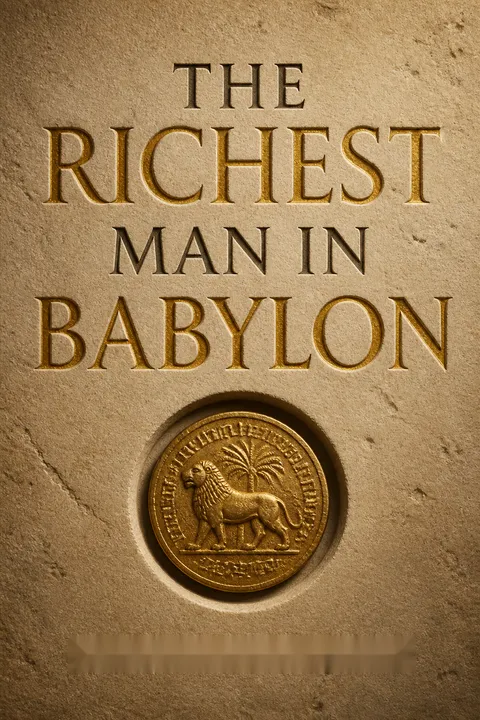


Key Takeaways
Keep a fixed share of every paycheck before the world spends it.
Start with the stream you have. Bansir, a skilled chariot maker, and Kobbi, a musician, work hard in wealthy Babylon but have no savings. Their friend Arkad explains that effort alone will not create wealth if every coin is spent. As a young scribe, Arkad learned to reserve at least one-tenth of his earnings before paying for other things. He found he could still manage on the remainder, and the savings gave him a base to build from.
Consistency beats a grand start. Arkad first lost his savings by trusting a brickmaker to buy jewels, then began saving again. The lesson is not that every household can immediately set aside ten percent. It is that saving should become a planned, regular claim on income, scaled to real circumstances, rather than whatever happens to remain.
What's striking is the order of operations: saving becomes a standing expense to the future self, not a leftover. Behavioral economics calls the underlying problem present bias, the tendency to value an immediate reward more than a distant one. Automatic transfers can make the book's principle easier to follow by removing repeated decisions. Still, a fixed percentage is not equally feasible for everyone. Low wages, debt, unstable work, and urgent needs can leave no surplus. The useful standard is a sustainable habit, not shame over failing to hit a particular number.
Use a budget to protect priorities from desires that expand with income.
Needs have elastic borders. Arkad observes that people often treat their whole income as necessary spending. When income rises, wants tend to fill the new space. His remedy is to list expenses, identify what genuinely supports household needs and worthwhile pleasures, and limit spending so savings remain untouched. A budget is not meant to eliminate enjoyment. It is meant to make choices visible and keep casual purchases from crowding out more important goals.
Spend deliberately, not blindly. Arkad compares unmanaged wants to weeds spreading wherever they find room. His students are told to judge each expense by the value it brings, then adjust their plan as needed. The point is not to copy a fixed lifestyle or follow a perfect spreadsheet. It is to decide in advance what money must do, instead of discovering at month's end that it has vanished.
A budget is most useful as a feedback tool, not a moral scorecard. In control theory, a system can only be steered when its actual behavior is observable; tracking spending makes the gap between intention and reality visible. That visibility can also expose expenses a person cannot easily change, such as housing or medical costs. The book's confidence that people can simply trim wants risks understating these constraints. A workable budget distinguishes discretionary choices from structural pressures, then directs whatever flexibility exists toward the household's chosen priorities.
Put savings to work, then reinvest what they earn.
Coins need a job. Arkad says that money left idle in a purse does not produce more money. His early productive investment was a loan to Aggar, a shieldmaker who needed funds to buy bronze. Aggar repaid the loan with a return, and Arkad reinvested that return instead of spending it. In the book's metaphor, saved money becomes a workforce whose output can itself produce more output.
Time amplifies small beginnings. A separate parable describes a farmer setting aside silver for his son. Left with a moneylender and allowed to grow through compound returns, the original ten pieces are said to become 167 over fifty years. The precise example belongs to the story, but its principle is clear: reinvestment gives growth more time to build. Returns are never guaranteed, and the book's illustration should not be mistaken for a modern forecast.
The compounding idea connects a small present sacrifice to a larger future capacity, which is why time matters as much as the initial sum. Reinvested returns can grow on top of earlier returns, but this arithmetic does not remove risk, fees, inflation, or interruptions. Nor does it make every investment productive. The key distinction is between money stored and money assigned to a sound purpose. Modern readers also benefit from treating expected growth as uncertain, rather than using a parable's neat trajectory as a promise about any real asset.
Choose investments you understand, and reject returns that sound impossible.
Protect the principal first. Arkad's first investment failed when he gave savings to a brickmaker who claimed he could purchase valuable jewels. The brickmaker knew bricks, not gems, and returned with worthless glass. The story anchors the book's Five Laws of Gold, a set of rules about saving regularly, putting money to productive use, protecting it through informed judgment, avoiding unfamiliar ventures, and refusing fantastic promises.
Ask who can judge the risk. Arkad recommends seeking guidance from people experienced in the specific kind of investment under consideration. The point is not that experts are infallible; it is that confidence and a persuasive story are not substitutes for relevant knowledge. He favors a fair, dependable return over a dramatic promise that could erase the original savings.
This is a durable warning against confusing a vivid opportunity with a credible one. Expertise is domain-specific: the person who knows a trade may not know how to assess a different market, just as Arkad's brickmaker could not authenticate jewels. Modern due diligence adds questions about incentives, fees, liquidity, and independent verification. Advice itself can be conflicted, so the label expert is not enough. The deeper lesson is to understand how an investment is meant to create value and what conditions could cause the loss of principal.
Use assets to secure your future household, not just today's comfort.
Plan beyond the working years. Arkad urges people to prepare for old age and for a family's needs if its main earner dies. He suggests long-term savings and productive property rather than hiding money where it can be stolen. He also recommends owning a home when it is affordable, arguing that a stable residence can reduce ongoing costs and give a family useful space. The central idea is to make present resources support future security.
Protection takes several forms. In the story of Babylon's siege, citizens depend on the city's walls to keep enemies out. Arkad uses that image to explain the value of financial defenses, including savings, dependable investments, and provision for dependents. The book even imagines a system of regular payments that would protect a family after a death, anticipating the logic of insurance without describing a modern policy.
The strongest idea here is not that every household should buy a home, but that future vulnerability deserves a place in present planning. Risk management asks what could cause severe harm and how to limit the damage before it occurs. Savings, insurance, and diversified assets can play different roles in that defense. Homeownership, however, is not automatically profitable: maintenance, debt costs, local prices, and mobility all matter. A home can be a source of stability, but the book's recommendation works best as a context-dependent option, not a universal rule.
Give creditors a steady share instead of fleeing your debts.
Replace avoidance with a schedule. Dabasir, a camel trader, once spent beyond his means, borrowed from friends, and fled Babylon rather than face his creditors. After falling into slavery, he resolves to return and repay them. His plan assigns one-tenth of his income to savings, seven-tenths to living costs, and two-tenths to debts. He lists each creditor, explains what he can realistically pay, and distributes payments fairly. Over time, he clears his debts and rebuilds his reputation.
A small plan can restore agency. Dabasir's approach does not make his obligations disappear, and some creditors remain angry. But regular payments show that he is addressing the problem rather than hiding from it. A later letter in the book's clay-tablet story describes a couple adapting the same proportions to their own income and negotiating with creditors. The essential move is an honest, sustainable repayment plan.
Debt can narrow attention until avoidance feels like relief, even when it makes the problem harder to solve. A written plan changes an amorphous burden into a sequence of obligations that can be discussed and tracked. Dabasir's example also highlights the social dimension of repayment: trust is repaired through repeated behavior, not declarations. Yet the exact 10/70/20 split is a story's template, not a universal prescription. Interest rates, legal protections, essential expenses, and creditor terms differ. A feasible plan may require negotiation or qualified financial advice.
Increase your earning power by becoming more useful at work.
Choose a concrete next step. Arkad tells his students that wanting to be rich is too vague to guide action. A specific aim, such as earning a defined additional amount, gives someone a problem to solve. When Arkad worked as a scribe, he noticed that others completed more work and earned more. He improved his concentration, persistence, and skill, and his increased output was recognized.
Work can build capability. In another story, Sharru Nada recalls meeting Megiddo, a farmer enslaved through misfortune. Megiddo treats careful work as a way to become valuable and improve his position. Sharru Nada later gains freedom through his own effort and commercial initiative. These stories argue that skill and reliability can widen opportunity. They should not be read as proof that every hardship is deserved or that effort alone can overcome every barrier.
The connection between skill and earning reflects human-capital theory: knowledge and practiced ability can increase the value someone offers in a market. Arkad's example is strongest when read as an invitation to improve a specific capability, rather than merely work longer or harder. The stories also risk making economic success appear entirely individual. Access to training, fair pay, health, discrimination, and the availability of good work shape what effort can achieve. A useful application pairs personal development with clear-eyed attention to the conditions under which that development is rewarded.
Treat luck as an opening to act, not a winning ticket.
Preparation makes opportunity usable. At Arkad's Temple of Learning, listeners debate whether good fortune comes from games of chance. Arkad argues that a game structured to favor its keeper is a poor path to lasting wealth. He instead points to two men who miss promising business opportunities: a merchant delays joining a land venture, and an animal buyer refuses a favorable flock purchase until morning. Both later regret their hesitation.
Speed is not the same as recklessness. The stories portray opportunity as something that can pass while a person postpones a decision. But the Five Laws of Gold also warn against unfamiliar investments and impossible returns. Taken together, the advice is not to leap at every offer. It is to build enough knowledge to recognize a sound opportunity, then avoid letting needless delay defeat a well-considered choice.
The chapter turns luck from a mystical force into a question of exposure and readiness: people cannot control every chance, but their preparation affects whether they can respond. This resembles the distinction between risk and uncertainty. Some outcomes can be evaluated with evidence; others remain unpredictable. The warning against procrastination is valuable, though urgency is also a common sales tactic. A disciplined person needs both a threshold for acting and time to verify a decision. Prepared action is not impulsivity; it is timely judgment after enough scrutiny.
Search nearby for value by noticing needs others overlook.
Opportunity can be local. The bonus essay, Russell H. Conwell's Acres of Diamonds, tells of Al Hafed, a farmer who sells his land to search far away for diamonds. After he dies, a successor finds gems in the stream on the property he left. Conwell uses the story to argue that people can overlook valuable possibilities close to home.
Look for a real need. The lecture adds examples of people who notice unmet demand and make something useful: a merchant asks customers what they want before buying stock, while an inventor sees a practical problem and develops a product. The lesson is not that every backyard conceals a fortune. It is that careful attention to local skills, resources, and problems can reveal opportunities more reliably than romantic fantasies of wealth elsewhere.
The most useful version of the diamond metaphor is not stay where you are, but investigate what your surroundings actually contain. Entrepreneurship research often describes opportunity as a fit between a need, a resource, and a workable solution. Conwell's customer-focused examples make that fit concrete: observe demand before committing capital. The story can also be misread as a promise that success is always nearby. Some places offer few viable paths, and relocation can be rational. The principle is to search with curiosity before assuming that distance itself creates value.
Build financial walls before shocks can reach your household.
Babylon's wealth was engineered. The opening sketch describes a city in a dry valley with limited natural resources. Its people used dams and canals to direct river water onto farmland, creating abundance through organized effort rather than favorable geography alone. The book presents Babylon as a model of wealth built through practical systems.
Defense matters as much as growth. In a separate siege story, the city's walls protect residents while the army fights outside. The author compares those walls to financial safeguards against sudden trouble. Applied to household finances, the image means preparing before a crisis through savings, dependable investments, and support for dependents. The point is not that any plan can prevent every loss. It is that a household with no reserves or protection is more exposed when income, health, or family circumstances change.
The Babylonian setting gives the financial advice a useful civic dimension: prosperity depends not only on individual thrift but also on infrastructure that makes work productive and protects what people build. In modern terms, households rely on public systems, stable institutions, and functioning markets as well as private reserves. That dependence complicates the book's emphasis on individual discipline. Personal preparation matters, but it cannot replace social insurance or reliable public services. The strongest reading combines household-level safeguards with recognition that resilience is partly collective.
Analysis
The book's lasting strength is its teaching method. Rather than present a technical manual, Clason turns financial habits into portable scenes: a scribe learns to save, a merchant misses an opportunity, and a debtor returns home with a repayment plan. The ancient setting makes ordinary choices feel memorable, while the repeated movement from mistake to correction gives the advice a narrative shape. Across the parables, wealth is not a windfall but a process: reserve part of income, control spending, put capital to work, protect it, prepare for dependence, and improve the ability to earn.
Its central model is accessible because it begins with behavior a reader can observe. The purse, the debt list, and the investment decision are concrete. The book also resists the seductive idea that luck or inheritance reliably substitutes for judgment. Its account of opportunity is particularly useful when paired with caution: preparation matters, but so does knowing when a tempting offer is poorly understood.
The limits are equally important. The stories often treat prosperity as the outcome of individual discipline, giving less attention to low wages, unequal access to capital, economic shocks, or the institutions that shape opportunity. The advice to save a fixed fraction assumes some surplus exists. Homeownership and lending are presented as broadly attractive, although their risks depend on circumstances. The book's examples should therefore be read as principles, not guaranteed formulas or current financial instructions.
The appended Acres of Diamonds broadens the theme from managing money to recognizing local value. Its claim that opportunity may be nearby complements the Babylon stories, but it does not erase the possibility that people need to move, retrain, or seek structural change. Taken together, the works offer a disciplined orientation: create a margin, learn before investing, notice practical needs, and act with purpose, while judging each recommendation against real constraints.
Review Summary
The Richest Man in Babylon receives mostly positive reviews for its simple yet timeless financial advice presented through engaging parables set in ancient Babylon. Readers appreciate its accessible approach to teaching basic money management principles like saving, investing wisely, and living below one's means. Some critics find the language dated and the advice repetitive, but many still recommend it as an excellent introduction to personal finance, especially for young adults. The book's enduring popularity is attributed to its practical wisdom and storytelling format.
People Also Read








Glossary
Seven Cures for a Lean Purse
wealth-building principlesA seven-part set of recommendations taught by Arkad: save a regular share of earnings, control spending, invest savings productively, protect against loss, consider owning a home, prepare income for old age and family needs, and improve earning ability. The framework links everyday money habits to long-term financial security.
Five Laws of Gold
rules for handling wealthA five-part guide to accumulating and protecting money. It emphasizes regular saving, putting savings to productive use, cautious investment, avoiding ventures outside one's understanding, and rejecting implausible returns or schemes. In the story, Arkad gives the principles to his son as a form of wisdom more valuable than a starting gift of gold.
Acres of Diamonds
local opportunity metaphorRussell H. Conwell's lecture, included as bonus material in this edition, uses a farmer's search for distant diamonds and their discovery on his former land to argue that valuable opportunities may exist close at hand. The essay also urges readers to identify practical needs and create value by meeting them.
FAQ
What's "The Richest Man in Babylon" about?
- Timeless financial wisdom: "The Richest Man in Babylon" by George S. Clason is a collection of parables set in ancient Babylon, offering timeless financial advice.
- Wealth-building principles: The book focuses on wealth-building principles through stories of characters like Arkad, the richest man in Babylon, and others.
- Practical financial lessons: It provides practical lessons on saving, investing, and managing money, using engaging narratives to convey its messages.
- Historical context: The book also gives a glimpse into the historical and cultural context of ancient Babylon, enhancing the storytelling.
Why should I read "The Richest Man in Babylon"?
- Proven financial strategies: The book offers proven financial strategies that have helped countless readers achieve financial success over the years.
- Engaging storytelling: Its parables make complex financial concepts easy to understand and apply in real life.
- Timeless advice: The advice is timeless and applicable to modern financial challenges, making it relevant for today's readers.
- Inspiration for financial growth: It inspires readers to take control of their financial future and build wealth through discipline and smart decision-making.
What are the key takeaways of "The Richest Man in Babylon"?
- Pay yourself first: The book emphasizes the importance of saving at least 10% of your income before spending on anything else.
- Control your expenses: It advises controlling expenditures to ensure you live within your means and can save consistently.
- Invest wisely: The book highlights the importance of making your money work for you through wise investments.
- Seek financial advice: It encourages seeking advice from those experienced in handling money to avoid financial pitfalls.
What are the "Seven Cures for a Lean Purse" in "The Richest Man in Babylon"?
- Start thy purse to fattening: Save at least 10% of your income.
- Control thy expenditures: Live within your means and budget wisely.
- Make thy gold multiply: Invest your savings to generate more income.
- Guard thy treasures from loss: Protect your investments from risky ventures.
- Make of thy dwelling a profitable investment: Own your home to reduce living costs.
- Insure a future income: Plan for retirement and future financial security.
- Increase thy ability to earn: Continuously improve your skills and earning potential.
What are the "Five Laws of Gold" in "The Richest Man in Babylon"?
- First Law: Save at least 10% of your earnings to build wealth.
- Second Law: Invest your savings wisely to generate more income.
- Third Law: Seek advice from experienced individuals before investing.
- Fourth Law: Avoid investments in unfamiliar or risky ventures.
- Fifth Law: Be wary of schemes promising unrealistic returns.
Who is Arkad in "The Richest Man in Babylon"?
- Richest man in Babylon: Arkad is the central character known as the richest man in Babylon.
- Wise teacher: He shares his financial wisdom and experiences with others, teaching them how to build wealth.
- Parable protagonist: Through his story, the book illustrates key financial principles and strategies.
- Role model: Arkad serves as a role model for financial success, demonstrating the power of discipline and smart money management.
How does "The Richest Man in Babylon" use parables to teach financial lessons?
- Engaging narratives: The book uses engaging parables set in ancient Babylon to convey financial lessons.
- Relatable characters: Characters like Arkad, Bansir, and Kobbi make the lessons relatable and memorable.
- Moral lessons: Each parable concludes with a moral lesson that reinforces the financial principles discussed.
- Timeless appeal: The use of parables gives the book a timeless appeal, making its lessons easy to understand and apply.
What is the significance of "Acres of Diamonds" in the bonus material?
- Inspirational lecture: "Acres of Diamonds" is an inspirational lecture by Russell H. Conwell included as bonus material.
- Central theme: The central theme is that opportunities for wealth and success are often found in one's own backyard.
- Self-discovery: It encourages readers to recognize and utilize their existing resources and talents.
- Legacy of success: The lecture has inspired millions and emphasizes the potential for success within each individual.
What are the best quotes from "The Richest Man in Babylon" and what do they mean?
- "Pay yourself first." This quote emphasizes the importance of saving a portion of your income before spending on anything else.
- "Wealth, like a tree, grows from a tiny seed." It highlights the idea that small, consistent savings can grow into significant wealth over time.
- "Gold flees the man who would force it to impossible earnings." This warns against chasing unrealistic investment returns and the risks involved.
- "A part of all you earn is yours to keep." It underscores the principle of saving a portion of your income to build financial security.
How does "The Richest Man in Babylon" address the concept of luck in wealth-building?
- Goddess of Good Luck: The book introduces the concept of the Goddess of Good Luck, emphasizing that luck favors those who take action.
- Opportunity and preparation: It suggests that good luck often comes to those who are prepared and seize opportunities.
- Action over chance: The book encourages readers to focus on actions and decisions rather than relying solely on luck.
- Consistent effort: It highlights the importance of consistent effort and smart decision-making in attracting good fortune.
What role does discipline play in the financial advice given in "The Richest Man in Babylon"?
- Foundation of success: Discipline is portrayed as the foundation of financial success throughout the book.
- Consistent saving: It emphasizes the need for disciplined saving habits to build wealth over time.
- Controlled spending: Discipline in controlling expenses is crucial to living within one's means and saving effectively.
- Long-term focus: The book encourages a disciplined, long-term approach to investing and wealth-building.
How can "The Richest Man in Babylon" be applied to modern financial challenges?
- Timeless principles: The book's principles of saving, investing, and managing money are timeless and applicable to modern financial challenges.
- Budgeting and saving: It provides practical advice on budgeting and saving, which are relevant in today's economic environment.
- Investment strategies: The book's investment strategies can guide readers in making informed financial decisions.
- Financial literacy: It promotes financial literacy and encourages readers to seek knowledge and advice to navigate modern financial complexities.
About the Author
Download PDF
Download EPUB
.epub digital book format is ideal for reading ebooks on phones, tablets, and e-readers.








