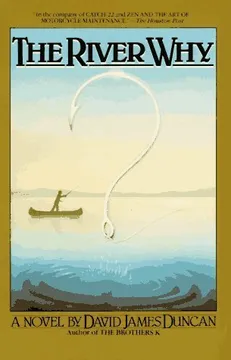


Plot Summary
The Deschutes Misfire
Gus1 begins with the story of his parents: Henning,3 an elegant fly-fishing celebrity, and Carolina,2 a blunt ranch girl who trusts worms. On the Deschutes, Henning3 hooks a huge steelhead, but Carolina’s2 sinker breaks his line.
She lands the fish herself, and Henning3 discovers that the cowhand he has been scolding2 is a woman. They fall in love beside the river, then conceal her role in the catch so Henning3 can claim the story and collect endorsements. Their honeymoon on the Rogue becomes a fishing contest.
Carolina2 catches more fish; Henning3 releases his, and their arguments turn physical before ending in passionate reconciliations. Their marriage survives as a lasting contest between incompatible angling creeds, and their son inherits both the river and the quarrel.
The family begins in a comic act of appropriation: Henning takes public credit for a fish Carolina actually landed. The lie establishes the novel’s central tension between expertise as performance and knowledge gained through bodily contact with the world. Yet neither parent simply defeats the other. Their marriage is sustained by the very disagreement that prevents them from understanding one another. Gus is conceived inside this unresolved contest, making his later effort to choose between bait and fly feel less like a hobby preference than an inherited demand to define himself.
Born Beside the Argument
Gus1 grows up with an unusual gift: he understands fish and can catch them with either bait or fly. He keeps exact logs, wins his parents’ admiration through fishing, and learns to stay neutral between their methods.
His younger brother, Bill Bob,4 is his opposite, a calm child indifferent to water and absorbed by whatever else catches his eye. At home, the old fishing manual The Compleat Angler fuels another parental battle. Gus1 reads it repeatedly, but its references to God unsettle rather than reassure him.
He cannot find the deity its author praises in the rivers he knows. By adolescence, Gus1 has become a fishing prodigy with little knowledge of ordinary life, and he begins to suspect that a life devoted entirely to catching fish may not answer every question.
Gus’s childhood turns competence into a substitute for belonging. Because his parents reward what he can do with a rod, his talent also becomes the most reliable way to remain loved without entering their arguments. Bill Bob’s indifference exposes the contingency of this family identity: shared blood does not produce shared attention. The old angling book widens the gap between mastery and meaning. Gus can interpret fish behavior with confidence, but the religious framework surrounding fishing remains inaccessible, forcing him to confront the limits of knowledge built solely around measurable success.
Garbage Gut's Last Witness
At twenty, Gus1 has secretly rented a coastal cabin and plans to leave home for a life of uninterrupted fishing. Before he can go, he tells his parents how he caught Garbage Gut, a bass that had been eating litter from a polluted lake.
Gus1 dressed like a picnicker, fed the fish a rotten bait, and watched it surrender rather than fight. A crowd then fought over the bass and killed it, while Gus1 stood ashamed of having betrayed the creature that cleaned their garbage.
His parents praise the catch, and Gus1 erupts, condemning his father’s3 fly-fishing snobbery and his mother’s2 killing. He smashes trophies and burns the mounted steelhead his father3 had falsely claimed. The family unexpectedly laughs together, and his parents help him move to the coast.
Garbage Gut breaks through Gus’s inherited habit of treating fish as records, opponents, or food. The bass had served a function in a damaged lake, yet its final value to the crowd lies in possession and spectacle. Gus’s anger is not an escape from his parents so much as a first attempt to name the moral cost of their shared obsession. Burning the fraudulent trophy destroys a family emblem built on concealed credit. The laughter that follows does not resolve their differences; it briefly frees them from defending those differences as their only form of intimacy.
The Ideal Schedule
Gus1 settles alone in a cedar cabin beside the Tamanawis River and puts into practice his carefully engineered schedule: nearly every waking hour belongs to fishing. He builds an aquarium, stocks it with small fish, and becomes especially attached to Alfred, an energetic steelhead smolt.
At first the cabin feels like the freedom he planned, but constant fishing turns into repetitive labor. Gus1 sleeps badly, speaks less, and begins hearing and seeing water even when he is away from it. A visit from Bill Bob4 makes the damage plain.
Gus1 cannot converse normally, and his brother4 notices that he has vanished into his own routine. Still unwilling to give up the one life he knows how to want, Gus1 returns to the river, more isolated and less certain that fishing makes him happy.
Gus’s schedule converts a beloved practice into an instrument of self-erasure. Its arithmetic promises control over satisfaction, but the body resists the fantasy: insomnia, impaired speech, and sensory fixation reveal that more fishing has not produced more freedom. The aquarium makes the contradiction intimate. Gus can call the fish companions while keeping them confined, just as he has narrowed his own life to a single environment. Bill Bob’s presence matters because he offers affection without sharing Gus’s expertise, a form of relationship that Gus has not yet learned to value.
Anvil Abe's Arrival
After killing a sea-run cutthroat, Gus1 accidentally scatters its blood into Alfred’s aquarium. The smolt crashes against the glass, injures himself, and dies while Gus1 is away fishing. Returning too late to save him, Gus1 releases Alfred into the river and grieves for the first time over a fish he has killed. The next morning, still hungover and intent on fishing, Gus1 drifts into thick fog.
He hooks what he thinks is a fish and finds a dead fisherman instead. With no paddle and no safe way to lift the body, he ties the man, Abe,18 to his canoe and swims beside it through the cold river to the landing. The ordeal leaves Gus1 feverish and physically broken, unable to keep death at a distance through statistics or jokes.
Alfred and Abe make mortality immediate in two different ways. Alfred dies because Gus’s casual actions carry consequences he did not intend; Abe’s body confronts him with an ending no skill can reverse. Gus initially tries to fit both events into the language of fishing, but that language cannot neutralize his grief or fear. The physical rescue matters because he must leave the safe position of observer and enter the water with the dead. His competence remains useful, but it no longer protects him from the lives and losses he has treated as abstractions.
The Garden Twin
During the fever that follows Abe’s18 rescue, Gus1 sinks into a bleak vision of life as meaningless decay. A remembered bedtime ritual with Bill Bob4 interrupts that despair. As children, they watched a burning pine knot while Bill Bob4 imagined every person and creature paired with a twin in a hidden Garden World; death meant exchanging places, not vanishing.
Gus1 cannot prove the story, but it gives him a way to imagine that suffering is not the whole of existence. He burns his fishing books and schedules, which have offered no answer to death. Later, he sees Abe18 in a vivid vision, upright and laughing in a green landscape. When the fog lifts, Gus1 is no longer certain that the visible world is all there is.
Bill Bob’s cosmology does not function as a doctrine Gus can verify. Its power lies in giving relationship a form that survives the boundaries of a single life. The image of paired shadows makes death less like a final verdict and more like an unseen exchange. Gus’s burning of his books rejects not knowledge itself but the false promise that information alone can settle existential fear. The vision of Abe remains ambiguous, preserving the difference between proof and hope. Gus begins to change when he allows uncertainty to carry emotional meaning rather than dismissing it as error.
The River's Question
Recovering, Gus1 climbs Tamanawis Mountain and sees the river’s bends as a written question. The view also exposes a clear-cut mountain, whose stripped slopes remind him of the fish he has treated as quarry.
He remembers Thomas Bigeater,9 a Warm Springs fisherman who handled each salmon with ceremony and killed only to feed people, unlike drunken anglers who wounded fish for sport. The memory shifts Gus’s1 concern from whether killing is always wrong to whether taking without gratitude is.
He visits valley residents, trades food and fishing help, and begins to know the neighbors he had ignored. Finally, he frees Sigrid, the steelhead smolt he had kept in his aquarium, into a protected spring creek. Letting her go costs him a companion but acknowledges her own longing for the river.
The mountain view expands Gus’s moral attention from individual fish to the landscape and the communities that depend on it. Thomas offers a model distinct from both Gus’s record keeping and his father’s release ethic: taking life can be necessary, but it calls for restraint, gratitude, and recognition. The neighbors complicate Gus’s belief that solitude is inherently purifying. His earlier isolation had hidden him from other people, not from his own habits. Releasing Sigrid is a small, concrete correction rather than a grand solution, and that scale makes it credible.
The Girl in the Alder
On the Siletz River, Gus1 spots a young woman fishing barefoot from a high alder with a homemade hazel pole. When she hooks a powerful steelhead, she releases the pole into the current, dives after it, and brings the fish to shore with daring, practiced control. Her skill astonishes Gus1 before her beauty overwhelms him. When she notices him, he tries to speak and produces a string of mangled sounds.
He flees into the river and climbs a cedar, convinced he has frightened her. From across the water, he learns her name is Eddy5 and manages to explain that he wants her to stay. She laughs with him, then hooks another steelhead and disappears into the woods. Gus1 finds the fish and pole but not Eddy,5 and returns home devastated.
Eddy disrupts Gus because she joins the two domains he has kept separate: technical mastery and unguarded beauty. His response is comic, but it also reveals a genuine ethical instinct. Rather than pursue her after she appears frightened, he retreats, accepting humiliation instead of claiming access to her. The river separates them physically and gives each room to choose. Gus’s longing begins not with possession but with an encounter he cannot control or explain, a sharp contrast to the predictable satisfaction of catching fish.
Titus and the Soul Pole
The next day, Gus1 meets Titus Gerrard,6 a learned angler who arrives with his unnerving dog, Descartes.7 Titus6 listens as Gus1 recounts his grief, the Garden World, Thomas Bigeater,9 and Eddy,5 then proposes that Gus1 use philosophy to investigate the soul as patiently as he investigates fish.
Their exchange gives Gus1 a tentative belief in an inner essence and a larger presence he calls the Whopper. In Portland, Gus1 visits his family and finds his parents laughing and experimenting with each other’s fishing methods, while Bill Bob4 has developed a new obsession with catching radio signals by kite.
The visit shows that his departure has not frozen the family in its old patterns. Gus1 then turns his attention to U.S. Grant Creek, the polluted stream of his childhood.
Titus does not replace Gus’s uncertainty with a ready-made creed. He changes the method: philosophical inquiry becomes another form of patient attention, not a demand to accept an answer in advance. The analogy of a fishing rod helps Gus imagine that he may be guided by an intelligence he cannot directly perceive. Meanwhile, the family visit reveals change occurring beyond Gus’s sight. His parents’ willingness to exchange techniques suggests that their conflict has become less rigid, while Bill Bob’s kite project preserves his independent way of attending to the world.
Sisisicu's Last Trout
U.S. Grant Creek, once called Sisisicu, has become a foul suburban drain. Gus1 follows it upstream through backyards and culverts until he traces its remaining flow to rainwater running off a replica Liberty Bell atop a bank.
Near the creek’s mouth, he finds one cutthroat trapped in a small spring-fed pool, the last living creature in the poisoned waterway. He improvises an ant fly from thread pulled from a discarded coat, then floats it to the fish in a tiny handmade canoe.
After catching it, Gus1 carries it beyond the creek’s polluted outflow and releases it into the Willamette. He does not pretend the act can revive the creek. Instead, he leaves the familiar suburbs and hitches back toward the Tamanawis, accepting that he must move forward.
The creek’s source in a decorative replica makes environmental damage inseparable from human systems of convenience and self-image. Gus cannot restore the water, and the novel refuses to let his rescue stand in for broad repair. What he can do is save one creature from a place with no future. That limited action joins care to grief without confusing them. The closed door at the creek’s end marks a psychological threshold: returning to the Tamanawis is not retreat to a private refuge, but a choice to live among consequences he can no longer ignore.
Hemingway Hooks a Giant
Back at the Tamanawis, Gus1 begins teaching the children of neighboring farmers to fish. During one lesson, five-year-old Ernie II, whom Gus calls Hemingway,12 hooks a large steelhead. The fish tangles in a submerged tree, and the other children snag their own lines while trying to help. Their combined pull shifts the tree close enough for Gus1 to dive in and net the exhausted fish.
Hemingway12 has hooked and tired it, so Gus1 insists the catch belongs chiefly to the boy, despite the family’s excitement over Gus’s1 rescue. The story spreads through the county. Children, local anglers, and visiting fishermen begin coming to Gus’s1 cabin, bringing food and trading for the rods and flies he makes. His solitary home becomes a small community shop.
Teaching changes fishing from a private contest into a shared skill. The children’s disorder is not merely comic; their accidental teamwork succeeds where a single expert could not. Gus’s insistence that Hemingway deserves the catch resists the credit-taking that marked his parents’ first story. Fame arrives through a collective event, but Gus’s response keeps it grounded in exchange rather than self-promotion. The new visitors also challenge his former equation of solitude with freedom: work, friendship, and material dependence enter his life without erasing his attachment to the river.
The Fishing Dutchman's Lie
At a secret blueback run, Gus1 helps an inept older angler by wrapping a nightcrawler in clay and lowering it beneath a ledge. The trick catches fish, but the angler turns out to be Dutch Hines,17 a newspaper columnist who invents an extravagant profile of Gus,1 renaming him Antoine Chapeau and attributing his skill to desert mysticism.
Gus1 lets the fabrication stand because Dutch17 includes a coded appeal to the woman who fled from him on the Siletz,5 asking her to contact him about her missing pole and fish. The column brings ridicule and protests, including an angry letter from Gus’s father,3 but it also reaches Eddy.5 Gus’s1 modest practical favor has become a public legend, and he cannot know whether the message will bring her back.
Dutch’s column converts a modest act of shared fishing into a spectacle, repeating the novel’s concern with how stories distort their subjects. Gus knowingly accepts the false biography because the lie serves a private, vulnerable purpose: it gives Eddy a route back to him. His choice differs from Henning’s earlier appropriation of Carolina’s catch, since Gus understands the deception and does not seek status from it. Still, the episode exposes the unstable boundary between storytelling as connection and storytelling as exploitation.
Nick's Hook Scar
Nick,8 an older Norwegian fisherman, comes to Gus’s1 cabin to learn rod building and fly tying before opening a tackle shop with his wife. Quiet and meticulous, he works beside Gus1 until he gives him a copy of The Compleat Angler as a farewell gift.
When Gus1 asks about the scar through Nick’s8 palm, Nick8 recounts his wartime minesweeper sinking in the North Sea. A Norwegian trawler rescues some survivors, but Nick8 cannot grip the fishing line thrown to him. He deliberately drives its hook through his hand, allowing the crew to pull him aboard.
The rescue does not make him conventionally religious, but it overturns his certainty that God cannot be present in human suffering. Nick’s8 story moves Gus1 to begin a solitary journey toward the river’s source.
Nick’s scar is not a proof that suffering is deserved or that providence can be neatly explained. It records a desperate act of participation: Nick must choose to wound himself in order to remain connected to the line that may save him. His account unsettles Gus’s preference for either skepticism or tidy religious explanations. Faith here emerges as a changed relation to uncertainty, not intellectual submission. The scar also turns the novel’s recurring fishing image inward, making the hook an instrument of danger, rescue, and a bond whose meaning only becomes visible afterward.
Walking to the Source
After Nick8 leaves, Gus1 walks upstream for days, following the Tamanawis toward its headwaters with little food or equipment. He endures hunger, cold, a night without matches, and a difficult realization that he cannot force a spiritual revelation. At the source, a spring beneath old Sitka spruce, he finds no spirit waiting to explain his life.
Instead, he understands that the river begins everywhere water gathers, not only at one spring. On the return journey, rain replenishes the watershed, and Gus1 accepts it as a kind of companion rather than a message he can decode. The pilgrimage leaves him less eager to capture meaning. His grief for Eddy5 remains, but it can now exist without controlling every thought.
The trek tests the difference between seeking and coercing. Gus initially treats the source as a destination that should yield an answer, repeating the same instrumental logic he used on fish. Physical deprivation strips that certainty away. His insight that a river’s source is distributed across rain, snow, groundwater, and mist is also a model of meaning: origins are networks, not single points. The rain matters because Gus receives it without claiming to understand it. This is a more mature form of attention than either his old scientific control or his earlier hunger for signs.
The Halloween Return
At the local Halloween party, Gus1 hears the children discuss invisible companions, then walks home expecting an empty cabin. Instead, Eddy5 waits inside with the newspaper column and a squirt gun.
She explains that she had watched Gus1 rescue the last trout in U.S. Grant Creek, later followed his work at the Tamanawis, and used Dutch’s17 appeal to find him. She had not fled the Siletz; she had hidden while he searched for her pole and fish. Eddy5 also saw him call her name and struggle through the river, which changed her fear into affection.
Gus1 admits that he watched her fishing in the alder and was so overwhelmed he could barely speak. Their honesty ends the misunderstanding, and they kiss. The next days bring shared meals, river walks, and love.
The reunion corrects Gus’s one-sided version of their first encounter. Eddy was not simply an idealized figure who vanished; she had been watching his actions and forming her own judgment. Her account makes his clumsy behavior legible as vulnerability without excusing the initial intrusion. Their relationship begins through reciprocal witnessing: each has seen the other act when no polished self-presentation was possible. The children’s stories of invisible friends provide a quiet counterpoint, suggesting that meaningful bonds can be real before they are fully explained or acknowledged.
A Chinook's Long Night
Eddy5 returns the next evening with a plan: she rigs a three-pound leader and roe to her handmade pole, hooks a huge chinook, and leaves Gus1 to follow it upstream while she goes back to Portland. The salmon could snap the fragile line, so Gus1 stops trying to dominate it.
He walks beside the fish through the moonlit river, keeping only enough tension to remain connected. As animals tolerate his presence, Gus1 feels the old hunter-and-quarry division loosen. He thinks of Eddy5 and recognizes that love, rather than emptiness, is now the balance guiding him.
Near dawn, he approaches the salmon in the water, touches its side, then breaks the leader so it can continue toward its spawning grounds. On the road home, a piercing inner light gives him a sense of divine love.
The chinook sequence brings together the novel’s ethical and spiritual strands without making them identical. Gus’s line keeps him connected to a fish he refuses to possess, and the fish’s migration gives direction to an experience he cannot command. Love becomes a form of attention that changes his conduct: he approaches cautiously, accepts vulnerability, and finally lets the salmon go. The climactic vision does not reward him with ownership of the fish or certainty about God. It gives him an encounter whose defining action is release.
The Line Comes Home
Eddy5 returns at sunset and listens as Gus1 describes the night with the chinook. She says she loves him, then stays far longer than planned. They marry the following May, with Bill Bob4 as best man and Titus6 delivering the ceremony’s elaborate reflections.
The reunion with family deepens when Gus1 discovers that his parents have had another child, Julie, and embraces them after learning they have become friends and begun fishing together.
Earlier, Gus1 had refused to honor his draft card, fearing a forced separation from Eddy5 and a war he did not understand; a later lottery places his birthday far down the list, and he is not called. The novel closes with Gus1 and Eddy5 fishing, killing two trout for food, and offering them grateful, loving farewells.
The ending returns Gus to family without returning him to his old role. His parents’ reconciliation shows that change can occur through shared practice, while Bill Bob remains the mediator who can recognize connections others miss. Gus’s marriage does not dissolve his uncertainty; it gives him a human relationship in which uncertainty can be shared. The draft episode places private love against an impersonal system that assigns lives by number. The final trout make gratitude practical rather than abstract: Gus and Eddy still take life, but they no longer confuse taking with entitlement.
Analysis
The River Why follows a young man whose expertise is both a gift and a defense. Gus1 can read water, predict fish, and construct elaborate systems for measuring success, but those abilities initially keep him from confronting dependence, grief, and moral responsibility. The novel’s turning points repeatedly make his abstractions physical: an aquarium fish dies because of his carelessness; a drowned fisherman18 must be towed through fog; a poisoned creek ends at a replica civic monument; a salmon’s fragile line requires him to follow rather than command.
The book also refuses a simple opposition between fishing and reverence. Thomas Bigeater9 models necessary taking governed by ceremony, while Gus’s1 early catch-and-release ethic remains entangled with pride and technique. The question becomes not whether human beings may use nature, but whether they can recognize what they take, what they damage, and what they owe. Environmental destruction is not background scenery: the clear-cut slope and dead Sisisicu measure the costs of treating living systems as resources without reciprocal obligation.
Religious belief enters through incompatible forms. Henning’s3 scientific account, Carolina’s2 impatience with metaphysics, Bill Bob’s4 Garden World, Nick’s8 wartime rescue, and Titus’s6 comparative philosophy each offer partial ways to face uncertainty. The novel does not collapse them into a single proof. Gus’s1 eventual faith grows through attention and relationship, not argument alone. The chinook sequence makes this change visible: he remains linked to the fish, but the measure of success is no longer landing it. Love becomes a discipline of restraint, allowing another creature to continue its journey.
The comedy is essential to that development. Gus’s1 embarrassment, his family’s absurd quarrels, and the valley’s eccentric neighbors keep spiritual seriousness from becoming solemn certainty. They show that intimacy often arrives through imperfect acts: sharing food, teaching children, telling a difficult story, or returning after misunderstanding. By the end, Gus1 has not stopped fishing or escaped the world’s violence. He has learned to act within it with greater gratitude, humility, and care.
Review Summary
Reviews for The River Why are largely enthusiastic, averaging 4.21/5. Many readers praise its rich blend of humor, philosophy, spirituality, and stunning nature writing, noting that fishing knowledge isn't required to appreciate it. Fans highlight its memorable eccentric characters, coming-of-age depth, and beautiful prose. Critics find it overlong, overly philosophical, or too fishing-focused. Several reviewers compare it favorably to Duncan's other novel, The Brothers K, while others prefer that work. The book's exploration of love, solitude, environmentalism, and personal spirituality resonates strongly with most readers.
People Also Read

Characters
Augustine Gus Orviston
The river-bound seekerGus is the son of a celebrated fly fisher and a formidable bait fisher, and he grows up treating fishing as both vocation and measure of worth. His prodigious skill gives him confidence in rivers but leaves him poorly equipped for ordinary social life and questions of faith. He is observant, comic, stubborn, and more tender than his self-image allows. His tendency to turn experience into statistics or technique protects him from uncertainty, yet it also narrows his capacity for connection. Gus’s defining struggle is not whether he will remain a fisherman, but whether fishing can become a way of attending to other lives rather than mastering them.
Carolina Ma Orviston
The backwoods matriarchCarolina, usually called Ma, is an Eastern Oregon ranch woman whose practical intelligence and fierce loyalty shape the family. She bait fishes, hunts, repairs, cooks, and protects her children with a directness that often looks rough from the outside. Her contempt for Henning’s3 purism is matched by an equally deep commitment to him, which makes their quarrels both destructive and sustaining. Ma trusts embodied judgment more than abstraction and has little patience for philosophical systems. Her blind spots are real, especially when she dismisses emotional nuance, but she is also capable of decisive care and of changing when experience reaches her more deeply than argument can.
Henning Hale-Orviston
The fly-fishing puristHenning, whom Gus1 calls H2O, is a polished writer and famous fly fisher who treats angling as a disciplined art with almost religious seriousness. His refined manners and careful technique mask a hot temper and a strong need to have his standards recognized. He loves his family, but at first he often understands them through their relationship to fishing, especially Gus’s1 talent. His opposition to Ma’s2 methods is both sincere and self-serving: it gives structure to a passion that has become central to his identity. Underneath the dogma is a man capable of loyalty, humor, and more flexibility than he initially permits himself.
Bill Bob Orviston
The quiet oddball brotherBill Bob is Gus’s1 younger brother, a serene, observant child who has almost no interest in fishing. He moves through the family’s noisy disputes without needing to win them, and his attention settles on radios, animals, objects, or an idea no one else has noticed. Gus1 initially interprets this difference as distance, but Bill Bob’s calm and imaginative independence offer another way to inhabit the world. His unusual stories about shadows, twins, and hidden realities express a capacity for wonder that exceeds his age. He rarely argues for his importance; instead, he changes how Gus1 sees other people simply by noticing what they overlook.
Eddy
The fearless fisherEddy is a skilled, unconventional angler who uses improvised equipment and moves through rivers with confidence. Gus1 is first captivated by her ability to fish in ways he has never seen, but her importance lies in her independent judgment, humor, and willingness to question his assumptions. She is alert to the attention her beauty attracts and cautious when she senses danger, yet she is not defined by fear. Eddy notices how people behave when they are embarrassed, grieving, or helping someone else, and she makes choices from what she observes rather than from a polished reputation. Her relationship with Gus1 rests on that mutual attention.
Titus Irving Gerrard
The philosophical anglerTitus is a scholar, fisherman, and friend who speaks through literature and religious traditions without behaving like a conventional preacher. His curiosity ranges across cultures and disciplines, but he values love for a subject more than the accumulation of facts. He becomes a mentor to Gus1 by treating fishing as a useful analogy for spiritual inquiry, while remaining willing to be the novice when Gus1 teaches him to fish. His humor and ceremonious habits keep his seriousness from becoming rigid. Titus’s essential gift is methodological: he helps Gus1 ask deeper questions without insisting that he already knows their answers.
Descartes
Titus's watchful dogDescartes is Titus’s6 large, blue-eyed mongrel, whose stillness and unnerving gaze make him seem more thoughtful than an ordinary pet. Titus6 interprets and translates the dog’s intentions, treating him as a being capable of intellectual and spiritual development. Their bond is part companionship and part philosophical experiment. Descartes also exposes the assumptions humans bring to animal intelligence: he has preferences, grievances, and a distinct way of reading the world, even when his behavior remains unmistakably canine.
Nick
The scarred survivorNick is an older Norwegian fisherman who comes to Gus1 to learn fine points of rod and fly making before opening a tackle shop with his wife. He works slowly and carefully, and his quietness carries a sadness Gus1 senses before understanding its source. Nick’s manner is shaped by a wartime survival that altered his certainty about God and human suffering. He is neither a confident evangelist nor a settled skeptic. His willingness to recount a painful experience makes him a powerful example of how an event can change a person’s understanding without resolving every question.
Thomas Bigeater
The ceremonial fishermanThomas is a Warm Springs fisherman whom Gus1 remembers from childhood, when he watched him harvest salmon at Celilo Falls. He is physically imposing yet careful with each fish, combining skill with reverence and responsibility to the people he feeds. Thomas challenges Gus’s1 simple division between killing and mercy by showing that taking life can be governed by need, restraint, and ceremony. His calm response to cultural loss also unsettles Ma’s2 more combative instincts. He remains a model Gus1 measures himself against, not because he offers an easy solution, but because his actions embody a relationship with the natural world.
Steve
The candle-making neighborSteve is a vegetarian candle maker who lives with his family in a weatherworn farmhouse near Gus1. His handmade candles transform ordinary forms into elaborate changing images, reflecting his playful, unconventional imagination. Steve speaks and acts with an acceptance that Gus1 initially finds strange, but his steady kindness makes him an important neighbor. He is also interested in fishing and recognizes the artistry of Gus’s1 unusual flies. Steve’s household introduces Gus1 to a community whose values differ sharply from his own without demanding that he abandon his identity.
Satyavati
The candle-maker's partnerSatyavati is Steve’s10 partner and the mother of Rama13 and Arjuna14. She is quiet, practical, and part of a family whose vegetarian habits and spiritual vocabulary contrast with the Orvistons’ combative fishing culture. Her help with Gus’s1 equipment and her gifts to the household show an unshowy form of generosity. She does not need to dominate conversation to influence the local community around her. Gus’s1 encounters with her family help him see that closeness can be built through shared work, food, and attention rather than through agreement on every belief.
Hemingway, Ernie II
The young steelhead hopefulHemingway is the youngest son of Ernie16 and Emma’s15 large farm family, a determined child whose serious manner distinguishes him from his noisy siblings. Gus1 sees in him a genuine appetite for fishing: he learns the basics, watches carefully, and becomes deeply invested in the fate of a hooked fish. His nickname reflects the child’s tough, focused image of himself. Hemingway’s relationship with Gus1 is affectionate and competitive, and it gives Gus1 a chance to teach without making the lesson about his own superiority.
Rama
The imaginative younger sonRama is Steve10 and Satyavati’s11 younger son, an energetic child attached to his monkey doll, Whitey. He approaches play with ceremony and imagination, treating the doll’s appearance and adventures as matters of real importance. His affection for Whitey offers Gus1 a glimpse of care that does not depend on usefulness or expertise. Rama is also part of the lively household that draws Gus1 into a wider network of relationships.
Arjuna
The combative older sonArjuna is Steve10 and Satyavati’s11 older son, a blunt, energetic child who carries a machete and meets new people with suspicion before friendship. His early clashes with Hemingway12 arise from sharply different ideas about food, masculinity, and family life. The two boys eventually form a bond through conflict and curiosity. Arjuna’s directness and physical confidence contrast with Gus’s1 inward hesitation, while his capacity to adapt keeps his toughness from becoming mere hostility.
Emma
The generous farm motherEmma is the overworked mother of a large farming family and a generous neighbor to Gus1. Her household is noisy, crowded, and practical, and she often gives Gus1 food or help before he can refuse. Emma’s warmth makes hospitality feel like a shared obligation rather than a favor that must be repaid exactly. She also manages the chaos of her children and husband16 with a force that Gus1 comes to respect.
Ernie
The muddled farm patriarchErnie is Emma’s15 husband and the father of their large, energetic family. He is a hardworking farmer whose speech becomes tangled, especially after beer, and his children often have to guess which of them he means. His comic confusion gives Gus1 access to a household where affection is expressed through noise, food, and constant motion.
Dutch Hines
The boastful fishing columnistDutch Hines, known as the Fishing Dutchman, is an older newspaper angler whose enthusiasm exceeds his accuracy. He is easily distracted by a catch and eager to turn fishing experiences into long public stories. Dutch’s eagerness makes him both an amusing companion and an unreliable narrator of other people’s lives. He is not malicious so much as governed by the pleasure of telling a tale, which can make his influence larger than his judgment.
Abe Mayfield
The drowned fishermanAbe is an older angler whose body Gus1 encounters during a fog-bound canoe trip. Though Gus1 never knew him in life, details of his clothes and wedding ring make him vivid as a husband, a family member, and a fellow fisherman. Abe’s presence forces Gus1 to confront mortality as more than an abstract subject.
Crawdad Benson
The riverbank veteranCrawdad Benson is an elderly local angler who fishes a familiar pool near his home with old, battered equipment. His persistence shows Gus1 that experience and attention can matter more than expensive gear. Crawdad’s suspicion of Gus1 also reflects the valley’s independent, guarded character.
Plot Devices
The Compleat Angler
A family argument in printIzaak Walton’s old fishing book becomes the Orvistons’ recurring battleground. Henning3 reads it as a defense of fly fishing, while Carolina2 finds evidence that Walton welcomed bait, varied species, and ordinary pleasures. Gus1 studies the same book and becomes preoccupied with its religious claims. It gives the family a common text through which to express their deeper disagreements about authority, pleasure, God, and what makes an angler complete. Its influence follows Gus1 beyond the house, where he must decide whether inherited interpretations deserve his trust.
The Ideal Schedule
A plan that becomes a trapGus1 devises a numerical system for maximizing satisfaction and drafts a daily routine that devotes almost all waking hours to fishing. The schedule gives form to his desire to escape school, family conflict, and ordinary social demands. Once he follows it at the coast, however, the plan reveals its cost: fishing becomes repetitive, sleep and speech deteriorate, and his world contracts. The schedule is a concrete expression of Gus’s1 belief that life can be optimized through calculation, making its failure a necessary step toward less controllable forms of attention.
The Aquarium
A mirror for captivity and careGus’s1 aquarium begins as a practical place to study live insects and test flies, then becomes a small world he watches for company. Alfred’s exuberant feeding and Sigrid’s steady gaze toward the river give Gus1 distinct fish to care about rather than anonymous catches to count. The tank allows him to observe how much an animal’s behavior changes under confinement, but Gus1 initially overlooks what Sigrid’s longing implies. These fish help expose the gap between affection and possession, and between keeping a creature safe and allowing it to live where it belongs.
The Hook and Line
Connection without possessionFishing line shifts from equipment into the novel’s central image of relationship. Gus1 first uses it to control fish, then encounters it through Nick’s8 scar and the rescue that changed Nick’s8 understanding of faith. During the night with the chinook, Gus1 keeps contact with a fish without forcing it toward capture, finally allowing the line to break. The image links physical skill, vulnerability, love, and spiritual dependence. Its meaning changes as Gus1 does: a line can wound or restrain, but it can also hold two beings in relation without making either one the property of the other.
The Dutchman Column
A false tale opens a doorDutch Hines17 turns Gus’s1 practical fishing advice into a fabricated public legend, complete with a false name and invented history. The column demonstrates how publicity reshapes a person into a story others can consume. Gus1 accepts the distortion because Dutch17 also carries a carefully worded appeal to Eddy5, making the fiction serve a private purpose. The episode binds the novel’s concern with storytelling to its plot: a false account can misrepresent Gus1 while still creating a chance for a true relationship to resume.
Download PDF
Download EPUB
.epub digital book format is ideal for reading ebooks on phones, tablets, and e-readers.








