

Key Takeaways
Treat identity as larger than the body, and widen your circle of concern.
A wider identity. Icke argues that a person is not just a temporary body, but an enduring consciousness connected to all life. He calls the deepest source of existence the Source, and describes the higher self as the part of a person that guides their physical life. Reincarnation, karma, chakras, and communication with other frequencies form parts of this spiritual model. He uses near-death experiences and intuitions as evidence, though they do not establish the model as fact.
Interdependence has consequences. If people are aspects of one consciousness, racism, nationalism, and revenge mistake temporary physical identities for the whole person. The practical implication is to treat others, animals, and the Earth as part of a shared whole, not as disposable outsiders.
What's compelling is the ethical reach of this view: it asks readers to extend concern beyond their immediate group, a move that resonates with ecological thinking and moral philosophy. Its practical force does not depend on proving that consciousness survives death. That distinction matters because near-death reports can be meaningful to those who experience them without settling questions about what happens after death. The book's spiritual claim is strongest as an invitation to humility and care, and weakest when personal experience is treated as conclusive evidence about the structure of the universe.
Question whoever claims a monopoly on truth, especially when dissent is punished.
The rebellion begins mentally. The book's central image of robots describes people whose beliefs and actions are shaped by institutions, inherited dogma, and constant messaging, rather than examined for themselves. Icke says a secret network called the Brotherhood has steered religion, politics, media, science, and finance to keep people disconnected from spiritual knowledge. He presents that network as a long-running conspiracy, but the book does not establish the full scope of that allegation with reliable evidence.
Keep the useful question. Regardless of the conspiracy claim, readers can ask who controls a message, whose interests it serves, and whether contrary evidence is heard. Icke's warning is that ridicule, censorship, and enforced conformity can make a belief system look more secure than it is.
The distinction between institutional influence and a single hidden mastermind is essential. Institutions can converge on similar incentives without following one coordinated plan: media outlets compete for attention, governments seek legitimacy, and professions defend expertise. That systems-level explanation is often more testable than a centuries-spanning conspiracy. The book is valuable when it prompts scrutiny of power and information, but its own account risks becoming unfalsifiable if every denial or counterexample is taken as proof of concealment. Skepticism should apply to the author as consistently as to the institutions he challenges.
Read history as a struggle over knowledge, not a straight march of progress.
A counter-history. Icke retells world history as a contest between forces of harmony and control. He interprets ancient gods as possible extraterrestrials or discarnate communicators, religious stories as transformed myths, and secret societies as vehicles for passing or withholding knowledge. He sees Christianity's rise under Emperor Constantine, its later suppression of dissent, and the growth of materialist science as successive systems that narrowed what people could believe.
Separate layers of the story. The book connects genuine historical events to speculative explanations, including Atlantis, extraterrestrial genetic intervention, and a coordinated Brotherhood. Its account of the so-called Protocols of the Wise Men of Zion treats the text as evidence of a secret agenda, despite the author's claim that the conspiracy is not Jewish. Readers should distinguish documented history from interpretation and unsupported claims.
The argument that victors shape historical memory is a serious and useful question. Control over archives, schools, and public narratives can affect which experiences are remembered. Yet a counter-history is not automatically a truer history. The Protocols are a notorious antisemitic forgery, not a reliable record of a hidden governing plan; repurposing them as proof of a different conspiracy does not repair their evidentiary failure. A sound reading separates verifiable events, plausible institutional criticism, and extraordinary claims that require stronger evidence than resemblance between myths or symbols.
Measure prosperity by unmet needs, not by how much an economy consumes.
Growth is not welfare. Icke attacks an economy built on producing, selling, and discarding more each year. He argues that gross domestic product measures economic activity, not whether people are healthy, secure, or fulfilled. In his account, a system that rewards throughput encourages resource extraction, pollution, waste, and competition, while leaving poverty and homelessness untouched. He also objects to treating the damage caused by economic activity as further evidence of success when money is spent responding to that damage.
Use human measures. The book proposes judging progress by how few people are hungry, homeless, isolated, or unable to develop their abilities. It also calls attention to the unequal distribution of consumption, arguing that a small share of the population uses a disproportionate share of the world's resources.
This critique anticipates a central concern in ecological economics: national output is not the same as human well-being, and it can ignore ecological costs and unequal distribution. The distinction helps readers ask what an economic indicator leaves out. Still, replacing GDP requires measures that are reliable, comparable, and resistant to political manipulation. A broader scorecard can improve public debate, but no single indicator captures every community's priorities. The book's strongest point is not that growth is always harmful, but that growth alone cannot tell whether an economy is serving people or degrading the conditions they depend on.
Build local capacity before distant systems fail you.
Meet needs nearby. Icke proposes reducing dependence on large banks, corporations, and centralized supply chains by organizing communities around food, shelter, warmth, and clothing. He favors local food cooperatives, community-owned businesses, and banks that serve local needs rather than profit from lending. The aim is not to isolate communities, but to make trade between them cooperative and mutually beneficial instead of built on unequal dependence.
Try exchange without cash. He describes LETS, or Local Employment and Trade Systems, in which members exchange services using an agreed local unit of account. A mechanic might repair a member's car, receive local credits, and spend them on someone else's work. Such systems, the book argues, let people use skills that would otherwise go unused when money is scarce.
Local resilience has practical value even without the book's prediction of systemic collapse. Research on community-managed resources, including work associated with Elinor Ostrom, shows that groups can sometimes govern shared goods effectively when they have clear rules, participation, and ways to resolve disputes. Barter networks can also make underused skills visible. Their limits matter: they do not replace specialized medicine, infrastructure, or goods that a locality cannot produce. The strongest case for local capacity is therefore diversification, not self-sufficiency at any cost.
Replace passive obedience with participation in schools and community decisions.
Education should open minds. The book argues that schools often reward conformity and memorization rather than curiosity, practical ability, or independent judgment. Icke wants children to encounter competing views of history, religion, science, and society, instead of being taught one official account as unquestionable fact. He also advocates learning practical skills, such as growing food, cooking, and maintaining a home, so people are less dependent on institutions.
Decisions should stay close. Politically, he favors neighborhood councils, open community forums, and regional coordination over distant party control. Residents and people with relevant experience would help shape decisions that affect them. A world forum could coordinate shared concerns, in his proposal, but would have limited power and no army.
The case for participation is supported by a broad principle in democratic theory: people are more likely to understand and accept decisions when they can influence them. Active learning similarly tends to engage students more deeply than one-way instruction. But local control is not inherently fair. It can reproduce exclusion, and local majorities can override minority rights. A workable participatory model needs transparent rules, access to information, and protections for people with less power. The book's emphasis on voice is persuasive; its assumption that local communities will naturally act with care needs qualification.
Resist manipulation without copying its violence or certainty.
Noncooperation, not revenge. Icke calls for peaceful protest, boycotts, sit-ins, and refusal to cooperate with systems he sees as exploitative. His proposed targets include banks, media organizations, government institutions, and secret societies. He argues that large numbers of people acting together can withdraw the cooperation on which institutions depend. He also warns that responding to oppression with hatred or retaliation perpetuates cycles of harm.
Forgiveness is strategic. The book treats forgiveness as a way to stop inherited resentments from directing present behavior. It argues that people should challenge harmful systems without condemning whole populations or treating political opponents as less human. The practical test is whether resistance builds solidarity and reduces harm, rather than creating new enemies or inviting violence.
The emphasis on nonviolent collective action is a constructive counterweight to the book's alarming language about enemies and control. Social movements often gain legitimacy by making their demands visible while avoiding tactics that alienate potential allies. Still, refusal alone rarely changes a system: campaigns need clear goals, durable organization, and plans for meeting immediate needs. Forgiveness can interrupt retaliation, but it should not mean absolving institutions or silencing those harmed. Accountability and compassion can coexist, and resistance is stronger when it makes that distinction explicit.
Explore spiritual ideas, but test claims before surrendering your judgment.
No new priesthood. Although Icke rejects conventional religions as systems of control, he also warns that spiritual movements can reproduce the same dependence through gurus, channellers, and elaborate services. He urges readers to be selective about channeled messages and skeptical of anyone who claims unquestioned authority. Intuition matters in his approach, but so does continuing to question one's beliefs rather than settling permanently into a comfortable group.
Science needs humility too. The book accuses mainstream science of neglecting consciousness, alternative healing, and nonpolluting energy technologies. It argues that research shaped by funding and professional norms can overlook important questions. At the same time, claims about hidden free-energy devices, mind control, and suppressed cures are not demonstrated by the text. The practical lesson is to distinguish open inquiry from accepting extraordinary claims without evidence.
This self-critique is one of the book's most useful safeguards: rejecting established authorities does not make every alternative authority trustworthy. In science, peer review and professional consensus can be imperfect, but they also provide methods for detecting error through replication and challenge. A claim that a treatment or technology is suppressed should be tested by asking what independent evidence exists and whether others can reproduce it. Intellectual openness works best with standards of proof, not without them. Otherwise, skepticism becomes a route to a different form of credulity.
Analysis
The book is built as a dramatic descent and return. It begins with a spiritual account of consciousness and identity, uses that account to reinterpret ancient religion and modern institutions, then turns toward an alternative social program: local economies, participatory politics, less coercive education, and personal responsibility. This structure gives the work emotional momentum. Its recurring image of awakening links cosmic claims to familiar experiences of conformity, consumer pressure, and political powerlessness.
Its most durable insights are also its most grounded: institutions can protect their authority, economic growth can conceal social and environmental costs, and citizens need meaningful ways to influence decisions. These claims can be examined without accepting the book's narrative of extraterrestrial intervention, Atlantis, a global Brotherhood, or a planetary frequency shift. The text often treats parallels, anecdotes, and intuitive impressions as if they established causation. That leap is the central weakness of its method.
The use of the Protocols of the Wise Men of Zion demands particular caution. The document is a forged antisemitic text that has been used to promote hatred against Jewish people. Although Icke insists that his alleged conspiracy is not Jewish, he repurposes the Protocols as a blueprint for a different hidden elite. This does not make the document credible evidence, and readers should not confuse the book's disclaimers with historical validation.
A careful reader can therefore separate three things: spiritual beliefs that may carry personal meaning, institutional critiques that can be tested against evidence, and sweeping allegations that the book does not substantiate. Its call to resist passivity and build community is worth considering. Its conspiracy framework should be treated as the author's speculative interpretation, not as established history or a trustworthy account of current events.
Review Summary
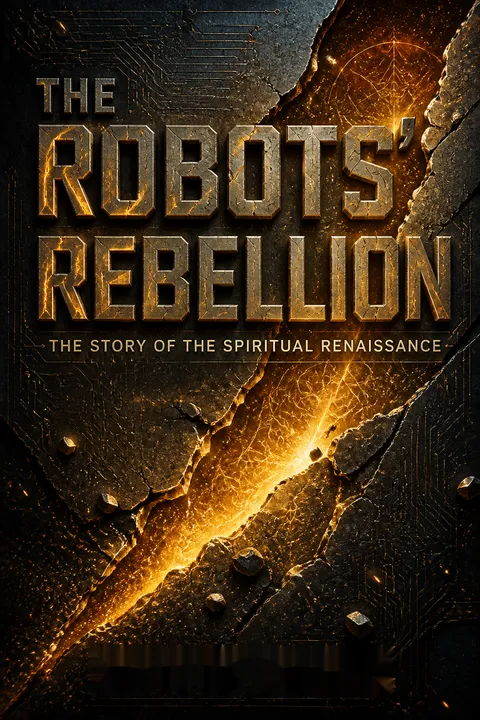
The Robots' Rebellion receives mixed reviews averaging 3.92 stars. Many readers praise Icke's historical analysis and predictions that seemingly came true, with some viewing it as visionary despite controversial content about reptilians and extraterrestrials. Critics appreciate his critique of organized religion and oppressive systems but fault the book for lacking references, making logical leaps, and relying on questionable sources including antisemitic material. Several reviewers note the book's idealistic solutions and acknowledge disagreeing with portions while still finding value in its perspective-challenging content.
Glossary
Source
Originating universal consciousnessIcke's name for the original consciousness from which all existence emerges. In his model, the Source creates aspects of itself that experience different levels of reality, then receives their accumulated experience in return. It is not a person-like deity, but an evolving, universal mind. This is a spiritual claim, not an established scientific account.
higher self
Nonphysical guiding awarenessThe part of a person's consciousness that Icke says remains outside the physical body during an incarnation. It is said to know the purpose and intended experiences of that life, and to guide the ordinary, embodied self through intuition. Icke compares it to a mission control center, while describing the everyday self as limited by physical experience.
Luciferic consciousness
Disharmony-seeking consciousnessIcke's term for a supposed stream of consciousness that has become imbalanced and seeks control, conflict, and separation. He says its influence spreads through thought patterns that people may mistake for their own beliefs. The term functions as a central explanation for human cruelty and political domination in the book; its cosmological claims are not verified.
Brotherhood
Alleged secret-society networkIcke's name for a network of secret societies that he claims has passed knowledge through elite ranks and manipulated political, religious, economic, and media institutions. He presents it as a continuing structure whose membership is mostly unaware of the alleged agenda. The book's expansive claims about the network are speculative and should not be treated as documented fact.
Photon Belt
Cosmic rebalancing bandA proposed band of highly charged particles that Icke believes the Solar System is crossing. In his account, the band raises the Earth's vibration and rebalances its energy field, producing major changes in human and planetary life. The idea is central to his timeline for spiritual transformation, but it is not an accepted astronomical explanation.
collective mind
Shared species-level awarenessIcke's concept of a shared field of consciousness to which individual minds are connected. He argues that repeated thoughts can influence this field and become available to others, helping explain both social conformity and sudden changes in behavior. The book links it to the Hundredth Monkey story, which it presents as evidence, though that story is not a reliable scientific demonstration.
LETS
Local barter networkShort for Local Employment and Trade System, a community exchange arrangement described in the book. Members list skills they can offer and needs they have, then trade services using locally agreed credits rather than cash. The credits track contributions within the group, allowing useful work to take place even when conventional money is scarce.
About the Author



Download PDF
Download EPUB
.epub digital book format is ideal for reading ebooks on phones, tablets, and e-readers.








