

Key Takeaways
Treat every outbreak as a process, not a story about its spark
Look beyond the origin. A striking beginning attracts attention, but most sparks fizzle. Ronald Ross showed why the processes after the spark matter. After discovering that mosquitoes transmit malaria, he modelled how infection, mosquito bites, and recovery interacted. His calculations showed that malaria could decline without eliminating every mosquito: reducing mosquito numbers below a critical level was enough to make new infections fall below recoveries.
Ross’s approach contrasted with descriptive analysis, which identifies patterns in past data, and mechanistic analysis, which represents how a system works to explore what might happen under changed conditions. His broader Theory of Happenings applied this logic to events that spread independently or depend on how many people are already affected. A model is not the world itself. It is a simplified way to ask useful questions about the world.
What's striking is how this approach shifts attention from dramatic beginnings to leverage points. The same reasoning underlies engineering: understanding how a bridge carries stress is more useful than merely cataloguing past collapses. Mechanistic models are especially valuable when experiments would be impossible or unethical. Their weakness is equally important: a model can only explore mechanisms its designers include. The strongest use is therefore not to treat an output as an oracle, but to make assumptions visible, compare predictions with observations, and revise the model when reality disagrees.
Use R to ask whether each case replaces itself
Measure replacement. The reproduction number, written as R, is the average number of new infections caused by one infected person in a particular population. If R is above one, cases can grow; below one, they tend to shrink. R is not a permanent label for a disease. Vaccination, behaviour, and population immunity can all change it. Measles can have an R above 20 where almost everyone is susceptible, but much less than one in a highly vaccinated population.
The book breaks R into four factors, called DOTS: Duration of infectiousness, Opportunities to transmit, Transmission probability per opportunity, and average Susceptibility. This helps identify practical interventions. Condoms reduce HIV transmission probability, while preventive medication reduces susceptibility. For measles, controlling outbreaks can require vaccinating more than 95 per cent of a population.
R is useful because it turns a vague claim about contagiousness into a question about replacement. It also discourages one-size-fits-all interventions: isolation changes duration, masks or safer practices can change transmission probability, and vaccination changes susceptibility. But averages can conceal important variation. An R of two does not mean every infected person infects two others. The number also depends on where and when it is measured. Used well, R is a decision aid and a comparison tool, not a score that can be separated from its population and circumstances.
Map the network before blaming its most visible node
Averages hide structure. Transmission is often concentrated in a small number of people or connections. In some outbreaks, a minority of cases account for most onward infections. That pattern is called superspreading, but it does not make the people involved inherently unusual. A Serbian teacher with smallpox infected 38 people in a hospital partly because nobody recognized the disease at first. Chance, setting, and delayed detection can matter as much as individual behaviour.
Networks shape these chances. In the United States banking network, 75 per cent of daily payments involved just 66 institutions. When major banks share investments and owe money across a dense web of connections, trouble at one firm can travel far. After Lehman Brothers failed, its links reached more than a million counterparties. The lesson is to examine central connections, shared exposures, and indirect routes, not just the apparent source.
Network thinking adds a systems-level view to problems often framed as individual failure. It helps explain why a modest shock can have a large effect when it hits a central node, and why a seemingly resilient system may be fragile under stress. This does not mean every hub should simply be removed. In finance, health, and communication, central connections can also make useful coordination possible. The practical question is how to preserve their benefits while preventing one failure from cascading, through buffers, monitoring, and alternative routes.
Separate social influence from shared tastes and shared circumstances
Similarity is not proof. Friends may resemble one another because they influence each other, because people choose friends like themselves, or because they share the same environment. This is the reflection problem: the same pattern of similarity can fit several explanations. Studies claiming that obesity spreads through friendship networks became influential, but researchers disputed whether the data could distinguish social influence from selection and shared circumstances.
A controlled experiment can help. Researchers taught a few great tits in separate wild populations to open a puzzle box for food. Within 20 days, about three-quarters of birds in trained groups had learned the technique, while untrained groups changed more slowly. This made the route of transmission clearer than an observational correlation. Some behaviours also require repeated social confirmation before people adopt them. This is complex contagion, where several exposures reinforce a choice rather than one contact being enough.
The distinction matters because policies built on mistaken causal stories can waste resources or stigmatize people. Randomized experiments provide strong evidence when they are feasible and ethical, while natural experiments and carefully designed observational studies can help when they are not. Even then, behaviour is rarely transmitted like a simple pathogen. A new idea may need repeated endorsement, practical support, or social permission. The bird experiment isolates learning unusually well, but human choices involve institutions, incentives, and meaning that a puzzle box cannot reproduce.
Interrupt retaliation where violence travels through trusted relationships
Change the transmission route. Physician Gary Slutkin noticed that maps of killings resembled maps of infectious disease outbreaks. This led him to treat violence as something that can spread through social relationships, rather than only as the result of bad individuals. Cure Violence hires trusted community members to intervene in conflicts, support people at high risk, and shift local norms about violence.
Research on Chicago shootings estimated a reproduction number of about 0.63: for every 100 people shot, contagion was associated with 63 follow-up attacks. The average time between linked shootings was 125 days, leaving an opportunity to intervene. In one early Chicago area, shootings fell by about two-thirds in the programme’s first year. This approach resembles smallpox ring vaccination, which protected close contacts around a detected case. It does not replace work on poverty, trauma, or other underlying conditions.
The public-health framing creates a useful alternative to punishment alone: it directs attention to timing, relationships, and prevention. It also recognizes that trusted local workers may reach people who would avoid formal authorities. The analogy has limits. Violence is not a pathogen, and describing it as contagious must not erase agency or structural causes. A sound programme therefore needs evidence of reduced harm, community legitimacy, and sustained support. The strongest case for this model is not that every feature of disease control transfers, but that some transmission patterns are interruptible.
Most online content needs a megaphone, not just a catchy message
Popularity is usually amplified. Around 95 per cent of Twitter sharing cascades in one large study stopped at the original post. Even popular online trends had far lower person-to-person contagiousness than measles. In practice, many widely seen posts spread because a celebrity, news outlet, or platform recommendation system broadcast them to a large audience. Big seed marketing uses the same principle: expose many people to a message at the start, so even modest sharing can build reach.
This distinction matters for misinformation. False claims can gain traction through novelty and repeated exposure, but journalists and platforms can provide the crucial amplification. Corrections can also slow spread. After a false warning circulated following Japan’s 2011 earthquake, a local government correction overtook the rumour; researchers estimated an earlier correction could have reduced its spread by 25 per cent. Limiting forwards, removing posts, or correcting claims target different parts of transmission.
The word viral can obscure the machinery behind online popularity. Reach may come from broadcast, recommendation, or paid placement rather than unusually persuasive content. That distinction helps locate responsibility without assuming a single hidden influencer caused an information outbreak. It also suggests several points of intervention, from platform design to newsroom choices. Still, reducing distribution is not the same as changing belief. A correction may limit exposure yet leave distrust untouched, so evaluating information controls requires measuring both circulation and their effects on understanding.
Secure connected systems at their overlooked links
One weak link can travel. The Mirai malware infected internet-connected cameras, routers, and household devices, then used them to overwhelm major websites. In its early stages, the outbreak doubled in size roughly every 80 minutes. The devices were useful to attackers partly because owners often left them running and had not secured them. WannaCry spread through another vulnerability, disrupting hospitals and cancelling 19,000 NHS appointments. In both cases, the threat moved through connections that users barely noticed.
Interdependence can create quieter failures too. When a developer removed a tiny code library called left-pad, thousands of software projects broke because they depended on it. And when Amazon’s cloud services briefly failed, some connected home devices stopped working. The internet of things and software supply chains show that security is not just a property of one device. It depends on the links, shared services, and dependencies around it.
The most revealing security failures are often failures of visibility. People protect the obvious computer while overlooking a camera, a shared software package, or a cloud provider on which many services rely. This is a classic resilience problem: efficiency encourages shared infrastructure, but concentration creates common points of failure. Redundancy and secure defaults can reduce risk, though they also add cost and complexity. Organizations should map dependencies before an outage, because the moment a hidden connection becomes visible is often the moment it is already causing damage.
Treat forecasts as conditional warnings, not promises
A scenario has conditions. A forecast says what is expected; a scenario shows what could happen if specified assumptions hold. During the West African Ebola epidemic, a CDC scenario estimated 1.4 million cases by January 2015 if growth continued unchanged. The epidemic ultimately produced almost 30,000 reported cases across Liberia, Sierra Leone, and Guinea. The scenario was not a claim that this outcome was inevitable, but its headline number was easily remembered as a failed prediction.
Models are most useful when they expose assumptions and help compare decisions. During Zika in Martinique, modelling helped estimate whether eight ventilators would be enough for people with Guillain-Barré syndrome. As data arrived, the team revised its projections, and the upper estimate matched the later peak of five patients needing ventilators. Reporting delays can also make a growing outbreak look as if it is fading, so analysts may need nowcasting: estimating the present from incomplete, delayed reports.
Outbreak forecasts are unusually entangled with the events they describe. A warning can prompt action that changes the outcome, making a useful projection appear inaccurate. That is different from a model that fails because its assumptions or data are poor. Clear communication should state what is being projected, under which conditions, and what evidence could change the estimate. The Martinique example shows the value of updating in real time. A single memorable number, stripped of its conditions, can undermine trust in careful analysis.
Read genetic and cultural traces to reconstruct hidden spread
Transmission leaves records. Phylogenetics uses differences in genetic sequences to estimate how organisms are related and when lineages diverged. During the SARS outbreak, viral comparisons suggested that bats had carried related viruses for years, while civets were a more recent stepping stone to humans. In a criminal case, HIV sequences from a nurse and a patient were closely related, supporting the possibility of a transmission link, though not proving every detail of the event.
The same logic can examine cultural change. Anthropologist Jamie Tehrani compared plot features across versions of familiar folktales and used them to build evolutionary trees. His analysis suggested that Little Red Riding Hood and The Wolf and the Kids preceded The Tiger Grandmother, contrary to a common origin story. Trees have limits: genes, stories, and code can also mix across groups, creating histories that resemble a tangled hedge more than a clean family tree.
Tracing patterns from inherited differences is powerful because it can recover histories that no observer recorded directly. It also forces a distinction between relatedness and causation: close genetic sequences can support a transmission hypothesis without establishing intent or the exact route. Cultural comparisons face a similar problem, since stories borrow from one another and records are incomplete. These methods are strongest when combined with dates, locations, and independent evidence, rather than asked to deliver a complete narrative from one dataset.
Make data useful without treating people as raw material
Visibility has a price. Data can help locate outbreaks, evaluate interventions, and reveal hidden patterns. It can also expose people who never agreed to be studied. A researcher matched supposedly anonymous Massachusetts hospital records to voter information and identified Governor William Weld’s medical record using age, gender, and postal code. In New York, taxi trip data that omitted real licence plates could still be linked to celebrities and traced to private routines.
The book argues for transparent research and meaningful public participation, not secrecy followed by apologies. A BBC and academic project asked volunteers to share limited movement and contact data to improve outbreak research; tens of thousands took part. The contrast with covert data harvesting shows that people may support research when its purpose and safeguards are clear. Technology can be dual-use: the same information may protect health or enable surveillance, depending on who controls it and how it is used.
The ethical question is not simply whether data can produce social value, but who bears the risk and who receives the benefit. Consent is necessary, though it cannot solve every problem when datasets reveal information about relatives or communities. Strong governance also requires limits on access, clear retention rules, and independent review. Transparency may slow some research, but secrecy can destroy the trust that future research depends on. Treating participants as collaborators makes data practices more legitimate and can improve the questions researchers choose to ask.
Analysis
The book’s most important move is to make contagion a comparative science without pretending that every outbreak is the same. A mosquito-borne virus, a bank failure, a rumour, and a shooting can all be studied through transmission, susceptibility, timing, and network structure. The shared vocabulary is valuable because it lets researchers borrow questions and methods across fields. Yet the analogy remains a tool, not an identity: social behaviour involves interpretation and choice, while financial crises can spread through expectations even without direct exposure. The book is strongest when it insists on these distinctions while still making the comparison productive.
Its recurring methodological lesson is that the visible curve is not the mechanism. An S-shaped adoption pattern may describe both technology uptake and infection, but only a model of the underlying process can explain what intervention might change it. Likewise, a network diagram can locate central actors but cannot establish why a behaviour spread. The repeated movement from anecdote to measurement, from measurement to model, and from model back to evidence is the book’s real framework. Its stories work because they demonstrate scientific correction: Ross’s mosquitoes, Snow’s pump, and the false Patient Zero narrative each show how a compelling explanation can be wrong or incomplete.
The adaptation also highlights a tension that becomes increasingly important as contagion research expands. Better data can improve public health and expose inequity, but collecting and linking data can create new harms. The book’s position is not anti-technology. It is that tools need to be judged by the questions they answer, the assumptions they hide, and the people they affect. A model that changes policy, a platform that steers attention, or an algorithm that directs policing is part of the system it measures. Contagion science therefore cannot stop at prediction. It must ask who can intervene, who benefits, and whether intervention changes the conditions that produced the outbreak.
Review Summary
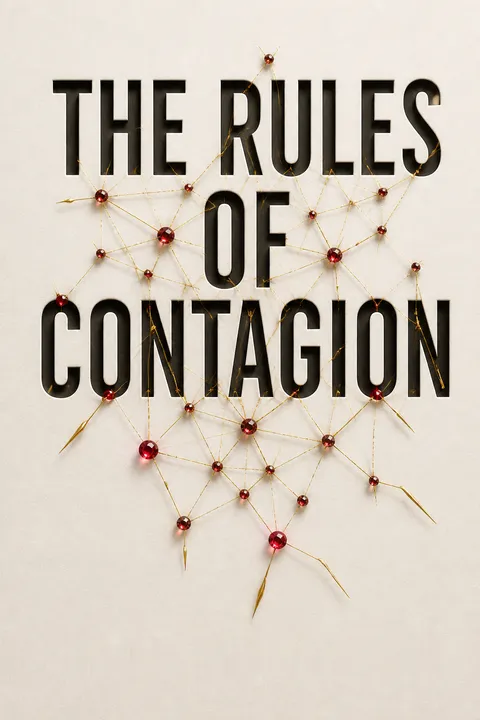
The Rules of Contagion explores how diseases, ideas, and behaviors spread, applying epidemiological concepts to various fields. Readers appreciated the book's timely insights, especially regarding pandemics, and found the explanations of key concepts like R0 helpful. Many enjoyed the diverse examples and connections drawn between different types of contagion. However, some felt the book lacked cohesion and strayed too far from its core focus on diseases. Overall, reviewers found it informative and thought-provoking, despite occasional criticisms of its structure and depth.
People Also Read









Glossary
Theory of Happenings
Model of event spreadRonald Ross’s proposal for studying how the number of people affected by an event changes over time. It distinguishes independent happenings, where one person’s experience does not affect another’s chances, from dependent happenings, where the number already affected changes the likelihood of further spread. The framework was intended to apply beyond infectious disease.
SIR model
Three-stage epidemic modelA mathematical model that divides a population into susceptible people, infectious people, and recovered people. People move from susceptible to infectious through transmission, then from infectious to recovered. The model helps explain why an epidemic can peak and decline while some people remain susceptible, because the number of new infections can fall below the number recovering.
reproduction number
Average onward infectionsThe average number of new infections caused by one infectious person in a specified population and set of conditions. Above one, infections can grow; below one, they tend to decline. The value changes with factors such as immunity, contact patterns, and control measures, so it is not a fixed property of a pathogen.
DOTS
Four transmission componentsA shorthand for the four factors that determine a reproduction number: Duration of infectiousness, Opportunities to transmit, Transmission probability per opportunity, and average Susceptibility of the population. Breaking transmission into these components helps identify possible control measures, such as reducing contact opportunities or lowering susceptibility through vaccination or preventive treatment.
herd immunity
Population-level transmission barrierA condition in which enough people are immune that an infection cannot spread effectively through a population, even though some individuals remain susceptible. Immunity can arise after infection or through vaccination. It can indirectly protect people who cannot be vaccinated, but the required level varies with how readily the infection spreads.
superspreading
Highly uneven transmissionA pattern in which a small share of infected people or events account for a large share of onward transmission. It can arise from individual differences, chance, setting, or failures to detect infection. The term describes an outcome, not a permanent type of person, and average transmission measures alone do not reveal how unevenly spread is distributed.
small-world network
Clusters joined by shortcutsA network in which most connections are local or clustered, while a smaller number of long-range links connect distant groups. Such shortcuts can let information, infections, or shocks move quickly between otherwise separate communities. The same structure can support useful connections while creating routes for rapid contagion.
complex contagion
Spread needing repeated exposureA form of social transmission in which one exposure is not enough to prompt adoption. People may need to encounter an idea or behaviour from several contacts before they trust it, see it as socially acceptable, or find it worthwhile. This helps explain why tightly connected groups can support adoption even when distant links alone do not.
phylogenetics
Reconstruction of evolutionary relationshipsThe study of relationships among organisms or other evolving entities. Researchers compare genetic sequences, physical traits, or cultural features to estimate how lineages or traditions are related and when they diverged. Phylogenetic evidence can help reconstruct the history of an outbreak, but usually cannot establish every transmission event or prove intent.
nowcasting
Estimate of current conditionsAn estimate of what is happening now, made from data that are incomplete or delayed. During an outbreak, cases may take days to be reported, making the latest figures look artificially low. Nowcasting adjusts for known reporting delays so decision-makers can assess the present before attempting to forecast the future.
big seed marketing
Reach many people initiallyA marketing strategy that exposes a message to a large audience at the outset rather than relying on strong person-to-person transmission. If the message is shared modestly, that initial reach can still produce substantial total exposure. The approach reflects the finding that many online campaigns do not spread widely through sharing alone.
dual-use technology
Technology with competing usesA technology or body of knowledge that can create benefits and harms depending on how it is applied. Data analysis can help detect disease or improve services, while also enabling surveillance or manipulation. The term highlights why researchers and designers must consider downstream uses, safeguards, and the distribution of risks as well as intended benefits.
FAQ
What's The Rules of Contagion about?
- Exploration of contagion: The book examines why certain ideas, behaviors, and diseases spread while others do not, covering social behaviors, financial crises, and infectious diseases.
- Interconnectedness of outbreaks: Adam Kucharski highlights connections between seemingly unrelated phenomena, such as how financial crises can mirror disease outbreaks.
- Mathematical modeling: The author discusses using mathematical models to predict and analyze outbreaks, focusing on transmission dynamics like the reproduction number (R).
Why should I read The Rules of Contagion?
- Insightful connections: The book provides a unique perspective on contagion in various aspects of life, relevant for public health, sociology, and economics.
- Real-world applications: Kucharski's analysis offers practical insights for managing disease outbreaks and understanding social media trends.
- Engaging storytelling: The author uses compelling narratives and historical examples to make complex concepts accessible and engaging.
What are the key takeaways of The Rules of Contagion?
- Understanding contagion dynamics: Recognizing the stages of contagion, including spark, growth, peak, and decline, is crucial for various contexts.
- Role of social networks: Social connections significantly influence the spread of ideas and behaviors, with "small-world" networks being particularly relevant.
- Intervention strategies: Effective outbreak control involves targeted interventions and understanding the importance of timing.
What is the reproduction number (R) in The Rules of Contagion?
- Definition of R: The reproduction number (R) represents the average number of secondary infections produced by one infected individual in a fully susceptible population.
- Implications of R values: An R greater than one indicates likely spread, while an R less than one suggests the outbreak will decline.
- Factors influencing R: Duration of infectiousness, number of contacts, and transmission probability are key factors affecting R.
How does The Rules of Contagion relate contagion to financial crises?
- Financial contagion concept: The book draws parallels between infectious diseases and financial crises, describing how economic problems propagate through interconnected systems.
- Historical examples: Kucharski discusses crises like the 2008 financial meltdown to illustrate contagion's impact on economies.
- Mathematical modeling in finance: Models are used to analyze and predict financial contagion, identifying vulnerabilities in the financial system.
What is the concept of complex contagion in The Rules of Contagion?
- Multiple exposures needed: Complex contagion requires several interactions or exposures before behaviors or ideas are adopted.
- Social reinforcement: Social networks play a crucial role, where multiple friends engaging in an action increases adoption likelihood.
- Contrast with simple contagion: Unlike simple contagion, complex contagion relies on social context and repeated interactions.
How does The Rules of Contagion relate to public health?
- Epidemiological insights: The book parallels infectious disease spread with information dissemination, offering lessons for public health strategies.
- Behavioral interventions: Understanding contagion can inform strategies to increase vaccination rates and reduce misinformation spread.
- Case studies: Historical examples, like the smallpox vaccination campaign, illustrate applying contagion principles to improve health outcomes.
How does social media influence contagion according to The Rules of Contagion?
- Echo chambers: Social media can create echo chambers, reinforcing existing beliefs and affecting idea spread.
- Algorithmic impact: Algorithms determine content visibility, amplifying some messages while suppressing others, influencing public perception.
- Viral content dynamics: Understanding social media sharing mechanics is crucial for effective communication of important messages.
What are the stages of an outbreak as described in The Rules of Contagion?
- Four main stages: The stages are spark, growth, peak, and decline, each with distinct characteristics and implications.
- Importance of the spark: Identifying factors contributing to the initial spark helps predict future outbreaks.
- Multiple peaks: Some outbreaks, like the 2009 flu pandemic, may experience multiple peaks, informing public health responses.
What are some examples of contagion in behavior discussed in The Rules of Contagion?
- Obesity and smoking: Behaviors like obesity and smoking spread through social networks, influenced by friends and family.
- Emotional contagion: Emotions spread through social interactions, affecting group dynamics and individual well-being.
- Complex contagions: Some behaviors require multiple exposures, suggesting social reinforcement is necessary for spread.
How does The Rules of Contagion suggest we can control outbreaks?
- Targeted interventions: Understanding social networks and contagion dynamics allows for more effective resource allocation.
- Behavioral change: Changing social norms and behaviors through community engagement and education can reduce contagion spread.
- Monitoring and response: Continuous monitoring and rapid response to emerging cases are crucial for controlling contagion.
What future implications does The Rules of Contagion suggest for society?
- Need for adaptive strategies: Understanding contagion is crucial for addressing emerging challenges in an interconnected society.
- Importance of data literacy: Individuals and organizations need to become more data-literate to navigate information spread complexities.
- Potential for positive change: Applying contagion principles can harness social networks to promote beneficial behaviors and ideas.
Download PDF
Download EPUB
.epub digital book format is ideal for reading ebooks on phones, tablets, and e-readers.








