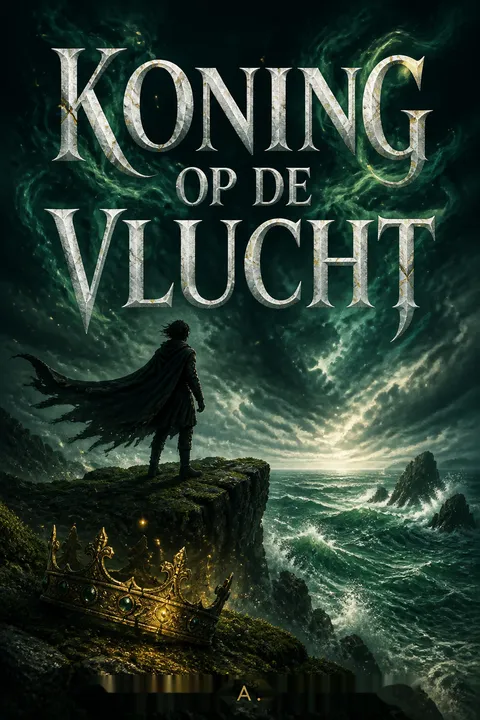


Plot Summary
The Garden Ambush
Only a month into his reign, Jaron slips away from his family’s funeral to escape courtiers who doubt he belongs on Carthya’s throne. In the gardens, he surprises one intruder, then finds himself trapped by a second attacker: Roden, the former friend who once competed with him for the crown. Roden says the pirates will destroy Carthya unless Jaron surrenders at Isel in ten days.
They also want Bevin Conner, the imprisoned nobleman behind the plot that killed Jaron’s family. Roden wounds Jaron and knocks him unconscious before fleeing. The attack turns Jaron’s private grief into a national emergency, and his knowledge that Avenian King Vargan has arrived at court makes the threat feel coordinated.
The opening makes the crown less a prize than a target Jaron cannot set down. His instinct to avoid the funeral reflects grief complicated by a family history he does not yet know how to interpret. Roden’s attack then forces private conflict into public responsibility: surrender would save lives only by leaving Carthya exposed to the pirates’ power. Jaron’s quick defiance shows courage, but also the impulsiveness that makes his judgment easy for others to question. The story begins with him already performing kingship while unsure that anyone around him will accept him as king.
The Friend He Sends Away
After the attack, Imogen, the former servant who helped Jaron survive Conner’s schemes, finds him outside the chapel and binds his wounded arm. Knowing the pirates could target her to hurt him, he cruelly denies their friendship and orders her away. He then confronts Vargan, who proposes taking a Carthyan spring in exchange for peace; Jaron refuses and warns him against using pirates to make war.
Captain Gregor Breslan dismisses Jaron’s suspicions because he lacks proof, even after seeing the bandage. Jaron’s isolation deepens: Imogen leaves believing he despises her, while Gregor treats his alarm as youthful paranoia. Jaron decides Conner may know how the old assassination plot connects to the present threat.
Jaron protects Imogen by taking away her ability to choose whether to share the danger. His deliberate cruelty works as camouflage, but it also repeats the court’s habit of treating other people as pieces to be moved for their own safety. Meanwhile, Vargan’s offer frames territorial loss as peace, a bargain Jaron recognizes as a slow surrender. Gregor’s skepticism is not merely an obstacle; it exposes how little credibility Jaron has earned among the adults who control the kingdom’s institutions. He is right to fear invasion, but rightness alone cannot yet make others follow him.
A Throne Under Custody
In the tower prison, Conner confirms that a pirate named Devlin supplied the rare poison used to kill Jaron’s family. He insists that he alone can help, but Jaron refuses to free him.
Gregor’s hand moves to his sword when Jaron asks how Conner smuggled the poison into the castle, an odd reaction Jaron notices without understanding. The regents, meeting without their king, decide to hide Jaron, surrender Conner, and install a steward. Jaron agrees to leave only after securing nine days before their decision, then secretly plans to reach the pirates himself.
He gives Tobias the royal ring and instructions to impersonate him at court, while Mott accompanies the supposed journey. The plan buys Jaron time, but leaves Tobias exposed to court politics.
The prison scene plants a clue whose importance Jaron cannot yet name: Gregor’s alarm at a question about access to the castle. The regents’ response turns their fear for Jaron into a political mechanism for removing him from power. Their proposed hiding place would preserve his body while abandoning his authority, a distinction Jaron refuses to accept. His decision to go undercover is therefore both strategic and personal. By asking Tobias to wear the crown, he keeps the court from mistaking his departure for surrender, but transfers danger to a friend who has little experience with power.
Nila at the Border
Riding toward Avenia, Jaron hears a child screaming and finds Nila beside her dying mother. Avenian raiders have killed Nila’s father and mortally wounded her mother, who asks Jaron to take the girl to her grandfather in Libeth. He buries the woman and brings Nila to Rulon Harlowe, a local landowner who welcomes them and gives Jaron food, clean clothes, and rest.
Harlowe’s servants explain that the raids have driven farming families from their homes, while officials told them to move inland rather than risk angering Avenia. The news unsettles Jaron’s faith in his father’s cautious rule. Before leaving, he asks Harlowe to conceal his visit and receives the man’s treasured pocket watch.
Nila’s loss gives the border conflict a human scale that court reports have kept abstract. Jaron cannot undo the raid, but he can carry one child out of its reach, a modest act with immediate consequences. Harlowe’s hospitality offers a contrast to the palace: care is given without demanding proof of rank or usefulness. The watch becomes a quiet bond between the stranger and the family he has helped. At the same time, learning that officials urged vulnerable farmers to retreat forces Jaron to question whether his father’s preference for peace protected Carthya, or merely left its poorest citizens to pay for it.
The Dead Priest’s Name
In the rough Avenian town of Dichell, Jaron finds the church where a priest once sheltered him. A street boy called Fink reveals that pirates killed the priest four years earlier, after he tried to help the lost prince. Fink identifies the killer as Devlin, now pirate king, and leads Jaron toward a thieves’ camp.
The thieves’ leader, Erick Loman, agrees to take Jaron to the pirates if he proves useful and shares a supposed route to Carthya’s hidden royal treasury. Jaron claims he can reveal the treasure’s location, though he intends to keep it from the pirates. He accepts Erick’s terms because he has no other way to reach Devlin. The priest’s death turns Jaron’s mission from political necessity into a personal reckoning.
The dead priest links Jaron’s private survival to a cost he never knew someone else had paid. His guilt is sharpened by the fact that Fontelaine died protecting a boy he believed was the prince, though Jaron was then living under another identity. Fink and Erick offer access through the same economy that has shaped their own lives: information, food, and safety are traded rather than freely given. Jaron adapts by using the royal treasury as bait. The strategy is clever, but it depends on a lie that could endanger everyone who helps him.
The Watch Is Stolen
To prove himself to Erick’s thieves, Jaron leads them to Harlowe’s estate, intending to steer them away from vulnerable farmers. He plans to take only money, but Erick takes Harlowe’s pocket watch as well. When Mott appears, Jaron cuts Mott’s arm to make Erick believe he has killed the man who recognized him; Mott accepts the injury to protect Jaron’s secret.
On the ride back, Vargan’s soldiers seize the thieves’ stolen goods and begin conscripting them into Avenia’s army. Jaron covers his face with bloody bandages and pretends to have plague sores. Vargan releases the entire group rather than risk infection. Jaron has bought their freedom, but Harlowe’s watch remains with Erick and the robbery has wounded a generous man’s trust.
Jaron’s attempt to divert the thieves away from poorer families still makes him complicit in robbing the person who treated him kindly. His choices have practical limits: he can reduce harm, but cannot keep every ally from paying for his deception. Mott’s willingness to bleed for him reflects a bond built through shared hardship, not ceremonial loyalty. The plague ruse shows Jaron’s talent for turning an opponent’s fears against him, yet it also reinforces his dependence on performance. To move safely through Avenia, he must continually make others believe he is someone else.
Branded at Tarblade
At Tarblade Bay, Erick presents Jaron and Fink to the pirates, who lock them up while they consider the offer. Jaron is stunned to discover Imogen working in the camp kitchen. She is angry that he sent her away without trusting her with the truth, but she has followed after recognizing that his supposed disappearance is a cover for a dangerous plan.
Devlin tests Jaron’s nerve, demands the location of the treasury, and makes him swear loyalty to the pirate code. Jaron agrees to survive the encounter, then receives the pirates’ serpent brand on his arm. He has entered the enemy’s ranks, but his promise to Devlin is a trap: Jaron has no intention of surrendering Carthya’s wealth or abandoning his country.
The brand makes Jaron’s disguise physical. He can speak as an Avenian thief, but the burned mark places him inside a community whose rules can be enforced on his body. Imogen’s presence complicates the protection he meant to provide: she has chosen the danger for herself, challenging Jaron’s assumption that care means control. His oath is a survival tactic, yet it creates a genuine obligation under the pirates’ law. The scene tests the gap between outward belonging and inward allegiance, a gap Jaron must manage without losing sight of the people his choices place at risk.
A Test at Tarblade
Agor, a senior pirate, tests Jaron’s theft skills, while Jaron deliberately loses a practice bout so the camp will underestimate him. When Devlin captures a ship’s navigator, Swifty Tilagon, Jaron persuades the pirates to delay killing him, then secretly frees him before the crew can exploit the cargo sale.
The escape brings punishment for the young pirate assigned to guard Tilagon. Jaron intervenes, and Devlin tests his boast that he can escape knots by dunking him underwater; Jaron frees himself.
Later, Devlin tries to provoke him into a sword fight by mocking the murdered priest. Jaron refuses to strike, recognizing that revenge could make him resemble Devlin. Imogen then warns that Roden is returning and that the attack on Jaron was personal.
Jaron’s deliberately poor swordsmanship is a strategic performance, but it also reflects his distrust of a culture that equates strength with domination. The captured sailor lets him act on a moral boundary even while he is embedded among pirates. His refusal to kill Devlin is more difficult than a simple test of nerve: he sees that anger could make him reproduce the violence he claims to oppose. Imogen’s warning redirects the plot from Devlin alone toward a more intimate danger. Roden is not merely an enemy commander; he is someone whose history with Jaron makes the coming confrontation emotionally unstable.
Gregor’s Hidden Bargain
Imogen tells Jaron that Roden is expected back, and her warning helps him recognize the clue from Conner’s prison visit: Gregor reached for his sword when Jaron asked how the poison entered the castle. Jaron concludes that Gregor helped Conner and is now working with the pirates.
He sends Imogen and Fink away with Harlowe’s watch and a letter for Mott, but Gregor recaptures them and brings them to Tarblade. There he offers Conner to Devlin and promises the pirates safe passage into Carthya once the regents make him steward. Jaron steps forward to protect Imogen, admits he stole the watch, and reveals to the pirates that he is King Jaron. His hidden identity can no longer shield him.
The revelation depends on Jaron revisiting a small gesture rather than receiving a confession. Gregor’s hand on his sword turns an ordinary question into evidence once Jaron understands the context of the palace searches. Imogen and Fink’s escape plan shows the loyalty Jaron inspires even when he has withheld the truth from them. Gregor’s proposal exposes the political danger behind the attack: the pirates are not simply an external enemy but a force invited in by someone seeking domestic power. Jaron’s disclosure ends his most useful disguise, but lets him redirect the threat toward himself.
Devlin’s Crown Is Challenged
Devlin orders Jaron to reveal the treasury and threatens Imogen when he refuses. Jaron invokes the pirate code and challenges Devlin for the kingship, forcing a duel instead of allowing the pirates to punish her. He fights faster than the larger man, wounds his shoulder, and knocks away his sword. Rather than kill Devlin, Jaron demands safe passage for Imogen in exchange for his own captivity.
Devlin accepts, and Jaron cuts Imogen free before the pirates seize him. The choice saves her from immediate punishment but leaves Jaron in the hands of men who have every reason to extract the treasury’s location. He has won the duel, yet refuses the crown before the pirates have accepted him as their leader.
Jaron uses the pirate code not because he trusts it, but because its rules offer a narrow protection when ordinary appeals would fail. Winning the duel demonstrates competence he has concealed, but his decision afterward matters more: he refuses to treat victory as permission to rule a hostile crew. By trading his freedom for Imogen’s, he acts from devotion while also repeating the habit of making decisions on her behalf. The scene complicates heroism. Jaron saves someone he loves, but the bargain places his own survival and Carthya’s future in greater peril.
Roden Takes Tarblade
Before Agor can whip Jaron for withholding the treasury’s location, Roden returns and stops him. Roden and Devlin argue over their earlier agreement about Jaron, then Roden kills Devlin and declares himself pirate king. He orders Jaron locked in a high room with Fink and Erick.
Though Roden initially leaves him alive for a public execution, he breaks Jaron’s leg with a club to prevent escape. The injury leaves Jaron chained and unable to walk, while Roden prepares a feast where he plans to kill him in front of the pirates. Roden has taken control of the camp, but his treatment of Jaron shows that their old rivalry is still driving his choices.
Roden’s intervention first appears to save Jaron from torture, but it does not restore their friendship or make Jaron safe. Killing Devlin gives Roden power in a community where authority is won through violence; breaking Jaron’s leg then turns that power into personal revenge. The shift also reveals Roden’s divided motives. He wants to rule the pirates, but he remains fixated on the boy he believes cheated him of a throne. Jaron’s physical vulnerability strips away his usual escape options, forcing the next contest to depend on endurance, ingenuity, and whether Roden can be reached by anything other than force.
The Cliffside Duel
With the pin Imogen left him, Jaron unlocks his restraints. Erick cuts away his boot while Fink helps brace the broken leg, and together they lift him to the window. Jaron climbs the cliff using vines and exposed rock, then finds a knife hidden beneath Imogen’s flowers and gets food from Serena. He reaches Roden’s feast and challenges him with a splintered wooden sword.
During the fight, Jaron offers Roden a place as Carthya’s captain of the guard, insisting he can use his hunger to matter in a better cause. A pirate interferes and injures Jaron’s leg again, but Roden stops the man and yields. He renounces the pirate crown and pledges loyalty to Jaron, who becomes their king.
The climb turns survival into a collective act. Imogen’s pin and hidden knives, Erick’s practical help, Fink’s assistance, and Serena’s food each supply something Jaron cannot provide alone. His body carries the cost of the decisions that brought him here, yet he keeps moving toward a confrontation he could avoid only by surrendering his people. In the duel, his offer to Roden is not sentimental forgiveness; it is a political claim that a rival’s strength can serve a shared future. Roden’s submission makes loyalty a choice rather than merely the victor’s reward.
A King Comes Home
Jaron appoints Erick to oversee the pirates and makes them swear not to harm Carthya. He leaves Gregor in pirate custody, chooses Harlowe as prime regent, and travels with Roden, Mott, and Fink to recover. At Harlowe’s home, Imogen returns, but refuses to go back to court; she accepts a place caring for Nila and urges Jaron to build a life with Amarinda.
Jaron and Mott repair their friendship, while Amarinda explains that she had suspected Gregor and had stayed close to him to seek evidence. They reconcile and agree to face their future together. When Jaron returns to Drylliad, citizens welcome him as their king. For the first time, he believes the people want him there.
The return resolves the crisis through relationships as much as military arrangements. Erick’s appointment converts the pirates from a threat into a constrained ally, while Harlowe’s elevation brings someone attentive to ordinary people into the court. Jaron also has to accept that protecting Imogen cannot mean claiming her future; she chooses a life away from him, and he accepts the loss without treating it as betrayal. Reconciliation with Amarinda begins through honest recognition of their mutual distrust. The welcome in Drylliad answers the book’s central political question: whether blood alone makes a king, or whether people must choose to follow him.
The Borders Break
After two months of recovery and a fragile calm, Jaron is training again when Harlowe, Mott, and Amarinda bring news from Libeth. Avenian soldiers have attacked the town, and Nila escaped with one of Harlowe’s servants. Imogen has been taken, apparently because the enemy knows she matters to Jaron.
The danger does not stop at the western border: Gelyn advances from the north and Mendenwal from the east. Carthya is surrounded, and the war Jaron had feared has begun on several fronts. The return home has restored his authority and brought allies to his side, but it has not made the kingdom safe. The book ends with Jaron facing a new crisis and Imogen once again in enemy hands.
The ending overturns the relief of Jaron’s homecoming without invalidating what he achieved. He has secured the pirates’ pledge and regained the public’s confidence, yet political legitimacy cannot stop three neighboring armies from moving at once. Imogen’s capture turns the international conflict into a personal threat, echoing Roden’s earlier promise to target the person Jaron loves most. The attack on Libeth also brings the border families’ vulnerability back to the center of the story. The unresolved ending tests whether Jaron can now combine the courage that carried him into danger with the trust and cooperation he has slowly learned to accept.
Analysis
The Runaway King asks whether a ruler can protect a country without becoming a version of the people who threaten it. Jaron’s first instinct is to treat himself as the expendable piece: he sends Imogen away without explanation, leaves Tobias to impersonate him, and enters the pirates’ camp expecting to solve the crisis alone. Each sacrifice has a cost. His secrecy injures trust, and his violence risks turning courage into the same appetite for control he sees in Devlin and Gregor.
The novel’s political conflict is grounded in concrete failures of care. Border farmers are told to retreat rather than protected; regents treat Jaron’s removal as a way to preserve stability; Gregor turns public fear into a route to power. Against this, Harlowe’s welcome and the pirates’ eventual oath offer models of authority built on responsibility. Jaron’s strongest decisions occur when he stops treating loyalty as something he can demand. He accepts help from Erick, Fink, Serena, and Imogen, and offers Roden a meaningful role rather than merely defeating him.
The friendships are not ornamental subplots. They test Jaron’s understanding of leadership. Mott’s loyalty includes opposition; Amarinda’s political insight becomes visible only when Jaron allows her to explain herself; Imogen’s care cannot be reduced to obedience. Her decision to remain in Libeth marks a real loss, even as Jaron and Amarinda begin to build a partnership. The citizens’ welcome answers Jaron’s fear that he is king only by blood, while the invasion that follows prevents that recognition from becoming a tidy ending. Public trust gives him a reason to lead, not a guarantee of victory. The closing threat therefore carries forward the book’s central tension: Jaron must protect Carthya through cooperation, while resisting the lonely certainty that only he can act.
Review Summary
The Runaway King receives mixed reactions with an overall 4.24/5 rating. Fans praise protagonist Jaron's wit, humor, and character development, along with fast-paced action and new characters like Fink. Many find it an excellent sequel with emotional depth and engaging pirate adventures. However, critics note the plot feels predictable and contrived compared to the first book, with convenient coincidences and less tension. Common complaints include Jaron's reckless decisions justified by luck, underwhelming villains, an unconvincing love triangle, and pacing issues. Despite flaws, most readers enjoyed the adventure and are invested in the series' conclusion.
Characters
Jaron
The reluctant kingKing of Carthya, Jaron is quick-witted, physically daring, and more comfortable improvising than asking for help. Years spent surviving under the name Sage taught him to distrust authority and use misdirection as protection. His sharp humor can conceal grief, fear, and a deep need to belong, while his refusal to appear vulnerable often hurts the people trying to stand beside him. He takes kingship seriously, but resists the formal habits that separate rulers from ordinary citizens. Jaron’s central psychological tension is between self-reliance and responsibility: he believes he must carry danger alone, even when his choices affect the friends and subjects he hopes to protect.
Imogen
The loyal truth-tellerImogen is a former servant who has earned Jaron’s trust through loyalty, clear judgment, and practical courage. Her modest origins do not make her deferential; she speaks plainly when Jaron’s pride or secrecy threatens to cloud his decisions. She is compassionate without being passive, and her care often takes concrete forms, from treating injuries to finding ways through locked doors. Imogen values being trusted as a person capable of choosing risk for herself. Her bond with Jaron is complicated by affection, but she does not define her life solely around him. She brings emotional clarity to a court and pirate camp where people often disguise their motives.
Roden
The rival with a swordRoden is an orphan trained alongside Jaron at Farthenwood, where the boys were made to compete for the identity of Carthya’s lost prince. He is a disciplined fighter whose pride is bound to the belief that he deserves a consequential place in the world. Rejection and rivalry make him vulnerable to anyone promising him importance, while his skill and intensity make him dangerous when he feels cheated. Beneath his ambition is a desire to be recognized as more than an interchangeable orphan. Roden’s relationship with Jaron carries the weight of genuine early companionship as well as resentment, making their conflict more intimate than a contest between strangers.
Amarinda
The wary future queenPrincess Amarinda of Bultain is Jaron’s politically arranged betrothed and the niece of Carthya’s principal ally. She is observant, socially capable, and more politically perceptive than Jaron initially assumes. Her friendships at court can look like divided loyalties, but they also give her access to information and influence. Amarinda wants a genuine partnership rather than a ceremonial place beside a king, and she is willing to take risks for Carthya even when Jaron tries to keep her safe by excluding her. Her reserve reflects a careful effort to understand people before trusting them. She expects to be treated as a participant in the kingdom’s future, not as an ornament.
Mott
The steadfast protectorMott, once Conner’s servant, is a formidable man whose blunt manner hides a strong capacity for loyalty. His history at Farthenwood ties him to Jaron’s painful past, including moments when both were forced to obey cruel authority. Mott does not confuse affection with agreement: he challenges Jaron’s reckless decisions, worries about the boy beneath the crown, and still stands beside him when danger arrives. He is attentive to practical needs, from tending a wound to judging when a plan is too dangerous. Mott’s loyalty is not passive obedience; it is a chosen commitment that includes holding Jaron accountable and refusing to let him mistake solitude for strength.
Tobias
The thoughtful stand-inTobias is one of the orphans Conner trained as a possible substitute prince. More patient and reflective than Jaron, he prefers teaching and careful thought to fighting. His friendship with Jaron survives the deception and competition of Farthenwood, though he is honest about the danger of Jaron’s plans. When asked to impersonate the king, Tobias accepts a role that requires composure rather than force. He is not a natural courtier, but his intelligence and steadiness help protect Carthya while Jaron is away.
Bevin Conner
The calculating courtierConner is a nobleman whose ambition once led him to train orphan boys as possible replacements for Carthya’s missing prince. Imprisoned after his schemes were exposed, he remains persuasive, self-justifying, and alert to other people’s weaknesses. He considers himself a patriot, though his definition of service allows him to rationalize brutal choices. His knowledge of the court and its history makes him both a valuable source of information and a dangerous person to trust. Even in confinement, Conner tries to shape Jaron’s understanding of the past and the threats facing the kingdom.
Devlin
The pirate kingDevlin rules the pirates at Tarblade Bay through force, discipline, and a strict code that protects the crew’s authority. He is calculating enough to recognize the value of Jaron’s claimed knowledge of Carthya’s treasury, but his appetite for power makes every bargain dangerous. Devlin treats fear as a tool and sees punishment as a way to secure obedience. His story is tied to Jaron’s earliest years in Avenia and the violence that followed the prince’s escape. Devlin’s view of loyalty is transactional: people are useful when they strengthen his position and disposable when they do not.
Gregor Breslan
The trusted guard captainGregor is Carthya’s captain of the guard, an experienced soldier whose sternness and competence give him influence over the regents. He values order and sees himself as a practical answer to the instability surrounding a young king. Jaron finds him grating and overly cautious, while Gregor believes the king’s instincts need evidence and discipline. Their disagreements are not only personal: Gregor’s position allows him to shape how the court interprets danger. He understands military realities, but his confidence in his own judgment can harden into a belief that he knows what is best for the country.
King Vargan
The expansionist monarchVargan is Avenia’s aging king, a shrewd political operator who presents territorial demands as reasonable compromises. He studies Jaron during a visit to Carthya and tests how firmly the young ruler will defend his borders. Vargan prefers to pursue power through pressure, alliances, and other people’s violence, while keeping room to deny responsibility. His interest in Carthya’s land and resources makes him a persistent external threat. He underestimates how quickly Jaron can read a provocation, though he also recognizes the young king’s courage.
Erick Loman
The thieves’ leaderErick commands a band of Avenian thieves and sees the pirates as a route to greater status. He is suspicious of Jaron but respects practical competence, especially when it can benefit his group. Erick’s life among criminals has not erased his capacity for fairness; he objects when thieves harm women and children and values rules that protect the vulnerable. His ambitions and his conscience pull in different directions. Jaron’s arrival forces Erick to decide whether leadership means taking whatever can be seized or accepting responsibility for the people who follow him.
Fink
The streetwise childFink is a hungry boy in Dichell who survives by gathering information, making bargains, and reading the people around him. He has no secure family or clear path into adulthood, so he is drawn to groups that promise belonging, even when they treat him as a servant. His talent for feigning tears is comic, but it is also a practical survival skill in a world where children have little leverage. Fink’s curiosity and persistence make him both an irritant and a useful companion to Jaron, who recognizes the cost of leaving a child to fend for himself.
Rulon Harlowe
The generous country lordHarlowe is a landowner in Libeth who feels responsible for the people living around his estate. He has endured family grief without turning away from others, and his hospitality is direct rather than ceremonial. Harlowe offers food, shelter, and practical help to a wounded stranger before knowing his identity. His calm judgment contrasts with the palace’s political suspicion, while his concern for local farmers keeps the consequences of national policy visible. He is reluctant to enter court politics, but his sense of duty makes him difficult to keep on the sidelines.
Nila
The orphaned farm girlNila is a young girl whose family lives among the farmers on Carthya’s exposed border. After an attack destroys her home, she must rely on strangers to reach her grandfather in Libeth. Her small acts of trust, including leading Jaron to her wounded mother, reveal both her vulnerability and her determination. Nila’s loss gives Jaron a personal view of the border raids and connects his decisions at court to the lives of ordinary families.
Fontelaine
The sheltering priestFontelaine is the priest who once gave Jaron refuge in Dichell when the boy was lost in Avenia. He is remembered through the stories of street children and the neglected church he served. His willingness to shelter vulnerable boys made him a threat to the pirates’ secrecy, and his memory becomes a source of grief and moral urgency for Jaron.
Serena
The helpful kitchen workerSerena works in the pirates’ kitchen and treats Jaron with uncomplicated kindness. She notices that he is underfed and later gives him a chance to eat when he is hiding from the camp. Her gestures are small but practical, offering help without demanding an explanation. In Tarblade, where most relationships are governed by suspicion and rank, Serena’s decency gives Jaron a brief reminder that kindness can survive even in hostile places.
Agor
Devlin’s senior enforcerAgor is one of Devlin’s senior pirates and helps enforce the camp’s rules. He is physically imposing, suspicious of newcomers, and quick to test whether they deserve a place among the crew. Agor’s attention to loyalty reflects a pirate community where weakness can invite challenge. He respects competence, but his authority depends on violence and on protecting those above him. Jaron’s arrival gives him a reason to question both the boy’s abilities and the wisdom of Devlin’s decisions.
King Eckbert
Jaron’s cautious fatherJaron’s late father, King Eckbert, left a legacy of caution and political compromise that shapes how his son approaches the threat from Avenia. Jaron struggles to distinguish prudence from fear and wonders what his father knew about the suffering on the border. Though absent from the present action, Eckbert remains an emotional and political presence in Jaron’s attempt to rule differently.
Darius
Jaron’s absent brotherDarius was Jaron’s older brother and the heir expected to marry Amarinda before the family’s deaths changed the succession. Jaron remembers him through the formal praise offered at the funeral and through the responsibilities that have fallen to himself. Darius represents the life and role Jaron might have inherited under very different circumstances.
Plot Devices
Sage’s borrowed identity
A mask for infiltrationJaron’s years of passing as an orphan named Sage give him a believable identity to use in Avenia. He adopts worn clothing, an Avenian accent, and a rough appearance to enter the thieves’ world without announcing himself as Carthya’s king. The disguise helps him reach Tarblade, but it also depends on controlling what friends and enemies know. Roden’s return and Gregor’s arrival eventually make the secret impossible to keep.
The royal treasury cave
Bait for pirate accessJaron claims he can lead the thieves and pirates to a hidden cave where Carthya keeps much of its wealth. The promise gives Erick a reason to bring him to Tarblade and gives Devlin a reason to keep him alive. Jaron uses the treasure as leverage, not as a gift: he never intends to reveal its location to enemies. The cave also raises the stakes beyond Jaron’s life, since exposing it would place Carthya’s resources in hostile hands.
The pirate code
Rules that create leverageThe pirates follow a code governing loyalty, punishment, and the authority of their king. A serpent brand marks Jaron as a member, and the code gives him the right to challenge Devlin for leadership. Its protections are limited and can be twisted by the people enforcing them, but Jaron uses the rules to prevent an immediate attack on Imogen. The code turns an otherwise chaotic camp into a political system with procedures Jaron can exploit.
The borrowed royal ring
A false king at courtBefore leaving Farthenwood, Jaron gives Tobias his royal ring and asks him to impersonate the king at Drylliad. Tobias’s resemblance and the cover of darkness help preserve the appearance that Jaron is only hiding in his chambers, delaying the regents’ attempt to replace him. The substitution buys time, but it places Tobias in a dangerous position and depends on Amarinda and Kerwyn protecting the deception. It is one of Jaron’s most consequential acts of trust.
Harlowe’s watch and flowers
A trail of practical aidHarlowe’s pocket watch begins as a token of trust between Jaron and a stranger who offers him shelter. When Jaron steals it during the thieves’ raid, it becomes a reminder of the harm caused by his plan. Later, Imogen carries the watch away from Tarblade, while the flowers she plants conceal supplies that help Jaron survive his escape. The objects connect kindness to action: people who care for Jaron leave him tools he can use when he is isolated.
Download PDF
Download EPUB
.epub digital book format is ideal for reading ebooks on phones, tablets, and e-readers.








