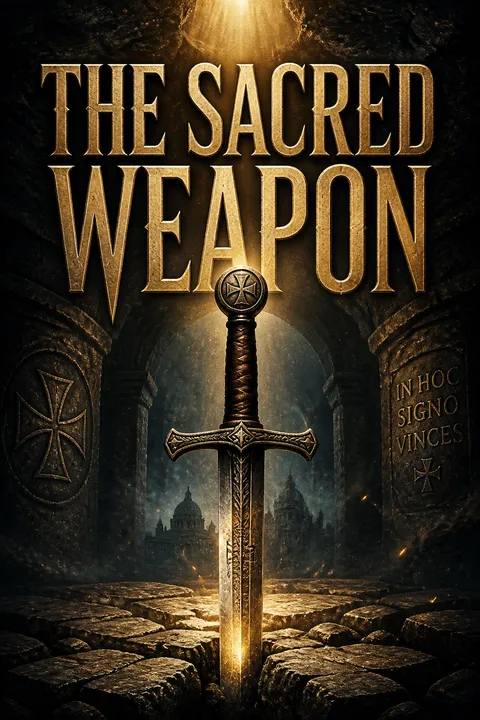


Plot Summary
Europe's Relics Disappear
In Turin, Jacinto Guerra and his armed crew take the Shroud of Turin, adding it to relics stolen across Europe, including the Crown of Thorns and the bones of the Three Wise Men. Guerra wants the thefts to frighten the public, and he has already used the Notre Dame fire to make the campaign impossible to ignore.
Outside the cathedral, he kills Raffaele, an orphan who has seen the disguised men, then leaves without hesitation. The next day at Milan airport, Austrian counterterrorism officer Tom Wagner sees a tattoo on a stranger's arm and recognizes the mark from the man who stood beside him after a bombing in Syria killed his parents. A childhood memory, long buried in grief, becomes a trail.
The opening makes sacred objects instruments of public fear rather than private devotion. Guerra treats the relics as signals, and the murdered child exposes the cost of his belief that control justifies cruelty. Tom's recognition turns a continent-wide conspiracy into a personal pursuit. His certainty rests on a child's traumatic memory, however, so the story begins with both a compelling clue and a psychological vulnerability: grief supplies his purpose, but can also distort his judgment.
The Plane's Stolen Phone
On Tom's flight to Vienna, a nervous passenger leaves signs of a weapons handoff in an airplane restroom. Tom spots two apparent hijackers and quietly organizes the crew around a trap: a meal trolley knocks one attacker down while a sudden dip of the plane gives Tom the opening to disarm the other. The passengers escape without serious injury.
Searching the unconscious man, Tom finds the same tattoo he saw in Milan and takes the man's phone before airport officials can secure it. Earlier, he overheard the name François Cloutard during a call in the restroom. Tom has no authority to keep the phone, but his suspicion that it connects the hijackers to his parents' killer outweighs procedure. He asks his friend Noah to investigate.
Tom's competence is real, but so is his habit of replacing institutional process with improvisation. His airborne trap succeeds because he reads people and space quickly; taking the phone, however, converts a useful clue into a liability. The scene establishes a pattern that will propel the novel: Tom can prevent immediate harm, yet his impatience makes the aftermath more dangerous. His private grief also narrows his attention, making the tattoo feel less like evidence to test than a verdict already reached.
The Key at Glastonbury
At Glastonbury, archaeologist Hellen de Mey arrives to meet Father Montgomery, hoping to investigate a legend tied to her family's search for a lost relic. She finds him shot inside the chapel, with the word meteor written in blood. As he dies, he grips the amulet inherited from her grandmother and tells her she will need a key.
A dark-skinned woman secretly photographs Hellen and takes an ancient key from the scene. That woman, Ossana Ibori, soon uses the key to enter a hidden library at Meteora, where she shoots two monks and steals an unusual version of the Chronicle of the Morea. Hellen has not yet learned that someone else is pursuing the same history, but the murder and missing book confirm that her research has become dangerous.
Hellen's investigation begins where scholarly distance fails: she must kneel beside a dying priest and recognize that her inherited amulet matters to the danger around her. The blood-written clue offers a direction without an explanation, preserving the mystery while making her family history newly urgent. Ossana's parallel theft turns Hellen's academic pursuit into a race. Their contrast is already sharp: Hellen seeks context through evidence, while Ossana removes evidence through violence.
Vienna's Treasury Chase
Noah identifies the tattooed airport passenger as Guerra, but their call is cut short when a BMW attacks Tom's Mustang and its gunman steals the phone. Tom survives a high-speed chase through Vienna's crowded streets only by crashing near St. Stephen's Cathedral.
At a UNESCO conference in the Hofburg, he recognizes Guerra entering the Imperial Treasury with armed accomplices. Tom and a young colleague pursue them through the exhibits. The thieves take the Holy Lance, and Guerra escapes amid explosions and gunfire.
Tom's reckless pursuit damages priceless objects and fails to stop the theft, so his commander suspends him. Hellen, attending as a Blue Shield expert, has also witnessed the attack. Tom leaves Vienna with neither official authority nor the evidence he had risked everything to keep.
The chase makes Tom's virtues inseparable from their costs. His alertness allows him to recognize Guerra inside a public institution, but his refusal to wait for support helps turn the Treasury into a second crime scene. The damaged artifacts matter because Tom's rescue instinct cannot simply be called heroic when cultural objects are also endangered. His suspension removes the badge that once gave his impulsiveness a structure, leaving personal obsession as his only permission to continue.
A Murder Names Tom
After the Treasury raid, Tom returns to his houseboat and finds Denise, the flight attendant from his plane, dead on his bed with the Holy Lance in her chest. An anonymous report has already sent police toward him, and Noah warns that Interpol is treating Tom as a fugitive. Tom escapes before officers arrive and follows the only lead he has, Cloutard, to an auction in Switzerland.
There he finds Hellen working as an expert and speaking with the French art dealer. During the sale of Joan of Arc's shield, Tom bids to test Cloutard's interest, while Hellen accidentally bids as well. Gunfire erupts before the auction can settle: Ossana takes the shield, and Guerra's men seize Hellen. Tom escapes the police, but loses her in the getaway.
The murder transforms Tom from a disgraced officer into a man actively hunted by the institutions he once served. The Lance is no longer merely evidence of a theft; someone has made it a weapon for framing him. At the auction, Hellen's independent mission collides with Tom's, exposing their unresolved intimacy under pressure. The sudden abduction prevents either from controlling the encounter. Their shared history creates trust, but it does not erase the old habit of trying to direct one another.
Cloutard's Fortress Betrayal
Tom tracks Cloutard to his fortified home in Tunisia, where Cloutard's companion, Ossana, invites him inside. Tom hopes to trade for the stolen shield and learn where Hellen is held, but Ossana reveals his identity and attacks him.
She orders Cloutard's guards to kill their employer and capture Tom alive. Tom and Cloutard escape through the fortress in a helicopter, leaving Ossana behind with the shield. Cloutard explains that the stolen relics and Hellen are being kept at a villa on Lake Como, and he directs Tom toward Italy.
Their helicopter is ambushed by supposed allies and crashes near Rome. Cloutard is separated from Tom, while Tom, injured and wanted internationally, must continue alone. The art thief becomes his only source of information, not a trustworthy partner.
Cloutard's fortress overturns the polished social world of the auction: wealth and hospitality conceal an organization already compromised from within. Ossana's attack makes personal attraction a tactical danger for Tom, who must escape rather than indulge his curiosity about her. His alliance with Cloutard is pragmatic, not redemptive. The criminal's knowledge is indispensable, but Tom has no guarantee that self-preservation will not shape every fact he offers.
The Chronicle's False Trail
While Hellen is held at the Como villa, Guerra gives her the stolen Chronicle and forces her to search it. She finds references to the Sword of Peter and three marginal clues, then lies that the weapon is hidden at a Syrian castle, buying herself time.
Tom reaches Como by escaping a mercenary assault aboard a speeding train, where he helps Interpol rookie Vittoria and the passengers survive a derailment. Nuns give him a ride, and an old intelligence contact supplies weapons and access plans.
Tom enters the villa through a hidden passage, finds the stolen relics, and frees Hellen with a carefully placed charge. Her clues point them toward Malta, while the decoy sends Guerra away from the real trail. Hellen's research and Tom's improvisation finally work in concert.
This turning point gives Hellen agency beyond being the person Tom must rescue. She uses the captor's demand for expertise to feed him a convincing false destination, converting scholarship into deception without abandoning its evidentiary basis. Tom's route through the train and villa demonstrates his capacity to adapt under pressure, yet the rescue succeeds because Hellen has made time for him. Their partnership becomes strongest when neither is merely the other's protector.
Valletta's Hidden Chamber
Hellen connects the Chronicle's clues to the Order of Malta and leads Tom and Count Palffy to St. John's Co-Cathedral in Valletta. There, the amulet inherited from her grandmother fits a hidden mechanism, revealing a passage beneath a Grand Master's tomb. The three follow concealed chambers and flooded tunnels to a chest containing the Sword of Peter.
Palffy takes the sword, then reveals that he has been directing Guerra's thefts as part of a plan to inflame anti-Muslim panic and impose his idea of cultural order. He leaves Tom and Hellen handcuffed to a column in a chamber the rising tide will soon flood. The mentor who helped Hellen pursue her life's work has turned her knowledge into a tool for a political scheme.
The discovery makes Hellen's family inheritance materially useful: the amulet is not a sentimental keepsake but part of a historical mechanism that only her research can interpret. Palffy's betrayal attacks the trust that made that research possible. His rhetoric converts preservation into domination, treating cultural heritage as proof of ownership over the present. The trapped pair now face the physical consequence of his ideology: people become expendable once an abstract cause is allowed to justify every means.
The Rising Catacomb Tide
As water rises around the column, Tom keeps Hellen focused on one problem at a time. They free their hands above the column's top, dive through the submerged passages, and use a paper clip hidden in Tom's clothing to open their handcuffs.
Hellen nearly drowns when masonry pins her leg, but Tom frees her and revives her in an air pocket. They emerge near Fort Manoel and understand Palffy's code name, Project Cornet: Antoni Gaudí's full name points to the Sagrada Familia, where the Pope is due to lead a major ceremony.
They infer that the stolen sword is intended for a public assassination blamed on Muslims. With only hours remaining, they contact Noah in Barcelona. Regular travel cannot get them there in time, so Tom and Hellen steal a seaplane.
The escape turns intimacy into coordinated action rather than a sentimental cure. Hellen accepts Tom's practical leadership, but contributes the decisive interpretation of Cornet; each survives because the other supplies a different kind of competence. Her near drowning makes the cost of trust concrete, while Tom's composure shows a changed relationship to danger. The mystery now resolves into a political mechanism: the relic is meant to make a staged act of violence appear to confirm a manufactured cultural conflict.
Barcelona by Seaplane
Noah directs Tom and Hellen toward Barcelona in a rented-looking Cessna that is actually stolen. When the plane enters a United States Navy training zone, Tom's uncle, an admiral, persuades the carrier to call off its fighter jets.
Tom then lands on a Barcelona boulevard, narrowly avoiding trees and parked cars. Noah gives him restricted credentials and a borrowed counterterrorism uniform, while nuns lend Hellen a habit and Cloutard a priest's clothing. They pass the security perimeter separately and search the crowded Sagrada Familia for Guerra and Ossana.
Noah remains in the Atlas command center, coordinating the operation. The plan has put them inside the ceremony, but their disguise cannot compensate for the warning that reaches the crowd: false reports of bombs and fire begin to spread.
The absurdly dangerous arrival reflects both the novel's comic energy and Tom's belief that urgency licenses risk. Yet this time his entry depends on a network of helpers: Noah's technical skill, his uncle's authority, and the nuns' practical courage. The disguises expose how much public security relies on signs of legitimacy, while the panic that follows shows how easily those signs can be manipulated. The operation's threat is not only an armed attacker, but a crowd taught to fear the wrong danger.
A Pope Beneath the Altar
Inside the basilica, bomb and fire rumors send worshippers surging toward the exits. A decoy convoy explodes outside, while the real Pope is taken into the crypt beneath the altar. Tom reaches him as Guerra prepares to kill him with the Sword of Peter for a recording meant to implicate Muslims.
The music tied to Tom's parents' deaths and the fire around him briefly paralyze him, but he confronts the memory and attacks. Guerra's own accomplice accidentally impales him with the sword during the fight.
Tom then races to the Atlas command center, where Ossana has killed its staff and trapped Noah beside an explosive. He disarms it in time. Ossana escapes through the crowd, however, and her warning leads Tom and Cloutard to suspect that another attack is underway underground.
Tom's decisive victory is psychological before it is physical. Guerra deliberately uses Telemann and fire to reopen the childhood scene that has governed Tom's life, but Tom can act once he stops treating memory as an order to freeze. The Pope's survival also exposes the intended false flag: the killing was designed for an audience, not simply for its victim. Noah's near death prevents the climax from becoming a private triumph; Tom's loyalties are tested across both public duty and friendship.
The Bomb Over Open Water
In a subway service tunnel, Tom and Cloutard find Ossana's timed device and realize it is nuclear. Tom carries it to the stolen Cessna, flies out over the Mediterranean, and lashes emergency flares to the case. Navy pilots fire a missile at the heat source, destroying the device before its timer expires.
The Pope survives, and the recovered sword is placed at the traditional tomb of Peter in the Vatican. Cloutard later explains that his earlier hijacking was an attempt to pass evidence about Absolute Freedom, or AF, to the authorities.
Tom and Hellen accept that their renewed closeness cannot make them a lasting couple, and he tears up the ticket he had bought for her. In the final scene, Ossana kills Palffy and reports to an unseen superior, leaving the larger organization intact.
The climax refuses a clean victory. Tom prevents mass death and recovers the sacred weapon, but the network that exploited the crisis survives beyond the visible conspirators. Cloutard's disclosure reframes his earlier criminal choices as a compromised attempt to expose AF, without erasing his responsibility. Tom and Hellen's separation is similarly unsentimental: shared danger restores affection, not compatibility. The final killing of Palffy leaves Ossana connected to a power structure the heroes have not yet reached.
Analysis
The novel treats cultural heritage as both a record of the past and a tool for governing the present. The relics matter to Hellen because they carry historical evidence, to Cloutard because they circulate through a criminal market, and to Palffy because he believes they can authorize a political restoration. Guerra and his sponsors exploit the same objects differently: they make them props in a false story about religious violence. The conflict is therefore not simply between those who preserve artifacts and those who steal them. It concerns who gets to interpret history, and what coercion becomes acceptable once someone claims to defend it.
Tom's arc gives that political problem a personal shape. He begins by treating recognition as certainty and action as proof of moral seriousness. His habits save lives, but they also compromise evidence, damage the Treasury, and leave him vulnerable to Guerra's use of music and fire. In the crypt, he gains agency not by erasing his trauma but by acting while it remains present. Hellen's role complements his: she makes connections that force events into a larger historical frame, and she deceives her captor with knowledge rather than physical force. Their renewed closeness is genuine, but danger cannot resolve the incompatibility that separated them.
The supporting alliances resist easy moral sorting. Cloutard is a criminal who helps recover stolen objects; Palffy is a heritage leader whose preservationist language conceals authoritarian ends. The book suggests that institutional respectability is not a reliable measure of ethics, just as criminality does not preclude every act of conscience. Its ending preserves that uncertainty. Tom prevents catastrophe, yet AF remains active, and Ossana's final report implies that defeating visible operators does not dismantle the system that recruited them.
Characters
Tom Wagner
Restless counterterror officerAn Austrian Cobra officer whose parents were killed in a bombing when he was a child. Tom is capable, quick to improvise, and frustrated by work that feels too cautious to matter. His drive to confront violence comes from both genuine moral conviction and a private promise to find his parents' killer. That combination makes him brave and difficult to manage: he often risks others' safety by acting before permission arrives. His old relationship with Hellen still unsettles him, while his loyalty to Noah gives him a steadier emotional bond. Music and fire are bound to his trauma, and his sense of justice must eventually survive both.
Hellen de Mey
Archaeologist chasing a legacyA leading archaeologist and Blue Shield expert, Hellen is disciplined by training but emotionally invested in a family quest she has pursued for years. She approaches the past through languages, manuscripts, and material clues, refusing to dismiss legends simply because they are difficult to verify. Her inherited amulet links personal memory to professional inquiry. Hellen and Tom were once lovers, and their differences remain visible: she plans and interprets, while he acts and improvises. She is not merely his romantic counterpart or a source of historical knowledge; under pressure, she makes strategic choices of her own and accepts the risks of acting on them.
Noah Pollock
Tom's intelligence lifelineTom's closest friend and a gifted intelligence specialist, Noah uses his technical skill and international contacts to connect clues that Tom cannot pursue from the field. He is wheelchair-bound after an earlier mission, a fact that has shaped both his practical ingenuity and Tom's lingering guilt. Noah understands Tom's impatience better than their colleagues do, and he challenges it without withdrawing his loyalty. His dry humor keeps their friendship from becoming only a caretaker relationship. He is most effective when he can turn information into options, but the story repeatedly places him in danger beyond the protection of his screens.
Jacinto Guerra
Music-loving relic raiderA mercenary leader who treats violence as a means of imposing order, Guerra is as controlled in planning as he is brutal toward anyone who obstructs him. His appetite for sacred artifacts is part of a larger operation built to make fear visible and contagious. Telemann's music gives him a private ritual of concentration, an unsettling counterpoint to his cold efficiency. He is formidable not because he is impulsive, but because he can make murder and logistics feel equally ordinary. His pursuit of the relics collides with Tom's pursuit of the man connected to his childhood trauma.
Ossana Ibori
Elegant, lethal operativeOssana moves easily between the worlds of elite auctions, criminal networks, and armed operations. She is observant, physically skilled, and comfortable using attraction as a means of disorienting an opponent. Her relationship with Cloutard gives her access to a vast smuggling network, while her own goals remain difficult for others to read. She rarely wastes motion or words, and her calm in violent situations makes her more dangerous than a simple enforcer. Ossana's self-possession contrasts with Tom's visible emotional intensity, setting them against each other as tactical opposites.
Nikolaus Palffy
Blue Shield's influential patronThe aristocratic president of Blue Shield, Palffy is Hellen's mentor and an advocate for giving cultural heritage protection more resources and authority. He understands the political and institutional barriers facing the organization, and he is willing to argue that expertise alone cannot protect priceless objects from armed thieves. His affection for Hellen is entangled with professional ambition, while his confidence in his own judgment makes him persuasive in rooms where others hesitate. He represents the uneasy boundary between safeguarding history and claiming the right to decide what history should mean.
François Cloutard
Gentleman art smugglerA cultured French art dealer who secretly commands a large network of thieves, smugglers, and fences, Cloutard is vain, theatrical, and more capable of loyalty than his profession suggests. He delights in fine food, expensive cognac, and the performance of refinement, but his elegance does not make him harmless. He measures people carefully and prefers bargains to unnecessary bloodshed. His connections give Tom access to places the police cannot reach, even as his criminal past makes every alliance uncertain. Cloutard's self-image as a man of style is repeatedly tested by the consequences of the business he built.
Captain Maierhofer
By-the-book commanderTom's Cobra superior, Maierhofer values procedure because one officer's improvisation can endanger colleagues, civilians, and the agency itself. His clashes with Tom are sharp and often personal, but they arise from a real institutional burden: he must answer for the damage Tom leaves behind. He sees the importance of unglamorous protection work that Tom tends to dismiss. Their conflict gives the story a practical counterweight to Tom's belief that direct action is always the more meaningful choice.
Vittoria Arcano
Ambitious Interpol rookieVittoria begins her Interpol career eager to prove that she belongs in the work. Her first encounter with Tom puts that ambition under pressure, forcing her to distinguish a wanted suspect from the armed team hunting him. She is quick to act and initially drawn to the prestige of a dramatic arrest, but the crisis aboard the train requires her to make decisions for other people's safety. Her brief partnership with Tom reveals both her nerve and her inexperience.
Sister Lucrezia
Fearless mother superiorThe mother superior leads three younger nuns on a journey to Barcelona, bringing practical authority and a firm religious conviction to a crisis far beyond their itinerary. After meeting Tom, she chooses to help him reach Como and later supports the effort to enter the Sagrada Familia. Her faith does not make her passive: she assesses the danger, gives the others clear tasks, and accepts responsibility for her decision. She offers a different kind of courage from Tom's, grounded in service rather than appetite for action.
Denise
Charming airline attendantA flight attendant on Tom's route from Milan to Vienna, Denise is warm, perceptive, and openly attracted to him. Their brief intimacy gives Tom a rare moment of personal ease just before his pursuit of the tattooed network closes around him. Her place in the story links the airplane incident to the danger that follows.
The Pope
Targeted spiritual leaderThe Pope is the public figure at the center of the planned Barcelona ceremony. His presence gives the conspirators a target whose death could be broadcast as a religious atrocity and used to intensify public fear. In the crisis, he remains composed, reminding Tom that refusing revenge can be as consequential as winning a fight.
Plot Devices
The Tattoo and Telemann
Trauma becomes a clueThe recurring tattoo links Guerra's operatives to the man Tom remembers from the bombing that killed his parents. Telemann's music connects the crime to Tom's mother and becomes a deliberate trigger Guerra uses against him. Together, the mark and the composition turn scattered incidents into a personal investigation, while also making memory a weapon that can both guide and immobilize Tom.
Relics as False Evidence
Thefts manufacture public panicThe stolen Christian relics are not pursued solely for their historical or religious value. Their disappearance, paired with arson, hijackings, and media manipulation, is intended to make violence appear to come from Muslim extremists. The objects give the conspiracy a visible story that the public can recognize, allowing stolen heritage to serve as propaganda and to make a political reaction seem like a natural response.
The Chronicle and Amulet
Family history unlocks the routeThe unusual Chronicle of the Morea contains historical references and faded marginal words that guide Hellen toward the Sword of Peter. Her grandmother's Maltese-cross amulet functions as a physical key in the hidden mechanisms beneath Valletta. The device joins scholarship, family inheritance, and architectural discovery: Hellen's linguistic knowledge identifies the clues, while the object she has carried since childhood makes the concealed route usable.
Project Cornet
A ceremony masks mass murderThe project name encodes the link to Antoni Gaudí i Cornet and the Sagrada Familia ceremony. A staged papal assassination, false reports of bombs and fire, and a hidden nuclear device are designed to create both a dramatic image and mass casualties. The plan exploits the event's visibility and the public's recent memories of attacks, turning security procedures and crowd panic into parts of the attack itself.
Download PDF
Download EPUB
.epub digital book format is ideal for reading ebooks on phones, tablets, and e-readers.








