

Key Takeaways
Read Christie as a record of forensic science learning to see
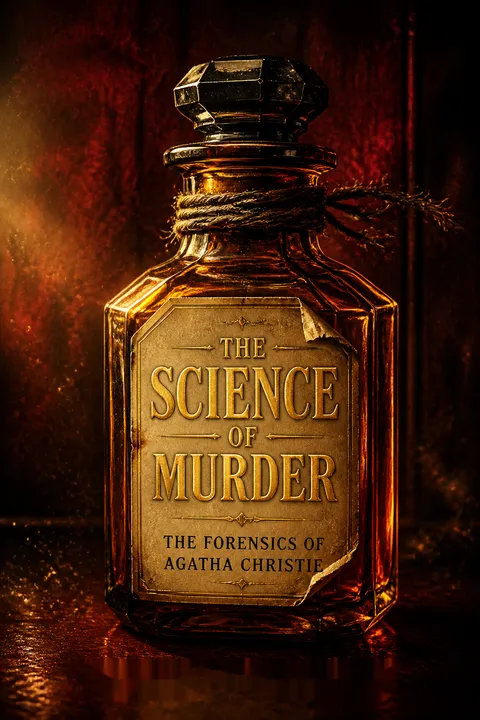
Fiction meets investigation. Carla Valentine traces forensic science through Agatha Christie’s mysteries, showing how the novelist incorporated methods that were new or developing in her lifetime. Christie began with practical knowledge of poisons gained while working in a First World War dispensary. Across a career of 66 detective novels, her grasp of fingerprints, firearms, documents, and pathology grew more detailed. Her stories therefore offer two puzzles at once: who committed the crime, and what could investigators of that era actually know?
Knowledge in motion. Christie consulted authorities and followed criminal cases in the news, while her writing also helped introduce specialist techniques to ordinary readers. The book follows that exchange between real investigation and fiction, from early fingerprint identification to the chemical detection of blood and poison.
What's striking is that Christie’s novels function as a changing record, not a timeless catalogue of perfect forensic methods. Their details show how knowledge enters public culture, then shapes what readers expect investigators to notice. That makes the books valuable beyond their puzzles: they reveal a period when laboratory science was becoming part of popular imagination. Yet fiction has a different contract from a courtroom. A novelist can compress waiting, uncertainty, and error to make a clue legible. The book is most persuasive when it distinguishes Christie’s genuine technical insight from the dramatic license required to make a mystery work.
Follow every transfer, but do not confuse contact with guilt
Traces travel. Trace evidence is small material, such as hair, fibers, glass, paint, or soil, that can move between a person, an object, and a place. It illustrates Locard’s exchange principle: contact can transfer material in both directions. In the 1936 murder of writer Nancy Titterton, investigators found upholstery horsehair in her bed and a piece of cord beneath her body. The cord’s manufacturer had sold it to the upholsterer who had delivered a loveseat. His assistant, John Fiorenza, eventually confessed.
A link is not a verdict. The horsehair and cord opened a path to the suspect, but a trace alone cannot establish why or when it was transferred. Fibers can even move through the air between people in close quarters, and innocent contact can leave evidence.
This distinction resembles a basic problem in causal reasoning: an observation can support a connection without explaining its meaning. A fiber may establish contact, but context determines whether that contact was criminal, accidental, or entirely ordinary. The Titterton investigation is compelling because different traces converged on a plausible source rather than one tiny clue carrying the whole case. That logic also cautions against the popular image of forensic science as a machine that turns particles into certainty. Collection, comparison, and interpretation remain human tasks, each with opportunities for error.
Use fingerprints to identify a person, not narrate their actions
Distinctive, not magical. Dactyloscopy is the recording and comparison of fingerprints. Ridge patterns form before birth and generally remain stable, making them useful for distinguishing people. In the 1905 Farrow murders, a bloody thumbprint on a money box matched Alfred Stratton’s, helping secure his conviction. The case brought fingerprint evidence to public attention, though investigators then had far fewer records than modern police databases.
Standards changed. Edmond Locard proposed a minimum of twelve matching fingerprint details in 1918. England and Wales replaced that numeric threshold with a nonnumeric standard in 2001, requiring broader judgment and expertise. A fingerprint can identify a likely source, but it cannot by itself establish when the mark was made or what the person was doing.
Fingerprints feel definitive because they are highly discriminating, but identification and narrative are different claims. A match may support the proposition that a person left a mark; it does not automatically prove the mark was left during a crime. This is a useful model for reading any forensic result: first ask what the method directly establishes, then what additional interpretation is being attached to it. The history of fingerprint standards reinforces that expertise involves judgment, not merely counting visible similarities. Greater precision in measurement does not eliminate the need to explain the limits of an inference.
Compare the bullet, casing, and weapon before trusting the shooting story
Firearms leave signatures. Forensic ballistics examines evidence from firearms, including bullets, cartridge cases, and the path of a shot. Grooves inside a rifled barrel mark a bullet; the firing pin and other parts of a gun can mark its casing. Together, these features may help determine what type of weapon fired a round or link it to a particular firearm. Christie’s later stories increasingly use this comparison instead of assuming that a gun found nearby was the one used.
Details expose a false account. In Death on the Nile, the wound’s scorching suggests the pistol was fired close to the victim. A velvet stole used to muffle a shot complicates that account, because firing through it would not produce the same marks. In The Hollow, investigators learn that the gun at the scene is not necessarily the murder weapon.
Ballistics demonstrates how one event can leave several related forms of evidence, each answering a different question. A wound may suggest distance, a bullet may reveal barrel characteristics, and a casing may carry marks from the weapon’s mechanism. Their combined value is greater than treating any one item as a complete reconstruction. The same care applies to dramatic stories about firearms: a weapon’s presence is not proof that it fired the shot. Christie’s evolving treatment of these details also illustrates a broader strength of the book, which tracks forensic knowledge changing alongside the conventions of detective fiction.
Treat letters and machines as physical evidence, not mere plot devices
Documents have material clues. Questioned document examination tests whether a document is genuine, altered, or linked to a writer, typewriter, ink, or paper. Handwriting comparisons require known samples; an expert can compare letter shapes and writing habits, but should not claim to infer personality from them. Typewriters also acquire faults that can make their output distinctive. Christie builds these methods into plots involving forged notes, anonymous letters, and typed messages.
A paper trail can close in. The Lindbergh kidnapping investigation examined ransom notes alongside serial-numbered money and a handmade ladder. The ladder’s wood and the ransom bills helped connect Bruno Hauptmann to the crime. In Murder on the Orient Express, Poirot’s examination of a burned letter fragment provides a crucial clue. A document is not just its words; its making, handling, and alteration matter too.
Documents are especially revealing because they preserve both communication and traces of production. The message may be deceptive, while paper, ink, typing, or edits provide a separate line of inquiry. This creates a useful distinction between what a document says and what its physical properties support. The Lindbergh example also shows why independent forms of evidence matter: a note, a financial record, and construction materials can reinforce one another. Still, comparison depends on reliable reference samples. If the supposed known sample is itself forged, a technically sound comparison can answer the wrong question.
Interrogate missing evidence: wiping can reveal more than a print
Absence can be informative. A clean object may be suspicious if ordinary handling should have left fingerprints. In Crooked House, investigators find an empty eye-drop bottle in the dustbin with no prints. That absence suggests deliberate wiping rather than casual use. Christie repeatedly turns missing evidence into a clue: an expected mark, stain, or footprint fails to appear, prompting investigators to ask what someone did to prevent it.
But absence has alternatives. Gloves, little contact, a surface that does not preserve marks, or simple investigative failure can also explain missing prints. Christie’s detectives sometimes exploit this uncertainty by inventing evidence. Poirot falsely tells suspects that a fingerprint has been found, and a guilty person’s reaction can reveal knowledge they should not possess.
The absence of evidence is most useful when investigators have a reason to expect the evidence in the first place. Without that expectation, a blank surface may say very little. This is why Christie’s clues work as small tests of competing explanations: did someone wipe the bottle, or was it never handled in a way that would leave a mark? The false fingerprint trick adds another layer, turning the suspect’s response into behavioral evidence. That can be dramatically effective, but it is not equivalent to a verified forensic result. A confession induced by a bluff still needs independent scrutiny.
Read bloodstains as a map of movement, not a verdict
Patterns record forces. Bloodstain pattern analysis interprets how blood reached a surface and what movements may have produced it. Drips and pools can form under gravity; contact can transfer blood into smears or prints; blows can cast droplets from a bloodied weapon. The shape and direction of stains can help reconstruct positions and actions. Christie uses blood not merely for atmosphere, but to distinguish where an injury occurred from where a body was later moved.
A missing patch matters. In the 1954 Sam Sheppard case, criminalist Paul Kirk examined a bloodstained room and noted a clear area within the pattern on a wall. That void suggested something had blocked the spray. He also found blood on both sides of a wristwatch, indicating it was likely not being worn during the attack. The findings challenged the prosecution’s account, and Sheppard was freed at retrial.
Blood patterns are powerful because they can preserve relationships between bodies, objects, and space. The Sheppard case shows how a scene that appears to confirm a story can look different when examined for what is absent as well as what is visible. Yet pattern interpretation is not a direct replay of an event. It depends on assumptions about force, position, and sequence, so conclusions should be stated with appropriate limits. The value lies not in treating stains as a perfect recording, but in using them to test whether a proposed account is physically consistent.
Ask the body what happened, but distrust precise death clocks
Autopsy has several jobs. A postmortem examination can investigate cause and manner of death, distinguish injuries from changes after death, and help identify the deceased. Temperature loss, blood settling, and muscle stiffening offer clues to elapsed time, but many conditions affect them. Christie often uses time of death to test alibis, while also acknowledging that a responsible doctor may give a broad range rather than an exact hour.
Some clues age badly. Her characters sometimes use stomach contents to estimate when someone died, a method once treated as useful but now discredited because digestion varies too much. The book also describes later doubts about the identification of remains in the celebrated Dr. Crippen case. Autopsy findings can be informative, but the body does not provide a simple clock or an infallible identity card.
The body is evidence, but its signals are shaped by biology, environment, and time. That makes forensic pathology a discipline of constrained inference rather than instant revelation. A narrow estimate of time of death may be narratively convenient, yet the real value often lies in showing that a suspect’s account is incompatible with the available range. The Crippen example adds an important historical warning: an authoritative expert and a persuasive courtroom presentation do not guarantee a correct conclusion. Scientific methods can improve, and earlier findings deserve reconsideration when better evidence becomes available.
Track poison through access, symptoms, and the body's chemistry
Chemicals leave different stories. Christie’s work as a wartime dispenser gave her unusual knowledge of poisons. The book distinguishes corrosive substances, which visibly damage tissue on contact, from systemic poisons that affect organs and bodily systems. A substance’s dose, taste, symptoms, and availability can all narrow the possibilities. In Christie’s fiction, poison appears in 41 of her 66 mystery and thriller novels, though arsenic, the poison most associated with her, kills only 13 characters.
One symptom can unlock a case. The Pale Horse uses thallium, which can cause varied symptoms, including hair loss. Two real patients were recognized as possible poisoning victims after readers or a nurse connected their symptoms to Christie’s description. The episode shows that accurate fiction can spread useful knowledge, though modern toxicology also depends on correctly collected samples and laboratory testing.
Poisoning makes access and relationship part of the evidence. A chemical may identify a mechanism, while the route by which someone obtained it and the pattern of symptoms help explain opportunity and intent. Christie’s pharmacy background gives these plots unusual specificity, especially when a poison resembles illness or an everyday hazard. The Pale Horse examples also show that public knowledge can have practical consequences. Still, recognizing symptoms is a prompt for investigation, not a diagnosis. Similar signs can have different causes, and the story’s useful insight is the value of informed suspicion followed by testing.
Demand converging evidence before a clue becomes a conviction
Evidence needs context. Across the book, forensic findings are strongest when they agree with independent facts and weakest when investigators treat one result as a complete explanation. A fingerprint can place a mark, blood can challenge a timeline, and a poison test can identify a substance, but none alone necessarily establishes motive or guilt. Christie’s plots exploit the gap between a clue and the story built around it.
History supplies warnings. The Sheppard case shows how overlooked blood evidence and a confident narrative can contribute to a wrongful conviction. In the Crippen case, later analysis challenged the old identification of remains. These cases do not make forensic science useless; they show why methods, samples, and interpretations must remain open to review.
The book’s deepest lesson is epistemic: forensic science narrows possibilities, but justice depends on how institutions interpret and combine its findings. Convergence is valuable only when evidence sources are genuinely independent, not when several conclusions all inherit the same mistaken assumption. Christie’s habit of planting, wiping, or misdirecting evidence dramatizes this vulnerability. The same habit can sharpen real-world reasoning: separate observation from interpretation, test rival explanations, and preserve uncertainty where the evidence cannot decide. Scientific progress is not a straight line from ignorance to certainty; it also requires the humility to revisit conclusions.
Analysis
The Science of Murder works through an unusual double lens: it is both a history of forensic techniques and a study of how a popular novelist made those techniques legible to the public. Its most coherent argument is that Christie’s mysteries reflect a discipline in transition. Fingerprinting, ballistics, document examination, blood analysis, autopsy, and toxicology did not arrive as a finished toolkit. Each developed through contested cases, new instruments, changing standards, and public attention. Christie’s own education followed a similar course, from pharmacy knowledge present in her early fiction to more elaborate forensic reasoning in later novels.
The book’s most valuable distinction is between evidence and the narrative built from it. A fingerprint can indicate contact without proving criminal action. Trace material may connect a person and scene but can also transfer innocently. A blood pattern can test a proposed sequence without replaying it perfectly. These limits are not weaknesses to conceal; they are part of competent interpretation. Christie’s plots make the distinction vivid by showing how clues can be planted, erased, misread, or used to frame an innocent person.
The historical cases deepen the point. The Stratton murders show how fingerprint evidence gained credibility. Nancy Titterton’s murder demonstrates the force of several traces converging. The Sheppard case and the later doubts surrounding Crippen’s identification show that expertise can be persuasive and wrong. The book is strongest when it places a forensic claim beside the conditions under which it was made, including the era’s available methods and assumptions.
There is also a productive tension between scientific accuracy and narrative convenience. A mystery requires clues to be noticed and interpreted on a useful timetable, while real investigations are slower, less tidy, and more ambiguous. The author acknowledges this tension rather than treating Christie’s stories as forensic manuals. The result is a compelling account of how science enters culture, and why popular knowledge can inspire better questions without replacing careful professional judgment.
Review Summary
The Science of Murder by Carla Valentine is praised for its fascinating exploration of forensic science in Agatha Christie's works. Readers appreciate the author's expertise, enthusiasm, and accessible writing style. The book offers insights into Christie's research methods and the evolution of forensic techniques. While some find it dense or overly informal at times, most reviewers recommend it for Christie fans, true crime enthusiasts, and aspiring mystery writers. The book's detailed analysis of Christie's novels, without spoilers, is particularly commended.
People Also Read

Glossary
Locard’s exchange principle
Contact transfers materialA foundational forensic idea associated with Edmond Locard: when people, objects, or places come into contact, material may be transferred between them. Hair, fibers, soil, paint, and other traces can connect a person to a scene or another person. Such a transfer supports a possible association, but does not by itself establish when, why, or under what circumstances contact occurred.
Dactyloscopy
Fingerprint recording and comparisonThe examination and comparison of fingerprints, including the impressions made by the friction ridges on fingers. Fingerprint patterns are highly useful for distinguishing individuals and can be recovered from some crime-scene surfaces. Their interpretation requires comparison and expertise; a print’s presence may support that a finger touched an object, but does not by itself prove when the contact occurred or establish guilt.
Individual evidence
Evidence linking a specific sourceEvidence whose features can associate it with a particular person or object rather than only a broad category. Fingerprints are commonly treated as individual evidence because their ridge details are highly discriminating. By contrast, class evidence places an item within a group, such as a type of shoe or firearm. Even a highly specific match must be interpreted in context and alongside other evidence.
Forensic ballistics
Firearm evidence examinationThe examination of evidence related to firearms, including bullets, cartridge cases, and the trajectory or distance of a shot. Rifling inside a barrel can mark a bullet, while parts of a firearm can leave marks on a cartridge case. Comparisons can help identify a weapon type or link evidence to a particular firearm, but a gun found near a victim is not automatically the weapon used.
Questioned document examination
Testing documents and writingA forensic discipline that examines whether documents are genuine, altered, or connected to a writer or writing machine. Examiners may compare handwriting with known samples, study typewriter defects, or analyze paper, ink, additions, and erasures. The term document can include many marked materials, not only letters. Handwriting examination compares physical features; it does not reliably establish personality.
Bloodstain pattern analysis
Interpreting bloodstain patternsThe analysis of bloodstains to infer how blood was shed, where it originated, and how people or objects may have moved. Analysts distinguish stains formed by gravity, contact, or projected droplets, and may use their shapes and distribution to test accounts of an event. Conclusions depend on interpretation and scene conditions, so patterns can support a reconstruction without functioning as a complete recording of the crime.
Livor mortis
Blood settling after deathAlso called lividity or hypostasis, livor mortis is the settling of blood in the lower parts of the body after the heart stops. Its distribution can help investigators assess how a body was positioned and whether it may have been moved. The pattern can resemble bruising to an untrained observer, so it must be distinguished from injury during examination.
Rigor mortis
Postmortem muscle stiffeningA stiffening of muscles that occurs after death as the body’s cells undergo chemical changes. Its timing varies with environmental and individual factors, so it can contribute to a broad estimate of time since death but cannot provide a precise clock on its own. Christie’s stories sometimes use rigor as a clue, while also showing that responsible estimates require caution.
Algor mortis
Postmortem body coolingThe cooling of the body after death as normal physiological processes cease and heat dissipates into the surroundings. A core temperature can contribute to estimating time since death, but accuracy depends on factors such as ambient temperature, body size, clothing, and posture. In forensic practice, algor mortis is considered alongside other observations rather than used as a precise, independent measure.
Forensic toxicology
Testing harmful substancesThe application of toxicology to legal investigations, especially the detection and interpretation of drugs, poisons, and other harmful substances in the body. Samples may include blood, urine, vitreous humor, bile, organs, hair, and nails, because substances persist differently across tissues. Results can help identify exposure or poisoning, but must be interpreted with symptoms, circumstances, and the quality of the samples.
Luminol
Chemical blood detection reagentA chemical reagent that can produce a brief blue glow when it reacts with the iron in hemoglobin, a molecule in red blood cells. Investigators may spray it in a darkened area to reveal traces of blood that are not readily visible, including stains someone has tried to wash away. A glowing reaction is an investigative lead, not by itself a complete identification of whose blood is present.
Download PDF
Download EPUB
.epub digital book format is ideal for reading ebooks on phones, tablets, and e-readers.








