

Key Takeaways
Choose whether your mind acts as a soldier or a scout
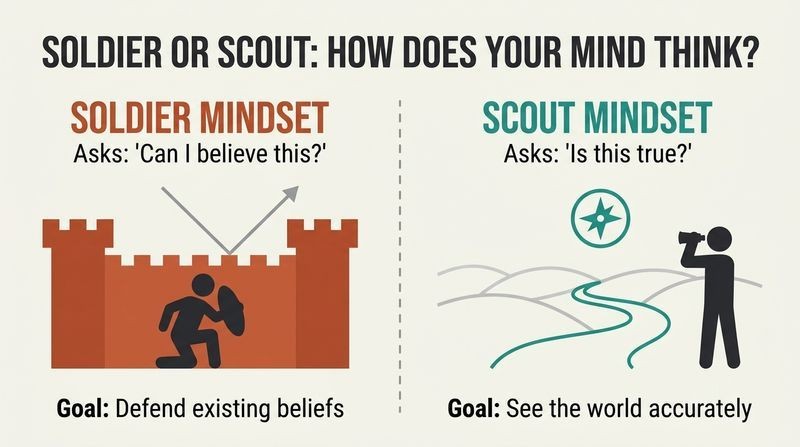
The book's central metaphor. Julia Galef splits our thinking into two modes. The soldier defends beliefs like a fortress under siege, asking about welcome ideas "Can I believe this?" and about unwelcome ones "Must I believe this?" The scout, by contrast, wants an accurate map of reality, asking only "Is this true?"
The 1894 Dreyfus affair illustrates both. French officers, eager to convict a Jewish officer of treason, treated flimsy rumors as proof and explained away contradicting evidence. That is soldier mindset. Colonel Picquart, who shared their prejudices but cared more about truth, kept following the evidence until it exonerated Dreyfus, at great personal cost. Asked why, he said simply: it was his duty. That is the scout.
What's compelling is how Galef reframes rationality as motivation rather than intelligence. The soldier/scout distinction maps onto decades of research on directional versus accuracy motivated reasoning, but the metaphor makes it visceral. Note a subtlety: the scout is not detached or passionless. Picquart risked his career precisely because truth mattered to him. This preempts the common objection that objectivity equals coldness. The framing also echoes Feynman's warning that the easiest person to fool is yourself, positioning self-deception not as a character flaw but as the mind's default operating system that requires deliberate counter-effort.
You reach for comforting beliefs because they pay off instantly

Motivated reasoning serves six functions. Galef argues we default to soldier mindset because it protects things we value: comfort (avoiding fear and regret, like the "This is fine" dog in a burning room), self-esteem (flattering narratives for our flaws), morale (irrational optimism to attempt hard things), persuasion (convincing ourselves to convince others), image (beliefs that signal the identity we want), and belonging (fitting into our tribe).
Crucially, these rewards arrive now while the costs of a distorted map come due later. This is present bias applied to thinking, not just behavior. Convincing yourself a mistake "wasn't my fault" delivers instant relief but forfeits the lesson. Because we systematically overvalue immediate emotional payoffs, we pick the soldier far more often than actually serves us.
Galef's invocation of Chesterton's fence is intellectually honest: before demolishing soldier mindset, she asks what purpose it serves. This restraint distinguishes the book from typical debiasing polemics. The present-bias framing is her sharpest contribution, connecting self-deception to the same discounting machinery behind procrastination and impulse spending. One tension worth noting: evolutionary psychologists she cites argue motivated reasoning evolved for social signaling, meaning it may be more adaptive than she allows. If our ancestors' survival depended on tribal belonging more than accurate cosmology, the soldier may not be a bug so much as a feature we have outgrown in modernity.
An accurate map matters more now than it did for your ancestors

Truth is undervalued because our instincts are outdated. Fifty thousand years ago you were stuck with your tribe, your role, and your circumstances. An accurate picture of your situation bought you little when only one path was open. Today you choose your career, city, partner, investments, and whether to have children. Every one of those choices rewards clear sight.
Galef also argues we badly overestimate social costs. In surveys, 61 to 81 percent of patients admitted hiding information from doctors out of embarrassment, sacrificing medical care to avoid mild judgment from someone whose opinion barely affects their lives. One tornado-chaser nearly died in a motel because he was too worried about looking foolish in front of locals to flee a storm.
The historical argument is elegant and underappreciated: the value of truth is not fixed but rises with the number of options available to you. This dovetails with Sen and Nussbaum's capabilities framework, where freedom is the real currency of well-being. More options mean judgment matters more. The doctor-lying statistic is a gut-punch example of what behavioral economists call the spotlight effect, our tendency to overestimate how much others notice and judge us. Gilovich's research confirms people consistently believe they are watched far more than they are. Galef's point lands: we trade real welfare for imaginary reputational stakes.
Feeling objective is the surest sign you might not be
Self-perception lies about scout mindset. Galef dismantles the false markers. Feeling calm and rational does not make you fair (a Redditor calmly demanded his girlfriend give away her cat). Being smart and educated does not protect you either. Yale's Dan Kahan found that as scientific literacy rises, liberals and conservatives diverge further on climate change rather than converging on truth. At the highest science-intelligence percentile, conservative belief in human-caused warming fell to 20 percent while liberal belief neared 100 percent.
Intelligence is just a tool that can defend a position or discover the truth. The only real evidence of scout mindset is behavioral: can you point to concrete times you changed your mind, welcomed criticism, or proved yourself wrong?
The Kahan finding is one of the most disquieting results in political psychology, and Galef deploys it perfectly: knowledge amplifies bias when identity is at stake because smarter people are better lawyers for their side. This should humble anyone who thinks education alone cures polarization. Her demand for a behavioral track record echoes the epistemology of revealed preference: what you actually do reveals more than what you claim to value. Worth adding: her self-aware admission that psychology researchers themselves fell for the "rigidity of the right" tautology (measuring conservatism and calling it rigidity) is a rare example of a field's bias caught red-handed.
Catch your bias by imagining the facts were flipped
Thought experiments peek into the counterfactual world. You cannot detect bias by staring harder at your own reasoning; it always looks sound from inside. Instead, vary a detail that should not matter and watch whether your judgment shifts. Galef offers five tests:
1. Double standard: would I judge this differently if it were my own group?
2. Outsider test: what would a stranger with no stake decide? (Intel's leaders escaped their failing memory-chip business by asking what a new CEO would do.)
3. Conformity test: if others dropped this view, would I still hold it?
4. Selective skeptic test: if this evidence backed the other side, how credible would I find it?
5. Status quo bias test: if this were not already my situation, would I actively choose it?
These tests operationalize what philosophers call reflective equilibrium, forcing consistency across relevantly similar cases. The genius is treating your own snap judgments as data points rather than verdicts. Galef borrows the magician's "forcing" trick as an analogy: your brain funnels you to a convenient conclusion while preserving the feeling of free choice. One caveat she acknowledges: these experiments reveal inconsistency but not truth. Discovering you have a double standard on adultery does not tell you which standard is correct. They are diagnostic, not prescriptive. Still, dislodging the illusion that your first judgment equals objective fact is more than half the battle.
Replace "I'm certain" with a bet you'd actually place
Treat confidence as a probability, not a feeling. Most people equate certainty with the absence of active doubt and declare themselves 100 percent sure. A scout treats each belief as a prediction: calling something "70 percent sure" means being right about seven times in ten. This is calibration, and studies show a couple of hours of practice can make people remarkably well calibrated.
To test your true confidence, imagine wagering on it. Galef borrows Robert Kurzban's image of a mind split between a press secretary (who says what sounds good) and a board of directors (who bet real resources on being right). A press secretary makes claims; the board makes bets. The equivalent bet test refines this: would you rather bet on your belief or on drawing a winning ball from a box with known odds?
This is the book's most practical toolkit and it mirrors the methodology of superforecasters and prediction markets, where putting stakes on beliefs strips away cheap talk. The press-secretary versus board metaphor is a compact model of dual-process cognition: one system manages reputation, the other manages truth. Tetlock's forecasting work provides the empirical backbone here. A subtle strength: quantifying uncertainty is not about false precision but about noticing the felt difference between bluster and genuine estimation. The equivalent bet test cleverly anchors subjective confidence to objective odds, a technique risk analysts like Douglas Hubbard use to extract honest probabilities from experts who resist committing to numbers.
You can cope with pain without lying to yourself
Honest coping beats self-deception. The myth is that facing reality breeds despair, so we need comforting illusions to stay sane. Galef counters that scouts stave off negative emotions using strategies that do not corrupt their map. Steven Callahan, adrift 76 days in a life raft, survived by refusing to fool himself while still keeping despair at bay: he counted blessings, reminded himself he was doing his best, and made plans.
Her honest toolkit includes making a concrete plan (the urge to deny "that's not true" fades once you know what you would do if it were), noticing genuine silver linings without pretending the whole cloud is silver, and shifting focus to a different goal. She also debunks the famous "positive illusions" research, showing it conflated accurate positive beliefs with delusions.
Galef's takedown of the positive-illusions literature is bracing and largely fair: much of it never established an objective baseline, so it labeled correct self-assessments as "bias." This matters because pop psychology has spent decades telling people self-deception is mentally healthy. Her alternative aligns with modern cognitive behavioral therapy, which treats catastrophic thoughts not by denying them but by testing and planning around them. The "make a plan" strategy is essentially implementation intentions research repurposed for emotional regulation. One limit: acute trauma may sometimes genuinely benefit from temporary denial, a nuance the survival-and-Darwin examples do not fully explore, though her broader claim that honest coping usually exists holds up well.
Bet on the odds, don't believe you can't lose
Motivation without delusion. The self-belief model says you must convince yourself success is guaranteed or you will not try. Galef rejects it. Accurate odds help you choose between goals, adapt your plan, and decide how much to stake. Elon Musk gave both Tesla and SpaceX roughly 10 percent odds of success and pursued them anyway because they were bets worth taking. Jeff Bezos put Amazon's chances near 30 percent and told investors so.
The scout is motivated not by "this will work" but by "this is a smart bet I will feel good about having made, win or lose." Accepting the probability of failure is liberating rather than paralyzing: Bezos imagined himself at 80 and knew he would regret not trying far more than failing. Building variance into expectations grants equanimity, like a pitcher crediting a hot streak to random variation.
This reframes grit through the lens of expected value, a concept from decision theory that most motivational advice ignores. The insight that accepting failure's probability reduces fear (Musk's "fatalism") echoes Stoic premeditatio malorum, deliberately contemplating worst cases to defang them. It also aligns with research on portfolio thinking: no single bet needs to succeed if you make many positive-expected-value bets over a lifetime. The counterpoint some entrepreneurs raise, that irrational conviction fuels the extraordinary effort required, is not fully settled. Yet Galef's roster of clear-eyed founders who succeeded while openly acknowledging long odds is strong evidence that delusion is not a prerequisite for boldness.
Project social confidence, not certainty, to earn influence
Two confidences people conflate. Epistemic confidence is how sure you are something is true; social confidence is how self-assured you seem. Research shows observers judge competence almost entirely on social confidence (posture, eye contact, tone, participation) and barely on expressed certainty. Benjamin Franklin deliberately dropped words like "certainly," prefacing views with "it appears to me," and became more persuasive, not less.
Galef also distinguishes two kinds of uncertainty. Uncertainty "in you" ("I've never seen this before") signals incompetence. Uncertainty "in the world" ("the evidence here is genuinely mixed, probably one in five") signals expertise. To communicate the latter well: show the uncertainty is justified, give informed estimates, and offer a plan. Bezos warned investors of a 70 percent chance of total loss and still won funding.
The separation of epistemic and social confidence is liberating for anyone who fears honesty will cost them authority. It resonates with Anderson's status research showing overconfident people gain status precisely because groups mistake assertiveness for competence, a bug Galef turns into an opportunity: you can cultivate presence without corrupting your calibration. The two-kinds-of-uncertainty distinction is genuinely useful for professionals, mapping onto the difference between epistemic humility and incompetence. Doctors who quantify risk ranges are trusted more than those who simply say "I don't know." The Franklin example is a 250-year-old case study in what negotiation scholars now call tentative language increasing receptivity.
Treat being wrong as an update, not a confession
Superforecasters excel at being wrong. In Philip Tetlock's tournaments, the best amateur forecasters beat CIA analysts with classified data by 30 percent, and their edge grew 25 percent yearly while others stagnated. Their secret: they changed their minds constantly in small increments, revising a single forecast dozens of times as evidence trickled in.
Galef urges swapping the language of "admitting a mistake" for "updating," borrowed from Bayesian reasoning. Being wrong usually is not a moral failure requiring contrition; you simply learned new information and improved your map. Errors also teach domain-general lessons ("cherry-picked evidence fools me," "I misjudge people who seem to say dumb things"). Seeing beliefs in shades of gray, rather than binary right or wrong, lowers the stakes of every piece of contrary evidence.
The reframe from "admit" to "update" is quietly radical because it removes the ego tax on changing one's mind. This is the practical core of Bayesian epistemology made emotionally palatable. Tetlock's superforecaster data is the gold standard here: incremental belief revision, not raw intelligence, predicts accuracy. The insight connects to growth-mindset research, where errors are reframed as information rather than indictment. One extension worth noting: organizations that punish being wrong (much of academia and politics) systematically breed soldier mindset, while cultures that reward updating (some tech and forecasting communities) breed scouts. The environment shapes which mode becomes rational, a theme Galef develops through the idea that communities mold identity.
When someone seems crazy, treat your confusion as a clue
Lean in to what does not fit. Our instinct is to explain away observations that clash with our beliefs. Governor Earl Warren took the absence of any Japanese-American sabotage in WWII as proof a plot was coming. Darwin instead followed a personal rule: immediately record any fact that contradicted his theory, because inconvenient facts slip from memory. The peacock's tail seemed to threaten natural selection until his confusion led him to discover sexual selection, strengthening the theory.
When people behave "irrationally," you are usually missing something. A London homeopathic hospital reported half the cholera death rate of mainstream hospitals in the 1850s; officials suppressed the embarrassing data instead of investigating and missed that the homeopaths had stumbled onto hygiene and rehydration decades early. Anomalies accumulate until they trigger a paradigm shift.
Galef's "de minimus error" borrowed from Gary Klein, explaining away one anomaly at a time so total confusion never builds, is a precise diagnosis of how smart people stay wrong. The spring metaphor (each explained-away anomaly stretches the spring until it snaps) captures the phenomenology of belief collapse better than Kuhn's original account. The homeopathy story is a striking case of motivated dismissal in science itself, a caution against rejecting data because its source seems absurd. The deeper lesson connects to signal detection: treating surprise as information rather than noise is the engine of discovery. Asimov's line that discovery begins with "that's funny" rather than "eureka" captures it perfectly.
Hold your identity lightly so beliefs stay revisable
Identity wrecks clear thinking. When a belief becomes part of who you are, criticism feels like an attack and empirical questions turn into loyalty tests. Beliefs harden into identities through two forces: feeling embattled (persecuted minorities and even both sides of the breastfeeding "mommy wars" feel besieged) and feeling proud. Warning signs include the phrase "I believe," defensiveness, defiant language, righteous tone, gatekeeping, schadenfreude, and epithets.
The fix is not erasing identities but holding them lightly, treating them as contingent descriptions rather than flags. Barry Goldwater, "Mr. Conservative," repeatedly broke with his party for truth. Make scout mindset itself part of your identity, as Susan Blackmore did when her truth-seeking overrode her identity as a paranormal believer, and surround yourself with communities that reward updating over cheerleading.
Paul Graham's "keep your identity small" is the intellectual ancestor here, but Galef improves on it by conceding that some identities are unavoidable and even useful, so the goal is lightness, not emptiness. This is psychologically wiser: identity fusion research shows totally identity-free people are rare and often disengaged. Her move to make truth-seeking itself an identity is clever jujitsu, harnessing the same ego machinery that normally distorts thinking to instead reward honesty. The community point is underrated: environments like effective altruism forums or ChangeAView, which grant status for conceding points, restructure the incentives so scout behavior becomes socially rewarding rather than costly. Identity is destiny only if left unexamined.
Analysis
The Scout Mindset belongs to the debiasing genre pioneered by Kahneman and Ariely, but Galef makes a distinct and important pivot: the bottleneck on good judgment is not knowledge but motivation. Knowing about cognitive biases no more improves your thinking than knowing about exercise improves your fitness. This reframing is the book's core contribution and its chief advantage over cognate works. Where Thinking, Fast and Slow catalogs the machinery of error, Galef asks why we want to err, and answers with a taxonomy of emotional and social payoffs.
The soldier/scout metaphor is more than rhetorical packaging. It converts an abstract distinction (directional versus accuracy motivated reasoning) into an identity a reader can adopt, which is itself an application of the book's final insight that identities shape behavior. There is a pleasing recursion: the book uses the psychology it describes to change the reader.
Galef's intellectual honesty is a model of her own thesis. She debunks flattering research (positive illusions, the rigidity-of-the-right theory) even when it would be convenient, and admits her own lapses. This lends unusual credibility. Her toolkit, the five thought experiments, calibration training, the press-secretary/board distinction, and the equivalent bet test, is more concretely actionable than most books in the space.
The main limitation is scope. Galef largely brackets the collective and structural dimensions of belief: how media incentives, algorithmic feeds, and institutional punishment of error manufacture soldier mindset at scale. Her remedies are individualist, which suits a self-help register but understates how much environment determines whether scout behavior is rational. The evolutionary-psychology thread also sits uneasily with her optimism; if motivated reasoning is a well-tuned social adaptation, individual willpower may be a weak lever. Still, as a practical philosophy of intellectual honesty, the book is unusually rigorous, humane, and, fittingly, calibrated in its claims.
Review Summary
The Scout Mindset encourages readers to adopt a truth-seeking mindset rather than defensively clinging to beliefs. Galef presents strategies for overcoming cognitive biases and improving decision-making. While some reviewers found the book insightful and practical, others felt it was oversimplified or repetitive. Many appreciated Galef's clear writing style and relatable examples. The book's emphasis on intellectual honesty and openness to changing one's mind resonated with readers, though some questioned the effectiveness of rational thinking alone in addressing complex real-world issues.
People Also Read








FAQ
What's The Scout Mindset about?
- Core Concept: The Scout Mindset by Julia Galef explores the idea of seeking truth and understanding reality, contrasting it with the "soldier mindset," which defends beliefs against contrary evidence.
- Motivated Reasoning: The book delves into how desires and biases influence conclusions, emphasizing the importance of recognizing this tendency to improve judgment.
- Practical Applications: Galef provides tools and strategies, such as thought experiments and self-reflection techniques, to help develop a scout mindset.
Why should I read The Scout Mindset?
- Improved Judgment: The book enhances critical thinking skills and decision-making by confronting biases and improving reasoning.
- Real-World Examples: Engaging stories, like the Dreyfus Affair, illustrate the principles of the scout mindset, making concepts relatable.
- Empowerment: Adopting a scout mindset empowers individuals to face challenges and uncertainties, leading to greater resilience.
What are the key takeaways of The Scout Mindset?
- Scout vs. Soldier Mindset: Understanding the difference helps recognize when motivated reasoning occurs.
- Value of Truth: Truth is crucial for better decision-making and problem-solving, leading to personal growth.
- Tools for Change: Practical tools like thought experiments encourage self-reflection and belief adjustment based on new evidence.
What is motivated reasoning, and how does it affect us?
- Definition: Motivated reasoning is when desires and emotions influence conclusions, leading to biased acceptance of evidence.
- Examples in Life: Political biases and personal relationships often showcase motivated reasoning, affecting self-image and social conformity.
- Impact on Decision-Making: It impairs judgment, making recognizing it essential for accurate understanding and better choices.
How does The Scout Mindset address the emotional aspects of facing reality?
- Coping Strategies: Strategies like making plans and recognizing silver linings help manage negative emotions without self-deception.
- Resilience Through Reality: Facing uncomfortable truths builds resilience and adaptability, preparing individuals for challenges.
- Empowerment in Acceptance: Embracing the scout mindset empowers individuals to confront fears, leading to thoughtful and courageous actions.
What are some practical tools for developing a scout mindset?
- Thought Experiments: Exercises like the outsider test help evaluate beliefs by considering different motivations.
- Self-Assessment Techniques: Assessing certainty about beliefs helps understand when to be cautious or take risks.
- Feedback Seeking: Seeking feedback and criticism identifies blind spots, improving judgment.
How can I recognize when I am in soldier mindset?
- Self-Reflection: Honest self-reflection helps identify when defending beliefs rather than seeking truth.
- Thought Experiments: Tests like the selective skeptic test evaluate if double standards are applied to beliefs.
- Feedback from Others: Feedback from trusted individuals can reveal defensiveness, indicating a soldier mindset.
How does The Scout Mindset suggest we deal with confusion?
- Curiosity over Dismissal: Embrace confusion as an opportunity to explore different perspectives rather than dismissing them.
- Puzzles to Solve: View confusing situations as puzzles, leading to greater insights and understanding.
- Case Studies: Examples like Darwin's struggle with the peacock's tail illustrate how confusion can lead to breakthroughs.
What is the difference between "admitting a mistake" and "updating" in The Scout Mindset?
- Language Matters: "Admitting a mistake" implies guilt, while "updating" suggests a routine learning process.
- Mindset Shift: Reframing reduces the emotional burden of changing beliefs, making it easier to accept new information.
- Bayesian Updating: Rooted in Bayesian probability, updating involves adjusting beliefs based on new evidence.
How can I practice the scout mindset in my daily life?
- Start Small: Focus on specific habits like questioning biases or seeking diverse perspectives.
- Embrace Uncertainty: Acknowledge uncertainties and explore them without rushing to conclusions.
- Engage with Critics: Listen to opposing views to refine beliefs and understand different perspectives.
What is the significance of the "ideological Turing test" in The Scout Mindset?
- Understanding Opposing Views: It challenges individuals to accurately represent opposing beliefs, fostering empathy.
- Promoting Intellectual Honesty: Articulating opposing arguments strengthens understanding and identifies belief weaknesses.
- Encouraging Open-Mindedness: Cultivates a mindset valuing truth over tribal loyalty, essential for growth and discourse.
What are the best quotes from The Scout Mindset and what do they mean?
- “The first principle is that you must not fool yourself—and you are the easiest person to fool.”: Emphasizes self-awareness and honesty in reasoning.
- “Discovering you were wrong is an update, not a failure.”: Changing one's mind is a positive growth experience.
- “If something’s important enough you should try. Even if the probable outcome is failure.”: Reflects the scout mindset's embrace of uncertainty and commitment to meaningful goals.
Download PDF
Download EPUB
.epub digital book format is ideal for reading ebooks on phones, tablets, and e-readers.








