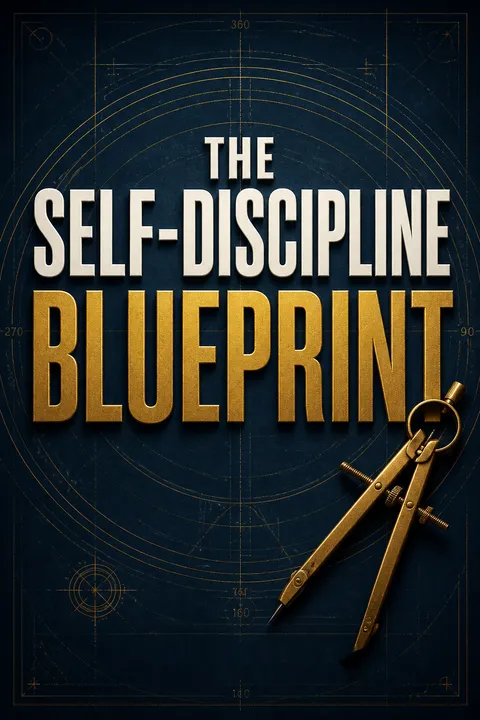


Key Takeaways
Build discipline by acting before motivation arrives
Action beats mood. The book’s central claim is that self-discipline means doing what matters even when the easier option feels more appealing. Insurance executive Albert Gray reached a similar conclusion after years of studying success: people who thrive repeatedly do tasks others avoid. The author illustrates the point with psychologist Walter Mischel’s marshmallow experiments. Children who waited longer for a second treat were later rated by parents as better at planning, concentrating, and handling frustration. The study is presented as evidence that self-control matters, not as proof that one childhood test determines a life.
Make it repeatable. Painter Chuck Close’s working method offers the practical lesson: begin the work instead of waiting for inspiration. Edblad describes moving from sporadic writing to a steady output by committing to a daily work period, whether or not he felt ready. The goal is not to feel disciplined first. It is to create a routine that makes action familiar.
The book usefully shifts discipline from a personality label to a behavior that can be practiced. That makes setbacks less fatal: a missed task is information about the routine, not evidence of a defective character. The distinction also guards against romanticizing constant effort. Persistence is valuable when aimed at a worthwhile goal, but effort alone cannot establish that the goal is wise, fair, or sustainable. The strongest application is deliberate action paired with periodic review of what the action is serving.
Treat sleep, food, movement, and attention as discipline's foundation
Stabilize the basics. Edblad identifies four foundational habits: sleep, nutrition, movement, and mindfulness. He argues that they influence one another, creating either an upward or downward cycle. Better sleep can make exercise and healthier eating easier; fatigue can make each of those choices harder. The book cites a sleep experiment comparing people limited to four or six hours nightly with people allowed eight. The restricted-sleep groups’ performance worsened over two weeks, while participants also underestimated how much it had declined. The author recommends that most adults aim for roughly 7.5 to 9 hours.
Start with one. Nutrition means choosing nourishing foods without excessive calories or harmful ingredients. Movement includes ordinary activity as well as planned exercise, since a gym session does not erase an otherwise sedentary day. Mindfulness trains attention to notice thoughts without automatically obeying them. Begin with the habit most likely to improve the others, rather than attempting a total lifestyle overhaul.
The four-part foundation is powerful because it treats self-control as embodied, not merely moral. A tired person facing a demanding task is working with different conditions than a rested one, so blaming character alone misses useful causes. The framework also invites practical diagnosis: when follow-through collapses, check energy, food, movement, and attention before adding another productivity trick. Its limit is that the four habits cannot explain every obstacle. Work schedules, illness, caregiving, and financial constraints can make healthy routines difficult, even when the person understands their value.
Use a growth mindset to make effort evidence of learning
Treat ability as developable. Psychologist Carol Dweck’s growth mindset describes the belief that abilities can improve through effort, learning, and strategy. Its contrast, a fixed mindset, treats talent or intelligence as largely set. Edblad uses neuroscientist Eleanor Maguire’s research on London taxi drivers to illustrate the brain’s capacity to change: drivers who learned the city’s extensive street network had larger hippocampi than comparison participants, and the difference was associated with time spent driving.
Answer the inner critic. A fixed mindset can make a challenge feel like a public test of innate talent, encouraging avoidance and defensiveness. A growth mindset reframes difficulty as a chance to acquire skill. When a task feels beyond reach, notice the discouraging thought, question whether it is a verdict or a temporary assessment, and choose a useful next action. The point is not that effort guarantees success, but that ability is not a reason to avoid practice.
This framing makes failure easier to interpret without pretending it is pleasant. A poor result can reveal a gap in skill, strategy, support, or time, rather than settle the question of potential. That distinction is especially useful in education and creative work, where visible mistakes are part of producing anything new. A growth mindset should not become a demand to persist indefinitely, however. Sometimes feedback indicates that the method or goal needs changing, not simply that more effort is required.
Choose work where interest, ability, demand, and purpose meet
Find a workable mission. Jim Collins’s Hedgehog Concept asks organizations to focus where their passion, strongest capability, and economic engine overlap. Edblad adapts that idea for individuals: look for the intersection of what you enjoy, what you do well, and what people need or will pay for. Interests need not begin as lifelong passions; sustained involvement may deepen them. Skills can be hard to see from the inside, so the author suggests asking trusted people what they seek your help with.
Connect tasks to purpose. Simon Sinek’s Golden Circle distinguishes what a person does, how they do it, and why they do it. The why is the purpose or belief that gives daily work meaning. The book’s bricklayer story makes the distinction vivid: the same labor can be experienced as laying bricks, building a church, or serving a larger calling. A useful mission joins a realistic livelihood to values that make the work worth doing.
The overlap model prevents three common misalignments: an enjoyable hobby with no viable livelihood, marketable work that ignores strengths, or a skilled job that steadily drains interest. The purpose model adds a reason to endure routine tasks without pretending every task is intrinsically meaningful. Together, they work best as guides for experimentation rather than a one-time revelation. Interests, abilities, and market needs change, and an initially imperfect fit can improve through experience. A mission should orient choices, not become a rigid identity that forbids revision.
Stay inside your competence, and make its boundaries explicit
Know your useful edge. Investor Warren Buffett argues that success does not require understanding every company, but it does require knowing which ones can be evaluated competently. Edblad extends this idea beyond investing: identify the areas where your knowledge and abilities give you a reasonable advantage, then focus your efforts there. A person who understands restaurant economics, for example, may be better equipped to assess a restaurant than a complex biotech company.
Name your fundamentals. The author recommends choosing three areas of work that connect to your mission and purpose. For his own writing business, he identifies writing, learning, and marketing. These become individual fundamentals: the recurring activities that strengthen his ability to do valuable work. Naming the boundaries matters as much as naming the strengths. It helps distinguish a deliberate opportunity from an attractive distraction that lies outside the work one can currently do well.
A clearly marked competence boundary combines ambition with intellectual humility. It discourages the common mistake of treating confidence as expertise, while still leaving room to expand what someone can do through learning. The idea also supports better delegation: tasks outside a person’s strongest areas may be handed to someone better placed to handle them. A boundary should remain provisional, though. If treated as permanent, it can become a polished excuse for avoiding unfamiliar work rather than a map of where judgment is currently reliable.
Make daily targets tiny enough to win, then reward the win
Build visible progress. Edblad recommends setting minimum daily targets so small that success is highly likely: a little writing, a few pages of reading, or a brief meditation. The purpose is to create a reliable record of action, not to pretend that a tiny task completes a large ambition. A calendar mark makes consistency visible and helps identify which habits are working or repeatedly breaking down.
Add a reward. The book connects small wins to Teresa Amabile’s Progress Principle, the idea that progress in meaningful work can support motivation and creative productivity. It also describes a token economy, in which tokens earned for desired behavior can be exchanged for rewards. For instance, someone building a running habit might save tokens toward useful equipment. The author recommends choosing rewards that reinforce, rather than undermine, the behavior being cultivated.
A minimum target is a floor, not a ceiling. That distinction lets a person preserve the identity and continuity of a practice on a difficult day, while still allowing deeper work when conditions permit. Tracking can reveal patterns that memory misses, but metrics can distort attention if the recorded activity becomes more important than its purpose. Rewards are most useful when they recognize effort and reinforce competence. They become less useful when every meaningful action depends on an external prize.
Change the defaults that make distraction easier than commitment
Design the path. The default effect is the tendency to stay with the option already presented. The book illustrates it with organ-donation forms: countries using opt-in forms had lower donation rates than those using opt-out forms, because many people left the default unchanged. At home and work, defaults also shape behavior. Snacks left within reach, a phone beside the bed, or a distracting app on the home screen can quietly steer a day.
Pre-commit before temptation. Edblad calls the friction required to begin a behavior its activation energy. Make desired actions easier to start and distractions harder to reach. A commitment device is a chosen constraint that helps a person follow through despite changing preferences, such as blocking websites or arranging accountability with a workout partner. The ancient story of Odysseus tied to his ship’s mast captures the principle: decide in advance how to handle the temptation you expect later.
This approach moves behavior change upstream. Instead of repeatedly asking a tired person to resist a temptation, it changes the situation in which the choice appears. The result is not a life without agency; it is agency exercised earlier, when planning is easier than resisting. The most useful constraints are specific, reversible, and proportionate. A blocker that protects a work session can support choice, while a rigid system that punishes every lapse may create needless stress or hide the real reason a habit is not working.
Raise the bar in small increments after consistency takes hold
Grow beyond the minimum. The book borrows supercompensation from sports science: after a challenge and recovery, the body can adapt to handle a greater demand. Repeating an identical workout indefinitely may maintain a routine without producing further improvement. Edblad applies the same principle to habits: once a small daily target is established, gradually increase the effort or add another manageable behavior.
Review and adjust. A weekly review helps turn good intentions into a learning loop. Look at which habits held, consider why others slipped, acknowledge completed targets, and choose one modest increase where consistency is strong. Someone who has reliably written a small amount each day could add a little more, rather than jumping immediately to an ambitious quota. The book’s central caution is against both extremes: starting with a target so large it collapses, and staying at an easy minimum forever.
The sequence matters: stability first, challenge second. Without that order, increasing demands can convert a useful practice into an all-or-nothing test. A regular review also makes adjustment normal, so changing a target is not automatically treated as retreat. The analogy to physical training has limits, since learning, work, and health do not all improve in neat increments. Still, the broader principle is sound as a planning rule: increase demands only when the existing routine is sufficiently dependable and recovery remains adequate.
Protect your best energy for essential work, not trivial choices
Spend attention deliberately. Decision fatigue describes the decline in decision quality after an extended period of choosing. Edblad recounts former President Barack Obama’s practice of limiting clothing choices so he could reserve attention for more consequential decisions. He also cites a study of judicial rulings in which favorable parole decisions varied with the time of day, suggesting that the decision-maker’s state may influence judgment.
Design the day. The author recommends routine for predictable parts of the day, such as preparing the next morning’s priorities the night before. He also suggests scheduling the hardest work when personal energy is strongest, and less demanding tasks for lower-energy periods. Protecting time means removing avoidable claims on attention: limit aimless browsing, notifications, email checks, and commitments that do not serve the person’s essential priorities.
Energy management makes scheduling personal rather than purely clock-based. The useful question is not only how long a task takes, but what kind of attention it consumes and when that attention is available. Routines can reduce needless choices, though too much routine can make a schedule brittle when life changes. The judicial example is a reminder to examine context, not a complete account of legal decisions. The practical aim is modest: make fewer low-value choices so that important work receives more deliberate attention.
Choose company that makes your desired standards feel normal
Notice social gravity. In psychologist Solomon Asch’s line-judgment experiments, participants sometimes agreed with a group’s plainly incorrect answer. The book reports that about a third conformed on average, and about three quarters did so at least once across repeated attempts. Edblad uses the finding to show how strongly other people can influence what seems normal, including habits, attitudes, and ambitions.
Seek a better norm. The author describes becoming more consistent as a writer after connecting with people who wrote regularly. Their routines reset his sense of what ordinary effort looked like. Readers can create a similar influence through an accountability partner, coach, mentor, or small group with shared goals. The point is not to copy every belief held by a group. It is to choose relationships and communities whose everyday standards make constructive behavior easier to sustain.
Social influence is not just pressure to conform; it can also provide models, encouragement, and a shared definition of progress. A group can make an unfamiliar practice feel ordinary before it feels natural. The same mechanism makes selection important: belonging is powerful, but agreement is not evidence that a group is right. Strong communities combine supportive norms with room for dissent and individual judgment. Accountability works best when it clarifies commitments and helps people recover, rather than turning private goals into public shame.
When plans fail, lower the bar, learn, and try again
Keep momentum on hard days. Jack Nicklaus, a champion golfer, valued how well a player performed when playing poorly. Edblad applies that standard to habits: when energy or circumstances are bad, return to the minimum target rather than abandoning the routine. A brief action may preserve momentum and make it easier to resume fuller effort. The minimum is a fallback, not a new measure of ambition.
Revise without self-attack. The book pairs this approach with self-compassion: respond to a setback with mindful recognition, an understanding that difficulty is part of being human, and kindness toward oneself. It closes with Pixar’s iterative filmmaking process, in which thousands of storyboards helped develop films such as WALL-E. The practical analogy is to treat a plan as a draft. When it fails, identify the obstacle, change the design, and test another version.
This is a particularly humane model of persistence because it rejects the false choice between perfection and quitting. A small fallback can keep a practice alive, while self-compassion reduces the impulse to turn one lapse into a sweeping judgment about character. The Pixar analogy adds an important experimental attitude: plans are hypotheses about what will work in a particular life. Yet iteration should include the option to stop or change direction when a goal no longer deserves the effort. Persistence is not the same as stubbornness.
Analysis
The book’s strongest contribution is its movement from willpower as a heroic inner resource toward discipline as a designed pattern of action. Sleep, food, movement, and attention establish the conditions; purpose and competence direct effort; tiny targets, tracking, rewards, and environmental constraints help action recur. This is a coherent architecture because each element addresses a different failure point. A person may lack energy, direction, confidence, a workable cue, or a reason to return after a lapse. Treating these as distinct problems is more useful than prescribing greater resolve for all of them.
Its narrative strategy also matters. The book moves from the marshmallow experiment and coaching stories to daily routines, then ends with Pixar’s iterative production process. The arc recasts self-discipline from a fixed trait into a craft: begin with a rough plan, learn from friction, and improve the conditions for follow-through. The image of producing many drafts is more psychologically forgiving than the familiar story of a single breakthrough.
The main qualification is that the book sometimes gives individual behavior a larger role than circumstance warrants. A well-shaped environment cannot always overcome unstable work hours, disability, caregiving demands, poverty, or health problems. Nor does the marshmallow study establish that early delay alone causes later success. The book’s practical advice is strongest when read as a set of available levers, not a universal explanation for achievement.
A second tension concerns measurement. Calendars and tokens can make progress visible, but what is easy to count is not always what matters most. The book’s own emphasis on mission and meaningful work offers a corrective: measures should serve a valued purpose, not replace it. Overall, the blueprint is most useful as an adaptive system. Choose a direction, make the next action feasible, observe what happens, and revise without confusing a flawed plan with a flawed person.
Review Summary
Reviews of The Self-Discipline Blueprint are generally positive, averaging 4.08 out of 5. Readers appreciate its concise, practical advice on building better habits, with helpful chapter summaries and actionable steps. Many find it an easy, motivating read, particularly for overcoming procrastination and improving productivity. Common criticisms include its simplicity, with some feeling the content is too basic or heavily summarizes other works. Shift workers noted limited applicability due to its routine-focused approach. Overall, most recommend it as a solid starting point for self-improvement.
People Also Read




Glossary
Keystone habit
Habit with ripple effectsA habit that tends to make other useful habits easier to maintain. Edblad suggests choosing one foundational behavior, such as sleep, that has a strong positive spillover into other areas. The concept helps readers identify a high-leverage starting point instead of trying to change every routine at once.
Personal Sleep Quotient
Your needed sleep durationThe amount of sleep an individual needs to wake refreshed and remain alert through the day. Edblad recommends beginning with about eight hours and adjusting bedtime in small increments if waking still feels difficult. The term emphasizes individual calibration alongside a consistent sleep schedule.
OTMs
Opportunities to moveShort for opportunities to move, OTMs are chances to add physical activity throughout an ordinary day. Edblad groups them as micro movements, brief changes from stillness; mini movements, somewhat longer activities; and macro movements, planned exercise sessions. The framework counters the idea that activity only counts when it happens at the gym.
Growth mindset
Belief that abilities can developA way of thinking that treats abilities as developable through effort, practice, and effective strategies. In Edblad’s account of Carol Dweck’s framework, it contrasts with a fixed mindset, which views qualities such as talent or intelligence as largely settled. A growth mindset makes challenges and feedback opportunities for learning rather than verdicts on innate worth.
Hedgehog Concept
Focus at a useful intersectionA focus model associated with Jim Collins that identifies the overlap among what a person or organization cares about, can do especially well, and can make economically viable. Edblad adapts it for individuals as the intersection of interests, strengths, and work that meets a real need. It is intended to guide sustained focus.
Golden Circle
Purpose behind workA model associated with Simon Sinek that separates what a person does, how they do it, and why they do it. The why refers to the purpose, cause, or belief that gives the work its deeper rationale. Edblad applies the model to self-discipline, arguing that a meaningful purpose can make ordinary tasks easier to sustain.
Circle of competence
Known area of reliable judgmentThe set of subjects or activities a person understands well enough to evaluate or perform with reasonable competence. The concept, associated in the book with Warren Buffett and Charlie Munger, emphasizes knowing the limits of that expertise. It guides people toward work where their knowledge offers an advantage and away from claims they cannot assess.
Winner Effect
Success strengthens future confidenceThe book’s name for the proposed reinforcing influence of prior success on later performance. Drawing on Ian Robertson’s account, Edblad describes how winning can affect brain chemistry and increase confidence, focus, and readiness for future challenges. In everyday life, the approach begins by making early goals small enough to achieve reliably.
Progress Principle
Progress supports motivationTeresa Amabile’s idea, as presented in the book, that making progress in meaningful work is a major source of positive emotion, motivation, and productive creativity. Edblad uses it to explain why small advances matter. A modest completed step can create a sense of movement that supports continued effort.
Token economy
Tokens exchanged for rewardsA behavior-reinforcement system in which a person earns tokens for completing desired actions and later exchanges them for chosen rewards. Edblad adapts the idea to personal goals, such as awarding a token for meeting a daily minimum and saving tokens for useful equipment. Rewards should reinforce the longer-term behavior rather than work against it.
Akrasia
Acting against better judgmentAn ancient philosophical term used in the book for failing to act according to one’s considered judgment. Edblad includes procrastination, weak follow-through, self-control difficulties, and addictive behavior within the problem. He connects it to time inconsistency: people can sincerely prefer a beneficial future choice while choosing immediate gratification in the present.
Commitment devices
Constraints that support follow-throughArrangements made in advance to make a desired action more likely or an unwanted action harder. Examples in the book include blocking distracting websites, setting up automatic savings, and agreeing to exercise with a partner. Such devices address the gap between a person’s long-term intention and the temptation they expect to face in the moment.
Activation energy of habits
Effort needed to beginThe initial effort required to start a behavior. Edblad applies the term to habit design: lower the activation energy for desired actions by making them easy to begin, and raise it for unwanted actions by adding friction. Preparing a book beside the bed or removing a distracting app from a phone are examples of changing that starting effort.
Supercompensation
Adaptation after added challengeA sports-science concept describing how the body may recover from a training challenge and adapt to handle a greater demand. The book extends the idea to habits: after a routine becomes dependable, increase its difficulty gradually to keep developing. It warns against repeating the same effort indefinitely or raising demands before the routine is established.
Self-compassion
Kindness during difficultyA way of responding to personal failure or suffering with mindfulness, recognition of shared human fallibility, and kindness rather than harsh self-judgment. The definition follows researcher Kristin Neff’s framework as described by Edblad. It is not an excuse to ignore mistakes; it helps a person acknowledge them without adding shame that makes recovery harder.
Download PDF
Download EPUB
.epub digital book format is ideal for reading ebooks on phones, tablets, and e-readers.








