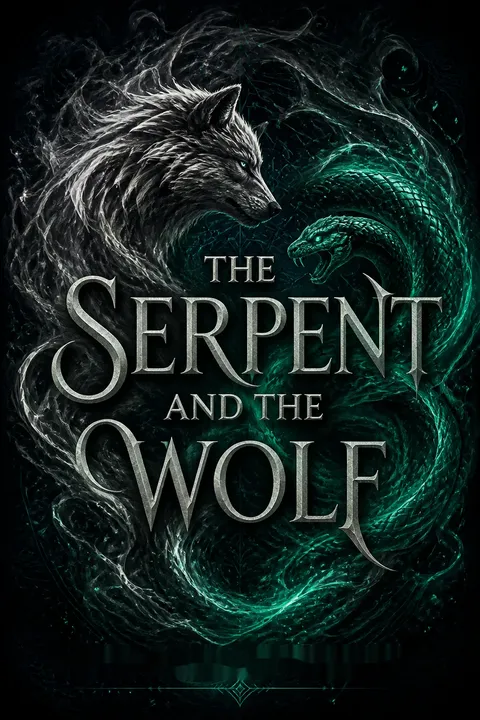


Plot Summary
A Bride Leaves Blood
After her parents die, Vaasa Kozár is married off by her newly crowned brother, Dominik, to Reid, a Mirehan foreman whose reputation makes the match feel like a sentence. She hides rope and a blade beneath the wedding bed, then uses a staged seduction to bind Reid and cut his throat. His insistence that she can refuse unsettles her plan.
When black mist leaks from her hands, she leaves him alive, takes his valuables, and escapes through the temple window. The magic resembles the force that consumed her mother, and Vaasa fears it will kill her before Dominik can use her marriage for political gain. She sells Reid’s silks for passage to Dihrah, hoping its scholars can explain the curse.
Vaasa begins by treating danger as something she can outmaneuver through preparation: rope, a knife, a false performance. Reid’s concern for her consent interrupts that script, but not enough to make her trust him. Her decision to spare him is therefore more than a tactical delay. It is an early refusal to reproduce the cruelty that trained her, even while she still understands herself as a weapon built by her family.
The Wolf Finds Her
For three months, Vaasa studies under a false name at Dihrah’s Library of Una, searching for an explanation of the black mist. A text links it to Veragi, a goddess of witchcraft, and recalls the strange residue surrounding her mother’s body. When Brielle notices Vaasa’s research, the young woman panics and vomits black matter, confirming that the magic is not merely a frightening vision.
Reid finds her later, recognizes the mist, and reveals that he knows a master of its power. He offers a bargain: Vaasa will publicly act as his wife while he seeks help for her magic and pursues Icruria’s leadership. In return, he promises a legal separation and a new life after three years.
The library gives Vaasa a way to name what she has experienced, but knowledge also sharpens the danger: her mother’s death may be connected to a force now inside her. Brielle offers ordinary kindness, which Vaasa rejects because intimacy feels like exposure. Reid’s bargain gives her practical shelter without demanding affection, yet his promise to honor her choice contrasts with the marriage imposed by Dominik. The arrangement begins as mutual use, but makes trust an unavoidable question.
Home Beneath the Flowers
Vaasa accepts the arrangement and returns with Reid to Mireh, where they perform affection before the people whose confidence he needs. At the Sodality of Setar, Reid introduces her to his mother, Melisina, the high witch of Veragi, and to the coven that shelters young witches. Melisina explains that Vaasa’s magic passed from her mother at death; it is inherited, not a parasite that can simply be removed.
Vaasa must learn to direct it. She begins practicing with Melisina and Amalie, while Reid establishes their shared home beside the Settara. The villa’s openness unsettles Vaasa, but its safety, the coven’s welcome, and Reid’s willingness to keep their bargain begin to make Mireh more than a place to hide.
The coven changes the terms of Vaasa’s problem: she cannot cut the magic out, so survival depends on learning to live with it. Melisina gives her information without forcing disclosure, making instruction itself a form of care. At the same time, Reid’s public performance exposes the split between what their marriage looks like and what it is. The villa becomes a physical test of that split: Vaasa expects a guarded prison, but finds a home whose trust she does not yet know how to accept.
The Serpent Learns Water
Vaasa learns to guide the mist by imagining it as water, but control falters when Kosana, Reid’s commander, cuts her during a sparring match and presses a blade to her throat. Vaasa nearly releases the void against the watching warriors. The coven helps her ground herself, and she finally sees the magic not as inherited wickedness but as pain she has kept buried.
Reid confronts Kosana, then accepts Vaasa’s request to replace her with Esoti as trainer. He cleans Vaasa’s wounds and listens as she admits that she wants to live, has no loyalty to Dominik, and fears what he will do. Vaasa also learns to trust the coven’s support, even when her first instinct is to hide.
The fight makes Vaasa’s fear bodily: Kosana’s blade and the crowd’s presence threaten both her life and her control. The coven does not solve this by suppressing the power; it helps her identify the pain beneath her anger and survive the moment without harming others. Her request to change trainers is an early exercise of agency. Reid’s care matters because he pauses at her boundaries, offering help without treating vulnerability as permission to control her.
Freya’s Painted Shore
Melisina takes Vaasa to a gallery of paintings by Freya, Vaasa’s great-grandmother, and reveals that the villa once belonged to her. Freya fled Asterya as a girl after inheriting Veragi magic, then helped establish the coven with Melisina’s family. Vaasa’s grandmother later left Icruria, and her mother returned only briefly before arranging the marriage that would place Vaasa near Melisina and the witches.
The revelation complicates Vaasa’s belief that her mother sent her away simply to die. She is angry that the women in her family concealed the truth, but begins to see their choices as shaped by fear and isolation. The villa’s familiar view becomes evidence of an inheritance she never knew she had.
The paintings turn ancestry into something visible and located: the landscape Vaasa has begun to inhabit was once her family’s home. That discovery does not immediately reconcile her with her mother. Instead, it forces her to consider that secrecy may have been both protective and harmful. The generations of women repeat a pattern of leaving, withholding, and trying to keep daughters safe without fully preparing them. Vaasa’s anger is justified, but the past is no longer simple enough to blame on one person.
Politics in the Lower Garden
When councilors Marc, Galen, and Kenen arrive without warning, Reid fears the visit is a political test. Vaasa proposes an informal evening in Mireh instead of a hurried ceremony, then guides the dinner and dancing so Marc feels welcomed without being flattered into power. Her strategy helps Reid gain Marc’s support, while Isabel, Marc’s consort, offers Vaasa a possible friendship.
Vaasa also tells Amalie that her marriage carries a hidden legal claim: if Dominik dies, Reid could inherit Asterya. The prospect frightens her, especially when Reid agrees to host Dominik. Soon after, Vaasa’s fear overwhelms her and she encloses herself in a vast dome of Veragi darkness. Reid helps her return from it without blaming her for losing control.
Vaasa’s political skill is not merely a survival reflex; she can use it to protect people and create room for others to act. The dinner works because she reads what Marc values rather than imposing Asteryan ceremony on him. Yet her secret about the throne reveals how easily political advantage can become another cage. The dark dome turns that conflict inward: Vaasa’s magic protects her by shutting out the world, but safety achieved through total isolation resembles the loneliness she is trying to escape.
Dominik’s Poisoned Wine
Dominik arrives in Mireh demanding access to trade routes and a foothold near Icruria’s border. In private, he offers Vaasa an ambassadorship if she helps Reid win office and prepares the way for Asteryan conquest. He tests her loyalty with wine that carries the faint scent of poison.
Vaasa refuses the offer and tells Reid the truth: Asteryan law gives her husband the throne if Dominik dies and she remains the last eligible heiress. She also reveals that Dominik had her former love, Roman, killed. Rather than seize an empire for himself, Reid agrees to help dismantle its concentrated power and restore local rule. Vaasa chooses to work with him, though neither can yet know what the choice will cost.
Dominik’s offer repeats the family’s central transaction: Vaasa is valuable only when she can be converted into access, influence, or a claim. The poisoned wine makes that logic literal, turning hospitality into a test of whether she can still detect danger. Her disclosure to Reid is a counter-move. By sharing the legal truth and Roman’s fate, she gives him knowledge that could empower him, then watches whether he uses it to dominate her. His plan to disperse authority marks a meaningful alternative to the empire that formed them both.
Blood on the Settara
As the election party sails across the Settara, archers attack from the cliffs and soldiers board from below. Vaasa refuses to remain hidden while the deck fills with blood. She and the Veragi witches fight beside Esoti and the Mirehan crew, using blades and magic to repel the attackers. Vaasa discovers Reid tied in their quarters with ropes threaded with material that suppresses magic.
She frees him, then recognizes the captured attacker as Ignac, an Asteryan cousin and general, whose men wore stolen Wrultho uniforms. The assault appears to be Dominik’s work, but Vaasa keeps Ignac alive as leverage. Her response earns Kosana’s respect and establishes that she will defend Reid and Mireh even when the danger comes from her own people.
The attack forces Vaasa to act before she can turn fear into analysis. Her magic becomes useful not because it stops being dangerous, but because she has learned to direct it alongside the coven. Freeing Reid reverses their first encounter: she once held him at knifepoint to escape, now she cuts through magic-dulling restraints to protect him. Keeping Ignac alive is equally important. Vaasa refuses to let the violence dictate her next move, choosing information and leverage over immediate revenge.
The Demon at the Tourney
At the election’s tourney, Reid fights Ton of Wrultho while Vaasa watches from the stands. A black, oily creature bursts into the colosseum and kills Ignac before disappearing. Its smell matches the one Vaasa remembers from the night she found her mother dead, leading her to suspect that her mother was murdered rather than destroyed by uncontrolled magic.
The witches identify the creature as a Miro’dag, a demon associated with the supposedly vanished Zetyr magic. That night, Vaasa throws herself into research, then lashes out when Amalie urges her to rest, insisting she will leave after three years. Amalie withdraws, and Vaasa realizes that her fear of attachment has wounded the friend who helped her feel less alone.
The Miro’dag makes Vaasa’s private trauma a public threat, and its scent gives memory evidentiary force. Her mother’s death is no longer only the origin story of her magic; it may be part of an active conspiracy. Yet Vaasa answers uncertainty by retreating into work and rejecting Amalie. Her promise to leave sounds like control, but it functions as emotional preemption: if she insists that every bond is temporary, she need not risk being abandoned. The cost is immediate, in Amalie’s hurt.
The Letter in the Catacombs
On the night of the witches’ public display, Vaasa goes looking for Amalie and is drugged, then wakes bound in an abandoned colosseum catacomb. Mathjin, Reid’s trusted advisor, has taken both women and wants Vaasa to write a letter describing the route Ton’s soldiers will use.
He intends to have the letter intercepted so Reid appears to have betrayed Wrultho, provoking a war and destroying his chance at leadership. Dominik arrives and threatens Amalie until Vaasa complies. With one hand freed, Vaasa writes the route accurately, knowing the document can ruin Reid and endanger Icruria. Mathjin leaves her tied beside Amalie, while Dominik prepares to kill them both.
Mathjin’s betrayal is painful precisely because Vaasa has treated his practical guidance as evidence of trustworthiness. His grief over his murdered family explains his desire for revenge, but does not make the plan less destructive. He converts Vaasa’s knowledge of routes into a weapon against the people who sheltered her. Dominik adds a more intimate cruelty by using Amalie as leverage. Vaasa’s forced letter exposes the danger of her old skill: information can preserve life, but in another person’s hands it can also manufacture a war.
A Wolf Made of Mist
Amalie releases a burst of magic that blacks out the catacomb and gives Melisina time to reach the captives. Vaasa kicks Dominik away from his knife, breaks free of her restraints, and summons the wolf-shaped form her magic has been moving toward. She kills Dominik before he can harm Amalie again.
The act ends his immediate threat, but leaves Vaasa holding the severed head of the brother who ruled her life through fear. She arrives at the election ceremony with Amalie and Melisina, carrying proof of the danger she has survived. Her victory is not clean: she has protected her friend and claimed control of her power, yet has also killed the last member of her family.
The wolf is not a new power dropped into the story at its climax. It grows from Vaasa’s gradual practice of sensing, directing, and releasing magic rather than treating it as an alien curse. Amalie’s intervention makes the transformation relational: Vaasa survives because someone else risks herself for her. Killing Dominik is an act of protection and self-determination, but the severed head makes clear that freedom does not erase grief. Vaasa has defeated the person she feared while carrying the consequences of becoming the one who ends him.
Two Crowns, One Captive
At the election, Ton presents Vaasa’s coerced letter as evidence of betrayal. Reid recognizes its final line as a warning, and Vaasa arrives carrying Dominik’s head. Ton’s forces attack; Koen stops Mathjin, and Reid kills the advisor after Vaasa exposes his bargain with Dominik.
Then Ozik reveals that he is the Zetyr witch behind the Miro’dag and admits he arranged the deaths of Vaasa’s parents to claim Asterya. The demon impales Reid, killing him. Desperate, Vaasa gives Ozik her magic in exchange for Reid’s life. Ozik revives Reid, then has Asteryan soldiers seize Vaasa. She is carried away without her power, while the battle and the election’s outcome remain unresolved.
The election’s public ritual collapses into a contest over who can control the story of Vaasa’s loyalty. Her letter is both authentic evidence and coerced testimony, while its final line lets Reid interpret her intention rather than judge her by appearances. Ozik’s revelation reframes the family’s history as an engineered succession, not merely sibling rivalry. Vaasa’s bargain saves Reid by surrendering the capacity she had fought to understand. The exchange is emotionally legible but politically perilous: love preserves one life while leaving Vaasa captive and the larger conflict open.
Headman, Emperor, Husband
Reid wakes more than a week later, physically restored by the Zuheia healers but unable to feel Vaasa’s magic as before. Melisina explains that Vaasa traded it to Ozik to bring Reid back, then disappeared with the Asteryan forces. The councilors held the election after Reid recovered, and he won the headmanship.
Melisina also reveals that Vaasa’s mother had asked her to protect her daughter, and that a goddess may be involved in the conflict surrounding the Zetyr. Reid refuses to treat his new office as a reason to stay behind. Since Vaasa is the last Asteryan heiress and he is her husband, Dominik’s death makes Reid heir to that empire as well. He sets out to reclaim his wife.
The ending gives Reid authority but withholds the person for whom that authority has become meaningful. His election confirms the political success he pursued, yet the cost is an immediate separation from Vaasa and a new responsibility for Asterya. Melisina’s account of Vaasa’s mother widens the conflict beyond the choices of individual rulers, while the missing magic leaves Vaasa’s fate uncertain. Reid’s decision to go after her transforms leadership from an abstract ambition into a commitment to use power for someone he loves.
Analysis
The novel binds Vaasa’s emotional life to the systems of power around her. In Asterya, she has been trained to translate languages and motives for a family that sees her usefulness as more important than her consent. Her brother’s marriage arrangement extends that logic: Vaasa is both a political asset and a potential danger to his rule. Icruria offers a different political structure, but not a simple refuge. Its six territories depend on one another for salt, food, ships, soldiers, and trade, so even a humane leader must negotiate within material constraints. Reid’s campaign makes the possibility of cooperation concrete, while Vaasa’s political intelligence helps him recognize what others need.
The magic gives this conflict an intimate form. Vaasa first experiences it as a serpent that appears to confirm her fear that she has inherited her family’s cruelty. The coven’s teaching does not erase the power or declare it harmless. Instead, Melisina and the other witches help Vaasa notice how fear, anger, and grief move through her body, then practice responding without letting those feelings dictate her actions. This process links emotional regulation to agency: control is not suppression, and strength is not the absence of pain.
Relationships test whether Vaasa can accept care without surrendering autonomy. Reid asks for consent and honors their agreement; Amalie offers friendship without demanding that Vaasa reveal everything at once. Vaasa still hurts Amalie when she treats departure as inevitable, showing that recognizing a pattern does not immediately undo it. Her final choice to save Reid through a Zetyr bargain reveals both the power and danger of attachment. She acts freely, but the price is severe. The ending leaves her captured and stripped of magic, while Reid gains political authority and commits himself to finding her. Love has not resolved the political struggle. It has given each of them a reason to continue it.
Review Summary
The Serpent and the Wolf receives mixed reviews, averaging 4.01/5 stars. Readers praise the political intrigue, slow-burn romance, strong female lead Vaasa, and compelling world-building. Popular tropes include enemies-to-lovers, arranged marriage, and found family. Many appreciate Reid's patience and kindness, though some find him one-dimensional. Common criticisms include choppy pacing, confusing magic system, underdeveloped world-building, formulaic writing, and excessive politics. The cliffhanger ending frustrated some but excited others. Reviewers debate whether it's true romantasy or fantasy with romance. Most agree it's an impressive debut with potential.
People Also Read








Characters
Vaasa Kozár
The guarded heiressVaasa is the eldest daughter of Asterya’s ruling family, trained to translate, read political motives, and survive among powerful people. Her instinct is to turn fear into anger and vulnerability into strategy, because dependence has repeatedly exposed her to danger. She is clever, observant, and capable of calculated deception, but her greatest struggle is distinguishing self-protection from isolation. Her search for control over Veragi magic forces her to examine the pain beneath her anger and decide what kind of person she wants to become. Vaasa’s intelligence is not simply a political tool; it is also how she tries to recover choices that others have made for her.
Reid
The patient war-leaderReid is the young foreman of Mireh, a formidable fighter who hopes to lead all six Icrurian territories. His strength is balanced by unusual patience: he asks for consent, keeps his promises, and prefers durable alliances to displays of domination. Vaasa initially reads his humor and confidence as arrogance, but his attention to her choices complicates that judgment. Reid is ambitious without being blind to the corrupting force of rule, and his friendship with Kosana and Koen shows how seriously he values loyalty. Beneath his easy manner is a man shaped by grief, responsibility, and a desire to make violence less necessary.
Dominik
The ambitious emperorDominik is Vaasa’s younger brother and the new emperor of Asterya. He has inherited a system built on conquest and treats family ties as another instrument of political control. His confidence is sharpened by suspicion: he sees potential rivals everywhere and believes security comes from eliminating them first. Dominik understands Vaasa’s intelligence and knows how to exploit her hopes, which makes their conflict more personal than a simple contest for territory. He embodies the logic Vaasa was taught to use, forcing her to decide whether survival requires repeating the methods that shaped her.
Amalie
The steadfast young witchAmalie is a young Veragi witch and a student at the Sodality of Setar. Warm and intellectually curious, she offers Vaasa friendship without demanding that Vaasa become instantly trusting. Her compassion is not passivity: she has survived poverty, grief, and the danger of being treated as a magical resource. Amalie hopes the scattered covens might one day work together, and she approaches that ambition with a practical understanding of what isolation costs. Her closeness with Vaasa gives the guarded heiress a rare experience of mutual trust, while Amalie’s own reserve reminds others that kindness can coexist with hard boundaries.
Melisina
The coven’s steady matriarchMelisina is Reid’s mother and the high witch of Veragi. She teaches Vaasa to approach magic as part of herself rather than as an infection to be removed. Patient but not indulgent, Melisina allows silence when Vaasa cannot yet speak and insists on practical work when she is ready to learn. Her authority comes from deep experience, though she does not pretend to know every answer about the gods or the covens. Melisina’s bond with Reid is affectionate but independent, and her commitment to protecting her community places her among the few adults who can offer Vaasa guidance without seeking to own her future.
Kosana
The formidable commanderKosana commands Mireh’s forces and has been Reid’s friend since childhood. A disciplined warrior, she distrusts Vaasa because of the danger and humiliation surrounding the wedding night. Her guarded loyalty is fierce, especially when Reid’s safety is involved. Kosana’s antagonism makes Vaasa confront the consequences of her choices rather than treating Reid’s forgiveness as proof that no one else was hurt. She is demanding, direct, and protective of the corps she leads.
Esoti
The watchful warriorEsoti is a skilled member of Mireh’s corps and Kosana’s wife. She becomes Vaasa’s combat instructor after Kosana’s training turns dangerous. Esoti is observant and disciplined, with a protective streak that does not prevent her from respecting Vaasa’s wish to face danger herself. Her instruction gives Vaasa physical tools to complement her political intelligence and developing magic.
Mathjin
The calculating advisorMathjin advises Reid and has served Mireh through years of political change. He is precise, emotionally restrained, and well versed in military and economic realities. His family history has been marked by the border conflict, giving him a personal stake in decisions that others treat as strategy. Mathjin’s practical manner earns Vaasa’s respect, though his reserve makes it difficult to know what loyalties or griefs he keeps to himself.
Ozik
The imperial counselorOzik is the longtime counselor to Asterya’s ruling family and helped shape Vaasa’s education. Fluent in Icrurian and practiced in political maneuvering, he watches people closely and understands how information can become power. His formal manner and steady presence have made him part of Vaasa’s memories of the palace, though his motives are difficult to read. He represents the continuity of the imperial court across changes in ruler.
Brielle
The scholar who reaches outBrielle is an acolyte at the Sodality of Una who notices Vaasa’s solitary research and offers to help. Warm but perceptive, she quickly understands that Vaasa is searching for knowledge beyond the ordinary library collection. Brielle does not force closeness when Vaasa rebuffs her, and her quiet actions show that care can persist without becoming pressure.
Isabel
The political connectorIsabel is Marc’s consort, a lively woman with a sharp understanding of Icrurian politics. Her warmth makes her an effective host, but she is also strategic, often noticing which people need privacy or encouragement. She recognizes Vaasa’s intelligence and offers a possible friendship as well as political advice. Isabel’s marriage to Marc provides a contrast to Vaasa and Reid’s initially staged partnership.
Marc
The influential councilorMarc is a former foreman of Mireh and an influential councilor whose support matters in the headman election. Stoic and difficult to impress, he values authenticity and has a deep history with the city. His affection for Isabel is one of the few emotions he displays openly. Marc’s judgment carries weight because he understands both the practical demands of leadership and the value of coming home.
Koen
The scholarly foremanKoen is the foreman of Dihrah, a scholar and Reid’s longtime friend. His mild, wry manner conceals a strong political understanding, and he is comfortable challenging assumptions without turning every disagreement into a contest. Koen supports Reid while maintaining a clear sense of his own role and limits. His ties to the academic world help bridge the sodalities and Icruria’s political leadership.
Ton
The hard-edged foremanTon leads Wrultho, a territory strained by drought and conflict with Asterya. He is physically imposing and proud, with an intense desire to prove himself within Icrurian politics. His distrust of Vaasa reflects both the history of Asteryan aggression and his own political ambitions. Ton’s decisions are driven by a need for strength and recognition, even when cooperation could offer his people a better future.
Vena Kozár
Vaasa’s distant motherVena is the empress of Asterya and Vaasa’s mother. Vaasa remembers her as distant and difficult to approach, a woman whose private feelings were rarely visible to her children. Her choices connect the imperial family to Icruria in ways Vaasa does not initially understand. Vena’s silence leaves her daughter to interpret her past from fragments, family customs, and the consequences of decisions made before Vaasa knew the full story.
Freya
The ancestral painterFreya is Vaasa’s great-grandmother, remembered through paintings of Mireh’s landscape. Her art preserves a personal link between Vaasa’s family and the city, giving the heiress a way to see history as lived experience rather than a list of political borders.
Roman
Vaasa’s lost first loveRoman is a soldier Vaasa once loved in secret. He taught her practical skills and offered a rare experience of tenderness within the dangerous world of the Asteryan court. His memory shapes Vaasa’s caution around attachment and her belief that love can make a person vulnerable to political cruelty.
Ignac Kozár
The Asteryan generalIgnac is an Asteryan general and a distant member of Vaasa’s family. He commands soldiers and understands the risks attached to the Kozár name. His appearance in Icruria links Vaasa’s family conflict to the military struggle between the two nations.
Kier
The outgoing headmanKier is Icruria’s current headman and Koen’s adoptive father. He oversees the election and embodies the republic’s rotating leadership. His easy familiarity with the foremen reflects the personal relationships beneath Icruria’s formal political structure.
Elijah
The outgoing high consortElijah is Kier’s husband and the current high consort of Icruria. Sociable and expressive, he welcomes Vaasa into the political community and treats the title as a role that can be passed on rather than a possession.
Plot Devices
Veragi inheritance
Magic passed through mothersVeragi magic passes from a witch to her eldest daughter at the mother’s death. Vaasa initially experiences it as a hostile black mist that responds to fear and anger, but the coven teaches her to sense, guide, and release it. Its forms reveal how she understands herself, eventually becoming a wolf rather than remaining the serpent she associates with her family’s cruelty. The magic is both a literal danger and a way for Vaasa to recognize emotions she has learned to suppress.
The public marriage
Alliance disguised as romanceVaasa and Reid agree to present themselves as a devoted couple so Reid can strengthen his political prospects and preserve an alliance with Asterya. Public dances, dinners, and affectionate gestures persuade Icrurian leaders to take their partnership seriously. In private, the marriage begins as a negotiated arrangement with limits and a three-year term. Its political function becomes more dangerous when Vaasa’s legal claim to Asterya means Reid could inherit the empire through their union.
The headman election
Leadership shaped by resourcesIcruria chooses a headman from among six territorial foremen, with councilors deciding the result. Reid’s candidacy depends on votes, reputation, and cooperation among city-states that rely on one another for salt, ships, soldiers, food, and trade. Vaasa’s political skill helps him court influential voters, while the conflict with Asterya and the crisis in Wrultho turn the election into a contest over whether Icruria will pursue trade or war.
The Miro’dag
A demon marks hidden powerThe Miro’dag is a monstrous creature associated with Zetyr magic, a tradition believed to have vanished. It appears at the election tourney and attacks again during the coup, leaving an oily residue and the smell Vaasa remembers from her mother’s death. Its presence connects separate acts of violence and points toward a hidden magical bargain-maker. Its attacks also turn the political conflict into a threat that ordinary armies and elections cannot contain.
Zetyr bargains
Power purchased through exchangeZetyr magic works through bargains: a witch can access power by promising something to another party, with broken terms carrying lethal consequences. The principle becomes central when Ozik uses a bargain to restore Reid’s life in exchange for Vaasa’s Veragi magic. The exchange saves Reid but leaves Vaasa without the power she has worked to understand and places her in the hands of Asteryan soldiers. The device makes desire itself dangerous, since the price is determined by what a desperate person is willing to surrender.
Download PDF
Download EPUB
.epub digital book format is ideal for reading ebooks on phones, tablets, and e-readers.








