

Key Takeaways
Practice all seven sacred flames, not just the quality you prefer
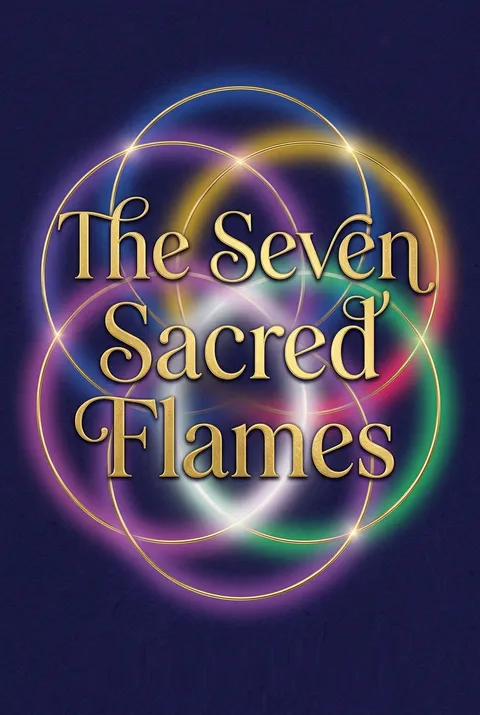
A balanced curriculum. The book presents the Sacred Flames as spiritual energies, each associated with a virtue to develop. It recommends focusing on a different quality each day, while remembering that none works alone: wisdom needs love, and healing needs discipline as well as compassion.
The weekly sequence is: Sunday, yellow for wisdom; Monday, blue for divine will; Tuesday, pink for love; Wednesday, green for healing and abundance; Thursday, purple and gold for renewal; Friday, white for purity; and Saturday, violet for transformation and freedom. The author links each ray to a chakra, spiritual teachers, and guided prayers or visualizations. The practical point is to cultivate a range of capacities rather than treating one favored spiritual practice as a universal answer.
The seven-part map gives a sprawling spiritual cosmology a memorable rhythm. Daily themes can function as attentional cues: a person might use a focus on wisdom to pause before deciding, or a focus on love to notice how they treat others. That practical use does not depend on accepting the flames as measurable energies. The system is most useful when its categories prompt reflection, not when color correspondences are treated as medical or scientific facts. Its insistence on balance also resists the common temptation to turn a single virtue, such as willpower or compassion, into the solution for every problem.
Turn spiritual aspiration into daily practice before chasing another teaching
Knowledge needs embodiment. The book repeatedly warns that collecting spiritual ideas can feel like progress while leaving conduct unchanged. Master Hilarion is presented as spending more than twenty years in solitude, contemplating the divine presence within, before his healing abilities emerged. The story makes patience and sustained attention central to spiritual development.
The practical advice is deliberately ordinary: set aside time for inner work, reflect on what matters most, and reduce distractions that crowd out those commitments. In one exchange, Adama urges readers to simplify their schedules rather than waiting for life to become less busy. The standard is not how many teachings someone has encountered, but whether their choices, habits, and relationships show that the teaching has been absorbed.
This is a sharp account of the gap between knowing and doing. In education, information is not the same as skill; repeated practice, feedback, and application are what make knowledge usable. The book's emphasis on consistency fits that distinction, and its warning about spiritual novelty applies well beyond spiritual reading. Still, simplicity should not be confused with withdrawal from obligations or professional care. A sustainable practice is more likely to endure when it fits a person's actual responsibilities instead of demanding an idealized life free of work, caregiving, or hardship.
Surrender is active alignment, not a shortcut around responsibility
Consent paired with effort. In the book's vocabulary, surrender means cooperating with one's deeper divine nature instead of letting fear or ego dictate every choice. It is not presented as waiting passively for rescue: the person must choose, practice, and take responsibility for change. The author connects this idea to free will, arguing that spiritual help can be invited but cannot do a person's inner work for them.
A story from the book's Telos narrative gives surrender a material shape. After Lemuria's destruction, survivors supposedly lost their former world and began rebuilding in a far less developed underground settlement. The story frames accepting loss as a starting point for making a new life, not as a reason to stop acting. Readers are urged to meet change with trust while continuing to participate in it.
The strongest version of surrender here resembles psychological flexibility: acknowledging what cannot be controlled while choosing a constructive response to what can. That differs from resignation, which abandons agency, and from control, which insists that reality obey a preferred script. The distinction matters because spiritual language about trusting a process can be misused to excuse preventable harm or defer practical decisions. Read carefully, the book's own emphasis on choice and effort supports a more grounded interpretation: trust may shape one's response, but it should not replace discernment, boundaries, or action.
Make love measurable through harmlessness, gratitude, and useful service
A conduct-based ideal. The book distinguishes its ideal of divine love from a passing warm feeling. Love is meant to show up as compassion, patience, forgiveness, gratitude, and care for living beings. Its guidance for disciples includes speaking gently, avoiding needless harm, respecting the Earth, and offering help beyond one's own household.
The Sixth Ray's focus on service makes this concrete: the aspiring student is asked to devote time to the welfare of others, not merely to personal advancement. The book also treats gratitude as a practice that changes attention, directing it toward what is already valued rather than only toward what is missing. These habits are presented as spiritual training, with the claim that a person's inner development should become visible in how they treat people and the natural world.
Turning a virtue into observable behavior makes it harder to use as self-flattery. Prosocial action, repair after conflict, and environmental care offer more meaningful evidence of compassion than declarations of spiritual attainment. Gratitude can also broaden attention, though it should not be used to silence grief or legitimate anger at injustice. Harmlessness is not the same as never confronting wrongdoing; in some situations, protecting others requires firm opposition. The idea becomes more robust when love includes both tenderness and a willingness to act responsibly.
Use visualization to focus intention, not as proof of supernatural results
Ritual directs attention. The book's meditations ask readers to picture colored light, breathe slowly, and imagine visiting temples associated with each ray. In one guided exercise, readers picture a healing temple in Telos and focus on what they hope to understand or change. These journeys are presented as encounters on an inner plane, and the author says their effects may be felt even without conscious memory.
The prayers and visualizations also give the reader a way to name an intention. The Violet Flame, for example, is invoked as a symbol of transformation, forgiveness, and freedom from harmful patterns. The text recommends returning to such practices regularly and bringing feeling and attention to them, rather than reciting words mechanically. Its metaphysical claims go beyond what the exercises themselves can demonstrate.
Guided imagery and ritual can provide structure for reflection, calm, and goal-setting; those effects are distinct from proof that a person traveled to an invisible temple or altered karma through colored energy. The book's methods can therefore be approached as contemplative exercises without requiring a literal interpretation. This distinction protects both the practice and the reader: meaningful subjective experience need not be dismissed, but it should not be mistaken for independent evidence. When a visualization concerns health, it can support coping, not replace diagnosis or treatment.
Treat healing as whole-person work, without blaming illness on emotion
Mind, body, and spirit. The book portrays physical, emotional, mental, and spiritual life as interconnected. It argues that unresolved emotional distress can contribute to bodily problems, and presents the Great Jade Temple as a place where spiritual counselors address all these dimensions together. Another distinctive figure is the Body Elemental, described as an intelligent being that maintains the body's functions and deserves care and gratitude.
The author's practical suggestions include reflecting on emotional patterns, seeking forgiveness, reducing harmful habits, and expressing appreciation for the body. These may encourage self-awareness and more attentive care. However, the book's broader claim that nearly all health problems originate in emotional imbalance is a spiritual doctrine, not a reliable medical rule. Illness can have many causes and should not be interpreted as evidence of personal failure.
A whole-person perspective has value because stress, mood, social support, and physical illness can influence one another. It can help patients and clinicians consider more than symptoms alone. But association does not establish that emotional conflict caused a disease, and many conditions arise through biological, environmental, or inherited factors. Assigning spiritual responsibility for illness can deepen shame or delay effective care. The most humane reading keeps the invitation to attend to emotional wellbeing while rejecting any implication that a sick person is sick because they failed spiritually.
Use karma as a prompt for accountability, not a verdict on suffering
Consequences and repair. The book describes karma as the return of energy created through one's actions, thoughts, and feelings. It also says that the Karmic Board moderates what returns in a lifetime, allowing a person to face only what they can manage. In this framework, the Violet Flame represents a means of transforming harmful patterns through love, forgiveness, and changed behavior.
That account encourages readers to ask what a difficult situation might teach them and how they can repair harm they have caused. The book extends the principle beyond personal relationships to mistreatment of animals and damage to the Earth. Its language can make moral responsibility feel cosmic, but it does not provide a way to verify that a particular hardship is repayment for a past action.
Karma can work as a moral lens when it encourages people to notice consequences, take responsibility, and make amends. It becomes dangerous when used to explain why someone else suffers or to imply that victims earned their hardship. No outsider can reliably infer a person's moral history from illness, poverty, or loss. A careful application focuses on choices within one's control: stop causing harm, repair what can be repaired, and build better patterns. That preserves accountability while resisting the cruel certainty that suffering must be deserved.
Measure readiness by transformed conduct, not promises of a cosmic deadline
A personal threshold. The book defines Ascension as a spiritual transformation in which a person unites with the divine presence within and lives with greater love, purity, and freedom. It rejects the idea that everyone automatically enters a higher dimension simply because the planet reaches a particular date. In its account, readiness depends on individual choices and inner development.
Published in 2007, the book repeatedly anticipates Earth's Ascension around 2012 and describes that period as an exceptional opportunity. That forecast is part of its historical setting, not an established event. The more durable message is that transformation requires practice and cannot be outsourced to a calendar, a group, or an outside rescuer. The book also holds that people progress at different speeds, rather than all reaching the same spiritual threshold together.
The distinction between personal change and a promised collective event is useful, especially in movements that attach spiritual urgency to a date. The 2012 prediction has passed without publicly verifiable evidence of the planetary dimensional shift the text describes. That weakens the forecast as a factual claim, while leaving room to consider its ethical emphasis on preparation and conduct. Readers can separate the two: test predictions against observable outcomes, and assess spiritual practice by whether it fosters greater care, honesty, and responsibility in ordinary life.
Let the masters represent virtues without surrendering judgment to authority
A spiritual map of roles. The book places seven Chohans, or ray leaders, within a vast hierarchy of spiritual beings. Each master is associated with a quality: El Morya with will, Lanto with wisdom, Paul the Venetian with love, Serapis Bey with purification, Hilarion with healing, Nada and Sananda with service, and Saint Germain with transformation. Readers are invited to pray to these figures for guidance and support.
The hierarchy gives the book a cast of characters and organizes its teachings into distinct forms of service. At the same time, the text urges obedience to spiritual authorities and describes a system in which the spiritually advanced govern. Such claims are part of the author's channelled cosmology, not independently established descriptions of the universe. Readers can engage with the figures as symbols while keeping their own discernment active.
Personifying virtues can make abstract ideals easier to remember: wisdom becomes a teacher, protection a guardian, and service a relationship rather than a slogan. This resembles the use of archetypes in literature and contemplative practice. The risk appears when symbolic authority is treated as unquestionable authority, especially when a claim of revelation is used to direct another person's choices. A healthy spiritual practice can value mentors and tradition while still asking whether an instruction is ethical, coherent, and respectful of consent.
Analysis
The Seven Sacred Flames is best read as a channeled spiritual manual organized around a seven-part map of virtue. Its recurring pattern is simple: introduce a ray, name its color and spiritual authorities, describe a retreat, then offer a message, prayer, or guided meditation. The repetition reinforces the teaching through ritual, although it also makes the book digressive and difficult to reduce to a conventional argument. Its narrative interest comes less from a continuous plot than from the recurring relationship between the surface world and the imagined community of Telos, whose beings act as teachers and custodians of forgotten wisdom.
The strongest practical thread is the demand to turn spiritual ideas into conduct. Daily attention, self-examination, gratitude, service, and harmlessness give the vast cosmology usable ethical content. The seven rays can be read as a mnemonic for balancing qualities rather than as a scientific account of energy. Likewise, the guided journeys may serve as imaginative contemplations without requiring readers to accept their settings as literal places.
The text also contains tensions worth noticing. It celebrates free will and personal responsibility, yet calls for obedience to a spiritual hierarchy. Its holistic account of healing can encourage reflection, but the claim that most physical illness originates in emotional imbalance risks blaming people for conditions they did not choose. Its predictions about planetary Ascension around 2012 have not been demonstrated by publicly verifiable evidence. These limitations do not erase the book's ethical aspirations, but they make careful interpretation essential. A reader can retain the practices of attention, compassion, and service while treating supernatural claims as beliefs rather than established facts. The book's most durable contribution is therefore less a guaranteed route to immortality than an invitation to assess spiritual growth through the quality of one's daily choices.
People Also Read



Glossary
Seven Sacred Flames
Seven spiritual qualitiesIn Jones's spiritual system, the Seven Sacred Flames are energies associated with divine qualities such as will, wisdom, love, healing, purity, service, and transformation. Each flame has a color, a spiritual teacher, and a related chakra. The book presents them as complementary practices to invoke and balance, rather than as a single energy that solves every problem.
I AM Presence
Inner divine identityThe I AM Presence is the book's term for a person's highest divine self, described as an enduring source of wisdom, power, and love within and beyond ordinary human awareness. Spiritual development means restoring conscious connection with this presence. The author treats it as the source of guidance and the aspect of self with which a person ultimately unites through Ascension.
Ascension
Union with divine selfAscension is described as a process of purification and spiritual transformation that culminates in union with the I AM Presence. In the book's cosmology, it can involve entry into a higher dimension and, for some candidates, continued life in a transformed physical body. The text presents it as requiring personal preparation and ethical development, not as an automatic consequence of a planetary date.
Violet Flame
Transformation through sacred fireThe Violet Flame is the Seventh Ray's spiritual fire of transformation, forgiveness, mercy, and freedom. The book recommends invoking or visualizing it to help change harmful patterns and what it calls misqualified energy. It is especially associated with Master Saint Germain. These are claims within the author's spiritual framework, not scientifically established effects of a physical flame or energy.
Body Elemental
Spirit serving the bodyThe Body Elemental is described as an intelligent spiritual being assigned to maintain a person's physical body, including its organs and systems. According to the book, it accompanies a soul across incarnations and is affected by how the person treats the body. The author recommends showing it gratitude and care. The concept belongs to the book's esoteric cosmology.
Atomic Accelerator
Ascension frequency deviceThe Atomic Accelerator, also called an Ascension chair, is a spiritual technology that the book attributes to Master Saint Germain. It is said to raise a person's vibration through the frequency of the Ascension Flame, either gradually or, for a fully prepared candidate, completely. The text describes guided ceremonies using an etheric version of the device; its existence and effects are not independently verified.
Download PDF
Download EPUB
.epub digital book format is ideal for reading ebooks on phones, tablets, and e-readers.








