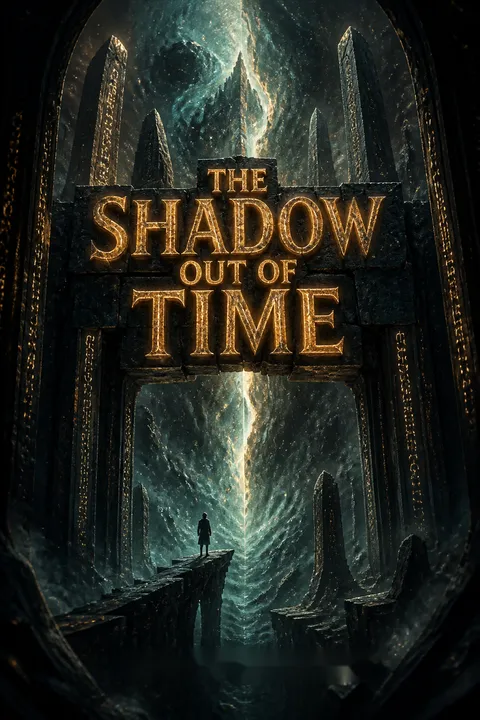


Plot Summary
The Professor Goes Blank
In May 1908, Nathaniel Wingate Peaslee, a respected economics professor at Miskatonic University, falters before his students and falls unconscious. When he wakes, he cannot remember his identity, and his halting English sounds learned rather than native.
He quickly absorbs unfamiliar subjects while revealing knowledge that seems impossible for a man of his time. Doctors call it a secondary personality, but his wife, Alice, and their children see a stranger wearing Nathaniel's face.
Only his young son Wingate believes his father may return. Nathaniel's body is healthy, yet his own life has become inaccessible: his family fears him, his colleagues study him, and the man speaking through him seems to be preparing for a purpose no one understands.
The collapse makes identity a contested fact rather than a private certainty. Nathaniel's body remains legible to everyone around him, but his speech, interests, and manner contradict the person they recognize. His family responds to this split as a relational catastrophe, while doctors turn it into a case to classify. Wingate's faith matters because it preserves a bond based on continuity of personhood when outward evidence points the other way. The story begins its central unease in this gap: a self may be absent even while its body continues to act, and no observer has a reliable test for who is inside.
Five Years Misplaced
From 1908 to 1913, the new personality uses Nathaniel's money and unusual powers of learning to investigate distant places and forbidden scholarship. He visits the Himalayas, Arabia, the Arctic, and isolated caves in West Virginia, while reading languages and histories with startling speed.
His journeys leave no clear account of what he sought, but his notes and contacts connect him to occult books and secretive groups. Alice obtains a divorce in 1910; Wingate remains the only child willing to keep faith with him.
In September 1913, after installing a strange machine in his Arkham home, the altered Nathaniel is found unconscious. When he wakes hours later, his original memories and personality have returned, while the device and a mysterious visitor have disappeared.
The five-year interval converts a medical mystery into a rupture with measurable costs. The altered Nathaniel is not inert or confused; he pursues knowledge, crosses remote landscapes, and appears to have planned a second transition. Yet his apparent competence offers no reassurance to the family, because intelligence without shared identity can feel more threatening than incapacity. Alice's divorce and Wingate's loyalty show two different ways of responding to an unrecognizable loved one: one protects the household from an apparent impostor, the other preserves hope for the person beneath the change. The vanished machine leaves the event without a witness or an explanation.
Home Without the Years
Nathaniel returns to a family and career that have moved on without him. He regains custody of Wingate, resumes teaching economics in 1914, and tries to learn from newspapers what his missing years contained.
The effort unsettles him: his former self seems to have possessed knowledge and abilities he cannot claim as his own. He leaves teaching in 1915 as painful impressions about time and displacement gather force. At first, the dreams are distant architectural glimpses: huge stone halls, enormous books, unfamiliar gardens, and a city beneath strange skies.
Nathaniel fears that looking at his own reflection might reveal something alien, so he avoids mirrors. Rather than dismiss the dreams, he begins investigating other amnesia cases, hoping research will give the blank years boundaries.
Nathaniel's return is not a restoration to his former life so much as an apprenticeship in its absence. He must reconstruct his own history through documents and other people's memories, a process that makes self-knowledge feel like external evidence. His decision to investigate the dreams is both intellectual discipline and an attempt to regain control over experiences he cannot own or explain. The mirror aversion gives that conflict a bodily form: even the familiar outline of his face has become something he must verify. His scholarly methods promise distance, but the images increasingly resemble memories rather than fantasies.
The Cone in the Library
By 1915, Nathaniel's visions sharpen from architecture into inhabitants. He sees enormous, cone-shaped beings moving through libraries and operating intricate machines. Then he looks down in a dream and recognizes that he occupies one of their bodies, with a long neck, claws, and tentacles used to handle books and write.
His dream-self studies records of vanished and future civilizations, exchanges knowledge with minds taken from many eras, and prepares an account of Nathaniel's own age for a vast archive.
He understands the beings as the Great Race, whose members project their minds across time and exchange places with other creatures. The original mind is sent to the Great Race's past, where it is guarded and studied. Nathaniel wakes with only fragments, but the dreams now explain his missing years with terrifying precision.
The dream changes Nathaniel's fear from an abstract suspicion into a specific image of captivity. The cone body is not merely monstrous; it performs scholarly work, making the library a place where knowledge and coercion occupy the same shelves. Nathaniel's dream-self is both prisoner and contributor, a contradiction that complicates any simple account of victimhood. His imagined archive also mirrors his waking project: he records details to preserve evidence, although he cannot prove the experiences are real. By making a scholar's exchange of knowledge inseparable from the seizure of his mind, the story questions whether intellectual discovery can ever be innocent when one consciousness controls another.
A Theory of Time
Nathaniel compares his dreams with medical records, old legends, and other accounts of sudden personality changes. He finds a rare pattern: victims acquire remarkable knowledge, then return to themselves with scattered nightmares resembling his own.
The folklore describes the Great Race's ancient cities, its exchange of minds across time, and a future catastrophe feared by its people. It also tells of sealed underground passages and hostile beings called the Elder Things. Nathaniel concludes that his altered personality must have encountered such stories and that his later dreams are memories reshaped by what he read.
This explanation steadies him enough to teach psychology again in 1922. He publishes his findings in 1928 and 1929, presenting the case as a psychological puzzle rather than proof of an impossible history.
Nathaniel's theory is a coping structure built from genuine scholarship. It does not erase the disturbing correspondences; it relocates them, explaining them as the aftereffects of reading, folklore, and memory. That distinction lets him live and work again, but it also leaves the story's evidence unresolved. His method is appropriately cautious, yet his conclusions carry an emotional function: they protect him from the thought that his mind was literally removed. The Elder Things and sealed passages extend the dream system beyond personal trauma into geological danger. What he calls a defensible explanation may be rational inquiry, self-protection, or both, and the narrative keeps those possibilities in tension.
Stones in Australia
In 1934, mining engineer Robert Mackenzie sends Nathaniel photographs of carved stones found in Western Australia's Great Sandy Desert. Their curved surfaces and markings match the masonry in Nathaniel's recurring visions.
Miskatonic University funds an expedition, and Nathaniel travels with his son Wingate, geologist William Dyer, historian Ferdinand Ashley, anthropologist Tyler Freeborn, and psychologist E. M. Boyle. After reaching the desert in 1935, the team excavates more than a thousand ancient blocks, including pieces shaped like arches and window casings.
Their age and scattered arrangement suggest a civilization far older than accepted history. Nathaniel becomes increasingly uneasy about the northeast, where aerial surveys reveal fleeting patterns in the sand. A dark basalt block, unlike the other stones, frightens him because it resembles the windowless ruins his dream-world associates with danger.
The photographs shift Nathaniel's problem from private experience to public investigation. The expedition gives his claims the procedures of archaeology: specialists, measured surveys, careful excavation, and material comparison. Yet the evidence is partial. The stones confirm a lost structure, not the dreams' full explanation, while shifting sand repeatedly erases the patterns Wingate sees from above. The different disciplines offer several ways to interpret the site, but Nathaniel's personal familiarity with its design makes neutrality difficult. The basalt block intensifies that conflict because its significance comes less from its physical difference than from the fear already attached to it in his dream-based theory.
The Northeast Pull
On July 11, Nathaniel wanders beyond the excavated area and uncovers a square-cut basalt stone. He recognizes it as the material of the ancient windowless towers that the Great Race feared, then runs back to camp before he can explain his reaction. The next day, he leads Dyer, Freeborn, Boyle, and Wingate to the spot, but the wind has reshaped the dunes and buried every trace.
In the weeks that follow, Nathaniel grows sleepless and takes solitary walks toward the northeast, drawn by a familiarity he cannot account for. He wants the team to dig there and fears what they might uncover. On the night of July 17, unable to settle, he leaves camp alone again, while the miners' local legends about violent desert winds sharpen his apprehension.
The lost basalt stone makes uncertainty active: the discovery is concrete enough to provoke fear, then disappears before the team can verify it. Nathaniel's reaction exposes how strongly his prior images govern perception, but the expedition's failure to relocate the block does not disprove what he saw. His repeated walks turn the desert into a psychological map, with the northeast functioning as both a location and a pull toward forbidden knowledge. The local stories about winds add a second source of interpretation, neither independent of the site nor sufficient to settle its meaning. Nathaniel's choice to go alone leaves scientific procedure behind just as the danger becomes most personal.
The Buried Corridor
Under a clear moon, Nathaniel follows the northeastward pull until he finds a mound of stones whose carved patterns fit together as parts of a former building. He knows how its corridors once connected, although the knowledge has no ordinary source.
A cool current of air rises through the rubble, revealing a hidden opening. Nathaniel moves heavy blocks aside and descends into a vast, collapsed structure. His flashlight finds octagonal paving, carved walls, and immense arches arranged exactly as in his dreams. He recognizes the building's levels, its machine rooms, and the route toward a central archive.
Despite the danger of falling masonry, he presses deeper, choosing familiar paths through the ruins. When the corridors lead toward the archive, his certainty about where to go overcomes his last effort to treat the experience as a dream.
The descent is the story's decisive collision between remembered space and physical evidence. Nathaniel does not merely encounter ruins that resemble his visions; he navigates them as if he has already lived in their arrangement. That procedural knowledge is harder to dismiss than a visual likeness because it directs his actions and exposes him to immediate danger. The rising air offers a physical cause for the local wind legends, while also suggesting an open passage into spaces the Great Race had sealed. Nathaniel's curiosity and compulsion converge here: he continues not because the evidence is complete, but because the familiar architecture has made retreat feel like denying his own memory.
His Handwriting Below
Nathaniel crosses fallen corridors and reaches the archive, where metal cases still line the shelves. Near an open trapdoor, he notices faint tracks with five circular marks, matching the ominous prints described in his dreams.
He nevertheless searches a particular shelf, climbs to it, and opens its complicated lock through movements his hands seem to remember. Inside the case lies a book whose page is written in English, in Nathaniel's own handwriting. The discovery overwhelms his belief that myth and dream have merely shaped one another.
As he hurries back, a cascade of masonry crashes behind him; whistling sounds and powerful winds rise from the open depths. He escapes into the desert injured and empty-handed, with the metal case lost somewhere in the darkness or the shifting sand.
The handwriting is the story's most intimate evidence because it links the cosmic archive directly to Nathaniel's authorship. It does not simply establish that an ancient civilization existed; it implies that his missing years produced a record in a place untouched by human history. Yet the proof is immediately made precarious: the case is lost, and the sounds and winds could belong to an escaping subterranean threat or to Nathaniel's overwhelmed perception. The footprints give the danger a bodily trace without revealing its source. In this sequence, the desire to verify reality creates the very conditions that prevent verification from surviving.
No Evidence Comes Home
At dawn, bruised and scratched, Nathaniel staggers back to camp and tells Dyer and Boyle that exhaustion and a nightmare caused his absence. He urges the expedition to stop digging northeast, but his reasons persuade no one. Wingate surveys the area from the air and finds no visible opening, and the wind soon alters the ground again.
Nathaniel flies to Perth, then sails for home without the case that might have proved what he saw. In the ship's cabin, he writes the account for Wingate, the family member most likely to judge it seriously. He cannot decide whether the buried city, the book, and the pursuing sounds were real. The warning remains his only evidence, and he hopes the hidden passages will never be found.
The ending does not resolve the mystery; it resolves Nathaniel's obligation to testify. His scientific colleagues can verify the stones, but not the night underground, and Wingate receives a report rather than an artifact. Nathaniel's restraint in presenting uncertainty preserves his credibility while making the account more disturbing: he neither declares himself sane nor asks belief on authority alone. The lost case turns proof into an ethical problem. He must warn others without being able to demonstrate the danger, and the very absence of evidence may encourage the excavation he fears. His final act is therefore a compromise between scholarship and protection, aimed at a future he cannot control.
Analysis
The story makes memory a problem of evidence. Nathaniel cannot access the five years that matter most to his identity, so he studies documents, dreams, folklore, and eventually stone. Each source supplies a different kind of knowledge, yet none is sufficient alone. The medical record confirms a dramatic personality change; the dreams provide an internally coherent history; the ruins offer material confirmation of an ancient city; and the book in Nathaniel's handwriting makes the missing years seem suddenly authored by him. But because he loses the book, the strongest evidence remains a report from a frightened witness.
This structure complicates the usual opposition between reason and superstition. Nathaniel's scientific method genuinely helps him recover stability, and his explanation that folklore shaped his dreams is plausible. It is also emotionally useful, protecting him from the more destructive possibility that his mind was taken and used. The expedition does not simply defeat rationality with the supernatural. Instead, it makes rational inquiry encounter evidence that it cannot close into a single account.
The Great Race's archive sharpens the story's ethical unease. Its knowledge depends on taking minds from other periods, turning people into both visitors and involuntary research subjects. Nathaniel's scholarly hunger mirrors the civilization's appetite for information, even as he fears what it has done to him. The book suggests that knowledge can enlarge a mind while also making it vulnerable to systems beyond its control.
Finally, the desert landscape gives uncertainty physical form. Wind erases routes, sand buries structures, and the missing case prevents a public test of Nathaniel's account. His written warning is not a solution but a duty taken on in the absence of proof. The title's shadow is therefore more than an ancient threat: it is the pressure of histories that may be real, yet cannot be securely possessed or communicated.
Review Summary
The Shadow Out of Time receives mostly positive reviews, with readers praising its cosmic horror elements, intricate worldbuilding, and philosophical themes. Many consider it one of Lovecraft's best works, appreciating its blend of science fiction and horror. Some readers find the detailed descriptions and repetitive passages challenging, while others are captivated by the story's exploration of time travel, alien civilizations, and the insignificance of humanity. The novella's ability to evoke a sense of dread and wonder is frequently highlighted, though a few reviewers find it less engaging than other Lovecraft stories.
Characters
Nathaniel Wingate Peaslee
The haunted professorA Miskatonic University professor of economics, Nathaniel begins as a disciplined scholar with a settled family life and little interest in occult speculation. A prolonged amnesia forces him to rebuild his personal history from records and other people's accounts. He responds to uncertainty by collecting evidence, studying psychology, and testing explanations rather than surrendering immediately to fear. That rigor is also his vulnerability: when details recur across dreams, folklore, and physical discoveries, he cannot dismiss them without betraying his own standards. Nathaniel's central struggle is not simply whether he is sane, but how to act responsibly when his strongest experiences cannot be independently confirmed.
Wingate Peaslee
His loyal son and colleagueNathaniel's second son, Wingate is the one member of his immediate family who maintains a bond with him through the years of estrangement. His early loyalty is grounded in the belief that his father may return, while his adult work as a psychologist gives him tools to assess Nathaniel's experiences without reducing them to ridicule. He assists his father in research and accompanies him to Australia, where concern for Nathaniel must coexist with the demands of a scientific expedition. Wingate represents both intimate trust and professional scrutiny. He wants to help his father, but he cannot simply substitute affection for evidence.
Alice Peaslee
The estranged wifeNathaniel's wife before his amnesia, Alice is confronted with a husband whose speech, manner, and apparent identity have changed beyond recognition. Her response is fear and self-protection, especially because she must also consider their children. She seeks a divorce rather than accept a family life organized around a person she experiences as an intruder. Alice is not presented as a scholar of the mystery; her role shows the human cost of an event that medical language cannot repair. Her judgment emerges from intimate observation, not from knowledge of what has happened inside Nathaniel's mind.
Robert and Hannah Peaslee
The children left behindNathaniel's elder son and daughter, Robert and Hannah, are young when his personality changes. Like their mother, they recoil from the unfamiliar behavior of the man in their father's body. Their absence from his later life marks how completely the amnesia fractures the household, while Wingate's continuing connection makes the family loss more visible.
Robert Mackenzie
The engineer who finds stonesA mining engineer based in Western Australia, Mackenzie has the practical knowledge to recognize that the desert stones are ancient and the judgment to document them carefully. After learning of Nathaniel's published research, he sends photographs and offers to help organize an expedition. His interest is partly professional and partly scholarly: he understands that the site may transform what is known about the region's past. Mackenzie supplies the material lead that moves Nathaniel's inquiry from books and dreams into the desert.
William Dyer
The expedition geologistA Miskatonic geologist and experienced expedition leader, Dyer helps assess the age and physical condition of the Australian masonry. His professional habits emphasize observation, excavation, and the limits of what the available evidence can establish. He also sees Nathaniel return to camp after the underground experience, but cannot verify what happened during the professor's absence. Dyer anchors the expedition in geological inquiry and makes its material discoveries credible without resolving their strangest implications.
Tyler M. Freeborn
The expedition anthropologistFreeborn joins the Australian expedition as an anthropologist. He notices that some marks on the stones resonate with distant cultural traditions, adding comparative evidence to the team's archaeological work. His discipline widens the site's meaning beyond geology, though the fragmentary symbols cannot tell him exactly who built the structures or why. Freeborn helps turn a field of broken stones into a question about how human communities inherit and reshape memories of the past.
Ferdinand C. Ashley
The expedition historianA Miskatonic historian of the ancient world, Ashley accompanies Nathaniel's team to examine the ruins. His presence gives the expedition a specialist concerned with historical context, though the stones predate any accepted human civilization. Ashley represents the limits of conventional chronology when confronted with remains that cannot be placed within known human records.
E. M. Boyle
The Perth psychologistAn elderly Perth psychologist, Boyle connects Mackenzie to Nathaniel's work and helps arrange the Australian research. His interest in psychology makes him a thoughtful companion for Nathaniel and Wingate, while his role at the site leaves him unable to confirm the professor's private experiences. Boyle offers informed attention without claiming certainty, a useful counterweight to both sensational speculation and easy dismissal.
The Great Race
The minds across timeIn Nathaniel's visions and research, the Great Race is an ancient civilization of towering, cone-shaped beings that masters the projection of minds across time. Its members collect knowledge from other eras and preserve records in immense archives. The civilization's pursuit of information is inseparable from its power over the minds it displaces, making it both intellectually magnificent and ethically frightening. Its history reaches Nathaniel through dreams, legends, and the ruins in Australia, though the truth of those connections remains uncertain.
The Elder Things
The sealed underground threatThe Elder Things appear in the legends and dreams connected to the Great Race's fear of buried ruins and sealed passages. They are described as profoundly alien beings associated with subterranean spaces, strange winds, and dangerous incursions. Their obscured nature makes them less a conventional antagonist than a limit on what the ancient civilization could safely know or control.
Plot Devices
Mind projection through time
Turns identity into territoryThe Great Race's central technology, as Nathaniel understands it, allows a mind to cross time and occupy a body from another era. The displaced consciousness is sent into the Great Race's past, where it can be guarded and questioned, while the visitor learns the future's knowledge. A return process is meant to restore each mind to its proper body, and hypnosis removes most memories of the exchange. This mechanism makes the 1908 amnesia intelligible within Nathaniel's theory, while also raising the possibility that a person can experience a whole life that the surrounding world cannot see. Its importance depends on whether the dreams and legends describe reality or shape Nathaniel's interpretation of it.
Dreams and lost memory
Keeps proof incompleteAfter returning to himself, Nathaniel experiences dreams that grow from vague architectural scenes into detailed memories of a prehistoric city, its inhabitants, and its archives. He studies similar amnesia cases and old folklore, then argues that reading during his missing years could have supplied the material for these dreams. The same evidence can therefore support opposing interpretations: the visions may be traces of an actual exchange, or memories reorganized by exposure to myth. Their gradual growth gives the narrative a method of revelation, but the erased recollections prevent Nathaniel from confirming the source directly.
The central archive
Stores history beyond humanityIn Nathaniel's dreams, the Great Race keeps immense libraries containing histories of Earth's past and future, including accounts written by displaced minds. The archive links the story's intellectual wonder to its coercive premise: captured visitors contribute knowledge to a system they did not choose. In the Australian ruins, Nathaniel follows remembered routes to the archive and finds a metal-cased book that appears to connect his missing years to the ancient site. The archive is thus both a repository of universal knowledge and the place where personal identity becomes a document that may outlive its author.
The Australian ruins
Makes dreams archaeologically tangibleMackenzie's photographs lead the expedition to weathered stones whose shapes and markings resemble the architecture in Nathaniel's visions. Excavation uncovers more than a thousand blocks, but the remains are scattered and shifting dunes make their original layout difficult to recover. This physical evidence strengthens Nathaniel's sense of recognition without proving the entire history attached to it. The desert's unstable surface is crucial: stones appear, disappear, and resist the team's attempts to map them, preserving a space between archaeological fact and the narrator's interpretation.
Winds, prints, and trapdoors
Signals danger without showing itLocal legends associate violent winds with ancient underground chambers, while Nathaniel's dreams connect sealed trapdoors to the Great Race's fear of the Elder Things. In the buried archive, faint tracks with five circular marks appear near an open passage, and whistling sounds and forceful air accompany Nathaniel's escape. These clues echo one another but never provide a clear view of what lies below. Their narrative function is to turn an inherited superstition into a possible physical threat while preserving ambiguity: the signs may be real evidence, dream-shaped perception, or both.
About the Author

Download PDF
Download EPUB
.epub digital book format is ideal for reading ebooks on phones, tablets, and e-readers.








