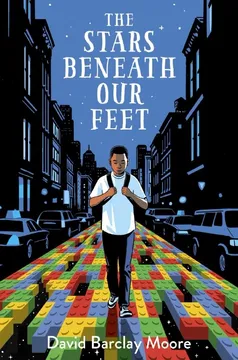


Plot Summary
Christmas Without Jermaine
On Christmas Eve, twelve-year-old Wallace Rachpaul, called Lolly, hurries through Harlem with gifts for his mother and her partner, Yvonne, while two older boys follow him. The neighborhood feels newly dangerous without his brother Jermaine, killed that fall. A family friend, Rockit, has left a large present Jermaine meant for Lolly.
It contains a video-game console, not the letter or miraculous explanation Lolly hopes for. After midnight, he tears apart his carefully assembled Lego kits, suddenly driven to build something new. On Christmas morning, Yvonne brings him bags of discarded bricks from the toy store where she works. Their arrival gives Lolly material for an invention, though he does not yet know what it will become.
The opening ties grief to ordinary risks: a boy guarding his shoes, navigating neighborhood borders, and waiting for a brother who cannot return. Lolly's hope that Jermaine might be alive is not a simple denial of fact. It is a child's attempt to preserve the relationship before accepting its finality. The console disappoints because it cannot carry the message Lolly wants, while dismantling the Legos lets him turn helplessness into action. Yvonne's bricks become a practical gift with emotional force, but their later origin complicates the comfort they provide. Creation begins as a refuge, not yet as a vocation.
A Castle Takes Over
Lolly's mother, Sue-ellen, gives him a smartphone, then breaks down over Jermaine's absence; he comforts her and still hopes his estranged father, Benny Rachpaul, will visit. Benny eventually arrives for their private, movable holiday and gives Lolly a tablet.
His girlfriend, Heike, comes too, and Lolly's mean-spirited prank with a supposed mouse leaves him uneasy about the person he is becoming. At after-school, counselor Akil Ali notices Lolly's sadness and anger. Lolly remembers how his brother once taught him to cook pancakes, but refuses to discuss their final argument.
Meanwhile, the donated bricks become the sprawling House of Moneekrom, an alien castle that takes over the family living room. When Sue-ellen threatens to dismantle it, Ali offers Lolly a storage room at the community center.
The adults around Lolly offer care in imperfect forms. Sue-ellen tries to protect him, Benny brings gifts but remains unreliable, and Ali presses him to name feelings he would rather organize into bricks. Lolly's castle provides structure: unlike death or family separation, its parts can be placed, measured, and repaired. Yet its expansion tests the household, showing that private coping has consequences for everyone who shares the room. The mouse prank marks a less comfortable development. Anger is not simply something Lolly feels; it begins to shape how he treats other people.
Rose Enters Harmonee
After a neighborhood shooting locks down the community center, Ali's unusual punishment leaves Lolly alone in its large storage room. The room's warmth and height spark a bigger vision: his castle grows into Harmonee, a city divided between heroes, monsters, and ordinary residents.
Then Rosamund Major, the huge, mostly silent girl other children call Big Rose, slips inside and begins taking bricks to build on the opposite side. Lolly resents the invasion, especially because Rose never asks permission.
He has already been acting cruelly, enjoying the way other children exclude her, and the competition for Lego space gives that impulse a target. Rather than evict her, Lolly proposes a tower contest: whoever fails to build ten feet must leave the room.
Harmonee begins as a world Lolly controls, but the storage room is communal space, and Rose's arrival exposes the limits of his ownership. His possessiveness is understandable after bereavement has stripped away control, yet it reproduces the exclusion he experiences in Harlem's territorial divisions. Rose's silence is read by the other children as emptiness or hostility; Lolly initially accepts that misreading because it serves his desire to dominate the room. The contest converts a conflict over belonging into a measurable challenge. Its rules look fair, but Lolly has already decided that the city is his.
Towers Against the Vent
Lolly names his tower for King Blaze, the ruler of his invented world, while Rose builds a replica of One World Trade Center. She works faster than he expects, forcing both builders to dismantle parts of their cities for bricks.
On the fourth day, her tower reaches the storage room's heating vent. Warm air makes the structure sway, then collapse, crushing her miniature city. Lolly celebrates too soon. His own tower wobbles, and when he reaches to steady it, that too falls. Rose laughs at his defeat, but neither child leaves the room.
They resume building on separate sides. Lolly later recognizes that Rose is carefully reproducing St. Nick Houses and nearby landmarks from memory. Their rivalry begins to shift into curiosity about what the other can make.
The collapse is not a clean victory for either child. Rose loses her painstaking model to the room's airflow; Lolly loses his tower because his triumph makes him careless. The vent, an ordinary building fixture, makes the limits of control visible without assigning blame to either child. More importantly, the contest reveals different forms of intelligence. Lolly invents from imagination, while Rose reconstructs the built world with striking precision. Their cities are not competing answers to one question. They are distinct ways of seeing, and recognizing that difference creates the first basis for collaboration.
Rose Hits Back
On an architecture outing Lolly has invited Rose to join, Harp and Gully corner him on the East Side and demand his phone. Rose charges in with her lunch box, striking Gully and then driving Harp away before Lolly can be badly hurt.
The two children continue through Midtown, identifying buildings from Lolly's architecture book and comparing what they notice. Rose explains that her mother, Desirée Green, died by jumping from a St. Nick building.
The tiny gold stars on Rose's model mark the sidewalks beneath which the dead are buried, while the soul, in the poem she remembers, rises above them. Lolly recognizes that Rose's exact models are also a way of remembering. He tells her about Jermaine and begins to see her as a friend, not an intruder.
Rose's intervention overturns Lolly's assumption that her quietness means helplessness. She acts decisively when Harp and Gully threaten him, then returns to her careful attention to buildings. The outing allows each child to disclose grief without being reduced to it: Rose's model is not merely an exercise in copying, and Lolly's Legos are not merely childish play. Her gold stars make the city hold both the living and the dead. Lolly's response matters because he does not try to correct Rose's unusual way of expressing herself. He listens, then offers his own loss in return.
The Bodega Beating
Harp and Gully later catch Lolly and his best friend, Casimiro Vega, outside Manny's bodega. They beat both boys, take their phones, and tell Vega the punishment will continue until his cousin Frito joins their crew. Manny drives them away with a baseball bat, but the damage follows the boys home: Lolly's mother blames him for carrying the phone, and Vega withdraws rather than admit that the older boys took his prized coat too.
When Vega visits Harmonee, he deliberately damages the bridge Lolly and Rose are building. Rose stops Lolly from chasing him, then helps repair the structure. Lolly's physical injuries fade, but the assault leaves both friends afraid, angry, and vulnerable to Frito's offer of protection.
The attack turns gang recruitment into intimate coercion. Harp and Gully do not merely steal possessions; they force their victims to surrender them, making humiliation part of the transaction. Vega's silence protects him from his parents' anger but isolates him from the friend who might help. His destruction of the bridge transfers that unspoken fear onto Lolly and Rose. Rose's restraint matters: she prevents Lolly from escalating the conflict, then repairs the damage with him. The bridge becomes a fragile counterexample to the gang's logic, built through cooperation rather than enforced allegiance.
A Bridge Above Harlem
As the community center prepares to reclaim the storage room, Ali tells Lolly and Rose their cities must come down. Lolly feels that Harmonee is being erased just as he has begun to move forward, but he and Rose build a final bridge joining her realistic Harlem models to his imagined districts.
At the center's health fair, they display sections of their work in the St. Nick courtyard. Neighbors, children, and Steve Jenkins admire the creations; Steve photographs Lolly describing them.
Benny arrives in clown makeup and sees how far his son has carried the small Lego set he once gave him. Lolly tells his father that he wishes he had been there when Jermaine needed him. The cities are dismantled afterward, and Lolly gives most of the bricks to neighborhood children.
The public display changes the scale of Lolly's work. What began as solitary protection becomes something neighbors can see, discuss, and use as inspiration. The bridge does not erase the difference between Rose's documentary precision and Lolly's fantasy; it connects them without making either subordinate. Dismantling remains painful, but sharing the bricks turns an ending into a transfer of possibility. Lolly's honesty with Benny also marks a change in their relationship: instead of waiting passively for his father to arrive as a rescuer, he names what was missing and lets the criticism stand.
Art Finds an Audience
After Steve posts video and photographs of the courtyard display, Lolly's work attracts thousands of followers. A local reporter interviews him, and the toy-store owner, Harold Tuttle, offers Lolly and Rose paid work building a window display for Easter.
The opportunity feels like proof that art could be more than a private refuge. Lolly and Rose explore the High Line, where an artist's glass home prompts them to imagine making work for a living. Meanwhile, Frito approaches Lolly and encourages him to join his crew, promising safety from Harp and Gully.
Lolly declines to commit, but the pressure grows as Vega stops attending after-school and spends more time with Frito. Lolly has a future opening before him, yet his closest friend seems to be choosing a more dangerous route.
Recognition arrives at a moment when Lolly is learning to imagine a future beyond immediate survival. The online audience and Tuttle's offer translate his private skill into public value, while the High Line shows him a kind of city space he did not know to seek. But opportunity does not cancel danger. Frito's offer is persuasive because it answers a real need for protection, and Vega's absence makes that choice feel more urgent. The section refuses a simple opposition between art and hardship: Lolly's creative path is promising, but it must contend with the same pressures shaping his neighborhood.
The Gun in Vega's Room
When Lolly visits Vega, he finds that his friend has withdrawn from everyone and obtained a Glock from Frito. Vega wants to frighten Harp and Gully and believes Frito's crew will protect them afterward. The weapon revives the guilt Lolly has kept hidden: before Jermaine died, his brother had urged him to run errands for the crew connected to the barbershop.
Lolly refused, and Jermaine stopped speaking to him. Lolly confesses that he fears he failed his brother. Vega answers that the old promise cannot protect them now. Before the boys can act, Sunnshyne visits Lolly with homemade pastelles and explains that she and April have been trying to keep a coyote safe from capture. Her choice to help despite the risk unsettles Lolly's fatalism.
The gun gives grief a dangerous direction. Lolly's guilt makes violence feel like a way to honor Jermaine, while Vega's fear makes it seem like practical self-defense. The parallel is painful: Jermaine once drew Lolly toward the same criminal world he had earlier warned him away from, leaving his younger brother with no simple memory to rely on. Sunny offers a different model of action. Her attempt to protect the coyote is imperfect and risky, but it is guided by care rather than retaliation. The boys have not yet chosen what to do, and that uncertainty is the point.
Yvonne Faces the Consequences
Yvonne fails to arrive for dinner, then calls Sue-ellen from police custody. She admits that the Lego bags she gave Lolly came from Tuttle's Toy Emporium, where she had worked, not from a pile of discarded toys. Sue-ellen takes Lolly to the precinct, where they wait through the night.
Seeing his mother frightened by the possibility that he might someday be arrested makes Lolly reconsider the gun and the path Frito is offering. The next day, Sue-ellen and Lolly meet Tuttle with help from a Legal Aid lawyer.
Tuttle's counsel accuses the family of complicity, but Lolly explains that he never asked Yvonne to steal and offers to work off the cost. Tuttle believes him and drops the matter, though Yvonne loses her job and the Easter commission is canceled.
Yvonne's arrest makes the costs of a seemingly generous act impossible to ignore. The Legos helped Lolly build a world, but their stolen origin placed him and Sue-ellen under suspicion. At the precinct, the possibility of being treated as a criminal stops being abstract; Lolly sees how much his mother fears that outcome. His offer to repay Tuttle is not a legal necessity, since Tuttle ultimately believes him, but it demonstrates a desire to take responsibility without accepting false blame. The cancelled commission and Yvonne's lost job ensure that forgiveness cannot erase consequence.
The Harlem River Choice
After the meeting with Tuttle, Lolly and Vega walk at night toward the Harlem River overlook, carrying the Glock between them. They wait in the dark for Harp and Gully, imagining what they might do if the older boys appeared. Then Vega gives the gun to Lolly, and Lolly hands it back. Vega hurls it into the river.
Lolly tells him that Frito's protection comes with a choice of its own, and reminds him that he and Steve Jenkins grew up together before taking different paths. Vega begins to sob, releasing the fear he had buried beneath silence and anger. Lolly stays beside him until he can breathe steadily again. The boys agree to ask Steve for advice about surviving the neighborhood without joining a crew.
The river scene is a decision, not a victory over Harp and Gully. Their threat remains, and the boys have no instant shield against future violence. What changes is their willingness to confuse revenge with safety. Lolly refuses the gun's invitation, while Vega's crying breaks the performance of hardness that had kept him alone. The scene also revises the meaning of protection. Jermaine once protected Lolly physically; now Lolly offers Vega companionship and a model of another possible future. Their promise to consult Steve turns survival into a question they can ask together.
Rose Moves North
Ali tells Lolly that child services has moved Rose from her grandmother's home to relatives in Mount Vernon, where she will attend a school equipped to support her. Rose has been identified as autistic, a possibility her grandmother had long resisted. Lolly is angry that Ali helped arrange the move, but he travels north with Benny to see her.
After initially arriving when Rose is away on a class trip, Lolly encounters her by chance as she walks with her new group. Rose recognizes him and explains to the adults that they build cities. Lolly gives her a small book of poems and hugs her before she has to leave. Benny drives him home, sharing a childhood memory of losing a friend who moved far away.
Rose's relocation is presented as both care and rupture. She may receive support unavailable in her grandmother's crowded home, yet the move separates her from the daily routines and relationships she had begun to build in Harlem. Lolly's anger at Ali reflects the pain of having no control over a friend's future, even when adults believe they are acting responsibly. The brief reunion cannot restore their shared city room, but Rose's recognition of their work confirms that the friendship mattered beyond its setting. Benny's memory offers Lolly a small, imperfect bridge between generations.
A Name Reclaimed
Back in Harlem, Yvonne explains to Lolly that she stole the Legos because she wanted to lift his spirits after Jermaine died, then kept bringing them because seeing him build made her feel useful. Lolly tells her that the bricks helped, even though the theft was wrong, and accepts her apology.
He saves pieces of Harmonee and uses Benny's tablet to design a new city, choosing to build again rather than preserve every old structure. In May, he tells Sue-ellen that he wants to be called Wallace, his given name, instead of Lolly.
He and Vega choose a new place to eat, and Wallace imagines returning to the river overlook when he needs to remember Jermaine. He still misses his brother, but no longer treats grief as a reason to follow the crew's path.
The ending does not claim that grief disappears or that Harlem becomes safe. Wallace still anticipates future threats, misses Jermaine, and has lost a friend to relocation. What changes is his relation to those facts. He can forgive Yvonne without calling theft harmless, preserve a few Lego pieces without rebuilding the same city, and remember Jermaine without treating their last argument as a command. Choosing his given name makes that development audible: he is no longer only the younger brother or the child everyone calls Lolly. He is beginning to author his next design.
Analysis
The novel makes grief visible through objects and spaces rather than treating it as an isolated inner condition. Jermaine's empty bed, the stolen Lego bricks, the storage room, and the Harlem River all shape what Wallace can imagine doing next. Building gives him control over scale, sequence, and repair, but the story refuses to present creativity as an escape that solves material danger. Harp and Gully can still attack him; Yvonne's gift can still be theft; the community center can still reclaim its room. Art matters because Wallace learns to act within those limits without surrendering his capacity to choose.
The contrast between Wallace's invented Harmonee and Rose's exact Harlem models is especially important. One child makes worlds from memory and possibility; the other records the world with unusual precision. Neither mode is treated as deficient. Their bridge works because it preserves the difference between them while allowing the forms to meet. That collaboration also revises Wallace's early possessiveness. He begins by treating the city as a territory he must defend, then learns that shared creation can produce more than solitary ownership.
The novel's account of violence is similarly specific. Gang recruitment offers the boys something real: protection in a place where ordinary movement can be dangerous. Refusing that offer is not presented as effortless moral superiority. Wallace and Vega are frightened, angry, and tempted by a gun. Their decision at the river becomes possible only after Wallace recognizes how guilt over Jermaine is distorting his judgment and after Vega can finally release his fear through tears.
By the ending, Wallace has not stopped missing Jermaine or outgrown the neighborhood's dangers. He has gained a more durable form of agency: he can keep memories without obeying them, accept help without mistaking it for weakness, and begin another design after the first one is dismantled. Choosing his given name makes that change personal. He is no longer only the child defined by loss, but a young maker learning to decide what his life will contain.
Review Summary
The Stars Beneath Our Feet received mostly positive reviews, praised for its authentic portrayal of urban life, diverse characters, and themes of grief, creativity, and personal growth. Readers appreciated the realistic dialogue and Lolly's journey through loss and self-discovery. Some found the pacing slow or choppy, and a few criticized the representation of queer characters. Many reviewers recommended it for middle-grade readers, especially those interested in Legos or facing tough choices.
Characters
Wallace Rachpaul
Grieving young makerWallace, usually called Lolly, is a twelve-year-old boy growing up in the St. Nicholas Houses in Harlem. He is observant, inventive, and meticulous, especially when he follows Lego instructions or studies buildings. His brother's absence leaves him angry and disoriented, and he sometimes makes that hurt someone else's problem. Wallace's imagination gives him a way to express what he cannot yet say plainly. He is also alert to danger, family strain, and the social codes governing his neighborhood. His development centers on learning that he can honor the people he loves without repeating their mistakes, and that making something new requires more than skill: it requires choice.
Rosamund Major
Exacting city builderRosamund, whom many children call Big Rose, is a large, quiet girl who attends the community center after school. She often avoids eye contact, prefers precise routines, and communicates in brief statements, causing other children to misread her reserve as rudeness. Her memory for buildings is extraordinary, and she recreates places with careful attention to their details. Rosamund has her own history of loss, which she expresses through architecture and small symbolic choices. She does not need Wallace to make her more like everyone else; she needs room to be understood on her own terms. Her relationship with him grows through shared work, patience, and the practical trust of building side by side.
Casimiro Vega
Lolly's music-loving friendVega is Wallace's closest friend, a Dominican boy who lives in the same housing complex. He is funny, loud, and quick to tease, but his violin offers a more private language for emotions he rarely explains. His family is close-knit, though household rules and expectations can feel restrictive to him. Vega wants to be accepted by his peers and protected from the older boys who target him, making him vulnerable to promises of crew loyalty. His friendship with Wallace is affectionate and competitive, and both boys use humor to keep fear at a distance. Vega's musical discipline reveals a gentler, more reflective side than his bravado usually allows.
Sue-ellen Rachpaul
Protective motherSue-ellen, whom Wallace calls Ma, is a hardworking security guard and a devoted parent. She is direct, funny, and watchful, aware of how quickly a visible phone or a wrong turn can make her son a target. Her grief over Jermaine is intense, though she tries to keep the household functioning and protect Wallace from the dangers that shaped her older son. She has a long-term relationship with Yvonne and remains connected to friends who help raise the children around her. Sue-ellen's protectiveness can become blame when fear overwhelms her, but her bond with Wallace also allows tenderness, humor, and honest conversation.
Jermaine
Absent older brotherJermaine is Wallace's older brother, once his protector, playmate, and closest companion. He could be clever and generous, solving household problems and teaching Wallace ordinary skills, but he was also drawn into the street economy around a neighborhood barbershop. His influence remains complicated in Wallace's memory: Jermaine once warned him away from that world, then later encouraged him to take part in it. Wallace remembers their shared jokes and routines alongside the painful distance that opened between them. Jermaine's presence in the story is felt through Wallace's memories, unfinished questions, and desire to understand what his brother hoped for him.
Akil Ali
Community-center counselorAkil Ali directs the neighborhood after-school program and works as a social worker. His physical difference and crooked humor make him memorable, but he takes the children seriously and notices when Wallace's sadness becomes anger. Ali pushes Wallace to speak about grief while offering him practical access to the storage room that becomes a place for building. He can be blunt and intrusive, and his decisions do not always feel fair to the children affected by them. His own experience of being denied support as a child shapes his efforts to secure help for Rose.
Yvonne Grayson
Generous family friendYvonne is Sue-ellen's longtime partner and a custodian at Tuttle's Toy Emporium. She treats Wallace with the affection of an aunt, often feeding him, joking with him, and bringing him into family outings. Her generous instincts are genuine, but she sometimes acts first and considers consequences later. She wants to make Wallace feel cared for, especially when his grief frightens the adults around him. Yvonne's relationship with Sue-ellen is warm and durable, though the pressure of work, money, and family responsibility can strain it.
Benny Rachpaul
Lolly's distant fatherBenny, Wallace's father, is a Trinidadian construction worker who also performs at children's parties as Rocky the Clown. He is physically confident and fond of giving advice, gifts, and affectionate nicknames, but he is not present as consistently as Wallace wants. His separation from Sue-ellen and his succession of girlfriends complicate the family's sense of stability. Benny's grief over his son is real, even when he struggles to express it directly. His connection with Wallace has room for repair because the boy is willing to speak honestly about what he needed.
Steve Jenkins
Neighbor and creative mentorSteve lives next door to Wallace and once spent much of his childhood with Jermaine. As an adult, he works in sound for film and television, having chosen an artistic path distinct from the street life that pulled at his former friend. He encourages Wallace's architectural eye and gives him a book that helps widen his ambitions. Steve's advice is sometimes blunt, but he sees the creative ability Wallace has not yet named for himself. His presence offers a local example of a life shaped by different choices.
Sunnshyne Dixon-Knight
Sharp-tongued classmateSunny is a bold, competitive girl in Wallace's after-school group. She and Vega trade insults, and she can be careless with other people's feelings, especially when she wants an audience. Yet she is more than her sharp tongue: she starts a small detective venture with her friend April and becomes concerned about a coyote in the neighborhood park. Her efforts to learn cooking and to act on what she believes is right reveal curiosity beneath the bravado. Wallace's shifting view of her shows how quickly a child can be both irritating and admirable.
Rockit
Jermaine's streetwise friendRockit knew Jermaine through the barbershop and remains invested in Wallace because he sees the younger boy as family. He delivers a substantial Christmas gift Jermaine had intended for Wallace and offers help if neighborhood trouble comes. Rockit speaks with the confidence of someone who knows the street economy from the inside, which makes his kindness reassuring but also complicated. He represents one of the routes Jermaine traveled and one Wallace must decide whether to follow.
Harper and Marq Gully
Coercive crew recruitersHarp and Gully are older boys from the East Side who follow Wallace and Vega, demand their belongings, and pressure Vega's cousin to join their crew. Their method is deliberately manipulative: they make victims appear to surrender possessions willingly, disguising intimidation as a gift. They understand the fear their reputation creates and use it to recruit and control younger boys. Their presence gives Wallace and Vega a concrete, recurring threat rather than an abstract worry about neighborhood violence.
Frito
Vega's influential cousinFrito is Vega's cousin, a teenager who survives a shooting and is courted by Harp and Gully for their crew. He presents himself as someone with influence and the ability to protect younger boys, including Wallace and Vega. His confidence makes his offer attractive to children who feel exposed, though his own motives and loyalties are not always easy to read. Frito stands at the crossroads between family protection and the street affiliations that can deepen danger.
Harold Tuttle
Toy-store ownerHarold Tuttle owns the Midtown toy store where Yvonne works. He notices Wallace and Rose's Lego creations and sees the possibility of displaying their work. Tuttle values toys and old poetry, but he must also reckon with the harm caused when his employee takes merchandise without permission. His decisions test whether admiration for Wallace's art can coexist with fair consequences.
Mr. Jonathan
Sue-ellen's longtime friendMr. Jonathan is Sue-ellen's friend and coworker, a warm, theatrical adult who acts like an auntie to Wallace. He brings humor into the family's tense first Christmas without Jermaine and helps connect Sue-ellen with legal assistance when Yvonne is in trouble. His steady presence contrasts with Benny's distance and gives Wallace another model of adult care.
Plot Devices
Lego cities
Grief made tangibleWallace's Lego building begins as a private refuge after Jermaine's death. The House of Moneekrom grows into Harmonee, a fantasy city populated by invented rulers, heroes, and monsters. Rosamund's precise replicas of Harlem provide a contrasting way to make a world: she records real places and marks the dead with small stars. As their work expands, the cities give Wallace and Rose a shared language, a reason to cooperate, and a form of art others can recognize. The buildings can be dismantled, but the skills and relationships developed through making them persist.
Neighborhood borders
Pressure toward allegianceHarlem's streets and housing developments are divided by informal crew territories. Wallace knows that crossing the wrong boundary can bring harassment, while Harp and Gully exploit those boundaries to threaten him and Vega. Their demand that Frito join their group makes territory a mechanism of recruitment, not just geography. The danger explains why a crew can look like protection to a frightened child. It also makes Wallace's creative and personal choices feel materially risky: he cannot simply ignore violence, even when he refuses to join it.
Jermaine's empty bed
Grief's daily reminderThe bed Jermaine once shared with Wallace remains in their room after his death. Wallace sees it as evidence that his brother could still return, while adults recognize that the room's arrangement keeps the loss physically present. The bed is not merely a symbol. It shapes Wallace's routines, his ability to accept what happened, and the family's reluctance to change. Eventually removing it becomes a practical act of mourning rather than a rejection of memory. Wallace can carry Jermaine with him without preserving every object exactly as it was.
The Harlem River
A threshold for choiceThe river divides Harlem from the Bronx and frames Wallace's first visit to the nightclub where Jermaine was killed. Later, its overlook becomes the place where Wallace and Vega confront the weapon they might use against Harp and Gully. Throwing the gun into the water does not solve the boys' danger, but it ends their immediate plan to answer coercion with violence. The river therefore holds two different crossings: Wallace's painful movement toward the truth of Jermaine's death, and his decision to protect the future from being governed by revenge.
Download PDF
Download EPUB
.epub digital book format is ideal for reading ebooks on phones, tablets, and e-readers.








