

Key Takeaways
Run a startup as a search, not a small corporation.
Search before execution. Blank and Dorf define a startup as a temporary organization looking for a business model that can be repeated, scaled, and made profitable. An established company already knows its customers and can execute a plan. A startup usually knows neither, so treating its forecasts as facts invites expensive mistakes.
Webvan shows the danger. It raised more than $800 million, built costly warehouses, and expanded before confirming demand. Its first distribution center cost $40 million, while daily orders reached 2,000 against a forecast of 8,000. Tesco and Peapod approached online groceries more cautiously, learning about customers as they grew. The book’s practical distinction is simple: first search for a workable model, then organize to execute it.
The search-versus-execution distinction resembles the difference between scientific inquiry and industrial production. When the underlying problem and buyer are uncertain, milestones should measure learning, not merely completed work. Webvan’s story also shows how sunk costs can turn an old forecast into a reason to keep spending. The warning is not that planning is useless, but that a plan becomes dangerous when its assumptions lose their provisional status. Some ventures face technical invention risk that customer interviews cannot resolve, so the method is most useful when market adoption, rather than basic feasibility, is the central uncertainty.
Put founders in customer conversations, where guesses become testable claims.
Start with explicit guesses. The founders map assumptions about customers, value, channels, pricing, partners, and costs, then design small tests to check them. The Business Model Canvas provides a compact picture of those assumptions; updating it records what changed and why. Tests should answer a specific question, use observable evidence, and have a result that would count as success or failure.
Iridium illustrates the cost of delay. The company spent about $5 billion and more than seven years building a satellite phone network. During that time, terrestrial mobile service expanded, while Iridium’s handset remained bulky and calls cost far more. Regular customer contact could not guarantee success, but it could have revealed that the original market assumptions were changing before so much capital was committed.
Founder involvement addresses a real information problem: customer observations lose force as they pass through layers of employees, reporting, and organizational incentives. Direct contact can make disconfirming evidence harder to explain away. The experimental approach also borrows the strongest habit of science: state what would change one’s mind before collecting results. Still, conversations are not automatically reliable experiments. Interviewees may be polite, and founders may hear what they hope to hear. A useful discipline is to record the original hypothesis, the evidence, and the next decision separately, so interpretation does not quietly rewrite the test.
Build for desperate first buyers, not an imaginary average customer.
Find the people with urgent need. The book calls an unusually committed early buyer an earlyvangelist. Such a person recognizes a pressing problem, is already looking for an answer, has improvised a workaround, and can obtain the budget to buy. These customers are more informative than people who merely say an idea sounds promising.
Make the first product small. A minimum viable product, or MVP, is the smallest standalone version that can test whether the proposed solution is useful. IMVU released an imperfect early product and studied what users did. Customers liked its customizable avatars but wanted to meet new people, not simply chat with existing contacts. Their behavior redirected the product. The aim is not to collect an endless feature wish list; it is to discover which few capabilities make the solution compelling.
Early buyers function like unusually sensitive instruments: they expose whether a problem has enough urgency to overcome the friction of trying something incomplete. Their willingness to pay is more persuasive than praise because it involves a real tradeoff. But earlyvangelists are not a miniature version of the mainstream. Their tolerance for bugs, novelty, and personal effort can produce misleading product priorities if their needs are treated as universal. The strongest use of this group is diagnostic: learn what creates value, then test whether that value travels to customers with less urgency and less appetite for experimentation.
Prove the problem matters before asking whether your solution delights.
Test the need first. Customer discovery separates two questions: do enough people care about the problem, and does the proposed product solve it well enough? A simple page, sketch, demo, or conversation can test whether a problem attracts meaningful interest. Only after that signal appears should the team test a working product. This prevents product polish from masking weak demand.
E.piphany learned through a missing detail. The company believed its marketing software could help Schwab analyze customer data. In discussion, the team discovered it lacked “householding,” a way to group people at the same address. Without that capability, the product could not solve Schwab’s actual marketing problem. The team changed its product specification, and Schwab placed an order after seeing the revised version. A real buying obstacle taught more than broad approval.
Separating problem evidence from solution evidence is a form of causal diagnosis. If a product test fails, the team needs to know whether the need is weak, the design is poor, or the message is unclear. The sequence makes those explanations easier to distinguish. E.piphany’s example also demonstrates why technical conversations can be valuable: a seemingly minor data structure reflected a central operating constraint. The caveat is that people can care about a problem without buying a particular solution. Evidence should therefore progress from attention and discussion toward actual use, commitment, or payment.
Choose your market type before choosing your growth tempo.
Markets set different rules. The book distinguishes entering an existing market, creating a new one, finding a niche or low-cost position inside an existing market, and adapting a proven model to another country. In an existing market, buyers know the category and can compare performance or price. A new market has no established customer base, so education and adoption take time. A niche strategy targets neglected needs; a low-cost strategy offers acceptable performance for less.
The choice affects forecasts and spending. A startup attacking a dominant incumbent may need far more resources than it has, making a narrower position more realistic. New-market revenue may take years to develop, while an existing market can offer faster comparisons and clearer buyers. The team should treat its market choice as a hypothesis and test who the customer is, what alternatives they use, and how they might switch.
Market type is useful because it prevents founders from confusing product novelty with immediate demand. A new category needs education; an established one requires a credible reason to switch; a niche strategy depends on serving a segment better than broad competitors. These are different adoption problems, not merely different marketing slogans. The categories are strategic lenses rather than permanent labels, and a company may fit awkwardly between them. That uncertainty is a reason to keep the classification provisional, while still aligning investor expectations and cash plans with the likely pace of adoption.
Use actual buying behavior to map a repeatable route to customers.
Orders outrank compliments. After early conversations suggest a promising problem and product, customer validation tests whether people will buy or engage, and whether the process can be repeated. A founder’s personal network may produce an impressive first sale, but that does not establish a sales model. The team needs to learn who uses the product, who recommends it, who controls the budget, who can block adoption, and how long purchasing takes.
Build the route before staffing the journey. A sales roadmap documents the repeatable path from first contact to order, including the sequence of people, presentations, objections, and approvals. E.piphany found that corporate sales required support from both business leaders and technical stakeholders; enthusiastic users alone could not secure adoption. A few full-price orders in enterprise software may provide useful evidence, while a consumer product may need retail reorders to show that demand extends beyond initial interest.
This approach treats selling as a process to discover, not simply a function to staff. It is especially valuable in organizations where the user, budget holder, technical reviewer, and veto holder are different people. Mapping those roles makes a vague sales funnel operational. There is a tension, however: sales conversations can generate revenue while distorting learning if the team over-customizes each deal. The crucial distinction is whether a sale reveals a pattern that another salesperson could reproduce, or merely reflects a founder’s exceptional effort and a one-off concession.
Protect runway while testing; spend heavily only after the pattern repeats.
Cash buys chances to learn. Customer discovery and validation delay expensive hiring, facilities, and broad marketing until the business model has stronger evidence. A startup should track how quickly it spends and how many months of cash remain, then preserve enough resources to run more than one cycle of tests. The purpose is not austerity for its own sake; it is avoiding commitments that make correction unaffordable.
Webvan scaled ahead of proof. Before shipping groceries, it spent $18 million on proprietary software and $40 million on its first automated warehouse, then committed to many more facilities. Its plans assumed demand that had not been established. The book’s financial check is grounded in customer evidence: estimate net revenue after channel fees, acquisition expenses, product costs, and operating costs. If the resulting model cannot support profitable growth before cash runs out, revisit the assumptions rather than financing a fantasy forecast.
Runway can be understood as an option: unspent cash preserves the ability to change direction when new information arrives. Premature infrastructure reduces that option because it creates fixed costs and emotional pressure to defend prior decisions. The logic is strongest when experiments are genuinely cheaper than scaling and when the product can be changed quickly. It is less straightforward for capital-intensive or regulated ventures, where meaningful tests may require substantial investment. Even there, staged commitments and explicit evidence thresholds can help distinguish necessary technical spending from growth spending based mainly on optimism.
Measure who activates, returns, pays, and refers, not traffic alone.
Follow the customer relationship. The book groups customer work into getting customers, keeping them, and growing their value through repeat purchases or referrals. In web and mobile businesses, acquisition brings visitors in; activation means they take a meaningful first action. Retention tracks continued use, while referrals show whether existing customers bring in others. Each step needs its own measure, because a large audience can still produce little business.
Watch the whole funnel. A site can attract thousands of visits and still fail if few people register, return, or pay. Cohort analysis compares groups of customers who began at different times or came from different sources, revealing whether activity decays. In a multi-sided business, user engagement is not enough: the paying side, such as advertisers, must also show credible demand. The relevant financial picture includes acquisition cost, conversion, retention, customer value, and cash burn.
This emphasis counters a common measurement error: confusing visible activity with economic value. A funnel makes losses observable, while cohort comparisons distinguish a healthy new-user spike from durable engagement. These measures are also useful because they connect product decisions to business outcomes. Yet more instrumentation does not automatically produce insight. Teams can optimize whatever is easiest to count, even when it is not what customers value. Metrics should therefore be tied to a specific decision, checked against direct customer evidence, and interpreted separately for different customer segments and payer groups.
Before scaling, make the team defend the model with joined-up evidence.
Stop before the expensive leap. At the end of validation, the founders and investors review the evidence together: customer enthusiasm, market size, pricing, channel costs, acquisition, product delivery, and the company’s cash position. These parts interact. A product can attract users but fail to monetize; a channel can bring sales but consume the margin; early demand can be too small to justify the target company size.
Use a deliberate decision point. Blank and Dorf recommend assembling the findings visually, updating the business model, and testing whether the sales process is predictable and profitable. If evidence is weak, revise the model and test again. If it is strong, the company can move from searching toward demand growth and a more formal operating structure. The decision is not whether the founders feel committed. It is whether additional spending is supported by repeatable customer behavior and a plausible path to enough revenue.
The final review is a governance mechanism as much as an analytical one. Making assumptions visible to founders and investors can interrupt escalation of commitment, the tendency to invest more because much has already been invested. It also forces discussion of tradeoffs across the model instead of celebrating one impressive metric in isolation. The method cannot eliminate uncertainty, and forecasts remain conditional even after testing. Its strength lies in making the remaining uncertainty explicit, identifying which assumptions carry the most risk, and choosing whether the next investment is proportionate to what has actually been learned.
Analysis
The book’s central contribution is organizational: it assigns a startup a different management problem from that of an established firm. Mature companies optimize a known system; startups must discover which system is worth optimizing. That shift changes what counts as progress, who must do the work, and when spending becomes rational. Customer conversations are not a soft supplement to engineering. They are a way to test the assumptions linking a product to a buyer, a channel, a price, and a source of profit.
The method is strongest when it connects qualitative learning to costly commitments. The founder’s direct exposure to customers can reveal what surveys flatten, while prototypes and measured behavior make vague enthusiasm more concrete. The transition from problem exploration to product tests, then to actual orders and repeatable sales, creates an evidence ladder. It is more useful than treating a launch date as proof that a business exists.
Its deepest practical insight may be about reversibility. Early choices should be easy to undo; durable commitments should wait for stronger evidence. This is a decision-theoretic view of entrepreneurship: preserve the option to change the customer, product, price, or channel while learning is cheap. The approach also improves investor governance by making milestones about validated assumptions rather than arbitrary calendar events.
The model has limits. Early adopters can be atypical, stated enthusiasm can diverge from behavior, and a small sample can produce misleading confidence. Some ventures require long technical development before a meaningful market test is possible. Customer discovery therefore should not be mistaken for a guarantee or an algorithm that replaces judgment. The authors acknowledge that founders must interpret evidence, especially in genuinely new markets. The most defensible practice combines direct observation, purchasing behavior, segment-level analysis, and explicit cash constraints. The aim is not certainty, which startups cannot obtain, but disciplined uncertainty: knowing which assumptions remain fragile before spending as if they were settled.
Review Summary
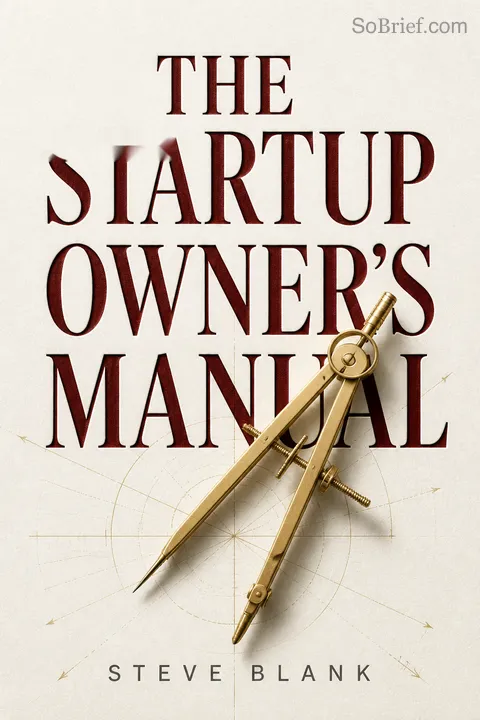
The Startup Owner's Manual receives largely positive reviews, with an average rating of 4.10/5. Readers praise its practical, step-by-step approach to building a successful startup, focusing on customer discovery and validation. Many consider it essential reading for entrepreneurs, offering valuable insights into business model development and lean startup principles. Some criticize its dry, formulaic style and repetitiveness, while others appreciate its comprehensive nature. The book is particularly recommended for those in the early stages of starting a business or interested in understanding startup dynamics.
People Also Read







Glossary
Customer Development
Structured business-model searchA process for testing a startup’s assumptions about customers, problems, products, channels, and revenue. The company first investigates whether a market and solution exist, then checks whether selling or customer acquisition can be repeated and scaled. Only after sufficient evidence does it shift toward growth and a more formal operating organization.
Business Model Canvas
One-page business mapA visual framework for describing how a company intends to create, deliver, and capture value. It organizes assumptions about the value offered, customer groups, channels, customer relationships, revenue, costs, activities, resources, and partners. In this book, teams revise the canvas as customer evidence changes their business model.
earlyvangelist
Urgent early buyerA prospective customer who recognizes a serious problem, is actively seeking a solution, has often built a workaround, and can obtain money to buy. Earlyvangelists are willing to try an unfinished product because solving the problem or gaining an early advantage matters more than waiting for a polished release. They can also provide feedback and referrals.
Minimum Viable Product
Smallest testable productThe smallest set of product capabilities that can function as a standalone offering and demonstrate a proposed solution. Its purpose is to test whether the team understands the customer’s need, while limiting wasted development. Depending on the product, an early test may use a simple page, prototype, demo, or working software.
Pivot
Major model changeA substantial change to one or more elements of a startup’s business model, prompted by evidence that an important assumption is wrong. A pivot can alter the customer group, value proposition, revenue approach, or another core element. It differs from a smaller adjustment, such as a modest price change, and is treated as learning rather than proof of failure.
Market Type
Category of market entryA strategic description of how a startup relates to its market. The book distinguishes entry into an existing market, creation of a new market, low-cost or niche re-segmentation of an existing market, and adaptation of a proven business model to another country. The choice shapes customer education, competition, expected adoption speed, spending, and revenue forecasts.
Sales Roadmap
Repeatable path to purchaseA documented sequence of steps that moves a prospect toward a completed sale. It identifies who uses, influences, approves, funds, or can block a purchase, as well as the needed conversations, presentations, approvals, and follow-up. Founders develop it through test sales before hiring a larger sales organization to execute it.
Metrics that Matter
Startup viability measuresA focused set of customer, revenue, cost, and cash measures used to judge whether a tested business model can grow profitably. Relevant figures vary by channel and business type, but can include market size, conversion, acquisition cost, retention, customer value, channel fees, operating costs, and cash runway. The purpose is to test viability, not decorate a forecast.
Get, Keep and Grow
Customer lifecycle activitiesA framework for organizing customer relationships around three tasks: acquiring customers, retaining them, and increasing their value through repeat purchases or referrals. Web businesses often measure acquisition and activation separately, then track retention and referral behavior. The framework helps teams see where customers disappear and which parts of the business model need improvement.
FAQ
What's The Startup Owner's Manual about?
- Comprehensive Guide: The Startup Owner's Manual by Steve Blank is a detailed guide for entrepreneurs on building successful startups.
- Customer Development Focus: It emphasizes the importance of understanding customer needs and validating business models through direct customer interaction.
- Structured Approach: The book outlines a structured approach with practical tools and frameworks, such as the Business Model Canvas, to systematically test and refine business ideas.
Why should I read The Startup Owner's Manual?
- Proven Methodology: The book presents a proven methodology that has been adopted by many successful entrepreneurs, reducing the risk of failure.
- Real-World Examples: It includes numerous real-world examples and case studies, making the concepts relatable and easier to understand.
- Actionable Insights: Readers gain practical advice that can be immediately applied to their ventures, making it valuable for both new and experienced entrepreneurs.
What are the key takeaways of The Startup Owner's Manual?
- Customer-Centric Approach: Emphasizes engaging with customers directly to validate assumptions and understand real problems.
- Iterative Learning: Advocates for continuously testing and refining business models based on customer feedback.
- Business Model Canvas: Introduces this tool to visualize and organize business model hypotheses, aiding in tracking progress and making informed decisions.
What is the Customer Development process in The Startup Owner's Manual?
- Four Phases: Consists of Customer Discovery, Customer Validation, Customer Creation, and Company Building.
- Hypothesis Testing: Involves formulating and testing business model hypotheses through direct customer interactions.
- Iterative Feedback Loop: Encourages a feedback loop where customer insights inform subsequent actions and decisions.
How does The Startup Owner's Manual define a Minimum Viable Product (MVP)?
- Core Features Only: An MVP is the simplest version of a product with essential features to solve a core problem for early customers.
- Testing Assumptions: Its purpose is to test assumptions about customer needs and validate the product's value proposition.
- Iterative Improvement: Feedback from MVP users is used to iteratively improve the product, ensuring it meets market demands.
What is the significance of the Business Model Canvas in The Startup Owner's Manual?
- Visual Framework: Serves as a visual tool to outline and organize business model hypotheses.
- Hypothesis Testing: Allows entrepreneurs to track assumptions and validate them through customer feedback.
- Dynamic Document: The canvas evolves as more information and insights are gathered, aiding in navigating startup uncertainties.
What are the common pitfalls startups face according to The Startup Owner's Manual?
- Premature Scaling: Expanding operations before validating the business model can lead to significant cash burn and failure.
- Ignoring Customer Feedback: Believing they know what customers want without listening can result in products that don't resonate.
- Overcomplicating the Product: Adding too many features can dilute the core value proposition and confuse potential buyers.
How does The Startup Owner's Manual suggest handling customer feedback?
- Active Listening: Emphasizes understanding customer needs and pain points rather than pushing the product.
- Iterative Process: Feedback should be used to refine the product and business model continuously.
- Documenting Insights: Encourages systematic documentation of insights to track progress and inform future actions.
What is the importance of earlyvangelists in the startup process according to The Startup Owner's Manual?
- Visionary Customers: Earlyvangelists are visionary customers who recognize significant problems and are eager for solutions.
- Feedback Providers: They provide valuable feedback that helps shape the product and its features.
- Risk Takers: Willing to take risks on new products, they help validate the startup's value proposition and build market momentum.
What are the best quotes from The Startup Owner's Manual and what do they mean?
- "There Are No Facts Inside Your Building, So Get Outside.": Emphasizes the necessity of engaging with customers directly to gather real insights.
- "No business plan survives first contact with customers.": Highlights the unpredictability of the startup journey and the need for flexibility.
- "Failure is an Integral Part of the Search.": Suggests that failure provides valuable learning opportunities in the startup process.
How does The Startup Owner's Manual define market types?
- Four Market Types: Existing markets, new markets, re-segmented markets, and clone markets.
- Impact on Strategy: Each type influences strategy, including customer acquisition, pricing, and competitive positioning.
- Tailored Approaches: Understanding the market type helps tailor the approach to customer discovery and validation.
How do I know when to pivot or proceed with my startup according to The Startup Owner's Manual?
- Data-Driven Decisions: Base the decision on thorough analysis of customer feedback and validation results.
- Key Metrics: Focus on metrics like customer acquisition costs and conversion rates to assess alignment with business expectations.
- Team Consensus: Engage the team and advisors in discussions to ensure alignment and commitment to the chosen direction.
About the Author

Download PDF
Download EPUB
.epub digital book format is ideal for reading ebooks on phones, tablets, and e-readers.








