Key Takeaways
1. Writing is a Lifeline for Navigating Life's "Tragic Gap"
Our writing can transform us.
Facing life's challenges. Life inevitably knocks us down, presenting a "tragic gap" between our hopes and our reality. Whether it's a cancer diagnosis, a sudden loss, or an avalanche of daily stresses, these moments can leave us feeling overwhelmed and "drowning." The author's own breast cancer diagnosis served as a stark reminder of this universal truth.
Reflection as a tool. Writing, particularly in a personal journal, acts as a lifeline during these crises. It provides a space for reflection, allowing us to:
- Calm feelings of panic.
- Experiment with potential changes.
- Make plans to move forward.
- Rewrite our story to incorporate unwanted life events.
Choosing to "wave, not drown." We cannot change the facts of what happens, but we can choose how we interpret and respond to them. Writing empowers us to shift our perspective from being a victim to actively shaping our narrative, transforming sad songs into better ones, and finding strength in sharing our stories.
2. Embracing Silence is a Necessary First Step Before Finding Words for Trauma
There are times when it is okay not to write.
The initial shock. When tragedy strikes, such as the sudden death of a student, the mind can be too overwhelmed to process or articulate the experience. In these moments, silence is not only natural but beneficial, allowing the brain to absorb and reflect on difficult information without immediate pressure to verbalize.
Time for assimilation. Like Elie Wiesel's decade of silence after the Holocaust or Cheryl Strayed's years before writing about her mother's death, space and time are often crucial for assimilating traumatic events. This period allows for internal processing before one can begin to make sense of the experience through words.
Waiting out the storm. During intense pain or grief, our minds can be flooded with uncontrollable emotions and memories. It's like being in the "trough" of a wave, where the horizon disappears. Resting in this silence, conserving energy, and observing the "shape of things" prepares us for when the wave will eventually bring us to its crest again, ready to find our words.
3. Expressive Writing Offers Profound Physical and Psychological Healing Benefits
Writing is a beautiful way to let all your pain out.
Releasing the "monster." When traumatic experiences are buried inside, they can morph into volatile emotions, flashbacks, anxiety, and even physical illness. Expressive writing provides a powerful outlet, allowing us to externalize these internal struggles and "release" them, much like saying goodbye to a monster that has been living within.
Scientific validation. Pioneering research by James W. Pennebaker demonstrated that writing about emotional upheavals for just 15-20 minutes over four consecutive days significantly improved physical and psychological health. Participants experienced:
- 43% fewer doctor visits for illness.
- Reduced general anxiety and depressive symptoms.
- Dissipation of recurring nightmares.
Beyond catharsis. While the initial act of writing can be cathartic, the true healing comes from constructing a complete story. This process helps us move beyond simply venting emotions to making sense of the chaos, grounding us, and allowing us to rewrite events within the framework of our identity.
4. Journals Serve as a "Room of One's Own" for Self-Discovery and Charting Change
In the journal I don’t just express myself more openly than I could to any person; I create myself.
A private sanctuary. A journal can be a metaphorical "room of one's own," a private space to explore secrets, struggles, and traumas without judgment. This personal archive allows for honest self-reflection, helping us to understand who we are, who we have been, and who we are capable of becoming.
Unearthing personal history. Reviewing old journals reveals patterns, completed life chapters, and moments where we might have been "stuck." This retrospective view offers clarity, allowing us to see ourselves through a new lens and identify areas for growth or change. The author's own journey through 27 journals revealed her evolution as a thinker, mother, and writer.
Charting a new course. Journaling helps us chart important changes by reflecting on dilemmas, experimenting with new perspectives, and making plans. Whether through freewriting, poems, doodles, or lists, the act of putting thoughts on paper helps organize internal chaos and guides us toward personal transformation.
5. Our Brains are Wired for Story, Using Narratives to Make Sense of Self and the World
Storytelling is something brains do, naturally and implicitly.
The brain's narrative device. Our minds are constantly cobbling together sensory input into narratives, creating "dynamic maps" that define our unique self. These stories are how we translate our world, experience feelings, and develop our "autobiographical self," consciously acknowledging past experiences and future plans.
Universal human need. From ancient myths to modern social media, humans are "storytelling animals," constantly immersed in narratives to connect, learn, solve problems, and find meaning. Our brains crave resolution; an unfinished story keeps playing in our minds, driving us to create endings even when facts are unknown.
Flight simulators for life. Psychologist Keith Oatley suggests stories act as "flight simulators of human social life." By engaging with characters facing obstacles, we mentally take notes on what works and what doesn't, internalizing these journeys. This "realistic practice" better prepares us to handle our own challenges, wiring survival responses into our brains.
6. We Can Rewrite Our Shattered Stories by Changing Perspective and Interpretation
We cannot change the facts, but we can change how we interpret those facts, how they affect us, and eventually how they teach us about our vulnerabilities and strengths.
The power of interpretation. The way we interpret our experiences is critical to our well-being. We can choose unhealthy views that lead to negative outcomes, or we can direct our energy into editing our stories to find meaning and purpose. The author's oncologist, Dr. Obenchain, reframed her own kidney cancer as a "gift" that made her a more compassionate physician.
Story editing for lasting change. "Story editing" involves techniques to redirect our narratives about ourselves and the world, leading to lasting behavioral changes. By consciously choosing how we frame events—for example, seeing a bad grade as an opportunity to improve rather than a sign of being "dumb"—we can alter our responses and outcomes.
Shifting viewpoints. Rewriting a painful anecdote from another person's perspective, such as a difficult boss, can provide significant benefits. This shift from a first-person ("I") to a third-person ("he or she") viewpoint allows logic to enter, moving us from rumination to adaptive self-reflection and empowering a new understanding of troubled relationships.
7. The Healing Journey Through Writing Follows Distinct Stages, from Pain to Transformation
There is no greater agony than bearing an untold story inside of you.
A ladder to healing. The process of writing to heal often follows a discernible pattern, a "ladder" of stages that guides us through difficulties. While not strictly linear, these stages help us chart our way through trauma, illness, or loss.
Five key stages:
- Experiencing pain and grief: Initial shock and silence, often with no words.
- Breaking the silence: Willingness to share the shattered story, often cathartic.
- Accepting and piecing together: Acknowledging the event, moving emotions into a logical framework.
- Finding meaning or making sense: Gaining objectivity, achieving a "complete story" and closure.
- Rewriting and moving forward: Recovering energy, redefining self, and pursuing creative, fulfilling paths.
Story transformation. This structured approach allows us to take shattered experiences, reassemble them, and give them meaning. By completing a difficult chapter in our lives through writing, we gain the emotional energy to move forward and transform our understanding of ourselves.
8. Breaking Silence Through Freewriting Helps Release Trapped Emotions
Writing that lets words come and dance with you can be a powerful form of self-revelation.
Unleashing the unspoken. Many painful stories remain buried deep within us, causing internal struggle and emotional turmoil. Breaking this silence is the crucial first step toward healing, allowing us to give voice to traumas that have been locked away for years.
The power of freewriting. Freewriting is a technique of writing without constraint, editing, or censorship. It encourages a continuous flow of thoughts onto paper, bypassing the left-brain critic and allowing the right brain to pour forth raw feelings and emotional experiences. This process provides a genuine psychological release, helping to "get stuck stories out."
Beyond catharsis to self-revelation. While the initial release can be cathartic, freewriting's deeper value lies in self-revelation. It helps us unravel internal knots, find a framework to understand and live with painful experiences, and take steps toward healing on our own, even without professional counseling.
9. Overcoming Rumination Requires Stepping Back and Asking "Why" from a Distance
If you’re constantly ruminating about what you just did — or what you should have done — or what you would have done if you only had the chance, you will miss your life.
The trap of rumination. Getting stuck in a loop of negative, repeating thoughts about past problems or what "should have been" drains energy and prevents forward movement. This mental immobilization makes it impossible to solve problems and leads to unfulfilling lives, as observed in studies of older adults.
Adaptive self-reflection. To break free from rumination, we must learn to pull back and observe our thoughts and behaviors from a distance. Analyzing negative experiences with a focus on reasons rather than emotions allows us to gain important insights and rework unhealthy patterns.
Rewiring the brain. Consciously changing our thinking and behavior is possible because our brain maps can be rewired. By identifying obsessive thoughts and replacing them with productive thinking and actions, we can minimize ruminations and embrace present experiences, leading to a much better way to live.
10. Illness and Injury Can Be Reframed Through Writing to Find Meaning and Positivity
I tell myself, ‘I may have cancer, but cancer does not have me.’
Accepting and making sense. When faced with illness or injury, writing helps us accept what has happened and make sense of it. By transferring experiences from emotion-filled right brains into language-based left brains, we can understand, realign, and even rewrite our narratives to manage the disease.
Honest feelings and positive outlook. Writing allows for the exploration of honest, even painful, feelings, but it also empowers us to choose our attitude. Jen, a young mother with stage four cancer, used her blog to openly share her struggles while consciously reframing her illness as a challenge to be met, not a death sentence.
Words to heal. The words we use to interpret an illness profoundly impact how we face it. While denying an illness is unhealthy, dramatizing it or allowing it to become a "stuck story" can create unhealthy thought patterns. Instead, embracing a positive outlook and focusing on gratitude can reduce depression and foster emotional, mental, and spiritual healing, even in terminal cases.
11. Writing Through Loss Helps Accept Grief, Embrace Community, and Find Gratitude and Wisdom
Grief is in two parts. The first is loss. The second is the remaking of life.
Navigating the abyss of loss. Losing a loved one, especially unexpectedly, creates a profound void, shattering intertwined associations, memories, and plans. Writing serves as a crucial navigational tool out of this abyss, helping us to make sense of the shards and begin the difficult process of remaking life.
Community and connection. During times of loss, the support of a community is vital. Writing about shared experiences, whether in a group or through letters, helps build bonds and provides meaning. Funerals, tributes, and ethical wills, while honoring the deceased, are primarily for the living, helping them accept and face their grief.
Gratitude and wisdom. Writing can help us find gratitude amidst sorrow, shifting our focus to positive memories and appreciation for the person lost. This practice can reduce depression and reground us. Furthermore, writing allows us to capture and share our wisdom—through ethical wills, memoirs, or stories—leaving a spiritual legacy for loved ones and ensuring our insights transcend our physical presence.
12. Resilience and Creativity Often Burst Forth from Rewriting and Transforming Difficult Experiences
Your life is your story. Write well. Edit often.
Transmuting pain into purpose. When individuals use writing to make sense of profound hardships—be it sexual abuse, war trauma, cancer, or grief—they often rediscover themselves and experience a powerful burst of creativity. This transformation allows them to transmute their pain into constructive works or new passions.
The "flow" of creation. This creative surge often manifests as a state of "flow," where individuals are so deeply engaged in something they love that they lose track of time and self-consciousness. This is the coming together of the creative process, allowing them to share newfound wisdom and let go of pain and guilt.
Redefining self and living fully. Writing is an act of resilience that enables us to rewrite our stories and re-create ourselves. By moving past suffering and fulfilling basic needs, we can tap into our passions, explore our creativity, and adapt well to circumstances. This leads to a fuller, happier, and more purposeful life, demonstrating that positive change in our stories can lead to a positive explosion of creativity.
Last updated:
Review Summary
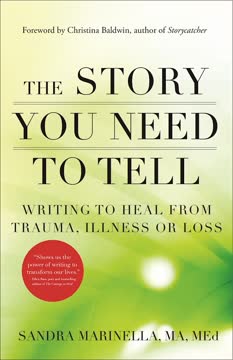
The Story You Need to Tell receives overwhelmingly positive reviews (4.4/5 stars) for its powerful approach to healing through writing. Readers praise Sandra Marinella's blend of personal cancer journey, research on expressive writing, and stories from veterans and patients. The writing prompts at each chapter's end are consistently highlighted as practical and transformative. Reviewers appreciate how the book addresses trauma, grief, and loss while remaining hopeful rather than heavy. Many report actually using their journals and finding healing through the exercises provided.