

Key Takeaways
Let readers help build the scene, then notice how quickly they believe it.
The reader supplies color. Jonathan Gottschall opens with a shipwreck scene from Nathaniel Philbrick’s account of a whaling disaster. The prose gives a few vivid clues, but readers unconsciously invent the captain’s appearance, the weather, and much of the scene’s texture. Gottschall even adds a detail of his own, then points out how readily a reader may accept it as part of the original passage.
Attention turns into participation. A story does not simply pour images into a passive mind. The writer offers cues, and the reader builds a world around them. That mental work helps explain why a song about a father and daughter, or a novel about a dying man and his son, can produce real tears. The imagined scene is incomplete, but the feeling it evokes is not.
What's striking is how much this resembles ordinary perception. Minds routinely combine incoming signals with expectation to form a usable picture of the world. Storytelling gives that process a safe, vivid playground: a few words can prompt an elaborate scene without specifying every detail. This helps explain both immersion and susceptibility. A reader's imagination is not merely receiving a message, it is helping manufacture one. The limit is important, though: emotional vividness is not evidence that a story is true, and reader participation can fill gaps with assumptions the writer never intended.
Story is not a pastime; it is the mind's everyday habitat.
Neverland is everywhere. Gottschall uses this name for the imaginative realm of stories, fantasies, dreams, and make-believe. Children spend hours inventing pretend worlds; adults keep entering them through novels, television, songs, games, and daydreams. The book cites estimates from its period that Americans spent about five hours a day with television and films, while studies suggested daydreaming occupied roughly half of waking life. The precise totals depend on how activities are counted, but the larger point is hard to miss: story reaches well beyond books.
The forms keep multiplying. Sports broadcasts turn matches into character-driven dramas. Advertisements sell through miniature plots. Family dinners and conversations trade stories about daily life. Even while the body stays in one place, imagination can roam through possible pasts and futures.
This account usefully broadens what counts as narrative. A person need not be reading a novel to be immersed in a story: a sports rivalry, a commercial, or a private rehearsal of tomorrow's conversation can all organize events around motives and consequences. That breadth connects storytelling to attention, not only to art. At the same time, counting all imaginative activity as story risks making the concept too expansive to test. The useful distinction is whether a mental sequence has agents, motives, and unfolding consequences, rather than simply being an image or stray thought.
Follow the trouble: stories rehearse the problems life makes costly.
Plots need an obstacle. Across genres, stories tend to follow someone who wants something, meets a serious impediment, and tries to overcome it. A quiet grocery trip is forgettable as a plot; the same trip becomes gripping when a child disappears. This recurring structure explains why fiction is not simply a pleasant escape. It often replaces ordinary worries with sharper imagined dangers.
Practice without the real-world price. Gottschall presents fiction as a kind of social flight simulator. Readers experience fear, desire, embarrassment, and conflict through characters, while remaining physically safe. Research discussed in the book found that people who read more fiction performed better on some tests of social understanding. The author also notes that the evolutionary purpose of storytelling remains unsettled, and that fictional solutions can be poor guides when copied literally.
The simulator analogy is powerful because social life is learned through observing motives, interpreting reactions, and anticipating consequences. Fiction can supply many examples that a single life could never provide. But exposure is not the same as training: a viewer might absorb a story's stereotypes or mistaken assumptions as easily as its insight. The analogy is strongest when treated as a possibility for practice, not a guarantee of improved judgment. A good reader can ask what a character misunderstands, what the story rewards, and whether that lesson transfers beyond its invented world.
Let children play at danger; make-believe is practice, not mere escape.
Trouble fills the nursery. Children’s spontaneous stories often involve getting lost, being chased, falling, or facing monsters. In classroom observations described by Gottschall, children invent plots about missing babies, dangerous forests, and battles with villains. Their play is not a sunny retreat from reality. It gives them a way to act out fear, power, separation, and rescue while controlling the scene.
Play prepares, but not identically. The book describes studies finding average differences in boys’ and girls’ play, including more rough physical conflict among boys and more pretend caregiving among girls. It also discusses girls with congenital adrenal hyperplasia, whose prenatal exposure to higher levels of androgens is associated with more typically boy-patterned play. These findings suggest biological influences, but averages do not prescribe what any particular child should enjoy.
Play is a form of low-stakes experimentation. Children can test roles, negotiate rules, and revise a frightening plot without facing its real consequences. That makes pretend play relevant to learning and emotional development, not an optional decoration around education. The gender discussion benefits from restraint: observed group differences do not define individual children, and culture can shape which toys and roles feel available. Protecting open-ended play means allowing a broad range of stories, including rough or frightening ones, while ensuring that children remain safe and can choose their parts.
Treat threatening dreams as possible rehearsal, not decoded prophecy.
Dreams often stage danger. The threat simulation theory proposes that dreams let the brain rehearse responses to threats. In a 2009 review summarized by Gottschall, researchers estimated that about 860 of 1,200 yearly REM dreams included at least one threat. These figures are projections from imperfect samples, not a precise count of anyone's dreams. Common themes included being chased, attacked, lost, or trapped.
The explanation remains contested. In experiments by sleep researcher Michel Jouvet, cats whose brain-stem mechanisms for sleep paralysis were disrupted acted out behaviors resembling stalking, fighting, and fleeing. This suggests that animal dreams may involve species-relevant problems. Other researchers argue that dreams may help organize memory, cope with emotion, or arise as a by-product of sleeping brain activity. The book presents threat rehearsal as a promising account, not a settled answer.
The key contribution is to treat dream content as potentially functional without assuming that every dream carries a hidden message. That distinction avoids both extremes: mystical decoding and dismissing dreams as meaningless noise. Still, seeing danger in dreams does not by itself prove that dreaming evolved to rehearse danger. A mind may generate threats for several reasons, and the same dream could support emotional processing as well as practice. The strongest claim is modest: dreams repeatedly simulate emotionally important problems, and their effects on the sleeping brain deserve investigation.
Audit the story your brain writes when facts are missing.
The interpreter hates a blank. Michael Gazzaniga called a left-brain system that explains experience “the interpreter.” In split-brain studies, one side of a patient’s brain might receive a cue and guide an action while the speaking side remained unaware of the cue. Asked to explain the action, the patient confidently invented a reason. The behavior was real; the explanation was not.
Confabulation happens in everyday life, too. In one experiment, people chose among identical pairs of socks, then supplied reasons for their preferences without realizing the products were the same. The mind connects sparse clues into a coherent account, sometimes even when there is no real connection. This habit can support useful inference, but it also helps conspiracy theories turn scattered events into plots with hidden villains. When an explanation feels complete, ask what evidence could disprove it.
The interpreter is less a liar than a coherence machine. A mind that waited for perfect evidence before acting would be slow and helpless, so rapid explanation has practical value. The same efficiency creates a predictable failure: a compelling account can feel more evidentially grounded than it is. This is especially important when uncertainty is uncomfortable or a story identifies a clear enemy. Skepticism works best as a method rather than a posture: compare alternative explanations, separate observation from inference, and remain willing to leave some events unresolved.
Remember that memory edits you into the hero of your own life.
Memory rebuilds rather than replays. In David Carr’s memoir, he recounts a drunken confrontation with his friend Donald, but later learns that he, not Donald, had held the gun. The central event remained recognizable while a crucial detail shifted. Research on so-called flashbulb memories found a similar gap: people could recall dramatic public events with great confidence while changing details over time. Some participants even remembered seeing footage of the first plane hitting the World Trade Center before such footage was available.
Self-image shapes the edit. People often recall mistakes in ways that soften their responsibility and see themselves as better than average in valued traits. Gottschall argues that this helps people maintain a coherent identity, though it can also make self-justification feel like honest recollection. A personal story can be useful without being an impartial record.
Autobiographical memory serves more than accuracy. It helps connect past choices to present identity, making a life feel continuous rather than like a pile of disconnected episodes. That function can support resilience, but it also creates a conflict of interest: the narrator is describing the person the narrator is. This is why corroboration matters most when memory supports a consequential accusation or excuses harmful behavior. A practical response is not to distrust every recollection, but to distinguish confidence from verification and to make room for other witnesses' versions.
Use shared stories to build belonging, while questioning their borders.
Stories coordinate communities. Religious traditions and national histories use shared narratives to explain origins, define duties, and identify common values. Gottschall presents the theory that religion can bind groups through shared rules and cooperation, while also strengthening divisions between insiders and outsiders. Stories can therefore create solidarity and provide a reason to defend a group, sometimes violently.
A unifying tale can conceal harm. The familiar school story of Christopher Columbus often celebrates discovery while omitting his treatment of Indigenous people. Revising that story can correct an injustice, though the book warns that counter-narratives can also simplify history. The point is not to reject common stories automatically. It is to ask who is included in the community they create, whose experience disappears, and whether belonging depends on distorting the past.
Shared stories are a kind of social infrastructure. They give strangers a common vocabulary for trust, obligation, and collective memory, much as institutions give cooperation a durable form. But cohesion has a boundary problem: solidarity for one group can license indifference or hostility toward another. A more mature civic narrative can preserve shared attachment while making room for evidence that complicates the founding myth. The useful test is not whether a story makes people feel united, but whether it allows the costs borne by excluded people to remain visible.
Fiction can alter beliefs precisely when it feels like entertainment.
Absorption lowers the guard. Studies cited by Gottschall found that people’s attitudes can shift toward ideas presented in a fictional narrative, sometimes after a single television episode. Viewers may also learn facts about subjects they have never experienced directly, from police work to historical periods. A story can influence not only what people know, but whom they fear, admire, or sympathize with.
Ink people can have real consequences. Harriet Beecher Stowe’s Uncle Tom’s Cabin helped intensify antislavery feeling in the North and deepen conflict over slavery. Richard Wagner’s operas and political ideas helped shape Hitler’s imagination, though they were only part of a much larger history. Stories do not mechanically dictate behavior, but they can influence emotion and belief. Treat immersive fiction as a force worth examining, not as harmless simply because it is entertaining.
Narrative persuasion works partly through identification: instead of evaluating a claim as an abstract argument, an audience follows a person through consequences. That can make distant suffering emotionally legible and broaden sympathy. It can also make a distorted account persuasive by hiding its assumptions inside a memorable plot. Effects depend on the audience, the story, and the surrounding social context, so one dramatic example cannot establish a universal rule. Still, the practical lesson is strong: ask which perspectives a story makes vivid, and which it leaves outside the frame.
New media change story's interface, not our appetite for narrative.
Story adapts its delivery. Gottschall sees songs carrying poetry, reality television shaping real people into dramatic characters, and video games placing players inside plots. Live-action role-playing lets adults act out invented characters together. Massively multiplayer online role-playing games, or MMORPGs, build shared fictional worlds with histories, customs, and communities. These forms change who controls the action, but they still rely on characters facing problems.
Immersion brings both value and risk. Online worlds can offer friendship, purpose, and a sense of competence that players may lack elsewhere. They can also become so absorbing that ordinary life loses its pull. The book compares abundant stories to abundant food: a useful appetite can become unhealthy when every available option is low-quality and endlessly accessible. Choose stories deliberately, and protect time for life outside the screen.
Interactive storytelling changes the audience from witness to participant, which can deepen agency and social connection. The appeal of a virtual world may say as much about unmet needs in everyday life as about the technology itself. That observation argues against dismissing players as escapists, while still leaving a legitimate concern about displacement. The relevant question is not whether a story happens on paper or a screen, but whether its rewards enrich relationships and capacities beyond itself, or steadily replace the settings where those capacities matter.
Analysis
The book’s central move is to treat storytelling not as a cultural ornament but as a recurring feature of human cognition. Its evidence ranges from toddlers inventing danger to adults reconstructing memory, from dreams and split-brain experiments to religion, politics, and digital games. That range gives the argument its force: storytelling appears wherever people interpret motives, connect events, and imagine outcomes.
The strongest claims are descriptive. Stories cluster around characters in trouble, readers mentally supply missing details, and the brain often turns incomplete evidence into a coherent explanation. The claim that fiction and dreams evolved specifically to train social or threat responses is more provisional. The author acknowledges competing explanations, but some cited correlations and vivid examples cannot establish an evolutionary function on their own. Likewise, a story’s influence is real without being uniform or inevitable. Readers bring prior beliefs, and institutions, relationships, and material conditions shape whether a narrative changes conduct.
The book is especially useful when its ideas are applied reflexively. Stories can build empathy, but can also naturalize stereotypes. Shared myths can coordinate cooperation, but may erase victims. Personal narratives can preserve motivation, but may make responsibility harder to see. This is not a contradiction to resolve by declaring stories good or bad. It is a reason to examine what a story makes imaginable, whom it casts as protagonist, and what evidence its emotional coherence may conceal.
The lasting insight is that humans do not merely consume stories. They use narrative to simulate, explain, remember, and belong. That capacity is powerful partly because it operates before conscious scrutiny. Understanding its mechanisms need not diminish the pleasure of a story; it can make readers more attentive to both the worlds they enter and the worlds they construct.
Review Summary
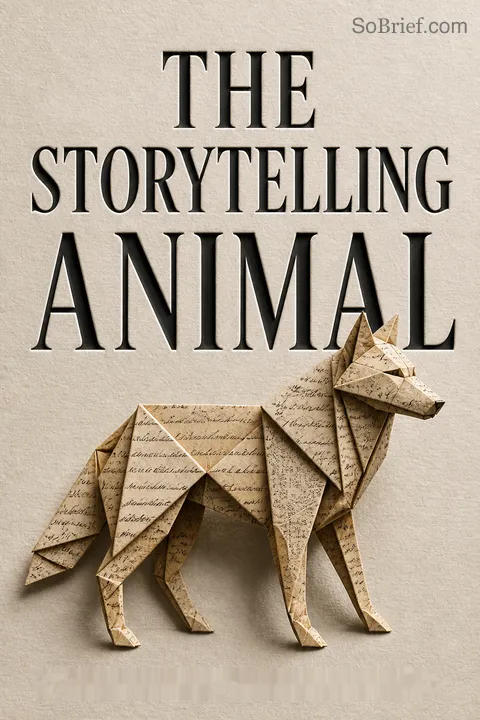
The Storytelling Animal explores why humans are drawn to stories and how storytelling shapes our minds and cultures. Gottschall argues that humans are inherently storytelling creatures, using narratives to make sense of the world and prepare for life's challenges. The book examines various aspects of storytelling, from dreams to fiction, and its impact on human evolution and society. While some readers found the book insightful and engaging, others criticized its lack of depth and originality. Overall, the book offers an accessible exploration of the role of stories in human life.
Glossary
Neverland
the imaginative realmGottschall’s name for the broad imaginative world people enter through fiction, dreams, daydreams, songs, and make-believe. It is not limited to children’s pretend play or to novels. The term emphasizes that humans spend substantial mental time imagining events and places beyond their immediate surroundings.
universal grammar
recurring story structureGottschall’s analogy for the common structure he finds across stories from different eras and cultures. A protagonist wants something, encounters obstacles, and attempts to overcome them. The characters, settings, and styles vary widely, but stories commonly organize events around human problems such as survival, love, and power.
the interpreter
the brain's explanation systemNeuroscientist Michael Gazzaniga’s term for left-hemisphere circuitry that interprets information and constructs a coherent account of experience. Split-brain experiments showed that this system can confidently invent an explanation when it lacks access to the true cause of an action. Gottschall uses it to illuminate the mind’s everyday drive to make events meaningful.
problem simulation theory
fiction as social rehearsalThe idea that stories function like mental simulations of difficult social situations. By following characters through conflict, readers can experience emotions and possible responses without facing the real-world consequences of those events. Gottschall presents this as a plausible function of fiction, while recognizing that fictional solutions may not transfer cleanly to real life.
threat simulation theory
dreams rehearse dangerA theory that dreams simulate threatening situations so the brain can practice responses to danger. Research discussed in the book finds many dreams contain physical or social threats, and studies of animals acting out dreams offer suggestive evidence. The theory remains disputed, and threatening dream content alone does not prove that rehearsal is its purpose.
random activation theory (RAT)
dreams from brain noiseA theory that dreams arise when the mind’s narrative-making systems try to organize random neural activity during sleep. On this account, dream bizarreness reflects the brain imposing stories on meaningless input, rather than a designed rehearsal process or symbolic message. The book presents RAT as a competing explanation for why dreams occur.
flashbulb memories
vivid public-event memoriesThe term psychologists Roger Brown and James Kulik used for vivid recollections of where someone was and what they were doing when learning about a dramatic public event. Such memories can feel exceptionally accurate, yet follow-up research found that details often change over time while confidence remains high.
confabulation
unintentional invented explanationThe creation of a false or inaccurate account that the speaker believes to be true. It can occur in people with brain disorders, but Gottschall also uses ordinary experiments to show how healthy people invent explanations for choices or actions when they do not know the actual cause. The process reflects the mind’s preference for coherence over admitting uncertainty.
Lake Woebegone effect
overrating oneselfA tendency for people to judge themselves as above average in desirable qualities, even when this cannot be statistically true for everyone. Gottschall uses the effect to show how self-assessment can become part of a flattering personal narrative. The bias can help sustain confidence, but it can also distort judgments of competence and responsibility.
MMORPG
shared online role-playing worldA massively multiplayer online role-playing game, a persistent virtual world where many players adopt characters and interact with one another. In the book’s examples, these environments contain shared histories, customs, economies, and ongoing adventures. They make storytelling interactive by allowing players to participate in an unfolding fictional world.
FAQ
What's "The Storytelling Animal: How Stories Make Us Human" about?
- Exploration of storytelling: The book delves into why humans are naturally drawn to stories and how storytelling is a fundamental aspect of human nature.
- Biological and cultural perspectives: It examines storytelling from evolutionary, psychological, and cultural viewpoints, suggesting that storytelling is an adaptive trait.
- Impact on human behavior: The book discusses how stories shape our beliefs, behaviors, and cultures, influencing everything from personal identity to societal norms.
- Role of fiction: It highlights the pervasive role of fiction in human life, from ancient myths to modern media, and its power to affect real-world events and individual lives.
Why should I read "The Storytelling Animal"?
- Understanding human nature: The book provides insights into why storytelling is a universal human trait and how it has evolved as a crucial part of our species.
- Interdisciplinary approach: It combines insights from biology, psychology, and neuroscience to offer a comprehensive view of storytelling's role in human life.
- Cultural relevance: The book explores the impact of stories on culture and society, making it relevant for understanding current media and communication trends.
- Engaging narrative: Jonathan Gottschall uses engaging anecdotes and examples to illustrate complex ideas, making the book accessible and enjoyable to read.
What are the key takeaways of "The Storytelling Animal"?
- Stories as evolutionary tools: Storytelling is an evolutionary adaptation that helps humans navigate social complexities and practice problem-solving.
- Moral and social functions: Stories reinforce societal norms and values, promoting cooperation and ethical behavior within communities.
- Impact on identity: Personal narratives shape individual identities, influencing how people perceive themselves and their place in the world.
- Future of storytelling: The book discusses the evolving nature of storytelling with technology, suggesting that interactive and immersive stories will become more prevalent.
How does Jonathan Gottschall explain the evolutionary purpose of storytelling?
- Problem-solving practice: Stories act as simulations that allow individuals to practice social and survival skills in a safe environment.
- Social cohesion: Storytelling fosters group identity and cohesion by reinforcing shared values and norms.
- Cognitive development: Engaging with stories enhances cognitive abilities, such as empathy and theory of mind, which are crucial for social interaction.
- Cultural transmission: Stories serve as a means of passing down knowledge and cultural heritage across generations.
What role do dreams play in "The Storytelling Animal"?
- Night stories: Dreams are described as vivid, narrative-like experiences that share structural similarities with stories.
- Threat simulation: The book suggests that dreams may serve an evolutionary function by simulating threats and allowing individuals to rehearse responses.
- Emotional processing: Dreams help process emotions and experiences, contributing to mental health and well-being.
- Implicit learning: Even though dreams are often forgotten, they may still influence behavior and decision-making through implicit memory.
How does "The Storytelling Animal" address the concept of moral storytelling?
- Moral reinforcement: Stories often convey moral lessons, promoting prosocial behavior and discouraging antisocial actions.
- Imaginative resistance: People are generally unwilling to accept stories that contradict their moral beliefs, highlighting the deep connection between storytelling and ethics.
- Cultural norms: Fiction reflects and reinforces cultural norms, shaping societal values and expectations.
- Empathy and understanding: Engaging with stories can enhance empathy and understanding of diverse perspectives, fostering social harmony.
What are some of the best quotes from "The Storytelling Animal" and what do they mean?
- "We are, as a species, addicted to story." This quote emphasizes the fundamental role of storytelling in human life, suggesting that stories are as essential to us as food and water.
- "Story is the glue of human social life." This highlights the unifying power of stories, which bring people together by creating shared experiences and values.
- "The storytelling mind is a factory that churns out true stories when it can, but will manufacture lies when it can't." This reflects the human tendency to create narratives to make sense of the world, even when the facts are unclear or incomplete.
- "Fiction is an ancient virtual reality technology that specializes in simulating human problems." This quote illustrates the idea that stories allow us to explore complex situations and emotions in a safe, controlled environment.
How does "The Storytelling Animal" explore the relationship between storytelling and identity?
- Life stories as identity: The book discusses how individuals construct personal narratives that define their identity and life purpose.
- Memory and narrative: It highlights the role of memory in shaping life stories, noting that memories are often reconstructed to fit personal narratives.
- Self-deception: The book explores how people often embellish or alter their life stories to maintain a positive self-image.
- Therapeutic storytelling: It suggests that revising personal narratives can be a therapeutic process, helping individuals cope with challenges and improve mental health.
What does "The Storytelling Animal" say about the future of storytelling?
- Technological evolution: The book predicts that storytelling will continue to evolve with technology, leading to more interactive and immersive experiences.
- Virtual worlds: It suggests that virtual reality and online role-playing games represent the next frontier in storytelling, offering new ways to engage with narratives.
- Cultural impact: The book discusses the potential for stories to shape cultural and social dynamics in the digital age.
- Enduring nature: Despite technological changes, the fundamental human need for stories is expected to remain constant.
How does "The Storytelling Animal" address the impact of storytelling on society?
- Cultural cohesion: Stories help maintain cultural cohesion by reinforcing shared values and beliefs within a society.
- Social influence: The book explores how stories can influence social attitudes and behaviors, often more effectively than factual information.
- Historical impact: It provides examples of stories that have shaped historical events and movements, demonstrating their power to effect change.
- Moral guidance: Stories often serve as moral guides, helping individuals navigate complex ethical dilemmas and reinforcing societal norms.
What is the significance of the "universal story grammar" in "The Storytelling Animal"?
- Common structure: The book argues that stories across cultures share a common structure, typically involving a protagonist facing a problem and seeking resolution.
- Evolutionary basis: This universal grammar is seen as an evolutionary adaptation that helps humans process and understand complex social information.
- Cultural variations: While the basic structure is universal, cultural variations add richness and diversity to storytelling traditions.
- Cognitive function: The universal story grammar aids cognitive processing by providing a familiar framework for organizing and interpreting information.
How does "The Storytelling Animal" explain the connection between storytelling and empathy?
- Emotional engagement: Stories engage readers emotionally, allowing them to experience the feelings and perspectives of characters.
- Empathy development: By simulating diverse experiences, stories help develop empathy and understanding for others.
- Social skills: Engaging with stories can enhance social skills by improving the ability to read and respond to social cues.
- Moral imagination: Stories expand moral imagination, encouraging individuals to consider ethical dilemmas from multiple viewpoints.
About the Author
Other books by Jonathan Gottschall
Download PDF
Download EPUB
.epub digital book format is ideal for reading ebooks on phones, tablets, and e-readers.








