

Key Takeaways
The commitments that make a strategy powerful can also make it fatal
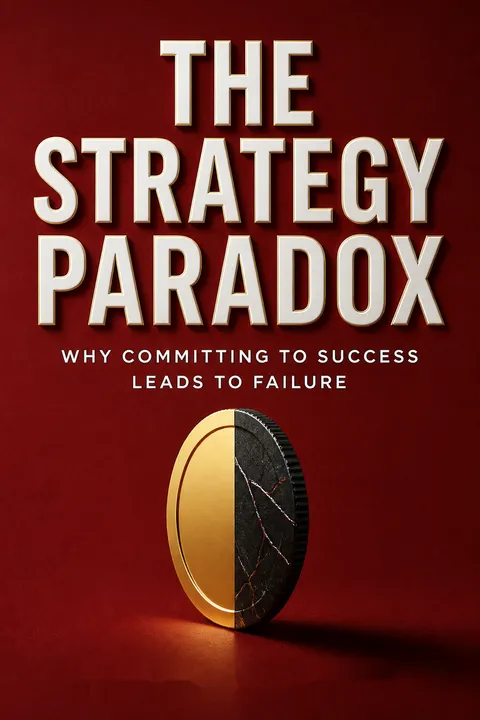
Success has a shadow. The Strategy Paradox is the tension between the commitments needed to build a hard-to-copy competitive advantage and the uncertainty about whether that advantage will still matter. Sony’s Betamax was built around excellent picture quality and recording television programs. VHS emphasized lower cost and longer recording time. As home movie rentals took off, VHS gained a slight lead that snowballed into dominance. Sony’s technology and execution were strong, but its costly commitments made a timely switch to a different strategy difficult. Betamax’s U.S. share fell to 0.3 percent before Sony withdrew it in 1989.
Good execution is not insurance. Sony’s MiniDisc faced a different chain of surprises: recordable CDs, broadband Internet, file sharing, and MP3 players changed how people acquired and carried music. The book’s point is not that every failure is bad luck, but that a sound strategy can still be undone by assumptions no manager can reliably settle in advance.
The useful distinction here is between a bad decision and a bad outcome. Organizations often treat results as proof of decision quality, even though a sensible choice can lose under an unfavorable turn of events, while a reckless choice can succeed by chance. That resembles the problem of evaluating medical decisions: treatment quality depends on the evidence available when the choice was made, not solely on the patient’s eventual outcome. This perspective can improve postmortems by asking what was knowable at the time. It should not become a blanket excuse, however. Betamax also faced concrete design and timing choices, so uncertainty explains vulnerability without making every choice beyond criticism.
Strategic purity earns more, but raises the chance of failure
Focus brings both stakes. A pure strategy concentrates on either differentiation or cost leadership. Such focus can make a company more profitable because its activities reinforce one another and competitors cannot easily copy the whole system. The book reviews evidence from more than 2,300 businesses showing a relationship between strategic purity and profitability. A separate analysis found that firms pursuing purer strategies also faced higher bankruptcy risk. Those results fit the Sony story: a company that commits deeply to a distinct position may win unusually well when customer preferences favor it, and struggle severely when they do not.
Survivors distort the lesson. Survivor bias occurs when analysis includes only firms still in business. Researchers can observe the strong returns of successful focused companies, but cannot easily measure the returns of comparable firms that went bankrupt. The apparent recipe for success therefore hides some of its mortality cost.
This argument improves strategy research by treating failure as evidence, not as a footnote. It also distinguishes volatility from ruin: fluctuating returns may be tolerable, while insolvency ends the experiment. The same selection problem appears in entrepreneurship research, where studying celebrated founders alone makes success look more repeatable than it is. Still, the finding that pure strategies correlate with profitability does not mean every firm should pursue an extreme position. A company needs the resources to survive a bad turn, and customer demand may not support every niche. The decision is therefore not simply focus or flexibility, but how much risk the organization can finance.
Adaptation fails when the world changes faster or slower than you can
Speed mismatch is dangerous. Adaptability helps only when an organization can change at roughly the pace of its environment. Fast change can leave a company with capabilities suited to a market that has abruptly disappeared. When oil prices rose sharply in the 1970s, North American automakers needed years to redesign their vehicle lines, while consumer demand shifted toward fuel efficiency. Slow change creates a subtler trap: incremental responses can keep a company functioning while concealing the need for a fundamental break. The Greenland Norse kept improving farming and trade practices as their environment worsened, but eventually lacked the resources to transform their way of life.
Change arrives at different speeds. A company may face abrupt shocks, gradual disruption, and ordinary competitive shifts at once. It cannot tune itself to every pace simultaneously. Adaptation is useful, but it cannot by itself manage strategic uncertainty.
The fast and slow distinction is powerful because it explains why the same remedy can fail in opposite ways. In crisis management, a sudden shock rewards pre-existing resilience, such as spare capacity or alternative suppliers. During gradual decline, those same reserves can be consumed by incremental fixes that postpone structural change. The Greenland example makes the second mechanism vivid: competence at small adjustments can become a reason not to reconsider the entire system. A qualification matters, though. Organizations can sometimes adapt more quickly through modular teams, acquisitions, or partnerships. Those methods do not eliminate timing limits, but they can change the organization’s effective capacity to respond.
Replace single-point forecasts with several plausible, strategically different futures
A forecast picks a path. A point prediction, such as a precise sales estimate years ahead, can disguise uncertainty as knowledge. The book cites evidence that economic forecasters often missed turning points: in one study, only two of sixty recessions were predicted a year in advance, and many remained unrecognized until the recession year. Even probability estimates are difficult to validate when strategic events are rare and cannot be replayed under identical conditions.
Scenarios map the edges. Scenario-based planning builds coherent descriptions of different plausible futures rather than naming one winner. Managers identify the uncertainties that matter, imagine credible boundary conditions, and test how the business would fare under each. These scenarios are not predictions or a checklist of minor variations. Their value is that they expose how different worlds can require different strategies, without forcing the leadership team to pretend it knows which world will arrive.
Scenarios are most useful as a disciplined way to surface assumptions, not as a more colorful form of prophecy. Their value resembles stress testing in engineering: a bridge is not designed for one forecast of wind speed but examined against demanding conditions within a plausible range. That approach reveals weak points before they become expensive. Scenario work can still mislead if the chosen futures all share the same hidden assumptions, or if a team mistakes vivid storytelling for probability. A good practice is to ask which strategic conclusion changes across scenarios and which remains stable. That keeps the exercise tied to decisions rather than producing an imaginative but unused report.
Put long-term uncertainty upstairs, and execution downstairs
Time changes the job. Requisite Uncertainty is the principle that organizational roles should reflect how much strategic uncertainty each level faces. Longer time horizons contain a wider range of possible changes, so the board and corporate office should manage uncertainty and create room for future choices. Operating-division leaders make the commitments required to compete now, while hedging the most dangerous assumptions. Functional managers focus on delivering those commitments and learning how to execute them well.
Not every risk is strategic. A supplier failure or currency swing can be serious, but usually calls for operational or financial risk controls rather than a new competitive strategy. Strategic uncertainty concerns the basic way the company creates and captures value. The board should judge the firm’s exposure to that uncertainty, deciding what to seek, accept, avoid, or manage, rather than trying to guess management’s winning strategy.
The framework assigns different kinds of work to different levels, rather than telling every manager to balance today and tomorrow in equal measure. That is a valuable correction to the assumption that senior leaders should personally make every strategic choice. It also clarifies board oversight: directors can assess whether the company’s risk exposure is acceptable without claiming superior knowledge of every market decision. The model needs contextual judgment, however. A long product-development cycle does not always mean that the most senior manager has the longest relevant strategic horizon. The book itself notes that industry conditions can disrupt a simple equation between organizational rank and time horizon.
Corporate strategy should preserve choices, not pretend to know the winner
Vivendi chose one future. Under Jean-Marie Messier, the French company borrowed heavily to assemble a global media business on the belief that digital convergence would rapidly reward an integrated model. The strategy nearly bankrupted the company when expected synergies and cash flows did not arrive. BCE took a different approach in several businesses, using partial ownership stakes to stay connected to opportunities without immediately buying full control. It later increased its stake in wireless when integration with its landline business became valuable, but left its IT consulting investment independent when expected synergies failed to materialize.
Options preserve alternatives. A strategic option is an investment that gives a company the ability, but not the obligation, to pursue a different strategy if conditions justify it. Microsoft’s many parallel investments in areas such as operating systems, gaming, mobile devices, and online services similarly kept possible platforms in play instead of relying on one forecast.
The contrast is not simply boldness versus caution. Vivendi committed its balance sheet to a specific account of convergence, while BCE and Microsoft maintained multiple paths, with different costs and degrees of control. This resembles portfolio thinking, but with an important difference: corporate options can join assets in ways that investors holding separate stocks cannot readily reproduce. The approach is not automatically superior. Parallel bets consume capital and managerial attention, and they can become a sprawling collection of distractions. An option is valuable only when its possible future use is clear enough to justify its cost and when the organization can act if the opportunity appears.
Use scenarios to separate no-regret capabilities from bets that need options
Build strategies before choosing. Strategic Flexibility is a process for turning uncertainty into investment choices. It begins by anticipating plausible futures, then formulating the best strategy for each. The company compares those strategies to identify core elements, useful across all scenarios, and contingent elements, valuable only in some. It commits to the core and seeks options on the contingent elements. The final phase operates the portfolio as new evidence clarifies which future is taking shape.
J&J made the idea concrete. Johnson & Johnson’s venture arm, JJDC, invested beyond the limits of its operating divisions, which were designed to stay focused on current customers and results. In one example, a small investment in Scott Labs helped develop technology for conscious sedation, an opportunity too distant from the divisions’ usual scope. JJDC helped preserve the possibility of applying that technology across the company instead of forcing one division to carry the whole risk.
This framework connects scenario planning to actual resource allocation. Many organizations stop at describing possible futures; the core-versus-contingent distinction asks what to fund, what to stage, and what to leave open. J&J’s arrangement also illustrates why decentralization and corporate coordination are not opposites. Divisions can stay focused while a central unit explores opportunities that no division can justify alone. The hard part is governance: corporate teams may label their favored projects as strategically important to escape ordinary scrutiny. Clear scenarios, explicit assumptions, and periodic review help keep option creation from becoming a protected budget for pet ideas.
Buy options on a different strategy, not merely more growth
Growth and strategy differ. A growth option lets a company invest more in a promising business. A strategic option can enable a fundamental change in how an existing business competes, often by combining capabilities that neither unit could use effectively alone. BCE’s partial investment in wireless first provided exposure to a growing business. It later helped the company integrate wireless with wireline services, a different competitive position that required control of both operations. That was more than increasing the size of one business.
Structure determines real choice. An option must be cheaper to create than to exercise, and its owner must retain enough influence to act if the opportunity becomes attractive. Joint ventures, partial stakes, and staged investments can help, but each creates different problems around control and coordination. A small investment that cannot be expanded when needed may provide exposure without providing a usable strategic option.
The distinction matters because organizations often call any small exploratory investment an option. But a pilot that can only grow or die within its original business model does not necessarily prepare a company to reposition itself. Strategic options require a credible path from exploration to recombination, including decision rights and access to complementary assets. This makes them organizational design problems as much as financial ones. There is a trade-off: too much control can drain the target’s independence, while too little can make integration impossible. The useful question is not whether an investment is small, but what future action it makes feasible.
Design exits before investing, so experiments do not become forced commitments
Preserve the right to walk away. A genuine strategic option needs four capabilities: create it, preserve it, exercise it, and abandon it. The target investment should remain viable on its own while staying compatible with a possible future strategy. J&J’s Scott Labs investment illustrates this balance: JJDC acquired a minority stake and commercialization rights while allowing the start-up to keep developing its own intellectual property. That helped protect J&J’s future opportunity without making the company entirely dependent on a single buyer.
Sunk costs distort judgment. Once money and attention have been invested, managers can feel compelled to continue even when the original rationale has weakened. If a company cannot abandon an out-of-favor investment, its supposed option has become a delayed commitment. Exiting can be evidence of disciplined risk management, not proof that the initial investment was foolish.
Exit is the feature that separates an experiment from a one-way door. Behavioral research on sunk costs shows how past investment can improperly influence future decisions, even though those costs cannot be recovered. A pre-agreed review process can counter that tendency by specifying what evidence would justify further investment, integration, or sale. Yet an exit rule should not be so mechanical that it discards slow-developing opportunities at the first setback. The point is to make continued investment earn its place on current evidence, rather than treating past expenditure as a reason to keep spending.
Analysis
The book’s central achievement is to shift strategy from the search for the right forecast to the design of an organization that can act without one. Its argument follows a clear chain: advantage requires difficult-to-reverse commitments; the future is not reliably predictable; and adaptability cannot match every kind of change. The proposed answer is to separate commitment from uncertainty management, then use scenarios and strategic options to preserve the possibility of changing course.
That move is both theoretical and organizational. Requisite Uncertainty assigns the longest horizons to senior leaders, who manage exposure and create options, while operating divisions make focused commitments and functional managers improve execution. Strategic Flexibility then links imagined futures to concrete investments. J&J’s JJDC example is especially useful because it shows how a corporate unit can explore opportunities outside the constraints that make individual businesses effective.
The strongest analytical contribution is the insistence that strategy research account for firms that disappear. Looking only at surviving winners can make high-return strategies appear less risky than they are. The book’s distinction between strategic uncertainty and operational risk also helps prevent unrelated problems from being collapsed into one generic risk-management exercise.
The solution, however, is not free or automatic. Scenarios can omit the future that matters most, options can consume scarce attention, and partial ownership can create governance conflict. The book also relies heavily on hierarchy as the means of separating time horizons, though a firm’s actual decision boundaries may not align neatly with titles. These limits do not undo the thesis. They clarify the practical test: options must be tied to specific alternative strategies, priced against their real costs, and monitored by people with authority to abandon or exercise them. Strategic humility is not indecision. It is a way to commit where commitment is necessary while refusing to mistake a current plan for knowledge of the future.
Review Summary
The Strategy Paradox receives generally positive reviews, averaging 3.89/5. Readers praise its unconventional, thought-provoking premise — that the same strategies driving success can also cause failure, with chance playing a significant role. Many highlight the "strategic options" framework as valuable, particularly for large organizations. Common criticisms include the book being overly academic, unnecessarily long, and less applicable to smaller businesses. Several reviewers note it challenges conventional business wisdom effectively, though some find the proposed solutions of strategic flexibility impractical or costly to implement.
People Also Read









Glossary
Strategy Paradox
Success creates failure riskThe conflict between the commitments needed to build a distinctive, hard-to-copy strategy and the uncertainty about whether future conditions will reward those commitments. Strong commitment can increase the chance of exceptional success, while also making it difficult to change course when the strategy proves misaligned with the market.
Strategic Uncertainty
Uncertainty about the business modelUncertainty about changes that could alter the basic way a company creates and captures value. It differs from operational problems, such as supplier disruption, and financial fluctuations, such as currency movements. It concerns whether the company’s core strategy, capabilities, or market position will remain viable over a longer horizon.
Requisite Uncertainty
Assign uncertainty by time horizonAn organizational principle that assigns responsibility according to the strategic uncertainty associated with each level’s time horizon. Senior leaders manage long-term uncertainty and create options, operating-division leaders commit to strategies while limiting downside, and functional managers concentrate on fulfilling existing commitments and learning how to execute them effectively.
Strategic Flexibility
Options for changing strategyA corporate-level approach to managing strategic uncertainty by creating and operating options on the elements needed for alternative strategies. Its four phases are Anticipate possible futures, Formulate strategies for them, Accumulate the needed commitments and options, and Operate that portfolio as evidence develops.
Strategic option
A choice to change strategyAn investment or organizational arrangement that gives a company the ability, but not the obligation, to pursue a different competitive strategy if conditions make it attractive. It is more than a growth option on a single venture: exercising it may require combining capabilities or assets to move the business into a fundamentally different competitive position.
Core elements
Useful across all scenariosResources or capabilities required by the optimal strategies developed for every scenario under consideration. Because their value does not depend on which of those futures occurs, they can generally be treated as commitments rather than contingent bets. They form the stable foundation of the company’s strategic response.
Contingent elements
Useful only in some futuresResources or capabilities needed for an optimal strategy in only some of the scenarios considered. Committing fully to all such elements may be too costly, so a company can seek options that preserve access to them. The options can be exercised or abandoned as the relevant future becomes clearer.
Strategic diversification
Diversification that creates optionsDiversification undertaken to create options on future strategic opportunities, rather than to capture immediate synergies or simply to add unrelated businesses. A company invests in assets or capabilities that may become valuable in combination with its existing operations if industry boundaries or competitive conditions change.
Download PDF
Download EPUB
.epub digital book format is ideal for reading ebooks on phones, tablets, and e-readers.








