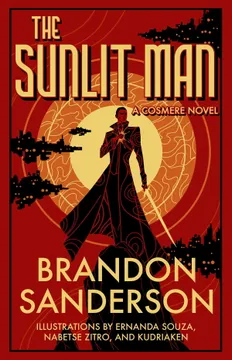


Plot Summary
Dragged Beyond Dawn
Nomad wakes among prisoners on Canticle, a world where sunrise burns people to ash. Nearly drained by his latest jump between planets, he cannot understand his captors, and a worsening spiritual affliction locks his muscles whenever he tries to fight.
As the lethal light approaches, he breaks his chain with Auxiliary, the metal companion living in his mind, then hooks himself to a departing hovercycle. The machine drags him across the ground, tearing his clothes and burning his skin, but his weakened healing keeps him alive.
The prisoners left behind are consumed. Suspended beneath the fleeing vehicle, Nomad sees the planet’s rings and a moving city assembled from smaller flying ships. His escape has saved him, but delivered him into another desperate society.
The opening makes survival feel less like triumph than an involuntary habit. Nomad can endure what would kill others, yet his body’s refusal to let him fight turns strength into a narrow, frustrating resource. His escape also has a moral cost: he saves himself while prisoners die within sight. That tension establishes the question driving his later choices, whether staying alive is enough when other people are being abandoned.
The Arena’s Lesson
The flying city carries Nomad to Union, where its ruler, the Cinder King, humiliates him and sends him into a muddy arena with unarmed prisoners and Charred warriors. Nomad cannot attack without his Torment freezing his body, so he uses Auxiliary as tools and shields, dodging the Charred while trying to protect the other captives.
A gap-toothed prisoner helps pull him onto a crate; later, Nomad knocks down the Charred woman hunting him by turning Auxiliary into a heavy weight. The Cinder King then demonstrates how he creates more Charred, burning a captured woman with an ember-tipped spear.
When he prepares to transform the helpful prisoner too, Nomad throws Auxiliary onto the platform to interrupt him. A sudden attack on Union begins before Nomad can absorb the spear’s power.
The arena offers a miniature version of the Cinder King’s rule: the powerful turn other people’s terror into spectacle, then call the spectacle order. Nomad’s inability to strike back exposes the difference between violence and protection. He cannot punish the Charred, but he can interfere, shield, and make room for someone else to survive. His intervention is tentative, almost grudging, yet it marks the first crack in his practiced indifference.
A Key in the Rain
During the attack, rescuers pull Nomad from the wreckage and take him to Beacon, a hidden city led by three elderly women known as the Greater Good. Their daring raid also stole a metal authorization disc from the Cinder King.
Nomad recognizes its Scadrian markings and suspects it opens an offworld facility, not the underground paradise the Beaconites imagine. After he pushes away from their council into a storm, his former teacher Wit appears through a fragile connection.
Nomad confronts him over the harm caused by his past choices, and Wit finally admits responsibility and apologizes. The meeting does not reconcile them, but it changes Nomad’s next move. He returns to the council, explains what the disc is, and offers to help Beacon find the door.
The stolen disc gives Beacon hope, while Nomad’s knowledge threatens to puncture it. His decision to help is not born from certainty that the refuge exists; he wants access to the same door, and the people need his expertise. Wit’s apology adds a second pressure: Nomad’s anger is justified, but it has not made him free of the relationship. The scene suggests that trust can begin without forgiveness, provided someone finally names the harm.
A Mother’s Sunheart
Beacon’s pilot, Rebeke, takes Nomad through the shifting landscape while they search for the supposed refuge. She explains that the city is running out of power and that its people survive by turning the dead into sunhearts.
Her own mother was left beneath the sun; the resulting stone now powers Rebeke’s hovercycle. The Cinder King makes the same sacrifice compulsory through a lottery, while Beacon chooses volunteers. Nomad recognizes that the arena had been a selection process for future Charred and that the king feeds on people to strengthen himself.
Before they can continue their search, they spot a scout. Nomad and Rebeke pursue him through a lava tunnel, and Rebeke shoots him down. The kill unsettles her, but his radio may already have warned the Cinder King.
Canticle’s cruelty is not an ancient custom untouched by thought. It is a functioning energy system, which makes its moral violence harder to dismiss as mere superstition. Rebeke’s mother powers the vehicle carrying her daughter, turning grief into infrastructure. Nomad understands the mechanism before he can offer an alternative, and his discomfort grows as he sees how necessity can make exploitation appear ordinary. Rebeke’s first killing begins a separate reckoning: she wants to protect people, but does not want violence to become her identity.
The King’s Offer
The Cinder King arrives alone after the scout’s apparent defeat and invites Nomad aboard his ornate ship. He has learned about other planets from a dead offworlder’s books and wants Nomad as a soldier for his plan to unite Canticle by force. When Nomad refuses, the king has Rebeke brought in at gunpoint. Nomad deflects the shot with Auxiliary, blocks the Charred, and escapes with Rebeke on her hovercycle.
He rejoins Beacon and warns the leaders that the king has discovered their search. They retreat, but his forces ambush them near the cloud cover. The Beaconites escape the battle only by abandoning their route and flying into a corridor hemmed in by impassable mountains. They have little fuel, few supplies, and no clear way forward.
The Cinder King’s offer reveals that he sees Nomad not as a person but as a useful specimen: an offworld warrior who might validate his own fantasy of greatness. Nomad’s refusal becomes more than personal resistance once Rebeke is threatened. Yet the escape does not deliver safety. It pushes Beacon into a trap, making the consequences of Nomad’s involvement tangible and leaving him with a burden he cannot simply outrun.
The Mountains Have Math
After the ambush, Beacon’s leaders face dwindling sunhearts, a hostile army to the north, and mountains that their ships cannot cross. Nomad calculates that Canticle is so small its atmosphere thins dangerously close to the ground; the vessels lose thrust because their engines push against air.
He proposes adapting them to expel superheated steam instead. With the city’s engineers, he tests prototypes and asks the Chorus, the community’s ancestral shades, to fabricate the necessary parts. Meanwhile, he discovers that a charged sunheart can draw the corruption from Elegy, Rebeke’s sister, who was transformed into a Charred.
Elegy regains speech and some self-awareness, though not her memories. A prototype finally flies. The Night Brigade’s warship appears overhead, but Beacon begins preparing to cross the mountains before its pursuers can close in.
Nomad’s old scholarly instincts return through a concrete problem: engines fail, so he asks why. His scientific approach contrasts with the society’s hard-won practical knowledge, which is formidable but rarely given time to become theory. The prototype succeeds because neither side is sufficient alone. The Chorus can build what the engineers design, while Nomad supplies the model. His experiment on Elegy similarly treats a person’s spiritual injury as something that can be studied, a choice that may help her but also exposes his tendency to act before he has earned trust.
Beacon Leaves Itself
Nomad pilots Beacon upward in a stripped-down formation, carrying its people in sealed ships while the steam engines burn through their limited water. The city slows before reaching the summit, so he releases one emptied water vessel to reduce its weight.
A second vessel remains jammed in place. Nomad climbs beneath the flying city, where ice has seized the lower locks, and works above a steep drop as the deadly sunrise approaches. Auxiliary urges him to use its remaining strength to fly, but Nomad refuses to risk consuming his friend again.
Instead, he forces a sharpened tool into the frozen mechanism. The water ship breaks away, giving Beacon enough lift to crest the mountain. Its engines then fail, and the city begins plunging down the far slope, leaving Nomad to reach the controls before impact.
The crossing turns engineering into an ethical test. Nomad’s design can save the city only if he personally accepts the risk of carrying it through the failure he could not prevent. His refusal to burn Auxiliary for extra power is also a refusal to repeat the act that left his friend diminished. The tool that finally frees the frozen coupling comes from the same capacity for violence that his Torment suppresses, hinting that his old combat self and his practical self are not as separable as he wishes.
Five Hearts in Darkness
Nomad restarts four engines just before Beacon crashes into the muddy ground beyond the mountains. The city survives, but its engines are damaged and its power is nearly spent. With less than an hour before sunrise, Nomad and Zeal fly toward the Cinder King’s harvest crews to steal sunhearts.
Nomad enters the burning maelstrom alone, where the heat drains his strength and leaves him buried under earth. After the planet turns and rain returns, he waits for the king’s workers to collect the new sunhearts, then hides inside their vault ship and steals five.
The Cinder King catches him outside. Nomad escapes the confrontation, reaches Zeal’s stranded craft, and uses a tiny sunheart from a dead offworlder to weaken his Torment enough to fight. He drives back the Charred and returns with power for Beacon.
The failed engine crossing does not end the story; it changes the kind of courage required. Nomad must survive without the technological plan that had made him feel competent, then improvise while nearly powerless. The stolen sunhearts are both practical fuel and the product of other people’s deaths. His dependence on them is uncomfortable, but he does not pretend that moral clarity can feed Beacon or keep it moving. Survival here requires taking power from a system he despises.
A Name Shared
Nomad reaches Beacon as its remaining ships race toward the shrinking shadow of the mountains. At the last moment, he uses the stolen power to enlarge Auxiliary into a shield over the trailing ship, protecting its passengers from the lethal sunlight until they reach darkness.
Exhausted and emptied of power, he watches the Beaconites pray together. The Greater Good and their people then give him warmth through their shared custom, restoring a small measure of Investiture and binding him more closely to Canticle.
They name him Zellion, a title meaning one who finds, after the first Lodestar who led their ancestors to the planet. Nomad accepts it. The welcome does not erase his past or his need to leave, but for the first time in years, he has a community that claims him without demanding a weapon.
The naming ceremony answers the story’s question of belonging without pretending that belonging cures trauma. Nomad accepts a communal identity after resisting the heroic title others tried to impose on him. The difference matters: he rejects a legend built around surviving sunlight and accepts a name tied to finding a way through. The tiny amount of power the community gives him is less important than its meaning. Their touch is an act of mutual recognition, not extraction.
The Refuge Is a Ship
Beacon’s improvised gunships punch through the Cinder King’s waiting fleet, and Zellion follows the king’s retreating vessels toward the hidden door. The authorization disc opens an entrance beneath the ground, but the supposed sanctuary is a small Scadrian research ship.
Its crew has already traded technology with the Cinder King and refuses to shelter Beacon, dismissing the refugees as a local problem. Zellion initially stays behind as the Beaconites return to face capture. On a monitor, he sees the king’s forces strip their ships of power and leave the people beneath the advancing sun.
A researcher then reveals that a sunheart can be recharged by giving it a small amount of living heat before exposing it to sunlight. The discovery could end the sacrifices, but Zellion must get it to Beacon before dawn.
The refuge’s failure is not simply a reversal of hope. It exposes the moral limits of institutions that possess knowledge and resources yet treat suffering as someone else’s jurisdiction. Zellion’s warning proved accurate, but accuracy becomes another excuse if he uses it to justify leaving. The Scadrian discovery shifts the problem from finding salvation to distributing useful knowledge. Its simplicity sharpens the indictment: the technology to end the sacrifices was withheld, not unavailable.
Auxiliary’s Last Gift
Zellion cannot take the research ship’s power cell without being thrown aside, but he learns how its crew has been recharging sunhearts and sees Beacon’s people about to die. He chooses to return. As sunrise closes in, Auxiliary burns away the last of his own living essence to restore Zellion’s armor and let him fly.
Zellion reaches Beacon, gives the people the recharging method, and uses the remaining power in a sunheart to raise a protective dome over them. The sacrifice kills Auxiliary completely, leaving Zellion with only his companion’s transformable body.
Meanwhile, Elegy breaks free of the Cinder King’s control and helps Rebeke escape transformation. The two women reach Union’s command center, where Rebeke persuades its people to abandon the king and steer the city away.
Zellion’s return is not a sudden restoration of the man he used to be. He acts while still believing himself compromised, and Auxiliary’s choice makes that decision irreversible. The sacrifice also turns knowledge into a public resource: Zellion brings back a method that can end a system of forced death. Elegy and Rebeke’s parallel actions matter for the same reason. They do not wait for a savior to free them; they take responsibility for one another and for their people.
The Tyrant Loses Heat
While Union escapes, Zellion faces the Cinder King alone. The king has weakened him with a device that magnifies gravity, then beats him toward the sunrise, boasting that he will take Zellion’s weapon and rule forever.
Zellion cannot win by force, so he grapples the king and uses Canticle’s heat-sharing prayer to draw the power the tyrant stole from thousands. The Cinder King’s strength drains away; the sun burns him to ash, and Zellion jumps from Canticle with the stolen power. Elsewhere, Rebeke and Elegy reunite with Beacon’s survivors.
Rebeke refuses to rule by force, promises to spread the method for recharging sunhearts, and treats the Charred as people who may choose a life beyond the king’s control. The sacrifices can end, though the work of rebuilding remains.
The final conflict overturns the king’s own definition of power. He believes taking from others proves superiority; Zellion defeats him by turning that accumulated extraction against him. Yet the resolution does not replace one ruler with another. Rebeke’s refusal to command the Charred as instruments gives political form to the lesson: liberation must alter the practices of power, not merely its occupant. Zellion leaves, but he has helped make survival less dependent on sacrifice and obedience.
Epilogue
After the king’s fall, the Beaconites recover and begin sharing the method that can recharge sunhearts without killing people. The Night Brigade investigates Zellion’s disappearance, learns that he reportedly died on Canticle, and turns its attention toward the Scadrian researchers who may have recorded his movements.
Zellion has in fact reached another world. Alone on a tiny beach, he waits until he believes Beacon is safe, summons Auxiliary’s weapon, and cuts free a device that has weighed him down. When a passing boat appears, he signals its crew and prepares to run again. His brief home on Canticle has changed him, but it has not ended the pursuit.
The epilogue refuses to turn a hard-won rescue into permanent safety. Beacon has a future, but Zellion cannot remain without exposing it to the Night Brigade. The final boat restores the book’s wandering structure, while the cut device gives that departure a small physical release. His companions are gone, yet the community’s gift has altered his sense of himself. He leaves not because nothing matters, but because people matter enough to protect from the danger following him.
Analysis
The Sunlit Man makes motion both a survival strategy and an emotional defense. Nomad has learned to jump between worlds before the Night Brigade can catch him, but his speed does not resolve the spiritual injury he carries or the damage of choices he cannot undo. Canticle externalizes that problem: its people must outrun a sun that will eventually catch them, and Nomad initially mistakes endless motion for a sufficient life.
The book’s strongest ethical conflict is not between violence and peace in the abstract. It is between systems that make survival depend on taking life and the possibility of changing those systems. Sunhearts keep cities aloft, but the Cinder King converts that necessity into a mechanism of domination. Beacon’s use of volunteers shows that benevolent intentions cannot remove the cost of a brutal arrangement. The revelation that sunhearts can be recharged matters because it changes the material conditions that made sacrifice seem inevitable. Hope becomes meaningful when it is joined to usable knowledge.
Nomad’s development likewise depends on action rather than a clean moral conversion. His early interventions are defensive and reluctant; he repeatedly tells himself that helping people is not his responsibility. Yet he designs engines, returns for sunhearts, risks himself under the lethal sun, and ultimately refuses to leave Beacon to die. These actions do not restore his old oaths or erase his failures. They show that a person can make consequential choices before feeling wholly repaired.
The novel also treats community as a form of power unlike the Cinder King’s accumulation. Beacon’s leaders argue openly, their engineers contribute knowledge, and their people give Nomad warmth without trying to own him. Rebeke’s leadership and Elegy’s struggle to direct her anger both suggest that liberation is not a single victory over a ruler. It requires habits that let people act without reproducing the control they escaped. Nomad must leave Canticle, but he leaves behind a practical discovery and a community capable of carrying it forward.
Review Summary
The Sunlit Man receives mixed reviews, with some praising its fast-paced action and Cosmere connections, while others find it less engaging than previous works. Many reviewers emphasize the need for extensive Cosmere knowledge to fully appreciate the story. The worldbuilding and magic system are widely praised, but some feel the character development is lacking. Despite mixed opinions, most agree it's an exciting addition to the Cosmere, offering intriguing glimpses into future storylines and satisfying longtime fans with its numerous references and revelations.
Characters
Nomad
Exiled knight-scholarNomad is the name used by a world-hopping Rosharan who has survived for years through flight, quick thinking, and extraordinary Invested abilities. Once a soldier and a student of the wandering teacher Wit, he carries a spiritual affliction that prevents him from deliberately harming others. The same power that keeps him alive also leaves him physically and emotionally depleted. Nomad tries to make detachment a survival strategy, insisting that other people’s dangers cannot become his responsibility. Yet his curiosity, old training, and hatred of bullies repeatedly draw him into local struggles. He is intelligent without being infallible, especially when exhaustion turns caution into cynicism. His central tension is whether he can acknowledge what he has become without surrendering the values he once lived by.
Auxiliary
A knight in his mindAuxiliary is a highspren bonded to Nomad and reduced to a remnant after a catastrophic use of power. He speaks in a dry, deliberately theatrical monotone and can take the shape of tools, shields, and weapons. His humor gives Nomad an intimate witness to his worst impulses, while his practical advice helps solve immediate dangers. Auxiliary is not merely equipment: he has memories, judgments, and loyalties of his own. His restraint also contrasts with Nomad’s increasingly narrowed sense of responsibility. Although he cannot directly control Nomad, he remains a companion who challenges his excuses and recognizes the person beneath them.
Rebeke
Beacon’s reluctant leaderRebeke is a young pilot from Beacon and the sister of Elegy. She is brave in action but uncomfortable with the authority and attention her family’s place in the community brings her. The death of her brother and her mother’s transformation into a sunheart leave her carrying grief alongside practical responsibilities. Rebeke wants to protect her people, yet fears that doing so will require her to become a killer or a tyrant. Her instinct is to act even when orders or convention tell her to wait. Through her relationship with Nomad and the community, she tests a different form of leadership, one grounded in service rather than domination.
Elegy
A sister remade by fireElegy is Rebeke’s older sister, a charismatic planner whose ideas helped Beacon resist the Cinder King. Her curiosity and appetite for bold experiments made her a natural Lodestar, the person who proposed routes and futures for the city. The Charred are feared for their aggression, but Elegy’s character is more complicated than the role imposed on her. She embodies the difference between having powerful impulses and deciding what to do with them. Her bond with Rebeke offers a path toward connection that does not depend on recovering an untouched past.
The Cinder King
Canticle’s self-made tyrantThe Cinder King rules Union and seeks to bring Canticle’s scattered corridors under one authority. He has learned about other worlds from an offworlder’s books and interprets their histories as confirmation of his own destiny. His power comes from controlling the Charred and feeding on the heat of others. He presents coercion as unity, and regards the ability to command people as proof of strength. His confidence is a performance built around deep insecurity, especially when faced with someone who cannot be impressed by his titles or intimidated by his displays.
Wit
The absent former teacherWit is Nomad’s former teacher, a long-lived traveler who prefers stories, sharp observations, and carefully managed appearances. His past choices helped shape Nomad’s present burden, and their relationship contains both affection and serious resentment. Wit often teaches indirectly, using a story or question when a direct answer would be unwelcome. He is not free of mistakes, despite his knowledge and age. His brief encounter with Nomad reveals how much can remain unresolved between teacher and student when regret is acknowledged only after years of silence.
Contemplation
A leader who asks whyContemplation is one of the three elderly women who guide Beacon. Curious and intellectually restless, she trusts investigation while recognizing that knowledge sometimes begins with a hope that cannot yet be proved. She respected Elegy’s plans and understands how necessary a shared future is to a community living under constant threat. Contemplation is willing to question her own assumptions, including her belief about what the hidden refuge might contain. Her title describes a habit, not passivity: she weighs the evidence, asks difficult questions, and then accepts the risk of acting.
Confidence
Beacon’s blunt realistConfidence is a member of Beacon’s ruling trio whose responsibility is to state what she believes with conviction. She is often skeptical of Nomad’s plans, but her objections force him and the others to confront costs they might prefer to ignore. Her name does not mean that she is cheerful or certain of easy solutions. She values clear-eyed judgment and refuses to offer comfort by pretending that danger is smaller than it is. Her role helps the group turn fear into an argument that can be examined and answered.
Compassion
Beacon’s gentle conscienceCompassion is the frailest member of Beacon’s Greater Good, but physical weakness does not make her politically timid. She responds to grief with closeness and sees the people around her as family rather than units in a plan. Her faith helps her accept uncertainty without confusing hope with proof. Compassion’s influence is quiet, expressed through gestures of care and a steady insistence that survival must still leave room for dignity.
Zeal
Beacon’s daring organizerZeal is a short, resourceful organizer who coordinates Beacon’s risky operations and field teams. He is pragmatic about danger, but his faith keeps him from treating a low chance of success as a reason to surrender. Zeal trusts plans enough to act on them while understanding that the people doing the work may need to improvise. He respects the Greater Good’s authority and is also willing to advocate for a desperate attempt when the alternatives seem worse.
Thomos
The arena’s helping handThomos is a captive in the Cinder King’s arena who risks himself to pull Nomad onto a high crate. His assistance is a small, clear act of solidarity in a contest designed to make prisoners compete for survival. He is injured during the later battle, and Nomad’s effort to carry him to safety marks an important change in Nomad’s willingness to involve himself.
Solemnity Divine
Beacon’s practical engineerSolemnity Divine leads Beacon’s repair and engineering work. She understands how to maintain a city whose survival depends on machines, even though she has had little opportunity to develop formal scientific theories. Her practical judgment is crucial to turning Nomad’s proposed engine changes into something that can actually fly. She approaches new designs with appropriate caution, then commits to testing them under severe time pressure.
Jeffrey Jeffrey
Beacon’s steady administratorJeffrey Jeffrey is a bearded administrator who provides continuity as Beacon’s leadership changes. He helps Nomad understand the ships’ controls and remains attentive to the practical needs of the people aboard. His ordinary steadiness makes him one of the community’s connective figures, less a public hero than a person who keeps systems and people accounted for.
Truth-Is-Waiting
A Brigade field officerTruth-Is-Waiting is a Night Brigade sergeant sent to investigate Canticle after Nomad’s reported death. He is alert to the danger of his mission but does not share the Admiral’s appetite for treating every local population as expendable. His brief report shows that the Brigade’s pursuit continues beyond Nomad’s apparent escape.
The Admiral
The Brigade’s relentless commanderThe Night Brigade’s Admiral is a disciplined commander who treats Nomad’s trail as a problem to be solved, not a personal feud. She is accustomed to directing the dead as well as the living and reacts to setbacks by searching for more reliable evidence. Her presence in the epilogue makes clear that Nomad’s flight has not ended.
Plot Devices
The Torment
A curse against violenceNomad’s Torment is the lasting spiritual scar left by carrying a Dawnshard, a primal source of power. It gives him unusual durability, healing, the ability to absorb many forms of Investiture, and the capacity to jump between worlds when he has enough power. It also restricts his ability to harm others: attempts to attack can lock his muscles, and his symptoms grow worse over time. The Torment is not a conscious judge or a tidy moral guide. It is a constraint Nomad must learn to work around, sometimes through tools, defensive action, and careful interpretation of intent. Its costs shape both the physical stakes and his conflict over whether he can still choose who to be.
Auxiliary
A companion made of metalAuxiliary is a highspren bonded to Nomad, with a physical form that can become a tool, shield, or weapon. Nomad summons these shapes from mist, spending little power for simple transformations but more when he enlarges or strengthens them. Because the Torment restricts violence, a crowbar or lifting jack may be available when a blade is not. Auxiliary also serves as a thinking partner, tracking danger and challenging Nomad’s self-deception. The spren’s presence ties technical problem-solving to emotional companionship: each transformation is useful, but the voice behind it belongs to a person, not an inexhaustible device.
Canticle’s Sunhearts
Fuel made from the deadOn Canticle, people left beneath the deadly sunlight can become glowing stones called sunhearts, which power cities and vehicles. The process is bound to the planet’s strange interaction between sunlight, Investiture, and its core. The Cinder King turns this resource into a system of coercion, using lotteries and forced deaths to supply his rule. Beacon’s more limited use of volunteers does not make the cost painless, especially for Rebeke, whose mother became a sunheart. The stones create the book’s central material dilemma: people need power to escape the sun, but the established way of getting it destroys lives. Their eventual recharging method offers a different future.
The Authorization Disc
A key to false refugeThe metal disc stolen from the Cinder King is an authorization key associated with an offworld facility. Beacon believes it may lead to a hidden refuge, while Nomad recognizes its Scadrian markings and expects a research installation. The key drives the group’s search and gives them a reason to cooperate with Nomad, who can read the disc and communicate with the facility’s occupants. Its importance lies in the gap between what it opens and what people hope it will provide. The device does not create the refugees’ hope, but it concentrates that hope on a physical destination whose actual purpose remains unknown to them.
The Moving Shadow
A world with a deadlineCanticle’s rotation divides the planet into regions of deadly sunlight, violent storms, rain-darkened cloud cover, and brief growing lands. Its flying communities must keep moving to stay ahead of dawn, while the landscape itself is repeatedly melted and remade. The ringlight helps plants grow, but the planet’s tiny scale and thin upper atmosphere create unexpected limits for flight. These physical rules determine the plot’s clocks and engineering challenges: crops must be seeded and harvested quickly, cities depend on lift, and mountain crossings threaten to starve engines of air. Nomad’s calculations turn the setting from spectacle into a problem the characters can act upon.
Download PDF
Download EPUB
.epub digital book format is ideal for reading ebooks on phones, tablets, and e-readers.








