

Key Takeaways
Close the knowing-doing gap before disruption appears in your earnings.
Awareness is not readiness. In the authors’ four-year study of more than 16,000 people, 87 percent expected digital technologies to disrupt their industry, but only 44 percent believed their organization was doing enough to prepare. The threat is not only a new competitor or product. Respondents most often pointed to internal obstacles such as complacency, inflexible culture, and slow decision making.
Make the response visible. Employees judge whether leadership’s digital promises match the work they see. That judgment matters even when leaders believe their plans are adequate: people who see no credible effort may leave for organizations they think are adapting. Start by listing the most urgent digital opportunities and threats, assessing the response to each, and naming the barriers preventing stronger action.
The gap is useful because it shifts the problem from forecasting the exact moment of disruption to examining whether the organization can act on what it already knows. It also makes communication part of execution, not decoration: employees need evidence that a strategy changes priorities, resources, and daily work. Perceptions are not objective audits, however. A pessimistic workforce may underestimate progress, just as executives may overstate it. Comparing views across levels of the organization can reveal where the real disconnect lies.
Build the organization's capacity to learn faster than its routines.
People create the adaptation gap. Technology changes faster than individuals adopt it; individuals adapt faster than organizations; and institutions and regulations often adjust more slowly still. The most pressing business challenge is usually the gap between what customers and employees can do with technology and what their organization lets them do. When a consumer can complete a digital task more easily outside work than inside it, the firm’s own systems become a competitive liability.
Make learning organizational. The authors call a firm’s ability to recognize, absorb, and use knowledge from outside it absorptive capacity. It grows when employees bring varied knowledge, learn relevant skills, notice changes beyond the company, and share information across internal boundaries. Adobe, for example, brought employee and customer experience under one leader and invited staff to test products and provide feedback, linking internal learning to customer experience.
This framing is stronger than the familiar claim that companies simply need to buy newer systems. It treats adaptation as a capability built through knowledge flows, which makes organizational design and employee experience central to technology strategy. The gaps also imply that one universal pace is unrealistic: regulated sectors, global operations, and different customer populations face distinct constraints. Learning capacity cannot erase those constraints, but it can help organizations recognize them sooner and respond with fewer assumptions.
Treat digital strategy as a compass, not a fixed technology shopping list.
Start with possible action. The authors define digital maturity as aligning people, culture, structure, and tasks to use opportunities created by technology. A digital strategy is therefore not a catalogue of tools or a plan that remains untouched for years. It sets direction, then changes as experiments reveal new options. The authors describe a loop: observe the environment, choose a meaningful goal, run a focused initiative, and revise the strategy using what the initiative teaches.
Look beyond features. An affordance is an action a technology makes possible for a particular user or organization. Like duct tape, one tool can serve several purposes. KLM first used Twitter for marketing, then recognized its value for disruption updates and returning lost items to passengers. The wider lesson is to test how a technology could change the business, not merely how it could automate an existing task. Long-range scenarios, such as autonomous vehicles changing insurance or real estate, help keep near-term plans from aiming at an outdated future.
The compass metaphor captures a productive tension: organizations need a stable purpose and flexible means. Without direction, experimentation becomes a collection of disconnected pilots; without revision, strategy becomes a commitment to yesterday’s assumptions. The affordance lens also asks a better question than whether a tool is technically impressive: what new action becomes feasible, and for whom? A promising use is not automatically a viable business advantage. It still needs customer value, organizational fit, and a path beyond the pilot.
Lead with direction, then give teams room to discover answers.
Leadership remains leadership. Digital conditions do not make the fundamentals obsolete: leaders still need to set direction, make decisions, inspire people, and help them succeed. What changes is how those skills are expressed amid uncertainty. Instead of pretending to have every answer, leaders need to frame important questions, make decisions with incomplete information, and empower people to learn through action. The book’s survey found that about 90 percent of respondents in digitally maturing organizations trusted their leaders’ capabilities, compared with about 25 percent in early-stage organizations.
Support the work materially. Digital projects need a clear business purpose, executive involvement, and sufficient time and resources. In the study, 75 percent of respondents who said their initiatives had adequate investment also reported success, compared with 34 percent where support was insufficient. Leadership also needs to reach beyond the executive suite: teams need a clear vision, practical authority, and opportunities to build skills.
The distinction between enduring leadership qualities and their changing expression prevents two common errors: discarding hard-won management judgment, or assuming old command habits still work unchanged. Delegating discovery does not mean leaders abdicate responsibility. They still set boundaries, explain what matters, and fund the work. A useful test is whether teams can make local decisions while understanding how those decisions serve the larger strategy. Autonomy without context produces fragmentation; context without autonomy produces delay.
Hire for learning agility, and make skill renewal part of the job.
Skills have a shorter shelf life. About 90 percent of survey respondents said they needed to update their skills at least annually, and nearly 45 percent said they needed to do so continually. Technical expertise matters, but digital work also demands communication, business judgment, creativity, and the ability to adapt. The authors reject the idea that age predicts digital ability: even 72 percent of respondents aged 60 or older said working for a digital leader mattered to them.
Create room to grow. Continuous learning is not limited to courses. Job rotations, project work, peer teaching, and time to explore new tools help employees apply knowledge in context. The book reports that managers in some organizations were fifteen times less likely to want to leave within a year when they had opportunities to develop relevant skills. As automation changes tasks, workers may need to augment their existing roles, retrain, or pivot into different work. Organizations retain talent better when they help employees prepare for those shifts instead of treating development as an employee’s private problem.
Learning agility is a more durable hiring signal than a snapshot of technical credentials, especially when tools and methods change quickly. Yet it should not become an excuse to underinvest in training or to ask employees to absorb constant change without time or security. Individuals need opportunities to practice new skills, while employers need plans for roles likely to be reshaped by automation. The strongest approach treats development as shared infrastructure: a benefit to the worker and a strategic capability for the organization.
Make culture pull people into change instead of pushing another mandate.
Culture is behavior, not décor. The authors distinguish visible artifacts, stated values, and deeper assumptions about how work is really done. A sleek office or a new executive title does little if people are still punished for sensible risks or blocked by hierarchy. Early-stage organizations often try to force adoption through orders; developing organizations may install a platform and simply expect employees to use it. Both approaches can miss the working conditions that make change stick.
Shape the conditions. Digitally maturing organizations are more collaborative, exploratory, agile, distributed in decision making, and open to experimentation. In the authors’ analysis, cultural patterns aligned closely with their three levels of digital maturity. Salesforce, for example, deliberately reinforces its values through hiring, employee feedback, and career development rather than assuming culture will take care of itself. Leaders can assess whether stated values appear in incentives, decisions, and everyday practices.
The push-versus-pull distinction is powerful because adoption is a social response, not merely a technical event. People interpret new systems through local incentives, trust, and their experience of what happens when they speak up. Culture is not a lever that leaders can simply pull, however. It is reproduced by repeated choices, including budgets, promotions, and which failures receive blame. A culture initiative becomes credible when those choices change, not just the language used to describe the desired workplace.
Give small cross-functional teams authority to respond where change happens.
Organize around the problem. Digital work crosses the boundaries between functions, so siloed approvals slow decisions and obscure customer needs. The authors report that roughly 80 percent of digitally maturing organizations use cross-functional teams, compared with about 20 to 30 percent of early-stage organizations. These teams combine different expertise, can pursue several options in parallel, and often reach decisions faster than a chain of separate departments.
Pair autonomy with a shared aim. Teams need clear objectives, access to relevant information, and enough authority to act without seeking permission at every step. CarMax, for example, gives teams a problem and performance measures but does not dictate the solution. This structure resembles modular design: teams can form around a task, change as needs shift, and disband when their work is complete. Leaders still provide strategic direction and oversight, while teams adapt the means to conditions on the ground.
Cross-functional teams are not a universal cure for bureaucracy. Without clear accountability, they can create meeting overload, blurred ownership, and competition for scarce specialists. Their advantage comes from connecting knowledge and decision rights around a real problem, not from changing the org chart’s labels. Leaders should therefore treat team boundaries as design choices: keep a group intact when shared learning matters, and reconfigure it when the work or required expertise changes.
Use collaboration tools to expose expertise, not just generate more messages.
Make knowledge easier to find. Digital collaboration platforms can reveal who knows what and preserve discussions so new team members can build on earlier work. The authors call the shared awareness of expertise across an organization transactive memory. In a study at Discover Financial Services, employees using an enterprise social platform became about 30 percent more accurate at identifying who knew what, and 88 percent more accurate at identifying who knew whom, after roughly six months.
Design collaboration deliberately. More communication is not necessarily better communication. Public feeds can be noisy, while groups of similar-minded colleagues may reinforce shared blind spots. Productive collaboration needs diverse perspectives, room for independent judgment, decentralized input, and a way to combine contributions into a decision. Tools can make expertise visible, but trust, norms, and useful work practices determine whether that visibility improves results.
The most interesting benefit here is often quiet: people learn where expertise resides before they have an urgent reason to search for it. That knowledge can make later problem solving faster without producing an obvious moment of discovery. But visibility also creates risks, including surveillance, self-promotion, and pressure to perform online. Organizations should be explicit about how collaboration data are used and judge a platform by whether it improves access to knowledge and decisions, not by post counts.
Run small experiments for learning, then scale what changes the core business.
Make failure informative. Established organizations often reward consistency, so experimentation can feel like a violation of the operating model. The authors recommend bounded tests with clear learning goals, a short timeline, and acceptable limits on risk. Teams should investigate why an experiment worked or failed, then use that knowledge to shape the next version. Success also needs diagnosis: without understanding why a test worked, it may not transfer elsewhere.
Move beyond the sandbox. Digitally maturing organizations were more than three times as likely as early-stage organizations to scale experiments across the enterprise rather than leave them isolated. A practical starting sequence is to assess where maturity is uneven, enable change in a few high-value areas, and improve those areas through short experimental cycles. Focus on three to five important capabilities, measure results, repeat the test, and spread what proves useful. Pilots that never influence the core business are activity, not transformation.
The authors’ emphasis on scaling corrects a real weakness in innovation theater: a company can accumulate pilots while protecting its established business from every consequence. Small tests limit exposure, but they can also become a permanent refuge from difficult choices. Scaling therefore requires a separate decision process, with evidence about value, operational readiness, and the costs of broader adoption. Learning is the bridge between experimentation and strategy; without that bridge, fast testing merely produces faster churn.
Analysis
The book’s most durable contribution is its reframing of digital change as an organizational learning problem rather than a technology acquisition problem. Its evidence, built from multi-year surveys and executive interviews, points repeatedly to a mismatch between what people can do with digital tools and what organizations allow them to do. That mismatch links strategy, leadership, talent, culture, collaboration, and experimentation into one argument: adaptability must become part of how the firm operates, not a temporary transformation program.
The Oz metaphor gives the book a useful narrative arc. The cyclone is not the main story; it is the event that makes old assumptions untenable. The organization’s task is to navigate a changed landscape without expecting a return to familiar conditions. This is more precise than the usual language of disruption, which can make change sound like an external shock rather than a continuing condition that firms can learn to handle.
The evidence also needs careful interpretation. Many findings rely on employee perceptions, which are strategically valuable but not equivalent to objective performance measures. A company perceived as mature may attract talent and confidence, while actual maturity may vary sharply by department. The authors acknowledge unevenness, and their practical advice to gather views across organizational levels follows logically from that limitation.
A further tension sits inside the prescription. Distributed authority and experimentation can accelerate adaptation, but they also create coordination costs and can expose organizations to inconsistent decisions. The book’s strongest answer is not to remove hierarchy, but to align autonomy with a shared strategy, feedback loops, and clear limits. That makes maturity less like adopting a fashionable culture and more like designing a reliable learning system. The book is most useful when read as a guide to that design: identify bottlenecks, create room to test alternatives, preserve what works, and scale changes that demonstrably improve the business.
Review Summary
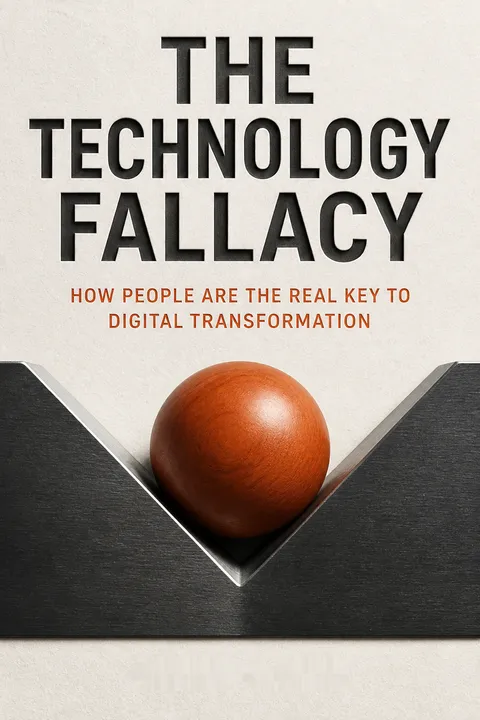
The Technology Fallacy receives mostly positive reviews, with readers praising its insights on digital transformation and emphasis on people over technology. Many appreciate the book's research-based approach, practical examples, and focus on organizational culture. Some readers found it repetitive or lacking in certain areas. Overall, reviewers recommend it for business leaders and those interested in digital maturity. The book's key message resonates: successful digital transformation depends more on people, leadership, and adaptability than on technology alone.
People Also Read










Glossary
Digital maturity
Organizational fit for digital changeThe ongoing ability to align an organization’s people, culture, structure, and work with opportunities created by technology. It is not a final state or a measure of how many tools a company owns. A digitally maturing organization keeps adjusting its practices as technology, customer expectations, and competitive conditions change.
Absorptive capacity
Ability to use outside knowledgeAn organization’s ability to recognize valuable knowledge beyond its boundaries, understand and adapt it, and apply it in its own work. It depends on employees’ existing knowledge as well as the systems that help a company detect external developments and move information between teams. It can be strengthened through learning, diverse expertise, and better internal information flow.
Affordances
Actions technology makes possiblePossible actions that emerge through the relationship between a technology or environment and the people using it. The same tool can enable different actions for different users and organizations. In business, this perspective focuses attention on what a technology allows a company to do differently, rather than treating the technology’s features or mere acquisition as the source of value.
Collective affordances
Shared uses of technologyThe complementary ways a group uses a technology to accomplish work together. A tool may be individually useful but fail to support organizational goals if people adopt incompatible practices. Shared understanding, communication, and employee input help teams coordinate their use and discover applications that benefit the organization as a whole.
Strategic agility
Adapting to digital market changeAn organization’s ability to sense and respond to changes in its competitive environment that arise from evolving technology. It involves deciding which opportunities or threats merit action, then adjusting plans as evidence changes. Cross-functional teams, distributed decisions, and ongoing environmental awareness can help a company respond without relying entirely on slow, centralized planning.
Growth mindset
Belief that abilities can developA view that skills and capabilities can improve through effort, feedback, practice, and learning rather than being fixed traits. Applied to digital work, it encourages employees and organizations to treat unfamiliar tools and changing tasks as opportunities to develop. It requires more than positive language: people need time, resources, and meaningful chances to learn.
Transactive memory
Shared knowledge of expertiseThe extent to which people in a group know what other members know and can locate the right expertise when needed. Collaboration platforms can strengthen this shared map by making discussions, contributions, and connections more visible. Transactive memory concerns knowledge of where expertise resides, not simply the amount of information stored.
Digital DNA
Organizational traits for digital workThe underlying structures, practices, and behaviors that shape how an organization works in changing digital environments. The book describes traits such as continuous innovation, flexible teams, distributed decisions, dynamic skill building, and iterative learning. Leaders can assess which traits the organization needs most, develop them in focused areas, and spread effective changes through the company.
FAQ
What's The Technology Fallacy about?
- People Over Technology: The book emphasizes that digital transformation is fundamentally about people and organizational change, not just technology.
- Digital Maturity: It introduces the concept of "digital maturity," which involves aligning people, culture, structure, and tasks to leverage technological opportunities.
- Research-Driven Insights: Grounded in four years of research, it provides insights from over 16,000 survey respondents and interviews with industry leaders.
Why should I read The Technology Fallacy?
- Practical Guidance: Offers actionable insights and strategies for leaders to effectively respond to digital disruption.
- Understanding Digital Leadership: Provides a clear understanding of digital leadership, including necessary skills and mindsets.
- Addressing Challenges: Tackles common barriers to digital transformation, such as the "knowing-doing gap."
What are the key takeaways of The Technology Fallacy?
- Digital Disruption is Inevitable: Organizations must acknowledge and prepare for digital disruption.
- People-Centric Approach: Successful transformation requires focusing on people, their skills, and organizational culture.
- Importance of Digital Maturity: Achieving digital maturity is essential for thriving in a digital world.
What is digital maturity, as defined in The Technology Fallacy?
- Alignment of Key Elements: Involves aligning people, culture, structure, and tasks to leverage technology effectively.
- Continuous Process: Digital maturity is a continuous process of adaptation and improvement.
- Framework for Success: Serves as a framework for evaluating current states and identifying areas for improvement.
What are the gaps identified in organizations regarding digital disruption?
- Knowing-Doing Gap: A significant gap exists between awareness of digital disruption and actual organizational action.
- Adaptation Challenges: Many companies struggle to implement effective strategies despite recognizing the need for change.
- Internal Barriers: Issues like complacency and inflexible culture are major barriers to effective digital transformation.
What is the role of leadership in digital transformation according to The Technology Fallacy?
- Vision and Direction: Leaders must provide a transformative vision and direction during digital transformation.
- Empowering Employees: Leaders should empower teams to think creatively and take ownership of their work.
- Continuous Learning: Fostering a culture of continuous learning and development is crucial.
How does The Technology Fallacy define experimentation?
- Learning from Failure: Experimentation is about testing ideas to learn what works and what doesn’t.
- Short-Term Sprints: Conducting short-term experiments allows for quick iteration and adaptation.
- Cultural Shift Needed: Organizations must embrace risk-taking and learning for experimentation to thrive.
What are the digital DNA traits mentioned in The Technology Fallacy?
- Key Characteristics: Includes traits like continuous innovation, real-time capabilities, and intentional collaboration.
- Assessment Tool: These traits help assess an organization's digital maturity and identify improvement areas.
- Iterative Improvement: Infusing these traits into culture through iterative changes allows for gradual improvement.
How can organizations attract and retain digital talent according to The Technology Fallacy?
- Investing in Development: Continuous development of employees' skills is crucial to keep pace with digital changes.
- Creating a Positive Culture: A supportive and engaging culture is essential for attracting and retaining talent.
- Offering Meaningful Work: Employees are more likely to stay with organizations that provide meaningful work.
What is the significance of a growth mindset in a digital workplace?
- Adaptability to Change: Encourages employees to embrace challenges and view failures as learning opportunities.
- Continuous Learning: Fosters a culture of innovation and agility within the organization.
- Collaboration and Support: Promotes collaboration and knowledge sharing among employees.
What are some practical steps organizations can take to improve their digital maturity?
- Assess Current State: Begin by assessing current digital maturity and identifying gaps.
- Foster a Learning Culture: Encourage continuous learning and experimentation within the organization.
- Align Strategy with Digital Goals: Ensure business strategy aligns with digital transformation goals.
What are some best practices for fostering a digital mindset in an organization?
- Encourage Experimentation: Create an environment where employees feel safe to experiment and learn.
- Invest in Training: Provide ongoing training and development opportunities for employees.
- Promote Collaboration: Foster a culture of collaboration across teams and functions.
Download PDF
Download EPUB
.epub digital book format is ideal for reading ebooks on phones, tablets, and e-readers.








