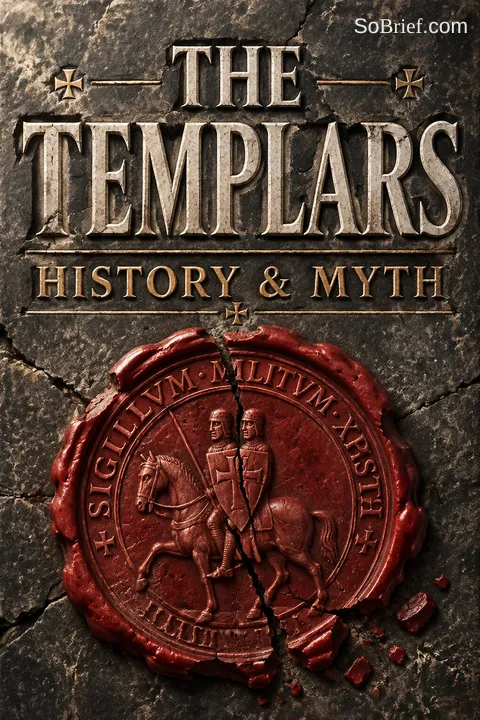


Key Takeaways
The Templars' sacred name concealed a practical mission: keep pilgrims alive
A dangerous road came first. Founded in Jerusalem around 1119, the Templars began as a small brotherhood of knights who vowed to protect Christian pilgrims from robbery, assault, and murder. The need was immediate: in 1119, pilgrims travelling toward the Jordan River were attacked, and many were killed. The founders took religious vows, but their work required weapons. That combination made them unusual from the start: monks were expected to renounce violence, while these monks were charged with using it in defence of travellers and the Holy Land.
A place gave them a name. The knights were given quarters in the al-Aqsa mosque on Jerusalem's Temple Mount, which the Crusaders associated with Solomon's Temple. Their full name, the Poor Fellow-Soldiers of Christ and of the Temple of Solomon, reflected both their religious purpose and their address. Accounts disagree about the number of founders, often said to be nine, so even the origin story contains uncertainty.
The order's founding problem resembles a recurring challenge in institutional design: a society may condemn a tool in principle yet depend on it in emergencies. The Templars made force answerable to vows, hierarchy, and a defined protective mission. That structure could restrain private violence, but it could also make violence appear morally certified. The distinction matters. Protecting pilgrims was a concrete public service, while the broader crusading project involved conquest and religious coercion as well. The Templars' origins are best understood as both a response to real insecurity and part of a political order that treated armed religious expansion as legitimate.
Turn European donations into overseas force, and build an institution kings need
A distant army needed a home base. The Templars' fighting took place in the East, but their money and recruits came largely from European properties, gifts, and privileges. They developed houses and estates, called preceptories, that managed land and generated income. At their peak, the book estimates that their European network included at least 870 castles and preceptories. The order also moved supplies and people by sea, built castles, and kept careful financial records.
Security became a financial service. The Templars accepted deposits, safeguarded valuables, and used credit notes that allowed money placed in one house to be collected at another. Their experience made them useful to rulers as well as crusaders. The Paris Temple became a major financial centre and effectively served as the French royal treasury. Their wealth belonged to a corporate institution, not to individual knights, whose prescribed lives remained austere.
The Templars' power came less from any single treasure than from combining logistics, trust, and organizational reach. In modern terms, they built an infrastructure that connected remote operations to a dependable funding base. The same arrangement reduced dependence on local rulers, which made the order resilient in the short term and politically exposed in the long term. It is a useful reminder that a mission's support system can become a source of influence in its own right. Yet trust is never simply a moral quality: it depends on records, oversight, and credibility. The Templars' network worked because contemporaries believed it could be relied upon.
Fortify the corridors behind Jerusalem, not only the city itself
Geography made defence difficult. The Crusader states stretched roughly 450 miles along the Mediterranean but were often only 50 to 75 miles wide. Muslim-held cities inland, including Damascus, Aleppo, and Homs, gave opponents routes for attack. The Franks also lacked troops: the book says that at no point could they field more than about 2,600 mounted knights. Castles guarding mountain passes and river crossings helped compensate for this shortage, and the military orders took responsibility for many of them.
A sacred destination was not a strategy. The author argues that the First Crusade's failure to capture Damascus left the Crusader states exposed, and that the Second Crusade's failed attempt to seize it made matters worse. Control of the hinterland could have disrupted enemy movement, while Jerusalem alone could not secure the long coastal strip. This is a strategic interpretation, not a provable alternative history: no one can know whether capturing Damascus would have made the states durable.
This account highlights a familiar principle in military geography: a defended point can remain vulnerable when the routes feeding it are exposed. The Templar castles were not merely dramatic stone monuments; they were parts of a network meant to control movement, shelter travellers, and slow enemy advances. The comparison with modern logistics is instructive, though not exact. A supply corridor can matter more than a symbolic capital, but it can also consume the very resources it is meant to protect. The claim that Damascus should have been taken is plausible as a critique of strategy, yet hindsight makes unrealized victories look simpler than they were.
Use religious identity to mobilize, but let local politics shape alliances
Faith did not dictate every partnership. In the twelfth century, Muslim rulers and Christian states often fought, negotiated, or allied according to immediate political interests. The Franks themselves were divided among competing principalities, while Muslim powers included rival dynasties and sects. The diplomat Usamah ibn Munqidh, who visited Jerusalem in the 1130s, described friendship with a Frankish knight and recounted that Templars made room for him to pray at al-Aqsa. His account shows that everyday contact could cross religious boundaries even amid conflict.
The Templars were not simply crusading zealots. They sometimes maintained pragmatic relations with Muslim neighbours and understood the value of restraint. But their choices could also conflict with kings and local leaders. The order's independent decisions about alliances and military priorities generated resentment, especially when its policies differed from those of Jerusalem's rulers.
The coexistence of religious hostility and personal cooperation is not a contradiction. People can regard another community as an enemy in doctrine while treating a particular neighbour as an ally, guest, or friend. This distinction helps explain why medieval frontier society cannot be reduced to a single, continuous religious war. It also guards against romanticizing contact: an anecdote about hospitality does not cancel massacres, enslavement, or unequal rule. The Templars' autonomy gave them room to act pragmatically, but institutional independence can look like disloyalty to political leaders who need coordination in a crisis.
At Hattin, thirst and faction undid an army before courage could
The march was the first defeat. In July 1187, Saladin's army threatened Tiberias while the Crusader forces waited near water and food at Sephoria. Count Raymond of Tripoli urged them to hold their position, arguing that the Muslim army would have to come to them. After a bitter council, King Guy of Lusignan ordered a march across hot, dry country. Saladin's forces harried the column, and the exhausted Franks reached the Horns of Hattin without a reliable water supply.
Disunity magnified the danger. On 4 July the Crusaders were surrounded and defeated. The True Cross was captured, many soldiers died or were taken prisoner, and Saladin ordered captured Templars and Hospitallers killed. The preceding disaster at the Springs of Cresson, where a small force of Templars and other knights was destroyed, had already exposed the danger of acting amid political distrust. Chroniclers disagree over responsibility, so the episode cannot fairly be reduced to one reckless commander.
Hattin illustrates how morale and leadership cannot compensate for basic logistics. Heat, water, terrain, and timing shaped what bravery could accomplish. The factional conflict matters because it distorted how leaders interpreted sound advice: Raymond's earlier agreement with Saladin made his strategic counsel suspect, even when it was reasonable. That pattern appears in many crises, where distrust turns information into a test of loyalty. The source record also deserves caution. Accounts were written from rival political positions, and the book itself shows how the same decisions could be framed as wisdom or treachery.
When Acre fell, the Templars lost purpose before they lost protection
The mission had depended on a place. In 1187 Saladin captured Jerusalem, and the Templars moved their headquarters to Acre. Crusading armies later recovered the city and some coastal territory, but the Mamelukes steadily took the castles and ports. Acre fell in 1291 after a major siege. The Templars retreated to Cyprus and held the small island of Ruad until 1302, when its garrison was overwhelmed. The order had lost the territory that had given its original mission practical meaning.
The West had new priorities. Templar resources and privileges made them useful to kings, but their international independence sat uneasily with rulers building stronger states. In France, Philip IV needed money and sought greater control over institutions beyond royal authority. The Templars had liquid assets as well as land, making them an especially tempting target. The book presents the loss of the Holy Land and the rise of royal power as converging pressures, not as a single cause of the order's destruction.
An institution can survive operational failure if it can redefine its purpose. The Templars struggled to do so because their identity was tightly tied to defending the Holy Land, while their finances and privileges continued to make them powerful in Europe. This created a dangerous mismatch: a group with declining public legitimacy still possessed assets and autonomy that rulers wanted. The comparison to modern organizations is useful but limited. Political institutions are not businesses, and the Templars' mission involved religion and war. Still, their predicament shows why an organization needs a credible account of what it does when its founding environment disappears.
A confession under torture is evidence of power, not proof of guilt
The trial began with force. On 13 October 1307, Philip's officials arrested Templars across France. They were accused of denying Christ, abusing the cross, sexual misconduct, and worshipping an idol called Baphomet. Torture and threats produced confessions, while the royal campaign framed ritual practices as a coherent heresy. The arrest was unusual because a king, not the Church, initiated it against an order that had answered directly to the Pope.
A lost record changed the story. The Chinon Parchment records a secret papal hearing in 1308. Pope Clement V absolved James of Molay and other leaders, accepting that their troubling initiation practices did not establish heresy. The order was nevertheless suppressed in 1312, without a formal condemnation, under intense pressure from Philip. In 1314, Molay and Geoffrey of Charney were burned after rejecting the charges. The document clarifies the Pope's position, but it does not make every disputed practice or confession fully knowable.
The trial is a sharp case study in how legal categories can be engineered to serve political ends. A confession may reveal what an interrogator wanted, what a prisoner feared, or what an institution had actually done; those possibilities must be separated rather than collapsed. The Chinon record corrects the long-standing image of Clement as simply Philip's accomplice, but it does not answer every historical question. This is where source criticism is most valuable: the surviving documents establish some facts while leaving others uncertain. A more complete verdict on the Templars cannot be extracted from a record shaped by coercion and political pressure.
Follow documented successors, not claims of an underground Templar survival
Some institutions continued openly. After the order was suppressed, Portugal created the Order of Christ in 1319, transferring Templar properties and personnel to a new body that served the Portuguese crown. In Aragon, the Order of Montesa took over many Templar assets and defended the frontier. These were recognized successors, not evidence that the medieval order survived secretly under another name. The Hospitallers also received much of the Templars' property, then established their own territorial base on Rhodes.
The stories grew beyond the records. Later claims that Templars escaped to Scotland, became Freemasons, or sailed to America are not supported by the evidence Haag presents. The book traces the modern Templar connection to Freemasonry to eighteenth-century writers who invented Crusader ancestry for the fraternity. The actual afterlife is less clandestine but more consequential: royal states absorbed some Templar resources and repurposed them for new political and maritime projects.
A useful historical distinction is between institutional succession and secret continuity. The Portuguese and Aragonese orders can be traced through explicit decisions, property transfers, and political sponsorship. A clandestine survival claim requires evidence of transmission, not just resemblance in symbols or ritual. This is a general lesson in evaluating lineage claims: continuity needs a chain, while similarity can arise through imitation or later storytelling. The documented successors are not less interesting for being public. Their histories show how states can inherit the assets of a defunct organization and redirect them toward different goals.
Missing archives invite myths, but missing evidence never confirms them
The record has real gaps. The Templars' own archives have not survived, and historians rely on outside chroniclers, pilgrims, royal documents, and church records. Those sources are often late, partisan, or contradictory. That leaves genuine uncertainties about the order's early size, activity, and internal customs. But uncertainty is not proof of hidden treasure, secret theology, or an unbroken network stretching into the present.
Popular culture fills the silence. The book follows the Templars from medieval Grail romances into novels, films, and conspiracy theories. In the eighteenth century, Freemason Andrew Michael Ramsay gave the fraternity a fictional Crusader past. Later writers attached the Templars to Rosslyn Chapel, the American Revolution, and the discovery of America. Haag challenges these claims by checking dates and physical evidence: Rosslyn was built more than a century after the Templar suppression, and the proposed American clues do not establish a Templar voyage.
The Templars offer an unusually clear example of how a historical vacuum becomes a cultural resource. Their dramatic end, missing papers, and proximity to sacred sites leave room for stories that convert uncertainty into connection. Such narratives can be entertaining, but they also reveal what audiences want history to provide: hidden causes, surviving heroes, and a single pattern behind scattered events. The corrective is not to dismiss imagination, but to label its work accurately. Fiction can explore possibilities; history must distinguish possibility from evidence, especially when a claim depends on symbols that acquired their meanings centuries after the events.
Analysis
This is both a history of an institution and an account of how institutions become myths. Its central narrative begins with a practical obligation, protecting pilgrims, and follows the Templars as they build a network of property, fortifications, finance, and papal privileges. That network helped them serve a frontier polity chronically short of soldiers and resources. It also made them unusually independent of local rulers. When the Holy Land was lost and European monarchies grew more assertive, the qualities that had once made the Templars valuable made them harder to tolerate.
The strongest interpretive thread is the collision between a universal religious order and an increasingly centralized French crown. The fall of Acre weakened the Templars' public purpose, while their wealth and immunity gave Philip IV strong incentives to destroy them. The Chinon Parchment complicates the familiar account of a weak Pope colluding with the king: Clement absolved the leaders, yet failed to make that decision public in time to protect them. The parchment clarifies papal intent, but it cannot settle every question about internal ritual or establish that all members experienced those practices identically.
The book is also a lesson in source criticism. The early history of the Templars rests on accounts written decades after their foundation, and the most vivid episodes survive in chronicles shaped by faction, theology, and political rivalry. Haag usefully puts conflicting versions beside one another, particularly around Hattin and the trial. Still, readers should distinguish the book's documented narrative from its more confident interpretations of early Islamic history and imperial decline, topics whose evidence and scholarship remain contested. Religious violence was not exclusive to either side, and friendly encounters do not erase conquest or massacre.
The final sections show why the Templars remain compelling: real successor orders, lost archives, sacred geography, and later fictional traditions overlap. The key discipline is to keep those categories separate. Historical inheritance can be traced; conspiracy depends on turning resemblance and silence into proof.
Review Summary
The Templars receives mixed reviews, averaging 3.68/5. Many praise it as an excellent introduction for laypeople, commending its debunking of conspiracy theories and myths surrounding the order. However, recurring criticisms include dry, textbook-like writing, an overabundance of names and dates, and a perceived pro-Christian/anti-Islamic bias. The final section reviewing Templar-related media divides readers—some find it useful, others tedious. Most agree it serves well as a factual foundation for those new to the subject.
Glossary
Outremer
Crusader lands overseasA medieval French term meaning lands across the sea. In this book it refers collectively to the Crusader states established in the eastern Mediterranean: the Kingdom of Jerusalem, the County of Tripoli, the Principality of Antioch, and the County of Edessa. These territories varied over time and were connected to European supporters by sea and, initially, through Byzantine lands.
Poor Fellow-Soldiers of Christ and of the Temple of Solomon
The Templars' original nameThe name adopted by the knightly brotherhood founded in Jerusalem around 1119. Its members combined religious vows with armed service, initially protecting pilgrims and later defending the Crusader states. The reference to Solomon's Temple reflected the Crusaders' understanding of their headquarters on the Temple Mount, not evidence that the order was founded to excavate the site.
preceptory
Templar house and estateA local Templar establishment, often including a house, agricultural land, and associated buildings. Preceptories helped administer the order's European properties, gather revenue, and support its military and religious work in the East. They formed part of a broad network rather than functioning as isolated monasteries, linking local production and donations to the order's international operations.
Chinon Parchment
Record of papal absolutionA document recording the testimony of senior Templar leaders, including Grand Master James of Molay, before papal representatives at Chinon in August 1308. It shows that Pope Clement V absolved the leaders after they repudiated heresy and sought reconciliation with the Church. The parchment does not erase the coercive circumstances of the wider trial or settle every question about Templar customs.
Mamelukes
Military slave rulersThe Mamelukes were soldiers, many of them enslaved and trained as elite troops, who rose to political power in Egypt and Syria. Their leaders established a sultanate and became the principal military force confronting the Crusader states. In the book's account, Mameluke victories steadily dismantled the Crusader fortresses and culminated in the fall of Acre in 1291.
Catharism
Medieval Christian dualismA religious movement that flourished in parts of southern France during the twelfth and thirteenth centuries. Cathars held a dualist view in which the material world was evil and distinct from the spiritual realm of the good God. Their beliefs challenged Catholic teaching, and the movement was violently suppressed in the Albigensian Crusade and subsequent persecution.
Latin Rule
Templar monastic codeThe formal rule governing the Templars, established at the Council of Troyes in 1129 with the influence of Bernard of Clairvaux. Its clauses regulated prayer, dress, meals, discipline, property, and obedience. The rule treated the knights as religious brothers while making allowances for their military duties, thus giving written form to the order's unusual combination of monastic life and armed service.
Templarism
Modern Templar mythmakingThe adoption and reinvention of Templar history in popular culture, including fiction, film, games, and conspiracy theories. Templarism draws on the order's dramatic suppression, sacred associations, and lost archives. It ranges from openly imaginative storytelling to claims of secret survival or hidden knowledge; the latter require historical evidence rather than symbolic resemblance or gaps in the record.
Download PDF
Download EPUB
.epub digital book format is ideal for reading ebooks on phones, tablets, and e-readers.








