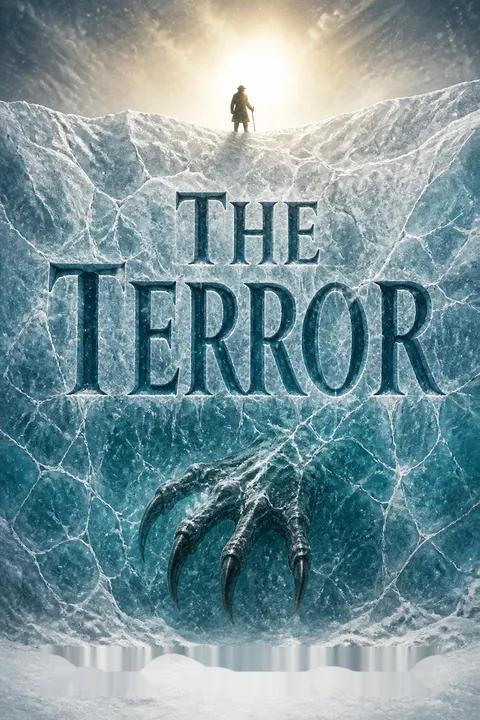


Plot Summary
Franklin Sails Into Ice
In May 1845, Sir John Franklin2 leads HMS Erebus and HMS Terror toward the North-West Passage with 129 men and stores meant to last years. His second-in-command, Francis Crozier,1 is an experienced Arctic captain; handsome James Fitzjames5 commands Erebus.
Before they sail, veteran explorer John Ross warns that their deep-draft ships, weak steam engines, scant coal, and lack of rescue plans make the expedition perilous. Franklin2 dismisses him. The provisions are also compromised: contractor Stephan Goldner wins the Admiralty contract with an implausibly cheap bid and rushed delivery.
Franklin2 leaves no message at the first winter station and trusts that orders, faith, and his own reputation will carry the expedition through. His wife, Jane,14 sends him off believing he will return in triumph.
The expedition begins not with ignorance but with warnings that authority chooses not to hear. Franklin’s confidence rests on institutional approval and religious certainty, while the ship’s actual limits are measurable: coal, draft, food quality, and the absence of rescue provisions. The contrast makes the coming disaster partly human-made before the Arctic becomes supernatural. Franklin’s faith is sincere, but it also protects him from the practical imagination that leadership requires. Crozier sees the danger more clearly, yet his subordinate position leaves him with no power to change the expedition’s course.
Beechey's Three Graves
The ships reach Beechey Island and freeze into their first winter quarters. Young stoker John Torrington dies of tuberculosis and pneumonia on New Year's Day 1846; able seaman John Hartnell collapses and dies days later, and Marine William Braine follows in April.
Assistant surgeon Harry Goodsir6 helps examine Hartnell, finding illness that had gone undetected. The crew buries the men beneath a black cliff, in darkness and bitter cold.
After the surgeons press for dietary changes, Franklin2 orders more tinned food and fewer salted provisions, and no further deaths occur before the thaw. When the ships are freed in May, Franklin2 sails south and west, treating their escape from the first winter as evidence that the expedition remains on course.
The graves are the expedition’s first durable record, more honest than Franklin’s confidence or the official log. They also show how limited the officers’ knowledge is: disease hides inside apparently healthy bodies, while the surgeons can diagnose but not reliably cure it. The dietary adjustment works temporarily, strengthening Franklin’s belief that the crisis can be managed. Yet the dead are left without the required message for future searchers. The expedition survives its first winter, but it also erases the very information that might later have helped anyone find it.
The Eastward Warning
By September 1846, the ships have pushed south through unfamiliar straits, but pack ice thickens ahead and Erebus's propeller shaft is damaged. Crozier1 argues that they should avoid the deadly western ice, turn east around King William Land, and consolidate both crews and their remaining coal aboard Terror. Ice Master Thomas Blanky8 supports him.
Franklin2 refuses to abandon his flagship or retreat, and the expedition presses on. Within days, the last open water freezes shut. The ships are trapped in the moving pack, far from shelter, and their boilers can no longer power a meaningful escape. Crozier’s1 warning becomes the reality: the crews face another winter in open ice, with dwindling fuel and no reliable way back.
This is the point at which caution becomes impossible to recover. Franklin does not merely make a bad decision; he rejects an alternative that could have preserved options, because retreat would look like failure and abandoning Erebus would violate naval pride. Crozier’s plan is uncertain, but it keeps survival ahead of prestige. The frozen ships turn command into a moral burden: those with authority chose the risk, while everyone else must live inside it. The ice does not need to crush the ships immediately. It only has to make every later choice more desperate.
Gore's Last Sledge
In May 1847, Franklin2 sends Lieutenant Graham Gore, mate Charles Des Voeux,13 Goodsir,6 and five men across the ice to place a message near Victory Point and search for open water. Lightning destroys their food and tent, enormous tracks appear, and the party struggles through fog and storms. When the group meets two Inuit, Private Pilkington shoots the older man.
Gore is then crushed by a towering white creature that seems to rise from the ice. The survivors bring the dead lieutenant and wounded Inuit back to Erebus, along with the man's daughter or wife, who cannot speak because her tongue was mutilated. Crozier1 keeps the young woman3 aboard Terror and calls her Silence.3 The wounded man dies, leaving her among the people who shot him.
The expedition’s first encounter with the supernatural arrives entangled with a human act of violence. The Inuit man is shot before anyone understands who he is, and the survivors then demand that his companion remain in their custody. Silence is treated as an object of fear and inquiry rather than as a person with knowledge. Gore’s death makes the creature real to the men, but his party’s conflicting reports allow Franklin to keep calling it a bear. The scene establishes the central asymmetry: the outsiders insist on interpreting a world they do not understand, while the person best placed to explain it has been silenced.
Franklin's Bear Blind
Franklin2 tries to restore morale after Gore’s death by promising every man a reward for killing the creature and assuring the crew that another winter will bring a thaw. Marines build a camouflaged hunting blind and use a bear cub as bait. On 11 June, the enormous predator tears through the blind, kills Marine Sergeant Bryant, mauls several men, and severs Franklin’s2 legs.
It drags the living commander2 into the opening where Gore was buried and devours his head beneath the ice. His death leaves Fitzjames5 in command of Erebus and Crozier1 leading the expedition. The promised bounty and Franklin’s2 sermon do nothing to protect the men; the bait instead teaches the creature where they gather and how they respond.
Franklin’s final plan turns leadership into theater: money, religious certainty, and a staged hunt are meant to give the crew a story in which danger can be mastered. The creature answers by using the blind as a trap, exposing the gap between symbolic control and actual power. Franklin’s death also removes the expedition’s central authority, but the deeper damage is the loss of his ability to keep faith and morale aligned. The men are left with a leader who promised rescue and a predator that has demonstrated intimate knowledge of their rituals.
Claws Beneath Terror
By the autumn of 1847, the ships remain trapped, summers have failed, and Goldner’s canned food is swelling, putrid, or poisonous. Crozier1 learns that more than half the remaining tins may be unusable, while coal is nearly gone and scurvy is spreading. Men hear scratching in Terror’s hold and fear the dead are clawing out of the locked Dead Room.
Crozier1 finds rats feeding on the bodies, then discovers the hull itself bent inward, splintered, and marked by enormous claws and bright blood. Meanwhile, two watchmen disappear and another is left with his skull crushed. Their remains later return in pieces, the upper body of one man joined to the lower half of another. Crozier1 can no longer explain the threat as ordinary ice or bear behavior.
Material failure and supernatural threat become inseparable. The food is poisoned by human fraud, the coal is exhausted by bad planning, and the hull is attacked by something beyond the sailors’ engineering. Each danger cancels the usual response to the others: there is no fuel to move, no sound food to sustain work, and no safe space beyond the ship. The bodies divided and returned make the creature seem less interested in feeding than in communicating. Crozier’s skepticism remains, but it no longer offers protection.
Blanky Climbs the Mast
On the night of 5 December, the creature gets aboard Terror and wrecks its deck shelter, cutting off the main hatch. Ice Master Thomas Blanky8 searches for missing watchmen and meets the monster as it climbs the mast after him. He escapes by swinging on loosened rigging, dropping into the snow, and crawling through a narrow tunnel between pressure-shifted icebergs.
The creature cannot follow him through the gap. Rescuers find Blanky8 badly mauled, with a ruined foot, a shattered leg, and fingers lost to cold, but he survives. His firsthand account persuades him that the thing is more than a polar bear. On the same night, the crew’s fear deepens, while Crozier’s1 authority is increasingly challenged by men who turn to fetishes and offerings.
Blanky survives through the skill the expedition depends on most: reading ice, rigging, and terrain under pressure. His escape is neither victory nor proof that the creature can be beaten; it is a narrow use of the environment against a stronger predator. The cost is permanent bodily damage, and the crew learns that the ships’ walls are not secure. Blanky’s experience also complicates the rational and supernatural explanations. He is a practical expert, not a credulous storyteller, so his certainty gives weight to what the officers have tried to dismiss.
The Masque Burns Bright
To lift spirits, Fitzjames5 allows a New Year’s masquerade built from colored sails and elaborate rooms on the ice. Crozier1 doubts the plan but permits it. The final black room contains Franklin’s2 clock and a severed bear’s head; costumed sailors parade a headless Franklin2 and a giant bear figure through it.
The real creature appears, attacks the revelers, and sends men fleeing through the canvas maze. Fires race through the dry sails and rigging, while Marines mistake fleeing men for the beast and shoot into the crowd.
Five men die, eighteen are injured, and three of the four surgeons are lost. Crozier1 publicly accepts responsibility, then has gunroom steward Aylmore, Hickey,4 and Manson12 flogged for their roles in the spectacle and its aftermath.
The carnival is a human attempt to manufacture pleasure in a world that has stripped away ordinary life. Its seven colored rooms turn the ice into a temporary civilization, but the black chamber stages death before the creature arrives. The men’s joke becomes a real arena of panic, and the firing line shows how discipline itself can become lethal when fear is mistaken for certainty. Crozier’s acceptance of blame matters because he refuses to make scapegoats carry the full moral cost, even as he enforces punishment. His leadership begins to separate from Franklin’s optimism.
Silence Knows the Ice
After Irving7 discovers Silence3 has escaped through a breach near Terror’s bow, he follows her across the ice and witnesses the creature meet her. It blows into her mouth, producing an eerie throat-song, then leaves fresh meat at her feet. Later, Irving7 finds her snow-house and shares marmalade and seal blubber with her, trying to learn how she hunts.
He cannot make himself understood, but he discovers her skill and warmth firsthand. When the crew turns against her as a supposed Jonah, Crozier1 prevents a killing by explaining that she may be their only teacher in finding food if they must abandon ship. Silence3 then leaves the ship to live on the ice, and Crozier1 secretly asks Irving7 to discover how she survives.
The scene Irving witnesses looks like predation, worship, and intimacy at once, leaving him unable to classify what he sees. His later visit replaces spectacle with practical exchange: she offers blubber, he offers marmalade, and each learns the other’s bodily needs without shared language. Crozier recognizes that the crew’s survival depends on knowledge they have treated as primitive or witchcraft. Silence’s move away from the ship is not an escape from the story but a refusal to be permanently confined by the men who need her.
Scurvy Turns the Crew
As men fall ill and rations shrink, a mob prepares to kill Silence,3 blaming her for the expedition’s disasters. Crozier1 brings her before the crew and asks Goodsir6 to describe scurvy: bleeding, weakness, rotting gums, failing judgment, and eventual collapse. The surgeon explains that only fresh food can truly help, and Crozier1 points out that Silence3 is the only person among them who can find it.
The men back down. Soon after, the creature enters Erebus through the hold, kills engineer John Gregory and stoker Tommy Plater, and attacks the carpenter’s party. A fire destroys more stores, while Goodsir6 saves the badly mauled second master, Henry Collins, by amputating his arm and treating his wounds. The men lose more food and trust.
Crozier turns a threatened execution into a confrontation with the crew’s own failing bodies. Naming scurvy makes it harder to project every misfortune onto Silence, and his argument is tactical without being sentimental: she may keep them alive. Yet the ship invasion shows that insight cannot restore safety. The disease is invisible until it transforms men, while the creature makes violence unmistakable. The episode reveals Crozier’s ability to use truth strategically, but it also shows how little remains for him to command.
Two Ships Become Graves
A council confirms that Erebus is breaking apart and Terror has too little coal to steam or heat itself much longer. Crozier’s1 crew prepares for an escape by boat and sledge, but the failed expedition toward Boothia proves the ice there impassable.
Erebus sinks on 31 March 1848. On 22 April, Crozier1 orders Terror abandoned after the survivors strip it of usable supplies. One hundred and five men leave the ship for Terror Camp on King William Island, dragging boats and gear across a route they have rehearsed for weeks.
Crozier1 walks away without looking back. On the march, a mirage makes Terror appear to sail nearby, briefly offering rescue before its upside-down image dissolves. The men continue toward the camp, carrying their last chance with them.
Abandoning a ship is a professional and emotional rupture, especially for Crozier, whose identity has been formed by naval service. Yet the choice also marks a change: he values the living crew more than the vessel or the prestige attached to it. The mirage of Terror sharpens the cruelty of that decision by giving the men a momentary vision of what they have lost. Crozier’s determination to survive is no longer confidence in rescue; it is a commitment to choose among disastrous possibilities and keep moving.
Irving Meets the Real People
At Terror Camp, Lieutenant John Irving7 finds ten Inuit hunters with dogs and a sled. He trades his treasured telescope for their goodwill, and they feed him seal meat and blubber. Before he can bring them back to camp, Hickey4 finds Irving7 alone, kills him, and mutilates his body.
Lieutenant Hodgson11 leads an armed party to the Inuit group, where the men kill eight people and two dogs; two Inuit escape. Goodsir’s6 examination of the dead reveals that they had eaten the same seal food as Irving,7 suggesting they had shared a meal before his murder.
Hickey4 claims he witnessed the killing by the Inuit, but his account conflicts with the evidence. Crozier1 recognizes the danger in the massacre and keeps the doubts about Hickey’s4 story from spreading.
The shared meal should have opened a channel between the stranded sailors and local people, but Hickey turns Irving’s trust into a murder and Hodgson converts grief into collective punishment. The evidence Goodsir finds complicates the crew’s preferred story: the Inuit fed Irving, and his possessions were not taken in the way Hickey describes. Crozier’s decision to conceal his doubts reflects both tactical caution and the collapse of any reliable justice system. The episode makes the cost of colonial arrogance immediate: potential allies become victims, and the survivors lose a source of food and knowledge.
South Becomes the Only Road
Crozier1 and Fitzjames5 reach Victory Point and add a message to Gore’s old canister, recording that Franklin2 is dead and the ships abandoned. The captain’s exhausted note says the survivors will head for Back’s Great Fish River.
Before the departure, a scouting team led by Des Voeux13 attempts the shorter route northeast toward Boothia, but pressure ridges and storms force them back after three weeks and little progress. Crozier1 accepts that the northern route would kill most of the men.
He turns south toward Terror Camp and the river instead, despite the long distance and unknown conditions. At the camp, he and the officers prepare ten boats, sledges, tents, food, and tools, knowing their next journey will demand more hauling than the crossing from the ships.
The message at Victory Point corrects Franklin’s silence, but it may never reach anyone in time. Crozier’s decision is shaped by hard evidence from Des Voeux’s failed sledge trip, not by optimism. The river offers a route that is longer and dangerous but still imaginable; Boothia has become a death sentence. This is a crucial distinction between hope and fantasy. Crozier chooses a path with a rationale even when its success is unlikely, and accepts responsibility for asking the men to follow it.
The March Takes Its Price
The boats move south at a punishing pace, often less than a mile a day across gravel, snow, and broken ice. Captain Fitzjames5 develops severe stomach cramps, vomiting, paralysis, and respiratory failure, then dies at Comfort Cove on 6 June. Goodsir6 suspects contaminated Goldner food may have poisoned him.
Ice Master Thomas Blanky,8 already missing part of a foot, later stays behind when gangrene reaches his stump; he expects the Tuunbaq to find him. The creature does. Blanky8 faces it alone and dies rather than continue as weight the others must haul. More men succumb to scurvy, exhaustion, and infection, while Crozier1 keeps the survivors moving south and then east, reducing their loads when they can no longer pull them.
The expedition’s calamity has become bodily arithmetic: each new illness reduces the number of people who can move the boats, and each boat increases the burden on those still standing. Fitzjames’s death is especially painful because the former naval hero dies conscious, unable to speak or control his body. Blanky’s decision to stay behind is not surrender to cowardice but a refusal to make exhausted comrades carry his failing body. Their different deaths reveal how survival has become a shared calculation with no painless answer.
The Lead Is a Lake
When the ice finally opens, the men believe they can launch their boats and reach Back’s River. Lieutenant Little, Ice Master Reid, foretop captain Harry Peglar,9 and six sailors scout ahead through a narrow lead. It widens into a blue lake in the pack ice, then closes against a wall of solid ice. On the return, something attacks their whaleboat.
The survivors later find its shattered bow, Reid’s body, and Peglar9 frozen on an isolated floe, surrounded by enormous tracks. The promised passage was a trap, and the creature has killed the expedition’s best navigator and one of its most trusted petty officers. Crozier1 leads the remaining men back toward land, now with fewer boats, fewer leaders, and no safe way forward.
The open water appears at the exact moment the survivors need it, but it offers no exit. The lead’s widening gives them hope before its dead end turns that hope into a physical trap. Little and Reid are not lost through carelessness; the ice and the predator defeat a carefully planned reconnaissance. Peglar’s body, frozen beside the tracks, becomes an image of endurance without rescue. From here, the men are not choosing between good and bad routes but trying to preserve enough strength to make any choice at all.
Rescue Camp Fractures
At Rescue Camp, Crozier1 offers the survivors a choice: remain with the dying or continue toward Back River. Hickey4 leads a faction that wants to return to Terror, and Crozier1 lets them leave with one pinnace rather than risk another fight. Before they can depart, Hickey4 ambushes Crozier,1 Goodsir,6 and their guards on the ice, killing Bosun John Lane and Captain of the Hold William Goddard.
Crozier1 is shot repeatedly and falls beside a polynya; Hickey4 takes Goodsir6 captive. Silence3 finds Crozier,1 pulls him from the ice, and hides him in her shelter. Meanwhile, Des Voeux13 returns with seals and news that open water lies south, but the others refuse to pursue Hickey.4 They prepare to leave Rescue Camp, unaware that their captain is alive.
The split is more than a disagreement about direction. It divides men who still accept shared risk from men who believe survival justifies coercion and the use of others as resources. Crozier’s willingness to release the rebels is an attempt to preserve the larger group, but Hickey answers restraint with an ambush. Silence’s rescue begins outside the naval chain of command, in a relationship Crozier had long treated as an inconvenience. His survival now depends on the person the expedition repeatedly misunderstood.
Hickey's Kingdom Ends
With Crozier1 presumed dead, Hickey’s4 party sails briefly through open water, then becomes trapped again and resorts to killing and eating its own members. He rules by threats, keeping the guns and medicines for himself, while Goodsir6 refuses to help butcher the dead.
Magnus Manson’s12 old wounds worsen, and Hickey4 grows convinced that he has become a god beyond ordinary danger. In October, the Tuunbaq reaches their pinnace. It kills Manson,12 then takes Hickey’s4 life and spirit, rejecting him even after his claims of divinity.
Goodsir6 has already poisoned himself rather than serve as the cannibals’ surgeon; his final diary records the horror and his remorse. Hickey’s4 attempt to escape dependence on other people ends in the creature’s judgment.
Hickey turns scarcity into a political system: he decides who eats, who dies, and who must obey. His claim to godhood is the endpoint of that logic, an effort to make his power feel natural rather than imposed. Yet his followers remain vulnerable bodies, and he cannot command the creature that has stalked the expedition. Goodsir’s refusal is not a rescue strategy; it is a final boundary around what he will do to others. The contrast makes survival itself morally unstable, not automatically virtuous.
Silence's World Revealed
While Silence3 tends Crozier’s1 wounds, he begins sharing her dreams and understanding her string-signs. The revelations show that the Tuunbaq is an ancient spirit-beast created by Sedna, the power of the sea, and bound by an agreement with the God-Walking People: they feed and honor it, and it leaves their souls alone. Silence3 belongs to the sixam ieua, the wordless spirit-governors who can communicate with it.
The stranded sailors have violated its territory and disrupted the covenant. As Crozier1 heals, he recognizes that he can return to England or seek another life, but both would separate him from Silence3 and their unborn child. He chooses to join her people, accepting the throat-song ritual that brings him into the Tuunbaq’s presence.
The revelation reframes the creature from an inexplicable predator into a force embedded in a moral and ecological relationship. The Inuit are not merely better adapted to the Arctic; their practices acknowledge obligations to animals and spirits that the expedition dismisses. Crozier’s recovery is therefore also a change in what counts as knowledge. He stops treating rationality as a shield against the world and chooses belonging over professional restoration. The throat-song makes that choice bodily: he must surrender control of his voice before he can enter a community built around another way of knowing.
Crozier Becomes Taliriktug
Crozier1 kneels on the ice as Silence3 breathes into his open mouth and uses his vocal cords to produce their shared throat-song. When the Tuunbaq approaches, he does not flee or reach for a weapon; he accepts the encounter as the final step away from his former life. The story later identifies him as Taliriktug,1 living with Silence3 and their children among the God-Walking People.
In 1851, Taliriktug1 travels with his family and other Inuit to a southern village, where the surviving expedition’s scattered belongings are recognized as the remnants of the lost sailors. The men’s maps, tools, and names survive as objects, but Crozier1 has chosen a life that no longer belongs to the Royal Navy or England.
Crozier’s ending is neither conventional rescue nor simple death. He survives by relinquishing the identity that once made him captain, accepting dependence, marriage, and a community whose knowledge he could not access through command. The final objects found by the Inuit preserve the expedition as material evidence, while Crozier’s new name preserves a different continuity: he remains himself without remaining the same. The resolution answers the opening’s question of what a man can do when his ship and institution fail. He can become responsible to a world beyond them.
Epilogue
In 1851, Taliriktug1 travels with Silence,3 their children, and a group of Inuit to a southern village. They find objects carried by the lost expedition, including silverware, a watch, and a small writing desk.
The items confirm that the pale sailors once passed through these lands, but Taliriktug1 does not return to their world. He recognizes the old life through its possessions while continuing forward with his family.
The coda makes survival legible without restoring the expedition’s lost hierarchy. Taliriktug encounters the material remains of naval rank and English domestic life, but these artifacts no longer define him. The Inuit community becomes the living archive that the Admiralty’s records failed to create: objects are identified, stories are carried, and family life continues. The scene neither erases the dead nor turns Crozier’s new life into a simple victory. It shows that continuity can pass through people who have changed their names, loyalties, and ways of understanding the world.
Analysis
The Terror makes catastrophe accumulate through two systems that reinforce each other. The first is institutional: Franklin2 ignores warnings, the Admiralty accepts a suspiciously cheap food contract, and the expedition leaves no message at its first winter station. The second is ecological and spiritual: the sailors enter a northern world whose rules they cannot perceive, then treat unfamiliar knowledge as superstition. Neither system alone explains every death, but together they narrow the survivors’ choices until ordinary leadership becomes triage.
Crozier’s1 arc is not a simple victory of toughness. His central struggle is whether responsibility means preserving the identity of a naval captain1 or protecting the people and life that remain after his command has failed. At first he treats the ship as a body and his career as the only life he knows. Later, his sober leadership requires him to abandon both ship and prestige. Finally, he accepts that survival may demand a different language, kinship, and account of the self. His choice is not an escape from responsibility; it is a willingness to enter a community whose obligations he must learn rather than command.
The novel also refuses to make suffering ennobling by default. Scurvy disfigures, hunger degrades judgment, and moral courage does not guarantee rescue. Goodsir’s6 medicine can identify causes without stopping them; Crozier1 can choose a path without making it safe; Irving’s7 decency cannot protect the Inuit he hopes to befriend. The story’s deepest contrast is between possession and reciprocity. Franklin’s2 men count stores, claim land, and try to kill the creature, while the God-Walking People survive through reciprocal obligations to animals, spirits, and one another. The expedition does not fail because its members lack courage. It fails because courage cannot substitute for understanding the world they have entered.
Review Summary
The Terror is a highly acclaimed historical fiction/horror novel based on the ill-fated Franklin Expedition. Readers praise Simmons' meticulous research, atmospheric writing, and ability to create tension and dread. The book's length and slow pacing are noted drawbacks for some, but many find it a gripping, immersive experience. Characters are well-developed, and the supernatural elements add intrigue to the already harrowing tale of survival in the Arctic. While not for everyone due to its gruesome content and length, most reviewers consider it a masterful blend of history and horror.
Characters
Francis Crozier
The iron-willed captainCrozier commands HMS Terror and becomes the expedition’s senior officer after Franklin’s2 authority is lost. An Irishman of common birth in a navy governed by class, he has spent a career watching less capable men receive recognition. His dry humor, melancholy, and dependence on whiskey conceal a fierce capacity for responsibility. Crozier notices practical dangers early, but he is also shaped by loneliness and a longing to be chosen. His relationship with his men is blunt but protective; he expects discipline while accepting personal responsibility for failure. His story tests whether a person can remain morally accountable when every institution and measure of success has collapsed.
John Franklin
The hopeful expedition leaderFranklin is the respected commander of the expedition, a devout and affable officer who wants to prove that he still deserves the Admiralty’s trust. His earlier Arctic hardships and public reputation shape his belief that perseverance can overcome almost any obstacle. He depends on faith, formal authority, and the affection of his wife, Jane14, but is less attentive to practical limits than Crozier1 or the ice masters. His good intentions are real, yet they do not prevent him from dismissing warnings about fuel, rescue, and route. Franklin embodies the peril of mistaking institutional confidence for sound judgment.
Lady Silence
The wordless ice guideThe young Inuit woman arrives with an older companion, whose death leaves her among the sailors who shot him. She has no tongue and communicates through gestures, objects, and string patterns. The crew calls her Silence, often treating her as a witch or omen rather than a person. She is observant, self-contained, and skilled at finding food in conditions the Englishmen cannot read. Her relationship with Irving7 is built through awkward attempts at exchange, while Crozier1 gradually learns that her apparent silence hides a different form of communication. She represents knowledge grounded in attention, kinship, and reciprocity.
Cornelius Hickey
The mutinous caulkerHickey is a small, clever caulker’s mate who understands how to turn fear and resentment into influence. His quick tongue, practical usefulness, and ties to ordinary seamen give him access to the crew’s grievances. He watches for moments when official authority looks weak, then offers certainty in its place. His bond with Magnus Manson12 combines manipulation, dependence, and intimacy, giving him a powerful instrument in the ship’s crowded lower decks. Hickey’s intelligence is real, but he uses it without regard for the people who must bear the consequences of his plans.
James Fitzjames
The celebrated naval commanderFitzjames commands Erebus and carries the reputation of a handsome, courageous officer with a distinguished record in war. He is socially graceful and accustomed to being admired, but his easy manner can conceal insecurity and an increasing awareness of his limits. He respects Crozier’s1 judgment even when the command structure makes their relationship difficult. Fitzjames tries to preserve morale through ceremony, warmth, and shared effort, particularly when the men have lost faith in the expedition’s prospects. His character exposes the difference between public heroism and the private vulnerability of a leader under prolonged deprivation.
Harry Goodsir
The searching surgeonGoodsir is an assistant surgeon and anatomist who joins the expedition hoping to study Arctic life. His early self-image as a naturalist gives way to the practical demands of treating frostbite, wounds, starvation, and scurvy. He is physically slight and sometimes socially awkward, yet his curiosity makes him unusually attentive to bodies and evidence. Goodsir’s medical work forces him to confront how little his training can do when food and medicine disappear. His careful observations challenge the officers’ assumptions, while his compassion makes him reluctant to reduce fellow human beings to problems of survival.
John Irving
The romantic young lieutenantIrving is a young Terror lieutenant trained in gunnery and accustomed to imagining a future of travel, advancement, and writing. His romantic nature makes him vulnerable to the isolation of the expedition, but he is not simply inexperienced: he treats Silence3 with courtesy and tries to communicate without forcing her to speak. His growing concern for her leads him into the ice alone and draws him toward the Inuit knowledge the officers need. Irving’s decency is expressed through small choices, including giving away a prized telescope and sharing scarce food.
Thomas Blanky
The veteran ice masterBlanky has spent decades navigating Arctic waters and can distinguish dangerous ice at a glance. His blunt humor and practical confidence make him a stabilizing presence among men who increasingly fear what they cannot explain. He supports Crozier’s1 warnings about the pack and understands that survival depends on reading its movement rather than forcing it. Even after injury, he maintains a stubborn dignity and remains attentive to the crew’s morale. Blanky represents expertise earned through repeated exposure to danger, not through rank or theory.
Harry Peglar
The literate foretopmanPeglar is a respected captain of the foretop, valued for strength, courage, and skill aloft. He learned to read as an adult and turned books into a private education, especially through the mentorship of John Bridgens10. His friendship with Bridgens10 carries emotional intimacy that neither man can safely display openly in the navy. Peglar’s coded journal records a thoughtful mind struggling to remain articulate as hunger and illness erode his abilities. He links the expedition’s physical labor to a larger inquiry about knowledge, love, and what people leave behind.
John Bridgens
The discreet old stewardBridgens is the elderly subordinate officers’ steward of Erebus, officially listed far younger than he is. He has read widely, taught Peglar9 to read and think, and learned to survive by staying observant and unobtrusive. His quiet manner allows him to hear what the officers and crew say when they assume no one important is listening. Bridgens is both a mentor and a companion to Peglar9, with a shared history that carries more tenderness than either can openly name. His patience and literary imagination help him understand the expedition’s choices without confusing wisdom with control.
George Hodgson
The wavering lieutenantHodgson is a young Terror lieutenant and a close friend of Irving7 from their gunnery training. He wants to be brave and useful, but the expedition’s violence and uncertainty expose his dependence on stronger personalities. He can command a party and accept responsibility, yet fear sometimes pushes him toward the wrong alliances. His place between Crozier’s1 authority and Hickey’s4 influence illustrates how pressure can deform judgment without erasing a person’s capacity for remorse.
Magnus Manson
Hickey's immense followerManson is a huge, slow-speaking seaman whom the crew treats as an amiable simpleton. His physical strength makes him invaluable for heavy work, while his fear of ghosts reveals how easily others can shape his understanding of danger. He is attached to Hickey4 and follows the caulker’s mate’s instructions with a childlike need for reassurance. Manson’s size makes him appear powerful, but emotionally he is dependent and easily frightened, a contrast that gives his presence both menace and pathos.
Charles Des Voeux
The resilient first mateDes Voeux is an Erebus mate and capable navigator who repeatedly leads difficult sledge parties. He combines professional discipline with an ability to keep moving when others have exhausted their strength. As losses remove senior officers, his role grows more consequential, and he must make decisions that would once have belonged to captains. He is not immune to fear or grief, but he treats responsibility as a practical obligation: assess the conditions, choose a route, and bring back what information the survivors need.
Jane Franklin
The indomitable wifeJane Franklin is Sir John’s2 wife, a forceful and intellectually curious woman who supports his expedition while maintaining a strong public presence. Her confidence and connections stand in contrast to her husband’s retiring temperament. To Franklin2, she represents home, approval, and the certainty that someone will keep faith with him. Her presence in his memories reveals how deeply his self-image depends on being loved and awaited.
Sophia Cracroft
Crozier's lost loveSophia is Jane Franklin’s14 niece, an energetic and socially confident woman Crozier1 meets while serving in Van Diemen’s Land. Her wit and ease in conversation awaken an emotional life Crozier1 had largely abandoned. She enjoys his company but does not share his hopes for marriage, leaving him with a lasting private wound. Sophia matters less as a romantic ideal than as proof that Crozier1 can want a home and tenderness, even when he expects himself to be denied both.
Plot Devices
The Goldner Provisions
Food becomes hidden poisonThe expedition’s tinned food is supplied by Stephan Goldner, whose unusually low bid and rushed production hide poor cooking and defective soldering. Over time, cans swell, rupture, or become dangerous, leaving the crews with far less edible food than their inventories promise. The tins first appear to be a modern safeguard against Arctic scarcity, then become a source of uncertainty and disease. They also intensify mistrust: the men cannot tell which cans are safe, and the officers must decide whether to risk feeding them to the crew. This device turns bureaucratic cost-cutting into a bodily threat and links the expedition’s collapse to choices made before it sailed.
The Brass Message Canisters
A record for rescuersThe expedition carries airtight brass cylinders intended to leave messages at landmarks along its route. Franklin2 fails to leave one at Beechey Island, while Gore later places a message at Victory Point. Crozier1 and Fitzjames5 add an update after abandoning the ships, recording the deaths and their plan to reach Back River. These canisters are meant to bridge the distance between lost explorers and future searchers, but their usefulness depends on the crew knowing that they exist and placing them where rescuers will look. They make the expedition’s errors legible: a tiny written record cannot compensate for a missing plan or an unmarked route.
The Ice-Bound Ships
A fortress becomes a prisonErebus and Terror begin as reinforced bomb ships equipped with experimental steam engines, central heating, and room for large stores. Their design offers shelter through the first winters, but deep drafts and damaged shafts make them poorly suited to escape through shifting pack ice. Once the ships are beset, their decks become defensible platforms against the creature, yet the hulls are slowly crushed and their coal dwindles. The men’s dependence on the ships changes from security to entrapment. Their abandonment is not a single dramatic failure but the final stage of a long mechanical struggle that has already limited every later choice.
The Tuunbaq Covenant
A predator guards a balanceThe Tuunbaq appears first as a supernatural hunter attacking isolated sailors and eventually even the ships themselves. Inuit understanding reframes it as an ancient spirit-creature whose relationship with the God-Walking People is governed by offerings, territory, and restraint. The sixam ieua communicate with it through thought, string patterns, and throat-song. The expedition’s arrival violates the balance that has kept the creature from preying on the local people. This device transforms the horror from a simple monster hunt into a conflict between incompatible ways of living in the Arctic. It is a major revelation, so the description includes spoilers.
Silence's String Signs
Meaning without spoken wordsSilence3 communicates through gestures and intricate string patterns, allowing her to convey ideas that Crozier1 and the sailors initially dismiss or misread. The patterns show travel, shelter, hunting, and relationships, while the later throat-song lets her and Crozier1 communicate through sound without ordinary speech. These forms of expression make language a physical practice rather than a simple exchange of words. They also shift authority: the English officers may command ships, but they cannot understand the environment until they learn to attend to a system they did not create. Its role in the final transformation includes spoilers.
FAQ
Synopsis & Basic Details
What is The Terror about?
- Trapped in Arctic Ice: In 1847, two Royal Navy ships, HMS Erebus and HMS Terror, are trapped in the Arctic ice while searching for the Northwest Passage.
- A Supernatural Threat: The crew faces not only the harsh environment but also a mysterious and malevolent creature that stalks them, picking them off one by one.
- Descent into Horror: As supplies dwindle and hope fades, the men must confront both the external threat and the internal demons that threaten to tear them apart.
Why should I read The Terror?
- Historical Fiction with Horror: It masterfully blends historical detail with supernatural horror, creating a unique and terrifying reading experience.
- Complex Characters: The novel features a diverse cast of characters, each with their own motivations, flaws, and struggles, making them compelling and relatable.
- Exploration of Human Limits: It delves into the psychological and physical toll of extreme conditions, exploring the limits of human endurance and the darkness that can emerge in the face of despair.
What is the background of The Terror?
- Historical Basis: The novel is based on the real-life Franklin Expedition, a British attempt to find the Northwest Passage in the mid-19th century, which disappeared without a trace.
- Arctic Exploration: It draws heavily on the history of Arctic exploration, including the challenges of navigating the ice, the dangers of scurvy and starvation, and the psychological toll of isolation.
- Cultural Context: The story incorporates elements of Inuit culture and mythology, adding a layer of mystery and otherworldliness to the narrative.
What are the most memorable quotes in The Terror?
- "He was — and always would be — the man who ate his shoes.": This quote, referring to Sir John Franklin, encapsulates his past failures and the desperation of arctic exploration.
- "This elusive quality it is, which causes the thought of whiteness, when divorced from more kindly associations, and coupled with any object terrible in itself, to heighten that terror to the furthest bounds.": This quote from Herman Melville's Moby Dick, used as an epigraph, foreshadows the nature of the creature and the psychological impact of the Arctic's vast emptiness.
- "They were like animals. The furs and hairy hides they wore might as well be their own beastlike skins as far as Francis Crozier was concerned.": This quote reveals Crozier's prejudice and dehumanization of the Inuit people, highlighting the cultural clash and the expedition's inherent biases.
What writing style, narrative choices, and literary techniques does Dan Simmons use?
- Multiple Perspectives: Simmons employs a shifting point of view, allowing readers to experience the story through the eyes of various characters, enhancing the sense of dread and uncertainty.
- Detailed Descriptions: The author uses vivid and often gruesome descriptions of the Arctic environment, the characters' physical and mental states, and the creature's attacks, creating a visceral and immersive reading experience.
- Foreshadowing and Symbolism: Simmons masterfully uses foreshadowing and symbolism to create a sense of impending doom, with recurring motifs and subtle hints that build tension and suspense.
Hidden Details & Subtle Connections
What are some minor details that add significant meaning?
- The Union Jack: The recurring image of the Union Jack, especially when laid over Sir John Franklin, foreshadows the expedition's tragic fate and the symbolic death of British ambition in the Arctic.
- The Names of the Ships: The names of the ships, Erebus and Terror, are not just names but also foreshadow the darkness and fear that the expedition will encounter.
- The Color White: The emphasis on the color white, as mentioned in the epigraph, symbolizes the cold, emptiness, and terror of the Arctic, as well as the creature's otherworldly nature.
What are some subtle foreshadowing and callbacks?
- Crozier's Alcoholism: Crozier's frequent drinking is not just a character flaw but a foreshadowing of his increasing despair and the loss of control he experiences as the expedition progresses.
- The Missing Tongue: The detail of Lady Silence's missing tongue is a subtle foreshadowing of her inability to communicate and the mystery surrounding her origins and connection to the creature.
- The Inverted Y: Dr. Goodsir's inverted Y incision during the autopsy of John Hartnell foreshadows the upside-down nature of their world and the perversion of natural order.
What are some unexpected character connections?
- Crozier and Sophia Cracroft: The recurring memories of Sophia Cracroft reveal a hidden vulnerability in Crozier and highlight the personal losses that fuel his despair.
- Hickey and Manson: The relationship between Cornelius Hickey and Magnus Manson is a complex and disturbing dynamic, showcasing the power of manipulation and the depths of human depravity.
- Goodsir and Silence: The shared silence and mutual observation between Goodsir and Silence hint at a deeper understanding between them, despite their inability to communicate verbally.
Who are the most significant supporting characters?
- Thomas Blanky: As the ice master, Blanky's expertise and experience are crucial to the crew's survival, and his resilience and determination make him a source of inspiration.
- Edward Little: As Crozier's executive officer, Little's pragmatism and loyalty provide a steadying influence amidst the chaos and despair.
- John Bridgens: As a steward and intellectual mentor, Bridgens's wisdom and knowledge offer a unique perspective on the expedition's challenges and the nature of human existence.
Psychological, Emotional, & Relational Analysis
What are some unspoken motivations of the characters?
- Crozier's Self-Destruction: Crozier's alcoholism and self-deprecating behavior stem from a deep-seated sense of inadequacy and a desire to punish himself for his past failures.
- Hickey's Power Lust: Hickey's actions are driven by a desire for power and control, as he seeks to manipulate and dominate those around him, revealing a deep-seated insecurity and a need for validation.
- Silence's Enigma: Silence's motivations remain largely unspoken, but her actions suggest a complex mix of fear, survival instinct, and a possible connection to the creature.
What psychological complexities do the characters exhibit?
- Crozier's Melancholy: Crozier's melancholic nature is a recurring theme, highlighting his internal struggles with self-doubt, regret, and the weight of command.
- Fitzjames's Denial: Fitzjames's optimism and denial of the expedition's dire situation reveal a deep-seated fear of failure and a need to maintain control in the face of chaos.
- Goodsir's Detachment: Goodsir's scientific detachment and intellectual curiosity serve as a coping mechanism, allowing him to observe the horrors around him without fully succumbing to despair.
What are the major emotional turning points?
- The Loss of Gore: The death of Lieutenant Gore is a major emotional turning point, shattering the crew's sense of security and highlighting the creature's power.
- The Carnivale Fire: The Carnivale's fiery catastrophe is a devastating emotional blow, destroying the crew's hope and plunging them into despair.
- The Discovery of the Spoiled Food: The realization that much of their food supply is contaminated or ruined is a major emotional turning point, as it confirms their impending doom.
How do relationship dynamics evolve?
- Crozier and Fitzjames: The relationship between Crozier and Fitzjames evolves from a professional partnership to a bond forged in shared adversity, as they grapple with the challenges of command and the weight of their responsibilities.
- Crozier and Silence: The relationship between Crozier and Silence is complex and ambiguous, marked by a mix of fear, curiosity, and a growing sense of understanding.
- The Crew's Factions: The crew's relationships are strained by the harsh conditions and the growing threat of mutiny, as they form factions and alliances based on fear and self-preservation.
Interpretation & Debate
Which parts of the story remain ambiguous or open-ended?
- The Creature's Origins: The true nature and origins of the creature remain ambiguous, leaving readers to speculate about its supernatural or natural origins.
- Lady Silence's Intentions: Lady Silence's motivations and her connection to the creature are never fully explained, leaving her as an enigmatic and mysterious figure.
- The Nature of the Arctic: The Arctic itself is presented as an ambiguous force, both beautiful and terrifying, capable of inspiring awe and despair.
What are some debatable, controversial scenes or moments in The Terror?
- The Cannibalism: The potential for cannibalism among the crew is a controversial theme, raising questions about the limits of human morality and the desperation of survival.
- Crozier's Actions: Crozier's decisions as a leader are often debatable, as he grapples with the impossible choices he must make to protect his men.
- The Ending: The ending of the novel is open to interpretation, leaving readers to ponder the fate of the surviving characters and the ultimate meaning of their journey.
The Terror Ending Explained: How It Ends & What It Means
- Abandonment and Despair: The ending sees the remaining crew abandoning the ships and taking to the ice, facing an uncertain future with dwindling supplies and hope.
- The Creature's Victory: The creature's continued presence and the crew's inability to defeat it suggest a victory for the forces of nature and the futility of human ambition in the face of the unknown.
- Ambiguous Fate: The final fate of the characters is left ambiguous, leaving readers to ponder the meaning of their journey and the enduring power of the Arctic's terror.
About the Author


Download PDF
Download EPUB
.epub digital book format is ideal for reading ebooks on phones, tablets, and e-readers.








