

Key Takeaways
Run today's business, retire yesterday's logic, and build tomorrow together
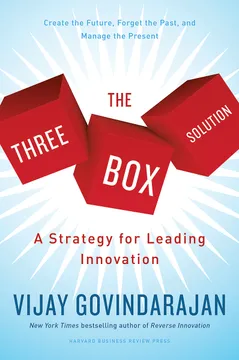
Three clocks at once. The Three-Box Solution is a way to manage three competing jobs: Box 1 runs the current business efficiently, Box 2 removes past practices and assumptions that no longer fit, and Box 3 develops new products or business models. Each calls for different skills, measures, and leadership, but none can be neglected. The present funds the future; forgetting creates room for it; experiments turn possibilities into businesses.
Change is a daily practice. Hasbro gradually evolved from a toy and board-game maker into a branded-play company, extending brands such as Transformers into films, television, games, and other experiences. The change unfolded through years of attention and learning, not a single dramatic pivot. New ventures can become tomorrow's core, so the boxes form a recurring cycle.
What's useful about this model is that it makes innovation an allocation problem, not just an inspiration problem. Organizations must decide where attention, money, talent, and patience go, while recognizing that a mature operation and an uncertain venture cannot be managed by identical rules. This echoes the exploration and exploitation tension in organizational research: firms need both refinement of what works and discovery of what might work. The added emphasis on forgetting matters because exploration can be blocked by routines built for past success. The framework names the competing demands clearly, though it does not prescribe a universal budget split. Leaders still have to make that choice in context.
Treat success as evidence, not proof, that your model still fits
Success can mislead. The success trap occurs when strong current results persuade an organization that its old recipe will keep working. The book describes three forces that sustain this trap: complacency, fear that a new offer will cannibalize current revenue, and overinvestment in skills useful mainly to the existing business. Together they create a dominant logic, meaning assumptions and routines that become so embedded they seem unquestionable.
IBM felt the drag. Its reputation for dependable mainframes reassured customers and sustained profits, even as personal computers and networked computing changed what businesses needed. A shift in how IBM booked mainframe revenue helped postpone the reckoning. The company eventually created protected emerging-business teams because research alone could not overcome systems designed to favor near-term results and familiar customers.
The case is stronger when success is understood as a system, rather than a psychological flaw. Customers, promotion criteria, budgets, and established expertise can all reward the old model at once, making dissent look imprudent even when it is perceptive. This resembles path dependence: earlier choices shape which later choices appear affordable or legitimate. The caution is that cannibalization is not automatically wise. A new offer can damage a profitable core without creating a viable replacement. The practical question is not whether to protect the core or disrupt it, but how to test the new direction while managing the transition costs and preserving capabilities that remain valuable.
Scan weak signals before the market makes them obvious
Notice early clues. Weak signals are incomplete signs of possible change in technology, customer behavior, demographics, markets, or culture. They do not reveal the future with certainty, but they can help leaders form useful hypotheses. Planned opportunism means building skills, relationships, and experimental capacity so an organization can respond to opportunities it could not reliably predict.
Hasbro looked beyond toys. The company could not know precisely how entertainment would change, but it could notice clues such as growing digital use, shifting family habits, and international market potential. Leaders can begin by asking which conditions support today's success, which may change, and how the company could prepare. Hasbro's later expansion across media and platforms illustrates how those early questions can shape options before a disruption becomes a crisis.
Weak-signal work is a disciplined alternative to pretending that forecasts are precise. In strategy, scenario planning serves a similar purpose: it does not identify one certain future, but helps decision-makers rehearse several plausible ones and notice which assumptions each depends on. The valuable output is often not a prediction, but an option the organization can exercise when evidence improves. There is also a filtering problem. A company can collect endless signals and mistake noise for insight. A useful process therefore needs both broad listening and a way to test whether a clue matters to customers, economics, or the firm's ability to act.
Use small experiments to earn the right to make bigger bets
Learn before scaling. Box 3 work begins with uncertainty, so early progress should be judged by learning rather than revenue. Keurig tested its single-serve coffee system first in offices, where it could build awareness, gather feedback, and fix technical problems before attempting the much larger home market. Early brewers were expensive and unreliable, but office users wanted the experience enough to encourage continued development.
Test the risky assumptions. Keurig researched whether home drinkers would pay premium prices, then redesigned its brewer after a first home model proved too slow and costly. The replacement combined a smaller water tank with faster heating technology. By the 2004 consumer launch, evidence supported brewer prices around $129 to $199 and premium coffee pods. Staging investment meant the company could adjust before committing everything to mass-market expansion.
This is the logic of real options: a modest early investment buys information and preserves the choice to expand, change direction, or stop. It is especially useful when a venture faces several uncertainties at once, such as customer willingness to pay, technical feasibility, and partner economics. But experiments only reduce risk when they are designed to distinguish between competing explanations. A demonstration that customers enjoy a product does not, by itself, prove repeat purchase or sustainable margins. Keurig's example is strongest because product trials, price research, engineering changes, and staged market entry answered different questions rather than treating initial enthusiasm as proof.
Give emerging businesses their own team, funding, and scorecard
Protect learning from quarterly pressure. IBM's Emerging Business Opportunities framework, or EBO, gave new ventures a structure distinct from the mature businesses that optimized near-term performance. The approach recognized that emerging ventures need time to understand undefined markets and test ideas. IBM assigned senior leaders to sponsor them, protected their funding from routine reassignment, and allowed them to draw on established company capabilities.
Measure what matters now. Instead of demanding immediate profits, EBO teams tracked milestones such as customer pilots and the testing of strategic assumptions. As uncertainty fell and the venture matured, financial measures became more important. IBM's pervasive computing unit, which explored internet-connected devices and services, used customer experiments to narrow its potential directions. The point is not to isolate a new team completely, but to keep core-business rules from judging a business that is still learning.
A separate team can create psychological and operational space for exploration, but separation alone is not a strategy. The venture still needs access to customers, technical assets, distribution, and decision-makers in the parent company. That creates a design challenge: protect the experiment without turning it into an island. The EBO approach addresses this through senior sponsorship and selective borrowing from the core. Its milestone logic also reflects a sound measurement principle: indicators should match the maturity of the activity being evaluated. Early ventures need evidence of learning and demand; established operations can be held to more predictable output targets.
Repair the core without letting local efficiency defeat customer value
A healthy core enables change. Box 1 produces the cash and operational capabilities that support future investment, but good execution is not simply cost control. United Rentals faced a failed buyout, a leadership gap, and the Great Recession. Its local branches often acted like separate businesses, sometimes refusing to move equipment between locations even when a customer needed it.
Redesign around customers. CEO Michael Kneeland grouped accounts into national, regional, and local tiers, changed incentives so branches shared responsibility, and used performance data to track service. The company closed about 150 locations and removed roughly $250 million in permanent costs, while investing in coordination and customer relationships. Its stock rose from just over $3 in 2009 to $75 in 2015, according to the book. The turnaround shows that Box 2 changes can improve the existing business as well as prepare a new one.
United Rentals illustrates that efficiency is meaningful only in relation to the value delivered. A branch can hit its own target and still harm the wider company by hoarding equipment or frustrating a high-value customer. This is a familiar systems problem: optimizing each component independently can worsen the performance of the whole. Shared measures and better information can help align local decisions with customer outcomes. Yet the turnaround also shows why metrics need judgment. What gets counted can redirect behavior, but a dashboard cannot substitute for understanding why customers leave, what employees can realistically deliver, or which costs are strategically useful.
Schedule renewal before crisis makes the decision for you
Make stopping routine. Willow Creek Community Church began by redesigning services for people who did not attend church, using research on why they found traditional services alienating. As interest in its approach grew, the church created a separate association to train other leaders, keeping the local congregation focused on its own mission. That association later shifted from teaching the Willow Creek model to hosting a broader Global Leadership Summit as the original training market matured.
Review the portfolio regularly. Willow Creek's leaders twice a year examined what was working, what had run its course, and what to try next. The habit made ending a program part of management rather than an admission of failure. Tata Consultancy Services similarly exited a growing call-center business because its labor demands and low strategic value pulled attention away from the capabilities it wanted to build.
Routine portfolio review helps counter a predictable human bias: existing programs feel more valuable because people have invested effort, identity, and relationships in them. Scheduled review creates a legitimate occasion to reconsider that attachment before a crisis narrows the options. Willow Creek also shows that innovation can preserve a mission while changing its delivery. The distinction between enduring purpose and temporary method is essential, especially in organizations where identity is strong. Still, stopping activities has real costs for employees and communities. A disciplined review should therefore ask not only whether a program is obsolete, but also what obligations remain when it ends.
Back unconventional talent, then build capabilities around what they teach
Listen beyond polish. At Mahindra, a young engineer proposed a tubular vehicle chassis that could solve repeated cracking without buying machinery costing about $8 million. Anand Mahindra backed the idea with staged seed funding, beginning with $15,000. The solution worked, and the total investment described in the book was $45,000. The engineer was difficult to work with, but his idea addressed a costly problem.
Turn a bet into a capability. Mahindra later supported the Scorpio, the company's first original vehicle design, despite limited experience and a development budget far below what a major automaker might spend. A young designer's concept, a dedicated team, and unusually collaborative suppliers helped create a new vehicle and engineering skills. The lesson is not to reward eccentricity for its own sake. It is to test unconventional proposals cheaply, protect promising work, and retain the learning in the organization.
Mavericks can function as sensors for possibilities that established routines overlook, but unconventional behavior is not evidence of good judgment by itself. The useful distinction is between tolerating a person's style and demanding that an idea withstand scrutiny. Mahindra's staged funding is important because it paired openness with limits: the proposal earned further commitment through results. The broader organizational gain came when a one-off solution became engineering competence. This connects innovation to capability building. A company should ask not only whether a project succeeds, but what knowledge, relationships, or methods remain available for the next problem.
Analysis
The book's central contribution is not simply that firms should balance the present and future. Many leaders already endorse that goal. Its sharper claim is that balance requires three distinct forms of work: operating the current business, deliberately loosening the grip of obsolete assumptions, and building new businesses under uncertainty. The second task makes the framework more diagnostic. A company can invest in innovation while leaving intact the incentives, identity, and processes that quietly reject it.
The cases show that the boxes are not departments with permanent borders. Keurig's office product became a route toward the home market. IBM's emerging ventures depended on assets from the established company. United Rentals used changes in structure and incentives to improve the existing operation. Willow Creek's new training organization grew from a church's core mission, then had to reinvent its own offer. These examples make the framework dynamic: a future business can become a core, and a once-useful practice can become a constraint.
The model's managerial value is its shared vocabulary. Teams can classify work, debate whether a project is being judged by the right criteria, and expose the tension between local incentives and company-wide goals. That clarity is not the same as an implementation recipe. The book offers cases and tools, but no fixed allocation of time or capital, and no universal test for when a core practice has become obsolete. Those decisions depend on industry speed, cash position, organizational capability, and the costs of transition.
A further caution is that experimentation can become theater. Dedicated teams and pilot projects do not create learning unless leaders specify the assumptions being tested and act on the results, including unfavorable ones. Likewise, the language of planned opportunism can excuse scattered initiatives unless each experiment connects to a strategic possibility. The strongest reading of the Three-Box Solution is therefore as a continuous portfolio discipline: protect what still works, question what no longer earns its place, and fund discoveries in stages. Its promise is not prediction, but a better capacity to adapt without waiting for catastrophe.
Review Summary
The Three-Box Solution receives mostly positive reviews for its innovative framework balancing present operations, eliminating obsolete practices, and creating future opportunities. Readers appreciate the practical examples and diverse case studies. Some find the concept simple yet powerful, while others feel it could have been more concise. The book is praised for its applicability to various organizations and industries. Critics note repetition and a lack of practicality in some sections. Overall, it's considered a valuable read for leaders seeking to balance current performance with future innovation.
Glossary
Three-Box Solution
Balances present, past, and futureA leadership framework for managing three organizational tasks at once: operating the current core business, abandoning past assumptions and practices that no longer fit, and developing new products or business models. It argues that each task needs different skills, measures, and structures, while remaining interdependent with the others.
Box 1
Current business performanceThe work of running an organization's established core business efficiently and profitably. It includes serving current customers, improving existing products and processes, controlling costs, and producing cash flow. Box 1 is essential because it supports ongoing operations and can provide resources and capabilities for new ventures.
Box 2
Selective forgettingThe work of identifying and relinquishing past businesses, assumptions, practices, and attitudes that have lost relevance or obstruct new opportunities. Box 2 does not mean discarding everything inherited from the past. It requires distinguishing enduring strengths from outdated constraints, and creating conditions in which new ideas can develop.
Box 3
New business creationThe work of developing breakthrough ideas into new products, services, or business models. Box 3 operates amid uncertainty, so teams test assumptions, experiment, build new capabilities, and adapt as evidence accumulates. Progress is initially assessed through learning and milestone achievement rather than the near-term financial standards used for mature businesses.
planned opportunism
Preparation for uncertain futuresA set of leadership practices that prepares an organization to respond to changes it cannot reliably predict. It involves building capabilities, gathering insight from emerging trends, developing relationships and flexible structures, and experimenting so the organization can act when opportunities or threats become clearer.
weak signals
Early clues to changeIncomplete or ambiguous indications that technology, customer behavior, demographics, culture, markets, or other conditions may be changing. Weak signals are not reliable forecasts. They provide raw material for hypotheses about possible future shifts, which organizations can investigate through discussion and experimentation.
dominant logic
Assumptions reinforced by successThe shared assumptions and habitual ways of interpreting business that grow from an organization's past experience. Dominant logic can coordinate and strengthen an established operation, but it can also cause people to dismiss unfamiliar customers, technologies, or business models because they do not match the old formula.
Emerging Business Opportunities (EBO) framework
Protected venture development processIBM's approach to incubating new businesses through structures and measures suited to their stage of development. EBO ventures received senior sponsorship, protected funding, access to company capabilities, and evaluation based on learning milestones before being judged by mature-business financial measures.
linear innovations
Improvements to the current modelChanges that improve an established business model, such as extending a current brand, refining an existing product, or making operations more efficient. They build on familiar customers, capabilities, and systems, and are typically managed as part of current-business performance.
nonlinear innovations
New models for new valueInnovations that significantly change a business's customers, the value offered to them, or the way that value is delivered. Because they depart from established models, they involve greater uncertainty and usually require experimentation, new capabilities, and management practices distinct from those used in the core business.
Download PDF
Download EPUB
.epub digital book format is ideal for reading ebooks on phones, tablets, and e-readers.








