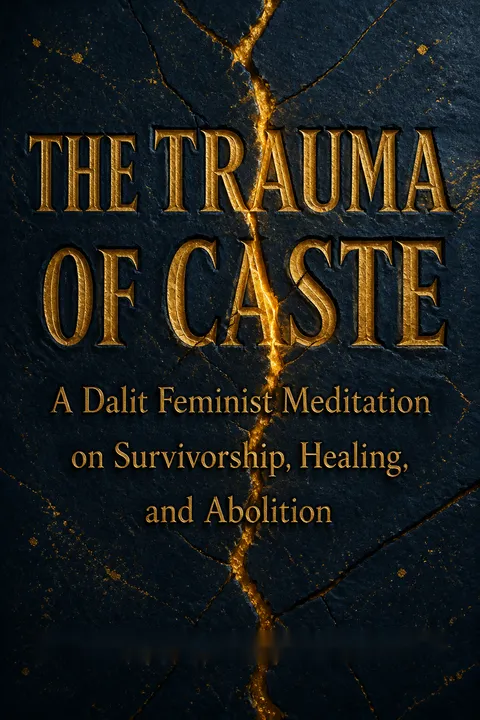


Key Takeaways
Treat caste as a living apartheid, not a vanished ancient custom.
Birth fixes the hierarchy. The book defines caste as an inherited ranking system built around ideas of purity and pollution. It can shape a person's work, residence, relationships, worship, and access to basic resources. Untouchability was outlawed in India in 1950, but the author argues that the social order persists through routine discrimination and violence. Her childhood discovery begins when her mother quietly tells her that their family is considered untouchable. At a classmate's home, the caste boundary becomes visible when the host changes the plate after learning the child's identity.
Numbers expose ordinary harm. The book cites Indian data reporting a crime against a Dalit every eighteen minutes, and denial of water access in 48 percent of surveyed villages. Such figures cannot contain the grief of individual lives, but they show that caste is not merely private prejudice or distant history. It is enforced through institutions and daily habits.
What's striking is the way a child's question turns an abstract hierarchy into intimate knowledge: a parent's evasions, a hidden identity, and a plate that marks a boundary. That sequence makes caste legible as both structure and experience. Statistics then widen the frame without replacing the story. The figures are drawn from particular reports and should be read with their context in mind, but their function is clear: to challenge the comforting idea that legal prohibition automatically ends a social practice.
Migration carries caste; build protections before silence becomes policy.
The ocean did not erase it. Soundararajan's parents left India believing that education and migration could put caste behind them. Instead, they entered South Asian networks in the United States where caste identity was concealed and dominant-caste norms often became the community default. The book traces this history from early South Asian laborers in North America, some of whom were excluded from shared meals, to later professional workplaces. It recounts the Cisco discrimination lawsuit and the author's account of caste bias around a Google event.
Policy can make harm visible. In Equality Labs' 2022 survey of 500 technology workers, 40 percent reported caste discrimination, including one in two Dalit respondents. The book says roughly 95 percent of technology companies lacked an explicit caste protection. Organizing changed policy at California State University, which added caste protections across 23 campuses serving more than 400,000 students.
The diaspora examples complicate a common story of migration as a clean break from inherited social relations. Networks, hiring, names, and informal workplace affiliations can carry old hierarchies into settings that lack language or procedures for recognizing them. Explicit policy does not solve every case, but it gives workers a route to report harm and institutions a duty to respond. The harder question is whether protections are backed by training, enforcement, and leadership that can recognize discrimination before a formal complaint arrives.
Name Brahminism, then question the stories that make hierarchy sacred.
Ideas authorize exclusion. The book uses Brahminism to name the ideology that legitimizes caste hierarchy and dehumanization. It argues that caste was not simply invented by British colonial administration: religious and legal texts had already been used to justify rank, exclusion, and punishment. In the Mahabharata story of Ekalavya, an Indigenous archer is denied formal teaching and then gives up his thumb when a privileged teacher demands it. A tale often presented as obedience becomes, in the author's reading, a lesson in how myth can make injustice look virtuous.
Knowledge is contested ground. At Berkeley, the author recalls professors discouraging her from studying caste even as the library held generations of anti-caste thought. She also describes textbook campaigns to remove Dalit history. The book examines caste across Hindu, Buddhist, Sikh, Christian, and Muslim communities, distinguishing doctrines from practices while insisting that no tradition is beyond critique.
The discussion of stories and curricula shows that power works not only by controlling resources, but by deciding which interpretations sound authoritative. A familiar legend can normalize unequal sacrifice; an omitted thinker can make resistance seem nonexistent. The book's cross-religious approach is strongest when it resists treating a community as uniform and asks how practices function in context. That distinction matters: criticism of a hierarchy is not the same as reducing every believer or tradition to that hierarchy.
Treat caste trauma as embodied harm, and pair inner repair with political abolition.
Injury outlasts the incident. The author uses caste stress for the psychological distress associated with caste discrimination. Repeated threat, humiliation, and denial can shape a person's habits and bodily responses, including vigilance, withdrawal, appeasement, and despair. She calls the cumulative historical pain a caste soul wound. Her argument is not that private healing replaces policy or material justice. Rather, political change alone may leave unaddressed the grief and disconnection that violence has carried into families and communities.
RAIN slows the reaction. Adapted from a mindfulness practice, RAIN means Recognize, Allow, Investigate, and Nurture. A person notices distress, makes room for it without immediately acting, examines what happened and their own interpretation, then considers what care or response is needed. The author presents grounding, breath, and somatic attention as ways to create room for deliberate action, not as a cure for caste oppression.
This framework connects social analysis to the moment when a person is most likely to react automatically. A pause can preserve agency and reduce the chance that pain becomes further harm within a family or movement. The book is also clear that regulation cannot neutralize an unjust environment. Trauma language is most useful here when paired with remedies to the conditions producing distress, and when somatic exercises are treated as supportive practices rather than substitutes for professional care or structural change.
Caste survives through control of intimacy, so make consent central to abolition.
Marriage polices the hierarchy. Caste passes through families, so endogamy, or marriage within one's caste group, helps preserve its boundaries. The book describes Brahminical patriarchy as the linked control of caste, gender, sexuality, and reproduction. Caste-based sexual violence can publicly shame a survivor and warn a whole community against resisting. The author cites a report estimating that more than 67 percent of Dalit women have experienced sexual violence, while emphasizing that violence also targets other genders.
Justice must include healing. Police, medical, and legal systems can retraumatize survivors through disbelief, humiliation, or neglect. The author distinguishes legal justice from healing and names relatives affected by violence as co-survivors. She also insists that movements confront gender-based abuse within their own communities rather than silence survivors to protect a group's reputation. Her great-grandmother's first blouse, given after a lifetime of caste restrictions on dress, becomes a small but vivid image of dignity returned.
The link between endogamy and social reproduction clarifies why control of intimate life is not a side issue in caste politics. Consent is a meaningful starting point because oppression narrows the ability to choose relationships, identity, and spiritual life. But consent language alone cannot dismantle the unequal conditions that make refusal dangerous or justice inaccessible. The section's insistence on addressing both external caste violence and internal community harm avoids a false choice between defending a group and protecting its members.
Call caste labor what it is: exploitation sustained by carceral power.
Work can become captivity. The author connects caste to slavery through coerced labor, inherited occupational exclusion, debt bondage, and the denial of control over land and livelihood. Jyotirao Phule's 1873 book Gulamgiri, meaning slavery, drew inspiration from the struggle against Black enslavement and helped establish the language of caste abolition. The comparison is not that these histories are identical, but that caste labor also involves systematic domination. The book reports that many cotton pickers in India are children, with a quarter under fourteen and another 35 percent aged fourteen to eighteen.
Control extends beyond work. The author describes caste as carceral because it regulates where people can live, whom they can love, and what forms of learning or worship are allowed. She cites disproportionate imprisonment of Dalit, Muslim, and Indigenous people in India. Caste abolition therefore means challenging not only discrimination but also the punitive institutions that reinforce it, while building restorative approaches that repair harm without reproducing domination.
Calling exploitative labor slavery makes a hidden relation of ownership and coercion harder to romanticize as tradition or village self-sufficiency. Historical comparisons can sharpen analysis, provided they preserve the distinct histories and political meanings of each system. The book's abolitionist frame also asks a more demanding question than whether punishment is deserved: what institutions prevent harm and restore safety? That question requires survivor-centered processes and material remedies, not simply replacing one punitive system with another.
Put caste-oppressed farmers at the center of climate decisions.
Land carries social history. The author connects caste to environmental destruction through land ownership, agricultural labor, and unequal access to water and other resources. Her mother's determination to garden during illness helps frame healing as inseparable from connection to soil and living systems. The book argues that people who work the land hold knowledge about crops, seeds, and local conditions that policy makers often overlook. At climate talks in Copenhagen, three Dalit women farmers reportedly burned their conference badges in protest at being excluded from decisions affecting their livelihoods.
Design with those affected. A just transition, as presented in the book, moves from an extractive economy toward regenerative livelihoods while addressing past harms and changing who holds power. That means treating caste equity, workers' rights, land, and climate adaptation as connected questions. The author calls for Dalit and Adivasi farmers to help design resilience plans, cooperatives, and sustainable food systems rather than being consulted after priorities have already been set.
The climate argument resists a narrow view of nature as scenery or a technical problem detached from labor. It asks who performs the work, who owns the land, and who gets to define a viable solution. That is a powerful corrective to policy processes dominated by distant expertise. Co-design still needs clear mechanisms for representation and accountability, since inviting affected people into a meeting does not automatically transfer decision-making power or resources.
Treat digital platforms as political infrastructure, not neutral town squares.
Online harm travels offline. The author argues that social media can reproduce caste hierarchy through harassment, surveillance, and disinformation. She describes the 2013 Muzaffarnagar violence, in which a widely shared video helped intensify communal tensions before riots that killed more than sixty people and displaced many others. For Dalit organizers, online platforms initially offered a way to publish stories without waiting for traditional media, but that visibility also made them targets of threats and coordinated attacks.
Design determines risk. The book criticizes technology companies for treating caste as an obscure or optional concern even when caste-based abuse is reported by workers and users. It recounts how a poster calling for an end to Brahminical patriarchy, held during a meeting with Twitter's leadership, triggered a global backlash and wider attention. The author argues for caste-aware moderation, worker protections, and technology built around consent and accountability, rather than assuming algorithms alone can solve political violence.
The section reframes platform governance as a matter of public safety and power, not merely content moderation. A service that shapes what people see and how quickly rumors spread can alter the conditions for political action. Yet no platform can repair the social conflicts it amplifies by itself. Effective accountability has to include transparent rules, contextual expertise, user safety, and pressure on the political networks that manufacture and distribute harmful narratives.
Use ancestor memory and cross-movement solidarity to build power.
Resistance has a lineage. The book gathers anti-caste figures such as B. R. Ambedkar, Savitribai Phule, Jyotirao Phule, Ayyankali, and Iyothee Thass, alongside everyday people whose acts of resistance were rarely recorded. Ambedkar's organizing for public water access and education, and Savitribai Phule's work to educate girls and oppressed communities, show that abolition has long involved building institutions, not only criticizing them. The author describes remembering ancestors as a practice of restoring dignity to people denied it in life.
Solidarity needs practice. The book traces connections between Dalit, Black, Indigenous, and other liberation movements, including Phule's engagement with Black abolitionism and the inspiration the Black Panthers provided to Dalit Panthers. It recalls the World Conference against Racism in Durban as a moment when movements shared public space and strategy. The practical lesson is to listen, learn, organize, and offer material support without collapsing distinct histories into one.
Ancestral memory can correct the sense that the present begins with injury, while movement histories offer tested examples of collective strategy. Solidarity becomes more than emotional recognition when it changes who receives resources, whose knowledge is centered, and who takes risks alongside whom. The book's insistence on difference within connection is essential: comparison can build alliances, but only if each community retains authority over its own experience and goals.
Treat genocide prevention as present work, not retrospective mourning.
Atrocities develop in stages. Writing in 2022, Soundararajan warned that laws, citizenship rules, detention infrastructure, and dehumanizing rhetoric in India could expose caste-oppressed, Indigenous, and religious minorities to mass exclusion and violence. She points to the proposed interaction of the Citizenship Amendment Act and National Register of Citizens, and to the use of personal records to identify targets during earlier pogroms. Her argument is that genocide is a process, not only a final episode of mass killing, and warning signs demand attention before violence reaches its most visible stage.
Responsibility is shared. The author calls on governments, companies, diaspora communities, and individuals to challenge disinformation, demand accountability, and protect those under threat. She argues that the work cannot be placed solely on people already facing violence. For her, choosing life means acting through political pressure and community relationships, while refusing the comfort of treating business as usual as neutrality.
The preventive frame is morally forceful because it shifts attention from retrospective condemnation to decisions made while institutions are still being reshaped. Such warnings deserve serious engagement, careful evidence, and continuing scrutiny, especially when a political diagnosis is made at a particular historical moment. Urgency and rigor strengthen each other: credible documentation, protection of civil liberties, and attention to targeted communities can make early action more persuasive and more effective.
Analysis
The book's central achievement is to make caste visible at several scales at once. It begins with a child learning that her family is treated as untouchable, then tracks the same hierarchy through scripture, education, labor, marriage, policing, technology, and migration. The result is not a detached account of a social system but a theory of how domination is reproduced in institutions and embodied in relationships. Its four-meditation structure gives that argument a movement: recognize suffering, examine its sources, identify routes of liberation, and imagine an ending.
The book's most distinctive claim is that abolition must be both structural and intimate. Laws and workplace protections matter, but so do grief, consent, inherited fear, and the habits that make people repeat exclusion. The RAIN practice gives readers a small method for responding to conflict without confusing regulation with justice. That distinction is essential. Somatic attention can support agency, but it cannot substitute for safety, income, legal recourse, or institutional accountability. The book largely holds these dimensions together rather than presenting healing as a private solution to public harm.
Its comparisons with Black, Indigenous, and other liberation struggles generate useful solidarity while requiring care. The author repeatedly signals that parallel systems are not interchangeable histories. That qualification helps preserve specificity, even as the language of slavery, apartheid, and genocide invites debate about analogy and scale. The claims about political developments are anchored in the book's 2022 context, so readers should distinguish its urgent warning from a current assessment of events.
The work is also a challenge to who gets to produce knowledge. Its recovery of anti-caste thinkers and its critique of academic gatekeeping make historical interpretation part of political struggle. The book asks readers not only to learn about caste, but to examine what their institutions reward, conceal, or call neutral. Its lasting proposition is demanding: freedom requires changing the structures that injure people and the relationships through which those structures become ordinary.
Glossary
Caste apartheid
Caste-based segregationThe book's political term for systematic segregation, discrimination, and violence organized by caste. Soundararajan prefers it to the neutral phrase caste system because it emphasizes the coercion and dehumanization that sustain caste hierarchy. The term also highlights that caste is not simply an old social custom, but an ongoing structure affecting access to work, housing, relationships, education, and public life.
Brahminism
Ideology legitimizing caste dominanceThe ideology that, in the book's account, justifies caste hierarchy and the dehumanization of caste-oppressed people. Though the author traces its authority to Brahminical texts and institutions, she uses the term for a broader structure that can be reproduced across social and religious settings. It names a system of power, not an accusation that every Brahmin individual acts in the same way.
Brahminical patriarchy
Caste hierarchy through gender controlThe book's term for the way caste and patriarchy reinforce each other through control of reproduction, sexuality, family, and gendered behavior. Because caste is passed through family lines and preserved by endogamy, women's and gender-diverse people's choices become central sites of caste regulation. The concept links caste hierarchy to gender-based violence, restrictions on relationships, and unequal control over bodily autonomy.
Caste soul wound
Historical pain carried across generationsThe deep emotional and spiritual pain produced by caste violence and its effects across generations. The concept includes more than an individual's response to a single event: it encompasses accumulated grief, denial, disconnection, and inherited patterns shaped by historical and ongoing exclusion. The book treats recognition and care for this wound as necessary parts of abolition, alongside political and material change.
Caste stress
Distress linked to caste experiencePsychological distress associated with experiencing or anticipating caste discrimination. The book describes possible effects such as fear, anger, vigilance, isolation, sadness, and self-doubt, which may also affect physical well-being. Caste stress can arise from an actual discriminatory event or from the body's response to the possibility of caste harm. The term makes the emotional costs of caste more visible.
RAIN framework
Four-step mindful responseA mindfulness practice adapted to caste stress from a framework developed by meditation teacher Michele McDonald and used by Ruth King. RAIN stands for Recognize, Allow, Investigate, and Nurture. A person notices distress, allows it to be present without immediate reaction, examines the event and their response, then considers what care or action is appropriate. The practice aims to support intentional responses, not replace structural remedies.
Debrahminization
Undoing Brahminical dominanceA multilayered practice of challenging Brahminical power within people, relationships, and institutions. In the book, it includes political, economic, geographic, and psychosocial change, as well as support for Dalit-Bahujan leadership and anti-caste movements. The term refers to dismantling a hierarchy and its practices, not attacking people identified as Brahmins.
Dhamma
The duty to seek freedomThe book's use of the Buddhist Pali term for a liberatory duty to inquire, choose one's conditions, and work toward freedom from caste and other forms of oppression. Soundararajan distinguishes this meaning from the Hindu use of dharma as a cosmic order that can demand submission to caste-based duties. In this interpretation, spiritual practice is connected to confronting material suffering.
Institutional murder
Systemic responsibility for despairA term used by Dalit activists to shift attention from an individual suicide to the institutional conditions that produce despair. It emphasizes how discrimination, exclusion, harassment, and failures of care can make a person's life feel unlivable. The phrase rejects the idea that the individual alone bears responsibility and calls for accountability from the society and institutions that shaped those conditions.
Mettāverse
A compassionate shared futureSoundararajan's term for a shared reality imagined around loving-kindness, trust, consent, and equitable relationships. It contrasts with corporate visions of digital worlds that reproduce surveillance, bias, and exploitation. The mettāverse is both a thought experiment and a design challenge: imagine collective spaces built to support freedom and connection, then use that vision to guide real-world organizing and technology.
Caste abolition
Transforming caste across societyThe book's broad project of ending caste oppression through connected political, social, cultural, economic, spiritual, and embodied change. It draws on Dalit resistance and Black abolitionist traditions, while aiming beyond the removal of a single discriminatory rule. Caste abolition includes building protections and accountability, addressing inherited harm, supporting oppressed communities' leadership, and creating relationships and institutions that do not reproduce hierarchy.
Download PDF
Download EPUB
.epub digital book format is ideal for reading ebooks on phones, tablets, and e-readers.








