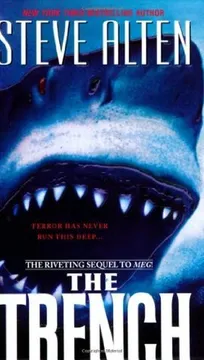


Plot Summary
Prologue
Seven miles beneath the Pacific, the submersible Proteus surveys hydrothermal vents while its impatient project leader pressures pilot Barry Leace to move faster. Arie Levy, posing as Khali Habash, watches sonar register three enormous shapes closing in. The crew cannot reach the surface ship through the storm.
When the creatures strike, they tear at the hull and drive the sub toward the larger predator. A glowing eye appears at the porthole; the pressure splits the vessel’s plates, and Arie is killed by a rivet as the cabin floods. Geo-Tech calls the disaster an accident, but its hidden sonar record points toward something alive in the trench.
The opening turns scientific exploration into a test of judgment under pressure. Leace understands that caution is not cowardice at these depths, yet institutional urgency and Richards’s bullying make the crew ignore the danger until options vanish. Arie’s death gives the reader a second, human cost beyond the physical destruction: he has reached the secret he was sent to uncover but cannot report it. The official explanation matters because the catastrophe is not merely a monster attack. It becomes the first contested piece of evidence in a larger struggle over who controls knowledge of the deep.
Jonas Refuses the Trench
Jonas Taylor wakes from a recurring nightmare in which a giant shark swallows his wife, Terry. His assistant reports that Angel, the enormous Megalodon kept at the Tanaka Institute, is again attacking the gate between her lagoon and the Pacific. Jonas wants the doors reinforced, but the Institute is cash-strapped after a lawsuit over earlier deaths, and its new owner, billionaire Benedict Singer, controls the money.
Singer also demands Jonas’s help investigating the Proteus disaster in the Mariana Trench. Jonas refuses even a surface meeting, convinced the abyss is where he is destined to die. Terry, hurt by his obsession and exhausted by their grief over a stillborn child, leaves with her father, Masao, to meet Singer.
Jonas’s refusal is less a simple phobia than an attempt to make fear predictive: if he avoids the Trench, he can pretend to control the death he imagines waiting there. That strategy has consequences at home. Terry experiences his vigilance as emotional absence, while he experiences her departure as confirmation that disaster is closing in. The threatened gate binds the domestic and institutional conflicts to the physical plot. Jonas knows Angel is becoming difficult to contain, yet his dread keeps him from confronting the place where the danger began.
Three Boys Enter
At dusk, three teenagers use a crowbar to enter the closed lagoon arena. They reach the underwater viewing corridor while Angel is feeding, spray-paint the glass, and provoke the shark by banging on it. The boys mistake the animal’s repeated charges for a game. Angel strikes the LEXAN window hard enough to shatter it, flooding the corridor and pinning the teenagers against its walls.
Jonas and his friend Mac arrive after the breach; emergency doors seal the viewing area, but Jonas sees Angel surface with one boy’s remains before consuming them. All three boys die. The attack shuts the arena and gives Singer’s CEO, Celeste, a new crisis to manage, while Jonas’s fear that the lagoon cannot hold Angel becomes harder to dismiss.
The boys’ deaths expose the gap between controlled spectacle and actual control. The arena sells proximity to a predator while asking visitors to trust barriers built for a different purpose. Their reckless behavior contributes to the immediate disaster, but the institution’s commercial framing has taught the crowd to treat danger as entertainment. Jonas reads the breach as evidence that the enclosure is failing; Celeste sees a legal and public-relations problem. Their competing interpretations foreshadow a broader conflict over whether human lives are safeguards to protect or costs to manage.
Angel Breaks Free
After the boys’ deaths, Jonas insists on inspecting the canal doors himself before Singer will approve repairs. Mac takes him by boat to the submerged gate, where Jonas finds its hinges buckling under Angel’s repeated impacts.
Several male great white sharks circle him, drawn by Angel’s scent while she is in estrus. One bites deep into his leg. Angel then smashes through the weakened doors, forcing Jonas behind a torn panel as she bursts into open water.
Mac fires a tracking dart into her dorsal fin and hauls Jonas aboard, pinching a severed artery until help arrives. In hospital, Jonas learns that Angel is loose and moving north. He agrees to join Celeste’s capture effort, determined to stop the shark and to make amends for the lives already lost.
Jonas’s return to the water is both an act of responsibility and a repetition of the behavior that has damaged his life. He knows the gate is failing, but his response is perilously improvised. The male sharks’ presence reveals that Angel’s behavior has a biological cause rather than the simple appetite Jonas first assumes. The tag gives the human characters a way to follow her, but it does not restore control. Jonas’s injury makes the pursuit personal and physical, while the escape turns his feared catastrophe into reality.
Terry Boards the Benthos
Aboard Singer’s research ship, the Goliath, Terry explores a concealed laboratory built into an old missile silo and finds a huge doughnut-shaped machine labeled as a tokamak. She cannot determine what Singer is doing, but she records the term.
When the Proteus investigation stalls, Singer persuades her to descend with him aboard the submersible Prometheus, ostensibly to convert sonar records for the Japanese science agency. At the bottom, he reveals the Benthos, a vast deep-sea laboratory, and opens its observation dome onto the hydrothermal world below.
Terry is awed by the strange life around the vents, but notices that Singer controls access and information. She begins examining the sonar data and sees evidence that the official account of the Proteus disaster may be false.
Terry’s curiosity becomes a form of agency, but it also provides Singer with leverage. He turns her sense of responsibility to her father’s institute into a reason to enter an environment where he controls the doors, the records, and the crew. The tokamak is introduced as a question before Terry has the knowledge to interpret it, creating a counterplot beneath the expedition’s public mission. Her response to the abyss differs from Jonas’s: wonder initially outweighs fear, but beauty does not make her trust the person who has brought her there.
The Coast Guard Falls
As Angel follows migrating whales north, she attacks a humpback and its calf near Half Moon Bay, then turns toward the commotion of a Coast Guard training vessel near Cape Disappointment. The shark strikes the Chinook in violent surf, capsizing it and killing two crew members.
Lieutenant Eric Wisdom and cadet Geary survive in the water, but Angel hunts among the wreckage. Jonas and Mac reach the scene by helicopter. Jonas pulls Wisdom aboard, then jumps into the sea and secures Geary, dangling from the aircraft’s cable while Angel lunges beneath them.
The rescue leaves Jonas exhausted and deepens his fixation on stopping the shark. Celeste’s team continues north, with scientist Michael Maren urging a rapid capture despite Jonas’s warnings about the conditions.
The Coast Guard sequence makes the human cost of the pursuit impossible to keep abstract. Jonas saves people by accepting the same kind of physical risk that once caused catastrophe, and the distinction between courage and self-destruction grows difficult to maintain. Maren treats danger as a problem of timing and data; Jonas recognizes that the shark’s behavior can outrun prediction. Their conflict is not simply expertise versus ignorance. It is a clash between confidence in models and attention to the living animal’s capacity to surprise.
Grays Harbor Trap
Sea World’s rescued gray whale calf, Tootie, has settled in Grays Harbor, and Angel follows her scent into the bay. Jonas warns that the shark will move faster than the capture team expects, but the trawler crew nets Tootie before they can pull her safely aboard. Angel arrives, tears free of the fishing gear, and drags the damaged trawler through the water.
The shark then attacks the wooden Lady Washington, which carries a wedding party, sinking the ship and overturning its rafts. Pilot Richard Diefendorf dives in the Abyss Glider to draw Angel away while rescuers pull passengers aboard the William Beebe. The shark destroys his sub and kills him. Angel escapes the bay, and the tracking device is lost in the struggle.
The failed trap is built from reasonable intentions that become dangerous when treated as pieces in a plan. Sea World wants to save Tootie, Celeste’s team wants to capture Angel, and Jonas wants to prevent another public disaster. Yet the calf is made into bait, and the attempt to contain the shark creates new victims. Dief’s sacrifice briefly changes the focus from capture to rescue, but it cannot undo the consequences of entering a crowded harbor with an exhausted predator. Angel’s escape also strips the pursuit team of its clearest tracking advantage.
The Ferry Becomes Prey
On Vancouver Island, Angel attacks a group of sea kayakers, killing travel writer Andrea Jacobs and leaving the survivors scrambling toward shore. She then strikes the ferry Lady Rose. Jonas and Mac arrive by helicopter as crew members pull one kayaker aboard, but fourteen-year-old Kevin Blaine falls into the sea and is eaten before anyone can reach him.
Jonas fires a second tracking dart into Angel as she turns away. He and Mac locate the remaining kayakers, but the shark attacks again near a pier, collapsing part of it and driving a couple through a seafood restaurant as the building breaks apart. Jonas’s new tag lets the crew resume the chase, but the killings have made clear that no shoreline or rescue operation is safe.
The second tag restores the pursuit but cannot restore the people lost along the way. The sequence repeatedly turns ordinary structures into unstable refuges: kayaks, ferry rails, a pier, and a restaurant all fail when Angel follows vibration and motion. Jonas’s response has become more capable, yet his ability to act does not make him master of the event. The scene also clarifies the shark’s sensory logic. It does not hunt out of malice; human activity becomes part of a landscape its instincts read as prey or disturbance.
Jonas Dies in the Gulf
Near Kodiak Island, Jonas rigs a sea lion carcass with anesthetic and an underwater speaker, then waits in a towed Zodiac to shoot Angel when she feeds. His grenade rifle will not fire, and the Zodiac’s towline has been cut. Jonas clings to the bait as Angel destroys the raft and lunges at him.
Mac pulls him aboard, but Jonas’s body temperature collapses; his heart stops before doctors revive him. Celeste visits him in hospital and secretly drugs him to obtain the coordinates of Devil’s Purgatory, the place where he first saw a Megalodon.
Meanwhile, Mac forces Maren to admit he disabled Jonas’s rifle, and the first officer, Harry Moon, reveals that he is a CIA operative. Jonas wakes with a changed understanding of his guilt, but the stolen coordinates send the danger back toward Terry.
Jonas’s brief death interrupts the story’s equation of survival with moral repair. He had treated killing Angel as the only way to settle every debt, but the attempt nearly makes him another casualty without protecting anyone. His renewed willingness to live is genuine, yet Celeste exploits it before he can act on it. The sabotage and drugging show how human manipulation compounds the natural threat. The shark is dangerous because of its scale and instincts; the expedition becomes dangerous because people conceal motives and turn one another into instruments.
The Trench Was the Prize
After Jonas shares the coordinates while drugged, the Benthos changes course for Devil’s Purgatory. Masao learns from CIA officials that Singer’s real aim is not seismic research but manganese nodules containing a rare helium isotope that could fuel a sustained fusion reaction. The agency admits it helped push the Tanaka Institute toward bankruptcy so Singer would acquire it and gain a legitimate reason to enter the trench.
Terry’s false report to the Japanese agency has also helped keep the operation moving. As Jonas returns to the sea, Angel follows the Pacific’s volcanic and seismic chain toward the Mariana Trench. A migrating sperm whale challenges her near Japan, but she kills it and continues south, accompanied by male great whites.
The revelation recasts the expedition’s respectable language as camouflage. Scientific infrastructure, public safety, and even the Tanaka family’s financial collapse have been folded into a geopolitical contest over energy. The CIA’s involvement complicates any easy opposition between a lawful government and an unscrupulous corporation: both have treated the Tanakas as expendable means to an end. Angel’s return to the Trench is driven by biological orientation, while the human return is driven by resource extraction. Their paths converge for different reasons, but both threaten the fragile life that already occupies the abyss.
The Hunters Have Gills
Aboard the Benthos, Terry endures Singer’s crew and learns that paleobiologist Heath Williams is secretly working for the CIA. Heath identifies a fossil as a Kronosaurus, a marine reptile that has adapted to the trench and now hunts in packs.
Terry also discovers Singer’s fusion operation: the manganese nodules contain helium-three and deuterium, the fuel source his partners hope to monopolize. Singer’s team mines the deposit despite repeated Kronosaur attacks.
Sergei, a violent guard, assaults Terry and later kills Captain Hoppe; Terry fights back and floods the hangar, killing Sergei. The Epimetheus is then struck while returning its load, imploding in the docking chamber. Terry survives, but Singer keeps her aboard because she knows too much.
The ancient predator is not an isolated marvel but part of an ecosystem that has survived by adapting to conditions humans barely understand. Singer’s mining project treats that ecosystem as a cache of resources and assumes engineering can neutralize whatever resists extraction. Terry’s survival depends on practical judgment rather than the heroic abstractions Singer uses to discipline his crew. Her fight against Sergei marks a shift from frightened witness to active opponent, though the violence does not free her. Knowledge gives her leverage, but it also makes her a target.
Celeste Turns on Singer
When Angel and the Kronosaurs threaten the damaged Benthos, Terry escapes confinement through an air duct, but Celeste catches her and locks her in the hangar. Singer has already learned that Terry can resist his control and orders her disposal. Celeste secretly drugs Singer, then confronts him with the truth she has long suspected: he murdered her mother.
He admits he fathered Celeste and used her mother in his political and business schemes. Celeste leaves Singer bound beneath the observation dome, where a Kronosaur smashes through the glass and kills him. She flees aboard the Prometheus with the mined nodules, but Angel attacks the sub as it climbs out of the hot layer. The vessel implodes, killing Celeste and its crew.
Celeste’s rebellion breaks the personal hierarchy that has held Singer’s expedition together, but it does not create a moral alternative to his rule. She has learned to use manipulation as he taught her, and her revenge is precise, intimate, and inseparable from the power she wants to inherit. Singer’s admission reveals that his paternal language concealed possession rather than care. Yet neither child nor parent can control the environment surrounding them. Their private reckoning ends inside a conflict neither of them can command.
A Barrel Holds Terry
Jonas descends in the deep-water Abyss Glider after seeing that the footage of the Epimetheus disaster was edited: Terry had left the camera’s view before the implosion. Celeste claims Terry is dead, then directs Jonas toward the Benthos hangar, where she has trapped her alive.
As the mother ship buckles under pressure and Kronosaurs attack, Terry escapes her bonds and climbs into an opened UNIS robot barrel, sealed against the abyss. Jonas reaches the hangar in his damaged sub and kills a Kronosaur when the chamber depressurizes.
He recognizes the missing control panel as evidence that someone has hidden inside the robot, opens the barrel, and revives Terry. Together they force their way into the controls, then launch the Abyss Glider’s emergency pod as the Benthos collapses around them.
The rescue turns an instrument designed to record seismic danger into a shelter from it. Terry survives through improvisation, while Jonas survives the descent only by abandoning his belief that his nightmares dictate the ending. Their reunion is therefore not a simple reward for courage: each has to recognize the other’s agency. The edited recording and the concealed body in the barrel make perception itself part of the survival problem. What appears to be a death can be a manipulation; what looks like equipment can become a refuge when someone notices its unused capacity.
The Nightmare Breaks
The powerless escape pod rises from the wreck of the Benthos with Jonas and Terry inside. Angel follows it through the hydrothermal layer, just as Jonas’s recurring nightmare has foretold. A Kronosaur attacks first, clamping its jaws around the pod and trying to reposition it for a bite. Angel lunges at the reptile, crushes its skull, and turns back into the trench rather than pursuing the escaping couple.
Jonas and Terry continue upward, and the pod finally breaks the surface. They activate its distress beacon; the William Beebe arrives with Mac and Masao aboard the rescue boat. Jonas and Terry cling to each other as help reaches them, and Jonas begins to imagine a life no longer organized around the shark or his guilt.
The ending does not make Angel benevolent; she saves the couple because another predator is competing for food. That contingency matters. Jonas’s liberation comes not from defeating nature but from surviving an encounter whose outcome he cannot command. The dream’s imagery is repeated, but its emotional meaning changes: Terry is beside him, and the expected death does not arrive. Their rescue gives Jonas a chance to make a future-oriented choice, while the shark’s return to the trench preserves the ecological danger beyond the human characters’ escape.
Epilogue
Back in the trench, Angel gives birth to two male pups, each large enough to hunt. She immediately chases them, but they are faster and scatter among the black smokers. Unable to catch them, she turns instead toward the Kronosaurus that still feed her species.
The Megalodon has returned to the warm depths where her kind survived, but the birth of her young does not promise safety. The mother is their first predator, and the ancient reptiles remain their next threat.
The epilogue refuses to let survival become a tidy victory. Angel’s escape from captivity has restored her to a habitat, but the habitat is a food web governed by hunger rather than sentiment. Her pups inherit danger from both parent and ecosystem, while Angel’s maternal role is immediately subordinated to predatory instinct. This ending also widens the novel’s time scale: the human crisis occupies days, but the trench holds an evolutionary struggle that will continue after Jonas and Terry return to the surface. Human intervention has altered the system, yet cannot simply master or end it.
Analysis
The Trench builds its thriller from a collision between biological time and human urgency. Angel follows scent, migration, temperature, and instinct; Singer’s expedition follows deadlines, contracts, and the promise of fusion power. Neither system is fully predictable, but Singer behaves as if wealth and technology can make uncertainty obey. The repeated failures of gates, trawls, nets, subs, and hulls show that engineering can create temporary margins of safety without abolishing ecological force.
Jonas’s arc turns on the difference between responsibility and self-punishment. He initially treats survival as evidence that he has evaded a death meant for him, then tries to settle his guilt by destroying Angel. His near-death experience exposes the hollowness of that bargain. Terry, meanwhile, moves from being caught between her husband’s absence and her father’s expectations to acting decisively inside Singer’s coercive world. Their reunion works because both must see the other as an active person, not a burden or a rescue mission.
The novel also complicates the usual divide between private villainy and public virtue. Singer exploits the Tanaka family for a secret energy project, but intelligence agencies have helped make the family vulnerable in pursuit of their own strategic aims. The institutions differ in legality and rhetoric, yet both treat ordinary people as instruments. Against that human machinery, the trench’s predators are terrifying but not morally corrupt. Their attacks arise from hunger, defense, and habitat. The ending offers no conquest of nature, only survival, renewed attachment, and a reminder that the deep world continues beyond the humans’ sight.
Review Summary
The Trench receives mixed reviews, with an average rating of 3.89/5. Many readers enjoy the action-packed plot and prehistoric shark thrills, praising it as entertaining popcorn fiction. However, some criticize the excessive subplots, underdeveloped characters, and perceived misogyny. The book is seen as a guilty pleasure by some, while others find it disappointing compared to its predecessor. Despite its flaws, fans appreciate the marine biology details and intense shark scenes, making it an enjoyable read for those seeking escapist entertainment.
Characters
Jonas Taylor
The haunted shark expertJonas is a former Navy submersible pilot turned paleobiologist, known for having encountered a Megalodon in the Mariana Trench. He is married to Terry and works at the Tanaka Institute, where he helped capture Angel. Jonas is intelligent and observant, but his sense of responsibility has become tangled with guilt over earlier deaths and the consequences of his decisions. He responds to fear by trying to make the danger disappear, sometimes through avoidance and sometimes through reckless action. His knowledge of sharks and the abyss gives him unusual insight, but it cannot protect him from grief or guarantee control.
Terry Taylor
The resourceful explorerTerry is Jonas’s wife and Masao Tanaka’s daughter, an experienced pilot and ocean researcher with a strong appetite for discovery. She loves her family but has grown frustrated with Jonas’s absorption in Angel and the losses surrounding the Institute. Terry tends to act when uncertainty becomes intolerable, even when she lacks full information. Her curiosity leads her toward Singer’s hidden technology, while her ability to improvise helps her navigate the dangers of the Benthos. Beneath her confidence is a deep sensitivity to abandonment, grief, and the fear of being treated as someone else’s responsibility rather than an equal partner.
Benedict Singer
The abyssal empire-builderSinger is a wealthy energy magnate who finances Geo-Tech Industries and takes control of the Tanaka Institute. Eccentric, cultured, and skilled at reading people, he presents himself as an explorer advancing humanity’s knowledge. In practice, he values power, obedience, and the freedom to pursue ambition without oversight. He recruits people whose vulnerabilities make them dependent on him, then frames that dependence as loyalty or purpose. His confidence in technology and personal judgment is immense, but his rhetoric about courage often serves to silence reasonable objections.
Celeste Singer
Singer’s ambitious protégéCeleste is Geo-Tech’s formidable executive and Singer’s protégé, raised within his orbit and trained to wield influence in a male-dominated corporate world. She is polished, provocative, and adept at changing her manner to suit the person she wants to persuade. Her relationship with Singer blends dependence, fear, affection, and ambition, making her difficult for others to read. Celeste values control because she has learned that vulnerability can invite exploitation. Her interest in Jonas is partly personal and partly strategic, and she is constantly measuring whether loyalty or self-preservation better serves her future.
Mac Mackreides
Jonas’s steadfast pilotMac is an ex-Navy helicopter pilot, Jonas’s closest friend, and a blunt, dependable presence in the pursuit of Angel. He uses humor and profanity to disguise how seriously he takes danger, but his actions repeatedly show loyalty and practical courage. Mac recognizes Jonas’s self-destructive guilt because he has lived through trauma of his own. He does not soften difficult truths, especially when Jonas confuses sacrifice with responsibility. His willingness to challenge his friend makes him more than a sidekick: he serves as Jonas’s anchor to a life beyond the hunt.
Masao Tanaka
The institute’s aging founderMasao founded the Tanaka Oceanographic Institute and is Terry’s father. He sees the institute as a life’s work, not merely a business, and its financial collapse weighs heavily on him. A patient mentor to Jonas, Masao understands the depth of his fear but also expects him to accept responsibility. His affection for both Terry and Jonas makes him vulnerable to the conflicts that surround the expedition. He values scientific purpose and family loyalty, though the pressures of the story force him to confront how much powerful institutions have manipulated those commitments.
Heath Williams
The fossil specialistHeath is introduced as a paleobiologist recruited to examine fossils recovered from the trench. Quiet and observant, he studies the physical evidence rather than accepting the expedition’s preferred explanations. His specialty in ancient marine reptiles makes him useful when the crew encounters unfamiliar predators. Heath is cautious about exposing himself, but his concern for Terry leads him to offer practical help when she is isolated aboard the Benthos. He represents a form of expertise that depends on revising conclusions as evidence changes.
Michael Maren
The capture-team scientistMaren is an ichthyologist hired to organize Angel’s recapture. He trusts calculations, schedules, and technical plans, and he resents Jonas’s authority even when Jonas’s experience offers a useful warning. Maren’s abrasiveness is partly professional arrogance and partly a need to establish himself in a mission dominated by larger personalities. He sees Jonas as emotionally compromised, but his own confidence can make him underestimate the risks created by a changing animal and a crowded environment.
Sergei
Singer’s violent enforcerSergei is a member of Singer’s personal staff, a Russian guard whose authority aboard the Benthos comes from his access and his employer’s protection. He is volatile, physically intimidating, and made more dangerous by his drinking. Terry recognizes that the ship’s formal rules offer little protection from him. Sergei’s behavior reveals the coercive culture Singer has built among his employees, where fear and impunity often replace ordinary accountability.
Richard Diefendorf
The submersible pilotDief is a former Navy man and experienced test pilot hired to operate an Abyss Glider during Angel’s recapture. He is capable and candid about the limits of his deep-water experience, a useful contrast to the overconfidence around him. His willingness to enter dangerous water reflects professional courage rather than ignorance of the risk. Dief’s role connects the surface pursuit to the close-quarters work required to restrain a giant animal.
Captain Breston Hoppe
The Benthos captainHoppe commands the Benthos and is one of the few people aboard willing to question Singer’s timetable. He understands that a captain’s duty extends to the crew, not merely to the mission’s success. His past is marked by alcoholism and personal tragedy, which helps explain his loyalty to the organization that gave him another purpose. Hoppe’s caution is not timidity; it is professional judgment shaped by the knowledge that a small mistake at depth can kill everyone aboard.
Tootie
The rescued whale calfTootie is a gray whale calf rescued after stranding and raised by Sea World before being released near migrating whales. Her presence in Grays Harbor attracts both rescuers and Angel. Tootie’s vulnerability drives the harbor capture plan, turning a well-meant animal rescue into part of a dangerous attempt to trap the shark. She embodies the difficult boundary between care for wildlife and the human tendency to intervene without controlling the consequences.
Arie Levy
The undercover observerArie is a Mossad agent embedded in Singer’s organization under the name Khali Habash. He is observant and disciplined, balancing a dangerous assignment with thoughts of his wife and children. His position allows him to witness the Proteus disaster from inside the sub, placing a human face on the mission’s hidden intelligence contest.
Plot Devices
SOSUS tracking beacon
The shark’s moving signalMac obtains a dartlike transmitter that Jonas fires into Angel’s hide as she escapes the lagoon. Its low-frequency signal can be detected through the Navy’s underwater listening system, allowing the crew to estimate her direction and movement across the coast. The beacon makes a wide-ranging pursuit possible, but it does not tell the humans what Angel will do next. It is torn away during the failed Grays Harbor capture, forcing Jonas to place a second tag during the ferry attack. Tracking therefore remains provisional, dependent on equipment that can fail and on human interpretation of incomplete data.
UNIS pressure barrels
Seismic sensors become shelterThe Unmanned Nautical Information Submersibles are titanium housings designed to be buried along the trench floor and record seismic activity for the Japanese agency. Their sturdy, pressure-resistant shells protect delicate instruments in a place where ordinary equipment would collapse. Singer’s crew treats them as tools for a public scientific mission, while the robots also serve the secret work taking place below. The barrel’s construction eventually offers a desperate refuge when the Benthos hangar floods. Its function shifts from gathering information about the earth to preserving a human body from the pressure surrounding it.
Helium-bearing nodules
A hidden energy sourceManganese nodules gathered from a particular hydrothermal region contain a rare mixture of helium-three and deuterium. Singer’s scientists believe this fuel can stabilize a fusion reaction and provide a major energy advantage. The search for the nodules explains why Geo-Tech has built a fleet of deep-sea vessels and why Singer presses his crews to continue despite mounting casualties. The Japanese seismic project and Proteus investigation provide cover for reaching the site. The nodules turn the trench into a geopolitical prize, linking the intimate danger aboard the Benthos to a contest over future energy and power.
Hydrothermal ecosystem
A hidden world’s life supportThe vents release superheated, mineral-rich water that creates a warm layer beneath the trench’s cold depths. Bacteria and other organisms draw energy from chemicals rather than sunlight, supporting tube worms, shellfish, fish, and larger predators. The layer explains how prehistoric species could persist in the abyss and why the Kronosaurs cannot follow the Benthos into colder water above it. It is both habitat and boundary: humans depend on machines to enter it, while the creatures are adapted to its particular conditions. The environment is not empty wilderness but a living system that resists being treated as an inert mine.
Jonas’s recurring nightmares
Fear rehearses the returnJonas repeatedly dreams of descending into the Mariana Trench and seeing Terry threatened by Angel. The nightmares begin amid his guilt over deaths connected to earlier dives, the Megalodon capture, and the loss of his and Terry’s child. They shape his refusal to return to the abyss, then intensify as Terry descends without him and Angel’s route bends back toward the trench. The visions do not provide reliable prophecy, but they make Jonas interpret coincidence as destiny. Their narrative function is psychological: they show how guilt can turn memory into a forecast and how that forecast can push someone toward the danger he fears.
Download PDF
Download EPUB
.epub digital book format is ideal for reading ebooks on phones, tablets, and e-readers.








