

Key Takeaways
Treat meaning as a human need, not a reward for getting well
Comfort does not complete life. Frankl calls his approach logotherapy, a form of psychotherapy that takes the search for meaning seriously. He argues that resolving symptoms or meeting material needs may still leave a person asking what life is for. He calls the resulting emptiness the existential vacuum. In one report he cites, 85 percent of 60 students who had attempted suicide said life seemed meaningless, although 93 percent were socially active, doing well academically, and on good terms with family. This was a small, specific sample, not a universal statistic. It illustrates his point: visible success and support do not guarantee purpose.
Listen beneath the symptom. Frankl argues that therapy can address distress linked to biology, learning, or psychological conflict while also asking whether a frustrated search for meaning contributes to it. Meaning is not a substitute for care, but it may be part of what care needs to hear.
What's valuable here is the distinction between functioning and feeling that life is worth inhabiting. Contemporary well-being research likewise treats purpose as related to, but not identical with, pleasure or life satisfaction. Frankl's framing gives clinicians and readers a reason to ask what a person cares about, not only what is wrong. The caution is equally important: meaninglessness is not a diagnosis by itself, and suicidal distress needs serious clinical attention. Material hardship, illness, and social isolation cannot be solved by exhorting someone to find purpose.
Find the distinct meaning hidden in the situation before you
Meaning is specific. Frankl distinguishes values, which traditions can pass between generations, from meanings, which must be discovered in particular circumstances. He describes three broad routes: creating or doing something, experiencing something or loving someone, and choosing a response when suffering cannot be changed. A noögenic neurosis, in his terminology, is distress that arises from frustration of the will to meaning, rather than from psychological conflict alone.
No universal script applies. Frankl recounts Yehuda Bacon, who survived Auschwitz as a child and later came to understand his suffering through the personal change it prompted. The example does not make suffering good or necessary. It shows how a person might find meaning in a response to an ordeal, even when the ordeal itself is senseless. A therapist can help someone explore possibilities, but cannot assign that person's meaning for them.
The situation-specific account avoids turning purpose into a single achievement, career, or creed. It also resembles practical ethics: the right action can depend on the people and constraints present, not an abstract rule alone. Yet meaning found in suffering must remain the sufferer's discovery. If helpers insist that pain is an opportunity or a lesson, they risk blaming people for circumstances they did not choose. Frankl's strongest formulation is not that every tragedy contains a hidden benefit, but that a person's response may still matter when circumstances cannot be changed.
Direct your life toward a person or purpose beyond yourself
Look outward to become more fully yourself. Frankl calls this self-transcendence: the human capacity to reach beyond private needs toward a person to love, a task to complete, or a cause to serve. He argues that fulfillment and happiness tend to arise as consequences of such commitments, rather than as states that can be forced by constant self-improvement.
Purpose can orient survival. Drawing on his experience in concentration camps and on reports from prisoners of war, Frankl says that some people endured by holding onto a future task or someone waiting for them. He treats this as evidence that meaning can help people cope, not as a guarantee of survival. He also describes a group of young people in a ghetto who carried books into deportation, an act suggesting that intellectual and cultural commitments persisted under extreme danger.
This outward orientation offers a useful counterweight to self-optimization culture, where every feeling can become another personal project to manage. It also fits evidence from caregiving and social psychology that purpose is often relational and enacted through contribution. Still, commitment should not be confused with self-erasure. A person can serve others while protecting their own health and boundaries. Nor should accounts of survival imply that those who died lacked purpose; Frankl's own distinction between a resource and a guarantee matters ethically.
Recognize your constraints, then choose the response still available
Freedom has limits. Frankl rejects the idea that people are free from biological, psychological, and social conditions. His narrower claim is that conditions do not always dictate a person's stance toward them. He calls this finite freedom: the possibility of responding within limits, rather than escaping them altogether.
Fear is not the whole person. Frankl tells of a Jewish army doctor who admitted being afraid during a firefight. When an aristocratic officer mocked him for it, the doctor answered that the officer might have fled if he felt the same fear. The point is not that fear can simply be switched off, but that it does not settle what a person will do. Frankl also warns that fatalistic explanations can take away agency. They should never be used to deny illness, trauma, or unequal circumstances.
This is a productive middle ground between blaming individuals for everything and treating them as passive products of circumstance. In trauma-informed practice, agency can be supported without pretending that choice is unlimited. The doctor's story captures the distinction vividly, though a single anecdote cannot establish how much control anyone has under extreme threat. The idea works best as an invitation to notice available choices, not a test of character. When options are severely constrained, acknowledging that constraint is part of respecting the person.
Use psychology without shrinking a person into a mechanism
Explanations are partial views. Frankl accepts that biology, conditioning, and unconscious processes can explain important parts of human behavior. He objects when any one account claims to explain the whole person. He calls that overreach pan-determinism: the view that people are entirely determined by prior causes, with no meaningful capacity to take a position or act responsibly.
Interpret motives carefully. Frankl recalls Peace Corps volunteers whose wish to help others was repeatedly reframed by a group leader as concealed feelings of superiority. He argues that such interpretation can turn genuine generosity into a symptom by definition. His criticism is not that unconscious motives never exist, but that interpreters can become too certain. Psychological science is most useful, in this view, when it explains mechanisms without dismissing values, reasons, and deliberate commitments.
The warning remains relevant wherever a model becomes a total theory of a person. Modern psychology often combines biological, cognitive, social, and cultural explanations precisely because no single level answers every question. Frankl's example also highlights an epistemic problem: an interpretation that treats every denial as proof can become impossible to test. At the same time, his defense of good intentions should not immunize them from scrutiny. Both charitable motives and self-deception are possible, so careful inquiry needs evidence as well as respect.
Build conversations around what matters, not just emotional display
Dialogue needs a subject. Frankl argues that communication does more than express emotion or reach another person. It also refers to something being discussed: a shared question, task, relationship, or reality. He uses the term logos for this meaningful world that people can address together. Without it, a conversation may become mutual self-expression without genuine engagement.
Relief is not resolution. Frankl describes an encounter group leader asking an angry woman to stab a balloon as a substitute for confronting her anger toward her former husband. The exercise might have offered temporary release, he argues, but it did not change the situation or help her decide what to do about it. This does not show that emotional expression is useless. It shows that catharsis alone may leave the reason for distress untouched.
The distinction resembles a basic principle in communication theory: a conversation is not only a display of inner states, but a way to coordinate attention around something in the world. Emotional expression can create trust and make experience shareable, yet it does not automatically repair a relationship or resolve grief. Frankl's critique is strongest when aimed at treating discharge as a complete cure. It is less convincing if used to dismiss group support, which can matter even when it does not directly alter the underlying problem.
Let shared attention, not performance monitoring, guide intimacy
Monitoring can obstruct pleasure. Frankl argues that sex becomes less satisfying when a person treats potency or orgasm as a required performance and watches themselves for signs of success. He calls excessive striving hyperintention and excessive self-monitoring hyper-reflection. Both can divert attention from a partner and intensify anxiety. Dereflection, his therapeutic technique, shifts attention away from monitoring and toward the partner or shared experience.
The relationship matters. In a case he describes, a couple under pressure to perform were advised to set aside intercourse temporarily and focus on affection. As the demand eased, intimacy returned. Frankl's broader point is that sexual experience can express love rather than function as a test. His 1978 judgments about promiscuity and gender expectations are historically situated; the more durable insight concerns pressure, attention, and treating a partner as a person.
The account anticipates a familiar problem in performance anxiety: monitoring an experience can interfere with the experience itself. Attention research and contemporary sex therapy also emphasize context, safety, and responsiveness over mechanical achievement. Frankl's language about sexual maturity, however, reflects moral assumptions of his era and should not be used to rank consensual relationships. A sound application preserves the practical insight while centering consent, mutuality, and each person's own understanding of satisfying intimacy.
Give leisure a worthy challenge, but do not worship strain
Challenge can make time meaningful. Frankl disputes the idea that people mainly seek to eliminate tension. He argues that a suitable challenge, especially one attached to a meaningful task, can give life direction. He sees sport as one way people voluntarily create difficulty in comfortable societies, from climbing mountains to testing athletic limits.
Compete with your own capacity. At halftime in a match against Hungary, the Austrian team was trailing 0 to 2. Their coach told them he would not blame them for losing if they gave their best. They returned with confidence and drew 2 to 2. Frankl uses the story to argue that fixation on victory can undermine performance, while attention to one's own effort can free it. The point is not that winning never matters, but that it is a poor sole measure of worthwhile effort.
Frankl's account helps explain why chosen difficulty can feel more engaging than passive comfort: a demanding task organizes attention and gives effort a clear direction. But not every hour of leisure needs to justify itself through growth, discipline, or achievement. Rest and playful activity can be valuable without becoming another performance project. His own argument is most persuasive when it concerns voluntary challenges that matter to the participant, not when it implies that comfort or ease is inherently empty.
Treat each present choice as something you add to your past
The past contains completed acts. Frankl argues that life's transience does not erase what has already happened. A possibility is temporary while it remains open; once acted upon, it becomes part of a person's history. He calls this an optimism of the past, a way of seeing work, love, and courageous endurance as realities rather than opportunities lost.
A life can be meaningful without a long future. Frankl recounts speaking with a terminally ill woman who had worked as a maid and valued the concerts and performances she had experienced with the family she served. He helped her see that those experiences and her efforts were not undone by approaching death. This is Frankl's philosophical claim about time, not a scientific proof of an eternal record. Its practical force is to ask what present possibilities deserve to be made real.
This perspective can counter the feeling that an unfinished future cancels a life already lived. It also resembles the role of memory and biography in making identity coherent: actions become part of a story that cannot be reduced to future potential. The metaphysical claim that the past is permanently preserved is not empirically verifiable, and the framing should not be forced on someone in grief. Even without accepting it literally, a person can recognize that past care and achievement remain consequential.
Invite the feared symptom to break anxiety's self-reinforcing loop
Fear can feed its own return. Frankl describes anticipatory anxiety as a cycle in which fear of a symptom helps trigger it, and the symptom then strengthens the fear. Paradoxical intention, his technique for interrupting that cycle, asks a patient to deliberately wish for or try to produce the feared response, often using humor. The aim is to reduce avoidance and create distance from the symptom, not to pretend the fear is unreal.
A student tests the method. One reader wrote that panic before an exam made familiar notes seem incomprehensible. He imagined deliberately producing an absurdly bad test, began to laugh, and found that the questions made sense when the exam started. Frankl also describes using dereflection to redirect attention from self-monitoring toward a task or partner. These are therapeutic tools, not universal self-help instructions; serious or complex symptoms require appropriate clinical care.
The technique has a plausible behavioral logic: approaching a feared cue can weaken avoidance, while humor may loosen the sense that a symptom is an unstoppable command. Its overlap with exposure-based therapy helps make the method intelligible beyond Frankl's philosophical framework. The book's many success stories are compelling but are not equivalent to controlled evidence, and techniques need adaptation to the person and problem. The important practical distinction is between reducing a fear loop and dismissing a legitimate medical or safety concern.
Analysis
This collection is best read as a sustained argument about what psychotherapy can miss when it explains people only through symptoms, drives, or conditioning. Frankl offers an alternative center of gravity: people seek meaning, and their lives are shaped by the tasks, relationships, and responsibilities they encounter. The argument moves from motivation to ethics and then to practical methods. Meaning is not simply a pleasant feeling; it is a relation between a person and a concrete situation. That makes the approach more flexible than a universal purpose prescription, while also placing a burden on the therapist not to dictate what a patient's life should mean.
Frankl's account of freedom is strongest when understood as constrained agency, not as proof that anyone can overcome any circumstance by attitude alone. His own experience in camps gives the claim moral weight, but it cannot establish that meaning guarantees survival or that those who died lacked it. Likewise, his insistence that suffering can be met meaningfully is humane only when it is offered as a possibility, never imposed as an obligation. Otherwise, the language of resilience can obscure preventable harm and structural injustice.
The clinical sections are strikingly practical. Paradoxical intention and dereflection identify how fear and self-monitoring can worsen the very experiences a patient wants to control. Yet much of the supporting material consists of cases and studies cited from the period, so contemporary readers should separate the conceptual insight from the evidentiary strength of each example. Frankl's treatment of sex and social life also carries period-specific moral assumptions that deserve scrutiny. The book endures less as a final theory of human nature than as a reminder to combine causal explanation with attention to purpose, agency, and the meanings people themselves discover.
Review Summary
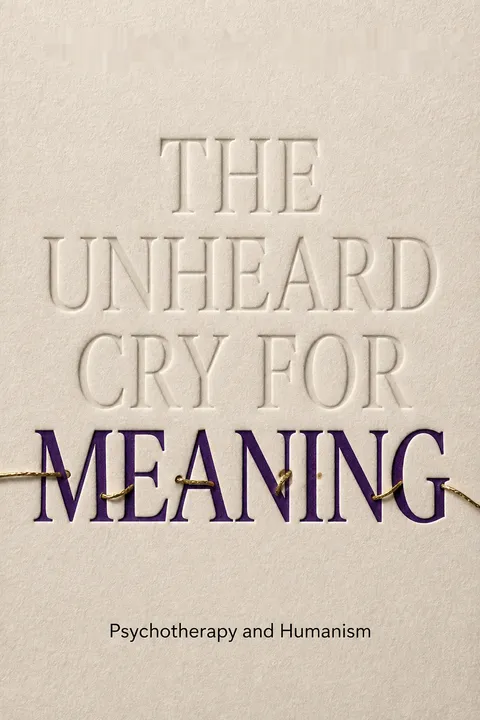
The Unheard Cry for Meaning explores Viktor Frankl's logotherapy, emphasizing the search for meaning as essential to human existence. Readers appreciate Frankl's insights on finding purpose in suffering and transcending oneself. Some found the book repetitive or overly academic, while others praised its depth and practical applications. The paradoxical intention technique and Frankl's critiques of other psychological approaches garnered interest. While some readers were disappointed compared to "Man's Search for Meaning," many found valuable ideas about responsibility, attitude, and the importance of meaning in life.
People Also Read




Glossary
Logotherapy
Meaning-centered psychotherapyA form of psychotherapy developed by Viktor Frankl that attends to a person's search for meaning. It treats biological, psychological, and social factors as important, while also asking what purposes, relationships, or responsibilities matter to the person. The therapist can help someone recognize possible meanings but cannot prescribe a universal answer.
Will to meaning
Drive to find purposeFrankl's term for the human motivation to find and fulfill meaning. He argues that it is not merely a disguise for the pursuit of pleasure, power, or comfort, and that it can remain important even when other needs are satisfied or circumstances are painful. Its frustration, in his view, can contribute to distress.
Existential vacuum
Emptiness from lost purposeFrankl's term for a sense of emptiness, futility, or lack of direction that can arise when inherited traditions no longer tell people what to do and they cannot identify what they want to do. He links it to boredom and to patterns such as depression, aggression, and addiction, while not treating every case as having one cause.
Noögenic neurosis
Distress rooted in meaningA type of neurosis that Frankl attributes to frustration of the will to meaning or conflict in the realm of values and purpose. He distinguishes it from neuroses primarily associated with psychological conflicts or conditioning. The term does not mean that every mental illness is caused by meaninglessness.
Self-transcendence
Orientation beyond oneselfFrankl's term for the human capacity to reach beyond self-focused concerns toward a task, cause, or another person. He argues that meaning is found through such engagement and that self-fulfillment is often a consequence rather than a direct target. The concept does not require religious belief or imply that people should neglect themselves.
Pan-determinism
Total denial of agencyFrankl's label for the claim that human behavior is wholly determined by biological, psychological, or social causes. He distinguishes it from acknowledging that people are strongly constrained by conditions. His objection is that total determinism overlooks the possibility, however limited, of choosing a response and taking responsibility.
Hyperintention
Excessive striving for an outcomeFrankl's term for trying too hard to produce an experience or performance, such as sleep, sexual pleasure, or calm. The effort can increase pressure and make the desired outcome less likely. He treats it as part of a self-reinforcing pattern that can be addressed by reducing performance demands or redirecting attention.
Hyper-reflection
Excessive self-monitoringFrankl's term for closely monitoring one's own feelings, bodily responses, or performance. The attention directed inward can interfere with an activity or relationship and increase anxiety about whether it is going well. Dereflection is intended to shift attention toward a meaningful task, experience, or other person.
Paradoxical intention
Deliberately approach the feared responseA logotherapeutic technique for certain phobic or obsessive patterns. The patient is encouraged to wish for, or deliberately attempt, the symptom or outcome they fear, often with humor. Frankl argues that this can weaken anticipatory anxiety and avoidance by changing the patient's relationship to the fear. It is a clinical method, not a universal self-treatment.
Dereflection
Redirect attention outwardA logotherapeutic technique that shifts attention away from excessive self-observation and toward a task, experience, or person. Frankl applies it especially to situations where monitoring one's own performance intensifies anxiety, including sexual difficulties. The aim is not distraction for its own sake, but engagement with something meaningful beyond the symptom.
FAQ
What's "The Unheard Cry for Meaning" about?
- Exploration of Meaning: "The Unheard Cry for Meaning" by Viktor E. Frankl delves into the human quest for meaning, particularly in the context of modern existential challenges.
- Logotherapy Focus: The book emphasizes logotherapy, a form of psychotherapy that Frankl developed, which centers on finding meaning in life as a primary motivational force.
- Critique of Modern Psychology: Frankl critiques contemporary psychological approaches, such as behaviorism and psychoanalysis, for neglecting the human dimension of meaning.
- Existential Issues: The book addresses existential issues like the feeling of meaninglessness, the existential vacuum, and the mass neurosis of modern society.
Why should I read "The Unheard Cry for Meaning"?
- Understanding Human Motivation: It provides insights into the fundamental human drive to find meaning, which can enhance personal growth and understanding.
- Therapeutic Techniques: The book introduces practical therapeutic techniques like paradoxical intention and dereflection, which can be applied to overcome various psychological issues.
- Philosophical Depth: Frankl's work offers a philosophical perspective on life, suffering, and the human condition, encouraging readers to reflect on their own lives.
- Critique of Reductionism: It challenges reductionist views in psychology, advocating for a more holistic understanding of human beings.
What are the key takeaways of "The Unheard Cry for Meaning"?
- Will to Meaning: The primary human motivation is the search for meaning, which is more fundamental than the pursuit of pleasure or power.
- Existential Vacuum: Many people experience a sense of emptiness and meaninglessness, which Frankl identifies as a mass neurosis of modern times.
- Logotherapy Techniques: Techniques like paradoxical intention and dereflection are effective in addressing phobias, obsessions, and sexual neuroses by redirecting focus and intention.
- Human Dimension: Acknowledging the human capacity for self-transcendence and self-detachment is crucial for understanding and addressing psychological issues.
What is logotherapy according to Viktor E. Frankl?
- Meaning-Centered Therapy: Logotherapy is a form of psychotherapy that focuses on the search for meaning as the central human motivational force.
- Techniques: It employs techniques like paradoxical intention, which involves encouraging patients to engage in or wish for the very things they fear, and dereflection, which shifts focus away from the self.
- Human Dimension: Logotherapy emphasizes the human capacity for self-transcendence and self-detachment, allowing individuals to rise above their conditions.
- Contrast with Other Therapies: Unlike psychoanalysis and behaviorism, logotherapy does not reduce human behavior to unconscious drives or conditioned responses.
How does Viktor E. Frankl define the "will to meaning"?
- Primary Motivation: The "will to meaning" is the fundamental human drive to find and fulfill meaning in life, surpassing other motivations like pleasure or power.
- Empirical Support: Frankl's concept is supported by empirical research, showing that individuals with a strong sense of meaning tend to have better mental health and resilience.
- Self-Transcendence: It involves self-transcendence, where individuals look beyond themselves to find purpose in serving others or fulfilling tasks.
- Survival Value: The will to meaning has survival value, as evidenced by Frankl's observations in concentration camps, where those oriented toward future tasks or relationships were more likely to survive.
What is the "existential vacuum" in "The Unheard Cry for Meaning"?
- Feeling of Emptiness: The existential vacuum is a widespread sense of meaninglessness and emptiness that many people experience in modern society.
- Result of Affluence: It often arises in affluent societies where basic needs are met, but individuals lack a sense of purpose or direction.
- Symptoms: The existential vacuum can manifest as boredom, depression, aggression, and addiction, forming a mass neurotic triad.
- Challenge to Overcome: Frankl suggests that overcoming the existential vacuum requires finding personal meaning and purpose in life.
What are paradoxical intention and dereflection in logotherapy?
- Paradoxical Intention: This technique involves encouraging patients to engage in or wish for the very things they fear, thereby breaking the cycle of anticipatory anxiety.
- Dereflection: Dereflection shifts the patient's focus away from themselves and their symptoms, redirecting attention to external tasks or the needs of others.
- Application: Both techniques are used to treat phobias, obsessions, and sexual neuroses by altering the patient's focus and intention.
- Human Capacity: These techniques leverage the human capacities for self-detachment and self-transcendence, allowing individuals to rise above their conditions.
How does Viktor E. Frankl critique modern psychology in "The Unheard Cry for Meaning"?
- Reductionism Critique: Frankl criticizes modern psychology for its reductionist tendencies, which often ignore the human dimension of meaning and purpose.
- Neglect of Meaning: He argues that approaches like behaviorism and psychoanalysis fail to address the fundamental human need for meaning.
- Human Dimension: Frankl advocates for a psychology that acknowledges the human capacities for self-transcendence and self-detachment.
- Integration of Meaning: He calls for the integration of meaning into psychological practice, emphasizing its importance for mental health and well-being.
What is the role of suffering in finding meaning according to Viktor E. Frankl?
- Transformative Potential: Suffering can be transformed into a personal triumph by finding meaning in it, turning a predicament into an achievement.
- Unavoidable Suffering: When suffering is unavoidable, individuals are challenged to change themselves and find meaning in their response to it.
- Example of Concentration Camps: Frankl's experiences in concentration camps demonstrated that those who found meaning in their suffering were more resilient.
- Meaning in Suffering: Finding meaning in suffering involves self-transcendence, where individuals rise above their pain to fulfill a higher purpose.
What are the best quotes from "The Unheard Cry for Meaning" and what do they mean?
- "The will to meaning is man's primary concern." This quote encapsulates Frankl's belief that the search for meaning is the fundamental human drive.
- "Life is never made unbearable by circumstances, but only by lack of meaning and purpose." It highlights the importance of meaning in coping with life's challenges.
- "When we are no longer able to change a situation, we are challenged to change ourselves." This emphasizes the transformative potential of suffering and the importance of self-transcendence.
- "What is to give light must endure burning." This metaphor suggests that personal growth and fulfillment often require enduring hardship.
How does Viktor E. Frankl address the concept of freedom in "The Unheard Cry for Meaning"?
- Finite Freedom: Frankl acknowledges that human freedom is finite, as individuals are not free from conditions but are free to take a stand toward them.
- Freedom and Responsibility: He emphasizes that freedom must be balanced with responsibility, as freedom without responsibility can lead to arbitrariness.
- Self-Detachment: The capacity for self-detachment allows individuals to choose their attitudes toward their fears and anxieties, exercising their freedom.
- Freedom in Meaning: True freedom involves the ability to find and fulfill meaning, transcending one's conditions and circumstances.
What is the significance of the past in "The Unheard Cry for Meaning"?
- Optimism of the Past: Frankl presents an "optimism of the past," suggesting that once possibilities are actualized, they are preserved in the past.
- Irreversibility: The past is fixed and unchangeable, providing a sense of permanence and security for the meanings and achievements stored there.
- Eternal Record: Everything that has been accomplished or experienced is part of an eternal record, contributing to the overall meaning of one's life.
- Contrast with Present Pessimism: This perspective contrasts with existentialism's "pessimism of the present," offering hope and reassurance in the face of life's transitoriness.
About the Author
Other books by Viktor E. Frankl





Download PDF
Download EPUB
.epub digital book format is ideal for reading ebooks on phones, tablets, and e-readers.








