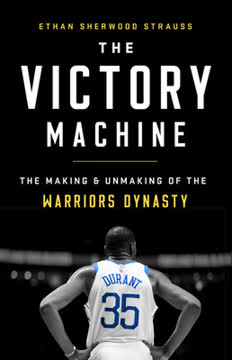
Key Takeaways
1. Unconventional Ambition Forged a Dynasty
Ego and ambition not only built the greatest team of this era, but were necessary for its purchase.
Relentless pursuit. Joe Lacob, a venture capitalist, acquired the Golden State Warriors in 2010 through an audacious "exploding offer" to then-owner Chris Cohan, outmaneuvering Oracle founder Larry Ellison, who was widely expected to buy the team. Lacob's ambition was not just to compete, but to dominate, aiming for "Warriors greatness forever," a perspective he openly admitted was "insane" but essential for success. This aggressive, almost monopolistic zeal was foundational to the dynasty's birth.
Beyond the auction. Lacob and his partner Peter Guber bypassed the standard auction process, flying to Baltimore to meet Cohan directly and present a take-it-or-leave-it offer. This move, which some considered ethically questionable, secured the team for $450 million—a record at the time—and was driven by a desperate desire to own a professional sports franchise after previous failed bids. The deal was sealed in 72 sleepless hours, reflecting Lacob's relentless, "bootstraps" mentality.
Owner's influence. Despite public preference to credit players, Lacob's hands-on, demanding ownership was crucial. He purged incompetence on the business side, hired key personnel like Bob Myers and Rick Welts, and fostered a culture of constant improvement. His belief in "speaking things into existence" and his Silicon Valley-style "doing our homework, VC style" approach, which involved canvassing many opinions, laid the groundwork for the team's rapid ascent from a "civilizational blight" to a historic dynasty.
2. The "Light-Years Ahead" Philosophy Drove Innovation
The Warriors were light-years ahead of probably every other team in structure, in planning, in how we’re going to go about things.
Bold declaration. Joe Lacob's infamous "light-years ahead" quote, though later attributed to the business side, encapsulated the Warriors' audacious self-belief and their commitment to innovation. This mindset, while often perceived as arrogant, fueled a top-down drive to constantly seek market inefficiencies and stay ahead of the curve, even in a league full of smart competitors. It was a philosophy of perpetual optimism and relentless future-orientation.
Strategic hires. The new ownership brought in a blend of fresh talent and seasoned wisdom to basketball operations.
- Bob Myers: A successful agent, unproven as a GM, but brought a fresh perspective.
- Jerry West: NBA legend hired as a consulting board member, providing invaluable experience and intuition.
- Rick Welts: COO from the Phoenix Suns, tasked with building a new arena in San Francisco.
This combination aimed to infuse the organization with both new ideas and historical understanding.
Drafting prowess. The Warriors' dynasty was built on exceptional drafting, often outside the top-5 picks, combined with a systematic approach to player evaluation.
- Klay Thompson (2011): Selected despite off-court concerns, backed by Jerry West, became a star under the right coaching.
- Draymond Green (2012): A second-round pick, initially overlooked due to his unconventional size and position, became the defensive lynchpin and emotional leader, thriving in "the grays" of improvisation.
- Harrison Barnes (2012): A top prospect who became a valuable rotation player, though he lacked the "unifying feature" for superstardom.
These picks, alongside the inherited Steph Curry, formed the core of the championship teams.
3. Coaching with "Joy" Transformed Team Culture
Your values have to come alive in the way you operate.
A new ethos. Steve Kerr, drawing inspiration from NFL coach Pete Carroll and his own mentors like Gregg Popovich and Phil Jackson, developed a coaching philosophy centered on "joy, compassion, competitiveness, mindfulness." He formalized this into a 30-page "manifesto" covering everything from travel policies to locker room conduct, ensuring his values were explicitly articulated and consistently reflected in daily operations. This approach contrasted sharply with the insecurity and internal strife of the previous coaching regime.
Empowering assistants. Unlike his predecessor Mark Jackson, Kerr actively sought out and empowered top-tier assistants like Alvin Gentry and defensive guru Ron Adams. He credited their ideas publicly, fostering a collaborative environment where expertise was valued over ego. Adams, in particular, revolutionized the Warriors' defense with innovative strategies like "switching" and leaving non-shooters unguarded, which became league-wide trends.
Cultivating connection. Kerr's leadership style emphasized honesty, self-criticism, and a willingness to connect with players on a human level, rather than relying solely on intimidation. He used music in practice, encouraged humor, and turned everything into a competition to foster a genuine sense of fun and engagement. This "playing with joy" ethos was not just about winning, but about creating a sustainable, enjoyable environment, which ultimately attracted key talent like Kevin Durant.
4. Sneaker Wars Shaped Player Allegiances and Narratives
Your primary employer is who pays you the most money.
Brand over team. The sneaker industry operates as a parallel, often more influential, ecosystem to the NBA. Players like LeBron James, with a lifetime Nike contract, demonstrate primary allegiance to their brand over their team, highlighting where the "real money" and long-term influence lie. This dynamic means players are, in a sense, "sneaker salesmen who play the role of basketball players," with their on-court success directly impacting multinational stock prices.
Nike's misstep, Under Armour's rise. Nike famously overlooked Steph Curry, botching a pitch meeting with mispronunciations and repurposed slides, leading him to sign with Under Armour in 2013. Curry's subsequent rise to superstardom, particularly his "underdog" appeal to children, propelled Under Armour's basketball sales, with analysts estimating his potential worth to the company at over $14 billion. This shift challenged Nike's dominance and created a new narrative in the sneaker wars.
KD's strategic move. Kevin Durant, a Nike athlete, joining the Warriors in 2016 was a "coup" for Nike, as it aimed to "slow Under Armour’s momentum with Steph Curry." While Durant denied Nike's influence, his move to a team with another Nike superstar (LeBron) in the Finals ensured Nike's continued visibility regardless of the winner. This decision, while beneficial for the Warriors' on-court dominance, ultimately impacted Curry's individual brand luster and Under Armour's stock, demonstrating how player decisions are intertwined with corporate strategy.
5. Superstar Egos and Social Media Fueled Internal Strife
A man with all the leverage can keep speaking in contradictions and reliably keep hearing in supplications.
The "Different Dude" phenomenon. NBA superstars, often isolated by immense power and fame, can become "Different Dudes"—iconoclastic personalities whose quirks are indulged due to their talent. Kevin Durant, a "searcher" with a "weightiness," exemplified this, often expressing deep-seated insecurities despite his unparalleled skill. His public persona was a complex mix of brilliance, brooding, and a constant need for validation, often clashing with team dynamics.
Social media's corrosive effect. The pervasive nature of social media amplified player insecurities and created constant "noise."
- KD's burner accounts: Caught defending himself online, revealing his obsession with public perception.
- "Grow Up" rant: Durant's public outburst against media for speculating on his free agency, ironically amplifying the very story he wanted to suppress.
- Kyrie Irving's "two max slots" video: A private conversation turned viral, leading to public scrutiny and frustration for players.
This constant scrutiny and the "sulfuric acid" of online insults contributed to player unhappiness and isolation, despite the league's efforts to leverage social media for engagement.
Internal friction. The KD-Draymond Green feud in November 2018, where Green called Durant a "bitch" for dangling his free agency, publicly exposed the underlying tensions. This incident, combined with Durant's perceived detachment and his public critiques of Steve Kerr's coaching philosophy, signaled a breakdown in team cohesion. While teammates tried to "force hello" and mitigate the distress, the "joy" that defined the early Kerr era dissipated under the weight of individual aspirations and external pressures.
6. The GM's Burden: Navigating Chaos with Humility
It is amazing how much can be accomplished if no one cares who gets the credit.
The thankless job. Being an NBA general manager is an "all-encompassing" and "monster job" filled with immense stress, drama, and constant pressure from owners, coaches, players, agents, and media. Unlike fantasy sports, it involves mediating conflicts, managing diverse personalities, and operating on multiple timelines simultaneously, often without public recognition. Many GMs, including Steve Kerr during his Suns tenure, find the role deeply unsatisfying.
Myers's unique approach. Bob Myers, a former agent and UCLA walk-on, embodies a philosophy of humility and collaboration, often using the phrase "I don't know." He prioritizes John Wooden's quote about not caring who gets credit and strives to foster a "synergy" of trust and open communication within the organization. This "merchant of maintenance" approach, focused on smoothing over rough edges and building relationships, contrasts with the self-promotional "brands" of other GMs like Daryl Morey ("Dork Elvis") or Sam Hinkie ("The Process").
Beyond the "brand." Myers's lack of a flashy "GM brand" or a specific analytics-driven concept makes him less famous than figures like Billy Beane or Pat Riley, despite his unparalleled success. However, his self-made background and genuine, non-duplicitous nature allow him to navigate the complex racial and power dynamics of the league more effectively. He focuses on the "art of the job"—managing people and fostering collective good—rather than seeking public validation or intellectual vanguard status.
7. Player Empowerment Redefined NBA Dynamics
Those who would give up essential liberty to purchase a little temporary safety deserve neither liberty nor safety.
Owners' self-inflicted wounds. Starting in the 1990s, NBA owners, seeking "safety" from their own tendency to overspend on long, onerous contracts, negotiated for "maximum contracts" and shorter guaranteed deals. While intended to control costs and prevent teams from being "submarined," this inadvertently shifted power to the players. By limiting long-term security, it incentivized superstars to pursue shorter-term commitments, giving them unprecedented leverage.
The one-year deal. LeBron James pioneered the one-year deal, signing contracts annually to maximize earnings and maintain leverage over the front office, threatening to leave if commitment to winning wavered. This "game changer" set a precedent, fostering a "social contagion" among elite players who realized their value would "express itself, roughly in proper proportion, regardless of rules meant to contain it." This meant superstars could dictate their terms and destinations.
Leverage and its consequences. The Anthony Davis saga, where he publicly demanded a trade to the Lakers, exemplified this new era of player empowerment. Davis, through his agent Rich Paul, leveraged his impending free agency to force a move, even if it meant alienating his current team and disrupting the Lakers' roster. While this strategy secured his desired outcome, it highlighted how individual superstar whims could override team cohesion and traditional organizational control, leading to protracted public humiliations for teams.
8. Dynasties Inevitably Succumb to Internal and External Pressures
Everything come to an end.
The diminishing returns of dominance. The Warriors' dynasty, despite its unparalleled talent, eventually faced the inevitable challenges of sustaining success. The "gratifying effects of dominance diminish," leading to complacency, internal friction, and a loss of the initial "joy." The 2018-2019 season, marked by the KD-Draymond feud and Durant's public disengagement, became a "dragging kind of regular season" where the team often went through the motions, despite their talent.
Injuries and fate. The 2019 NBA Finals became a "horror show" of injuries, ultimately sealing the dynasty's fate.
- Kevin Durant: Blew out his Achilles in Game 5, a "Pyrrhic victory" that cost him his season and future with the team.
- Klay Thompson: Tore his ACL in Game 6, further depleting the roster.
These catastrophic injuries, combined with the Raptors' strong play, led to a stoic acceptance of defeat, rather than the regret of 2016. The team's "will to fight outlived happiness," but could not overcome fate.
The end of an era. Durant's departure to the Brooklyn Nets and Thompson's injury forced the Warriors into a radical restructuring. The "KD-less game" in the playoffs, while "more fun to watch" for some, highlighted the team's vulnerability without its full complement of stars. The dynasty, which had "ruined basketball" for its competitors, died a violent death, leaving Bob Myers with the daunting task of building a "new civilization out of Rome's rubble," as the team moved from Oakland to San Francisco.
Last updated: