

Key Takeaways
Treat face-to-face connection as health maintenance, not optional leisure
Connection does more than comfort. Susan Pinker opens with John McColgan, a musician whose failing kidneys left him needing a transplant. Four friends offered to donate, and one, Fred, ultimately became his donor. Their friendship had been built over decades of shared life, not assembled in a crisis. Most people will never need an organ, Pinker argues, but everyone needs relationships that can provide care when life turns difficult.
The evidence reaches beyond anecdotes. A review of 148 studies involving about 309,000 people found that those integrated into social relationships had substantially better odds of survival than those with weaker connections. Contact can also bring practical help, useful health information, and emotional support. Digital communication can sustain relationships across distance, but it does not automatically provide the presence and assistance of someone nearby.
What's striking is that relationships function like a distributed health resource. A friend may notice a symptom, help navigate care, or make treatment manageable, while companionship can soften the body's response to stress. That makes social connection more than a pleasant supplement to medicine. Still, population studies cannot fully separate the effects of relationships from differences in health, income, or personality. The strongest lesson is not that friendship cures disease, but that a person's health is partly supported by the people able to show up.
Build a village, not a single point of emotional failure
A network needs several strands. In Sardinia's mountain villages, unusually large numbers of residents, including men, reach extreme old age. The community's traditions keep older people close to relatives and neighbors, with frequent visits, shared work, and everyday conversation. Genes, physical activity, and other features of local life may also contribute, so the village alone cannot explain longevity. Its social structure offers a vivid example of how people can be woven into daily care.
Diversify the relationships. Pinker draws on long-term studies showing that marriage, friendships, family contact, and participation in groups each contribute to social integration. No single bond is a sufficient safety net. A spouse may die, a friend may move, or health may limit participation. Build regular contact with people in more than one setting, and keep relationships close enough for help to be practical, not merely symbolic.
The village is best understood as social infrastructure, not a demand to reproduce one culture's family arrangements. Nearby people make support easier to notice and deliver, while multiple circles reduce dependence on a single caregiver or confidant. That principle has implications for neighborhood design, elder care, and the organization of everyday life. At the same time, dense communities can police insiders and distrust outsiders. Belonging is protective when it offers care without requiring conformity or exclusion.
Let close ties care for you and weak ties surprise you
Different ties do different jobs. Close friends and family are often the people who provide comfort, rides, meals, and care. But new information often travels through weaker connections: acquaintances, colleagues, or friends of friends who move in different circles. Sociologist Mark Granovetter named this pattern the strength of weak ties. Because close friends often share the same contacts and knowledge, an acquaintance may be better placed to point someone toward a new doctor, job, or opportunity.
Keep both kinds of connection. Pinker describes how medical information reached a woman with breast cancer through several links in her network. The same logic helps explain why professional networks can open doors, while people with fewer bridges beyond family and close friends may hear about fewer opportunities. Weak ties are useful for discovery; they are not substitutes for intimate relationships when someone needs sustained care.
This distinction clarifies why a huge contact list can feel socially rich yet offer little dependable support. Network value depends on structure: close ties provide depth, while bridging ties connect otherwise separate pools of information. The practical challenge is to cultivate both without treating acquaintances as emergency caregivers. The book also notes that people with fewer resources may rely more heavily on strong ties. That is not a personal failing. It is a reminder that access to useful connections is unevenly distributed.
Use social influence deliberately: it can heal, and it can spread harm
Support can reach the body. In a breast cancer study, women with larger social networks were more likely to survive than isolated women. Pinker describes three kinds of support: information about care, practical assistance, and the emotional effects of being with people who care. Animal research adds a possible biological pathway: socially isolated female rats developed far more breast tumors than group-housed rats. That result is striking, but it is not proof that isolation causes cancer in people.
Influence travels both ways. The Framingham research followed connected residents over decades and linked social networks to patterns in obesity and drinking. Friends can normalize habits, just as they can encourage healthier ones. Some network effects may reflect people choosing similar friends or sharing environments, not direct contagion alone. Relationships are powerful partly because they influence what feels normal, but that influence is not automatically beneficial.
The useful insight is not that people should select friends as health products. It is that habits and emotional states are socially situated, so changing an individual routine may require changing the setting around it. Network analysis can reveal patterns that an individual-level explanation misses. Yet the causal story is difficult: similarity, shared circumstances, and influence overlap. A responsible reading treats social effects as plausible contributors, not as grounds to blame sick people or stigmatize those whose networks include unhealthy behavior.
Give babies responsive people, not a screen-shaped substitute
Infants learn through exchange. Newborns respond to familiar voices, faces, and touch. They imitate expressions and attend to adults who respond to their actions. The interaction is a back-and-forth process, not simply exposure to sounds or images. In a large Belarus study, a program that encouraged breastfeeding was associated with improved verbal IQ in children years later. The researchers could not establish whether the benefit came from breast milk, more time together, or the face-to-face interaction that often accompanies nursing.
Touch can soothe and support development. Kangaroo care means holding a diaper-clad infant against a caregiver's bare chest. Studies described by Pinker found that this contact reduced infants' pain responses and helped premature babies gain weight and regulate their bodies. Research on early caregiving also suggests that experience can alter how genes are expressed, a process called epigenetics. These findings support responsive care, not the idea that parents can control every outcome.
Early development is presented here as a relationship, not a delivery system. A screen can transmit words, but it cannot reliably provide the contingent response that teaches an infant that another person is attending. This distinction matters when public debate reduces feeding or learning to a contest over products. The evidence does not justify shaming parents who use formula or need technology. It does support policies that give caregivers time, support, and practical help to interact with children.
Protect children's learning from screens that displace conversation
Time has an opportunity cost. Pinker argues that screens matter partly because they can replace conversation, play, and adult attention. In a study recording children's home sound environments, each hour of audible television was associated with hundreds fewer adult words directed to a child, as well as fewer child vocalizations and conversational turns. Other studies linked heavy early viewing with later difficulties in classroom engagement and school performance. These are not all proof of direct cause, but they show why passive exposure should not be confused with interactive teaching.
Technology is a tool, not a teacher. Programs such as Reach Out and Read gave books to families during pediatric visits and modeled interactive reading. Children in the program showed stronger language skills than comparable children without it. By contrast, studies of classroom laptop programs generally found little improvement in achievement. The book's practical distinction is not books good, screens bad. It is responsive human guidance versus technology used without a clear learning purpose.
The displacement model is more useful than a simple screen-time panic. It asks what an activity replaces, and whether the technology is being used with an adult who can adapt to a child's questions. That approach leaves room for tools that support specific tasks while resisting the assumption that novelty equals learning. It also shifts attention from parental virtue to conditions: time, work demands, safe play spaces, and access to books all shape how much interaction families can provide.
Make shared meals a daily practice in language and belonging
Dinner can be a conversation workshop. Studies reviewed by Pinker link regular family meals with stronger vocabulary, reading, and school outcomes. The food itself is not the magic ingredient. Children benefit when adults respond to their stories, explain ideas, ask questions, and keep a conversation moving. A meal can give children repeated practice in listening, taking turns, and talking about what other people think or feel.
The social effects may last. In one study, girls who regularly ate with their families at twelve had about half the odds of drinking, smoking, or using marijuana at seventeen compared with girls who did not. Other research linked family meals with lower risks of depression and disordered eating. These are associations, and family connection may be the active ingredient rather than eating at a table. The useful aim is dependable, low-pressure time for parents and children to talk.
The dinner table is a recurring setting, which makes it valuable precisely because it is ordinary. It creates a routine where language and attention can accumulate without turning every interaction into a lesson. The evidence also counsels against moralizing: families working long hours may not be able to share nightly dinners, and a strained meal is not inherently protective. The transferable element is reliable, attentive conversation, wherever a family can make room for it.
Choose partners by how you handle trouble, not profile compatibility
Profiles cannot capture rapport. Pinker notes that most couples in the studies she cites met through work, school, friends, or other in-person settings. Online dating can introduce people, but profiles are incomplete and often misleading. In one study of online daters, 81 percent misstated at least one basic detail about themselves. Experiments also found that stated preferences for an ideal partner did not reliably predict attraction during a live encounter. The face-to-face meeting supplies information a checklist cannot.
Look for repair and support. Research reviewed in the book associates marriage with better health, but relationship quality matters. Hostile couples in one experiment healed skin wounds more slowly than supportive couples. Pinker also describes how men may depend heavily on a spouse for social connection, while women often draw on broader networks. A stable partnership can be protective, but conflict or isolation can be damaging. How partners face problems together is more revealing than whether their profiles match.
This account separates two questions that dating platforms often blur: who attracts someone, and who can build a durable life with them. The second depends on interaction under ordinary stress, not merely shared traits. Online introductions can widen the pool, but they should lead to real conversation rather than prolonged fantasy built around a profile. Marriage findings also require caution because health and relationship status influence each other. The strongest practical principle is to assess mutual care and conflict repair, not marital status alone.
Design work for human contact, and verify trust before investing
Conversation can improve performance. In a bank call center study, researchers coordinated workers' break times so colleagues could talk in person. Overall performance rose by 8 percent, weaker teams improved by more than 20 percent, and employee satisfaction increased. The conversations allowed workers to share tips and decompress. Pinker describes these informal exchanges as a source of trust and coordination that formal meetings or email may not provide, especially when work is complex.
Trust can also be exploited. Financial adviser Earl Jones stole more than $51 million from 160 clients, many of them older women who had known him for years through overlapping community ties. Their shared social world helped him appear trustworthy and encouraged referrals. A familiar face is not proof of sound judgment. Build chances for colleagues to interact, but use independent records, clear explanations, and verification when money or major decisions are involved.
The workplace lesson is architectural: schedules and spaces can either create useful contact or quietly prevent it. Social trust lowers the friction of asking for help, but the same trust can become a blind spot when a familiar insider is not scrutinized. Good institutions need both connection and accountability. Informal conversation can support coordination; transparent procedures protect people from confusing warmth, shared identity, or reputation with evidence.
Analysis
The book's central move is to treat social contact as part of the body's operating environment. It connects daily interaction to physiological resilience, early learning, emotional regulation, habits, romantic attachment, and workplace performance. The recurring contrast is not simply online versus offline. Digital tools can carry information, maintain distant ties, and help people meet. The distinction is whether communication supplies the responsive signals, shared attention, and practical presence that in-person relationships often provide.
The stories give the argument human scale: a musician receives several kidney offers; Sardinian elders are embedded in community life; infants learn through reciprocal attention; and colleagues become more effective when their schedules allow conversation. The range is the book's strength. It makes social connection legible as both affection and infrastructure, something built through repeated contact and embedded in institutions.
The evidence, however, is not uniform. Population studies show associations, not always causation. The rat tumor experiments illuminate possible mechanisms but cannot establish the same effect in humans. Findings about network contagion can be difficult to separate from shared environments and the tendency to form relationships with similar people. The book generally acknowledges these limits, but its most memorable numbers can sound more definitive than the underlying designs warrant.
The practical conclusion survives that caution. Relationships are not a guaranteed treatment, and loneliness is not a personal failure. Yet policies and routines that make human contact harder carry costs that ordinary measures of convenience may miss. A useful test for technology, education, health care, and workplace design is therefore not whether a tool connects people in principle, but whether it strengthens or displaces the human interaction a situation requires.
Review Summary
Glossary
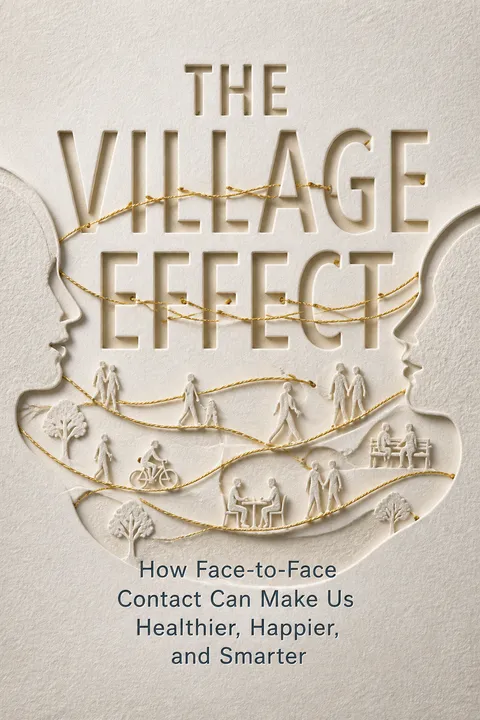
The Village Effect
benefits of close contactPinker’s name for the health, learning, emotional, and practical benefits that arise from frequent, meaningful face-to-face relationships. It is a metaphor, not a requirement to live in a literal village. The effect depends on ongoing contact with people who know one another and can offer information, care, trust, or shared activity.
social capital
trust and mutual supportThe knowledge, trust, and reciprocal assistance available through relationships among friends, neighbors, colleagues, and community members. Social capital is not simply the number of contacts someone has. It includes expectations that people will share useful information, help when needed, and participate in common life.
the strength of weak ties
acquaintances bring new informationSociologist Mark Granovetter's term for the way acquaintances and other less intimate contacts can connect people to information beyond their close circle. Close friends often share contacts and knowledge. Weaker ties can bridge different social groups, making them useful for discovering jobs, services, or expertise that intimate friends may not know about.
social contagion
behaviors spread through networksThe spread of feelings, habits, or behaviors through a social network, sometimes beyond direct acquaintances. Pinker discusses research linking social ties with patterns such as obesity, alcohol use, and emotional states. Such findings do not by themselves prove that one person caused another's behavior, since similarity and shared environments can also shape patterns.
tend-and-befriend
seek connection under stressPsychologist Shelley Taylor's term for a response to stress in which people, especially women in the research described, seek affiliation and care for others. Pinker connects this pattern with social support and the neuropeptide oxytocin. The term emphasizes that stress responses can include protecting relationships and building support, not only confronting or fleeing a threat.
McClintock Effect
proposed menstrual synchronyThe name associated with Martha McClintock's early research proposing that menstrual cycles among women who spend time together can become synchronized. The book describes the finding as suggestive of subtle social or chemical influence, while noting that menstrual synchrony is not universal and that scientists continue to debate how it works.
honest signals
unconscious social cuesNonverbal features of interaction, including voice, movement, posture, mimicry, and timing, that convey attention, confidence, affiliation, or emotion. People often respond to these signals without consciously analyzing them. Pinker describes wearable sociometric badges that measure patterns in movement and voice, without needing to record the content of conversations.
Dunbar's Number
rough limit on meaningful tiesRobin Dunbar's estimate that humans can maintain roughly 150 meaningful social relationships, based on the cognitive demands of keeping track of people and their connections. The figure is not a precise universal ceiling and does not refer to every online contact. It concerns relationships with enough substance to involve recognition, familiarity, and potential interaction.
affinity fraud
scams exploiting shared identityFraud that uses shared community, cultural, religious, or social ties to gain trust. A perpetrator may appear credible because victims know the same people, attend the same institutions, or share a sense of group identity. These relationships can help a scam spread through referrals while discouraging independent scrutiny.
video deficit
weaker learning from screensThe difficulty young children can have learning from a screen compared with learning through live interaction. Pinker uses the term in discussing research on toddlers and language. Screen media may be entertaining or useful in specific contexts, but young children often learn more effectively when a responsive person directs attention and reacts to their behavior.
kangaroo care
skin-to-skin infant careA caregiving practice in which a diaper-clad newborn is held directly against an adult's bare chest, usually under a covering. Research described by Pinker associates this contact with reduced pain responses and benefits for premature infants, including support for weight gain and bodily regulation. The practice also gives caregiver and infant sustained close contact.
Framingham Heart Study
long-running community health studyA multigenerational study of residents of Framingham, Massachusetts, originally focused on cardiovascular health. Its repeated measurements of health and behavior, together with information about participants' social contacts, gave researchers material to study how relationships and behaviors cluster across a community. Pinker discusses its use in research on obesity and alcohol consumption.
Download PDF
Download EPUB
.epub digital book format is ideal for reading ebooks on phones, tablets, and e-readers.








