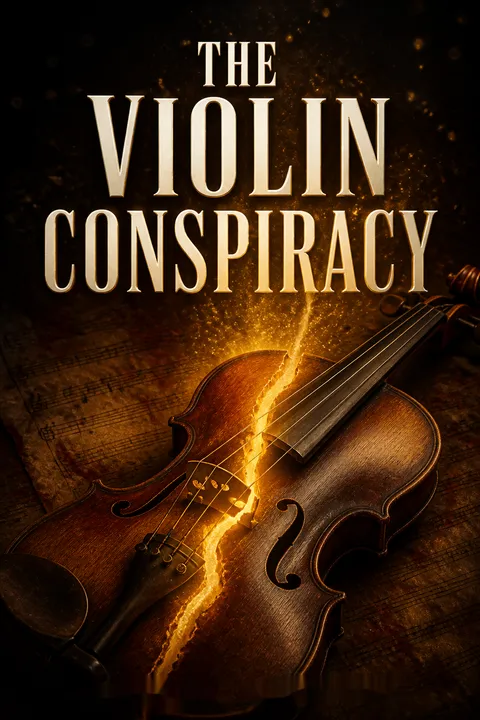


Plot Summary
The Shoe in the Case
On May 16, after flying from New York to Charlotte, violinist Ray McMillian opens his case and finds a size 10½ Converse where his priceless Stradivarius should be. The folded note demands five million dollars in bitcoin by July 15. The theft threatens more than Ray’s livelihood: he is weeks from the Tchaikovsky Competition, the summit he has spent years preparing to reach.
He calls the police, then returns to New York as investigators question him about every movement. Shame quickly joins panic. Ray suspects his relatives or the Marks family, both with reasons to want the instrument, and fears that losing the violin proves every person who doubted his talent right.
The opening makes the violin’s value intimate before it becomes financial. Ray experiences its absence as the loss of a bodily extension and of the history he carries through music. The absurd shoe turns a carefully controlled life into a puzzle, while the ransom deadline converts grief into a countdown. His first instinct to blame himself also exposes how deeply racial judgment has taught him to treat setbacks as evidence of personal unworthiness.
A Loaner and Leads
Ray’s teacher and surrogate mother, Janice Stevens, flies in to support him, while his girlfriend Nicole helps him choose a temporary instrument at Mischa Rowland’s shop. Ray first refuses to touch another violin, then accepts a 1959 Lehman and plays again. FBI investigator Alicia Childress joins the search and focuses on access, forensics, and motive.
The hotel housekeeper, Pilar Jiménez, becomes a person of interest after investigators discover that she used false identification and disappeared after delivering breakfast. Nicole admits she briefly lost sight of the breakfast cart while fetching Ray’s wallet, giving Pilar a possible opening to swap the violin for the shoe. No one has proof, but the investigation finally has a direction.
The loaner forces Ray to distinguish the instrument from the musician without pretending the two are interchangeable. Janice’s reassurance is practical: he must keep preparing while the search continues. Alicia, by contrast, insists that affection and intuition cannot substitute for evidence, even when Ray is certain his family or the Markses are responsible. Nicole’s guilt shows how a criminal investigation can turn a brief lapse into an accusation, especially when the missing object has become the center of everyone’s attention.
The Wedding Gate
At seventeen, Ray accepts a two-hundred-dollar wedding job arranged by his orchestra friend Aiden Reed, hoping to avoid leaving school for steady work. The bride’s uncle mistakes him for an intruder, blocks him from entering, then reluctantly lets him play after Aiden intervenes. Ray performs well, but the uncle later forces him off the property and directs racist abuse at him.
Ray leaves without the reception or the meal, stunned that his music could be welcomed while he was treated as though he did not belong. At Thanksgiving, he finally tells Grandma Nora what happened. She tells him that prejudice is real, but urges him to keep his dignity, work hard, and refuse to let cruelty make him cruel.
The wedding separates recognition of skill from recognition of personhood. Ray is allowed to contribute once his usefulness is clear, yet the host still denies him the social place offered to the other musicians. The injury is not simply insult; it is the discovery that polish, talent, and professional conduct cannot guarantee safety from racist judgment. Nora gives him a discipline rather than a consoling illusion: perseverance may be necessary, but he must not mistake injustice for a verdict on his worth.
Grandma’s Alligator Case
On Christmas, Grandma Nora gives Ray the old fiddle she has kept for decades in its alligator-skin case, despite objections from his mother and other relatives. Ray has searched Nora’s attic for it, believing that playing the instrument for her would honor her family story. A racist mall repair clerk initially dismisses the filthy violin, but Ray insists on paying for the repairs.
Back at Nora’s house, he plays Vivaldi for the family and sees how deeply the music moves her. The gift gives him an instrument of his own and a connection to Leon Marks, Nora’s grandfather, whose music had helped sustain their family. Ray begins to believe music might be more than a private refuge.
The violin changes hands as an act of recognition, not inheritance by status. Nora chooses the grandson who wants to hear the instrument, while other relatives see a household possession or future asset. Ray’s insistence at the repair shop is an early rehearsal of the self-advocacy he will need throughout his career. The case also makes history tangible: the family’s memory is not abstract ancestry but an object preserved, neglected, and finally made audible again.
Janice Opens a Door
Ray’s audition for the North Carolina Regional Orchestra catches the attention of Dr. Janice Stevens, a violin professor who recognizes his musicality despite his lack of private lessons. His strong audition earns him third chair, and Janice offers him a full scholarship to Markham University.
His mother rejects the opportunity and strikes him when he insists on going; Ray calls Nora, who supports his choice. At college, Janice gives him extra lessons until he catches up with students who began training years earlier.
Nora dies while Ray is still a student, leaving her family stories and her violin as his inheritance. As Ray advances toward a solo career, luthier Jacob Fischer discovers that the old fiddle may be far more valuable than anyone imagined.
Janice’s intervention matters because she supplies both access and instruction, not praise alone. Ray’s talent becomes viable through sustained labor in a system that assumes advanced preparation is already in place. His mother’s opposition frames education as a threat to family income, while Nora’s encouragement lets him imagine a future beyond immediate obligation. The violin binds that future to the past: Ray’s achievement does not replace his grandmother’s legacy, but grows from the care she placed in him and the instrument.
The Fiddle Is a Strad
Jacob Fischer restores the instrument and urges Ray to seek expert authentication in New York. Mischa Rowland identifies it as an eighteenth-century Stradivarius and appraises it for insurance at $10.1 million. Ray refuses Rowland’s purchase offers because Nora gave him the violin to play, not to sell.
When Ray tells his mother and aunts and uncles about the discovery, they immediately discuss dividing the proceeds; he insists the fiddle remains his. The publicity transforms him into a national story, and the Marks family contacts him claiming that their ancestor owned the violin. They trace their lineage to the family that enslaved Leon, while Ray’s family maintains that the instrument was passed down to them.
Authentication multiplies the violin’s meanings rather than settling them. Its market price attracts relatives and claimants who had little interest in the object when it was merely old, while Ray regards it as a relationship with Nora and Leon. The dispute over ownership also exposes an unresolved historical asymmetry: the Marks family has documents and legal resources, whereas Ray has inherited family memory. The instrument becomes both a work of art and a test of whose account of the past will be treated as credible.
A Rose Before the Music
At his first solo performance, Ray must replace the scheduled Mendelssohn with Bruch because the orchestra has failed to obtain the correct score. He performs under a blinding spotlight and finds his mother arriving late, but earns a standing ovation.
His mentor helps him secure concerts, festivals, and teaching work. To prepare him for larger audiences, Janice connects him with showman Kristoff van Cordan, whose staging ideas help draw crowds even as his stereotypes about Black performers make Ray wary.
At a music festival, Ray defends teenage violinist Bryce Webster from judges who dismiss him before listening, then arranges an affordable instrument for him. Ray’s rising career gives him a chance to offer another young musician the opportunity he lacked.
Ray learns that performance is shaped by institutions as much as by the notes on the page. The missing score and hostile assumptions could have reduced his debut to a spectacle of failure, yet he adapts and makes the music his own. Kristoff’s coaching offers useful theatrical tools wrapped in racial caricature, forcing Ray to take what serves him without accepting the premise behind it. His support for Bryce turns hard-won access outward, making mentorship a practical response to exclusion.
Baton Rouge Arrest
While driving to a Louisiana State University recital, Ray is stopped for an illegal lane change by Officer Ezra Bocquet. Bocquet points a gun at him, handcuffs him, strikes his head against the car, and books him for assault after Ray accidentally steps on his foot. Police take Ray’s Strad along with him. LSU’s dean and Janice intervene, and he is released after hours in custody.
Rather than quietly resume his career, Ray holds a press conference describing the arrest and naming the officer. When Kristoff criticizes him for damaging the performance’s publicity, Ray fires him. The incident sharpens Ray’s resolve to trust his own judgment, even when doing so risks professional approval.
The arrest strips away the protection Ray might have expected from his education, celebrity, or priceless instrument. He is treated as dangerous before his conduct can be assessed, and the violin itself becomes vulnerable to the same authority that targets him. Speaking publicly converts private humiliation into a record that others can examine. Firing Kristoff marks a related change: Ray no longer accepts demeaning treatment as the unavoidable price of access to expertise.
Carnegie Hall and Nicole
Ray meets Erie Philharmonic violist Nicole Sellins during a performance and sees her again at his Carnegie Hall debut. Their mutual understanding as musicians becomes a relationship, and Nicole travels with him to support major opportunities, including a performance with the Chicago Symphony.
A 60 Minutes profile then introduces Ray to a national audience and presents both the Marks family’s claim and his relatives’ demand for the violin. The Marks siblings pursue their claim through lawyers, while Ray’s mother and four other relatives sue him separately.
Aunt Rochelle refuses to join them and helps Ray search for family papers that might establish how Leon received the instrument. Under growing pressure, Ray must protect both his career and the inheritance Nora entrusted to him.
Nicole offers Ray a companion who understands the demands of performance rather than merely admiring its prestige. At the same time, public recognition enlarges the audience for every conflict surrounding him. The television profile turns an intimate inheritance dispute into a national contest over history, while Ray’s relatives convert kinship into a claim on his labor. Rochelle’s support stands out because she helps without bargaining for a share, offering a model of family loyalty grounded in care rather than entitlement.
A Million-Dollar Settlement
With lawsuits looming, Ray proposes a settlement to his mother and her siblings. He will pay each of them $100,000 over ten years, name them beneficiaries of the violin’s insurance, and give them another $500,000 to divide if they find Leon’s missing papers by June 1. In return, they must end their claim and stop disrupting his preparation for the Tchaikovsky Competition.
They accept, but their search of Nora’s old house and other archives turns up nothing. Ray still cannot resolve the Marks family’s claim, and the key documents remain missing. The agreement gives him temporary quiet, not certainty, as he enters the competition and faces the ransom deadline without the violin.
Ray’s offer is a compromise shaped by unequal power: he pays for peace even though he believes the violin was lawfully given to him. The insurance provision tries to turn his relatives’ financial motive into an incentive to keep him safe, revealing how little trust remains. His insistence on the papers, however, shows that he is not simply buying silence. He wants evidence capable of restoring Leon’s history to the family, a form of security money alone cannot provide.
Moscow Without the Strad
With Alicia’s investigation stalled and the insurer unwilling to pay the ransom early, Ray turns to crowdfunding, media appearances, and wealthy donors. Janice mortgages her home to contribute, while Ray’s relatives offer little help because their settlement protects their future claim.
He arrives in Moscow with Nicole and Janice, carrying the loaner Lehman instead of Nora’s violin. The competition audience learns about the theft, and Ray asks viewers to help raise the five million dollars.
He advances through the prequalifying round and First Round, where anxiety and the unfamiliar instrument make practice difficult. His live performance reconnects him with the music, however, and he reaches the Second Round alongside Serbian violinist Mikhail Lezenkov, the rival audiences have begun to follow.
The competition becomes two contests at once: Ray must establish himself as a musician and persuade strangers to help recover the object that made his story newsworthy. The missing Strad removes an advantage but also strips away the public’s easiest explanation for his success. His return to expressive playing depends on an audience, not on the instrument’s reputation. That dependence is vulnerable, yet it is also evidence of Ray’s actual gift: he can create connection even while the symbol attached to him is absent.
Serbia’s False Violin
Ray suspects Mikhail’s family may know about a violin rumored to be for sale in Serbia, and Mikhail agrees to ask his parents. Alicia follows the lead to Belgrade undercover, posing as a buyer; Ray secretly travels there, despite her warning that he could compromise the operation. The police sting arrests several men, but the recovered violin is not Ray’s.
He rushes back to Moscow and performs both concertos in the Third Round, drawing a powerful response from the audience. At the awards, Mikhail wins first prize and Ray takes silver, the highest placement by an American violinist since the competition’s inaugural event. Ray has not retrieved his violin, but his performance proves he belongs on the world stage without it.
The Serbian trip is a costly collision between Ray’s need for action and Alicia’s need to protect an investigation. The wrong violin briefly offers the shape of a solution, then makes the loss feel more absolute. Returning to perform requires Ray to accept that recovery cannot be forced on his timetable. The silver medal matters because it is earned under the condition he feared most: without the Strad. His achievement separates genuine musicianship from the mythology that the instrument alone made him exceptional.
Nora’s Hidden Letter
After the competition, Jacob Fischer calls Ray with news about the old alligator-skin case. A slit in its lining hides the envelope Ray once found in Nora’s attic and later gave back to her.
Inside are photographs, Leon’s death certificate, and pages Nora wrote as a child, recording her grandfather’s account of enslavement, violence, and the fiddle. Leon describes Thomas Marks giving him the instrument and freedom papers before he left the plantation. Ray sends the documents to his lawyer, and the Marks family withdraws its lawsuit.
The papers vindicate Leon’s history, though they do not explain who stole the Strad. As Ray thinks through the theft, he remembers Nicole saying she drove from New York to Erie, a journey she had never mentioned before.
The hidden papers make the family archive a literal object of suspense: Ray has possessed the evidence but did not know how to read the case that carried it. Nora’s childhood writing preserves violence and affection without making either cancel the other. Leon’s story unsettles the Markses’ claim by placing the instrument inside a history their version excluded. Yet resolving ownership does not resolve the theft. The next clue emerges from ordinary memory, as Ray tests the small inconsistencies in the story closest to him.
Storage Locker 601
Ray tells Alicia that Nicole must have driven the violin from New York to Erie, but airline records show that she flew. He goes to Nicole’s house while she is at rehearsal and searches for evidence. In the bathroom, an old magazine subscription leads him to Marcus Terry, the previous tenant and Nicole’s former boyfriend.
Ray breaks into Marcus’s house and finds storage invoices and keys for a locker rented on the day of the theft. At Lowrey Storage, he impersonates Marcus to obtain the access code. The unit contains a cardboard box and a cheap violin case. Inside lies Nora’s Stradivarius, undamaged. Ray calls Alicia, and the discovery finally gives investigators a location to secure the instrument and unravel the theft.
The recovery depends not on a dramatic confession but on Ray noticing the friction between Nicole’s habits and her account of a journey. His detective work is imperfect and dangerous: he trespasses, risks arrest, and improvises his way past a storage clerk. That breach of law mirrors the investigation’s larger moral difficulty, as Ray must act without the protections that institutions have failed to provide. The instrument’s survival offers relief, but its hiding place makes trust impossible to restore by simple reunion.
The Love Was a Lie
Investigators establish that Nicole stole the violin while Ray showered, paid Pilar $5,000 to disappear, and moved the instrument through Marcus Terry to the storage locker. The ransom was meant to secure Nicole money for her own musical ambitions, while leaving open the possibility that Ray would recover the violin.
Nicole and Marcus are convicted; she receives eight years and a $1.8 million fine, he receives five years and a $950,000 fine. Ray rejects her requests for leniency.
He continues performing internationally, forms the BESK Quartet, supports young musicians, and keeps the Strad close. Years later, he helps create a community arts center and mentors a young violinist, carrying Nora’s insistence on effort, dignity, and kindness into the next generation.
The betrayal wounds Ray in two registers: Nicole steals the instrument and exploits the intimacy through which he understood himself as supported. Her explanation makes ambition sound like fairness, but it erases the risk she imposed on Ray and on everyone who donated to the ransom. His refusal to secure leniency is not presented as easy closure; it is a boundary after calculated deception. The final movement redirects inheritance from possession toward practice: Ray safeguards the violin, but also passes on access, attention, and the chance to play.
Epilogue
Years later, Ray sits with Janice outside the Charlotte community arts center he helped create. He is on his way to hear Bryce, the student whose playing he once encouraged, and plans to begin teaching another boy the Bach concerto that first mattered to him.
Janice reminds Ray that he plays because he loves music, not because an audience demands a particular kind of showpiece. As the boy arrives with his mother, Ray invites him inside for an early lesson. The old pattern of practice and mentorship continues, now with Ray opening a door that was once opened for him.
The ending measures success through transmission rather than celebrity. The arts center makes institutional access concrete, while Bryce and the younger student show that Ray’s influence travels through individual acts of attention. Janice’s presence closes the circle without diminishing Ray’s independence: she recognizes that the work was already within him, then helps him offer it onward. The violin remains precious, but the deepest inheritance is a teaching relationship that can survive loss, fame, and time.
Analysis
The novel uses the theft of a Stradivarius to join a contemporary crime plot to a longer argument about inheritance, access, and credibility. Ray’s violin is exceptionally valuable in the market, but its personal value comes from Nora’s gift and Leon’s life. The competing claims expose how ownership can be narrated differently by descendants of enslavers and descendants of the enslaved. The Marks family can mobilize lawyers and written records; Ray’s relatives initially offer oral history, and the decisive document survives almost by accident inside the case.
Ray’s professional ascent tests the belief that skill alone earns recognition. He is repeatedly treated as an exception, a publicity gesture, or a threat before anyone listens to his playing. His responses develop from private shame toward clear self-advocacy, most visibly when he speaks publicly after the Baton Rouge arrest and refuses to let Kristoff define his presentation. The novel does not suggest that success dissolves racism or family obligation. Instead, Ray learns to distinguish support from extraction: Janice and Rochelle help him grow, while others regard his talent and the violin as resources to claim.
Music provides the story’s most durable form of connection. It lets Ray communicate across audiences and later offer a path to students who lack instruments or instruction. Yet the book avoids making music a magical escape from material conditions. Ray needs money, legal representation, institutional access, and protection from violence. His achievement rests on talent joined to labor and to people willing to make that labor possible. The ending therefore defines legacy less as possessing a priceless object than as keeping its history intact and widening the circle of people allowed to make music.
Review Summary
The Violin Conspiracy tells the story of Ray McMillian, a talented Black violinist facing racism in the classical music world. When his inherited violin, a priceless Stradivarius, is stolen before a major competition, Ray must overcome family greed and prejudice to recover it. Reviews praise the book's exploration of racial issues in music, though some criticize underdeveloped characters and predictable plot elements. Many readers found the story engaging and inspirational, appreciating the author's insider knowledge of classical music, while a few felt the writing could have been stronger.
People Also Read








Characters
Ray McMillian
The relentless violinistRay is a Black classical violinist whose discipline is forged by poverty, limited access to training, and repeated underestimation. He loves music for the emotional life it opens, not merely for the prestige of performing. His grandmother’s fiddle connects him to family history, while its extraordinary value forces him to navigate competing claims, public attention, and danger. Ray can be self-doubting and impulsive, especially when institutions fail him, but he is also generous with younger musicians and unwilling to let prejudice dictate his repertoire. His development centers on learning that endurance does not require silent acceptance: he can insist on respect, protect what matters, and still remain open to the people who need his help.
Janice Stevens
The steadfast mentorJanice is a violin professor who notices Ray’s musical imagination before he has the technical education to match it. She offers him a scholarship, teaches him fundamentals, advocates for his career, and accompanies him through professional setbacks. Her mentorship is demanding rather than indulgent: she expects preparation, adaption, and ownership of his choices. Janice understands the barriers Ray faces as a Black musician because she has confronted similar judgments herself. She is a model of practical care, using her expertise and professional relationships to make doors available while ensuring Ray does the work of walking through them.
Grandma Nora
The family’s living memoryNora is Ray’s loving grandmother and the keeper of stories about their ancestor Leon Marks. Her warmth gives Ray a refuge from a household that often treats his music as an inconvenience. She encourages him to persevere in the face of racism without surrendering his decency, and she gives him Leon’s old fiddle because she believes he will honor its musical purpose. Nora’s family history carries both affection and painful truth. Her influence shapes Ray’s understanding of the violin as a legacy of survival, not simply an expensive possession.
Nicole Sellins
The fellow musicianNicole is a violist Ray meets while performing with the Erie Philharmonic. Her ear for music and her shared experience of working in classical orchestras make her an appealing companion and collaborator. She is resourceful, attentive, and comfortable moving between performance schedules and travel logistics. Ray values the way she encourages him during moments of doubt, and their relationship becomes an important source of closeness as his career expands. Nicole’s professional ambitions also give her a perspective on opportunity and inequality that is distinct from Ray’s, shaping the way they understand one another.
Alicia Childress
The art-recovery investigatorAlicia is an experienced investigator hired by the violin’s insurer. Blunt, methodical, and difficult to distract, she examines access, forensic evidence, and financial motives rather than accepting Ray’s strongest suspicions as fact. Her work takes her across borders and into the specialized world of stolen art, where she must rely on informants, aliases, and police cooperation. Alicia respects the emotional significance of Ray’s loss, but professional caution governs her actions. Her contrast with Ray is productive: his intimate knowledge of the violin and the people around him can generate leads, while her skepticism tests whether those leads can withstand scrutiny.
Ray’s mother
The practical opponentRay’s mother is a single parent focused on bills, steady employment, and the needs of her younger twins. She sees music as an unreliable path and repeatedly pressures Ray to choose work that can contribute to the household. Her practical concerns harden into discouragement, even when Ray earns money through performances or receives a scholarship. Their relationship is marked by affection that rarely becomes understanding, leaving Ray to seek encouragement elsewhere while continuing to feel responsible for his family.
Aunt Rochelle
The dependable allyRochelle is Ray’s aunt, a paralegal who keeps some distance from the family’s quarrels but treats him with steady respect. She supports his music, helps him find legal counsel, and remains a trusted connection when other relatives become difficult to reach. Her loyalty is not based on what Ray can give her; she listens, offers practical help, and makes room for his feelings. That independence makes her one of his few reliable family allies.
Leon Marks
The ancestral violinistLeon is Ray’s great-great-grandfather and Nora’s grandfather, an enslaved musician whose skill makes him valuable to the Marks household. He learns and teaches music, plays for enslaved workers as well as the plantation family, and carries a deep attachment to the fiddle. Nora remembers him as respectful and kind even after enduring brutality. His life gives the violin its historical weight and explains why Ray understands it as a family inheritance rather than a commodity.
Aiden Reed
Ray’s first musical allyAiden is Ray’s orchestra friend in high school and the person who invites him to play his first paid wedding. He offers practical friendship, shares opportunities, and recognizes Ray’s ability when others overlook it. His invitation gives Ray an early glimpse of a life in which music can earn money and connect him with listeners.
Jacob Fischer
The restoring luthierJacob Fischer is a skilled violin maker and repairer who restores Leon’s neglected fiddle. His careful examination reveals that the instrument deserves a serious appraisal, and his later inspection of the original case uncovers important family papers. Fischer treats the violin as both a craft object and a piece of history, helping Ray understand its quality without deciding its meaning for him.
Dante Marks
The family claimantDante is Andrea Marks’s brother and a descendant of the family that enslaved Leon. He approaches Ray with a claim to the violin and later pursues that claim through legal channels. He presents himself as reasonable and conciliatory, but his sense of entitlement is rooted in a family history that centers the Marks inheritance while minimizing the people whose labor sustained it.
Andrea Marks
The determined claimantAndrea is Dante’s sister and a descendant of the Marks family. She helps advance the claim that Ray’s violin belongs to their family and presses him to return it. Her confidence reflects a version of family memory that treats documented ownership as decisive while leaving the conditions of slavery at the edges. Andrea functions as a foil to Ray’s understanding of inheritance as something carried through lived family experience.
Kim Wach
Ray’s legal defenderKim is an art and entertainment lawyer who advises Ray as the Marks family and his relatives press competing claims. She explains the legal risks clearly, questions his impulsive strategies, and seeks documentary evidence that can strengthen his position. Her counsel is practical and sometimes sharply opposed to Ray’s instincts, but she works to preserve his rights while keeping the disputes from swallowing his career.
Mikhail Lezenkov
The Serbian rivalMikhail is a Serbian violinist and one of the most formidable competitors at the Tchaikovsky Competition. He brings elite preparation, dazzling technique, and the confidence of a musician raised within a strong classical tradition. Ray initially sees him through the rivalry built by online audiences, but their encounters reveal a more complicated professional respect. Mikhail represents a different route to excellence, shaped by intensive training and family involvement in music.
Marcus Terry
The Erie personal trainerMarcus is a personal trainer in Erie whose name surfaces during Ray’s search for the missing violin. He lives modestly and leaves behind ordinary records that become relevant to the investigation. His presence links a quiet neighborhood and a storage facility to the international search surrounding Ray’s instrument.
Plot Devices
The Stradivarius violin
Inheritance under pressureLeon’s fiddle passes through generations before Nora gives it to Ray. Its authentication as a Stradivarius raises its financial value dramatically, attracting family and historical claims, but Ray’s attachment rests on music and kinship rather than price. Its sound and its absence shape his confidence, career, and emotional life. The violin functions as a contested object through which the story examines who can claim family history, who controls cultural value, and what it means to preserve an inheritance by using it.
The ransom shoe
A misleading clueThe Chuck Taylor placed in Ray’s case accompanies a note demanding five million dollars in bitcoin by July 15. It turns the theft into a deadline-driven investigation and initially directs attention toward the hotel housekeeper, whose disappearance appears suspicious. The shoe’s precise size encourages investigators and Ray to treat it as a possible signature or clue, while its ordinary, widely sold nature makes it difficult to trace. It gives the thief a way to make the disappearance look like a conventional ransom crime.
The alligator-skin case
A hidden family archiveThe old case is made from the hide of an alligator killed near the plantation where Leon was enslaved. Ray initially values it as the container that protected his ancestor’s fiddle, then replaces it with a safer modern case. Years later, a concealed envelope inside its lining yields Nora’s childhood account and records connected to Leon. The case therefore preserves two inheritances at once: the instrument itself and the documentary story that can challenge the Marks family’s claim.
The crowdfunding campaign
A public ransom effortWhen the insurer refuses to pay the ransom before its investigation is complete, Ray appeals directly to music fans, donors, and viewers of the Tchaikovsky Competition. The campaign turns his performances into opportunities to raise money and gives audiences a practical way to support him. Its progress also measures his growing public reach, but the total remains short of the deadline. The device ties artistic visibility to financial vulnerability and forces Ray to compete while carrying the responsibility of recovering the violin himself.
FAQ
Synopsis & Basic Details
What is The Violin Conspiracy about?
- A Musician's Struggle: The Violin Conspiracy follows Ray McMillian, a Black violinist, as he navigates the theft of his priceless Stradivarius violin and the complex web of family secrets, legal battles, and personal betrayals that ensue.
- A Quest for Justice: Ray's journey is not just about recovering a stolen instrument but also about reclaiming his heritage and identity, as he confronts the systemic racism and personal betrayals that threaten his career and his sense of self.
- A Story of Resilience: The novel explores themes of perseverance, the power of music, and the importance of mentorship, as Ray fights to overcome obstacles and pursue his dreams despite the odds stacked against him.
Why should I read The Violin Conspiracy?
- Intriguing Mystery: The novel offers a compelling mystery with unexpected twists and turns, keeping readers engaged as they try to unravel the truth behind the violin's disappearance and the motives of those involved.
- Rich Character Development: The characters are complex and multifaceted, each with their own motivations and flaws, making them relatable and compelling. Ray's journey is particularly moving, as he grapples with his identity and the challenges he faces as a Black musician.
- Exploration of Important Themes: The book delves into important themes such as race, class, family, and the power of music, prompting readers to reflect on their own experiences and beliefs. It also offers a glimpse into the world of classical music and the challenges faced by musicians of color.
What is the background of The Violin Conspiracy?
- Classical Music World: The novel is set against the backdrop of the competitive world of classical music, highlighting the challenges and pressures faced by musicians, particularly those from marginalized communities. It explores the elitism and exclusivity often associated with classical music.
- Racial and Social Injustice: The story is deeply rooted in the history of racial and social injustice in America, particularly the legacy of slavery and its impact on Black families. It examines the ways in which systemic racism continues to affect individuals and communities.
- Art and Cultural Heritage: The novel explores the significance of art and cultural heritage, particularly the value of a priceless instrument like a Stradivarius violin. It raises questions about ownership, legacy, and the importance of preserving cultural artifacts.
What are the most memorable quotes in The Violin Conspiracy?
- "It's about the music, remember? It's about what you bring to the music.": This quote, spoken by Janice, emphasizes the importance of passion and personal connection in music, highlighting that the instrument is just a tool for expression. It underscores the novel's theme of music as a universal language.
- "You work twice as hard. Even three times. For the rest of your life. It's not fair, but that's how it is.": Grandma Nora's words to Ray reveal the harsh realities of racism and the need for Black individuals to work harder to achieve the same level of success. This quote encapsulates the novel's theme of resilience and perseverance.
- "You can't let them take that away from you. They will try and keep trying.": This quote, also from Grandma Nora, speaks to the importance of maintaining one's identity and passion in the face of adversity. It highlights the novel's theme of self-preservation and the need to stay true to oneself.
What writing style, narrative choices, and literary techniques does Brendan Slocumb use?
- Dual Timeline Narrative: Slocumb employs a dual timeline, alternating between Ray's present-day struggles and flashbacks to his past, which builds suspense and provides context for his character development and the significance of the violin. This technique enhances the reader's understanding of Ray's motivations and the emotional weight of his journey.
- Detailed Descriptions: The author uses vivid and detailed descriptions of the music, the instruments, and the settings, immersing the reader in Ray's world. This technique allows readers to experience the beauty and power of music alongside Ray, enhancing their emotional connection to the story.
- First-Person Perspective: The novel is primarily told from Ray's first-person perspective, which allows readers to intimately experience his thoughts, feelings, and struggles. This narrative choice creates a strong sense of empathy for Ray and allows readers to fully invest in his journey.
Hidden Details & Subtle Connections
What are some minor details that add significant meaning?
- The Chuck Taylor Shoe: The white Converse shoe left in the violin case is not just a random object but a symbol of the theft and a clue to the thief's identity. It represents the jarring intrusion of the mundane into Ray's world of music and art.
- The Eighth-Note Tattoo: Nicole's eighth-note tattoo is a subtle detail that initially seems to connect her to Ray's musical world, but later becomes a symbol of her duplicity and the betrayal that Ray experiences. It highlights the deceptive nature of appearances.
- The Alligator-Skin Case: The description of the alligator-skin case, with its loose handle, is a recurring detail that connects Ray to his family history and the legacy of his great-great-grandfather. It serves as a reminder of the violin's past and its significance to Ray's identity.
What are some subtle foreshadowing and callbacks?
- Nicole's Comments on Tempo: Nicole's seemingly innocent comment about the tempo of the Mozart piece foreshadows her deep understanding of music and her ability to manipulate Ray's performance. It hints at her hidden agenda and her manipulative nature.
- The Description of the Hotel Clerk: The description of the rude hotel clerk from Ray's previous visit foreshadows the hotel's role in the theft and the possibility of an inside job. It highlights the recurring theme of racism and discrimination that Ray faces.
- Grandma Nora's Stories: Grandma Nora's stories about her PopPop and his fiddle serve as callbacks to Ray's heritage and the importance of music in his family. They also foreshadow the eventual discovery of the violin's true value and its connection to Ray's identity.
What are some unexpected character connections?
- The Marks Family and Leon Marks: The connection between the Marks family and Ray's great-great-grandfather, Leon Marks, reveals a complex history of slavery and exploitation. It highlights the lasting impact of historical injustices and the ways in which they continue to affect families across generations.
- Janice and Ray's Shared Experiences: The connection between Janice and Ray, as Black musicians navigating a predominantly white world, creates a powerful bond of mentorship and understanding. It highlights the importance of representation and the need for support within marginalized communities.
- Nicole and Marcus Terry: The relationship between Nicole and Marcus Terry, revealed later in the story, is an unexpected connection that highlights the depth of Nicole's deception and the extent of her involvement in the theft. It underscores the theme of betrayal and the hidden motives of those closest to Ray.
Who are the most significant supporting characters?
- Janice Stevens: As Ray's mentor, Janice provides crucial guidance and support, helping him navigate the challenges of the music world and the investigation. Her belief in Ray's talent and her understanding of his struggles make her a vital figure in his journey.
- Alicia Childress: As the art recovery expert, Alicia brings a new level of intensity and focus to the search for the stolen violin. Her expertise and determination are crucial in uncovering leads and navigating the complexities of the investigation.
- Grandma Nora: Though deceased, Grandma Nora's influence is felt throughout the novel. Her stories and her gift of the violin shape Ray's identity and his passion for music. She serves as a symbol of his heritage and the importance of family legacy.
Psychological, Emotional, & Relational Analysis
What are some unspoken motivations of the characters?
- Nicole's Ambition: Nicole's unspoken motivation is her desire for success and financial security, which drives her to betray Ray and steal his violin. Her actions reveal a deep-seated ambition and a willingness to manipulate others to achieve her goals.
- The Marks Family's Entitlement: The Marks family's unspoken motivation is their belief in their own superiority and their entitlement to the violin, stemming from their family's history as slaveholders. Their actions reveal a deep-seated racism and a refusal to acknowledge the injustices of the past.
- Ray's Need for Validation: Ray's unspoken motivation is his need for validation and recognition as a talented musician, which is why the loss of the violin is so devastating. His journey is not just about recovering the instrument but also about proving his worth to himself and to the world.
What psychological complexities do the characters exhibit?
- Ray's Internal Conflict: Ray exhibits a complex mix of confidence and insecurity, as he grapples with his identity as a Black musician in a predominantly white world. He struggles with self-doubt and the pressure to succeed, while also maintaining a strong sense of determination and resilience.
- Nicole's Deceptive Nature: Nicole's psychological complexity lies in her ability to present a facade of support and affection while secretly plotting against Ray. Her actions reveal a manipulative and calculating personality, driven by her own ambitions.
- The Marks Family's Denial: The Marks family exhibits a psychological complexity rooted in their denial of their family's history of slavery and their belief in their own superiority. Their actions reveal a deep-seated racism and a refusal to acknowledge the injustices of the past.
What are the major emotional turning points?
- The Discovery of the Theft: The moment Ray discovers his violin is missing is a major emotional turning point, plunging him into despair and setting off a chain of events that will test his resolve. It marks the beginning of his journey to reclaim his identity and his heritage.
- The Betrayal by Nicole: The revelation of Nicole's involvement in the theft is a devastating emotional blow for Ray, shattering his trust and forcing him to confront the reality of their relationship. It marks a turning point in his understanding of human nature and the complexities of love and betrayal.
- The Recovery of the Violin: The moment Ray recovers his violin is a major emotional turning point, bringing him a sense of relief and closure. It marks the end of his quest and the beginning of a new chapter in his life as a musician.
How do relationship dynamics evolve?
- Ray and Nicole's Relationship: Ray and Nicole's relationship evolves from one of trust and affection to one of betrayal and disillusionment. The revelation of Nicole's involvement in the theft shatters their bond and forces Ray to reevaluate his understanding of love and loyalty.
- Ray and Janice's Relationship: Ray and Janice's relationship evolves from a mentor-mentee dynamic to a deep friendship based on mutual respect and understanding. Janice's unwavering support and guidance help Ray navigate the challenges of his career and his personal life.
- Ray and His Family's Relationship: Ray's relationship with his family evolves from one of tension and conflict to a more complex understanding of their motivations and struggles. The legal battles and family secrets force Ray to confront the realities of his family's history and the impact of their choices on his life.
Interpretation & Debate
Which parts of the story remain ambiguous or open-ended?
- The True Motives of the Marks Family: The novel leaves some ambiguity about the true motives of the Marks family, particularly whether they were genuinely interested in recovering the violin or simply seeking financial gain. This ambiguity raises questions about the nature of greed and the complexities of human behavior.
- The Future of Ray's Career: The novel ends with Ray's success at the Tchaikovsky Competition, but it leaves open-ended questions about the future of his career and his ability to navigate the challenges of the music world. This ambiguity highlights the ongoing nature of his journey and the uncertainties of life as a musician.
- The Impact of the Theft on Ray's Psyche: While Ray recovers his violin, the novel leaves open-ended questions about the long-term impact of the theft and the betrayal on his psyche. It suggests that the experience will continue to shape his identity and his approach to relationships.
What are some debatable, controversial scenes or moments in The Violin Conspiracy?
- Ray's Decision to Trust Nicole: Ray's decision to trust Nicole, despite her suspicious behavior, is a debatable moment that highlights his vulnerability and his desire for connection. It raises questions about the nature of trust and the ways in which we can be blinded by our own desires.
- The Portrayal of the Marks Family: The portrayal of the Marks family as racist and entitled is a controversial aspect of the novel that prompts readers to consider the complexities of historical injustices and the ways in which they continue to affect contemporary society. It raises questions about the responsibility of descendants of slaveholders to acknowledge and address the legacy of their ancestors.
- Ray's Relationship with His Family: Ray's complex relationship with his family, particularly his mother, is a controversial aspect of the novel that prompts readers to consider the challenges of balancing familial obligations with personal aspirations. It raises questions about the nature of family loyalty and the ways in which financial pressures can strain relationships.
The Violin Conspiracy Ending Explained: How It Ends & What It Means
- Ray's Triumph Over Adversity: The novel ends with Ray's success at the Tchaikovsky Competition, which symbolizes his triumph over adversity and his ability to overcome the challenges he has faced. It highlights the power of resilience and the importance of pursuing one's dreams despite the odds.
- The Recovery of the Violin: The recovery of the violin, though not through the ransom, represents Ray's reclamation of his heritage and his identity. It symbolizes the importance of preserving cultural artifacts and honoring the legacies of those who came before us.
- The Importance of Self-Belief: The ending emphasizes the importance of self-belief and the need to trust one's own instincts. Ray's journey is a testament to the power of perseverance and the ability to overcome obstacles through determination and hard work.
Download PDF
Download EPUB
.epub digital book format is ideal for reading ebooks on phones, tablets, and e-readers.








