

Key Takeaways
Emerging market crashes are balance sheet failures, not policy failures
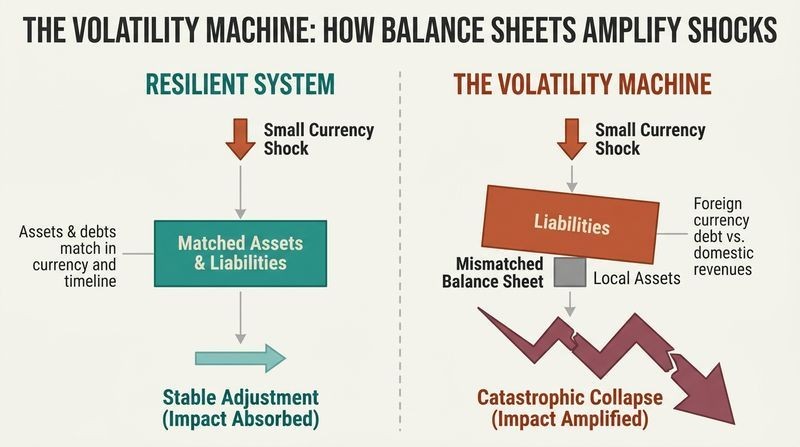
The core reframe of the book. Pettis argues that the great emerging market collapses of the 1990s (Mexico 1994, Asia 1997, Russia 1998, Brazil 1999) were not caused by bad economic policy, crony capitalism, corrupt bankers, or irrational panic. They were caused by badly designed capital structures: the way a country indexes its debts, currencies, and revenues over time.
A country is like a company. Corporate finance specialists study how market risks flow into a firm through its balance sheet. Economists study long-run growth but ignore the balance sheet. Pettis fuses the two. A small shock, like a modest currency devaluation, only becomes a catastrophe when the national capital structure mechanically amplifies it. The devaluation is the trigger, not the bomb.
What's striking is how this shifts blame away from the moralized narratives that dominated 1990s crisis coverage, where poor countries were scolded for insufficient virtue. Pettis is closer to Hyman Minsky and Charles Kindleberger, who located instability in financial structure rather than character. The claim is bold and partly deflationary: if structure drives collapse, then the endless reform checklists (transparency, deregulation) miss the point. A fair challenge: structure and policy are not fully separable, since weak institutions often produce fragile balance sheets in the first place. Still, the diagnostic power of treating a nation as a leveraged firm is genuinely clarifying.
Your capital structure is a machine that magnifies or absorbs shocks

The title metaphor. Every economic entity, from a household to a nation, has a capital structure that converts external price swings into internal volatility. Whether it dampens or amplifies depends on how revenues and financing costs are linked. A US carmaker selling to Europe hedges by borrowing in euros: if the euro weakens, sales fall but so does debt cost, canceling out. That is a shock absorber.
But the same machine can run in reverse. A building supplier funding itself with floating-rate debt does great when rates fall (construction booms and interest drops together) but gets crushed when rates rise on both sides at once. Well-run firms deliberately index financing so shocks to revenue are offset by shocks to costs. Most emerging economies do the opposite.
The volatility machine framing is the book's enduring contribution, and it anticipates later work on currency mismatch and original sin by Eichengreen and Hausmann. What deserves emphasis is that volatility is not merely uncomfortable, it changes behavior: it raises default probabilities, diverts managers from strategy to firefighting, and alters who invests. The insight generalizes well beyond sovereigns. Airlines hedging jet fuel, universities managing endowment payout rules, and even personal finance (fixed versus adjustable mortgages) are all volatility machines. The subtle point often missed: reducing expected cost and reducing volatility are different goals, and chasing the cheapest funding usually buys hidden fragility.
Rich-country liquidity, not poor-country reform, drives capital to emerging markets

Two competing models. The conventional investment model says capital flows to countries because their fundamentals improve, rewarding good reformers. Pettis champions the rival liquidity model: capital floods out of rich financial centers when they are awash in money, and desperate for yield, investors chase risk offshore. Growth follows the money, not the other way around.
The evidence is the timing. Chile, Mexico, Argentina, and Brazil enacted market reforms years or even decades apart, from Pinochet's Chile in the early 1970s to Brazil in the early 1990s. Yet capital flowed to all four in near-perfect synchrony: massive inflows in the 1970s, cut off in 1982-83, resumed 1989-91, peaking 1995-97. If reform drove flows, the timing would be random. It was not.
This is the book's most contrarian and consequential claim, echoing Kindleberger's displacement theory and Minsky's financial instability hypothesis. It implies humility bordering on fatalism: a finance minister's virtue matters far less than the Federal Reserve's stance. Stephen Roach's figure that a mere half-percent shift from US equities into emerging markets equals 6% of those markets' capitalization dramatizes the asymmetry of scale. The nuance worth adding: pull and push factors are not mutually exclusive. Liquidity may set the tide while fundamentals steer which boats rise. Recent quantitative work on the global financial cycle (Rey) strongly vindicates Pettis's emphasis on the center over the periphery.
Financial history rhymes: every lending boom follows the same four beats
180 years, one script. Pettis traces sovereign lending manias from the 1820s to the 1990s and finds a repeating sequence:
1. A displacement (bank creation, a huge new bond issue, gold inflows) expands money in a financial center.
2. Domestic asset prices boom and risk appetite explodes.
3. Some spark turns attention abroad; money pours into peripheral countries.
4. Liquidity reverses at the center, flows dry up, and defaults cascade.
The absurd proof. In the 1820s British mania, investors bought bonds of Poyais, a Central American country that did not exist, invented by a Scottish con man. The bonds traded up before buyers discovered there was no there there. Rome suffered a strikingly modern real-estate liquidity crisis in 33 AD, ended only when the emperor injected interest-free loans.
The historical sweep is the book's rhetorical engine, and it lands: pattern recognition across centuries is more persuasive than any single model. The Poyais episode is a gift, an 1820s prefiguration of collateralized nonsense that resurfaced in 2008's synthetic CDOs. What the recurrence suggests, uncomfortably, is that markets do not learn, or learn and forget within a generation, consistent with Reinhart and Rogoff's later This Time Is Different. A caveat: selecting episodes that fit a four-stage arc risks confirmation bias, since messy cases can be smoothed into the template. But the correlation of boom timing across unrelated economies is hard to explain any other way.
Emerging markets lack the patient long-term investors who stabilize prices
Investors live on a time-horizon spectrum. At one end sit market makers and day traders who care only about the next price tick; at the other, pension funds and insurers holding for years who buy when assets look cheap on fundamentals. In deep markets like the US, long-term value investors act as a floor: when prices drop for technical reasons, they scoop up bargains and dampen the swing.
Poor countries have no floor. Weak legal systems and opaque accounting keep foreign long-term investors away, and domestic long-term investors are too small to matter. So emerging markets are dominated by short-horizon traders and hedge funds who all react the same way to a price drop: they sell. There is no buyer of last resort, so technical selloffs spiral into collapses.
This microstructure argument enriches the macro thesis and connects to De Long, Shleifer, Summers, and Waldmann's noise-trader models, which Pettis cites. The deeper point is that market stability is a public good produced by heterogeneity of beliefs and horizons. Strip out the contrarians and you get self-reinforcing momentum. It reframes the tired villain of hedge fund speculators: they are not evil, they are simply the only players present, and their homogeneity, not their greed, is the problem. A modern extension: the same fragility appears in thinly traded crypto assets and small-cap stocks, where the absence of committed long-term holders produces violent, fundamentals-detached price cascades.
The capital structure trap turns a small shock into a self-reinforcing collapse
The book's signature concept. A capital structure trap is a funding setup where an external shock forces a borrower's revenues down and debt-servicing costs up at the same time, spiking default risk, which then drives the structure even further in the wrong direction. It is a positive feedback loop with no stable equilibrium until something breaks.
Watch it snap. After Mexico devalued in 1994, nearly all local debt was short-term or floating-rate. Rates shot up, borrowers defaulted, banks scrambled for liquidity, rates rose further, and peso rates blew past 100%. In Indonesia in 1997, companies with dollar debt rushed to buy dollars to hedge, which sank the rupiah further, dragging in more companies. The currency overshot any rational level not from panic but from mechanical forced selling.
The trap concept is what separates Pettis from a generic warning against mismatched balance sheets. His crucial distinction: an ordinary bad capital structure merely fails to hedge, while a trap actively amplifies through feedback. It requires the borrower to be large enough to move the very prices it is exposed to, which is why sovereigns and not individual firms fall into it. This is essentially a bank-run logic generalized to whole economies, and it dovetails with Krugman's later balance-sheet crisis models. The sobering implication: because the process is mechanical rather than psychological, appeals to calm or fundamentals are useless once the trap springs. Only a large lender of last resort or default halts it.
Match your debt payments to your revenues, or volatility will bankrupt you
Correlated versus inverted structures. A correlated capital structure links debt costs to move in the same direction as revenues: when times are good and you can afford more, you pay more; when times sour, your burden automatically shrinks. An inverted structure does the reverse, doubling up both gains and pain. Short-term dollar debt is the classic inverted trap for emerging markets, since a strengthening local currency lowers real debt cost during booms but explodes it during busts.
Ancient wisdom, modern amnesia. Hammurabi's code, 3,000 years ago, forgave a farmer's debt in a year when storms or drought destroyed his harvest, the earliest recorded correlated structure. Yet during booms, confident policymakers keep choosing inverted funding to shave borrowing costs, unwittingly wiring their economy to detonate on the next shock.
The Hammurabi reference is a masterstroke, showing that risk-sharing indexation is not exotic financial engineering but one of civilization's oldest instincts, since eroded by the pursuit of cheap money. The principle scales down beautifully: income-contingent student loans, revenue-based startup financing, and catastrophe bonds all embody correlated structures. The behavioral obstacle Pettis identifies is profound: optimism is structurally biased toward inverted funding because it looks cheaper precisely when you feel most confident. This is a cognitive trap, not just a financial one. The tension worth flagging: correlated funding costs more in good times, so it demands the discipline to buy insurance you hope never to use.
Credibility is the ability to survive shocks, not the will to
Redefining a fuzzy word. Economists usually treat credibility as political willpower: will the government stick to its policies? Pettis argues the real question is capacity: can the structure withstand a shock without forcing a policy reversal? Britain and Mexico both had overvalued currencies in the early 1990s. When Britain was pushed out of the European exchange mechanism in 1992, investors assumed nothing else would break, and markets rose. When Mexico devalued in 1994, investors fled, because its fragile capital structure meant devaluation could trigger total collapse.
The credibility Laffer curve. Governments try to prove resolve by making a policy reversal painfully expensive (Mexico's dollar-linked Tesobonos, Argentina's gold-backed bonds in 1890). Past a point, this backfires: the threatened self-destruction so alarms investors that credibility falls instead of rising.
This is one of the book's most elegant reframings, dissolving a debate about intentions into a question about engineering. It resonates with Nassim Taleb's later distinction between robustness and fragility: a credible system is anti-fragile enough that a shock reveals only its direct cost, not a cascade. The credibility Laffer curve captures a genuine paradox of commitment devices: raising the stakes of failure can signal confidence up to a threshold, then tip into a doomsday machine that investors refuse to stand near. Argentina in 1890 and Mexico in 1994 running the identical playbook a century apart underscores Pettis's claim that these are structural regularities, not one-off blunders.
Sovereigns should barely borrow in foreign currency, and build local bond markets
Winkler's rule. Pettis revives a 1933 insight: the only guarantee a country will not default on foreign debt is to have no foreign debt. The US in the 19th century saw its states, banks, and railroads default en masse on British loans, yet the federal government never did, because it never borrowed in foreign currency. Successful graduates from emerging to developed status share this trait: few sovereign defaults.
The fix is a fixed-rate local currency market. This is the closest thing to equity funding a country has. When a crisis hits and inflation surges, the real value of fixed-rate local debt erodes automatically, giving borrowers relief exactly when they need it. Mexico only auctioned its first three-year fixed-rate peso bonds in January 2000, absurdly late.
Pettis's prescription anticipates the actual policy evolution of the 2000s, when many emerging economies deliberately extended local-currency yield curves and accumulated reserves, precisely to escape the trap he diagnosed. Argentina's later 2001 collapse under a rigid dollar-linked currency board reads like a tragic confirmation. The provocative implication is that letting private corporates, whose defaults resolve case by case without systemic gapping, carry more foreign-currency risk may be safer than concentrating it in the sovereign. One tension: developing a deep local bond market requires the very investor base and institutional credibility that fragile economies lack, so the advice can be circular. Building the market is itself the hard, slow work.
The 1990s rebounds were dangerously misleading because global liquidity stayed high
Two types of crisis, very different outcomes. Pettis separates short-term margin collapses (sudden shocks during abundant global liquidity, like Mexico 1994 and Asia 1997) from long-term liquidity contractions (a real drying-up at the center, like the 1930s and 1980s). The first kind reverses fast; the second grinds economies into lost decades of default.
The trap of optimism. The 1990s crises were the survivable first kind, yet they were still devastating. The quick recoveries tempted observers to conclude the world was structurally sound. Pettis warns this is backwards: economies nearly collapsed during optimal, high-liquidity conditions. When liquidity eventually contracts, the same fragile capital structures will produce crises that do not bounce back, echoing the 1930s and the 1980s debt crisis.
Written around 2000, this is the book's boldest forward-looking bet, and it aged with unsettling relevance through 2008 and beyond. The distinction between a liquidity-abundant shock and a genuine contraction is the analytical payoff of the entire historical survey, and it explains why pundits repeatedly misread crises. Ironically, Pettis notes the Asian crisis actually increased global liquidity, as crisis countries swung to huge current-account surpluses and recycled savings into US Treasuries, foreshadowing the global imbalances debate. The lesson for any risk manager: recoveries during easy conditions prove nothing about resilience. The true test arrives only when the tide of central-money finally goes out, and structural flaws papered over by cheap capital stand exposed.
Analysis
The Volatility Machine is a hinge book in Pettis's career, the analytical seedbed for his later work on global imbalances and Chinese overinvestment. Its method is its message: import corporate finance rigor into sovereign analysis, a discipline traditionally monopolized by macroeconomists who, in Pettis's telling, systematically overlook how balance-sheet indexation transmits shocks. The result is a framework that treats nations as leveraged firms whose funding architecture, not policy virtue, determines whether a spark becomes an inferno.
The book's intellectual lineage runs through Kindleberger and Minsky (liquidity displacements, stability breeding instability) fused with Black-Scholes option theory (debt as a short put, equity as a call, the delta and kappa of sovereign obligations). This synthesis is genuinely original and lets Pettis explain puzzles that defeated conventional analysts: why currencies overshot any rational equilibrium, why South Korea with strong fundamentals cratered while similarly flawed neighbors survived, why Brazil devalued without catastrophe. The answer each time is the shape of the capital structure trap.
Where the book is strongest is its historical humility. By marching from the 1820s Poyais fraud through the 1873 crash to the 1990s, Pettis makes the recurrence of manias feel less like coincidence and more like law, prefiguring Reinhart and Rogoff. Where it is most contestable is the sharp separation of structure from policy. Fragile capital structures do not arise in an institutional vacuum; weak states, shallow markets, and inflationary histories jointly produce both bad policy and bad balance sheets, so the causal firewall Pettis erects is more porous than he admits.
The practical legacy is substantial. His prescriptions (minimize foreign-currency sovereign debt, build fixed-rate local bond markets, hold ample reserves, design correlated funding) map closely onto the actual defensive playbook emerging economies adopted after 2000. The book reads, two decades on, less as prophecy fulfilled than as a diagnostic manual whose logic the world was forced to learn the hard way.
Review Summary
The Volatility Machine receives high praise for its insightful analysis of emerging market financial crises. Readers appreciate Pettis's unique perspective, blending corporate finance with macroeconomics to explain how capital structure affects market volatility. The book's focus on liquidity flows and balance sheet management in emerging economies is seen as prescient and highly relevant. Many reviewers highlight its comprehensive historical analysis and practical framework for understanding financial crises. Despite some critiques of writing style, the book is widely recommended for those interested in emerging markets and sovereign debt analysis.
Download PDF
Download EPUB
.epub digital book format is ideal for reading ebooks on phones, tablets, and e-readers.








