

Key Takeaways
Judge claims by evidence, not by whether their conclusions feel virtuous.
Science tests its beliefs. The anthology’s central argument is that science advances when claims remain open to criticism and are judged by evidence, not by whether their findings comfort or offend. A double-blind medical trial illustrates the principle: neither patient nor clinician knows who receives the real treatment, reducing the chance that expectations distort results. The contributors argue that personal values may help determine which questions deserve study, but should not decide what the evidence says.
Facts inform, not dictate, policy. Scientific findings can clarify consequences, while public policy also involves values and tradeoffs. The collection’s warning is that suppressing inconvenient findings can leave even well-intentioned policymakers less informed. Its own essays vary in political emphasis, but share a concern that treating contested claims as beyond discussion weakens the methods that make scientific knowledge trustworthy.
The distinction between evidence and policy is valuable because it prevents two different debates from collapsing into one. Researchers can establish likely effects; communities still have to decide which effects matter most. This resembles the separation between descriptive and normative reasoning in ethics. The anthology’s own confidence in objectivity, however, can sound more complete than scientific practice allows. Measurements, categories, and research priorities can reflect human choices. That does not make results mere opinion; it makes transparency and criticism essential at every stage.
When political loyalty dictates findings, science becomes a tool of power.
Lysenko offers a warning. In the Soviet Union, agronomist Trofim Lysenko rejected genetics and promoted the claim that environmental changes in plants could be inherited. His ideas appealed to Stalin’s political vision, so political loyalty displaced evidence in agricultural policy. Geneticist Nikolai Vavilov challenged Lysenko and died in prison. The contributors connect this history to contemporary pressure on scholars, while recognizing that today’s cases are not equivalent in scale or violence.
Universities are not immune. Historian Niall Ferguson describes how German universities, once world leaders, became entangled with Nazi ideology. The lesson is not that every political controversy leads to dictatorship. It is that credentials and scholarly institutions cannot, by themselves, protect inquiry when leaders reward conformity and punish dissent.
Lysenko’s story is powerful because it shows how political incentives can corrupt both research and its practical application. Similar patterns appear whenever authorities reward conclusions in advance, whether in public health, economics, or climate policy. Historical comparisons are most useful as warnings about mechanisms, not as claims that present events equal past atrocities. The anthology sometimes draws its analogies sharply. Readers should ask which mechanisms genuinely match, such as retaliation against dissent, and which differences in power, coercion, and consequence remain decisive.
Keep vague harm rules from becoming hidden vetoes over research.
Censorship can look protective. The book examines journal policies that allow editors to reject research if it might harm or stigmatize a group. Contributors argue that terms such as harm and dignity can be so subjective that they give decision-makers broad discretion to suppress unwelcome findings. Alan Sokal asks what happens when research on obesity, sexual behavior, or sex differences is treated as harmful because someone dislikes its implications.
Pressure can spread quietly. The anthology describes retracted papers, rejected rebuttals, online campaigns, and scholars who avoid controversial topics. One study cited in the volume found that people more offended by scientific findings often reported greater difficulty understanding them, a pattern the researchers call dismissive incomprehension. Yet the collection also argues that formal censorship is only part of the problem: fear can shape what researchers choose to study or submit.
A rule against vague ideological vetoes protects more than unpopular scholars. It protects the public’s access to knowledge that may improve health or expose mistaken assumptions. Still, publication decisions do involve legitimate ethical limits, including privacy, research misconduct, and credible risks of enabling harm. The challenge is to distinguish these concrete duties from discomfort with a result. Clear criteria, written explanations, independent appeals, and consistent treatment across political viewpoints make that distinction testable rather than intuitive.
Demand measurable results before making identity-based rules govern scholarship.
Hiring rules shape inquiry. Lawrence Krauss reports that 24 of 25 physics job advertisements he examined required an explicit commitment to diversity, equity, and inclusion. He also cites a Berkeley life-sciences department where 76 percent of applicants were reportedly screened out on diversity statements before their research records were reviewed. Other contributors describe positions restricted to applicants from selected identity groups and grant applications judged partly on diversity plans.
Ask what the policy achieves. The book argues that demographic imbalance alone does not establish discrimination or prove that quotas will fix its causes. It distinguishes equality of opportunity from equality of outcomes and calls for evidence that a policy improves access, research, or patient outcomes. Its strongest practical demand is accountability: define the objective, measure results, and disclose who benefits or loses.
Requiring evidence for institutional reforms is a sound rule, especially when hiring and funding decisions affect careers and public resources. But merit is not always a neutral, self-explanatory measure: institutions choose which achievements count, and unequal access to preparation can affect the pool being assessed. That does not settle the case for quotas. It does suggest that fair evaluation should examine both individual performance and the conditions that shape opportunity, using criteria that can be scrutinized rather than presumed.
Respect cultural knowledge without confusing tradition with experimentally tested explanation.
Different claims need different tests. Contributors distinguish practical knowledge, such as local experience with plants or navigation, from scientific explanations that are tested, revised, and expected to work beyond one community. They object when spiritual narratives are presented as equivalent to empirical science in classrooms or research. Their argument is not that traditional knowledge has no value, but that a claim about nature should be evaluated by evidence.
Mathematics makes the distinction vivid. Its history spans cultures: the number system used today developed in India and was transmitted through Arabic scholarship into Europe. The contributors argue that this shared history enriches teaching without changing whether a mathematical proof is valid. In classics, they make a related case for retaining language study, arguing that careful attention to ancient words helps prevent modern assumptions from being mistaken for historical meaning.
The distinction between cultural importance and empirical support is a useful safeguard against treating every knowledge claim as interchangeable. At the same time, community knowledge can generate questions, observations, and hypotheses that formal research has overlooked. The productive approach is not to dismiss it or grant it automatic authority, but to examine each claim with methods suited to the claim. That approach can preserve respect for cultural history while maintaining standards that make scientific results open to testing and correction.
Keep disputed medical questions researchable, and demand patient-centered evidence.
Standards matter most under uncertainty. Contributors challenging gender-affirming care for young people argue that treatment guidelines and evidence have not always received adequate scrutiny. They point to the UK Cass Review, which found limited evidence about long-term outcomes, and describe disagreements between US professional associations and more cautious approaches in several European countries. Their concern is that contested treatments, especially for minors, require careful assessment of benefits, risks, consent, and alternatives. The anthology includes critical arguments, not a comprehensive review of the medical debate.
Language and data matter too. Karleen Gribble reports that replacing terms such as women and mothers with expressions such as pregnant people or birthing parents can make health information less clear. She notes that research on how readers understand these terms remains sparse. The broader lesson is to test changes in medical practice and communication for their actual effects on patients, rather than assuming good intentions guarantee good outcomes.
The call for rigorous evidence is especially important in medicine, where decisions can have lasting consequences and patients may be vulnerable. The same standard must apply to both established and proposed care, and to claims made by advocates or critics. A collection of essays cannot substitute for systematic reviews, clinical data, and careful attention to the experiences of patients. Its critique is most useful as a demand for transparent evidence and open debate, not as a reason to treat one side’s conclusions as settled.
Defend both speech and due process when campus outrage targets a scholar.
A complaint is not a verdict. Several contributors describe scholars losing teaching roles, invitations, or jobs after controversial speech or online campaigns. Carole Hooven recounts leaving Harvard after colleagues and administrators failed to defend her ability to discuss biological sex. Astrophysicist Christian Ott describes an investigation in which, by his account, he could not review the full evidence or receive an independent appeal. Frances Widdowson describes a university canceling a public lecture after protests.
Institutions face incentives. The essays argue that administrators may act to reduce reputational risk rather than determine what happened fairly. These are contributors’ accounts, and the anthology does not provide a neutral adjudication of every dispute. Still, their cases raise practical questions about access to evidence, clear procedures, proportional sanctions, and independent review.
Procedural fairness protects complainants as well as respondents: credible investigations depend on evidence, consistent rules, and a meaningful chance to answer allegations. Public outrage can expose misconduct, but it can also reward premature certainty and punishment by association. The personal accounts in this volume illuminate how institutions may fail, though personal testimony alone cannot establish every disputed fact. A reliable process should neither presume guilt nor dismiss a complaint as a mob tactic. It should make its reasoning reviewable.
Rebuild universities around neutrality, viewpoint diversity, and accountable scholarly standards.
The proposed repair is institutional. Steven Pinker’s five-part plan calls for free speech, institutional neutrality, nonviolence, viewpoint diversity, and reducing the power of DEI bureaucracies. Other contributors urge faculty to defend open inquiry, journals to explain publication decisions, and administrators to protect academic freedom consistently. They also argue that viewpoint diversity matters because a field dominated by one political outlook may miss weaknesses in its own assumptions.
Neutrality is not silence. The book’s distinction is that universities should host debate rather than issue official positions on every political controversy. The anthology also warns that government action can threaten scientific independence, even when presented as a corrective to campus ideology. Its final appeal is therefore broader than protecting any one faction: preserve fair procedures and room for disagreement, while holding scholarship to evidence and disciplinary standards.
These reforms address different failure points: speech rules protect discussion, neutrality limits institutional pressure, and viewpoint diversity improves the chances that assumptions will be challenged. None guarantees truth by itself. A university can be neutral about politics while enforcing rigorous methods, and a diverse faculty can still share blind spots. The anthology’s own caution about government interference is crucial: reform should not replace one political orthodoxy with another. Durable safeguards need transparent rules, academic self-governance, and the same protections for dissenters across ideological lines.
Analysis
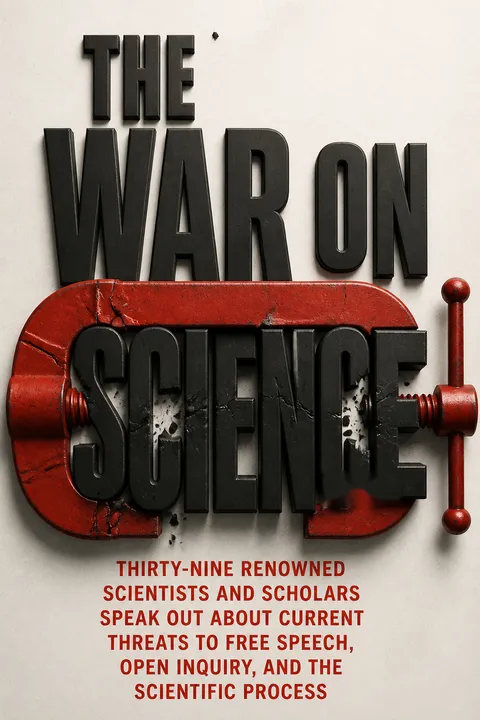
The War on Science is a large, argumentative anthology, not a unified research report. Thirty-nine contributors bring disciplinary and personal perspectives to one shared concern: that political commitments can displace evidence, open debate, and scholarly independence. Its narrative moves from historical warnings, especially Soviet Lysenkoism and the politicization of German universities, through disputes about hiring, publishing, academic speech, medicine, and cultural knowledge, then toward institutional reforms. The anthology’s strongest contribution is its insistence that good intentions are not evidence of good outcomes. It asks universities and medical institutions to define goals, collect relevant data, explain decisions, and tolerate findings that complicate preferred narratives. Its examples make the consequences concrete: research topics avoided, articles challenged, talks canceled, and careers altered. The recurring distinction between scientific evidence and political values also helps readers see why empirical findings can inform policy without determining it.
Its central limitation is that the volume is openly advocacy-driven. Contributors largely share a diagnosis, and many chapters rely on selected cases, personal testimony, and disputed interpretations rather than systematic comparisons of how often these events occur or what policies cause them. That does not make the cases irrelevant, but it does mean they should be read as evidence of possible mechanisms and institutional failures, not proof that every institution or DEI program operates as described. Several subjects, particularly sex differences and gender-related medical care, remain contested and require direct engagement with high-quality evidence from multiple perspectives.
The book’s most durable test is therefore reciprocal: would its authors defend the same procedural protections when the political pressure came from the other direction? Its warning about external attacks on science suggests they should. A credible defense of inquiry must resist both internal orthodoxy and government control, distinguish criticism from harassment, and apply evidence standards consistently. The collection is most valuable when it invites that disciplined defense, rather than when readers treat its political conclusions as a substitute for the open investigation it champions.
Review Summary
The War on Science receives mixed reviews, averaging 3.22/5. Supporters praise its defense of empirical science against ideological capture in academia, highlighting essays by Dawkins, Pinker, and others as brilliant and courageous. Critics argue the book ignores the more pressing right-wing assault on science, feels mistimed given Trump's re-election, and dismiss it as privileged academics complaining about accountability. Several reviewers question the credibility of contributors given personal controversies, while others find the proposed solutions disappointingly weak.
Glossary
liberal science
open, provisional knowledge-makingA term used for a system of inquiry in which no person has final authority over knowledge and no person’s identity gives their claims automatic authority. Findings remain open to revision, and evidence should be assessable across people and settings. The book presents this as a core condition for scientific exchange and criticism.
institutional neutrality
universities avoid official political positionsThe principle that a university, as an institution, should not take official sides on broad social and political controversies. Individual faculty members and students remain free to argue for positions. Advocates contend that neutrality protects dissenters from being implicitly opposed by their own institution and keeps the university focused on teaching and inquiry.
Universal biological definition (UBD)
sex defined by gamete sizeA definition of biological male and female based on reproductive cells: males produce small gametes, such as sperm, and females produce large gametes, such as eggs. Contributors use it to distinguish the definition of sex from the varied biological processes that determine sex during development and from social categories such as gender.
radical equalitarianism (RED)
group differences attributed to discriminationSergiu Klainerman’s label for a belief that groups are broadly alike in abilities, interests, and motivation, so observed disparities must result from bias or discrimination. He also uses RED for the claim that cultures contributed equally to major intellectual developments. The chapter argues that these assumptions can encourage policies aimed at equal outcomes rather than equal treatment.
outrage mob
crowd seeking punitive sanctionsA group that seeks punishment for a person or institution believed to have offended its members. In the cited account, the group shows little interest in further explanation and often pressures an authority to impose consequences. The distinction matters because online criticism alone cannot fire a scholar or retract a paper without institutional action.
Five-point plan to save universities from themselves
five institutional safeguardsSteven Pinker’s proposed reform program: protect free speech, maintain institutional neutrality, prevent coercive disruption, encourage viewpoint diversity, and reduce the authority of DEI bureaucracies. The plan treats these as complementary safeguards for academic inquiry, rather than as a single speech policy or a promise that universities will avoid political conflict.
Download PDF
Download EPUB
.epub digital book format is ideal for reading ebooks on phones, tablets, and e-readers.








