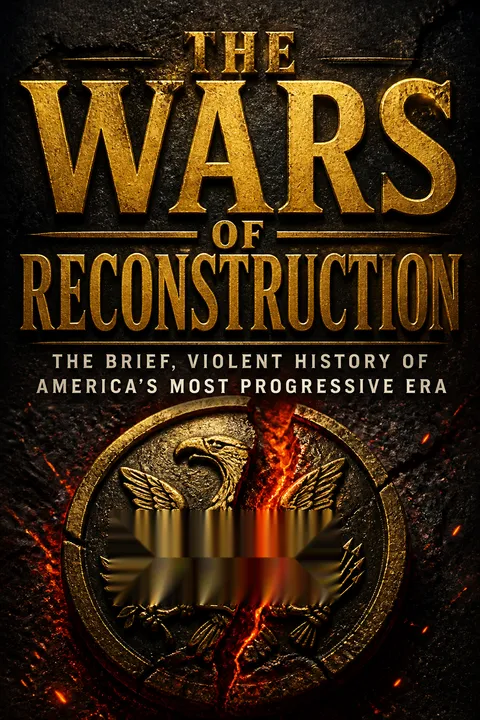


Key Takeaways
Read Reconstruction as a democracy violently overthrown, not a reform that simply failed.
Charleston offered a beginning. In April 1865, black troops entered the city where secession had begun, and thousands of Black Charlestonians paraded behind them. Children carried signs rejecting racial caste; freed people organized schools, churches, and political meetings. The carpenter Robert Vesey, son of the executed abolitionist Denmark Vesey, helped rebuild a church and emerged from years of obscurity into public life.
The promise was brief. The book argues that Reconstruction was the nineteenth century’s broadest experiment in interracial democracy, not a tidy success or a self-defeating failure. Its gains were real, its limits substantial, and its collapse in much of the South came through organized political resistance and violence. The assassination of Lincoln and Andrew Johnson’s leniency toward former Confederates helped close the opening.
The distinction between failure and overthrow changes the questions asked of the past. Instead of searching only for defects in reform, it directs attention to who benefited from dismantling it, and by what means. That is a useful lens for studying any democracy under pressure: institutions can be flawed and still worth defending. The framing also resists triumphalism. A brief expansion of rights is not the same as durable equality, especially when protection depends on federal power and political will.
Use military service as a claim to citizenship, then build power beyond the uniform.
The army became a school. More than 178,000 African Americans served in the Union military. For many, enlistment meant fighting slavery, freeing loved ones, and making a public claim to citizenship in a country that had long denied their rights. Soldiers also learned to read, practiced leadership, and debated politics in camp. Their service helped prepare men to become teachers, ministers, organizers, and elected officials.
The path had a cost. The Fifty-fourth Massachusetts, one of the first Black regiments raised in the North, suffered devastating losses attacking Fort Wagner in 1863. Its men also protested unequal pay, sometimes serving for months without wages. Of 1,510 identified Black officeholders during Reconstruction, at least 130 had served in the military. Service strengthened their political case, but neither sacrifice nor competence guaranteed equal treatment.
Military service made citizenship visible in a society that often treated legal claims as abstractions. Uniform, rank, and public leadership supplied evidence that could be difficult for opponents to dismiss. Yet the episode also shows the limits of respectability as a strategy: sacrifice might strengthen an argument for rights without persuading those committed to racial hierarchy. The army’s educational role matters here, too. Political capacity was not innate or absent; it was developed through access, practice, and responsibility.
Secure land and economic independence, or freedom remains exposed to old power.
Land meant autonomy. Formerly enslaved people wanted more than legal release from bondage. Owning land could make it possible to support a family without depending on former owners, build wealth, and pass security to children. In 1865, General Sherman reserved 400,000 coastal acres for Black refugees, generally in forty-acre parcels. About 40,000 people claimed land under the order.
The promise was reversed. The Freedmen’s Bureau, a federal agency created to assist freed people and impoverished whites, was also charged with managing abandoned lands. President Johnson restored hundreds of thousands of acres to pardoned former Confederates, including land already occupied by freed people. Many had to negotiate labor contracts instead. Sharecropping gave some families control over their work, but debt and unequal bargaining power kept independence precarious.
The land struggle exposes the difference between formal freedom and material power. Without an independent economic base, people can be legally free yet remain vulnerable to employers who control housing, credit, and access to work. The case also complicates the idea that market contracts alone create equal opportunity: a contract signed by parties with radically unequal resources may preserve dependence in a new form. Land redistribution was not the only route to economic security, but reversing the promised transfers narrowed the choices available.
Fund schools as civic infrastructure, not as a charitable extra.
Education enabled self-rule. Freed people sought schooling to read labor contracts, understand political choices, and give their children opportunities denied under slavery. Churches often doubled as classrooms, while parents raised money, built schoolhouses, and studied after exhausting workdays. By 1869, Bureau-supported schools numbered about 3,000, with roughly 150,000 students. Many Black teachers took over from white missionaries as the school system expanded.
The gains came under attack. Southern states had largely lacked public education before the war, and Black literacy had been actively restricted. Yet schools faced chronic shortages of books, buildings, and teachers. White opponents burned schoolhouses and threatened educators. Northern teachers could be dedicated and still patronizing, and Black communities often preferred teachers of their own race. The achievements were substantial, but access remained uneven and vulnerable to violence and public neglect.
Treating education as infrastructure captures its role beyond individual advancement. Schools create shared skills that make participation in courts, elections, and public administration more possible. They can also help communities preserve knowledge across generations. The story cautions against equating institutional growth with equal access: enrollment figures cannot show every difference in school quality, safety, or local control. Nor should community demand be mistaken for passive gratitude. Freed people built and financed education because they understood its practical and political value.
Turn local grievances into organized demands before opponents define the agenda.
Conventions made a movement. Beginning with a national gathering in Syracuse in 1864, Black activists created a network of state and local conventions. They demanded equal rights, voting access, education, and fair treatment in public transportation. The National Equal Rights League helped connect these efforts. Its chapters often overlapped with churches, schools, and the Union League, a Republican-linked civic network that organized political education and voter activity.
The campaigns were practical. Philadelphia teacher and activist Octavius Catto challenged streetcar exclusion by remaining aboard a whites-only carriage in 1865. Black organizers then lobbied legislators, helped draft a bill, and pressed for enforcement. Across the South, convention delegates brought together ministers, veterans, workers, and freeborn activists. Their priorities did not always align, but the gatherings gave scattered demands a public platform and a shared political language.
A convention is more than a meeting. It converts private grievances into a platform that can be repeated, debated, and carried to lawmakers. This is a core mechanism of collective action: coordination reduces isolation and helps participants discover common interests. The varied backgrounds of delegates also matter. Coalition-building does not erase class or status divisions, and the book shows that Black activists sometimes disagreed over land, suffrage, and strategy. Their organizing strength lay in making those debates part of public politics rather than leaving them to opponents to define.
Rights on paper cannot restrain a president determined to restore white rule.
Johnson returned power to ex-Confederates. After Lincoln’s assassination, President Andrew Johnson allowed former Confederate leaders to regain office and opposed strong federal protections for freed people. Southern legislatures passed the Black Codes, state laws that restricted Black rights, limited movement, and pressured freed people into controlled labor. Johnson vetoed both the Freedmen’s Bureau extension and the Civil Rights Act of 1866, though Congress overrode those vetoes.
Congress changed the terms. The Fourteenth Amendment established citizenship and equal protection, while the Reconstruction Acts required former Confederate states to write new constitutions and protect Black male voting. The Fifteenth Amendment later prohibited denying the vote on account of race. These measures shifted authority away from Johnson and toward Congress, but enforcement still depended on officials willing and able to carry them out.
This episode is a study in the gap between lawmaking and implementation. Constitutional language can establish standards, but those standards need administrators, courts, and political coalitions to make them effective. The struggle also shows that executive power is not automatically a neutral instrument: the same office can protect rights or weaken them through appointments, pardons, and nonenforcement. A legal victory is therefore neither hollow nor self-executing. Its durability depends on institutions that can withstand hostile leadership.
Treat the ballot as power to shape schools, courts, and public services.
Voting opened public offices. Once Black men gained the vote in the former Confederacy, they elected representatives and served as sheriffs, judges, school officials, and local administrators. By 1872, African Americans held about 15 percent of southern offices. The figure varied sharply by state: South Carolina had a Black majority in its legislature, while Black officeholders remained a minority across the region. Blanche K. Bruce, born enslaved in Virginia, became a U.S. senator from Mississippi in 1875.
Officeholding changed daily life. Reconstruction governments established public schools, expanded services, and revised laws affecting transportation, courts, and property. Black officials did not simply represent one issue or one constituency, though their power was limited by hostile legislators, weak resources, and white resistance. The ballot mattered because it gave communities a means to influence institutions that had previously excluded them, not because elections alone could remove every barrier.
The chapter’s portrait of political participation broadens democracy beyond national elections. Local offices affect whether a complaint is heard, a school is funded, or public order is maintained. Representation is therefore both symbolic and administrative. At the same time, counting officeholders can obscure the constraints they faced, including unequal budgets and threats to their lives. The book’s evidence supports a useful distinction: access to office creates channels for change, but power also depends on whether those channels command resources and are protected from coercion.
Recognize political terror as counterrevolution, not mere disorder.
Violence targeted political capacity. White vigilantes, including the Ku Klux Klan and other local groups, attacked Black voters, teachers, officeholders, and Republican organizers. The attacks were often planned to weaken communities before elections or remove influential leaders. In 1866, white mobs killed 46 Black people in Memphis and 34 Black people and four white people in New Orleans. In 1868, South Carolina state senator Benjamin F. Randolph was assassinated during an election campaign.
Federal protection proved fragile. Congress passed Enforcement Acts to protect voting rights and authorized federal action against conspiracies. President Grant used troops and prosecutors, with some success, but soldiers were withdrawn and often concentrated in cities. Rural districts remained exposed. Violence was not simply a breakdown of order. It was a means of changing who could vote, organize, and govern when fair political competition threatened white supremacy.
Calling political terror counterrevolution clarifies its purpose: the violence sought to reverse a change in who held power. The incidents were not interchangeable with ordinary crime, because victims were selected for their organizing roles and political commitments. That interpretation also makes state response central. Enforcement can deter violence, but only if witnesses, officials, and voters believe protection will last. The book is careful to show that Black communities sometimes defended themselves, while the imbalance in institutional power and the scale of targeted repression remained decisive.
Do not mistake 1877 for the end of Black political life.
The retreat was uneven. The withdrawal of federal troops after the disputed 1876 election sharply reduced protection in the South, but it did not erase every gain at once. Black men continued to hold local and state offices, and Black members of Congress served until 1901. In some southern cities, African Americans retained political influence after Republican state governments fell. Black voters in parts of the North kept rights they had gained during Reconstruction.
The movement continued. Activists kept organizing conventions, challenging segregation, and documenting violence. The Civil Rights Act of 1875 attempted to prohibit discrimination in public accommodations, though the law was weakened in practice and later struck down by the Supreme Court. The period’s end is therefore not a single date. It describes a retreat across much of the South, while political work and institutional gains persisted elsewhere and in altered forms.
Period labels are useful shorthand, but they can make change look cleaner than it was. A date like 1877 can conceal uneven regional timelines, continuing political service, and the survival of rights outside the former Confederacy. It can also imply that a movement ended when federal policy shifted, even though organizers kept working. The book’s longer view makes the distinction between formal protection and lived capacity visible. It does not minimize the retreat; it shows why a retreat should not be confused with total disappearance.
Challenge histories that call Black self-rule chaos and white terror order.
Memory became another battlefield. For decades, influential writers and popular films depicted Reconstruction as vindictive misrule, often portraying Black officeholders as incompetent and the Ku Klux Klan as a force restoring order. The Dunning School, a tradition of scholarship associated with Columbia historian William A. Dunning, helped establish this interpretation. D. W. Griffith’s 1915 film The Birth of a Nation carried a similar story to mass audiences.
Black historians contested it. W. E. B. Du Bois’s Black Reconstruction in America argued that freed people and their allies built democratic institutions, including public schools, and that white violence helped destroy them. The debate over a proposed Denmark Vesey monument in Charleston shows how public memory still shapes what communities honor. Memorials cannot settle every historical dispute, but asking whose political work is remembered, and whose violence is excused, reveals the values beneath a public story.
Historical memory is not just a record of what people think happened. It shapes which political choices appear legitimate in the present. When Black participation is portrayed as disorder while white coercion is described as restoring stability, the moral vocabulary itself becomes part of the contest. The book’s attention to monuments, textbooks, and film makes that process concrete. A caution remains: correcting a distorted narrative requires more than replacing heroes. It also requires explaining conflicts within communities and the limits of the reforms being defended.
Analysis
Egerton organizes Reconstruction as a contested process with three linked phases: Black political capacity grows during the Civil War, federal and community institutions expand after emancipation, and organized white resistance narrows those gains. The narrative opens in Charleston in 1865, where the return of Black troops, the rebuilding of a church, and the emergence of Robert Vesey make freedom visible in civic life. It ends with a debate over a monument to Denmark Vesey, connecting postwar politics to the present struggle over public memory. That circular structure gives the argument a human scale without reducing it to a single family or city.
The book’s most consequential interpretive move is to distinguish a reform’s weaknesses from the causes of its defeat. Reconstruction had internal conflicts, limited economic redistribution, uneven federal protection, and political compromises. Those constraints matter, but they do not explain away the targeted violence that removed organizers, frightened voters, and attacked institutions. Egerton also resists a Washington-only account. Soldiers, teachers, ministers, women, conventions, and local officials appear as political actors, not merely recipients of national policy. This broadens the reader’s picture of how democracy is built: through public law, community labor, and everyday challenges to exclusion.
The argument is strongest when it connects rights to material conditions. Voting and citizenship mattered, but so did land, schools, wages, family autonomy, and access to transport. Its attention to divisions among Black communities and to the paternalism of some white allies keeps the story from becoming a simple tale of unity. The framing of Reconstruction as the nation’s first progressive era is persuasive as a description of its democratic reach, though it remains an interpretation rather than a neutral label. The book’s deeper point is not that the era achieved equality. It is that a multiracial democracy briefly became possible, and that its destruction was a political choice carried out through legislation, retreat, and terror.
Review Summary
The Wars of Reconstruction receives strong praise for its accessible, detailed account of post-Civil War America, correcting Lost Cause myths while centering Black Americans' experiences. Reviewers appreciate Egerton's focus on local activists, his documentation of widespread racial violence, and his argument that Reconstruction was overthrown rather than failed. Some critics note the narrative can feel dense, disorganized, or repetitive, particularly in early chapters, and that scholars familiar with Du Bois or Foner may find little new. Overall, most readers consider it essential, illuminating history with clear contemporary relevance.
Glossary
Freedmen’s Bureau
Federal aid and land agencyFormally the Bureau of Refugees, Freedmen, and Abandoned Lands, this federal agency was created in 1865 to assist formerly enslaved people and impoverished whites. It distributed relief, supported schools, helped negotiate labor arrangements, and managed some abandoned or confiscated lands. Its authority and resources were limited, and President Johnson’s policies returned much of the land it had set aside for freed people.
Black Codes
Laws restricting freed peopleState laws passed in the South after the Civil War to constrain the rights and choices of formerly enslaved people. Their provisions varied, but often restricted movement, access to land, employment options, and legal standing. Vagrancy rules and labor-contract requirements could pressure freed people back into plantation work. Congress challenged these laws through federal civil rights legislation and Reconstruction policy.
Union League
Republican political networkA political organization that began in the North during the Civil War to support the Union and the Republican Party. In the South, Black members used local chapters for political discussion, voter organizing, and community protection. The League connected churches, teachers, veterans, and activists to party activity, though its members did not all share the same views on land reform.
Reconstruction Acts
Congressional rules for state restorationFederal laws passed in 1867 that placed much of the former Confederacy under military districts and set conditions for restoring states to representation in Congress. States had to create new constitutions, protect Black male voting, and ratify the Fourteenth Amendment. The acts shifted control of Reconstruction away from President Andrew Johnson and toward Congress, but their success depended on enforcement.
Enforcement Acts
Federal protection for votingA series of laws passed between 1870 and 1872 to enforce the Fifteenth Amendment and protect citizens from conspiracies that interfered with voting rights. They authorized federal action, including the use of marshals and prosecutors, against organized intimidation and violence. The laws enabled some prosecutions of white vigilantes, but declining troop numbers and local resistance limited their reach.
Dunning School
Anti-Reconstruction historical traditionA school of historical writing associated with Columbia University historian William A. Dunning and his students. It portrayed Reconstruction as a period of corruption and incompetent Black rule, and often praised white resistance as a recovery of political order. Douglas R. Egerton contrasts this tradition with scholarship that emphasizes Black political agency, public institution-building, and the violence that dismantled Reconstruction governments.
Lost Cause
Romanticized Confederate memoryA postwar interpretation that defended the Confederacy and softened or denied slavery’s central role in secession. Lost Cause writers often presented the antebellum South as benevolent, Confederate leaders as honorable, and Reconstruction as unjust punishment. Veterans’ groups, public commemorations, novels, and films helped spread these ideas, shaping popular memory well beyond the former Confederacy.
carpetbagger
Northern migrant in the SouthA label used for a person from the North who moved to the South during or after the Civil War, especially one involved in Republican politics. Southern opponents used the term to suggest that these newcomers sought personal profit or political control. Egerton notes that many were teachers, ministers, former soldiers, and officials, though their motives and attitudes varied.
scalawag
White southern RepublicanA hostile label for white southerners who supported the Republican Party during Reconstruction. They included former Unionists and people who had opposed secession, as well as others who joined the party for varied political reasons. Some supported Black rights and public reforms; others were cautious or self-interested. The term helped opponents portray interracial Republican politics as illegitimate.
Download PDF
Download EPUB
.epub digital book format is ideal for reading ebooks on phones, tablets, and e-readers.








