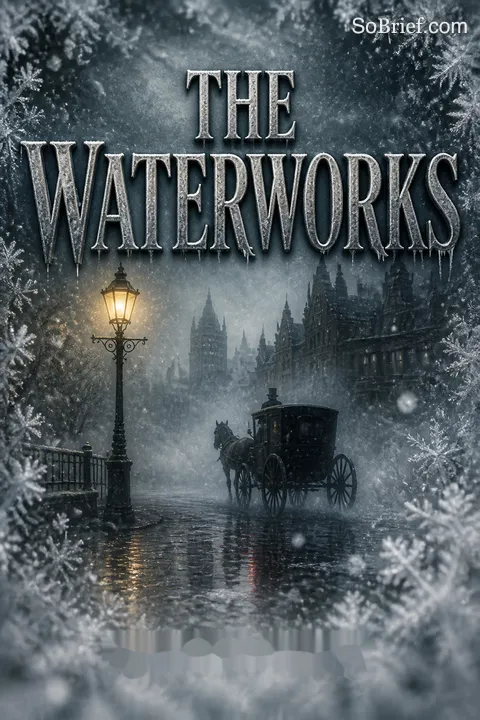


Plot Summary
The Father on Broadway
In 1871, newspaper editor McIlvaine notices that his gifted freelance writer, Martin Pemberton, has arrived bruised, muddy, and carrying bloodstained pages. Martin says his father, Augustus, is alive.
McIlvaine treats the claim as one more dark metaphor from a young man who despises the city and the corruption that made his father rich. Martin takes his payment and disappears. His shabby room on Greene Street is abandoned, rent unpaid, and three letters remain unopened.
McIlvaine's concern grows when Martin misses assignments and his fiancée, Emily Tisdale, and the Reverend Grimshaw confirm that Martin has told them the same startling thing. The editor begins to suspect the statement is not metaphor, and that Martin himself may be in danger.
McIlvaine’s first mistake is professional as much as personal: he translates an alarming claim into a familiar newspaper idiom, as if language can make danger manageable. Martin’s battered arrival and discarded letters place evidence in plain sight, but the city’s daily urgency encourages everyone to look past it. The scene also establishes the novel’s central uncertainty. In a place where corruption routinely disguises itself as respectability, an apparently impossible claim may be more accurate than the official record.
A Son's Inheritance of Shame
Martin’s estrangement from Augustus began at Columbia, where Martin wrote a moral philosophy thesis accusing his father’s wartime business of supplying shoddy goods and trading in slave ships. Augustus disowned him, and Martin refused the inheritance.
Emily, Martin’s childhood companion and uncertain fiancée, recalls that he had also seen Augustus’s face in a public stage during a March snowstorm. In the later rain, he pursued another stage and glimpsed the familiar shape of his father.
Sarah, Augustus’s second wife, tells McIlvaine that Augustus left Ravenwood for treatment at Saranac Lake, then was reported dead by a doctor she never met. The family fortune has vanished, leaving Sarah and her son Noah dependent on relatives. McIlvaine sees that Martin’s visions are bound to a suspicious death and a deliberately broken family.
The family history makes Martin’s suspicion more than a haunting: it is the consequence of a son who publicly documented what his father’s respectable reputation concealed. His refusal of the inheritance is both ethical protest and self-punishment, while Sarah’s quiet acceptance of uncertainty shows how dependence can make moral judgment difficult to act upon. The stage sightings force a collision between private memory and public evidence. Martin knows his father’s body and habits intimately, yet the records, funeral, and family accounts all insist on a death he cannot confirm.
Donne Takes the Case
McIlvaine recruits Captain Edmund Donne, an unusually honest police officer, to find Martin and investigate the suspicious death. Donne searches the morgue, checks records, and begins looking for Eustace Simmons, Augustus’s former business manager.
A street tough called Knucks Geary brings him a more urgent lead: a stranger is offering money for children from the streets. Donne presses Knucks to learn more, but Knucks is later found dead with his neck broken. At a tavern, a flower-selling girl and the bartender help describe the man who fought him.
McIlvaine’s artist friend Harry Wheelwright turns their accounts into a portrait. The drawing matches the powerful driver Martin had seen with the stage, transforming a ghostly vehicle into a traceable part of a living operation.
Donne’s methods counter the city’s habit of treating the poor as disposable and the powerful as untouchable. His questions about a dead street tough and a frightened flower seller are not side investigations: they uncover the human supply chain beneath respectable institutions. The portrait is a hinge between forms of knowing. The witnesses offer fragments, Harry renders them visible, and McIlvaine recognizes the driver from Martin’s account. Evidence accumulates through cooperation among people the city usually keeps at its margins.
The Boy in Woodlawn
After Martin asked Harry to help inspect Augustus’s grave, the two men traveled to Woodlawn Cemetery and hired gravediggers to open the coffin. Harry expected Augustus’s remains. Instead, he found the body of a boy dressed in clothes that did not belong to the wealthy merchant.
Martin recognized that the grave had been made to support a false death, but the discovery gave him no explanation for where his father had gone. He made Harry promise to keep the secret, then disappeared from their familiar haunts.
When Harry finally tells McIlvaine and Donne what happened, the captain has a concrete reason to pursue the Pemberton matter beyond missing-person inquiries. A child has been buried in a man’s place, and someone has built an elaborate deception around Augustus’s supposed death.
The substituted body converts an uncanny suspicion into an act of deliberate violence against truth. Yet the grave yields no neat answer: it proves Augustus was not buried there, but leaves the child unidentified and the father’s fate unknown. Martin’s demand for secrecy isolates him further, while Harry’s belated confession brings the secret into a fragile alliance. The scene also shifts the moral scale of the mystery. This is no longer only a wealthy family’s private deception; a child’s body has been made an instrument of it.
Ledgers Beneath the City
While Donne pursues the medical trail, Sheriff James O’Brien brings McIlvaine copied ledgers detailing the Tweed Ring’s theft of public money. McIlvaine’s publisher refuses to print them, so he resigns; the New York Times later publishes the evidence, helping break the Ring’s grip on the city.
Donne studies the same accounts and notices that the Ring granted a charter without taking its usual payment. The institution is the Home for Little Wanderers, a new orphanage directed by Eustace Simmons, with Dr. Wrede Sartorius listed as its physician.
Dr. Mott confirms that Sartorius treated Augustus after diagnosing a fatal blood illness, but Sartorius is absent from the medical registry. The orphanage, the missing doctor, and the children sought by Knucks now converge in one investigation.
The political scandal and the private mystery share a structure: both depend on records that respectable institutions have altered, hidden, or declined to inspect. McIlvaine’s resignation demonstrates that publishing is not automatically a public service; a newspaper can protect power as efficiently as it can expose it. Donne, by contrast, reads a suspiciously ordinary ledger entry as a clue. The orphanage’s free charter links municipal corruption to the children on the streets, showing how civic benevolence can provide cover for an enterprise that would otherwise be impossible.
The Cell Below the Orphanage
Donne’s men watch the Home for Little Wanderers until a white city stage leaves its gate. The driver, Wrangel, fights the police with his whip, but Donne knocks him down and the officers open the locked coach. Six terrified children spill out; one escapes across the fields.
Inside the orphanage, staff and children panic as police search the rooms. The classrooms and dormitories appear clean and well supplied, but a locked basement compartment contains a starving, barely recognizable Martin. Simmons is gone.
Donne arranges for the children to be transferred to another home, and Sarah has Martin taken to hospital. The raid rescues him from confinement, but the children can explain little about their journey or why they were being moved under lock and key.
The orphanage’s clean rooms are essential to the deception: visible order persuades outsiders that the children are safe, while a concealed cell holds the truth. Donne’s raid turns observation into intervention, but it cannot undo the fear the children have learned. Martin’s rescue is emotionally incomplete because he is alive yet unable to respond, and Simmons has escaped. The scene exposes a particularly modern form of cruelty: exploitation does not need a visibly brutal institution if paperwork, good supplies, and public trust can keep scrutiny away.
Sartorius's Living Garden
As he recovers, Martin explains that he found Simmons at a political dinner and followed him outside. Wrangel seized him, and he awoke among children aboard the white stage. Dr. Sartorius received him without denying that Augustus was alive, then allowed him limited freedom inside a hidden medical complex.
Martin was first drawn to the physician’s intellect and observed his experiments: brain measurements, transfusions, and treatments involving children’s blood and marrow. He eventually understood that Sartorius was trying to preserve elderly, terminally ill men by manipulating their bodies with material taken from the young.
When Martin hesitated to submit to a procedure himself, Simmons had him returned to the orphanage and locked below ground. Martin’s fascination collapsed into horror, but he still cannot tell whether Augustus survived the experiments.
Martin’s ordeal exposes how intellectual fascination can suspend ordinary moral resistance. Sartorius does not need to threaten or persuade him; the force of his scientific attention draws Martin into observing procedures that he gradually understands as exploitation. Martin’s turning point comes when he recognizes his own complicity, not simply when he learns the facts. His confinement then makes the analogy literal: like the children above him, he has been reduced to a body under someone else’s authority. The unresolved fate of Augustus keeps knowledge from becoming closure.
The Waterworks Unsealed
Using clues from the city accounts, Donne leads police to the Croton waterworks, where a hidden conservatory shelters the old men from the fellowship. The officers find several dead patients and one still dying; Augustus is absent.
They capture Sartorius, who explains that he treated the men as experimental subjects and never promised the ordinary recovery they imagined. Donne then takes McIlvaine to Ravenwood. On the lawn they find Augustus’s wasted body, and below the bluff they discover Simmons dead beside a footlocker filled with money.
The body confirms that Martin’s father had been kept alive beyond the family’s knowledge, but not that he remained capable of recognition or independent will. The enormous fortune survives in part, while the physician’s laboratory and its patients collapse into a scene of death.
The waterworks literalizes the novel’s conflict between civic infrastructure and hidden use. A system built to carry water for the city conceals an artificial ecosystem designed to prolong the lives of wealthy men. Sartorius’s explanation does not restore moral clarity; it makes the horror more precise by separating technical success from human good. Augustus’s body and Simmons’s money provide material answers, but neither can repair the family’s lost years. The investigation reaches its factual climax while leaving the deeper question of what counts as life unresolved.
Survivors and Their Stories
A medical commission declares Sartorius unfit for trial and sends him to an asylum, where another inmate later kills him. Augustus is buried at Ravenwood, and Sarah receives the money recovered from Simmons’s footlocker. Donne will not seek a public trial, fearing Sartorius’s ideas would gain an audience; McIlvaine keeps the story from print, believing Martin should inherit it as a writer.
Martin marries Emily in the garden of their childhood, while Sarah marries Donne. McIlvaine returns to newspaper work at the Sun, but the case remains unpublished. In the final winter scene, a Sunday freeze stills New York’s machines, rails, and ships. The city soon resumes its motion, carrying its old corruption and its new silences into another year.
The resolution restores intimate bonds without producing a public reckoning. Sarah and Donne, Martin and Emily, and the recovered money offer forms of continuity, yet the commission’s secrecy and McIlvaine’s silence leave the city’s larger complicity largely untouched. His choice to preserve Martin’s authorship is generous, but it also protects his own wish to keep the story whole and private. The frozen city briefly resembles a paused moral machine. Its thaw promises not transformation but continuation, making the ending tender and uneasy at once.
Analysis
The Waterworks builds its mystery from a contradiction between what New York records and what its residents can see. Augustus is declared dead, eulogized, and buried, yet Martin recognizes him riding through the city. Each official system seems to confirm the next: a church conducts the funeral, the press repeats the public account, and the family accepts a story shaped by a private doctor. The investigation succeeds only when people compare those systems rather than trusting any one of them.
The novel’s central ethical problem is not simply that Sartorius violates medical norms. His experiment makes instrumental logic visible in its starkest form: the wealthy purchase continued existence, children become biological resources, and the physician calls the process inquiry rather than cruelty. That logic is not isolated from the city. Tweed’s government, the orphanage’s respectable appearance, and the newspapers’ dependence on patronage all show how exploitation can be sustained by ordinary arrangements. The children’s vulnerability is not an interruption of civic life; it is one of the costs the city has learned to ignore.
McIlvaine’s narration complicates any easy claim that exposure alone is justice. He values evidence, resigns when his paper suppresses it, and helps bring Donne into the investigation. Yet he also delays publication, partly to protect Martin’s claim to the story and partly because he wants to possess its complete meaning. His restraint may be humane, self-serving, or both. The book refuses to separate those motives neatly.
The final marriages restore companionship, while the city’s machinery resumes after the winter freeze. Private lives can recover more readily than public institutions. New York’s brief stillness offers a vision of moral pause, not conversion. The unresolved force of the ending lies in the possibility that the city will keep moving, carrying forward the same bargains beneath new headlines.
Review Summary
Reviews of The Waterworks are mixed, averaging 3.45/5. Many praise Doctorow's evocative portrayal of 1871 New York City, its corruption under Boss Tweed, and the novel's atmospheric, philosophical depth. Admirers highlight its elegant prose, compelling moral themes, and blend of detective fiction with science fiction elements. Critics, however, frequently cite the overuse of ellipses as deeply distracting, and some find the pacing slow, characters underdeveloped, and the plot underwhelming. Overall, readers appreciate the rich historical setting more than the mystery itself.
People Also Read
Characters
McIlvaine
The city's implicated editorMcIlvaine is a newspaper editor who believes that arranging facts into print is a civic duty. His wit and professional skepticism help him read New York’s politics, but they also let him dismiss what does not fit his expectations. Martin’s disappearance draws him from detached observer into a case involving his own choices as a publisher and investigator. He is alert to the power of records and the limits of public language, yet his desire to possess a story can compete with his concern for the people inside it.
Martin Pemberton
The estranged freelanceMartin is a gifted, impoverished writer and the son of Augustus Pemberton, a wealthy merchant whose business practices Martin condemns. He is perceptive, proud, and intensely responsive to the moral failures around him. His refusal of his inheritance expresses both a principled rejection of his father’s wealth and a punishing estrangement from the family that produced him. Martin’s analytical mind can become isolating: he experiences convictions as obligations rather than opinions, and his fierce self-sufficiency makes it difficult for loved ones to know how to help.
Edmund Donne
The methodical policemanCaptain Donne is a disciplined, unusually incorruptible officer in a police force shaped by political patronage. Tall, solitary, and reserved, he approaches a mystery through records, witnesses, and patient observation rather than bravado. His respect for procedure does not make him indifferent to vulnerable people; he attends to street children and even to a compromised informer with unusual seriousness. Donne’s self-command can look like distance, but it also allows him to act steadily when McIlvaine’s appetite for the story threatens to outrun the evidence.
Emily Tisdale
Martin's steadfast equalEmily is Martin’s childhood companion and fiancée, the daughter of an ironworks founder. Plainly dressed and forthright, she is training to teach rather than accepting the narrow expectations her class sets for her. Her loyalty to Martin is deep, but not passive: she recognizes how his convictions and moods burden their relationship and questions the cost of waiting for him. Emily’s practical intelligence, commitment to education, and emotional candor offer a counterweight to Martin’s abstractions.
Sarah Pemberton
The composed widowSarah is Augustus’s second wife and Noah’s mother. Raised in an old Dutch family, she enters marriage across a gulf of wealth and social standing, then learns to endure a household shaped by Augustus’s imperiousness. Her composure is not simple meekness: it is a discipline that lets her continue functioning when information and security are withheld from her. She cares for Martin despite their strained family ties and tries to protect Noah from adult instability. Her patience can preserve relationships, but it can also delay the moment when she permits herself to judge what has been done.
Wrede Sartorius
The unorthodox physicianSartorius is a brilliant physician and natural scientist whose experience in Civil War field hospitals earns him a formidable reputation. He is precise, self-contained, and impatient with professional consensus. Unlike conventional villains, he is not driven by obvious vanity or a desire for social power; he follows questions about the body with a rigor that excludes ordinary moral limits. His distinction between scientific inquiry and personal responsibility makes him intellectually compelling and ethically dangerous.
Harry Wheelwright
The compromised artistHarry is Martin’s large, convivial college friend and a painter who earns money from society portraits while making unsparing studies of wounded veterans and city poverty. He enjoys irony and sometimes lies for amusement, but his artistic eye is exact. His friendship with Martin is mixed with resentment and affection, and his interest in Emily complicates it further. Harry’s impulse to protect his own reputation makes him slow to disclose what he knows.
Augustus Pemberton
The absent patriarchAugustus is Martin’s father, a self-made merchant whose fortune is associated with defective Union Army supplies and illegal slave trading. He prizes control, money, and his own judgment, and treats family relationships as subject to his authority. His public image as a patriotic businessman contrasts sharply with Martin’s accusations. Even before he becomes the focus of the mystery, Augustus shapes the choices of his son, his wife, and the city officials who benefited from his wealth.
Eustace Simmons
The trusted administratorSimmons is Augustus’s pockmarked former business associate and secretary, a man whose career connects port administration, maritime commerce, and the Pemberton household. He is observant, discreet, and skilled at operating behind a more powerful man. Sarah finds his presence unsettling, while Martin sees him as a link to his father’s affairs. Simmons’s practical competence and willingness to serve make him a consequential figure in a world where power often acts through intermediaries.
Noah Pemberton
The watchful younger brotherNoah is Sarah’s young son and Martin’s half-brother. He is solemn, observant, and more adaptable than adults assume, finding excitement in public school even as his family’s circumstances change. His attachment to Martin gives the older brother a responsibility beyond his own principles. Noah’s perspective reveals how children absorb changes in status and security before they can fully understand their causes.
Charles Grimshaw
The shaken rectorGrimshaw is the rector of St. James and a longtime religious associate of Augustus. He once stood against abolitionist sentiment in New York, but age and social dependence have softened his authority. He tries to interpret Martin’s claims through pastoral care and Christian doctrine, even when those frameworks fail to account for the evidence. His concern for the family is real, though loyalty to Augustus shapes what he is initially willing to believe.
William Tweed
The municipal kingpinTweed dominates New York through patronage, bribes, contracts, and control over public institutions. His charm and political generosity help sustain a system that profits from the city’s neediest residents as well as its wealthiest contractors. He is not the investigator’s sole antagonist, but his government gives hidden enterprises protection and legitimacy. Tweed embodies how corruption can become an everyday civic arrangement rather than a secret practiced by a few individuals.
Dr. Thadeus Mott
The cautious physicianMott is a respected doctor who diagnoses Augustus with a fatal blood illness and later shares his medical records with Sarah. He represents a conventional medical profession that values collegial exchange, even as it cannot explain every practice undertaken outside its institutions.
Knucks Geary
The streetwise informerKnucks is an aging tough who once made his living through violence and now survives through observation and schemes among street children. His attempt to alert Donne to a buyer’s interest in children reveals both his capacity for self-preservation and a late, uneasy recognition of the harm around him.
Wrangel
The obedient driverWrangel is a powerful, shaven-headed driver who served under Sartorius during the war. He is loyal, physically formidable, and accustomed to carrying out instructions without asking what they mean. His military discipline makes him useful to people who prefer their work to remain unseen.
James O'Brien
The aggrieved sheriffO’Brien is the county sheriff and a participant in Tweed’s political machine. He brings McIlvaine a record of the Ring’s thefts after Tweed denies him his expected share. His motives are self-interested, but the evidence he provides helps expose corruption that more principled citizens could not safely document.
Plot Devices
The white omnibus
A moving trail of evidenceThe ordinary public stage appears to Martin during storms, carrying Augustus and other sickly old men through Manhattan. At first the vehicle seems to support a supernatural or delusional explanation. Witness descriptions, the driver’s portrait, and the later police raid reveal it as transport used by a hidden medical operation. Its public visibility is part of its concealment: New Yorkers are accustomed to seeing stages pass and rarely ask who is inside.
The substituted body
A false death made physicalThe boy buried in Augustus’s coffin turns Martin’s repeated sighting into evidence of a staged death. The discovery proves that the public record and the funeral cannot establish what happened to Augustus. It also introduces a disturbing question about the children connected to the hidden enterprise. The substituted body is not merely a mystery clue; it shows how the powerful can use the vulnerable to construct a convincing public account.
Tweed's ledgers
Corruption leaves a paper trailThe ledgers brought by O’Brien record the Ring’s financial thefts and expose how political influence can make public institutions serve private interests. Donne’s attention to an unusual charter entry leads him to the Home for Little Wanderers, linking municipal accounts to missing children and the hidden medical operation. The documents advance both the political and personal investigations, while the newspapers’ refusal or willingness to print them determines what the public is allowed to know.
The newspaper archive
Memory assembled from fragmentsMcIlvaine’s newsroom archive collects old reports, obituaries, and public records that can be compared against current events. The files reveal Augustus’s earlier investigations, his business connections, and the contradictions surrounding his supposed death. But the archive is not neutral: omissions and flattering obituaries reflect the same city that produced the corruption. McIlvaine must read not only what the paper preserved, but also what its silence and editorial choices conceal.

Download PDF
Download EPUB
.epub digital book format is ideal for reading ebooks on phones, tablets, and e-readers.








