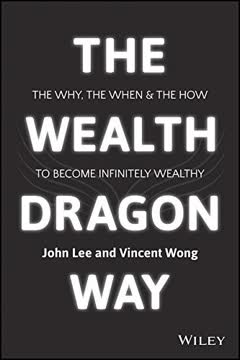
Key Takeaways
1. Embrace a Holistic Definition of Wealth
So monetary wealth is a fairly straightforward measurement. But that is only one type of wealth that we are talking about here. We also place a huge value on what you are worth to the world in terms of your attitude and feelings.
Beyond cash. Wealth isn't merely a large bank balance; it's a combination of monetary and moral worth. Monetary wealth is measured by your net worth (assets minus liabilities), focusing on appreciable assets like property or a business, not just cash. Moral wealth, on the other hand, reflects your compassion, integrity, generosity, and positive contributions to humanity.
Interconnected value. While seemingly distinct, monetary and moral wealth are deeply connected. High moral wealth, coupled with monetary wealth, empowers you to do more good in the world, spreading your positive impact further. Conversely, a lack of monetary wealth can limit your capacity to help others, and even erode moral standards if one is trapped in desperation. The ideal state is to achieve both, as money provides choices and amplifies your ability to contribute.
Moral obligation. The authors argue that you have a moral obligation to become as wealthy as possible. This isn't about greed, but about maximizing your potential to enrich your own life and the lives of others. Good people with more money can effect greater positive change, making the world a better place.
2. Challenge Conventional "Undesirable Truths"
Whether you think you can or you think you can’t, you’re probably right.
Rethink education. Many societal "truths" are actually limiting beliefs. For instance, the idea that a good formal education guarantees a secure future is often a false promise. Self-education, focused on practical skills and real-world experience, often creates more opportunities and can lead to greater financial success than academic qualifications alone.
- Formal education: May provide a living, but self-education can build a fortune.
- Saving money: Less effective than investing it carefully to generate regular income.
Money and happiness. The adage "money doesn't buy happiness" is debunked; while it doesn't guarantee happiness, it certainly enriches life by providing choices, freedom, and the ability to pursue passions and help loved ones. Furthermore, the notion that "rich people are mean and corrupt" is largely a fallacy; money tends to magnify one's existing character, making generous people more generous.
- Money's role: It's a tool that amplifies who you already are.
- Frugality: An abundant mindset, where money is seen as infinite and easily replenished, is more virtuous than a miserly, fear-based frugality.
Overcoming limitations. The belief that you need money to make money is also challenged; resourcefulness, creativity, and determination are far more critical. The only true limits are those you impose upon yourself. By questioning these ingrained beliefs, you open yourself to a "parallel universe" of possibilities where success is within reach.
3. Conquer Fear and Procrastination to Act
Our deepest fear is not that we are inadequate. Our deepest fear is that we are powerful beyond measure.
Fear's paralysis. Fear is the biggest roadblock to achieving your goals, often manifesting as "False Evidence Appearing Real." While some fear is rational and protective, most anxieties are unfounded projections of future events that never materialize. This paralyzing fear leads to procrastination, keeping individuals stuck in their comfort zones.
Confronting the beast. Instead of burying your head in the sand or escaping through distractions, you must confront and challenge your fears. Each time you do, its power over you diminishes. This involves pushing past discomfort, embracing hard work, and accepting that failure is an essential part of the learning process, not a reason to quit.
- "What-if analysis": Leads to paralysis.
- Laziness: Often a fear of hard work or stepping outside comfort.
Action over wishing. Procrastination, often disguised as waiting for the "right time," is a crippling epidemic. Success comes from taking immediate, decisive action, even if the outcome is uncertain. Visualizing goals is helpful, but it must be coupled with a concrete plan and relentless execution. Your life won't change until you take action, recognizing that time is finite, while money is infinite.
4. Escape the Rat Race by Working Smarter
When you work for someone else, it doesn’t matter how much effort you put in, you will only ever get a limited return on your time investment.
The trap. The "rat race" describes a conventional life path: formal education, a job, debt, and reliance on pensions. This path often leads to misery, boredom, and a constant fear of redundancy, as individuals trade all their time for a limited, often insufficient, income. Many people are "brainwashed rats," wishing their lives away for weekends and holidays.
Beyond employment. The authors advocate for working for yourself as soon as possible. As an employee, your return on effort is capped, and your time is owned by someone else. As an entrepreneur, 100% effort can yield 100% (or more) return, offering true financial freedom and control over your time.
- Employee vs. Entrepreneur: Limited return vs. potentially unlimited return.
- Pensions: Relying on state or private pensions is risky; build your own controlled fund.
Planning for freedom. While not everyone needs to be a full-time entrepreneur, everyone deserves the skills to control their financial future. This means learning entrepreneurial skills, building assets, and creating passive income streams. This provides a safety net against redundancy and the option to leave the rat race when desired, transforming a life of obligation into one of choice.
5. Navigate the Wealth Superhighway for Growth
If you don’t design your own life plan, chances are you’ll fall into someone else’s plan. And guess what they have planned for you? Not much.
Strategic progression. The "Wealth Superhighway" is a metaphor for a structured path to infinite wealth, moving from stagnation to exponential growth. It outlines three distinct lanes:
- Hard Shoulder: Relying solely on a monthly salary and state pension, with no savings or passive income.
- Slow Lane: Investing in appreciable assets, primarily property, to slowly grow wealth.
- Middle Lane: Generating passive income through rental properties, Forex trading, or other investments.
- Fast Lane: Building a profitable business and a strong brand, leading to exponential wealth.
Asset building. The foundation of wealth is appreciable assets, with property being the most accessible for most. Unlike depreciating assets, property generally increases in value over time and can be highly leveraged (banks lend a large percentage of its value). Your greatest appreciable asset, however, is yourself – investing in your skills, knowledge, and well-being is paramount.
Passive income and business. Once assets are acquired, the focus shifts to generating passive income, freeing up your time to pursue greater wealth. The ultimate stage is building a business and brand, leveraging your unique skills and passions. This involves identifying a "nano niche" where you can become an expert, positioning yourself to stand out, and scaling your offerings.
6. Cultivate an Abundant "More Money" Mindset
The possession of anything begins in the mind.
Infinite money. A core belief for wealth creation is that money is infinite and constantly available. Unlike finite resources, money, especially in its virtual form, is always being created and circulated. This mindset counters scarcity thinking, which limits opportunities and fosters fear.
- Money is everywhere: Opportunities abound if you're prepared to see and seize them.
- Law of attraction: Focus on what you do want (e.g., smooth deals, good partnerships) to attract it.
Perspective is reality. Your mindset filters your perception of the world. Changing your perspective can transform your reality, turning perceived obstacles into opportunities. This includes valuing things by their "worth" (investment) rather than their "cost" (consumption), and understanding that "luck" is often preparation meeting opportunity.
- Value vs. Cost: Shift from "how much will it cost?" to "what's the investment worth?"
- Greed redefined: Wanting more for freedom and generosity is not greed; it's a desire to expand and contribute.
Take control. Entrusting your money to "financial experts" without understanding investments is irresponsible. You must educate yourself and take personal control of your finances. This proactive approach, combined with an abundant mindset, ensures you are ready to manage and grow wealth when opportunities arise.
7. Master Value Property Investing Principles
Make money when you buy (i.e., buy properties below their market value so you’re in profit from day one).
Buy low, profit immediately. The foolproof guide to property investing is simple: make money when you buy. This means acquiring properties significantly below their market value, ensuring an immediate "paper profit." This differs from speculation (hoping for future appreciation) or development (adding value through renovation), though these can be combined with value investing.
- Property investor: Buys below market value (BMV).
- Property speculator: Buys at market value, hopes for appreciation.
- Property developer: Adds value through improvements.
Leverage and control. Property is a highly leveraged investment; you can borrow most of the money, amplifying your return on investment. It also offers control, allowing you to force appreciation through improvements or generate passive rental income. Even in market slumps, rental income can provide stability.
- Leverage: Small deposit controls a large asset.
- Forced appreciation: Renovations or additions increase value.
Golden rules for success. Successful property investing requires adherence to key principles:
- Motivated sellers: Essential for BMV deals.
- Direct negotiation: Focus on terms, not just price.
- Due diligence: Thorough research prevents costly mistakes.
- Rental demand: Crucial for passive income.
- Numbers game: Consistent outreach to find deals.
- Buy and wait: Long-term strategy for capital growth.
8. Leverage Lease Options for Property Control
Lease options give the investor control even without having to transfer ownership.
Innovative financing. Lease options offer a creative way to control property without immediate ownership, especially beneficial during market downturns or for motivated sellers. This strategy involves taking over mortgage payments and renting out the property, while securing an option to buy it at a pre-agreed price in the future.
- Win-win: Seller is relieved of mortgage burden; investor gains control, rental income, and future appreciation.
- Control vs. Ownership: Focus on controlling the asset, not just owning it outright.
Overcoming resistance. Vincent Wong pioneered the legalization of residential lease options in the UK, demonstrating the power of persistence against conventional resistance. This method provides a flexible solution for both financially distressed homeowners and investors seeking to build a portfolio with less upfront capital and reduced risk.
- Legalization: Required tireless effort to establish legitimacy.
- Benefits for investors: Lower entry barrier, passive income, future capital gains.
Strategic advantage. Lease options are less time-consuming and stressful than traditional purchases, avoiding complex conveyancing and eleventh-hour paperwork. They allow investors to secure properties at today's prices, benefiting from future market appreciation, while providing a vital service to sellers in difficult circumstances. This approach highlights the importance of creative problem-solving in property investment.
9. Prioritize People Skills in All Business Dealings
The property business is a people business, and that’s why you must invest in learning people skills.
Human element. Despite being about physical assets, the property business is fundamentally a "people business." Every step, from finding motivated sellers to negotiating deals and managing tenants, involves human interaction. Excellent people skills are paramount for success.
- Motivated sellers: Understanding their circumstances is key to crafting mutually beneficial deals.
- Networking: Building relationships with solicitors, brokers, and other investors is crucial.
Compassion and negotiation. Dealing with highly motivated sellers often means engaging with individuals in difficult or extreme circumstances. A compassionate approach, combined with strong negotiation skills, allows you to offer solutions that benefit both parties. This contrasts sharply with the perception that cash investors exploit vulnerable sellers; instead, they provide a vital service when no one else can.
- Problem-solving: Offering solutions to sellers' urgent needs.
- Ethical approach: Helping people avoid repossession or bankruptcy.
Beyond the property. The true value lies not in the bricks and mortar, but in the stories and needs of the people involved. Direct communication with sellers, rather than through agents, allows for creative deal-making based on terms that address their specific situations. Investing in people skills, therefore, is as critical as understanding market trends or financial strategies.
10. Commit to the 10 Wealth Dragon Principles
You are never too old to set another goal or to dream a new dream.
Action-oriented commitment. Becoming a Wealth Dragon requires unwavering commitment and a proactive mindset. It starts with clearly defining your desires and igniting a passionate drive to achieve them. "Ready, Fire, Aim" emphasizes taking action after preparation, rather than endless procrastination, accepting that mistakes are part of the learning process.
- Commitment: Essential for overcoming obstacles.
- Action: "Do and Grow Rich" – consistent action leads to results.
Resilience and high standards. Success demands doing "whatever it takes" within ethical bounds, pushing past discomfort, and never giving up, even in the face of repeated failures. Maintaining the highest standards in all aspects of life, from menial tasks to business operations, builds discipline and attention to detail.
- Persistence: "Never, never, never give up" – crucial for long-term success.
- Quality: "How you do anything is how you do everything."
Strategic growth and giving back. Learn from the best, make necessary sacrifices, and take calculated risks. Do what others won't to create a future others don't have. Finally, embrace the abundance mindset by giving back generously, understanding that generosity attracts more wealth.
- Learning: Invest in education from successful mentors.
- Risk-taking: Calculated risks are essential for progress.
- Generosity: Giving back reinforces an abundant mindset.
Last updated:
Review Summary
The Wealth Dragon Way receives mixed reviews averaging 3.36/5 stars. Readers appreciate the mindset development around wealth creation and passive income strategies, particularly property investing. The book emphasizes financial abundance psychology and presents ten wealth principles including commitment, action-taking, and learning from experts. However, critics note the content is generic, similar to other self-help books like Rich Dad Poor Dad. Major criticisms include overemphasis on property investment requiring high leverage, insufficient detail on alternative wealth-building methods like stocks and forex trading, and lack of practical guidance for those without initial capital.





