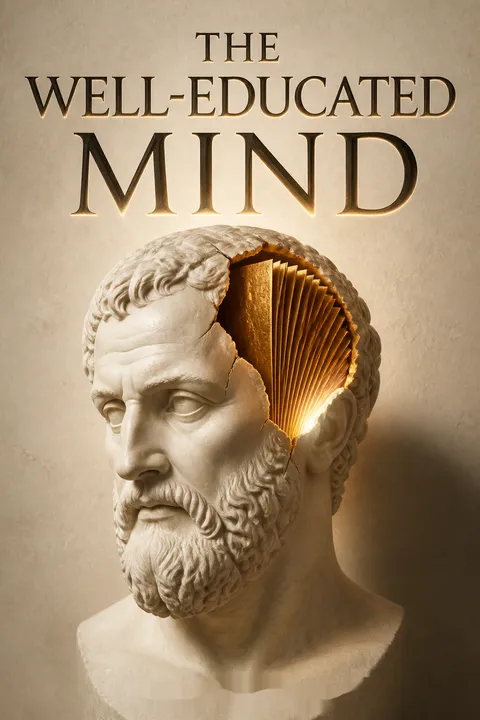


Key Takeaways
Treat serious reading as a trainable practice, not a talent test.
Ability grows through practice. Reading a newspaper is not the same skill as following Homer, Plato, or Henry James. Difficult books demand concentration and unfamiliar habits, but struggle does not prove a reader lacks intelligence. Bauer’s own graduate seminars taught her to read independently, summarize arguments, and test conclusions. Earlier self-educators did much the same without university credentials. Mary Gilchrist, who had only a brief period of formal schooling, read authors from Charlotte Brontë to David Hume and organized a Shakespeare reading club with a neighbor.
Start small and protect the time. Bauer recommends scheduling four weekly sessions of about thirty minutes, preferably in the morning, and keeping email and other distractions away. A modest, repeatable practice matters more than an ambitious plan that collapses after a week.
The central promise is unusually democratic: serious study is a set of learnable actions, not a privilege bestowed by schooling or innate brilliance. That resembles deliberate practice in music, where fluent performance grows from repeated work on difficult passages. The comparison also clarifies why short sessions help: they make sustained attention easier to establish before the material becomes familiar. The schedule is practical rather than universal, however. Caregiving, shift work, disability, and fatigue can make mornings or four fixed sessions unrealistic. The durable principle is protected, recurring time, adapted to the reader’s actual life.
Understand a book before deciding whether its claims deserve belief.
Three stages of thought. Bauer adapts the classical trivium, a sequence of grammar, logic, and rhetoric. Here, grammar means grasping what a work says; logic means examining how its parts and evidence support its claims; rhetoric means forming and expressing a considered judgment. Readers often jump straight to agreement or disagreement before they have understood the argument. The book’s method reverses that reflex: establish the content first, test the reasoning next, and decide what to think only after that.
The order changes the verdict. A history needs to be checked against evidence, while a novel is better assessed by how convincingly it builds a human world. Both can be discussed intelligently, but neither benefits from an opinion formed before the reader knows what the work is doing.
This sequence offers a practical defense against snap judgment. It resembles the distinction between comprehension and evaluation in education: a student cannot critique an argument that has not yet been reconstructed fairly. The stages also make disagreement more precise. Instead of saying a book feels wrong, a reader can identify whether its facts, reasoning, or values are at issue. The framework is not a claim that emotion should be removed from reading. First impressions can reveal what matters to a reader, but they become more useful when tested against careful understanding.
Trade speed for attention when sentences carry several ideas.
Information is not understanding. Bauer distinguishes gathering facts from grasping what those facts mean. A news report can tell readers that an event occurred; serious reading connects it to history, belief, politics, and competing explanations. A vivid image may provoke emotion, but it cannot replace the work of following a complex argument.
Slow prose needs its small words. Speed-reading can help with straightforward material, but it can distort the distinctions in a passage by Aristotle or the ironies in Jane Austen. In Aristotle’s account of mistakes, the difference between intention, accident, and harm depends on exact wording. Bauer suggests previewing a difficult paragraph for its key ideas, then reading it carefully. As readers gain background in a subject, its vocabulary and conventions become more familiar, and the work often becomes easier without sacrificing attention.
The contrast between information and understanding remains useful in a media environment designed for quick updates. A fast summary can establish what happened, while extended reading helps reveal what assumptions or causes organize the account. Cognitive science describes a related limitation: working memory can hold only a small amount of unfamiliar material at once, so rereading, note-taking, and prior knowledge ease the load. Slowness itself is not proof of depth, and speed is not always careless. The useful test is whether the pace preserves distinctions that matter to the argument.
Turn reading into memory by quoting, summarizing, and answering back.
Make an external memory. Bauer’s self-education journal is modeled on the commonplace book, a notebook for saving passages and ideas worth remembering. It does more than collect quotations. The reader first records selected words from the book, then restates its main ideas in their own language, and finally adds questions, objections, and personal connections. This movement from copying to paraphrasing to responding helps turn borrowed ideas into understood ones.
Keep summary and reaction distinct. E. M. Forster’s notebooks offer a model: he copied lines, summarized historical arguments, criticized plays, and recorded observations from daily life. A reader can use margins or different colors to separate what the author says from what the reader thinks. That separation makes it easier to notice when a reaction is grounded in the text and when it comes from elsewhere.
The journal functions as a bridge between reading and thinking. In contemporary terms, it is a form of external cognition: the page holds details that would otherwise compete for limited attention, freeing the mind to compare and evaluate. Paraphrase is especially valuable because it exposes false familiarity. A sentence may seem clear until the reader tries to explain it without borrowing the author’s wording. Yet note-taking can become busywork. The strongest journal entries are selective, tied to a question, and useful for returning to the book rather than a transcript of every page.
Read once for the whole, again for structure, then discuss your judgment.
Let the first reading move. On an initial pass, Bauer advises readers to keep going through confusion rather than stopping at every unfamiliar word or difficult passage. Record brief chapter summaries and mark questions, but avoid exhaustive notes. Once the whole work is visible, return to passages that seem central, trace the structure, and ask how well the author achieved a purpose.
Use conversation as a test. The final stage asks what the work wants readers to believe, do, or experience, and whether it succeeds. A reading partner can reveal hidden assumptions and force clearer definitions. Specific references to the text keep discussion anchored. The partner need not share the reader’s background; difference can be useful because an idea that seemed obvious may need to be explained carefully.
The method resembles a useful research cycle: orient to the whole, inspect the evidence, then communicate a conclusion to someone who can question it. Delayed rereading also prevents local difficulty from disguising a book’s larger pattern. Conversation adds a social check on private interpretation, much as peer review tests whether an argument is intelligible beyond its author. A partner is not automatically a reliable judge, and agreement is not proof. The safeguard is the book itself: interpretations should be connected to passages, not merely to confidence or group consensus.
Read in historical order so each book answers its predecessors.
Build a sequence, not a pile. Bauer’s reading lists run chronologically because writers inherit forms, assumptions, and problems from earlier writers. Reading the novel from Cervantes toward Calvino, for instance, reveals shifts in how fiction handles realism, individual identity, and its own status as a made story. Reading poetry across centuries likewise shows changing expectations of language, from oral epic to tightly patterned verse and modern experimentation.
Join literature to history. A novel can illuminate the concerns of its era, while a history can reveal the political and social conditions behind a literary work. Chronology helps readers see these connections rather than treating classics as isolated monuments. The lists are deliberately incomplete, however. Bauer invites readers to add, remove, or skip works, and argues that a single list cannot be a neutral or final canon.
Chronological reading turns influence into something a reader can observe rather than merely hear about. A form that once felt natural may look like a response to an older form when placed beside it. This is close to intellectual history, which studies how ideas change and shape action. The method can also suggest a smooth march toward modernity where literary history is actually uneven, overlapping, and contested. Bauer’s warning against treating her lists as canonical matters for that reason. Chronology is a map for comparison, not a ranking of cultures or a verdict on literary worth.
Judge novels by the worlds they build, not by plot alone.
Ask what changes. In a first reading, track who the central people are, what happens to them, and how they differ by the end. On a closer pass, ask what each character wants, what blocks that desire, and what strategy the character uses. These questions uncover more than plot mechanics. Elizabeth Bennet’s wish to marry, for example, also reflects her effort to negotiate family pressure and the limits placed on women in her society.
Notice the storyteller’s choices. Point of view, setting, style, recurring images, and the ending all shape a novel’s picture of human life. Austen’s irony depends on how narration frames manners and money; modernist and postmodernist novels often challenge the idea that one narrator or one account can settle what is real. A novel invites readers into an experience, so ask whether its people and world feel persuasive, not merely whether events are exciting.
The approach combines literary form with a reader’s ordinary questions about motive and consequence. It helps explain why a novel can matter even when its plot is simple: perspective and setting may reveal what a character cannot see about themselves. It also resists reducing fiction to a slogan. A novel’s claim about society is carried through scenes, voices, and contradictions, not just through a detachable message. Still, a convincing fictional world is not automatically a truthful account of all people. Readers should distinguish emotional credibility from broad social evidence.
Read autobiography as a life interpreted, not a life replayed.
Memory makes a plot. An autobiographer looks backward and selects events that support a meaning for the life. The adult Richard Rodriguez interprets a childhood moment when his parents switch from Spanish to English as part of his movement into public American life. The child experienced the event before he could understand it that way. The remembered scene may be sincere without being a neutral recording.
Look for the organizing pattern. Bauer suggests asking what turning point the writer identifies, what ideals the writer measures themselves against, what faults are confessed or explained, and where the story chooses to end. Augustine arranges his early life around religious conversion; Benjamin Franklin presents self-improvement as a path to achievement, while Frederick Douglass makes literacy and resistance central to his transformation. Ask whose experience the author claims to represent, and what the narrative leaves out.
Autobiography is valuable partly because it makes interpretation visible. The narrator is both a participant in past events and the editor of their present meaning, a tension familiar from memory research and narrative psychology. That does not make autobiography useless as evidence. It means the work can tell readers both about remembered events and about the identity the writer is constructing. Bauer’s questions help readers notice that construction without assuming deception. A further caution is necessary: an individual’s account may illuminate a shared condition, but it cannot stand in for every member of a group.
Treat every history as an argument built from selected evidence.
Find the claim beneath the story. Historians do not simply assemble facts. They choose questions, sources, and explanations to make a past intelligible. Bauer asks readers to identify the historian’s main assertions, the evidence used to support them, and the link between evidence and conclusion. Diaries, government records, interviews, and statistics reveal different parts of the past, and each has limits.
Test the reasoning. Watch for a striking example offered as proof of a general trend, a cause inferred only because it came first, or a single cause used to explain a complicated event. Bauer’s historical survey traces changing ideals, from Greek accounts centered on leaders to Christian histories shaped by providence, Enlightenment confidence in reason, and later efforts to recover overlooked lives. These approaches reveal different questions, but perspective does not make every interpretation equally well supported.
The chapter’s strongest lesson is methodological: historical writing must be evaluated both as narrative and as an evidentiary claim. This connects with modern source criticism, which asks who produced a record, for what purpose, and whose lives it excludes. The turn toward diaries and ordinary people can correct elite-centered accounts, while quantitative records can reveal patterns individual memoirs cannot. Neither approach is sufficient by itself. A broad theory can flatten difference; a single life can be too narrow to establish a general pattern. Readers need both scale and specificity.
Read plays as actions awaiting staging, not novels on a page.
Imagine the event, not just the dialogue. A play leaves sound, movement, lighting, and much of the setting to performers and directors. Bauer asks readers to notice stage directions, who is present but silent, where tension rises, and what action changes the situation. The script gives a reader room to imagine a production, but a staged version makes one set of choices visible and changes how an audience encounters the work.
Form reveals assumptions. Greek tragedy concentrates action around a crisis; medieval morality plays personify qualities such as Death or Good Deeds; Shakespeare gives characters conflicting motives; modern and absurdist drama may disrupt plot or realistic speech. Comparing productions can show how the same play’s meanings shift with setting, casting, and audience. Drama is therefore both literature and an event shared by people in a particular place and time.
Treating a play as a potential performance restores the body and the audience to literary analysis. A pause, a glance, or a character’s location can carry meaning that a plot summary misses. This also makes interpretation tangible: a director’s choices can be compared rather than treated as invisible. The form has a limit, since reading alone cannot reproduce the timing or collective response of theater. But that incompleteness is productive. The reader becomes a provisional director, testing how different staging decisions alter the play’s emotional and intellectual force.
In poems, examine how language and form make meaning.
The poet remains in view. Bauer likens a poem to a periscope: readers encounter its subject through both the poet’s perspective and the poem’s language. Unlike a novel that may survive adaptation while retaining its identity, a poem depends on its particular words and arrangement. Rhythm, images, syntax, and sound are not decoration added to an idea; they help create the idea.
Read before reducing. First notice the mood, scene, or experience, then examine how the poem is built. A sonnet may shape an argument through its turns; a modern poem may fracture syntax to express uncertainty. The book traces poetic practice from oral epic and medieval alliteration through Renaissance form, Romantic self-expression, and modernist fragmentation. A paraphrase can clarify a poem’s subject, but it cannot replace the experience of its language.
This account treats form as a way of knowing, not an ornamental package. A repeated rhythm can make an idea feel inevitable, while broken syntax can enact a speaker’s uncertainty. That insight has parallels in music, where changing tempo or harmony alters the listener’s sense of a melody without changing its basic notes. Bauer’s advice to experience a poem before consulting commentary also protects the reader’s direct response. Yet no reading is entirely unprepared: language, translation, and cultural knowledge all shape what seems audible or clear.
Analysis
The book is best understood as a practical apprenticeship in interpretation, not as a list of classics or a defense of one fixed canon. Its narrative begins with an adult returning to graduate school and discovering that the valuable work happens through reading, writing, and argument, not passive reception. From there, the method expands across novels, autobiography, history, drama, and poetry. The organizing principle is consistent: learn what a work is doing, examine how it does it, and only then decide what it means or whether it persuades.
The most durable contribution is the insistence that genre changes the questions a reader should ask. A novel invites judgment about character and experience; a memoir requires attention to memory and self-fashioning; history calls for scrutiny of evidence and causal claims; drama depends on embodied action; poetry makes its language inseparable from its meaning. This gives readers a portable method without pretending every text can be evaluated by one checklist. The book also carries a productive tension. Its chronological reading lists present literature as a continuous conversation, but their center of gravity is the Western canon, and the author acknowledges that such lists reflect selection and bias. The method is stronger when readers treat those lists as a starting route rather than the whole map. Likewise, the claim that serious reading cultivates wisdom is compelling, but reading alone cannot guarantee sound judgment. Readers need discussion, historical knowledge, and willingness to revise interpretations.
The result is a humane model of self-education: serious reading is not a test of cultural credentials but a disciplined practice. Mark the text, summarize it, question it, and bring it into conversation with other works and readers. The book’s deeper wager is that interpretation can be taught, and that adults can recover the education they did not receive by learning how to read actively.
Review Summary
The Well-Educated Mind receives mixed reviews, with praise for its reading lists, historical context, and guidance on approaching classic literature. Critics appreciate Bauer's insights into different genres and her emphasis on critical thinking. However, some find her recommended reading method too rigorous or impractical for busy adults. The book is seen as a valuable resource for those seeking to improve their reading skills and engage with the Western canon, though some readers disagree with her book selections or find her writing style occasionally condescending.
People Also Read

Glossary
Trivium
Three stages of learningA classical model of learning that moves through grammar, logic, and rhetoric. In Bauer’s reading method, grammar means understanding a book’s content, logic means analyzing its structure and reasoning, and rhetoric means forming and expressing a judgment. The sequence is intended to prevent readers from giving opinions before they understand and evaluate a work.
Commonplace book
A reader’s idea notebookA notebook in which readers collect passages, facts, and ideas they want to remember. Bauer presents an expanded version for self-education: readers save selected words from a book, summarize its ideas in their own language, and record their questions or responses. It joins the author’s material to the reader’s developing thought.
Historiography
The writing of historyThe study and practice of writing history. Bauer uses the term to describe how historians’ aims and methods have changed, from ancient accounts focused on leaders to approaches shaped by religious providence, Enlightenment reason, social history, and postmodern skepticism. Historiography asks not only what happened, but how historians select and interpret evidence.
Double consciousness
Seeing oneself through othersW. E. B. Du Bois’s term for the divided perspective experienced by Black Americans who understand themselves both from within and through the hostile or limiting judgments of white society. Bauer connects the idea to a recurring pattern in Black autobiography, where a person’s recognition of racial identity becomes a turning point in the story.
Metafiction
Fiction that reveals its makingA kind of fiction that openly draws attention to itself as a constructed story rather than presenting its imagined world as simply real. Bauer points to Italo Calvino’s novel, which directly addresses its reader and plays with interrupted beginnings. The technique invites readers to notice how stories create, organize, and question the idea of reality.
Sprung rhythm
Meter counted by stressesGerard Manley Hopkins’s poetic rhythm, which counts stressed syllables rather than requiring a fixed number of syllables in each foot or line. A foot can contain one strong syllable or several lighter syllables followed by a stress. Hopkins used the flexible pattern, along with unusual rhymes and word forms, to give poems a distinctive structure.
FAQ
What's The Well-Educated Mind about?
- Guide to Classical Education: The Well-Educated Mind by Susan Wise Bauer is a guide for adults seeking a classical education through literature and critical thinking.
- Structure and Content: The book is divided into two main parts: preparation for classical education and reading lists across various genres.
- Self-Education Focus: It emphasizes self-directed learning and the importance of engaging with texts meaningfully.
Why should I read The Well-Educated Mind?
- Empowerment Through Knowledge: The book empowers readers to take control of their education and intellectual development.
- Practical Reading Strategies: Bauer provides strategies for understanding complex texts, making classic literature more accessible.
- Engagement with Great Literature: It offers curated reading lists that enhance literary knowledge and appreciation.
What are the key takeaways of The Well-Educated Mind?
- Three Stages of Learning: Bauer outlines a process for engaging with literature: understanding, evaluating, and expressing opinions.
- Importance of Journaling: Keeping a journal is emphasized as a crucial tool for self-education and reflection.
- Reading Lists by Genre: The book includes extensive reading lists categorized by genre, serving as a roadmap for exploration.
What specific methods does Susan Wise Bauer recommend for reading?
- Sustained Reading Practice: Bauer advocates for regular, dedicated reading time to establish a routine and foster engagement.
- Active Reading Techniques: She encourages underlining, annotating, and taking notes to reinforce understanding.
- Rereading for Depth: Emphasizes the importance of rereading texts for deeper understanding and critical analysis.
What is the "Great Conversation" mentioned in The Well-Educated Mind?
- Concept of the Great Conversation: Refers to the ongoing dialogue of ideas throughout history, connecting thinkers and writers.
- Literature as a Medium: Literature serves as a bridge to this conversation, enriching understanding of human experience.
- Encouragement to Join In: Readers are encouraged to contribute their thoughts and insights to this dialogue.
How does The Well-Educated Mind address the challenges of modern reading?
- Critique of Modern Media: Bauer discusses the impact of television and the internet on reading habits, advocating for prioritizing literature.
- Encouragement to Focus: The book encourages dedicated reading time, free from distractions, for meaningful engagement.
- Reinforcement of Reading as a Skill: Emphasizes that reading is a skill that can be developed with practice and active techniques.
What is the significance of keeping a journal as suggested in The Well-Educated Mind?
- Tool for Reflection: Journaling allows readers to reflect on thoughts and insights gained from reading.
- Organization of Ideas: Serves as a space to summarize key points and track intellectual journeys.
- Encouragement of Critical Thinking: Writing in a journal fosters deeper analysis and development of personal viewpoints.
How does The Well-Educated Mind approach poetry?
- Focus on Personal Experience: Emphasizes connecting with the poet's voice and understanding the context.
- Explore Different Forms: Discusses various poetic forms and how their structures contribute to meaning.
- Encourage Active Engagement: Suggests reading aloud and reflecting on sounds and rhythms to reveal layers of meaning.
What role does historical context play in The Well-Educated Mind?
- Understanding Cultural Shifts: Historical context is crucial for understanding cultural shifts influencing autobiographical writing.
- Connection to Personal Experience: Illustrates how historical events impact personal experiences and narratives.
- Framework for Analysis: Provides a framework for analyzing themes and messages within autobiographies.
How does Susan Wise Bauer define a "well-educated mind"?
- Curiosity and Openness: A well-educated mind remains curious and open to new ideas, fostering a lifelong love of education.
- Critical Thinking: Engages in critical thinking, analyzing and questioning material for deeper understanding.
- Integration of Knowledge: Integrates knowledge from various disciplines, recognizing interconnectedness of ideas.
What are some recommended books from the reading lists in The Well-Educated Mind?
- Diverse Genres Covered: Includes novels, autobiographies, histories, dramas, and poetry for exploring different forms of literature.
- Notable Titles: Recommends works like Don Quixote, Pride and Prejudice, and The Scarlet Letter for rich themes and analysis.
- Chronological Approach: Organized chronologically to help understand historical context and enhance comprehension.
How can I apply the principles from The Well-Educated Mind to my own reading?
- Establish a Reading Routine: Set aside specific times for reading to create a consistent habit.
- Practice Active Reading: Engage with texts by underlining, annotating, and summarizing key points.
- Join a Reading Group: Consider finding a reading partner or joining a book club for discussion and new perspectives.
About the Author
Download PDF
Download EPUB
.epub digital book format is ideal for reading ebooks on phones, tablets, and e-readers.








