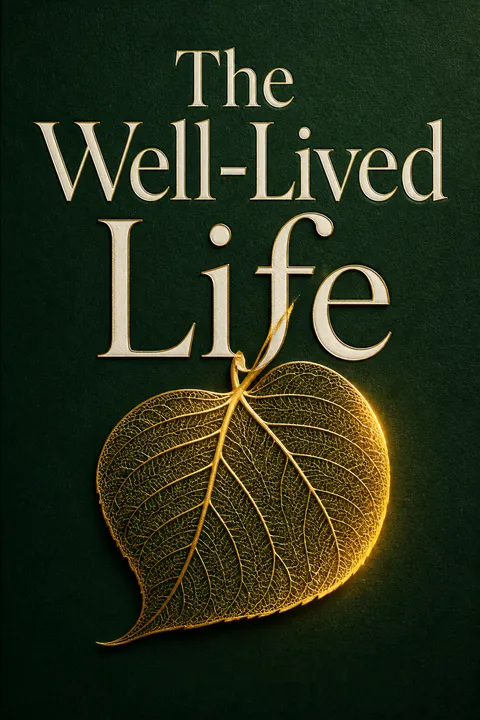


Key Takeaways
Treat health as the capacity to participate, not the absence of illness.
A broader definition. McGarey argues that health is not simply a body without symptoms. It is the ability to engage with life, relationships, and a sense of purpose, even when illness or pain remains. In her view, clinicians can treat disease and support patients, but patients also need a role in their own healing. This whole-person approach considers physical, emotional, and spiritual life together, without rejecting conventional medicine.
Purpose has measurable links. Studies she cites associate a stronger sense of purpose in adults over fifty with lower mortality and cardiovascular risk, and with resilience in the face of Alzheimer’s disease. These are associations, not proof that purpose prevents illness. Still, they support her central point: a meaningful life is not a luxury added after health is secured. It is part of how people experience well-being.
The book’s most useful distinction is between being symptom-free and being well. That distinction fits the biopsychosocial model, which treats health as an interaction among bodily processes, psychological experience, and social conditions. It also gives patients a more humane measure of progress: someone with chronic illness can still have agency, relationships, and goals. Purpose should not become another demand placed on sick people, however. Not every person needs a grand mission, and illness is not evidence of insufficient meaning. Purpose can be modest, temporary, and shared, such as caring for someone or making a contribution that feels worthwhile.
Follow what gives you energy, even when its shape changes.
Purpose begins in response. McGarey calls the enlivening force that comes from meaningful activity “juice.” As a child in India, she struggled to read and feared she was unintelligent. Then she helped her mother treat an injured elephant, carrying supplies and watching the wound get cleaned. The experience showed her that healing work mattered to her, and helped her persist through school toward medical training.
There is no single route. A computer science graduate named James felt no interest in the career his family expected. After time alone on a mesa, he chose to pursue music production. Another patient, Lilian, felt empty after her children left home. While recovering from a broken hip, she restarted work on a children’s fundraiser and found renewed involvement. A source of purpose can be a job, a hobby, caregiving, or service, and it can change with a person’s life.
These stories make purpose less like a hidden vocation to discover and more like a pattern of attention: notice what brings engagement, then give it room. That resembles self-determination theory, which links well-being with autonomy, competence, and connection. James needed permission to choose; Lilian needed a role in which her effort mattered. The framing also reduces the pressure to monetize every passion. One caution: a temporary lift in energy is useful information, not a guarantee that a career change is practical or sustainable. Small experiments can help distinguish lasting interest from escape or novelty.
When life feels frozen, begin with the smallest safe movement.
Movement can restart engagement. McGarey treats movement as both physical activity and a way of loosening emotional stuckness. For a young mother named Maria, depression had left her on the couch with recurring headaches and little contact with friends. McGarey suggested starting with ordinary motion: move an arm while turning a magazine page, stand up, or play with her children. Maria gradually began walking with a cousin and sketching fashion designs.
Begin within your limits. McGarey also describes Theresa, whose bowel obstruction persisted after several close losses. In the author’s account, Theresa finally cried while discussing her grief, and her digestion improved soon afterward. That story illustrates the book’s mind-body perspective, but does not establish that grief caused the obstruction. McGarey also cites research associating even ten minutes of brisk daily walking with longer life expectancy. Movement should be adapted to the person’s condition, not used instead of medical care.
The practical strength here is the low threshold for action. Behavioral activation, a treatment approach often used for depression, similarly starts with manageable activities that reconnect people with routine, pleasure, or other people. Small actions can precede motivation rather than wait for it. The book’s broader claim that emotional blockage can show up as bodily blockage is more speculative. Symptoms can have many causes, and metaphors should not replace assessment. The safest interpretation is not that every ailment has an emotional message, but that gentle movement and emotional support may complement appropriate diagnosis and treatment.
Meet fear with love while keeping medical care firmly in view.
Care includes participation. After a car crash left Susan with multiple spinal fractures, she was immobilized in a cast and told she might never walk again. McGarey listened to her fear, reminded her that she mattered to others, and helped her imagine her body rebuilding. Susan pictured workers constructing a city as an image for bone repair. Her medical team continued treating her injuries; just over a year after the accident, she began walking again.
Love does not rule out intervention. When McGarey developed breast cancer in her nineties, she chose surgery and radiation with her medical team. She also used imagery to help herself approach treatment with less fear and more care for her body. The book presents love and visualization as ways to participate in healing, not simply as positive thoughts. Its clearest practical message is to stay engaged with the body and with clinicians, rather than treating illness as an enemy or oneself as powerless.
The account captures an important role for hope: it can help patients tolerate uncertainty, communicate with clinicians, and remain involved in rehabilitation. Therapeutic relationships and expectations can shape distress and pain, even when they cannot determine the course of a disease. The boundary matters. Susan’s recovery is a striking personal story, not evidence that visualization repairs spinal injuries, and McGarey’s own cancer treatment underscores the value of conventional care. Framing love as support is empowering; framing it as a cure would risk blaming patients whose bodies do not respond as hoped.
Build community by listening, contributing, and setting clear limits.
Connection is a health resource. McGarey cites research linking loneliness with poorer health, including one estimate comparing its effect on longevity to smoking fifteen cigarettes a day. She also notes that poor social relationships are associated with a 29 percent increase in heart disease risk and a 32 percent increase in stroke risk. These findings make connection more than a pleasant extra; relationships can affect how supported people feel and how they manage hardship.
Start by hearing people. In Afghanistan, McGarey and a colleague invited local women to share their experiences of childbirth. Listening helped identify practices that could be changed, including fasting during labor and unsafe cord cutting. The women then carried practical health information back to their villages. Community also needs boundaries. McGarey’s sister focused her attention on her crying baby rather than absorbing repeated criticism from her mother-in-law. Connection works best when giving and receiving do not require surrendering all one’s energy.
The chapter’s model of community is unusually concrete: listen before advising, share useful knowledge, and let everyday interdependence build trust. Social epidemiology supports the importance of relationships, although population-level associations do not mean every connection is beneficial. The emphasis on boundaries prevents a common misreading of community as unlimited availability. A person can be compassionate without tolerating abuse or becoming the permanent caretaker. The practical question is not whether to need others, but which relationships are reciprocal, safe enough, and capable of sustaining real contact.
Let hardship teach you without pretending it was deserved or good.
Meaning is not blame. McGarey urges readers to ask what an experience might teach them, while explicitly separating that question from the idea that suffering is deserved. Her marriage of forty-six years ended when her husband left her. She was devastated and angry, then chose to look for a future beyond the betrayal. The process took years. She eventually built a new clinic with her daughter and developed work that had previously taken a back seat.
Stay honest about pain. McGarey distinguishes gratitude from denial: acknowledging a useful lesson does not require calling a loss wonderful or rushing grief. She also suggests asking dreams for perspective, recording them, and interpreting their images through personal associations. Dreams may prompt reflection, but they are not reliable predictions or instructions. When no lesson is visible, the immediate task may simply be to feel the loss, seek support, and avoid turning the search for meaning into another test to pass.
Meaning-making can help people integrate an event into a life story rather than experience it as an endless interruption. Research on coping and post-traumatic growth suggests that some people find new priorities or relationships after adversity, but such growth is neither universal nor proof that the event was beneficial. The distinction between curiosity and compulsory optimism is crucial. A useful question invites interpretation; it does not demand a silver lining. McGarey’s account is strongest when it allows anger and grief to coexist with the possibility of a future.
Invest energy where it returns meaning, and rest before depletion.
Energy is an investment metaphor. McGarey’s final principle is to direct effort toward activities and relationships that return a sense of life, rather than guarding every reserve out of fear. Barry, a retired patient with chronic fatigue, spent much of his time watching news and assuming he should conserve energy. He began writing stories, traveling alone, and cycling again. He also realized that bridge was not enjoyable for him, so he stopped playing. He later reported feeling more engaged and less fatigued.
Rest belongs in the rhythm. McGarey does not advocate constant activity. She treats sleep, recovery, and slower periods as necessary parts of a full life, much like rest between physical efforts. The point is to rest deliberately, not to withdraw from everything that matters. Barry’s experience is an anecdote, not proof that changing activities cures chronic fatigue. Persistent or severe fatigue can have medical causes and warrants appropriate evaluation.
The investment metaphor shifts attention from raw output to return: which commitments nourish connection, curiosity, or satisfaction, and which merely consume effort? That can be useful for retirement, caregiving, and work redesign. It also resembles resource-based approaches to stress, where recovery is essential to sustained participation. Yet energy is not a simple account that reliably replenishes when someone chooses a more meaningful activity. Disability, poverty, illness, and caregiving demands constrain choice. The principle is best used as a guide to allocate available energy, not as a judgment about people who have little to spare.
Make a ten-year plan without treating delay as failure.
Growth takes its own time. McGarey rejects the idea that aging closes every door. She describes finding greater confidence in her voice in her nineties, and at 102 she was still making plans for the future. Her suggestion is to choose a ten-year horizon: long enough for meaningful change and preparation, but close enough to make a plan feel usable.
Preparation may be invisible. She uses the coined term “femifesting” for the unobservable preparation that comes before a goal takes form, comparing it to development in a womb. The term encourages patience while a person gathers skills, experience, and resources. It does not mean every ambition will arrive on schedule. A plan can set direction while leaving room for uncertainty, changing abilities, and events beyond one’s control. The actionable question is not whether it is too late to begin, but what worthwhile step fits the present moment.
A longer planning horizon can counter the false urgency of short-term productivity culture. It makes room for apprenticeship, recovery, and goals that mature slowly. The idea also challenges ageism by treating older adults as people with futures, not merely histories. Still, age and timing impose real constraints, and not every aspiration remains feasible indefinitely. The humane use of a ten-year plan is flexible commitment: name what matters, identify a next step, and revise as circumstances change. Patience is not passivity, and an open future is not a promise of any particular outcome.
Analysis
The book is part memoir, part holistic health philosophy, organized around six recurring principles and carried by stories from McGarey’s century of life. Its persuasive force comes less from a formal theory than from the continuity between the doctor’s biography and her advice: the child who found meaning in helping treat an elephant becomes the physician who asks patients what makes them want to participate in life. Stories of patients give the ideas memorable shape, while the author’s own divorce, cancer treatment, medical practice, and aging supply a long arc of lived revision.
That form is both the book’s strength and its main evidentiary limit. A personal case can show how a patient understood an experience, but it cannot establish that grief caused an obstruction, that visualization repaired an injury, or that a change in purpose resolved fatigue. The research cited on purpose, movement, and social connection generally supports association, not the stronger causal claims a reader might infer from individual stories. The most responsible reading treats these accounts as prompts for reflection and participation, not as clinical protocols.
The book is alert to the danger of blaming patients for illness, yet its language of symptoms as messages can still be misused. A reader may feel pressured to extract a lesson from pain or suspect that a condition reflects a failure of love, movement, or purpose. McGarey’s own acceptance of surgery and radiation offers a useful counterweight: holistic care can include conventional treatment, and meaning-making need not replace it.
The durable contribution is a practical orientation rather than a medical mechanism. Notice what makes life feel worth engaging with. Take a manageable action when inertia dominates. Let other people help, while protecting time and attention. Ask what an experience may teach, without denying its costs. Taken together, these ideas position well-being as ongoing participation, not a perfect body or a final achievement. Their value lies in making agency and connection imaginable across changing circumstances.
Review Summary
The Well-Lived Life by Dr. Gladys McGarey receives overwhelmingly positive reviews. Readers praise the author's wisdom, compassion, and holistic approach to health and happiness. The book offers six secrets for living well, including letting go of the past, living in the present, and finding one's purpose. Many readers find the author's personal stories and patient experiences inspiring. While some critics find the content basic or too spiritual, most readers appreciate the practical advice and life lessons shared by the 102-year-old doctor.
People Also Read








Glossary
juice
energy from meaningful engagementMcGarey’s term for the vitality, joy, and motivation that arise when a person connects with activities or relationships that feel meaningful. It may come from paid work, caregiving, creativity, service, or everyday pursuits. Its source differs among people and can change over time. The author treats finding this energy as a continuing process, not as a single career choice.
living medicine
patient-participatory holistic careMcGarey’s name for a collaborative approach in which clinicians offer treatments and support while the patient remains an active participant in well-being. It considers the body and mind together and may use conventional medical care alongside other therapeutic approaches. In this framework, treatments support the body’s healing processes rather than replacing the patient’s role.
femifesting
unseen preparation before realizationMcGarey’s term for the period of development and preparation that precedes a visible outcome. She compares it to gestation: experiences, skills, or resources may be accumulating before a goal becomes tangible. The concept encourages patience with processes whose timing is uncertain, while not guaranteeing that a particular wish will come true.
Kutch par wa nay
a phrase for releasing what does not serveA Hindustani expression McGarey learned from her mother, meaning “It doesn’t matter.” She uses it as a cue to release what cannot be changed or what is consuming attention without helping, including regret and resentment. The phrase does not mean that harm is unimportant; it is a deliberate gesture of redirecting energy toward what can still be done.
physician within
inner guide for personal healingMcGarey’s phrase for a person’s own capacity to notice needs, values, and responses while participating in care. It describes self-attentiveness, not a substitute for medical expertise. The idea encourages patients to contribute their knowledge of their own experience, ask questions, and make decisions with appropriate clinicians.
FAQ
What's "The Well-Lived Life" about?
- Author's Journey: The book is written by Dr. Gladys McGarey, a 102-year-old doctor who shares her insights from over eight decades in medicine and ten decades on the planet.
- Holistic Health: It focuses on holistic health and happiness, offering six secrets to achieving these at any age.
- Personal Stories: Dr. McGarey includes personal stories and experiences from her life and her patients to illustrate her points.
- Spiritual and Physical Healing: The book emphasizes the importance of spiritual healing alongside physical health, suggesting that true health involves transforming our relationship with life's challenges.
Why should I read "The Well-Lived Life"?
- Timeless Wisdom: The book offers timeless wisdom from a centenarian who has lived through significant historical events and medical advancements.
- Holistic Approach: It provides a holistic approach to health and happiness, integrating physical, emotional, and spiritual well-being.
- Practical Advice: Dr. McGarey shares practical advice and exercises that readers can incorporate into their daily lives to improve their health and happiness.
- Inspiration: The book is filled with inspiring stories of transformation and healing, encouraging readers to find their purpose and live a fulfilling life.
What are the key takeaways of "The Well-Lived Life"?
- Six Secrets: The book outlines six secrets to health and happiness, focusing on finding purpose, embracing movement, and the power of love.
- Holistic Medicine: It emphasizes the importance of treating the whole person—body, mind, and spirit—rather than just symptoms.
- Life's Lessons: Dr. McGarey encourages readers to see every experience as a teacher and to learn from life's challenges.
- Community and Connection: The book highlights the importance of community and connection in amplifying individual life force and well-being.
What are the six secrets to health and happiness according to Dr. Gladys McGarey?
- Purpose: You are here for a reason, and finding your purpose is crucial for a fulfilling life.
- Movement: All life needs to move; physical and emotional movement is essential for health.
- Love: Love is the most powerful medicine, capable of transforming and healing.
- Connection: You are never truly alone; community and connection are vital for well-being.
- Learning: Everything is your teacher; life’s challenges offer valuable lessons.
- Energy: Spend your energy wildly; invest your life force in what brings you joy and fulfillment.
How does Dr. Gladys McGarey define holistic medicine?
- Whole Patient Approach: Holistic medicine treats the whole patient, not just the disease, considering physical, psychological, and spiritual aspects.
- Integration of Practices: It incorporates a variety of healing modalities, including allopathic and alternative treatments.
- Body as an Instrument: The body is seen as an instrument that assists the soul in its tasks, with diseases and symptoms being part of a perfect design.
- Patient Empowerment: Patients are encouraged to actively participate in their healing, recognizing that true healing comes from within.
What role does love play in "The Well-Lived Life"?
- Transformative Power: Love is described as the most powerful medicine, capable of transforming labor, laughter, and listening.
- Fear vs. Love: The book discusses the relationship between love and fear, emphasizing that love dispels fear and is essential for healing.
- Self-Love: Self-love is the foundation of all love, and it is crucial for receiving and giving love to others.
- Healing and Connection: Love is integral to healing and connecting with others, amplifying individual and collective life force.
How does Dr. McGarey suggest we find our purpose?
- Juice of Life: Finding your "juice" or life force is key to discovering your purpose and staying vital.
- Engagement with Life: Engage with life’s challenges and joys, and be curious about what makes your heart sing.
- Unique Gifts: Each person has unique gifts to offer, and connecting with these gifts activates the desire to be alive.
- Continuous Search: The process of searching for your purpose is as important as finding it, keeping you connected to life.
What is the significance of movement in "The Well-Lived Life"?
- Essential for Health: Movement is essential for physical health, aiding in circulation, digestion, and overall well-being.
- Emotional Release: Movement helps release emotions and energy, preventing stagnation and promoting mental health.
- Life's Flow: Life is always moving, and aligning with this flow is crucial for health and happiness.
- Overcoming Pain: Movement can help manage and overcome physical and emotional pain, encouraging healing and growth.
How does Dr. McGarey view community and connection?
- Amplifies Life Force: Community and connection amplify individual life force, contributing to overall well-being.
- Never Alone: The book emphasizes that you are never truly alone, and building a supportive network is essential.
- Collective Purpose: Each person’s purpose contributes to a greater collective purpose, creating a more beautiful whole.
- Social Health Benefits: Positive social connections are linked to longer life expectancy and better health outcomes.
What are some practical exercises from "The Well-Lived Life"?
- Finding Your Juice: Exercises to help identify what brings you joy and purpose, encouraging you to lean into these activities.
- Letting Go: Practices for releasing what doesn’t serve you, such as negative thoughts or regrets, to align with life’s flow.
- Loving Yourself: Exercises to cultivate self-love and visualize healing, enhancing your ability to give and receive love.
- Community Building: Suggestions for building and nurturing connections with others, strengthening your support network.
What are the best quotes from "The Well-Lived Life" and what do they mean?
- "Love is the most powerful medicine." This quote emphasizes the transformative and healing power of love in all aspects of life.
- "You are here for a reason." It highlights the importance of finding and fulfilling your unique purpose in life.
- "All life needs to move." This quote underscores the necessity of physical and emotional movement for health and well-being.
- "Everything is your teacher." It encourages readers to see every experience as an opportunity for learning and growth.
How does Dr. McGarey address the concept of aging in "The Well-Lived Life"?
- Positive Vision: Dr. McGarey offers a positive vision of aging, suggesting it can be a source of joy and fulfillment.
- Aging into Health: She encourages readers to "age into health" by spending energy on what brings joy and purpose.
- Continuous Learning: Aging is seen as a continuous process of learning and growth, not a decline.
- Embracing Life: The book advocates for embracing life at every age, living fully and with purpose until the end.
Download PDF
Download EPUB
.epub digital book format is ideal for reading ebooks on phones, tablets, and e-readers.








