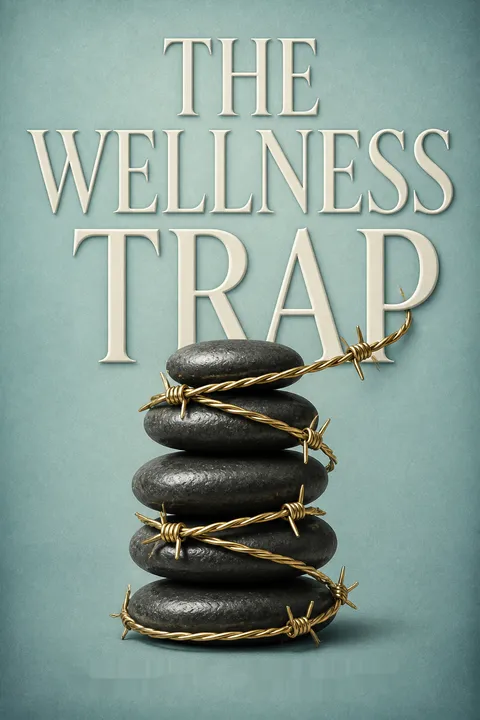


Key Takeaways
Stop treating peak health as the price of being good
Wellness is not simply health. Harrison uses the term for a culture that treats health as an ongoing personal project, links certain behaviors and body types with moral virtue, and sells the promise of control over illness and aging. Its reach is immense: one estimate valued the global wellness market at $4.4 trillion in 2020.
The promise can backfire. Harrison describes pursuing perfect eating while living with chronic conditions. Restriction and overexercise contributed to some of her problems, and inadequate food intake helped produce symptoms that were misdiagnosed as PCOS. She is not arguing that every wellness practice is harmful. Yoga and meditation, for example, have evidence of benefit for some people. The trap is treating constant optimization as the definition of being well.
The distinction matters because a useful practice can become a moral test when it is tied to identity. Health promotion works best when it offers options rather than a hierarchy of disciplined and undisciplined people. That is especially important for people living with disability or chronic illness, whose well-being cannot be measured by whether symptoms disappear. The critique also benefits from a clear boundary: commercial wellness is not identical to every practice sold under its name. A calming ritual can be meaningful without being a cure, and pleasure need not be defended as a medical intervention.
Call restrictive wellness diets diets, even when they promise healing
A new label, familiar rules. Wellness eating inherited diet culture's tendency to divide food into virtuous and dangerous categories. The shift took shape in the 1970s, when Donald Ardell's popular writing helped place nutrition and exercise at the center of wellness. Diet and fitness businesses later gained a loftier rationale: body-changing practices could be marketed as a route to overall health, not merely appearance.
Restriction has costs. Jaime, a reader with no prior dieting history, tried an elimination diet for several symptoms. It became difficult to eat enough, weight loss drew approving comments, and her focus shifted toward maintaining that weight. Her digestive symptoms worsened, too. The book also notes a survey in which 75 percent of women aged 25 to 45 reported some form of disordered eating. Food rules can cause harm even when weight loss was never the stated goal.
Calling a diet by its name makes its demands visible. A plan that dictates which foods are acceptable, or when and how much to eat, can narrow social life and intensify attention to food, even if its marketing uses the language of intuition or healing. That does not mean dietary changes are never clinically appropriate. It means the reason, evidence, duration, and possible psychological cost deserve scrutiny, especially for someone with a history of disordered eating. A health intervention should be assessed by its full effects, not by whether it sounds virtuous.
Put health problems back into the conditions people live in
Individual habits are not the whole story. Social determinants of health are the economic, social, and physical conditions shaping people’s lives, including income, housing, education, discrimination, healthcare access, and neighborhood safety. The book cites estimates that about 70 percent of population health outcomes reflect socioeconomic factors, healthcare, and environment, while diet and exercise account for about 10 percent.
The pandemic made this visible. Essential workers faced greater exposure to COVID-19, often without the option to work from home or take paid sick leave. Crowded housing and unequal access to care added further risk. Trauma also has physical effects: prolonged stress can influence immune and hormonal systems, while discrimination and violence can leave lasting health consequences. These realities cannot be solved by buying a supplement or following a stricter meal plan.
This framework changes the question from why an individual failed to be healthy to what conditions made health easier or harder. It connects clinical care to housing, labor policy, and environmental justice, where many causes of unequal health actually sit. The population-level percentages should not be misread as a verdict on an individual patient: food and movement can matter greatly in a specific case. Their key use is corrective. They challenge the assumption that lifestyle choices explain most disparities, and they make collective conditions part of any honest account of well-being.
Do not confuse natural with safe, tested, or effective
Supplements operate under different rules. In the United States, the 1994 Dietary Supplement Health and Education Act sharply limited the FDA's ability to assess supplements before they reach consumers. Regulators generally must identify a problem and act after a product is on the market. The book describes supplements containing undeclared or prohibited drugs, and cites research attributing 20 percent of medication-related liver injury in the United States to herbal and dietary supplements.
Natural products can still harm. Vitamin E, once promoted for heart health, was linked in trials to increased risks of heart failure and death. Supplements can also interact with medication or contain ingredients not listed on the label. Harrison is critical of pharmaceutical companies and the medical system, too, but points out that prescribed drugs undergo premarket safety and efficacy review. Natural origin alone cannot establish either safety or benefit.
The useful comparison is not natural versus artificial, but what is known about a product, how its risks are monitored, and who is accountable when it causes harm. A regulated medicine can have serious side effects, while a supplement may be harmless for many users. Neither possibility settles the question for a particular person. The regulatory gap does, however, put more burden on consumers, who rarely have the tools to evaluate purity or interactions. Skepticism should apply to both pharmaceutical marketing and supplement claims, without assuming the evidence and oversight are equivalent.
Respect healing traditions instead of selling disconnected cultural fragments
Holistic claims can hide extraction. The book describes Western ayahuasca tourism in the Amazon, where ceremonies marketed as traditional may be detached from Indigenous practices and community authority. The influx of visitors can also increase pressure on local plants and turn collective cultural knowledge into a commercial product.
A practice has more than its marketable surface. Yoga, for instance, includes ethical, reflective, and spiritual dimensions. The physical postures commonly sold in Western fitness settings are only one part of a larger tradition. When wellness businesses keep the exercises and imagery but omit context and origin, they can erase the people and beliefs that shaped the practice. Respectful participation, the book argues, requires learning from tradition-bearers and recognizing that some practices cannot simply be transplanted into any setting.
This is a challenge to the idea that a practice becomes universal simply because it feels beneficial to its consumers. Cultural context can include obligations, community relationships, and limits on who may teach or administer a practice. Respectful exchange is possible, but it requires more than adding an origin story to a product label. There is also a productive tension: practices can travel and change, yet that movement need not erase their sources. The ethical question is not only whether a practice helps a customer, but who controls it and who benefits from its sale.
Treat viral health claims as products of an attention market
The feed rewards what grabs attention. Social platforms are designed to encourage engagement, and content that sparks outrage, disgust, or surprise can spread especially well. A 2018 study tracking more than 125,000 Twitter rumors found that false claims traveled farther and faster than true ones, and were 70 percent more likely to be retweeted. Wellness claims that sound novel or alarming fit neatly into this system.
The information environment affects health. The book calls the infosphere the information environment in which people live, now largely digital. It can expose users to escalating diets, false claims about ingredients, and vaccine misinformation. Social media also places credentialed experts and personal testimonials side by side, making them appear equally authoritative. Individual users are not simply choosing from a neutral library: the platform helps decide what they see.
The attention economy makes misinformation more than a problem of individual gullibility. It is an incentive problem: platforms can profit from engagement while users bear the costs of confusion and fear. This helps explain why asking people to check every claim is not a complete remedy. At the same time, the book's emphasis on platform design should not obscure the value of personal judgment or the real support people find online. A better information system would protect that connection while making it harder for provocative false claims to masquerade as reliable guidance.
Notice when wellness anxiety is being redirected toward vaccine fear
Fear can become a pipeline. Anita Emly entered anti-vaccine spaces while pregnant and searching for ways to protect her child. Social networks, online groups, and a trusted recommendation introduced her to claims that she did not initially recognize as unreliable. She came to see herself as cautious rather than anti-vaccine, even after stopping her daughter's vaccinations.
A notorious claim gained credibility through repetition. In 1998, Andrew Wakefield's paper described only 12 children and did not establish that the MMR vaccine caused autism. Later investigations found serious ethical and factual problems, and the paper was retracted. Yet it helped launch a lasting movement. The book argues that vaccine distrust can grow where healthcare has failed or mistreated people, then be exploited by influencers selling fear and unproven alternatives.
This history shows why correction alone is rarely enough. People are more likely to reconsider a belief when they are treated with respect and when the concerns beneath it are addressed, rather than mocked. That is not the same as treating unsupported claims as equally credible. It means distinguishing a person's understandable desire to protect family from the entrepreneurs who profit by amplifying suspicion. Trust depends partly on accurate information and partly on whether institutions listen, explain uncertainty, and acknowledge their own failures.
Honor real symptoms without accepting invented diagnoses
A symptom can be real while its explanation is not. The book examines adrenal fatigue, a popular wellness diagnosis that claims stress exhausts the adrenal glands. A review of 58 studies involving more than 12,000 people found no evidence supporting the condition. The symptoms people report, such as fatigue, still deserve investigation. By contrast, adrenal insufficiency is a real medical disorder with distinct causes and testing.
Attention can help without proving a treatment works. Some patients feel better when a practitioner listens carefully and provides time and reassurance. In one IBS trial discussed in the book, the relationship and care surrounding sham acupuncture helped reduce symptoms. Such effects are genuine, but they do not prove that a claimed diagnosis or treatment addresses disease. False labels and restrictive protocols can also delay proper evaluation.
The distinction between suffering and explanation is essential. Rejecting an unsupported diagnosis should never mean dismissing the person who received it. The book also rightly treats compassionate care as a real therapeutic factor, not a trick or an illusion. Yet empathy cannot substitute for basic diagnostic work. A clinician who listens well and tests carefully offers something stronger than either a rushed dismissal or a confident theory unsupported by evidence. The difficult cases are those where symptoms persist without a clear answer; uncertainty is uncomfortable, but it is safer than pretending certainty.
Investigate the seller before you invest in a cure
A compelling story is not proof. Belle Gibson built a wellness following by claiming to have survived terminal brain cancer through natural methods. She later admitted she had never had cancer and had not made the charitable donations she had promised. Her rise shows how a moving personal narrative, attractive branding, and media attention can create authority without evidence.
Use SIFT before sharing or buying. SIFT is a quick method for checking online information: stop, investigate the source, find better coverage, and trace claims to their original context. Ask whether a seller has relevant credentials, whether independent sources confirm the claim, and whether cited research actually supports it. A claim that only the seller can verify, especially one promising a cure or urging an expensive protocol, deserves particular caution.
Source-checking is useful partly because it interrupts the emotional momentum of a sales pitch. A story may be sincere and still fail to establish that a treatment works; a confident voice may be persuasive without being qualified. SIFT offers a practical pause rather than demanding that every reader become a scientist. Its limits matter too: reputable sources can make mistakes, and established institutions have histories of failure. The goal is not unquestioning trust in authority, but comparison, context, and a willingness to withhold judgment when the evidence is thin.
Reject wellness programs that reward metrics instead of well-being
Workplace wellness often promises more than it delivers. Safeway's wellness program was promoted as a way to control healthcare costs, but reporting found that the company's spending changes preceded the program and came largely from shifting costs to employees. Later randomized trials of workplace wellness programs found little or no effect on most measured health, spending, or productivity outcomes.
Incentives can become pressure. Some programs tie insurance discounts to screenings, weight goals, or other measures, which can burden people with disabilities or chronic conditions. Weight-loss contests and exercise challenges can also encourage disordered behaviors. The book's point is not that workplaces should ignore health, but that biometric targets and lifestyle contests are not a substitute for safe working conditions, adequate benefits, or mental-health support.
The workplace examples expose a broader measurement problem: institutions often count what is easy to quantify, then mistake the metric for the goal. A weight target or screening completion rate can look concrete while saying little about whether workers feel supported or can afford care. Programs may still offer useful resources, but participation should not be coerced through financial penalties or designed around a narrow body ideal. Better workplace health policy would begin with conditions employees experience every day, including workload, safety, leave, and access to care.
Measure well-being by the life you can live, not perfect health
Well-being is broader than physical optimization. Harrison describes it as including mental, emotional, social, and economic life, as well as purpose, autonomy, and agency. A person can have chronic illness, take medication, and still experience meaningful well-being. Being symptom-free is not a prerequisite for a satisfying life.
The path is personal and collective. The book recommends critical consumption of health information, supportive relationships, self-compassion, and room for solitude. It also calls for systemic changes: better access to healthcare and mental-health services, action on social determinants, and stronger oversight of supplements and technology platforms. The central shift is from endlessly correcting the individual body to creating conditions in which more people can live with safety, support, and purpose.
This closing distinction gives the critique a constructive destination. It avoids replacing one perfectionist standard with another by allowing health and a good life to coexist imperfectly. Social connection and purpose can enrich life, but they should not become fresh obligations imposed on people already struggling. Nor can personal practices repair inadequate housing, inaccessible care, or discrimination. The strongest version of the argument holds both levels together: individuals deserve meaningful choices and reliable information, while institutions must stop treating private discipline as a substitute for public responsibility.
Analysis
The book's central achievement is to recast wellness as a system of interpretation, not merely a collection of questionable products. It shows how familiar practices acquire moral force: food choices become evidence of character, thinness becomes proof of virtue, and illness becomes an accusation that someone failed to optimize. The history matters because it reveals that this system was assembled over time. A broad conception of wellness, attentive to social and emotional life, narrowed into a marketable program centered on diet, exercise, products, and individual control.
The narrative earns its critique through people who move between conventional medicine and wellness seeking, often after being dismissed or left without answers. That prevents an easy division between foolish consumers and virtuous experts. Patients may be drawn to alternative providers because they receive more time and empathy, while the advice they receive can still be unsupported or harmful. The book's distinction between real symptoms and false explanations is therefore essential: scientific skepticism should increase care, not reduce it.
Its strongest political argument is that private self-management cannot compensate for structural conditions. The distribution of illness is shaped by income, discrimination, work, housing, healthcare, and information access. The same principle applies to misinformation. Users have responsibilities, but algorithms and commercial incentives shape what is visible and profitable. Individual media literacy is useful, yet it cannot replace institutional accountability.
There is a productive tension in the book's reliance on scientific evidence. Science is presented as the best available tool for evaluating health claims, while the book also acknowledges that evidence can be incomplete, biased, and historically entangled with inequity. This is not a contradiction to resolve by choosing either science or personal experience. It is a call to use evidence provisionally, transparently, and alongside humane clinical practice. The result is a practical standard: preserve helpful rituals and relationships, but do not mistake comfort, plausibility, or commercial confidence for proof of cure.
Review Summary
The Wellness Trap receives mixed reviews, with an average rating of 3.82 out of 5. Readers appreciate Harrison's critique of wellness culture and its potential harms, but some find the book oversimplified and lacking nuance. Many agree with her overall message but criticize her broad generalizations and limited research. Some readers find the book informative and eye-opening, while others feel it covers too many topics without sufficient depth. The book's political stance and approach to alternative medicine are points of contention for some reviewers.
People Also Read



Glossary
wellness culture
Moralized pursuit of optimal healthA belief system that treats wellness as an ongoing set of individual choices and links particular behaviors and body types with moral goodness. It often adopts diet culture's food and body ideals, while also idealizing alternative, natural, or holistic approaches and giving personal stories more weight than strong scientific evidence.
wellness diet
Diet culture in wellness clothingA restrictive approach to food presented as a route to health, prevention, or healing rather than as a conventional diet. It can include eliminating foods or food groups, cleanses, and rigid eating rules. The term highlights how diet culture adapts its language while preserving its focus on controlling food and body size.
healthism
Health as personal moral dutyA term coined by political economist Robert Crawford for a worldview that treats health as a supreme value and an individual's responsibility. Healthism locates health problems primarily in personal behavior and bodily choices, while minimizing social and economic forces that shape health. It can make illness seem like evidence of personal failure.
social determinants of health
Conditions shaping health outcomesThe social, economic, and physical conditions in which people live and work, and the forces that shape those conditions. They include healthcare access, education, income, housing, discrimination, employment, and neighborhood environment. These factors influence exposure to risk and access to care, often producing unequal health outcomes across populations.
infosphere
A person's information environmentThe realm of data, information, knowledge, and communication in which people live. In contemporary life it is largely digital, shaped by search engines, social media, and recommendation systems. The book presents the infosphere as a factor affecting health because exposure to unreliable information can influence behavior, trust, and access to care.
conspirituality
Conspiracy thinking in spiritual wellnessA term used for the overlap between New Age or wellness beliefs and conspiracy theories. It describes how ideas about intuition, hidden connections, and alternative explanations can combine with claims of secret plots. In wellness communities, this can link distrust of conventional medicine with vaccine misinformation and broader conspiratorial narratives.
SIFT
Four moves for checking claimsA media-literacy method for assessing online information. Its steps are to stop, investigate the source, find better coverage, and trace claims, quotations, or media to their original context. The method shifts attention away from dissecting dubious content and toward checking its source and comparing it with more reliable reporting.
care effect
Benefit from attentive careThe improvement in a patient's experience or symptoms that can come from the quality of the care relationship, including empathy, time, and attention. The book discusses it as one contributor to what may be called placebo effects. A care effect can be real without proving that the specific treatment or diagnosis is effective.
About the Author
Other books by Christy Harrison
Download PDF
Download EPUB
.epub digital book format is ideal for reading ebooks on phones, tablets, and e-readers.








