

Plot Summary
The City Stops Breathing
A brief opening glimpse shows a woman and an accomplice arranging an old man’s body at the foot of a marble staircase, with a dropped candle and slipper to suggest a fall. The story then turns to Judge Dee, emergency governor of a capital emptied by plague. With the court and Emperor gone to the mountains, he struggles to keep food moving and panic contained.
The death of Mei Liang, a tireless benefactor who organized rice distribution, is reported as an accident. Dee mourns the loss because the city has few trusted leaders left. A street rhyme about the three ancient families, Mei, Hoo, and Yee, takes on a darker edge when Mei’s death seems to fulfill its warning.
The staged body offers the reader knowledge the investigator does not yet possess, making the city’s crisis feel doubly unstable: its public order is failing while private violence hides inside a familiar explanation. Mei’s death matters beyond the household because civic care has depended on him. Dee’s administrative burden therefore becomes part of the mystery’s stakes. The rhyme gives frightened residents a pattern for interpreting disaster, but its ambiguity also shows how easily fear turns coincidence into fate. Against plague, hunger, and rumor, Dee must distinguish evidence from the stories people need in order to endure.
Singers and Shadow Puppets
Colonel Chiao Tai catches Doctor Lew trying to force himself on a young street singer, Coral, but the physician recasts himself as her rescuer and she escapes before Dee can question her. Later, Colonel Ma Joong waits in a shabby tavern and meets Yuan, an educated itinerant puppeteer who shows him a peep box of moving scenes.
One depicts a man whipping a woman in a gallery; another shows a waterside villa. When four ruffians crowd a striking young acrobat, Bluewhite, she breaks one man’s arm with a weighted sleeve and sends the others fleeing. Ma tries to help afterward, then learns she is Yuan’s other daughter. Her strength and reserve unsettle his usual confidence around women.
The two twins enter through contrasting forms of vulnerability and control. Coral is cornered by a respectable professional whose authority helps him disguise predation; Bluewhite meets danger with practiced force. Their difference is not simply temperament. It shows the narrow options available to young women in a city where protection often depends on men who claim ownership of the situation. Yuan’s miniature theater introduces the novel’s central question of who directs a scene and who merely appears in it. Ma’s attraction to Bluewhite begins with admiration for her self-command, a departure from his habitual, easy pursuit of women.
The Marquis Found Dead
As Ma and Chiao cross the Halfmoon Bridge, a frightened doorman reports that Marquis Yee has been murdered in his fortified mansion. Chiao goes to the house while Ma carries the news to Dee. The judge reaches a gallery overlooking the canal and finds Yee’s face crushed, a whip and broken porcelain beside him.
The building has only one practical entrance, a small door that locks from the outside, so someone inside must have admitted the killer. Yee’s widow sits amid decaying symbols of imperial authority and blames a long-dead rival, revealing how completely she inhabits her family’s vanished past. The street rhyme now seems to assign a grim fate to each of the three houses.
Yee’s murder shifts the book from an apparent accident to a pattern of deaths among families whose authority has outlived its political world. His mansion makes that past physical: a fortress in the middle of a modern capital, defended by relics and memories rather than real power. The widow’s accusation is not reliable evidence, but it is psychologically coherent within her sealed world. Dee must investigate both a corpse and a culture that has trained its inhabitants to explain present events through obsolete feuds. The rhyme functions as public pressure, encouraging the city to see the killings as destiny rather than human acts.
The Willow Abode
Cassia, Yee’s maid, describes her master’s cruelty and claims a hired bully may have killed him while defending a young dancer. A bloodied ear pendant supports the presence of a woman, but the doorman’s account of the dancer’s companion conflicts with what Cassia suggests. Dee and his secretary Tao Gan find a wiped window ledge, a wet cloth marked with a water plant, and a route from the canal into the gallery.
The trail points to a strong swimmer. Across the water, Hoo, Yee’s old friend, admits that Yee used the dancer, Porphyry, to provoke his jealousy. Hoo also relates his family’s version of the Willow Pattern’s history, then grows visibly troubled when Dee mentions Yee’s ruined eye.
The investigation advances through material contradictions rather than a single decisive clue. The pendant points toward a woman, the cleaned ledge implies deliberate concealment, and the plant on the wet cloth places the canal inside the crime scene. Each fact makes the easy story less adequate. Hoo’s emotional shifts are equally important: his blunt manner does not conceal how personally he experiences the old family legend and the rhyme. The Willow Pattern joins architecture, memory, and suspicion, but it does not yet provide a verdict. Dee’s restraint matters here; he notices the force of a clue without mistaking suggestiveness for proof.
The Granary Under Fire
While Dee questions Hoo, a crowd gathers at the imperial granary, where the rice stores are the city’s last dependable defense against hunger. Ma and Chiao arrive with a small guard force as protesters tear up paving stones and attack the gate. When torches set part of the roof alight, the officers order archers to fire.
More than thirty people die before the crowd breaks, a terrible cost that prevents the granary from being looted and thousands from losing their rations. Dee accepts responsibility for the decision, then orders tighter control of scavengers who use their anonymity to steal and extort. He also orders the canal sluices opened, hoping to clear the clogged sewers and drive out the rats feeding on refuse.
The riot makes Dee’s authority morally costly rather than merely procedural. He protects the food supply by permitting lethal force against people who are themselves starving, and the arithmetic of survival cannot erase the dead. His response recognizes that emergency governance involves preventing a wider catastrophe through choices that leave visible injuries. The scavengers and rats extend the same problem into the streets: systems meant to manage death can become instruments of exploitation, while neglected infrastructure magnifies disease. Dee’s order to flush the sewers is both practical and symbolic, an attempt to move a city whose stagnation has become dangerous.
Bluewhite in the Canal
On his night patrol, Ma spots a struggling figure caught in waterweeds beneath Hoo’s balcony and dives into the canal. He frees Bluewhite’s legs and drags her to shore, where he revives her. She explains that Hoo summoned her with a promise of information about Yuan, then tried to force himself on her; she escaped by jumping from the balcony.
Bluewhite refuses to accuse Hoo publicly, fearing he could ruin her father. Ma believes her and offers protection, but she treats their sudden intimacy as no promise of a lasting affair. At dawn he tells Dee what happened. The judge issues a warrant for Hoo’s arrest and asks Ma to bring Bluewhite and Yuan in for questioning.
The rescue joins physical danger to an uneven negotiation of trust. Ma’s strength can pull Bluewhite from the canal, but it cannot compel her to accept his protection or define their encounter as romance. Her fear concerns not only Hoo’s violence but the power he holds over her father, a reminder that coercion reaches beyond its immediate victim. Ma’s belief in her marks a shift from gallantry to accountability: he listens when her account conflicts with a powerful man’s standing. Dee’s warrant turns private testimony into public consequence, though the investigation still needs to establish what happened.
Porphyry Was Invented
Dee’s investigation chief, Fang, reports that no registered dancer named Porphyry exists and that Yee had stopped ordering performers from the licensed houses. The supposed courtesan and her companion were impostors, likely operating outside the official trade. Fang also confirms that Mrs Mei once worked as an apprentice courtesan under the name Sapphire, though her path into marriage remains obscure.
Before Dee can pursue the connection, a messenger reports that Mrs Yee has hanged herself; Lew found her behind a locked door. Dee goes to examine the death himself. Meanwhile, Hoo is arrested for his assault on Bluewhite, and Dee directs Ma and Chiao to locate Yuan and his daughters, whose invented performance may connect to Yee’s murder.
Fang’s findings strip away the respectable categories that had made the case seem legible. Porphyry is not a documented courtesan, so the men’s accounts of her cannot be taken at face value. Sapphire’s appearance in Mrs Mei’s past creates a second mystery, one linked to the vanished world of the old families. Mrs Yee’s suicide adds a different kind of consequence: long exposure to a cruel household has left her dependent on an idealized image of her husband. The investigators now face a fragile distinction between a person’s public role and private history, a distinction that repeatedly shapes who can speak and who will be believed.
Black Hoods Close In
Ma and Chiao search the impoverished old city for Yuan, using a tree monkey’s needs and the view from a pagoda to narrow their route. Doctor Lew leads them to a derelict house where two women have died, but the bodies are not Yuan’s daughters. Scavengers gather outside, then trap the officers in a corridor and fire arrows through a hole in the roof.
Ma and Chiao use a dead body as a shield, overpower two attackers, and escape across the roof. Their military post rounds up armed scavengers, exposing a planned uprising disguised as a religious brotherhood. The colonels eventually find Yuan and Coral in a deserted mansion, where Coral dances as Yuan plays flute, and escort them to Dee.
The search turns the city’s abandoned spaces into active threats. Ma and Chiao’s escape depends on improvisation, but the dead body they use as cover also makes the cost of the crisis impossible to ignore. The scavengers exploit the anonymity of their work and the population’s fear, converting public service into a disguise for violence. Their planned revolt is not an unrelated adventure: it grows from scarcity, collapsing authority, and the belief that disaster licenses seizure. The quiet scene of Yuan and Coral performing after the ambush offers no simple refuge, but it reveals how art persists even where institutions have failed.
Yuan’s Revenge Play
Before Dee, Yuan reveals that Yee transferred his wife from Hoo’s household and later whipped her to death as a bondmaid. Yuan never reported the crime because he believed the old families and their servants stood beyond ordinary justice.
He and Coral devised false identities and staged performances to provoke a confrontation between Yee and Hoo; the tavern keeper, a skilled knife-thrower, accompanied Coral as protection. Coral explains that Yee summoned her alone, threatened Yuan, and began whipping her in the gallery.
She fled when a shadow appeared behind the curtains and assumed Hoo had attacked Yee. Dee recognizes that her assumption may be wrong, but finds no charge against her or Yuan for performing without payment. He releases them and prepares to attend Mei’s funeral.
Yuan’s plan is revenge shaped by a history of failed recourse. He wants an official to notice the crime, yet chooses a private drama because he believes the law did not protect his wife when it mattered. Coral’s participation is therefore both an act of loyalty and a risk imposed by her father. Her account gives Dee new evidence while also demonstrating the limits of eyewitness certainty: fear supplies an interpretation for the shadow, but not proof of who stood there. Dee’s release of the pair distinguishes moral disapproval from a prosecutable offense, preserving the principle that a court cannot punish merely because a scheme feels dangerous.
The Staircase Was Staged
At Mei’s funeral, Dee visits the staircase where the merchant was supposedly killed and learns that the hall’s great lantern burned until midnight. Later, he inspects Mei’s library and finds its writing tools clean, then searches a guest room the widow claimed had gone unused. Cosmetics have been handled, the bed has been slept in, and ink stains remain on the marble beside the bed.
Blood marks the reverse of a curtain seam. Dee concludes that Mei was killed in the room with a heavy ink slab, then carried to the staircase and arranged to resemble an accidental fall. The staged candle and slipper cannot fit the timing. He arrests Mrs Mei and Doctor Lew, whose earlier account placed him at the scene.
The case turns when ordinary domestic details become a more reliable record than the official story. The staircase was arranged to narrate a fall, but the lamp’s burning time contradicts the supposed journey from library to steps. In the guest room, cosmetics, bedding, ink, and blood reconstruct an intimate encounter and its violent interruption. Dee’s method depends on revisiting a space after his assumptions have changed, rather than treating the first explanation as settled. The revelation also implicates his own bias: his respect for Mei had made him reluctant to consider that the merchant’s marriage concealed a lover and a murder.
The Sapphire Confession
At the military tribunal, Lew admits that he lied about Mei’s death and concealed the truth after Mrs Mei told him her lover had struck her husband. He had also believed her false account of her family and tried to protect her. Mrs Mei then confesses that she killed Mei, describing a life in which wealth could not repay the injuries of her youth or restore love.
As she collapses, the matron discovers plague spots on her skin; Mrs Mei dies before the hearing can continue. Hoo is brought before Dee and confesses that he struck Mei with the ink slab after the older man offered to let him take his wife away. Hoo is sentenced for Mei’s murder and executed as rain finally breaks over the capital.
The confessions expose different forms of self-deception. Lew mistakes private loyalty for a reason to falsify evidence; Mrs Mei sees wealth as compensation for a past that remains psychologically active; Hoo turns a moment of mercy into an insult because he cannot bear to be pitied by the husband he resents. The plague interrupts legal closure with bodily finality, taking Mrs Mei before the court can complete its work. Hoo’s confession resolves Mei’s death, but the timing of rain places justice inside a wider emergency. The city’s survival arrives alongside, not in place of, punishment and grief.
The Avenging Swimmer
After Hoo’s execution, Dee explains that Hoo could not have killed Yee: the blow came from someone taller, and Coral had mistaken a shadow for the man she feared. Dee believes Bluewhite followed her sister to the mansion, climbed from the canal, and struck Yee with a weighted scarf when he began whipping Coral. The wet cloth, water plants, wiped sill, and her single loaded sleeve support his reconstruction.
Bluewhite had later returned to remove evidence and was caught by the canal’s stronger current, which is how Ma found her. Dee keeps the murder officially unsolved to spare her public exposure. He sends Ma to the Chancery, where she may still be waiting, while the first street hawkers return to the rain-washed city.
The final reconstruction corrects a chain of errors without pretending that the truth is always suitable for public record. Bluewhite’s violence is framed by imminent danger to Coral and the murder of their mother, yet Dee does not convert that context into a public trial. His choice protects her from exposure while leaving an official uncertainty in the file. The ending therefore separates factual knowledge from institutional declaration, a tension already present in the invented identities and staged deaths. Ma’s movement toward Bluewhite remains a possibility rather than a guaranteed romance. The returning hawker gives the close its modest measure of recovery: ordinary bargaining resumes before the city can forget what it cost.
Analysis
The novel’s central concern is the gap between a story that can be publicly accepted and an event that can be established. The staged fall at Mei’s mansion works because its objects offer a ready-made explanation; Dee dismantles it by asking whether the light, the route, and the injuries fit that account. In Yee’s case, witnesses see what their loyalties and fears lead them to expect. Coral assumes Hoo is the shadow in the gallery, while Bluewhite’s actions remain concealed even from her own father. Truth emerges through patient comparison, but it does not always become a public verdict.
The three old families embody a social order that has survived as habit after losing its authority. Their mansions, titles, and servants preserve the texture of feudal power inside a capital governed by a different state. Yuan’s refusal to trust the law is not abstract rebellion; it follows from the way his wife’s suffering went unchallenged. His revenge plot reproduces the manipulation he condemns, turning Coral into an actor in a dangerous scene. Dee’s response insists that grievance deserves attention without allowing private vengeance to replace law.
The plague intensifies every conflict by thinning the institutions people rely on. Food shortages turn a granary into a battlefield, scavenger hoods conceal crime, and the epidemic can interrupt a trial as suddenly as any human act. Dee’s authority cannot remove these conditions, only make decisions inside them. His final choice to leave Yee’s murder officially unresolved marks a limit as well as a kindness: the investigator knows more than the record will say. Meanwhile, Ma’s regard for Bluewhite begins with recognition of her agency, not possession of it. The return of the street hawker closes the book on an ordinary transaction, suggesting that civic life resumes through small acts before it can claim to be healed.
Review Summary
People Also Read
Characters
Judge Dee
The emergency magistrateJudge Dee is the President of the Metropolitan Court and, during the plague, the emergency governor left to manage the capital. He approaches people and objects with equal attention, testing a witness’s account against the room, the timing, and the physical traces. His authority is not effortless: he is exhausted by administration and troubled by decisions that save many people at the cost of a few. Dee’s respect for law is strongest when he must resist both public panic and private sympathy. He wants every violent death investigated, but he also understands that justice requires judgment about what the evidence can actually establish.
Ma Joong
The soldier with a pastMa Joong is a powerful colonel in the Imperial Guard, shaped by a childhood in a poor fishing family and an earlier life outside the law. His directness and physical courage make him useful in the city’s dangerous streets, but he is also impulsive and accustomed to treating attraction as uncomplicated. Bluewhite’s independence unsettles that habit. His loyalty to Dee and his friendship with Chiao Tai give his strength a discipline beyond force. Ma is most revealing when he listens: his respect for ordinary people grows from recognizing their skill, fear, and choices rather than assuming his rank gives him the right to decide for them.
Chiao Tai
The steady guard colonelChiao Tai is a colonel of the Imperial Guard and one of Dee’s most dependable officers. He is observant, dryly humorous, and more restrained than his blood brother Ma Joong, though no less capable in a fight. His knowledge of the capital’s streets and his practical judgment help Dee connect official investigation with the lives of ordinary residents. Chiao rarely draws attention to himself; instead, he steadies Ma, carries out difficult orders, and recognizes when a public emergency is worsening. His loyalty is expressed through competence, a form of care that matters in a city where exhaustion and panic can make every decision dangerous.
Tao Gan
The archival observerTao Gan is Dee’s Chief Secretary, a slight, quiet man with a formidable appetite for documents and an eye for small physical details. He researches the histories of prominent families and assists Dee by testing deductions, examining evidence, and noticing when a clue has been overlooked. His dry wit keeps solemn work from becoming pompous, while his curiosity sometimes runs ahead of what a case can prove. Tao’s strength is not brute force but patient comparison: files, surfaces, family customs, and testimony all become parts of the same record. He is the kind of colleague who can challenge his superior without weakening their trust.
Yuan
The bitter puppeteerYuan is an itinerant puppeteer, a skilled maker of small moving figures, and the father of Coral and Bluewhite. Educated and perceptive, he distrusts the protections claimed by powerful families because he has lived near the bottom of their hierarchy. His art gives him a language for thinking about people as performers, but it also tempts him to arrange real lives as if they were a show. Grief has made him guarded and resourceful, especially where his daughters are concerned. He wants the past acknowledged, yet his methods reveal the danger of substituting private vengeance for a justice system he has never trusted.
Bluewhite
The fearless acrobatBluewhite is Yuan’s strong-willed twin daughter, an acrobat who can defend herself with weighted sleeves and move with unusual agility. She is not easily impressed by rank or masculine bravado, and she values practical loyalty over social approval. Her reserve can look like coldness, but it reflects a habit of protecting her choices in a world where other people readily claim authority over her. She cares deeply for her family and has a fierce temper when someone threatens them. Unlike Coral, Bluewhite meets danger directly, a difference that shapes how the sisters navigate the same precarious life.
Coral
The singing twinCoral is Bluewhite’s twin sister and Yuan’s more gentle, musically gifted daughter. She sings and dances, and her soft manner can make others mistake her for helpless. Her loyalty to her father and sister makes her willing to take risks, even when she is frightened. Coral’s experiences reveal how a seemingly docile person can exercise courage through endurance, performance, and difficult choices. She also reminds the investigators that a witness may report honestly while still misreading what fear has led her to expect.
Hoo Pen
The vanished-world heirHoo Pen is the impoverished representative of an old aristocratic family and a longtime friend of Yee. He lives in the family’s deteriorating villa, where memories of former military prestige sit beside debt and isolation. He is physically formidable, emotionally less guarded than he thinks, and uncomfortable with the modern order that has reduced his family’s standing. His attachment to the past is not simply pride; it gives shape to a life in which inheritance has become more burden than privilege. Hoo’s blunt manner can conceal strong passions and a longing for personal loyalty.
Madame Mei
The guarded widowMadame Mei is the younger second wife of the wealthy merchant Mei Liang. She presents herself with reserve and dignity, moving through an aristocratic household whose customs and expectations surround her. Her marriage links her to the old families while her personal history remains difficult for outsiders to trace. She is intelligent enough to understand how reputation shapes a woman’s safety, and she has learned to manage what other people know about her. Her composed manner invites sympathy, but the silences around her past make it difficult to separate self-protection from concealment.
Doctor Lew
The polished physicianDoctor Lew is a fashionable, well-regarded physician whose learning and social poise give him access to wealthy households. His polished behavior contrasts with his treatment of women, especially those with less protection than he has. He is careful about appearances and adept at presenting himself as a respectable professional, but his confidence can become entitlement. Lew’s role complicates any easy division between competence and character: a person may possess genuine skill while using status to serve personal appetites. He is also attentive to the dangers of disease, even as his conduct creates dangers of its own.
Yee Kuei-ling
The fading aristocratYee Kuei-ling is the head of one of the capital’s ancient families, living in a fortified mansion that recalls the power his ancestors once held. He keeps apart from official society and remains embedded in the customs of the old set. Unlike Mei, he has not turned his position into public service, and his household reflects the insulated world he prefers. To the city, Yee represents a past that still occupies space even after its political authority has vanished. His relationships with Hoo and the other old families make him central to the novel’s examination of inherited power.
Mei Liang
The civic benefactorMei Liang is a wealthy merchant and philanthropist who organizes food distribution and supports charitable institutions. Unlike the other old families, he takes an active part in the life of the city and earns the trust of people beyond his class. His death is therefore an administrative crisis as well as a personal loss. Dee admires Mei’s public-mindedness, while the circumstances around his household reveal that civic virtue does not make a person’s private life transparent. Mei’s work gives the novel a concrete measure of what is at stake when fear and violence disrupt the city.
Cassia
The loyal housemaidCassia has spent her life in the Yee household and remains fiercely loyal to its old social order, even when she despises her master. Her testimony is colored by resentment, class loyalty, and a wish to protect the household’s surviving dependents. She understands the mansion’s routines and secrets better than an outsider, but her motives make her account difficult to accept without checking.
Madame Yee
The grieving aristocratMadame Yee is the isolated wife of the Marquis, surrounded by the faded emblems of her family’s former rank. Her mind sometimes retreats into the vanished era those objects represent, especially under emotional strain. She is both a witness to an old household and a person harmed by its confinement, and her fragile dignity invites Dee’s compassion.
Fang
The discreet investigatorFang leads the municipal section that supervises brothels and gambling houses. Small, sharp-eyed, and practiced in confidential work, he knows how unofficial networks operate and can test a person’s claimed identity against their records. He brings Dee information that respectable witnesses cannot supply, without confusing discreet observation with certainty.
Hunchback Wang
The tavern’s hidden bladeHunchback Wang runs the rough Tavern of the Five Blessings and is an old friend of Yuan. His unassuming appearance hides a rare skill with knives, and his loyalty makes him a quiet safeguard for the puppeteer’s family. He belongs to the network of working people who protect one another beyond the reach of official institutions.
Plot Devices
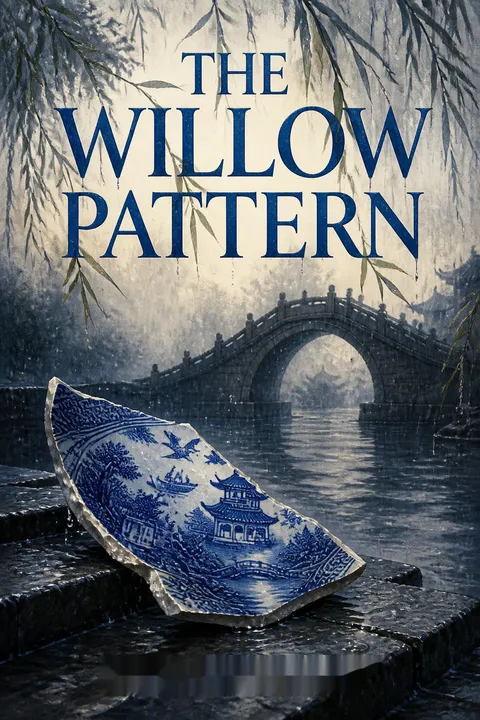
The Willow Pattern
A legend that misdirectsA blue-and-white porcelain design shows a waterside villa, willow trees, a bridge, and figures in flight. Its popular romantic legend suggests one story, while Hoo supplies a family version bound to old love and loss. Dee notices that the design resembles Hoo’s home and that the pattern unsettles Madame Mei, so it draws suspicion toward the relationship between the families. The broken vase found beside Yee’s body may also carry a more immediate meaning than the famous design. The motif links the novel’s physical clues to the ways people reshape the past into a story that suits their present fears.
The Plague Emergency
Pressure on every decisionA deadly epidemic empties the capital of its court, reduces patrols, disrupts food distribution, and fills the streets with scavengers removing bodies. Dee must govern with limited personnel while confronting hunger, rumor, and the risk of revolt. The stagnant canals and clogged sewers worsen the city’s physical danger, while fear makes ordinary encounters perilous. The epidemic is not merely background: it removes witnesses and servants, creates openings for hidden crimes, and forces the court to use emergency procedures. Its eventual change in the weather provides a public sign of hope, though it cannot undo the losses already suffered.
The Old Families’ Rhyme
A prophecy that distortsA street rhyme predicts three kinds of loss for the Mei, Hoo, and Yee families: a bed, an eye, and a head. Because Mei dies first and Yee is found with his face destroyed, residents and investigators try to assign each image to a person. Hoo’s anxious attention to the rhyme becomes a clue to his private understanding of the deaths, but the words do not identify a killer or establish a supernatural design. The rhyme captures how a frightened population turns a sequence of events into a forecast, and how that forecast can shape the behavior of those who believe it.
Yuan’s Peep Show
A miniature crime stageYuan’s portable peep show uses paper figures, careful shading, and fine threads to create moving scenes. One depicts a woman being whipped in the same gallery where Yee is later found, while another shows a villa resembling Hoo’s home. The images establish Yuan’s artistic ingenuity and his habit of translating painful memories into performance. They also alert Ma to a history that the official record does not contain. The peep show is both testimony and manipulation: it preserves an event, but Yuan chooses what to display and what emotional response he hopes to provoke.
The Staged Accidents
False scenes invite scrutinyThe deaths of Mei and Yee are surrounded by objects that invite investigators to reconstruct a plausible event: a candle and slipper at the staircase, a broken vase and whip in Yee’s gallery, and signs of entry from the canal. Dee compares those details with the buildings’ lighting, routes, bodily injuries, and traces of water or ink. The staged fall at Mei’s mansion looks convincing because its clues are carefully arranged, but their excess becomes suspicious. In Yee’s case, the apparent clues point toward several people before Dee can distinguish what is evidence from what is assumption.
Judge Dee Series
Download PDF
Download EPUB
.epub digital book format is ideal for reading ebooks on phones, tablets, and e-readers.








