

Plot Summary
Orders for Berlin
In 1939, Commander Victor Henry1 expects his warning about vulnerable American battleship armor to earn him sea duty. Instead, the Navy orders him to Berlin as naval attaché, where intelligence matters more than his career ambitions.
His wife, Rhoda,2 welcomes the prospect of Europe, though years of Navy moves have made her resent the life she once promised to accept. Their children are scattered: Warren5 serves at sea, Madeline6 is restless at college, and Byron3 drifts through Europe without a plan.
Victor1 chooses the Berlin post despite his misgivings, then writes to Byron3 cautioning him about marriage to Natalie Jastrow,4 a Jewish scholar's7 niece. The family leaves Washington divided by distance, old grievances, and ambitions it rarely discusses.
The assignment begins as a professional setback, but it also exposes the family's accustomed way of living: Victor makes consequential choices, while everyone else is expected to absorb them. His advice to Byron is shaped by a marriage he regards as a hard-won success and by his fear that his son lacks the discipline to manage adult life. Rhoda's cheerful consent does not erase her resentment; it shows how affection and grievance can coexist inside a household that has learned not to speak plainly.
A Palio Rescue
Byron3 reaches Siena after abandoning graduate study in Florence, and Dr. Aaron Jastrow7 hires him to research Emperor Constantine. Byron's3 attention is divided between the work and Natalie,4 the intelligent niece who already loves Foreign Service officer Leslie Slote.8 When a Palio horse breaks loose in the crowd, Jastrow7 falls into its path.
Byron3 distracts the animal with the professor's7 hat until others seize its reins. The rescue earns him Jastrow's7 trust and Natalie’s4 gratitude, though she still plans to visit Slote8 in Warsaw. When war rumors intensify, Natalie4 asks Byron3 to accompany her. He agrees, hoping to remain near her, and Jastrow7 approves because Byron's3 presence might protect his headstrong niece.
The rescue is the first time Byron's passivity gives way to useful action. He does not become ambitious or suddenly self-aware; he simply sees a person in danger and moves. Natalie responds to demonstrated steadiness rather than Byron's looks or infatuation, while Jastrow turns the incident into evidence that the young man may be more capable than his record suggests. The Palio's staged rivalries also foreshadow the political spectacle gathering around them, where ritual and real violence are already difficult to separate.
Behind Nazi Banners
In Berlin, Victor1 and Rhoda2 settle into a mansion rented cheaply from Jewish owner Herr Rosenthal, whose property is threatened by Nazi rules. Rhoda2 enjoys the city and its social life, yet gradually accepts the exclusion signs she once found appalling. Victor1 studies the military machine beneath the parades.
On a visit to the U-boat base at Swinemünde, he sees clean boats and skilled crews, but also idle yards that undermine the claim of limitless German production. He writes an intelligence report arguing that Germany is not ready for a war with Britain and France. More daringly, he predicts Hitler20 is negotiating with Stalin,21 citing trade, diplomatic changes, and a submariner's15 warning to watch the east.
Victor trusts measurable capacity because it belongs to his professional world; German history and ideology seem too vast and muddy to interpret. His report therefore pits industrial evidence against political theater, without yet grasping how effectively the regime turns partial truths into public confidence. Rhoda's adjustment is subtler and more troubling: repeated exposure makes exclusions ordinary enough to live beside. Rosenthal's house is not merely a bargain. It makes the policy's material consequences part of the Henrys' domestic comfort.
The Pact Arrives
Hitler's20 agreement with Stalin21 confirms Victor's1 prediction and shocks the European governments that dismissed it. Byron3 and Natalie4 see the news while traveling toward Warsaw, but Natalie4 refuses to turn back. She wants to meet Slote8 and visit the Polish family from which her relatives came. In Warsaw, Slote8 warns that Germany may invade, and the British guarantee has not calmed the crisis.
Natalie4 persuades Byron3 to travel with her to Medzice, where relatives welcome her as a returning daughter of the village. During the wedding celebrations, Byron3 and Natalie4 draw closer. The next morning, Berel Jastrow22 warns that German forces are coming, and the party begins its dangerous drive toward the capital.
The pact transforms diplomatic surprise into physical danger, but Natalie continues to treat travel as a promise to herself and her family. Her insistence is not simple recklessness: Warsaw and Medzice are attempts to encounter a heritage she once dismissed as irrelevant. Byron's devotion begins in romantic longing, yet the journey pulls him into obligations that cannot be reduced to winning her affection. The wedding briefly gives the visitors a living connection to the old community just as invasion threatens to erase it.
War Reaches the Henrys
German forces invade Poland, and Victor's1 return from Berlin becomes urgent. Before he can leave, Madeline6 walks into a CBS newsroom and persuades Hugh Cleveland19 to hire her, turning a secret taste for New York independence into a job.
Warren,5 meanwhile, enters accelerated naval flight training at Pensacola and wins a place in the demanding fighter squadron. He begins courting Janice Lacouture,17 a politically ambitious congressman's18 daughter. Victor1 reaches Washington, briefs Franklin Roosevelt,11 and learns the President11 values his judgment, especially his prediction about the Nazi-Soviet pact.
A message from Warsaw confirms Byron3 and Natalie4 are trapped there. Victor1 keeps the news from Rhoda,2 who is already unhappy in Berlin, and returns to Europe as the Polish crisis worsens.
The war gives each child a different route out of the family pattern. Madeline discovers that competence can earn her the independence her father withheld; Warren converts discipline into a new kind of service; Byron is already caught inside the conflict. Victor's meeting with Roosevelt makes his private observations politically consequential, yet the President's casual manner leaves him unsure whether he is being recruited or merely consulted. His silence about Byron protects Rhoda from worry, but repeats the family's habit of managing one another through omission.
Warsaw's Burning Road
Byron's3 party leaves Cracow in an overloaded Fiat with Natalie,4 Berel Jastrow,22 relatives, and a driver whose household goods rattle on the roof. German aircraft strafe the refugee road, killing a mother and wounding Byron.3 At a town checkpoint, Polish soldiers seize the car and Byron's3 passport, treating the travelers as suspects.
He escapes with the group before they can be detained, choosing a dangerous back-road route toward Warsaw rather than abandon Berel's22 family. The journey takes two days through damaged villages, dwindling fuel, and roads crowded with fleeing civilians. When they reach the American embassy, Leslie Slote8 welcomes Byron3 and Natalie,4 but explains that Warsaw is surrounded and there is no safe way home.
Byron's decision to continue without a passport is the clearest break with his habitual evasion of responsibility. His earlier courage at the Palio protected one man; now his choices carry a whole family toward uncertain survival. The wounded mother on the road and the Polish soldiers at the checkpoint complicate any easy division between victim and rescuer. The invasion is not an orderly contest of armies. It enters civilian life through exposure, suspicion, and the collapse of ordinary protections.
The Embassy's Last Road
As Warsaw is bombed, Byron3 repairs a makeshift water cart and supplies the American embassy, while Natalie4 works in an overcrowded maternity ward. He carries her money to Berel,22 who directs food relief in the Jewish quarter, where shells destroy a synagogue as its community tries to save the sacred scrolls.
When the Germans and Russians both enter the conflict, the Americans arrange an evacuation. Byron's3 rough road sketch guides the refugees through no-man's-land during a brief cease-fire. At a German station, Leslie Slote8 refuses to identify Jews in the American party; Byron3 and a minister help protect Mark Hartley from separation. They board for safety, leaving Warsaw and the people who cannot go.
The siege turns Byron's practical talents into a kind of service he has never found in school or civilian work. His water hauling sustains the embassy, but it cannot save the city or the people outside its protection. Slote's refusal to classify Jewish Americans is a meaningful act of resistance within narrow diplomatic limits; Byron's lies support it. Their escape is therefore both a rescue and a moral wound, because safe passage depends on leaving others behind.
A Son Returns
Victor1 and Rhoda2 meet Byron3 in Berlin after his escape from Warsaw. Gaunt and exhausted, he recounts the bombing, the bodies, the hungry embassy, and the strange feast the Germans served the departing neutrals. Victor1 recognizes the value of Byron's3 eyewitness account and makes him help prepare a report for Naval Intelligence.
Byron3 instead immerses himself in books about German culture, then asks to return to Siena and resume work with Jastrow.7 Victor,1 proud but wary, does not stop him. Back in Italy, Byron3 and Natalie4 meet again. She admits her love, and Byron3 proposes marriage, though she refuses to settle their future before facing the demands of family, work, and war.
Byron's story gives his parents evidence they had not learned to request: he can act decisively, endure hardship, and observe clearly. Victor's instinct is to turn this experience into useful intelligence, while Byron wants to make sense of the people who attacked Warsaw. Their differing responses reveal a family that can share facts more easily than feelings. Natalie and Byron's love emerges from proximity and shared danger, but her hesitation recognizes that desire alone cannot answer practical questions about faith, vocation, and military service.
Hitler's Peace Theater
Victor1 is promoted to captain and sent on an unusual peace feeler with banker Luigi Gianelli. Mussolini agrees to receive a proposed American mission but insists Italy will remain tied to Germany.
At Karinhall, Hermann Goering and Joachim von Ribbentrop surround the meeting with accusation and spectacle. Hitler20 spends more than an hour justifying his conquests and insisting he wants peace, while Victor1 hears the practiced charm beneath the false account of Poland.
Back in Berlin, financier Wolf Steller14 invites Victor1 to his estate and explains how German banks profit from Jewish businesses forced to sell. Steller14 then offers access to Goering's hidden funds in exchange for influence in Washington. Victor1 rejects him and reports the approach.
The mission puts Victor inside the theater of power, where persuasion and intimidation can coexist in a single conversation. He is impressed by Hitler's composure even as he recognizes the lies, a dangerous reminder that understanding a manipulator is not the same as trusting him. Steller's offer turns persecution into a business system and tests whether Victor's professional curiosity can be purchased. His refusal matters because it separates intelligence gathering from complicity, even when the man offering the bribe speaks in the language of friendship.
France Falls Fast
Germany's invasion of Norway and Denmark ends the so-called Phony War, then the breakthrough through the Ardennes shatters the French defense and drives the British toward Dunkirk. Roon's inserted account explains how the Germans mass armor where the Allies spread theirs, while also exposing the danger of Hitler's20 interference in military operations.
At home, Warren's5 flight training accelerates, and the invasion forces his wedding to Janice17 forward. The couple marries in Pensacola and is immediately separated by Warren's5 Pacific orders. At the same time, engineer Palmer Kirby13 tells Victor1 that scientists are investigating uranium fission and that magnetic equipment may help separate the material needed for a powerful weapon.
The fall of France makes military doctrine visible through consequence: the Maginot Line cannot protect a country whose forces are outmaneuvered and whose leaders lack reserves. Roon's account argues from a defeated general's perspective, useful for technical insight but compromised by its habit of shifting blame. The Henry children's milestones are similarly shaped by events beyond their control. Warren's wedding becomes both a promise of family continuity and an immediate farewell, while Kirby's technical report hints that industrial science may change war more radically than tanks or aircraft.
The Bomber's Night
Sent to Britain, Victor1 visits Chain Home radar stations and sees how operators use the system to guide fighters toward German raids. Churchill12 asks for destroyers and landing craft, arguing that Britain needs time and equipment to survive. Victor1 also watches exhausted fighter crews at Biggin Hill and becomes close to Pamela Tudsbury,9 who is serving with the WAAF while her pilot fiancé is missing.
He accepts an invitation to accompany a bomber crew on a night raid over Berlin. Searchlights and flak catch their Wellington, a gunner is wounded, and the aircraft limps back. Pamela9 welcomes Victor1 with kisses, and the near-death flight makes him recognize that he has fallen in love with her.
Radar makes warfare less a contest of heroic eyesight than a system of detection, communication, and timing. Pug's visit teaches him that Britain has developed capabilities its public image conceals. The bomber mission then reverses his role from observer to exposed participant: he sees Berlin from above while a young gunner bleeds behind him. Pamela's affection meets him at the boundary between survival and death, but their connection remains constrained by marriage, duty, and the uncertainty surrounding her missing fiancé.
A Bribe in Abendruh
After returning to Berlin, Victor1 visits Abendruh again and meets the banker Wolf Steller,14 General Armin von Roon,16 and other Nazi-connected figures. They press him to see German power as a force for order and to regard American support for Britain as the work of Jewish influence. Steller14 finally offers him a share of Goering's hidden wealth if he helps shift American policy.
Victor1 refuses, recognizing that the appeal to honor is camouflage for treason. Around him, the war's direction changes: German forces prepare to invade the Soviet Union, while Roon's account records the vast gamble of Barbarossa and the German army's early advance. Victor1 leaves Berlin for a new assignment in Washington.
Steller's recruitment pitch is effective because it uses Victor's own habits against him: his desire to gather information, his discomfort with diplomatic hypocrisy, and his belief that practical men can speak across political divides. The offer converts those virtues into a route toward corruption. The looming eastern invasion enlarges the stakes, but Roon's framing keeps revealing the moral evasions of military memoir. He can describe operational mistakes with precision while treating conquest as a reasonable answer to German need.
Lisbon Vows
Byron3 completes submarine training and is assigned to the S-45, while Natalie4 remains in Italy, caring for Aaron7 and trying to secure his return to America. Her father dies after a heart attack, deepening her regret over their estrangement. She later reaches Lisbon, where Byron's3 submarine unexpectedly arrives after a change of orders.
With Leslie Slote8 and a Portuguese naval officer helping assemble the required documents, Byron3 and Natalie4 marry in a civil ceremony. They spend one night together in the hotel before the S-45 must sail. Natalie4 stays behind to bring Aaron7 out of Italy, while Byron3 returns to duty, now a husband and father-to-be separated by ocean and war.
The marriage is not a tidy resolution but a hard-won commitment made under severe time pressure. Byron's initiative in gathering documents turns his talent for improvisation toward building a shared life, while Natalie accepts a bond that crosses religious and cultural divisions she has spent years trying to understand. Her return for Aaron shows that marriage does not erase family obligation. Their brief wedding night is therefore both joyful and provisional: the couple has chosen each other, but war immediately dictates where they can live.
The Atlantic's Thin Line
In Washington, Victor1 joins the secret planning that coordinates American and British operations, even as public debate insists the United States must remain neutral. Roosevelt11 uses Pug1 to help transfer surplus Navy dive-bombers to Britain and later sends him to assess radar and naval needs.
When U-boats threaten the Atlantic supply route, Pug1 helps organize a covert convoy exercise that escorts Lend-Lease ships toward Iceland. The ships reach the British handoff without attack, but the operation exposes how close policy has moved to undeclared war. Roosevelt11 still delays a formal commitment, balancing military necessity against a divided public and Congress.
Pug's work turns the gap between public neutrality and private preparation into the novel's central political tension. The administration does not simply deceive for convenience; it is trying to move a reluctant democracy toward action without losing the authority needed to act. Pug's role remains deliberately narrow: he arranges ships, evaluates risks, and reports what he sees. His professionalism gives him influence, but it cannot resolve the public argument or make the President's strategy morally uncomplicated.
A Fleet at Risk
By late 1941, Pug1 is in the Pacific, where naval leaders still focus on Japan even as German armies drive toward Moscow. He attends planning meetings and argues that the conflict cannot be understood as a distant European quarrel. Warren5 is serving aboard the Enterprise, and Byron3 is with the Devilfish in the Philippines, pressing for a transfer to the Atlantic because Natalie4 and their new son are stranded in Italy.
Pug1 reaches Manila as tensions rise, while Japanese forces gather across the Pacific. The family is scattered across continents, each member tied to a different front, and the long-awaited sea command Pug1 hoped to reclaim remains vulnerable to events.
The novel's geography becomes a psychological map: the Henrys' separations mirror a war that has outgrown any single theater. Pug sees the Pacific as strategically bound to Europe, while many of his colleagues still treat Japan as the only immediate danger. Byron's attempt to leave his assigned boat is driven not by cowardice but by the need to reach his wife and infant son. The crisis tests whether military duty can accommodate intimate responsibility, or whether it will keep tearing families apart.
Pearl Harbor Burns
On December 7, Japanese aircraft strike Pearl Harbor while Janice17 tends a feverish baby and Warren5 is away with the Enterprise. Pug1 has arrived in the Pacific just as the attack begins. The California, the battleship he expected to command, is hit by torpedoes and bombs and sinks into the harbor.
Warren5 survives the first attack and fights as a naval aviator; Byron3 and the Devilfish remain in the wider Pacific crisis. The surprise assault brings the United States into the war and ends Pug's1 long wait for a conventional battleship career. The book closes as he confronts a war that has finally reached his own family and fleet.
Pearl Harbor converts the political crisis Pug has tracked for years into immediate physical loss. The California's destruction is more than a setback in rank: it erases the ship that had embodied his professional identity. The attack also collapses the distance between public policy and family life, as Warren fights, Janice protects their child, and Byron is already at sea. The ending leaves no victory or reunion to soften the shock. The family has entered the war together, but not in the same place.
Analysis
The novel places one family inside a war that keeps changing its scale. At first, conflict reaches the Henrys1 through assignments, newspaper reports, and arguments over whether Victor1 belongs at sea. Then it becomes physical: Byron3 crosses roads under strafing, Natalie4 works in bombed Warsaw, and Victor1 flies over Berlin in a damaged bomber. The family's separations are not decorative subplots. They make the cost of military choices legible in letters, missed reunions, hurried weddings, and children born far from their fathers.
Victor's1 professional creed rests on competence and factual judgment. His reports about German production, his radar observations, and his work on convoys all show the value of close analysis. Yet the novel also shows that facts do not decide policy by themselves. Roosevelt11 must maneuver around public opinion; Churchill12 must make Britain endure; Hitler20 turns lies into political instruments; and German officers can speak of honor while serving conquest. The embedded Roon narrative intensifies this problem. Its campaign analysis is often sharp, but its explanations repeatedly transfer blame away from Germany. Historical knowledge is therefore necessary and morally unstable.
Byron's3 movement from idleness to responsibility offers a smaller counterpoint to the great commanders. He becomes useful before he becomes ambitious: rescuing Jastrow,7 guiding refugees, carrying water, and finally accepting submarine service. Natalie4 challenges him to think about what he will do with his life, while he offers her a kind of steady affection she did not expect. Their marriage is a real commitment, but not an escape from history; war separates them almost immediately.
The ending refuses triumph. Pearl Harbor brings the United States into the conflict, but it also destroys the battleship that represents Victor's1 career ideal. The book closes at the moment when private family life, national policy, and industrial warfare can no longer be kept apart. Its deepest question is not whether individuals can avoid the war, but what forms of loyalty and judgment remain possible once the war has entered every home.
Review Summary
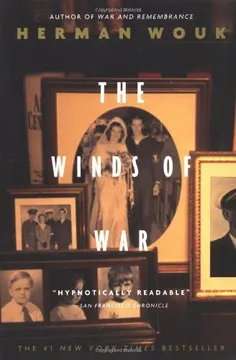
The Winds of War is a sweeping historical epic set during World War II, following the Henry family through the tumultuous pre-war years. Readers praise Wouk's meticulous research, compelling characters, and ability to weave historical events seamlessly into the narrative. While some find the book's length and occasional historical lectures challenging, most appreciate its depth and insight into the era. The novel's blend of family drama and global events creates an immersive experience, leaving readers eager to continue the story in the sequel, War and Remembrance.
People Also Read

Characters
Victor Henry
The Navy's hard-eyed witnessKnown as Pug, Victor is a career naval officer, ordnance expert, husband to Rhoda2, and father of Warren5, Byron3, and Madeline6. He trusts evidence, competence, and duty, often more than personal disclosure. His instinct is to study machinery, ships, and military capacity rather than make broad claims about politics, yet his assignments repeatedly force him to interpret the people behind the weapons. He can be severe with his children and emotionally reticent with Rhoda2, but he is not devoid of tenderness; he shows it through practical help, loyalty, and a fierce sense of responsibility. His central tension is between the career he believes should define him and a wider war that keeps demanding judgment beyond his specialty.
Rhoda Henry
The restless Navy wifeRhoda is Victor's1 attractive, socially capable wife and the mother of their three children. She can make a temporary home elegant, entertain diplomats, and move confidently through social worlds, but the repeated dislocations of Navy life have worn down her patience. She speaks freely about servants, weather, clothes, and inconvenience, while often leaving deeper injuries unspoken. Her dependence on Victor1 is real, but so is her wish for a life shaped by pleasure, recognition, and choice. She responds strongly to attention and beauty, and her moods can turn from flirtatious warmth to sharp complaint. Rhoda's character reveals how a person may sincerely love a spouse while also resenting the structure that marriage has imposed.
Byron Henry
The drifting son who actsByron is Victor1 and Rhoda's2 younger son, an intelligent but chronically undirected young man who avoids the Navy, schoolwork, and any career that demands sustained effort. He is observant, mechanically handy, charming, and more courageous under pressure than he believes himself to be. His attraction to Natalie4 first appears as infatuation, but their shared journey forces him to move beyond fantasy and become useful to other people. Byron's relationship with his demanding father is colored by a long history of disappointing him, even as he craves his approval. He is drawn toward action when others need help, yet struggles to accept the discipline and obligations that action requires.
Natalie Jastrow
The fierce, searching scholarNatalie is Aaron Jastrow's7 niece, an American graduate student and researcher who works closely with him in Italy. She is intellectually confident, quick-witted, physically adventurous, and impatient with people who underestimate her. Her relationship with Leslie Slote8 has left her wary of being managed or treated as a career complication. Natalie is also uneasy about her Jewish inheritance: she rejects religious practice but remains curious about the people and history from which her family came. Her attachment to Byron3 challenges her assumption that love must follow intellect, age, or shared background. She is driven by independence, family loyalty, and a restless desire to know where she belongs.
Warren Henry
The ambitious naval aviatorWarren is Victor1 and Rhoda's2 older son, an Annapolis graduate whose competence, confidence, and ambition distinguish him from Byron3. He is a natural athlete and a capable student when he commits himself, though his youthful appetites have sometimes threatened his career. Flying offers him both a demanding professional path and a vivid sense of purpose. Warren can be playful and sexually confident, but he also takes history and military strategy seriously. His engagement to Janice17 connects him to an influential political family, and his affection for Byron3 survives their differences. He represents the Navy's forward-looking generation, trained for an air-centered war rather than the battleship world his father reveres.
Madeline Henry
The ambitious radio producerMadeline is Victor1 and Rhoda's2 daughter, a young woman who dislikes college and discovers a more natural fit in broadcasting. She starts by bluffing her way into CBS, then proves herself through quick learning, organization, and reliability. Madeline has her mother's social ease and her father's moral seriousness, though she wants to test a life outside both parents' expectations. Her private views on sex and work are more conventional than her New York surroundings, which makes her independence complicated rather than simple. She is eager to be treated as an adult, yet still cares deeply about her family and responds to their judgments even when she resists them.
Aaron Jastrow
The self-absorbed historianAaron is Natalie's4 uncle, a Polish-born Jewish historian and successful author living in a villa near Siena. He is brilliant, eccentric, vain about his work, and accustomed to having Natalie4 organize the practical details of his life. His scholarship moves easily between Christianity, Jewish history, and political change, though his confidence in his own interpretations can exceed his knowledge of present dangers. Aaron prizes his books, house, routines, and independence, making departure difficult even when circumstances grow threatening. He is capable of affection and gratitude, but often expresses both awkwardly, through intellectual conversation or self-absorbed reflection. His dependence on Natalie4 gives their relationship warmth and friction in equal measure.
Leslie Slote
The brilliant, fearful diplomatLeslie Slote is a Rhodes Scholar and Foreign Service officer whose languages, political insight, and analytical discipline make him valuable in a crisis. He has a complicated romantic history with Natalie4 and understands her intelligence, but his professional ambition and fear of physical danger shape many of his choices. In Warsaw, responsibility for the American embassy forces him to act despite his private panic. Slote is neither a simple coward nor a conventional hero: he can freeze under shellfire, then show courage in a bureaucratic confrontation where American principles and Jewish safety are at stake. His life is divided between the person he wants to be and the person he fears he may be.
Pamela Tudsbury
The searching wartime daughterPamela is the daughter and assistant of British broadcaster Alistair Tudsbury10. On the Bremen, she appears quiet and observant; in wartime Britain she works with the WAAF and becomes closely involved with fighter pilots and air operations. Her upbringing as a traveler and caretaker has made her adaptable, but her past relationships have left her wary of being controlled. Pamela is capable of loyalty and courage, though she does not treat either as a reason to surrender her own desires. Her connection with Victor Henry1 gives her a rare sense of being understood, while her love for a missing pilot pulls her toward another life and another duty.
Alistair Tudsbury
The irreverent British correspondentAlistair, known as Talky, is a famous British broadcaster and correspondent, and Pamela's9 father. He treats impending catastrophe as both serious news and a spectacle, using humor to puncture political complacency. His reporting instincts are sharp, though his habits and failing eyesight make him dependent on Pamela9. He understands that Britain needs American help, but his attempts to influence Victor1 can blur the line between friendship and persuasion. Talky's flamboyance masks fear and affection, especially when his daughter considers leaving him to serve with the WAAF.
Franklin D. Roosevelt
The patient political tacticianRoosevelt is the President of the United States, a former Assistant Secretary of the Navy, and a skilled political operator whose public promises of neutrality coexist with increasingly direct efforts to aid Britain. His charm, memory, humor, and appetite for detail help him draw people close, while his wheelchair and illness never erase his command of a room. He relies on unofficial channels and carefully staged ambiguity because Congress and public opinion limit what he can openly do. Roosevelt's governing strength lies in timing and persuasion, but that same caution frustrates people who see delay as dangerous.
Winston Churchill
Britain's defiant war leaderChurchill is Britain's Prime Minister, an orator and political survivor who understands that his country must keep fighting even when its army and air force are strained. He is a forceful amateur in military matters, eager to shape operations and impatient with those who counsel retreat. His speeches give the British public a language for endurance, while his requests to Roosevelt11 reveal the material weakness beneath the rhetoric. Churchill is not presented as flawless, but as a leader whose persistence helps prevent Britain's collapse at a moment when a negotiated peace remains tempting.
Palmer Kirby
The engineer at a thresholdPalmer Kirby is a widowed Colorado engineer who has built a business around precision magnetic amplifiers. Shy and physically ungainly, he becomes talkative once he can explain his work, and his practical mind is alert to the distance between scientific theory and industrial production. His attraction to Rhoda2 grows through conversation rather than spectacle, and their shared loneliness gives their companionship real emotional weight. Kirby's work brings him close to the emerging uranium project, where the engineering challenge may have consequences beyond anything he has previously built.
Wolf Steller
The banker of legalized plunderSteller is a cultured German banker with influential ties to Goering and a practiced talent for making predatory systems sound respectable. His bank profits by arranging purchases of Jewish businesses whose owners have been squeezed by Nazi restrictions. He treats Victor Henry1 as a potential channel to American decision-makers, presenting self-interest as mutual understanding and honorable service. Steller's courteous manners make him more unsettling, not less: he can discuss art, food, and finance while treating confiscation as ordinary business.
Ernst Grohke
The professional U-boat officerGrohke is a German submarine commander and professional sailor who shares Victor's1 technical interests and respect for seamanship. He is candid about machinery and shipyards, yet loyal to Hitler's20 restoration of Germany and confident in the U-boat campaign. His warmth toward Victor1 grows from the fraternity of naval officers, not from agreement about the war. Grohke's divided outlook shows how military competence and ordinary affection can coexist with political allegiance to an aggressive regime.
Armin von Roon
The soldier who explains defeatGeneral von Roon is a brilliant German staff officer whose postwar military analysis is presented through translated excerpts. He offers detailed explanations of campaigns and the decisions behind them, often identifying operational strengths and failures with professional clarity. His interpretation is compromised by a persistent effort to defend German soldiers, minimize German responsibility, and shift blame toward opponents. Roon's voice gives the narrative a second lens on the war, forcing readers to distinguish technical insight from self-justifying argument.
Janice Lacouture
The ambitious naval brideJanice is Warren's5 fiancée, the daughter of Congressman Isaac Lacouture18, and a beautiful, politically alert young woman with ambitions beyond the social world of Pensacola. She takes Warren5 seriously because he can discuss history and strategy rather than simply court her. Janice is capable of independence and argument, but she also understands the advantages of family wealth and political influence. Her marriage brings her into the Henry family1 and the Navy's unsettled future, where private plans must bend around war.
Isaac Lacouture
The isolationist congressmanLacouture is Janice's17 father, a Florida congressman and lumber businessman who argues that the United States should remain outside Europe's war. He is politically astute, self-assured, and more knowledgeable about American industry than European military realities. His isolationism is not mere ignorance; he fears that intervention will bankrupt the country and cost a generation of young men. His position makes him a useful voice for the domestic opposition that Roosevelt11 must navigate, while his relationship with Warren5 links political ambition to family life.
Hugh Cleveland
The radio impresarioCleveland is Madeline's6 employer at CBS, a popular broadcaster who mixes charm, appetite, and show-business instinct. He recognizes her reliability and gives her room to grow, though his flirtatious behavior and casual use of people trouble her. Cleveland understands how to turn news and personalities into entertainment, and he sees military amateurs as compelling radio material. His successful career offers Madeline6 a model of professional life very different from the Navy household in which she was raised.
Adolf Hitler
The persuasive German dictatorHitler appears through Victor Henry's1 observations, diplomatic encounters, and Roon's retrospective account. He can seem tired, awkward, or almost boyishly charming, then reveal a concentrated will and a gift for political performance. He presents conquest as historical correction and repeatedly frames aggression as a search for peace. His ability to make contradictory claims sound coherent unsettles Victor1, who learns that the comic public image of Hitler is dangerously inadequate. The narrative emphasizes both his personal persuasiveness and the German political culture that allows him to speak for the nation.
Joseph Stalin
The guarded Soviet rulerStalin is the Soviet leader whose pact with Hitler20 shocks Europe and whose military state becomes Germany's next target. He rarely appears directly, but his decisions shape the Polish invasion, the struggle for Moscow, and the Allies' calculations. To American and British visitors, he is opaque, suspicious, and difficult to read; he combines a willingness to negotiate with an appetite for territorial advantage. His rule embodies the Soviet system's secrecy and coercion, even as the invasion turns Soviet soldiers and civilians into essential opponents of Nazi expansion.
Jochanan Berel Jastrow
The resourceful family patriarchBerel is Natalie's4 Polish cousin, a prosperous trader and practical survivor who knows languages, local networks, and the habits of officials. He guides Byron3 and Natalie4 through Medzice and the invasion's early chaos, then helps organize food and relief in Warsaw. His attachment to family and community is expressed through action: arranging transport, finding shelter, and keeping business obligations in view even amid bombardment. Berel is also a link between Aaron's7 American success and the poorer Jewish world from which the family emerged.
Ernst Bayer
The courteous German officerBayer is a young German officer who recognizes Victor Henry's1 family connection while escorting neutral refugees out of Warsaw. He is polite, self-conscious, and capable of discussing destruction as though it were an administrative necessity. His ordinary courtesy contrasts with the violence carried out by the army he serves, making him a small but revealing example of how civilized manners can coexist with aggressive power.
Admiral Ernest King
The severe naval commanderKing is a hard-driving senior naval officer who values readiness, clear orders, and professional accountability. He clashes with Victor1 over past technical questions, but trusts him when a delicate Atlantic operation requires discretion. His frank pessimism about American preparedness contrasts with public optimism, and he recognizes that neutrality can become an operational fiction. King is not warm, yet his directness makes him a useful counterweight to Roosevelt's11 political indirection.
Plot Devices
Roon's war history
A German counter-narrativeTranslated excerpts from General Armin von Roon's16 military study interrupt the Henry family story to explain campaigns from the German staff's perspective. The sections supply operational detail about Poland, Norway, France, Barbarossa, and the Battle of Britain, while Victor Henry's1 translator notes challenge Roon's16 omissions and self-defense. The device makes history itself part of the conflict: Roon16 is technically perceptive but repeatedly rationalizes aggression and minimizes German culpability. Readers must compare what his account claims with the civilian suffering and political events the Henrys directly encounter. The contrast prevents either viewpoint from becoming a complete explanation of the war.
Reports and letters
Private lives become evidenceVictor's1 intelligence reports, Roosevelt's11 informal notes, and the letters exchanged among the Henrys and Jastrows carry information across distance and bureaucracy. They reveal what characters cannot say face to face, from Victor's1 assessment of German readiness to Natalie's4 doubts about marriage and Aaron's7 citizenship problem. Documents also create political action: Victor's1 prediction of a Nazi-Soviet pact reaches Roosevelt11, and Natalie's4 records help her secure Aaron's7 return. Their limitations matter too. Messages arrive late, disappear, or expose their writers to censors. In this story, paper is both a fragile family connection and an instrument of state power.
Sea routes and submarines
Distance becomes dangerThe ships, submarines, convoys, and ocean crossings connect otherwise separate strands of the story. Byron's3 submarine training gives him a way to turn drifting into disciplined work, while its deployments repeatedly separate him from Natalie4. U-boats threaten Britain's supply lifeline and force Roosevelt11 to test the limits of neutrality through covert convoying. The Pacific fleet embodies Victor's1 professional identity, but its destruction shows how quickly naval power can be neutralized by aircraft. Sea travel can offer escape, as it does for Natalie4 and Aaron7, yet every passage depends on schedules, fuel, paperwork, and the possibility of attack.
Radar and landing craft
Technology changes the oddsThe British radar system and the disputed need for landing craft turn technical details into strategic turning points. At Chain Home, Victor1 sees how detection and fighter control compensate for Britain's limited air strength. Later, Churchill's12 insistence on landing craft forces American planners to confront the practical requirements of returning to Europe. Victor1 repeatedly translates large political promises into industrial questions: what can be detected, built, shipped, and delivered in time? These devices also expose the limits of celebrated plans. A map or slogan cannot land an army; the machinery, crews, and supply routes must exist.
Stolen Jewish property
Persecution enters the homeThe Henrys' Berlin mansion belongs to Herr Rosenthal, a Jewish manufacturer forced by discriminatory rules to rent it cheaply. Later, Victor1 learns that bankers such as Wolf Steller14 profit by arranging the purchase of Jewish businesses under pressure. These transactions show persecution not as an abstract policy but as a chain of ordinary bargains, official restrictions, and private advantages. The device implicates people who are not direct perpetrators: the Henrys benefit from the house, and Victor's1 professional socializing gives him access to men who profit from dispossession. It makes material comfort part of the moral landscape.
Download PDF
Download EPUB
.epub digital book format is ideal for reading ebooks on phones, tablets, and e-readers.








