

Key Takeaways
Enter a craft as a beginner, even when your résumé says otherwise.
Begin without your armor. At twenty, Morishita expected Tea to be an old-fashioned hobby she could pick up easily. Instead, she struggled with every small movement, from carrying a water jar to crossing the tatami correctly. Her school success and confidence were no help. She had to recognize that looking down on a practice prevented her from learning it.
The Japanese term chajin means a person who studies Tea. Morishita’s teacher, Takeda-sensei, had the composure and independence that first drew her attention. Becoming her student meant accepting not only the unfamiliar rules, but also the humbling fact that she knew almost nothing about this particular world.
What's striking is that beginnerhood here is not a motivational slogan. It is a practical diagnosis: prior competence can become a blind spot when a new skill depends on different kinds of attention and knowledge. Expertise research distinguishes knowing facts from being able to perform a task, and the book dramatizes that gap through Morishita's fumbling hands. The humility is useful, but it should not be confused with unquestioning obedience. A learner can admit inexperience while still asking whether a rule is safe, ethical, or meaningful.
Repeat the movements until your hands understand what your mind cannot.
Practice builds a different memory. Morishita and her cousin repeated the tea procedure week after week, often forgetting the sequence and making the same mistakes. Their teacher discouraged memorizing steps or taking notes. She wanted them to repeat the movements until their hands began to proceed without constant verbal instruction. After a summer break, Morishita found her hands completing a familiar sequence before she had consciously decided what came next.
The learning was not smooth or final. Seasonal changes brought new arrangements, utensils, and procedures. Just as the summer setup began to feel familiar, the winter hearth changed where the tools went and how the host moved. Practice meant adapting, not merely storing a fixed routine.
This account resembles procedural learning, in which repeated action becomes more fluent and less dependent on conscious step-by-step control. It also suggests why deliberate variation can matter: people must retrieve and adapt a skill, rather than simply repeat it under identical conditions. Still, rote repetition is not automatically wisdom. In fields where a mistaken action carries serious consequences, learners need explicit explanations and feedback as well as bodily practice. Tea makes repetition meaningful by placing it inside a teacher-student relationship and a changing seasonal setting.
Let form hold meaning before you can explain it.
A gesture can carry respect. At first, Tea’s exacting procedures seemed arbitrary to Morishita. She wondered why a particular foot had to enter first or why a bowl needed to be turned in a prescribed way. The purpose became clearer when she watched Takeda-sensei bow to her students. The movement was simple, but its measured pace and posture conveyed respect without either groveling or display.
The book’s key distinction is between empty formalism and form inhabited by intention. The teacher’s bow showed how an outward gesture can give an inner value a visible shape. Morishita began to understand that precise movement was not necessarily the enemy of feeling. Sometimes it gave feeling a reliable way to be expressed.
Ritual can function as embodied ethics: instead of merely declaring respect, a person rehearses attention to another through posture, timing, and restraint. Similar insights appear in social psychology, where repeated behaviors can shape how people interpret a situation, not just signal what they already feel. The qualification matters. A form can also preserve status or exclude newcomers, especially when its rationale is withheld. This section is strongest when the practice earns its authority through the teacher's conduct, rather than demanding that strictness be treated as meaningful by default.
Train your senses to notice the season hiding in ordinary things.
The world gains finer detail. Morishita once thought of seasons mainly as hot weather and cold weather. Tea gradually taught her to notice the sequence of blossoms, the smell of damp soil, the sound of rain on different leaves, and the feel of a room changing with the calendar. Traditional Japan divides the year into twenty-four seasonal markers, offering many more transitions than the familiar four-season scheme.
A summer downpour sounded different from autumn rain because the leaves receiving it had changed. The rainfall itself had not become another substance; her attention had become more discerning. Seasonal awareness turned familiar streets and gardens into a changing landscape, with flowers, buds, fruit, and fallen leaves marking time.
The book treats attention as a learnable skill rather than a personality trait. Naming a plant or noticing how rain sounds against its leaves gives perception categories to work with, much as learning musical vocabulary helps a listener distinguish instruments. This is a powerful antidote to the flattening effect of routine. Yet access to these cues varies: a person in a dense city or an unstable climate may not experience seasons as a neatly legible cycle. The transferable practice is attentive observation, not the assumption that every environment offers the same seasonal signs.
Read the room's objects as deliberate messages of welcome.
Hospitality lives in details. Takeda-sensei selected the tea room’s flowers, scroll, utensils, sweets, and sounds to suit the day. A confection could resemble the season’s first fish or a piece of snow. A scroll painted with a waterfall made Morishita imagine cool spray during summer heat. Flowers from the garden offered a changing display that a shop-bought bouquet could not replicate.
These objects were more than decoration. They invited guests to look, taste, touch, and infer what the host had prepared for them. The effort was often quiet and easy to miss. Over years of lessons, Morishita learned to notice more of the thought woven into the room and to recognize that welcome can be communicated without an announcement.
This is a theory of hospitality made material. A host does not simply say that guests matter; the host arranges an environment that rewards their attention and gives them ways to participate. Design research often describes such objects as cues that guide behavior and interpretation. The Tea room makes those cues unusually rich because they involve all the senses. There is a useful caution: elaborate preparation can become performance or expense for its own sake. Here, its value lies in responsiveness to the particular day and the people present, not in the price or rarity of the objects.
Meet each day's weather directly, and no day is wasted.
Presence begins with attention. One June afternoon, Morishita nearly skipped her lesson because heavy rain made the trip unpleasant. In the tea room, she tasted a hydrangea-shaped sweet, drank matcha, and listened closely to rain striking the roof and garden. For a few moments, the noise absorbed her so completely that work worries and self-criticism fell away. The scroll in the room urged her to listen to the rain, and the familiar idea that every day could be good finally felt real.
The point is not that rain becomes pleasant by decree. It is that calling weather bad can close attention before experience begins. Meeting the actual conditions through sight, sound, smell, touch, and taste can reveal something worthwhile within a day one might otherwise dismiss.
The episode connects contemplative attention with a basic principle of mindfulness: present sensory detail can interrupt repetitive thought. Its force comes from the scene, not from a promise that attention cures distress or makes every hardship acceptable. The book describes a brief opening, not permanent serenity. That distinction keeps the lesson humane. Some conditions call for protection, action, or change. Still, when circumstances cannot be altered in the moment, noticing them closely can restore a measure of agency and make experience larger than the story of how unpleasant it is.
Learn the whole by assembling its parts in lived context.
The sequence reveals the purpose. For years, Morishita learned separate Tea procedures without seeing how they fit together. A formal gathering called chaji finally brought them into one event. It includes a meal, a pause in the garden, and the preparation and sharing of tea. The meal, called kaiseki, prepares guests to appreciate the strong, thick tea served afterward.
Hosting a chaji helped Morishita see why earlier lessons had included charcoal preparation, different utensils, and distinct styles of tea. In winter, the charcoal heats the room and water while guests eat. What had seemed like disconnected drills became parts of a coordinated occasion. Understanding arrived not from another rule, but from experiencing the structure in full.
This is a vivid case of situated learning: knowledge becomes more intelligible when applied within the environment and purpose that give it meaning. The separate procedures are like components in an orchestra, but the full performance reveals their relationships. The same principle applies to technical training, where isolated exercises often fail to teach judgment under real conditions. There is a tradeoff: whole experiences can be demanding and expensive, while component practice is efficient. The lesson is not to abandon drills, but to reconnect them periodically to the human situation they are meant to serve.
Let grief move at the pace of its own seasons.
Recovery does not follow a timetable. After Morishita ended an engagement because of her fiancé’s betrayal, she felt emptied by grief and stopped attending Tea for a time. When she returned, the group treated her normally rather than demanding an explanation. In the room, small signs of the calendar continued: early flowers, seasonal sweets, and the traditional markers between winter and spring.
These signs did not instantly make her happy. Her feelings rose and fell as the weather did, and laughter returned only after another winter. The seasonal calendar gave her a way to understand that a setback was not necessarily permanent, without pretending that the pain had already passed. Nature offered company and orientation, not a shortcut around mourning.
The seasonal image offers a valuable alternative to linear recovery narratives, which can make people feel defective when grief returns. Bereavement research likewise recognizes that adaptation can involve recurrent waves rather than a clean sequence of stages. The book is careful, in practice, not to turn seasonal optimism into a demand to cheer up. A calendar can orient someone, but it cannot guarantee when relief will come. The group’s ordinary welcome matters just as much: continuity and social presence can support a grieving person without forcing disclosure or prescribing an emotional schedule.
Make time for people before an ordinary day becomes the last.
Do not postpone affection. Morishita had begun living separately from her parents but often declined her father’s invitations to stay or share a meal. One night she considered visiting after he had called, then decided against it. Days later, he collapsed and died without regaining consciousness. She learned that he had been looking forward to their next family dinner.
The loss made ichi-go ichi-e more than a formal idea. The term means treating each meeting as unrepeatable, even when the people involved have met many times before. It does not require dramatic speeches or constant urgency. It asks people to notice that ordinary meals, calls, and visits are not guaranteed to recur, and to act on affection while there is still an opportunity.
The story gives urgency to a principle that can otherwise sound ceremonial. Its ethical force is not that every missed visit is a failure; no one can know which ordinary encounter will be the last. Rather, the uncertainty makes postponement a choice worth examining. This resembles the logic of regret minimization, but the book grounds it in love and shared daily life, not productivity. The advice also needs balance: family relationships can be strained or unsafe, and distance can be necessary. Seizing an opportunity to connect is meaningful when connection is genuinely wanted and possible.
Measure growth against your former self, not somebody else's mastery.
There is no final graduation. After twenty-five years of study, Morishita still felt that she understood only a small part of Tea. A tea bowl used for the zodiac animal of the year appeared only at the beginning and end of that year, then returned after twelve years. Holding it prompted the students to consider how much their lives might change before they met it again.
The cycle made time visible without making life seem fully controllable. Morishita could compare her present understanding with her own earlier understanding, but not claim that she had reached the complete meaning of Tea. Different practitioners saw different facets. Progress meant continued discovery, not winning a contest or arriving at a final, universal answer.
The ending refuses the tidy arc in which years of practice produce mastery and closure. Instead, expertise includes knowing how partial one's understanding remains, while still being able to notice genuine change. That stance resembles lifelong learning models that emphasize feedback and revision over fixed credentials. The zodiac bowl also makes time concrete: an object recurs, but the people encountering it have changed. The limitation is that endless apprenticeship can blur the difference between open-ended growth and inaccessible standards. The book's more generous measure is personal development, not perfection.
Analysis
The book is a memoir of learning, but its deeper subject is how attention becomes part of a life. Tea first appears to Morishita as a collection of rules she neither understands nor respects. The narrative makes the reader experience that frustration: movements are corrected, seasons change the setup, and explanations are withheld. Over time, the very features that seemed restrictive become instruments for noticing. The hands learn sequences, the room teaches through objects, and the calendar lends shape to change that might otherwise pass unnoticed.
This structure matters. The book does not persuade by laying out a doctrine and then supplying examples. Instead, understanding accumulates as it does for the student, through repeated encounters and retrospective recognition. The slow form mirrors its claim that some knowledge cannot be delivered as information alone. A reader is invited to notice how a procedure acquires meaning only when connected to hospitality, place, and other people.
The central tension is between discipline and freedom. Tea imposes a precise form, yet Morishita comes to experience that form as room for attention rather than mere constraint. This is not a universal defense of tradition. Rules can encode care, but they can also conceal hierarchy, and a teacher's silence can either protect discovery or prevent questioning. The memoir's strongest evidence is relational: Takeda-sensei's care makes the discipline credible, while the student's eventual insights remain her own.
The book's account of happiness is similarly grounded. A good day does not require ideal weather, professional certainty, or unbroken cheer. It requires a willingness to encounter what is actually present, including rain, uncertainty, grief, and the knowledge that meetings end. That is a modest but demanding ethic. It does not erase hardship; it asks that hardship not consume the whole field of vision. Tea becomes a practice for returning to the world, one concrete moment at a time.
Review Summary
The Wisdom of Tea receives mostly positive reviews for its insightful portrayal of the Japanese tea ceremony and life lessons learned through the practice. Readers appreciate Morishita's personal journey, the cultural insights, and the book's calming atmosphere. Many find the book thought-provoking and spiritually enriching. Some readers note the slow pace and technical details as potential drawbacks. The book is often recommended for those interested in Japanese culture, mindfulness, and personal growth. Several reviewers mention the book's ability to encourage living in the present moment.
People Also Read

Glossary
chajin
Tea practitionerA person who studies and practices the Japanese Way of Tea. In Morishita's story, being a chajin is more than knowing how to prepare matcha. It names a relationship to a continuing practice, with its procedures, seasonal awareness, hospitality, and years of learning.
o-temae
Tea preparation procedureThe prescribed sequence for preparing and serving tea. An o-temae specifies how the host enters, handles utensils, prepares the bowl, and completes the service. Procedures vary with the season, the type of tea, and the utensils being used, so competence involves adjustment as well as memory.
chaji
Formal tea gatheringA formal gathering for a small number of invited guests, combining a meal with the preparation and sharing of tea. The meal, called kaiseki, precedes the tea. In the book, taking part in a chaji helps Morishita understand how the separate procedures practiced in weekly lessons fit into a larger event.
chakai
Tea gatheringA tea gathering that offers guests an occasion to drink tea and encounter the host's arrangements. The public gatherings Morishita attends are larger and less intimate than a chaji. They expose her to the roles of host and guests, the examination of utensils, and the social world surrounding Tea.
ichi-go ichi-e
Each meeting is unrepeatableA principle of treating each encounter as unique and impossible to reproduce exactly. Even familiar people meeting again do so at a different moment in their lives. Morishita connects the idea to the sudden loss of her father and to the importance of acting on affection while an opportunity to meet remains.
chabana
Flowers for the tea roomSeasonal flowers and plant forms arranged for display in the tea room. They are generally presented simply, with attention to how they appear in nature and to the time of year. Morishita learns to recognize not only flowers, but also buds, leaves, grasses, and berries as part of this seasonal practice.
matsukaze
Kettle's boiling soundLiterally, the wind through the pines, this term refers to the sound of water heating in the tea kettle. As the water approaches a boil, the sound changes in intensity. Morishita experiences its brief silencing as a rare pause in her stream of thoughts.
kaiseki
Meal before the teaThe meal served during a formal chaji before the tea is prepared. Its food, sequence, utensils, and setting form part of the gathering rather than a separate restaurant-style meal. In the book, the meal also has a practical purpose: it prepares guests to appreciate the strong, thick tea served afterward.
FAQ
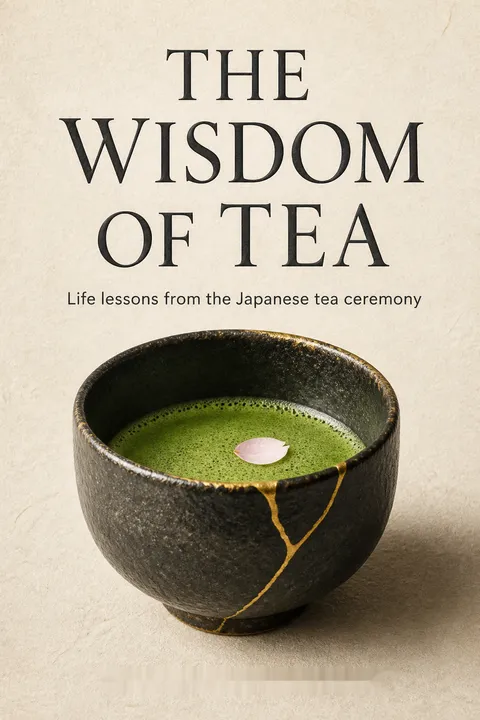
What's "The Wisdom of Tea: Life Lessons from the Japanese Tea Ceremony" about?
- Exploration of Tea Culture: The book delves into the Japanese tea ceremony, known as "Tea," exploring its cultural significance and the life lessons it imparts.
- Personal Journey: It follows Noriko Morishita's personal journey over 25 years of studying Tea, highlighting her growth and insights.
- Philosophical Insights: The narrative intertwines philosophical reflections on life, nature, and personal growth, using Tea as a metaphor.
- Cultural Practices: It provides a detailed look at the practices, rituals, and aesthetics of the Japanese tea ceremony.
Why should I read "The Wisdom of Tea"?
- Cultural Understanding: Gain a deeper understanding of Japanese culture and the philosophical underpinnings of the tea ceremony.
- Personal Growth: The book offers insights into personal development and mindfulness through the lens of Tea.
- Inspirational Journey: Follow the author's transformative journey, which may inspire readers to reflect on their own lives.
- Unique Perspective: It presents a unique perspective on finding beauty and meaning in everyday rituals.
What are the key takeaways of "The Wisdom of Tea"?
- Mindfulness and Presence: The importance of being present and mindful in everyday activities, as exemplified by the tea ceremony.
- Embracing Change: Understanding that life is a series of seasons and changes, much like the cycles in Tea.
- Personal Growth: Growth and understanding come with time and experience, not instantaneously.
- Cultural Appreciation: A deeper appreciation for the subtleties and beauty of Japanese culture and traditions.
What are the best quotes from "The Wisdom of Tea" and what do they mean?
- "Every day is a good day": This phrase encapsulates the idea of finding joy and contentment in everyday life, regardless of circumstances.
- "When it’s raining, listen to the rain": A reminder to be present and appreciate the moment, no matter the situation.
- "Things are fine as they are": Encourages acceptance and contentment with one's current state, without unnecessary comparison or dissatisfaction.
- "Live in the moment with an eye to the future": Balances the importance of being present with the need to consider future implications.
How does Noriko Morishita's journey in "The Wisdom of Tea" unfold?
- Initial Reluctance: Morishita begins her journey with skepticism and reluctance, viewing Tea as a rigid tradition.
- Gradual Awakening: Over time, she experiences moments of clarity and understanding, leading to personal growth.
- Deepening Appreciation: Her appreciation for the subtleties of Tea and its life lessons deepens as she continues her practice.
- Transformation: By the end, Morishita finds profound meaning and freedom in the practice, transforming her perspective on life.
What life lessons does Noriko Morishita learn from the Japanese tea ceremony?
- Patience and Practice: The importance of patience and repeated practice in mastering any skill or understanding.
- Embracing Simplicity: Finding beauty and meaning in simple, everyday rituals and objects.
- Connection to Nature: The tea ceremony fosters a deep connection to nature and the changing seasons.
- Acceptance and Letting Go: Learning to accept things as they are and letting go of unnecessary burdens.
How does "The Wisdom of Tea" explore the concept of mindfulness?
- Focus on the Present: The book emphasizes focusing on the present moment, a core aspect of mindfulness.
- Sensory Awareness: Encourages heightened awareness of the senses, such as the sound of water or the smell of charcoal.
- Rituals as Meditation: The repetitive and deliberate nature of Tea rituals serves as a form of meditation.
- Mindful Living: Illustrates how mindfulness can be integrated into daily life through simple practices.
What role does nature play in "The Wisdom of Tea"?
- Seasonal Awareness: The tea ceremony is deeply connected to the seasons, reflecting nature's cycles.
- Natural Elements: Tea utensils and settings often incorporate natural elements, enhancing the connection to nature.
- Symbolism: Nature is used symbolically to convey deeper philosophical insights and life lessons.
- Harmony with Nature: The practice of Tea encourages living in harmony with the natural world.
How does "The Wisdom of Tea" address the theme of personal growth?
- Long-term Commitment: Personal growth is portrayed as a long-term commitment, requiring patience and perseverance.
- Learning from Mistakes: Emphasizes learning from mistakes and the importance of humility in the learning process.
- Self-Reflection: Encourages self-reflection and introspection as part of the growth journey.
- Transformation: Illustrates how consistent practice and dedication can lead to profound personal transformation.
What is the significance of the phrase "Every day is a good day" in "The Wisdom of Tea"?
- Philosophical Core: This phrase is central to the book's philosophy, emphasizing contentment and gratitude.
- Perspective Shift: Encourages a shift in perspective to see the positive in every situation.
- Daily Practice: Reflects the idea that daily practice and mindfulness can lead to a fulfilling life.
- Universal Message: Offers a universal message of hope and positivity applicable to all aspects of life.
How does "The Wisdom of Tea" illustrate the importance of tradition?
- Cultural Heritage: Highlights the importance of preserving cultural heritage and traditions.
- Rituals and Practices: Demonstrates how rituals and practices can provide structure and meaning in life.
- Intergenerational Wisdom: Shows how traditional practices pass down wisdom from one generation to the next.
- Balance of Old and New: Encourages finding a balance between respecting tradition and embracing modernity.
What insights does "The Wisdom of Tea" offer about finding beauty in everyday life?
- Attention to Detail: Encourages noticing and appreciating the small details in everyday life.
- Simple Pleasures: Highlights the beauty in simple pleasures, such as a well-made cup of tea or a blooming flower.
- Aesthetic Appreciation: Cultivates an appreciation for aesthetics and the art of living.
- Mindful Observation: Teaches the value of mindful observation and being present to fully experience life's beauty.
Download PDF
Download EPUB
.epub digital book format is ideal for reading ebooks on phones, tablets, and e-readers.








