

Key Takeaways
Read this as a comedy of historical certainty, not a trustworthy textbook.
The narrator is the joke. Philomena Cunk presents a sweeping world history in the voice of an assured television documentarian, while repeatedly getting basic facts, names, and cause-and-effect wrong on purpose. The humor comes from the gap between her confidence and her understanding, not from a new historical theory. Her account of the earliest societies, for instance, turns farming, writing, and ancient monuments into absurdly literal misunderstandings.
The book knows its limits. Cunk admits that the supposedly complete history is short, shaped by her British television work, and aimed largely at English-speaking readers. That self-mockery is part of the point: a grand story of everything is always being selected, simplified, and told from somewhere.
What's striking is how the joke targets not only ignorance, but the polished authority that can make ignorance sound like expertise. That makes the book a useful prompt to ask who is speaking, what they leave out, and how certainty is being performed. Its limitation is equally important: because comic errors are woven into real events, a reader could mistake parody for information. The satire works best when the reader recognizes the mechanism and checks historical claims elsewhere, rather than treating every punchline as a correction.
Civilization begins when survival leaves room for records, trade, and specialists.
Surplus changes daily life. The book traces a comic path from mobile hunter-gatherers to farming communities that can stay put. Agriculture, as the story presents it, creates room for settled homes, towns, and people who can develop skills beyond finding the next meal. The narrator treats farming as a convenience upgrade, but the underlying point is that food production reshapes how people organize work and live together.
Tools connect communities. In the account of Sumer, bricks make more durable buildings, wheels help move goods, and coins make exchange easier than swapping awkward loads of animals or pottery. The abacus helps count wealth and taxes; writing allows records to persist beyond memory. These inventions make a society more capable of coordinating people, goods, and obligations.
The sequence links material conditions to institutions: reliable food supports settlement, while trade and recordkeeping make larger systems manageable. That is a helpful corrective to histories focused only on rulers and battles. The underlying pattern resembles the study of organizations, where shared records and standards let people coordinate beyond personal relationships. Still, this is a comicly compressed route, not a universal timetable. Farming did not produce one inevitable kind of civilization, and technological change can bring new dependencies as well as new capacities.
Every history has a map-shaped blind spot.
The book admits its lens. Cunk says her account is disproportionately British and European, despite presenting itself as world history. The imbalance becomes part of the satire: non-European societies are sometimes treated as late additions to a story that has already spent considerable time on Europe. The text mentions Chinese contributions such as paper and printing, and acknowledges that historical life continued beyond Europe during the period commonly called the Dark Ages. It also rushes past Islam while joking about its own lack of coverage.
Omission shapes importance. A reader can see how language, audience, and familiar school narratives influence which places receive detail and which become brief asides. The book’s self-awareness makes the bias visible, even when the treatment of those histories remains shallow.
This section invites a useful distinction between a history that includes the whole globe and one that merely names places outside Europe. Historians depend on sources, institutions, and categories that can make some experiences easier to recover than others. The book exposes that problem through self-parody, but exposure is not repair: a joke about an omission does not supply the missing context. Readers can use the admission as a cue to seek accounts built from the histories and perspectives that this narrator leaves at the margins.
A technology can multiply knowledge, propaganda, and power at once.
Printing changes who can speak. The printing press is presented as a turning point because it makes written material reproducible instead of dependent on laborious hand-copying. Ancient Greek ideas can circulate again, helping nourish Renaissance learning; pamphlets can also spread claims to people beyond a small circle of readers. The book compares this shift with the internet, where access and speed expand while reliable information becomes harder to distinguish from falsehood.
Reach is not wisdom. The same broad communication channels that circulate science, art, or political arguments can also amplify manipulation. In the modern chapters, social platforms connect people while intensifying rumor and conflict. The recurring lesson is not that a medium is inherently good or bad, but that the ability to distribute a message does not establish its truth.
The connection between print and digital media is one of the book's clearest organizing ideas. Communication technologies alter the scale of public debate, but they do not remove the need for judgment, trust, or institutions that test claims. Media research often distinguishes access to information from the ability to evaluate it, and the book's comedy makes that gap memorable. Its analogy has limits, since different media have different economics and forms of gatekeeping, but the central question travels well: who gains reach, and who checks the message?
Do not confuse cultural brilliance with political inclusion.
Big ideas can have small boundaries. The ancient Greeks are credited with philosophy, theatre, mathematics, sport, and democracy. Yet the book points out that Greek democracy excluded women, enslaved people, and foreigners. Its polished cultural legacy therefore coexists with a narrow definition of who counted as a citizen.
Freedom can conceal coercion. The same tension appears in later chapters. The American colonies declare independence while slavery persists; European powers celebrate exploration while seizing land and resources; Britain's imperial story presents rule over India as benevolent administration even as wealth flows outward. The comic framing draws attention to the recurring mismatch between the language of liberty or improvement and the people denied its benefits.
The contrast is a strong way to examine political ideals without treating them as self-executing. A society can invent democratic institutions and still draw its membership boundaries unjustly. That distinction remains useful today: formal rights, actual access, and social power are related but not identical. The book's satirical shorthand makes hypocrisy easy to spot, although compressed jokes can flatten differences among ancient citizenship, slavery, and modern colonial rule. Taking the comparison seriously means preserving those distinctions while still asking who is included in a society's promise.
Treat technological progress as a bargain with visible costs.
New power brings new burdens. The Industrial Revolution replaces much animal and human labor with steam-powered factories and transport, but the book also describes workers enduring long hours, dangerous conditions, and crowded urban poverty. Later inventions make communication and travel faster, yet the same technologies help turn regional conflicts into world wars. The twentieth century's machinery can move goods and people, but it can also deliver destruction on a vast scale.
Modern convenience has a bill. The chapters on computers, global trade, and climate change connect everyday technology and energy use to environmental harm. The narrator jokes about the devices people rely on, but the serious thread is that a tool's benefits do not erase its costs. Progress is not simply a parade of better gadgets.
The book's timeline resists the idea that invention automatically equals improvement. A technology redistributes labor, risk, and power; its benefits may reach consumers while its costs fall on workers or the environment. This resembles the broader idea of externalities, where a product's price fails to include all the harm associated with making or using it. The caution is not to treat every innovation as a net loss. A fuller assessment asks what problem it solves, who benefits, who bears the cost, and whether that cost can be reduced.
Ask who profits when empire calls conquest a gift.
The book turns imperial pride inside out. Britain's expansion is described through trade, settlement, and the seizure of territory, including the East India Company's growth from a trading concern into a force that governed India. The text mocks the later presentation of railways and other infrastructure as generous gifts, since those projects existed alongside extraction and political control.
The label matters. Calling an empire a company, a civilizing mission, or a beneficial partnership can soften the reality of who holds power. The narrator's British perspective is especially revealing here: the country's self-image as helpful and exceptional sits beside a record of taking resources and imposing rule. The joke works by making that contradiction difficult to ignore.
This is satire aimed at the language that makes domination sound administrative or benevolent. In political analysis, infrastructure can deliver real public value while also serving the strategic and economic interests of those who build it. Those facts are not mutually exclusive. The important question is who decided what to build, who controlled the resources, and who received the gains. The book's mockery challenges imperial nostalgia, though its quick treatment cannot substitute for the specific histories of the people and regions under colonial rule.
Treat current events as unfinished history, not settled hindsight.
Distance changes the story. Near the end, the narrator observes that events still unfolding are difficult to rank: the present offers no reliable view of which moments will matter most to future readers. The book was written in 2024 and openly worries that elections, wars, and new developments may make its final pages outdated before publication.
Media complicates the record. The recent chapters describe smartphones and social platforms as forces that shape attention, political division, and the circulation of claims. A person can experience an event directly, encounter it through a feed, and receive conflicting accounts of what it means. The book's uncertainty is comic, but its point is serious: the news has not yet become a stable narrative.
This is a reminder that historical significance is not obvious at the moment of an event. Contemporary observers have proximity but lack the hindsight that reveals consequences, connections, or forgotten alternatives. Digital archives preserve enormous amounts of material, yet abundance does not settle interpretation; attention and selection still determine what becomes visible. The book's self-conscious uncertainty is refreshing, though its own contemporary judgments remain shaped by the same limits it describes. Readers can treat current accounts as provisional evidence rather than final verdicts.
Ask what a grand history sells, especially when it ends with a printer.
The ending punctures the epic. After tracing human life from early societies to modern politics, the book concludes by presenting a multifunction printer as humanity's greatest achievement. The sudden turn from civilization-wide questions to product promotion makes the ending a parody of both grand historical conclusions and advertising copy.
The sales pitch completes the joke. The device is described in the language of a polished commercial, down to its functions and convenience. That is not a historical explanation of human progress; it exposes how easily a story about everything can become a platform for selling something. The final gag also points back to the book's own commercial form: a published, illustrated history is itself a product competing for readers' attention.
The ending is more than a random joke. It collapses the lofty language of human destiny into ordinary consumer desire, inviting scrutiny of who benefits when history is packaged as a single triumphant story. Advertising often borrows the rhetoric of innovation and progress, making products feel like the next stage of civilization. The printer makes that move visible by exaggerating it. The satire should not be mistaken for a claim that commerce explains all culture; its sharper point is that even accounts of humanity can be shaped by the incentives of the marketplace.
Analysis
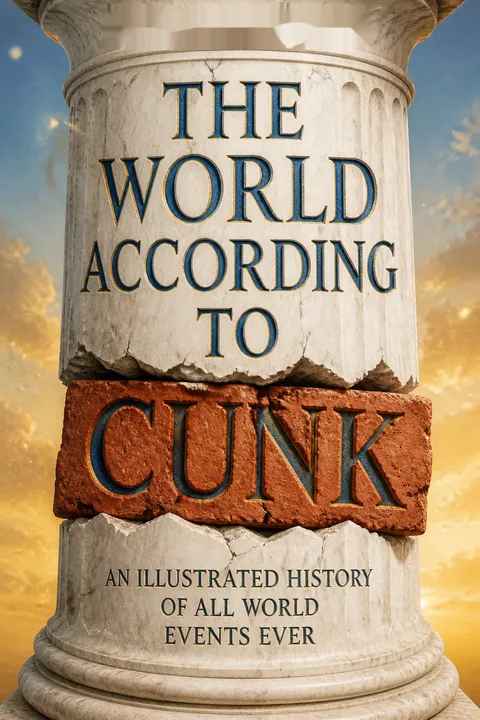
The World According to Cunk is a parody of the all-encompassing history book. Its central device is a narrator who speaks with documentary confidence while misreading events, terms, and causal relationships. That mismatch turns historical authority into comedy. The book is not primarily offering a competing account of the past; it is exposing how easily a smooth narrative can disguise gaps, bias, and simplification.
Its ten-part chronology supplies an accessible route through familiar milestones: agriculture and early cities, classical societies, religious change, the Renaissance, revolution, industrialization, world wars, and the digital present. Across that route, recurring concerns emerge beneath the jokes. Technologies reorganize society and communication, but also create new forms of risk. Democratic ideals coexist with exclusion. Empires describe extraction as improvement. Historical memory is shaped by the storyteller's national perspective, available media, and commercial audience.
The book is especially alert to its own limitations. The narrator flags the British and English-speaking emphasis, admits that modern events are hard to judge while they are happening, and ends by replacing a grand answer about humanity with an absurd product pitch. These gestures make the book's form part of its argument: no history is simply the past itself. It is a selection, arrangement, and interpretation of evidence.
That self-awareness does not make the book a reliable reference. Deliberate factual distortions sit beside real names and events, and jokes can blur distinctions among very different histories. The treatment of serious matters, including slavery, colonial rule, war, and religious conflict, is often compressed for comic effect. The best use of the book is therefore as a lively introduction to questions about historical storytelling, not as a substitute for factual study. Its lasting value lies in training readers to notice the voice behind a sweeping claim, the people left outside its frame, and the interests served by a story of inevitable progress.
Review Summary
The World According to Cunk received mixed reviews, with an average rating of 3.95 out of 5. Readers praised its humor, particularly in the audiobook version narrated by Diane Morgan. Many found it laugh-out-loud funny, appreciating Cunk's unique perspective on history. Some felt the book was less engaging than the TV series and that the humor became repetitive. Critics noted that the modern history sections were weaker, and the book's relentless sarcasm could be tiring. Overall, fans of Cunk's character enjoyed the book's irreverent take on world history.
People Also Read
Glossary
Immersive History
Suggested historical activitiesA recurring feature in which the narrator proposes projects, discussions, outings, or exercises connected to the period being discussed. The activities parody educational engagement while extending the book's comic voice, often asking readers to perform an impossible, absurd, or impractical version of historical life.
Aggroculture
Comic name for farmingThe book's deliberately mangled name for agriculture, introduced in its account of the shift from mobile foraging to settled food production. It signals the narrator's pattern of treating major historical developments with confident but foolish explanations. The underlying subject is the cultivation of crops and domestication of animals.
Dark Ages
Contested label for medieval EuropeA traditional label for a period of European history after the Western Roman Empire and before the Renaissance. The book first mocks the term as a period supposedly hidden by literal darkness, then notes that historians dispute its usefulness because it can wrongly imply that learning and cultural activity disappeared. It also satirizes the Europe-centered use of the label.
Humanism
Focus on human learning and cultureIn the book's Renaissance account, Humanism describes renewed attention to human life, art, music, science, and classical learning. The recovery and circulation of ancient ideas help artists and thinkers explore subjects beyond the dominant religious texts. The narrator treats the movement irreverently, but it marks a change in European intellectual and artistic interests.
Manifest Destiny
Claim of a divinely destined expansionA phrase associated with the nineteenth-century belief that the United States was destined to expand across North America. The book presents it satirically as a religious justification for settlers taking land already inhabited by Native peoples. The term helps frame the westward movement as both a national story of expansion and a history of dispossession.
American Dream
Promise of success through opportunityThe book's name for the belief that people arriving in the United States can rise from humble beginnings through effort and opportunity. It treats the idea as a powerful national invention while joking about its promise and contradictions. The concept connects immigration, ambition, economic growth, and the unequal distribution of wealth.
Globalisation
Worldwide links in trade and financeThe growing connection of economies and businesses across national borders, enabled in the book's account by computers and the internet. People and corporations can trade and move financial information across the world more easily. The text emphasizes that this interconnected system can generate wealth while leaving poor people outside its rewards and exposing economies to shared crises.
Culture wars
Conflict over social valuesThe book's label for contemporary political and social conflict between people described as woke and anti-woke. It portrays arguments over language, offense, identity, and social norms as a new kind of public struggle, intensified by smartphones and social media. The treatment is deliberately provocative rather than a neutral definition of every dispute grouped under the term.
Download PDF
Download EPUB
.epub digital book format is ideal for reading ebooks on phones, tablets, and e-readers.








