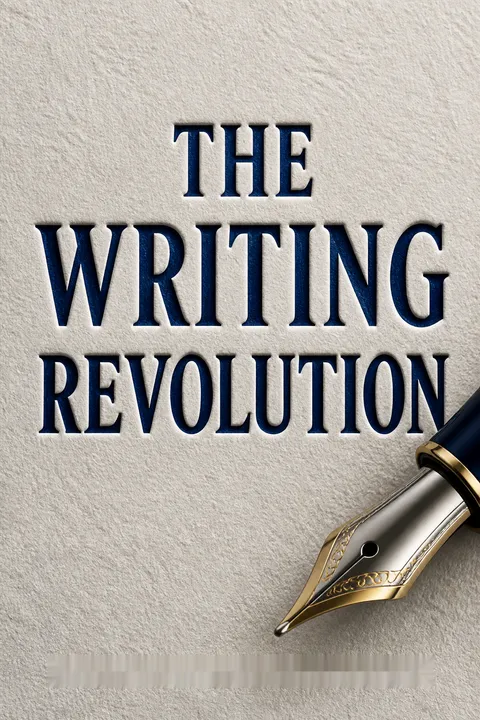


Key Takeaways
Teach writing explicitly, beginning with the sentences students cannot yet control.
Start with what is missing. Monica arrived at New Dorp High School unable to turn her ideas into a coherent essay. Asked to write about Alexander the Great, she managed six simple sentences, one unclear. The problem, the authors argue, was not that Monica lacked ideas. She had not been taught the steps that make ideas readable: building sentences, organizing points, and revising drafts.
Small skills, large stakes. At New Dorp, writing instruction appeared across subjects. The English Regents pass rate rose from 67% to 89%, while the graduation rate climbed from 63% to nearly 80%. By senior year, Monica wrote essays and scored above the exam threshold for college-level work. The method begins with instruction and practice, not the hope that students will absorb writing by reading or by being assigned essays.
The shift from evaluating students' written products to teaching the process behind them changes the diagnosis of failure. A weak essay may reflect an untaught skill, not a lack of effort or intelligence. New Dorp's gains make the case compelling, though schoolwide results cannot isolate writing instruction from every other influence on achievement. The useful lesson is therefore practical rather than triumphalist: identify a specific bottleneck, teach it, and look for evidence that students can use it independently.
Use sentence structure to teach students how ideas relate.
Syntax carries logic. Students need more than correct grammar. They need sentence structures that show whether ideas explain, contrast with, or depend on one another. The authors use short, focused exercises: students complete a sentence in different ways using because, but, or so; begin a sentence with a word such as although; add an appositive, a noun phrase that renames or explains another noun; or combine several short sentences into one.
Practice both directions. When students learn to construct these relationships, they have more ways to express complex thinking. They also encounter similar structures in textbooks and other challenging reading. Teachers introduce examples, model the task, practice it orally with students, then ask students to write. Grammar is taught through making and improving sentences, rather than mainly through isolated rule memorization.
This approach treats grammar as a way to make meaning visible. A contrast marker does intellectual work: it tells readers that the second idea qualifies the first. That makes sentence practice relevant to both composition and close reading. Still, syntactic complexity is not the same as strong reasoning. A polished sentence can connect claims that are poorly supported. The best instruction pairs language choices with questions about whether the content and evidence justify the relationship being expressed.
Put writing inside the subject matter, where knowledge gives it rigor.
Content makes practice meaningful. The Writing Revolution, or TWR, embeds writing instruction in the material students are already studying. A science class might explain how two processes are alike and different; a history class might connect a leader's popularity to both its causes and its critics. The sentence activity stays manageable, but the subject matter determines how much knowledge and reasoning it requires.
Use writing to teach. A brief response can show whether students understand a lesson before misconceptions become harder to address. Writing also asks students to retrieve information, choose relevant details, and put ideas into their own words. The authors recommend regular short activities, often just 5 to 15 minutes, across subjects. Because skills practiced on unrelated topics may not transfer automatically, students need repeated practice using writing strategies with the knowledge they are expected to learn.
The model makes writing part of learning rather than a separate performance added after learning. Its reciprocal logic matters: subject knowledge improves what students can write, while writing forces them to organize and retrieve that knowledge. It also gives teachers a window into misunderstandings. The challenge is coordination. If each subject uses different expectations for evidence, vocabulary, and feedback, students may experience the approach as a pile of disconnected tasks rather than a shared way to think.
Make students distill information before asking them to explain it.
Move from notes to prose. Sentence expansion starts with a kernel sentence, a short, complete sentence that students make more informative by answering selected questions such as who, when, where, why, or how. Students first record brief notes, then use them to build a complete sentence. This teaches them to anticipate what a reader needs to understand, while giving teachers a check on comprehension.
Alia learns to fill the gaps. In an Animal Farm assignment, Alia wrote that a meeting had been called, assuming her teacher already knew who called it and why. With prompts for the missing details, she could turn a vague statement into an explanation identifying Old Major, the farm, the timing, and his purpose. TWR also teaches students to reduce reading into key words, abbreviations, and symbols, then reconstruct meaning instead of copying whole passages.
The movement between compressed notes and full sentences makes students perform two different intellectual acts: selecting what matters, then explaining it to someone who lacks their context. That is a useful antidote to both copying and cryptic shorthand. The book also describes research favoring handwritten notes for conceptual questions, because note-takers must select information rather than transcribe it. That finding should not become a blanket ban on digital notes; the deeper principle is active selection, regardless of tool.
Plan paragraphs before drafting to prevent drift, gaps, and repetition.
Give ideas a route. Writing a paragraph requires students to manage content, sentence mechanics, audience, and organization at the same time. Planning reduces this load. TWR's Single-Paragraph Outline, or SPO, is a simple plan with a complete topic sentence, notes for supporting details, and a concluding sentence. Students identify the topic, purpose, and audience, then select relevant details and arrange them logically before drafting.
Ben's detour becomes avoidable. Writing about monarch butterflies, Ben wandered into a personal trip, repeated himself, and introduced spiders. A plan could have helped him decide which facts supported his main point before investing effort in a draft. Students can brainstorm details, group related ones, discard irrelevant material, and sequence what remains. For a narrative, sequence may be chronological; for an opinion paragraph, the strongest reason can come last.
The outline is not clerical preparation. It is where a writer decides what the piece is actually about and what the reader needs next. That makes planning a visible form of reasoning, and it gives teachers a chance to catch a weak or unsupported main idea before a student builds a page around it. Templates can become mechanical if treated as permanent rules. Their value lies in providing temporary structure that students can use while learning to make those decisions.
Teach argument by having students represent both sides before choosing one.
Build toward judgment. The authors distinguish opinion writing, which gives a position and reasons, from pro-con writing, which presents evidence on both sides without choosing, and argumentative writing, which evaluates the evidence and defends the stronger position. Practicing these forms in sequence gives students a chance to learn each demand separately, including how to represent a view they do not personally share.
Make the case, not just the claim. A full argumentative essay asks students to state a thesis, explain relevant background, present the opposing case fairly, and support their own position with evidence. They need to judge which evidence is strongest, use transitions to signal contrast, and introduce quotations with context and explanation. David's Industrial Revolution essay faltered because facts about child labor undermined his claim that industrialization was positive, while his quotation showed change but not whether it was beneficial.
Separating the counterargument from the writer's own case can help students avoid confusing, stop-start paragraphs. More importantly, representing both sides before taking a position makes fairness part of the writing process, not a decorative gesture. The method depends on students having enough reliable material to weigh. Without that foundation, an apparent debate can become an exercise in arranging sentences around predetermined conclusions. The teacher's selection of sources and the class's scrutiny of evidence are therefore central to the quality of the argument.
Revise meaning and flow before correcting commas and spelling.
Change the substance first. Revising improves the content, organization, sentence structure, and word choice of a draft. Editing corrects mechanics such as spelling, punctuation, and capitalization. Since revision may replace or rearrange sentences, it should come before detailed editing. Students can practice first on an unelaborated paragraph: a short, mechanically correct passage that needs more detail, variety, or coherence. This lets them focus on improving the writing without feeling protective of their own draft.
Give actionable feedback. Students can expand sentences, combine ideas, choose more precise words, and add transitions that show how one point relates to another. Quotations need the same care: identify the speaker, clarify the quotation's meaning, and explain how it supports the writer's point. Teachers should name a specific next move instead of asking students vaguely to make a paragraph better. Transitions help, but students should not force one into every sentence.
The distinction gives students a workable order for a task that otherwise feels like fixing everything at once. It also makes teacher feedback teachable: a precise cue points toward a move the student has already practiced. The unelaborated paragraph is a particularly useful bridge between demonstration and independent work. One risk is that revision can shrink into a checklist of visible devices. The goal is not simply more transitions or longer sentences, but clearer relationships and more useful information for the reader.
Treat summaries as demanding acts of judgment, not shortened retellings.
Choose what survives. A summary is a concise account of a text's main points, not a miniature retelling of every event. Students must distinguish central ideas from incidental details, paraphrase accurately, and decide how much information their audience needs. The authors connect summarizing to sentence expansion and outlining because all three require students to identify what matters and how supporting details fit together.
Scale the task. Students can begin with a Summary Sentence, a single sentence built from key questions about a text. Those ready for more can organize the summary in an SPO. The Combined Outline joins a one-sentence summary with additional supporting details and a concluding point about the text's importance. In a college psychology course cited in the book, students who wrote summaries of key ideas in their own words performed better on related exam questions than when they copied prepared material.
Summarizing is difficult precisely because it looks simple from the outside. A short account can conceal careful decisions about importance, scope, and fidelity. The graduated formats give teachers ways to adjust the challenge without abandoning the underlying goal of selecting and organizing ideas. A summary is also purpose-dependent: a study aid may need details that a headline does not. Making audience and purpose explicit helps prevent brevity from becoming omission.
Assess writing repeatedly, then adjust the scaffolds instead of labeling students.
Measure what instruction targets. TWR recommends independent writing samples at the beginning, middle, and end of the school year, alongside diagnostic checks of particular strategies two or three times a year. Student portfolios make change visible; a first-grade student's September and May samples, for example, showed growth in sentence boundaries, detail, and paragraph structure. Assessment should guide what to teach next, not merely produce a score.
Change the support, not the destination. Students can work on the same material and strategy with different amounts of help. One student may receive selected question prompts for sentence expansion; another may supply the prompts independently. A text-based assessment can be misleading if a student cannot decode the text or lacks the background knowledge it assumes. Teachers should consider those barriers, give specific feedback, and use progress data to decide whether to reteach, extend, or modify an activity.
This approach makes assessment part of instruction rather than a final judgment about ability. Repeated samples can show whether students use a skill independently, while diagnostics reveal which component needs attention. The cautions about reading demands, handwriting, and prior knowledge are important because a writing score can reflect more than writing. Fair comparison also requires consistent prompts and clear criteria. The result is a more useful question than whether a student is good at writing: which skill is secure, and what support would make the next step possible?
Analysis
The book's central contribution is a change in what counts as writing instruction. Instead of treating writing as a product students should somehow produce, it treats writing as a set of teachable decisions: how to form a complete sentence, connect ideas, select evidence, order information, and revise for a reader. The sequence matters because each skill frees attention for more complex work. A student who is still fighting punctuation and sentence boundaries has less capacity for argument structure or audience awareness.
The method is strongest when it joins three things that schools often separate: language, subject knowledge, and formative assessment. A brief sentence about history or science is simultaneously a writing exercise, a retrieval task, and a diagnostic window into understanding. Outlines make the organization of thought visible before a student commits to a long draft. In this sense, the framework is not merely a set of writing templates. It is a way to make invisible cognitive work discussable and coachable.
Its own principles also imply limits. Templates can reduce overload, but students may mistake the scaffold for the destination. Sentence variety, transitions, and formulaic introductions are tools, not proof of insight. Content integration improves relevance, but it requires teachers to know the subject well enough to design prompts that elicit meaningful reasoning rather than shallow completion. And impressive school-level gains, such as those reported at New Dorp, establish a persuasive case for implementation, not a clean experiment isolating one cause.
The most productive reading of the book is therefore neither that every writer must follow one fixed recipe nor that explicit instruction can replace authentic composition. It argues for a disciplined apprenticeship: teach components explicitly, practice them against substantive material, give usable feedback, and gradually remove support. The destination remains independent judgment. Students should learn not only how to fill an outline, but why one detail belongs, one claim needs qualification, or one sentence leaves a reader stranded.
Review Summary
The Writing Revolution receives praise for its practical approach to teaching writing across subjects and grade levels. Reviewers appreciate the focus on sentence-level skills, explicit instruction, and scaffolding techniques. Many find the book's strategies easy to implement and effective for improving student writing. Some critics note the formulaic nature of the methods but acknowledge their usefulness for struggling writers. Teachers from various disciplines find value in the book's resources and ideas for incorporating writing into content areas.
People Also Read

Glossary
The Writing Revolution (TWR)
Explicit writing instructionA method for teaching writing through sequenced, focused practice, beginning with sentences and progressing to paragraphs, summaries, and compositions. TWR embeds instruction in the content students are studying, uses student writing to teach grammar and conventions, and emphasizes planning and revision. The strategies are adapted to students' current skills and revisited across subjects.
Hochman Method
The method behind TWRThe name originally used for the writing approach developed by Judith Hochman at Windward School. It emphasizes explicit instruction, sentence-level practice, content-based writing, and structured support for planning and revising longer work. The approach became known as The Writing Revolution as it spread to schools and teacher training.
kernel sentence
A simple complete sentenceA brief, complete sentence used as the starting point for sentence expansion. It typically has one verb and no modifiers or connecting words, so students can add information by answering prompts such as who, when, where, why, and how. A kernel sentence must express a complete thought and should not be a fragment or command.
sentence expansion
Adding essential sentence detailA writing activity in which students begin with a kernel sentence, record notes in response to selected question words, and turn those notes into a fuller sentence. The exercise helps students identify what a reader needs to know, practice written sentence structures, and demonstrate their understanding of the subject matter.
because-but-so
Three ways to extend an ideaA sentence-stem activity in which students complete the same idea using because, but, and so. Each conjunction prompts a different relationship: explanation, contrast, or consequence. The structure gives students a focused way to reason about curricular content and practice connecting ideas in complete sentences.
appositive
A phrase that renames a nounA noun or noun phrase placed beside another noun to identify or explain it more fully. In TWR activities, students use appositives to add detail and precision within a sentence. An appositive can usually be removed without making the main sentence grammatically incomplete; the method distinguishes it from a clause containing a verb.
Single-Paragraph Outline (SPO)
A plan for one paragraphA compact outline for planning a unified paragraph. It includes a complete topic sentence, notes for supporting details, and a concluding sentence. Students use the outline to select relevant information, organize it, and avoid repetition or digression before drafting. Notes are written as key words and phrases rather than complete sentences.
Multiple-Paragraph Outline (MPO)
A plan for an essayAn outline used to organize a composition of three or more paragraphs. It records the main idea and supporting details for each paragraph, usually as notes. For more advanced students, it also includes a thesis statement and planning for the introduction and conclusion. Its structure varies to fit genres such as biography, comparison, problem-solution, and argument.
Transition Outline (TO)
A bridge to essay planningAn intermediate planning format for students who can use a Single-Paragraph Outline but need more guidance before an MPO. It asks students to write a topic sentence for each paragraph and a concluding sentence for the composition. Unlike the more advanced MPO, it does not require a thesis statement.
GST formula
A structure for introductionsA planning structure for an introductory paragraph: a general statement introduces a broad idea, a specific statement narrows the focus, and a thesis statement presents the composition's main theme. Students reverse the order in a conclusion, rephrasing the thesis before adding specific and general closing statements.
Combined Outline
A summary plus supporting notesA challenging summary format that combines a one-sentence summary with the planning structure of an SPO. Students state the text's main idea, add distinct supporting details in note form, and write a concluding sentence that explains the text's importance. It is intended for more advanced students who can already summarize and outline.
unelaborated paragraph
A plain paragraph for revisionA short paragraph of related, simple sentences that contains no mechanical errors but needs stronger detail, sentence variety, or flow. Students practice revising this borrowed text before revising their own work. Teachers may first provide explicit revision directions, then gradually ask students to identify improvements independently.
FAQ
What is The Writing Revolution by Judith C. Hochman about?
- Evidence-based writing method: The book introduces a clear, structured, and research-backed approach to teaching writing that can be applied across all subjects and grade levels.
- Writing as a thinking tool: It emphasizes that writing instruction not only improves writing skills but also enhances reading comprehension, speaking, and critical thinking.
- Sentence-level foundation: The method starts with explicit instruction at the sentence level, building up to paragraphs and full compositions.
- Proven classroom impact: Developed over 25 years, the Hochman Method has shown dramatic improvements in student outcomes, especially in low-performing schools.
Why should educators read The Writing Revolution by Judith C. Hochman?
- Addresses instructional gaps: Many schools assign writing but do not teach it explicitly; this book provides practical, step-by-step solutions.
- Boosts multiple skills: The method improves students’ writing, reading comprehension, oral expression, and analytical thinking.
- Applicable across curriculum: Strategies are designed to be embedded in any subject, making writing instruction relevant and rigorous.
- Supports all learners: The approach is especially effective for struggling writers and English language learners.
What are the key takeaways from The Writing Revolution by Judith C. Hochman?
- Explicit, early instruction: Writing must be taught directly from early grades, not left to develop through reading alone.
- Sentences as building blocks: Mastery of sentence construction is essential before moving to more complex writing.
- Content-driven rigor: Embedding writing in content instruction deepens learning and makes grammar instruction more meaningful.
- Planning and revising focus: The most important phases of writing are planning and revising, which require explicit teaching and practice.
What are the six core principles of the Hochman Method in The Writing Revolution?
- Explicit instruction from the start: Students need direct writing instruction beginning in elementary school.
- Sentence mastery first: Sentences are the foundation; students must master them before paragraphs and essays.
- Content integration: Writing should be taught within the context of curriculum content for rigor and relevance.
- Emphasis on planning and revising: These phases are prioritized over drafting and editing for deeper thinking and clarity.
- Grammar in context: Grammar is best taught through students’ own writing, not in isolation.
- Collaboration and consistency: Multiple teachers using the method together achieve the best results.
How does The Writing Revolution by Judith C. Hochman approach sentence instruction?
- Correctness and variety: Students learn to identify and correct fragments, run-ons, and use different sentence types.
- Sentence expansion: Instruction includes expanding simple sentences with conjunctions, appositives, and subordinate clauses.
- Sentence combining: Students practice combining short sentences into longer, more complex ones to build fluency and flexibility.
- Embedded grammar: Grammar and conventions are taught through sentence-level activities, not as separate lessons.
What is sentence expansion in The Writing Revolution and why is it important?
- Anticipating reader needs: Students learn to add necessary information so their writing is clear to unfamiliar readers.
- Using question words: Expansion is taught by answering who, what, when, where, why, and how to enrich kernel sentences.
- Supports note-taking: Sentence expansion is linked to note-taking skills, helping students convert notes into complete sentences.
- Builds complexity: Gradually increases sentence complexity, supporting comprehension and retention.
How does The Writing Revolution by Judith C. Hochman teach planning and outlining?
- Stepwise writing process: Writing is broken into planning/outlining, drafting, revising, and editing, with most time spent on planning and revising.
- Single-Paragraph Outline (SPO): Students use SPOs to organize topic sentences, supporting details, and conclusions for coherent paragraphs.
- Multiple-Paragraph Outline (MPO): For longer compositions, MPOs help students plan introductions, thesis statements, main ideas, and conclusions.
- Scaffolding and modeling: Teachers model outline creation before expecting independent student work.
What is the Single-Paragraph Outline (SPO) in The Writing Revolution and how is it used?
- Paragraph planning tool: The SPO helps students organize a paragraph with a topic sentence, supporting details (as key words), and a concluding sentence.
- Focus on coherence: Encourages logical sequencing and unity within a paragraph.
- Supports note-taking: Teaches concise note-taking and the use of abbreviations and symbols.
- Versatile application: Can be adapted for narrative, compare-contrast, problem-solution, and opinion paragraphs.
What is the Multiple-Paragraph Outline (MPO) in The Writing Revolution and how does it support essay writing?
- Essay organization tool: The MPO extends the SPO to plan multi-paragraph essays, including introduction, thesis, main ideas, supporting details, and conclusion.
- Promotes logical structure: Helps students avoid repetition and irrelevant information, and plan transitions between paragraphs.
- Supports various essay types: Adaptable for expository, narrative, argumentative, pro-con, and biographical essays.
- Differentiation: Includes intermediate steps like the Transition Outline for students needing more support.
How does The Writing Revolution by Judith C. Hochman teach the use of transitions in writing?
- Five transition categories: Time-and-sequence, conclusion, illustration, change-of-direction, and emphasis transitions are introduced.
- Building coherence: Transitions help link sentences and paragraphs, making writing smoother and easier to follow.
- Progressive instruction: Taught first at the sentence level, then applied to paragraphs and full compositions.
- Practical activities: Includes word banks, fill-in-the-blank exercises, and modeling to build familiarity.
How does The Writing Revolution by Judith C. Hochman guide students in incorporating quotations effectively?
- Selecting relevant quotes: Students are taught to choose concise, striking quotations that directly support their points.
- Quotation sandwich method: Quotes are introduced, presented, and then explained to provide context and meaning.
- Paraphrasing and explanation: Students practice paraphrasing and explaining quotations to reinforce understanding.
- Argumentative writing focus: Proper use of quotations is emphasized in opinion and argumentative essays.
How does The Writing Revolution by Judith C. Hochman recommend assessing student writing?
- Multiple assessment types: Includes independent writing samples, diagnostic worksheets, and strategy-specific assessments.
- Rubrics and checklists: Tools like the Single Paragraph Checklist and Independent Writing Rubric help evaluate structure, coherence, and mechanics.
- Progress tracking: The Independent Writing Tracker monitors individual and class growth over time.
- Differentiation and feedback: Frequent assessment identifies struggling students and guides differentiated instruction, with brief, focused feedback preferred over extensive comments.
About the Author
Other books by Judith C. Hochman
Download PDF
Download EPUB
.epub digital book format is ideal for reading ebooks on phones, tablets, and e-readers.








