

Key Takeaways
Treat Torah as a doorway into divine life, not a closed record.
A text with inner rooms. The Zohar is a running commentary on the Torah, but its rabbis treat each verse as a threshold. A word, spelling, or echo elsewhere in scripture can disclose a hidden dimension. Abraham’s command to leave home, for example, can also become a call to search within oneself. The opening of Genesis describes not only the physical world’s beginning, but the emergence of divine powers.
Interpretation is the practice. Midrash, a Jewish mode of scriptural inquiry, links verses and generates fresh readings. The Zohar does not simply explain the Bible. It invites readers to enter the divine reality it finds within the text, while leaving many meanings open to exploration.
What's striking is that interpretation is not a decorative layer added to scripture. It is the means by which scripture becomes active in the reader's world. This resembles close reading of poetry, where sound, ambiguity, and allusion produce meaning rather than merely convey it. The method rewards patience and imaginative attention. Its risk is equally clear: because a word can support several readings, interpretation needs discipline, not just ingenuity.
See the ten sefirot as one divine life unfolding through distinct powers.
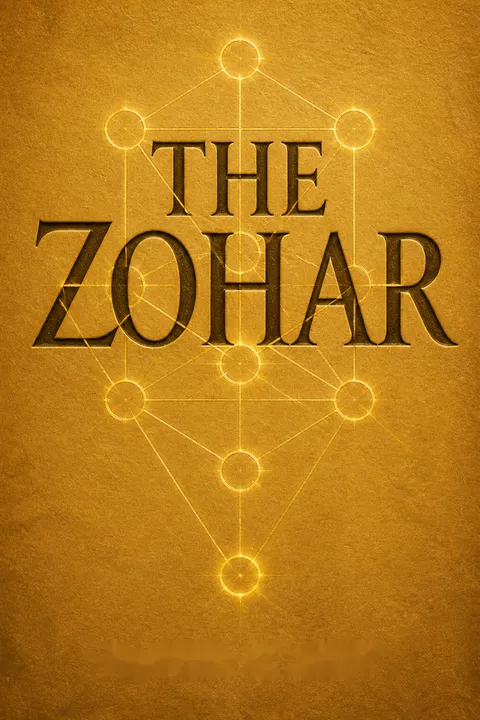
One source, many expressions. Ein Sof means the limitless divine source, beyond description or comprehension. From it emanate the ten sefirot, the interrelated aspects through which divinity becomes knowable and creation unfolds. The first movements are Keter, or Crown; Ḥokhmah, Wisdom; and Binah, Understanding. The lower seven express divine qualities and transmit life to the worlds.
Not separate gods. The sefirot are a dynamic unity, not independent deities. Shekhinah, the indwelling Divine Presence and final sefirah, receives the flow from above and sustains the worlds below. The Zohar's creation story is therefore also a map of divine life: the hidden source becomes a network of relationships, without ceasing to be one.
This model makes transcendence and intimacy coexist. The divine source remains beyond language, yet its qualities become present through relationships, much as a person is known through actions without being exhausted by them. That is a powerful alternative to imagining God as either a distant abstraction or a single humanlike figure. The tension is productive, though readers should distinguish symbolic plurality from literal multiplicity, a boundary the imagery deliberately blurs.
Balance divine love with judgment before either becomes destructive.
Opposing powers need each other. Ḥesed means loving-kindness and overflowing generosity; Gevurah means power and judgment, the force that limits and measures. Tif’eret, associated with compassion and beauty, integrates them. The Zohar reads the second day of Creation, when waters are separated and the text does not say that creation was good, as a picture of conflict. The third day restores balance.
Evil grows from imbalance. The demonic Other Side is not an independent rival to God. The Zohar traces it to judgment hardened against love, then strengthened by human wrongdoing. Its account of Korah contrasts a destructive refusal to reconcile with the disputes of Hillel and Shammai, which it portrays as capable of serving a larger harmony.
The framework treats justice as necessary but dangerous when it loses compassion. That distinction is useful in ethics and politics: rules protect people, yet rigid enforcement can become cruelty. The Zohar's more startling move is to place the origin of evil within divine imbalance rather than outside the sacred order. This deepens the problem of responsibility, however. A cosmic explanation should not become a simple claim that sufferers caused their own misfortune.
Let prayer, justice, and care for the poor repair more than private souls.
Human acts reach beyond the human. In the Zohar, prayer, commandments, and ethical conduct affect the relations among the sefirot. The kabbalist does not merely ask for blessing; through worship, the person helps prepare the divine couple's reunion. The text even portrays generosity to the poor as giving God a share in festive joy. Without that care, the Accuser can disrupt the celebration.
Ritual has cosmic weight. Sabbath observance, prayer, and offerings are described as helping restore Shekhinah and keep the flow of blessing moving. These acts connect daily behavior with the structure of the world. The claim is larger than private spirituality: human conduct either supports harmony or feeds forces that unsettle it.
This view refuses to separate ethics from ritual. Feeding someone poor is not an optional supplement to worship; it is part of what makes worship whole. That link gives religious practice a public consequence and makes cosmic language answerable to human need. At the same time, describing injustice or calamity as a disruption caused by human sin can slide into blaming victims. Its strongest use is as a demand for responsibility, not a verdict on sufferers.
Study creatively, but never mistake an untested insight for sacred knowledge.
Interpretation creates worlds. The Zohar says that a genuinely new insight into Torah rises before God and can become a new heaven. Study is therefore more than collecting information: it participates in creation. The Companions make this work together, often at night, adorning the divine Bride with readings drawn from Torah, Prophets, Writings, and mystical reflection.
Invention has obligations. The same text warns that an ignorant student who teaches an idea without understanding it may distort sacred teaching and empower destructive forces. Innovation is prized, but it should grow from careful study and reliable transmission. The message is not to avoid fresh thought; it is to recognize that a teacher's words can shape more than a private opinion.
The Zohar presents creativity as a responsibility because interpretation has consequences for a community, not just for the interpreter. This connects naturally to intellectual traditions in which claims must answer to shared standards and accumulated knowledge. Its warning about careless teaching is unusually sharp for a work that celebrates novelty. The productive tension is between fidelity and invention: preserve enough continuity to prevent fantasy from masquerading as insight, while leaving room for discovery.
Measure righteousness by whom it protects, not only whom it saves.
Noah is both model and warning. The Zohar reads Noah as a righteous man who embodies the covenant, the divine bond associated with sexual integrity and continuity of life. Noah enters the ark and survives the Flood; one passage says he warned his contemporaries for 300 years. Yet the text also faults him for protecting himself rather than pleading for the world. His righteousness saves a remnant, but does not make him an advocate for everyone.
Moses offers a contrast. When God threatens Israel after the Golden Calf, Moses argues for the people and even offers his own life. The Zohar thus distinguishes personal virtue from responsibility for others. Noah preserves life; Moses risks himself to defend a community.
The contrast shifts righteousness from a private scorecard to a question of solidarity. Noah's survival matters, but the story asks whether virtue also requires intercession for those who are failing. That question travels well beyond religious leadership: expertise and innocence are incomplete if they never become public responsibility. The Zohar's judgment of Noah is deliberately demanding, though it sits beside its recognition that he warned his generation and carried the burden of preserving life.
Question Scripture closely, but resist reducing its secrets to one answer.
Words are working parts. The Zohar builds interpretations from Hebrew and Aramaic wordplay, letter order, repetition, and links between distant verses. It can reread the opening of Genesis as divine emanation, or find a spiritual meaning in a grammatical detail. These leaps often move far from a verse's plain sense, but they are meant to expose layers rather than replace the surface story.
A principle is not the whole feast. A Zoharic parable tells of a man who eats raw wheat and claims to know every kind of bread because all are made from wheat. He understands the source but misses the distinct pleasures made from it. So, too, grasping one principle should lead to more exploration, not flatten scripture into a single explanation.
The parable captures a subtle intellectual trap: reducing a rich practice to its most abstract summary can feel like understanding while erasing what makes it meaningful. The Zohar's layered reading resists that flattening by keeping narrative, law, sound, and symbol in play at once. Its wordplay can also be difficult to verify, especially across languages. The best reading therefore holds two things together: imaginative openness and awareness of how much depends on interpretation.
Learn in company, and let an unexpected teacher unsettle your rank.
Wisdom arrives on the road. The Zohar's rabbis wander through the Galilee, discussing scripture with one another and encountering children, strangers, and donkey-drivers who reveal surprising knowledge. In one story, Rabbi El’azar and Rabbi Abba dismiss a donkey-driver's status until his teaching on the Sabbath astonishes them. They kiss him, then discover he is Rav Hamnuna Sava, a revered sage in disguise.
Questions make the group wiser. The Companions praise sharp questions, and a challenging question can earn a kiss rather than a rebuke. Their study depends on argument, affection, and shared attention. The road itself becomes a setting for Torah, suggesting that learning can happen wherever people meet with enough openness to listen.
The recurring stranger punctures the assumption that knowledge follows social rank. The story makes intellectual humility concrete: the group changes its behavior once the supposedly low-status teacher proves insightful. This is a strong model for collaborative learning, where challenge improves understanding. Yet the tale's authority still rests on recognition of a hidden sage. In ordinary life, good ideas need careful evaluation, whether or not their source is impressive.
Read the Zohar as medieval sacred invention, not an ancient transcript.
A layered book with a disputed past. The Zohar emerged in late thirteenth-century Castile, written mostly in an invented, literary form of Aramaic. Its transmitters attributed it to the second-century Rabbi Shim’on son of Yoḥai. The introduction reports that modern scholarship places Moses de León at the center of its composition or editing, while also recognizing multiple layers and possible contributors.
The text itself has a history. Daniel Matt built this translation on a critical comparison of about twenty manuscripts for the first two volumes, rather than relying only on early printed editions. The goal is to recover earlier readings and preserve the Zohar's strange, poetic language instead of smoothing its roughness into easy prose.
Historical distance does not make the text spiritually trivial; it clarifies how tradition is made and received. The ancient attribution gives the work authority within its literary world, while manuscript comparison exposes revision and collective transmission. That combination makes the Zohar a document both of mystical speculation and of medieval religious creativity. A reader can take its ideas seriously without treating its claimed antiquity as settled historical fact.
Analysis
The Zohar's deepest move is to make interpretation part of the reality it describes. Scripture does not merely report a completed creation. Read with sufficient attention, it becomes a living medium through which divine powers are disclosed, joined, or separated. This is why the book can treat a Hebrew letter, a prayer, a marriage, a sacrifice, and an act of charity as events with consequences across several levels of existence. Its world is not divided into a spiritual realm that matters and a material realm that does not. The lower world both reflects and affects the upper one.
That reciprocal structure gives the work unusual ethical force. Human conduct is not private: sexual restraint, care for the poor, study, and prayer can sustain cosmic harmony. The same idea also carries a danger. If suffering is routinely explained as the result of sin or spiritual failure, the cosmology can make victims appear responsible for their misfortune. The Zohar partly complicates that conclusion by portraying exile and separation as conditions embedded within the divine story, not merely punishments imposed on individuals.
Its gendered symbolism is similarly productive and limited. The divine couple gives intimacy and desire a central role in understanding the sacred, and Shekhinah is not simply an ornament: she receives, rules, sustains, and gives life to the worlds below. Yet her frequent portrayal as receptive, diminished, or dependent on male emanation reflects an unequal symbolic order. Modern readers can explore what the imagery reveals about dependence and mutuality without mistaking its hierarchy for a universal account of gender.
Finally, the book's literary self-presentation matters. A medieval work speaks through ancient rabbis, hidden teachers, and traveling companions, blending inherited tradition with startling invention. Its authority rests partly on that imaginative performance, while the Pritzker edition's manuscript method makes the performance historically legible. The result is best read neither as transparent revelation nor as mere forgery, but as a communal act of sacred interpretation that makes novelty feel ancient and ancient scripture feel newly alive.
Review Summary
The Zohar is praised as a profound work of Jewish mysticism, offering deep insights into Kabbalah and Torah interpretation. Readers appreciate Daniel Matt's translation for its clarity and extensive commentary. Many find it challenging but rewarding, noting its vast depth and allegorical nature. Some highlight its value for understanding metaphysical concepts and Jewish mystical tradition. While most reviewers give it high ratings, a few mention it can be difficult to read without prior knowledge of Hebrew or Torah. Overall, it's regarded as a significant scholarly achievement in making this esoteric text accessible.
Glossary
Ein Sof
Limitless divine sourceThe Zohar's name for the boundless divine reality beyond all names, qualities, and human comprehension. Ein Sof is not simply a distant creator outside the universe. Nothing can exist beyond it, and the sefirot are ways its hidden life becomes manifest. The term literally means “there is no end.”
sefirot
Divine powers in relationshipThe ten interrelated aspects of divine personality through which the unknowable source becomes manifest and sustains creation. They are not ten separate gods. The Zohar describes them through images such as light, water, trees, body parts, and masculine and feminine partners. Their relationships, rather than any one sefirah alone, form the inner life of divinity.
Shekhinah
Indwelling divine presenceThe final sefirah, also called Malkhut or the Divine Presence. She is the aspect of God most closely connected with Israel and the lower worlds, receiving the flow of emanation from above and transmitting it below. The Zohar portrays Her as both a divine female partner and a presence vulnerable to exile, separation, and restoration.
Ḥesed
Unbounded divine loveThe sefirah of loving-kindness, generosity, and overflowing grace, often associated with the right side of the divine body and with Abraham. Ḥesed gives life freely, but the Zohar presents it as needing balance from Gevurah, the force of judgment. Its flow reaches the lower worlds through the other sefirot.
Gevurah
Divine power and judgmentThe sefirah of power, restraint, and judgment, often associated with the left side of the divine body and with Isaac. Gevurah limits the limitless giving of Ḥesed, making moral boundaries possible. When judgment dominates without compassion, however, the Zohar associates it with rage and the emergence of destructive forces.
Tif’eret
Compassionate divine balanceThe sefirah that harmonizes Ḥesed and Gevurah, combining love with judgment. Often called Beauty, Compassion, or the central pillar, Tif’eret is symbolized by Jacob and by the personal God addressed in prayer. The Zohar also associates Tif’eret with Written Torah and with the masculine partner of Shekhinah.
Yesod
Channel of divine flowThe sefirah called Foundation or Righteous One. Yesod gathers the flow of the higher sefirot and conveys it to Shekhinah, sustaining the lower worlds. It is symbolized by Joseph, whose sexual restraint makes him a model of righteousness, and by the covenant of circumcision, associated with the divine phallus.
Sitra Aḥra
The demonic Other SideAn Aramaic phrase meaning “the Other Side,” used for the demonic realm that opposes or imitates the holy sefirotic order. The Zohar does not treat it as an independent power equal to God. It emerges from imbalance within the divine realm and gains strength through human wrongdoing.
devequt
Attachment to GodA Hebrew term meaning cleaving or attachment to God. In the Zohar, devequt is not only inward concentration or belief. It is an intimate, often erotic relationship pursued through Torah study, prayer, and religious practice. Human devotion can mirror the union between the divine masculine and feminine.
kavvanah
Focused mystical intentionThe inward intention directed toward the meaning of prayer or ritual. In the Zohar, kavvanah connects a human act with its symbolic and cosmic significance. Prayer performed with intention can help align the sefirot and stimulate divine union, whereas action without understanding may fail to achieve that purpose.
Midrash
Interpretive scriptural inquiryA Jewish mode of studying scripture that explores connections between verses, words, and traditions, often extending beyond a passage's plain meaning. The Zohar uses midrashic techniques to uncover mystical meanings in the Torah. Its readings can be playful and imaginative, but they are presented as disciplined engagement with an inherited text.
FAQ
1. What is The Zohar: Pritzker Edition, Vol. 1 by Daniel C. Matt about?
- Foundational Jewish Mysticism: The book is a critical translation and commentary on the Zohar, the central work of medieval Jewish mysticism (Kabbalah), focusing on the mystical interpretation of the Torah, especially Genesis.
- Mystical Commentary on Torah: It presents the Zohar’s poetic, symbolic, and esoteric readings of biblical stories, exploring the nature of God, creation, and the spiritual structure of the universe.
- Divine Emanations and Symbolism: The text delves into the sefirot (divine attributes), the interplay of male and female principles, and the cosmic drama of exile and redemption.
- Narrative Framework: The Zohar is framed as the teachings of Rabbi Shim’on bar Yoḥai and his companions, wandering in ancient Galilee and uncovering divine secrets.
2. Why should I read The Zohar: Pritzker Edition, Vol. 1 by Daniel C. Matt?
- Access to Kabbalistic Wisdom: Daniel C. Matt’s edition makes the Zohar’s complex mystical teachings accessible to English readers, with a new critical text based on reliable manuscripts.
- Comprehensive Scholarly Commentary: The translation is accompanied by extensive notes, glossaries, and references, clarifying dense symbolism and unique terminology.
- Spiritual and Intellectual Enrichment: The book bridges ancient mystical insights with modern scholarship, offering profound reflections on spirituality, ethics, and the human-divine relationship.
- Engagement with Jewish Tradition: It deepens understanding of Jewish thought, ritual, and the symbolic language of the Torah, making it valuable for scholars, students, and spiritual seekers.
3. What are the key takeaways and core concepts from The Zohar: Pritzker Edition, Vol. 1?
- Sefirot and Divine Emanations: The ten sefirot are explored as channels of divine energy, structuring both the cosmos and the human soul.
- Shekhinah and Divine Union: The union and separation of Shekhinah (Divine Presence) and Tif’eret (Beauty) symbolize cosmic harmony and spiritual exile.
- Mystical Interpretation of Scripture: Biblical stories are reinterpreted to reveal hidden spiritual dynamics, such as the role of the evil impulse, demonic forces, and the restoration of divine harmony.
- Human Role in Redemption: Human actions, especially Torah study, mitzvot, and prayer, are seen as affecting the divine realm and hastening redemption.
4. What is unique about Daniel C. Matt’s translation and commentary of The Zohar: Pritzker Edition, Vol. 1?
- Critical Textual Foundation: Matt’s translation is based on a newly constructed critical text, restoring earlier readings and removing centuries of scribal revisions.
- Literal Yet Poetic Approach: The translation preserves the Zohar’s lyrical energy, ambiguity, and mystical strangeness, while making it comprehensible to modern readers.
- Extensive Scholarly Support: The edition is supported by an academic committee and includes detailed commentary, making complex ideas accessible without oversimplification.
- Invitation to Active Engagement: Readers are encouraged to wrestle with the text’s ambiguity and multivalence, fostering ongoing discovery and spiritual growth.
5. How does The Zohar: Pritzker Edition, Vol. 1 explain the sefirot and their significance in Kabbalah?
- Ten Divine Attributes: The sefirot are ten aspects or stages of divine emanation, from the infinite Ein Sof to the manifest world, structuring both the cosmos and the inner life of God.
- Dynamic Interactions: The sefirot interact as male-female pairs, with their union and separation driving the cosmic drama of creation, exile, and redemption.
- Human and Cosmic Correspondence: The sefirot are reflected in the human soul and body, and biblical figures are mapped onto specific sefirot, illustrating their spiritual roles.
- Ethical and Spiritual Implications: Each sefirah embodies a divine quality (e.g., love, judgment, beauty), guiding human spiritual development and ethical behavior.
6. How does The Zohar: Pritzker Edition, Vol. 1 interpret the creation narrative in Genesis?
- Creation as Divine Emanation: The world is created through a process of divine emanation, with the sefirot and Hebrew letters serving as channels of creative power.
- Role of Divine Names and Speech: Creation unfolds through the utterance of divine names and the permutation of Hebrew letters, with each day of creation corresponding to specific spiritual forces.
- Primordial Light and Darkness: The text discusses the primordial light, its concealment, and the interplay of light and darkness, male and female, in the formation of the world.
- Sabbath as Consummation: The Sabbath represents the completion and sanctification of creation, symbolizing the union of divine attributes and the restoration of harmony.
7. What is the role and symbolism of Shekhinah in The Zohar: Pritzker Edition, Vol. 1?
- Divine Feminine Presence: Shekhinah is the immanent aspect of God, dwelling among Israel and symbolizing the feminine principle in the divine realm.
- Exile and Redemption: Her separation from Tif’eret represents cosmic exile and spiritual fragmentation, while their reunion signifies redemption and restored harmony.
- Linked to Ritual and Community: Shekhinah is associated with the Sabbath, prayer, and mitzvot, and her presence is invoked through communal study and ritual observance.
- Symbol of Awe and Judgment: Shekhinah embodies both divine compassion and judgment, inspiring reverence and spiritual longing.
8. How does The Zohar: Pritzker Edition, Vol. 1 describe the relationship between Torah study and mystical experience?
- Torah as Living Presence: Torah is seen as a living, divine entity, with study likened to a sacred marriage between the soul and the divine.
- Innovative Interpretation: Every verse, word, and letter of the Torah is mined for hidden mystical meanings, transforming study into a journey through the sefirotic universe.
- Ecstatic and Communal Practice: Mystical experience is often communal and ecstatic, with study sessions at night invoking the Shekhinah and divine light.
- Means of Redemption: Torah study is a primary means of reuniting the divine couple and hastening cosmic redemption.
9. What is the significance of the Aramaic language and symbolic language in The Zohar: Pritzker Edition, Vol. 1?
- Archaic and Mystical Aura: The Zohar’s unique Aramaic gives the text an esoteric, mysterious quality, marking it as a work of hidden wisdom.
- Linguistic Creativity: The language is rich in neologisms, puns, and wordplay, reflecting the text’s poetic and cryptic nature.
- Spiritual Effect: The sound and rhythm of Aramaic are believed to enhance the text’s mystical power and spiritual atmosphere.
- Barrier and Invitation: The language both veils the secrets and invites deeper engagement, challenging readers to uncover hidden meanings.
10. How does The Zohar: Pritzker Edition, Vol. 1 address the themes of exile, sin, and redemption?
- Cosmic Exile: The separation of Shekhinah from her divine spouse is seen as a cosmic exile, mirrored in the suffering and exile of Israel.
- Sin as Separation: Sin, especially sexual transgression, is understood as causing separation between divine attributes, disrupting cosmic harmony and empowering demonic forces.
- Human Role in Restoration: Through Torah study, mitzvot, prayer, and acts of love and awe, humans participate in reuniting the divine couple and restoring harmony.
- Messianic Hope: The text is suffused with longing for redemption, envisioning a future restoration of divine unity and the end of exile.
11. What is the mystical significance of commandments (mitzvot), rituals, and festivals in The Zohar: Pritzker Edition, Vol. 1?
- Mitzvot as Cosmic Acts: Commandments are seen as spiritual actions that affect the divine realm, uniting the sefirot and drawing down divine presence.
- Rituals as Symbolic Acts: Practices like Sabbath observance, circumcision, and the waving of the four species during Sukkot are interpreted as stimulating the flow of divine energy and maintaining cosmic order.
- Festivals and Divine Names: Rituals and festivals are linked to the unification of divine names and attributes, ensuring blessing and protection for Israel.
- Ethical and Spiritual Life: Observance of mitzvot is essential for spiritual purity, the presence of Shekhinah, and the world’s stability.
12. What are the best quotes from The Zohar: Pritzker Edition, Vol. 1 by Daniel C. Matt and what do they mean?
- “How abundant is Your goodness that You have hidden away for those in awe of You” (Psalms 31:20): This highlights the primordial light treasured for the righteous, symbolizing hidden divine blessings and mercy.
- “The image of their face was a human face” (Ezekiel 1:10): This refers to the unity of the four faces (lion, ox, eagle, human) in the divine throne, symbolizing the integration of diverse spiritual forces in creation.
- **“With
Download PDF
Download EPUB
.epub digital book format is ideal for reading ebooks on phones, tablets, and e-readers.








